I. INTRODUCTION
In recent years, the synthesis of nanomaterials based on oxides such as TiO2, MnO2, ZnO, VO x , and Nb2O5 has attracted increasing interest in different research fields due to their chemical, physical, optical, and electronic properties that make these materials promising in several technological applications, such as catalyst in various types of reactions, Reference Liu, Wang, Chen, Wang, Peng and Li1,Reference Aegerter2 electronics, Reference Lübke, Sumboja, Johnson, Brett, Shearing, Liu and Darr3,Reference Kim, Mhamane, Kim, Roh, Aravindan, Madhavi, Roh and Kim4 semiconductor elements in solar cells, Reference Cho, Ko, Yoon, Sekhon, Kang, Hong and Han5–Reference Chao Liang, Wu, Li, Fan and Zhang8 or photocatalytic applications, Reference Belver, Bedia and Rodriguez9–Reference Karunakaran, Dhanalakshmi, Gomathisankar and Manikandan11 among others.
In particular, niobium pentoxide (Nb2O5) has n-type semiconductor properties with a band gap of 3.0–3.4 eV, low toxicity potential, good chemical and thermal stabilities, surface acidity, and high selectivity. Reference Graca, Meireles, Nico and Valente12,Reference Ziolek13 Furthermore, this material has a high potential for application in different photocatalytic systems, including the photodegradation of organic dyes, and hydrogen production. Reference Yue, Liu, Zhang, Huang, Zhu, Du and Yang14–Reference Oliveira, Oliveira, Mayrink, Mansur, Mansur and Moreira16
It is well established that the structure and morphology of oxides strongly depend on their synthesis method and the involved experimental variables. Different preparation conditions can produce materials with different structural and morphological properties, with enhanced performance for specific applications. In this context, various studies have been proposed to optimize the properties of Nb2O5 and maximize their application efficiency. Reference Jiang, Liu, Zang, Li and Wang17–Reference Tang, Liu, Li and Bian20
Stable sols can be prepared by the hydrolysis and polycondensation of alkoxides or metal–organic compounds in organic solvents or by colloidal sol–gel in water. Colloidal sol–gel is based on the hydrolysis of metal salts or alkoxides yielding to the precipitation of hydrous oxides, which can then be peptized with an acid or a base. During peptization those precipitates break down into nanoparticles that remain in suspension by electrostatic charging and hence, the nanoparticulate sols are very stable. In a previous work, Reference Falk, Borlaf, Bendo, Novaes de Oliveira, Rodrigues Neto and Moreno19 the synthesis of a stable nanoparticulate Nb2O5 sol via colloidal sol–gel route was reported. The peptization time needed to obtain the nanoparticles was approximately 96 hours, which makes this method too slow to be competitive industrially. To reduce the time of synthesis we report a new colloidal sol–gel route modified by a rapid microwave-assisted hydrothermal method.
The microwave-assisted hydrothermal method has received great attention because it can reduce the reaction time for the synthesis of nanoparticles from days to hours or minutes, demonstrating advantages that include unique microstructure and properties, improved product yield, energy savings, reduction in manufacturing cost, and versatility for the synthesis of new materials in relation to conventional methods. Reference Mirzaei and Neri21–Reference Meng, Wang, Ma and Lin23 The microwave-assisted hydrothermal synthesis begins with the rapid and homogeneous heating process, which is achieved by microwave dielectric heating, where the microwave energy is transmitted directly to the material by means of molecular interactions with the electromagnetic field, thus generating a homogeneous nucleation and a growth of uniform nanoparticles. Reference Kim, Mhamane, Kim, Roh, Aravindan, Madhavi, Roh and Kim4,Reference Bhattacharya and Basak24,Reference Lin and Shih25 Very recently, the synthesis of T-Nb2O5 nanowires by microwaves-assisted hydrolysis using organic solutions for hybrid supercapacitors has been proposed. Reference Yang, Xu, Wang, Zhang, Huang and Hu26
In this context, this research had the objective of both developing a new method for the synthesis of Nb2O5 nanoparticles by a modified microwave-assisted hydrothermal sol–gel route in water and to evaluate the structural, morphological, and photocatalytic properties of the powders subjected to a thermal treatment as well as thin films obtained by dipping on glass substrates.
II. EXPERIMENTAL
A. Synthesis and characterization of the Nb2O5 nanoparticles
Nb2O5 nanoparticles were synthesized by the microwaves-assisted hydrothermal method. The preparation started with the dissolution of NbCl5 in acetic acid glacial (HAc, C2H4O2, 99%, Sigma-Aldrich, Hamburg, Germany) based on the colloidal sol–gel procedure previously reported by Falk et al. Reference Falk, Borlaf, Bendo, Novaes de Oliveira, Rodrigues Neto and Moreno19 Subsequently, the obtained solution was rapidly hydrolyzed into a mixture of water (18.2 MΩ cm, ultrapure, Milli-Q, Millipore S.A.S., Alsace, France), and nitric acid (65%, Vetec, Rio de Janeiro, Brazil), in a H2O:Nb5+ molar ratio of 200:1 and a molar ratio H+:Nb5+ = 0.1. Nitric acid was used as a dispersing agent.
The solution was stirred continuously at 700 rpm for 30 min and then transferred to a commercial microwave digestion system (ETHOS One, Milestone, Sorisole, Italy) where hydrothermal reactions occurred at a microwave frequency of 2.45 GHz. The reactions were carried out in a 100 mL sealed vessel made of high-purity TFM (modified teflon), surrounded by a safety shield. Temperature and pressure during synthesis were monitored and controlled with the aid of a shielded thermocouple inserted directly into the vessel and with a pressure transducer sensor connected to the vessel. Built-in magnetic stirring (Teflon-coated stirring bar) was used.
In the present investigation, for each synthesis the heating ramp was set in 10 min with holding times of 20 min at a maximum temperature of 180 °C. After cooling at room temperature, the obtained powders were carefully washed for at least three times with deionized water and centrifuged every time using a multipurpose bench top centrifuge at a gyration speed of 2400 rpm (Nuve NF800, Ankara, Turkey).
Particle size distributions before and after the microwave process were measured by laser diffraction (LD; Mastersizer, Malvern Instruments, Malvern, United Kingdom) and dynamic light scattering (DLS) in a Nanozetasizer ZEN 3600 equipment (Malvern Instruments).
The nanoparticles were dried in an oven at 100 °C during 24 h and subjected to different thermal treatments using heating and cooling rates of 10 °C/min and a dwell time of 1 h. After that, the powder was crushed using an agatha mortar for further characterization.
The specific surface area (SSA) was measured with a one-point Brunauer–Emmett–Teller (BET) method (Monosorb Surface Area Analyser MS-13, Quantachrome Corporation, Boynton Beach, Florida) after degassing at 150 °C during 2 h.
To identify the crystalline phases formed, X-ray diffraction (XRD) patterns were recorded using a PW-1830 diffractometer (X’Pert–NL, Philips, Eindhoven, The Netherlands). Also, Raman spectroscopy analyses were performed with a spectrometer (inVia, Renishaw plc, Gloucestershire, United Kingdom) coupled to an Olympus microscope (BX41 TM, Olympus Corporation, Tokyo, Japan), which was used both to focus the laser to the desired point of the sample and to collect the dispersed radiation. All spectra were obtained using an argon laser (λ = 514.5 nm). Transmission electron microscopy (TEM) images were acquired in a Philips Technai 20 T electron microscope operating at 200 kV and with a 2.7 Ε resolution. The crushed samples were dispersed in acetone applying 1 min of sonication and then a droplet of the suspension was poured onto a carbon-coated copper grid.
Ultraviolet-Visible (UV-Vis) diffuse reflectance spectra in the wavelength range 200–800 nm were recorded with a spectrophotometer PerkinElmer Lambda 950 (Waltham, Massachusetts). From the spectrum of each material, the optical band gap was determined using the Tauc plot Reference Tauc27 for an indirect semiconductor,
 $${\left( {\alpha h\nu } \right)^{0.5}}\;{\rm{versus\ }}h\nu \quad ,$$
where α is the absorption coefficient and hν is the photon energy in eV.
The photocatalytic activity of synthesized materials was evaluated through the degradation of methylene blue (MB) using a batch reactor. The light source was a medium pressure Hg lamp (150 W, Heraeus TQ-150, Heraeus Instruments, Hanau, Germany; maximum intensity at λ = 365 nm) axially immersed inside the reactor and provided with a cooling tube. An aqueous copper sulfate solution kept at 25 °C was circulated through the cooling tube both to prevent the overheating of the lamp and the solution, and to avoid photolytic processes. Photocatalytic reactions were carried out at initial pH = 6, a catalyst loading of 0.25 g/L, and initial MB concentration of 20 mg/L. Samples periodically taken from the reactor were filtered through 0.22 μm nylon syringe filters to remove the catalyst prior to the analysis. The MB degradation was quantified by measuring the absorbance at 665 nm in a UV–Vis spectrophotometer (JASCO V-630, JASCO Inc., Tokyo, Japan). Before the photocatalytic tests, the suspensions of catalyst and MB were kept in the dark under magnetic stirring for 30 min to reach equilibrated adsorption. The amount of MB adsorbed onto the catalyst was calculated by the difference between the initial and equilibrium MB concentrations.
B. Thin film preparation and characterization
Thin films were prepared by dipping glass substrates using a withdrawal rate of 1 mm/s at room temperature. The glass substrates were previously washed with water, acetone, and finally ethanol. A suspension was prepared by dispersing 1 g of the as-synthesized Nb2O5 nanoparticles (obtained after the centrifugation process) in 10 mL of ethanol absolute (EtOH, ≥99.8%, Sigma–Aldrich). The pH = 3 was adjusted with nitric acid and 1 min of ultrasonication (UP 400S, Dr. Hielscher Ultrasonics GmbH, Teltow, Germany; with a power of 400 W) was applied to improve the dispersing conditions. The thin films were dried at room temperature for 30 min and then, they were stabilized in a muffle at 200 °C during 1 h to remove the solvent and to induce the condensation process. Stabilized films were then thermally treated at 500 °C for 1 h in air. The same procedure was followed to obtain commercial TiO2-P25 (Degussa-Evonik, Essen, Germany) coatings used as a reference. This material was used for the sake of comparison to check the photocatalytic performance of niobium oxide powders and films as it is worldwide used as a reference photocatalytic material with excellent properties.
Ellipsometry measurements were performed on a UV–visible (from 1.22 to 3.00 eV at an angle of incidence of 75°) GES5E spectroscopic ellipsometer from SOPRALAB (Courbevoie, France), and the data analysis was performed with the WINSE software. From the measurements, the thickness and the refractive index (RI) of the thin films were obtained.
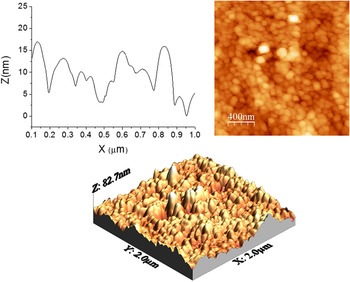
Atomic force microscopy (AFM; Nanotec Electronica, Madrid, Spain) was used to observe the surface topography of selected thin films, with the sole objective of confirming their homogeneity and nanocrystalline nature. The films were also characterized by Raman spectroscopy using the same procedure previously cited for the analysis of the nanoparticles in powder.
The photocatalytic activity of the coatings was evaluated following the same experimental conditions described above for the powders. However, in this case, a 10 ppm MB solution was used for a total catalyst concentration of approximately 0.05 g/L distributed as 6 thin films of 3 × 7 cm2 in size, which were placed inside a circular reactor in a symmetrical arrangement to ensure they got the maximum UV radiation.
III. RESULTS AND DISCUSSION
A. Synthesis and characterization of Nb2O5 nanoparticles
To evaluate the effectiveness of the microwaves radiation in the preparation of Nb2O5 nanoparticles, the particle size distribution was analyzed before and after the microwaves heating. Before the microwave process, a large particle size between 1.5 and 4 μm is observed. This demonstrates the presence of agglomerates due to the fast hydrolysis process of the Nb precursor and is expected since the peptization process has not taken place yet. Subsequently, after the microwave process (20 min at the maximum temperature of 180 °C) a monomodal particle size distribution with an average size of 45 nm is measured, verifying the efficiency of the microwave-assisted hydrothermal method. This demonstrates that the microwaves’ radiation is capable to induce the peptization in only few minutes, whereas the conventional colloidal sol–gel process requires up to near 100 h to achieve peptization.
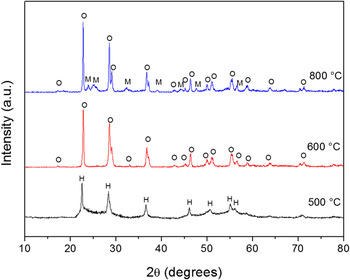
Figure 1 shows the XRD patterns of the samples calcined at different temperatures. Up to 400 °C, the synthesized powder presents amorphous Nb2O5 characteristics (not shown). With increasing calcination temperature (500 °C/1 h) it is possible to observe the crystallization of the TT-Nb2O5 phase (JCPDS No. 00-007-0061), which has a pseudohexagonal structure, remaining some amorphous phase. At higher temperatures (600 °C), the transformation of the TT-Nb2O5 phase in the T-Nb2O5 phase (JCPDS No. 00-030-0873) with well-formed orthorhombic structure occurred. The major difference between these two phases is that TT is a less crystalline form of T, which is only stabilized by impurities such as OH−, Cl−, or vacancies. Reference Valencia-Balvín, Pérez-Walton, Dalpian and Osorio-Guillén28,Reference Herval, Von Dreifus, Rabelo, Rodrigues, Pereira, Gobato, de Oliveira and Godoy29 At 800 °C, the T-Nb2O5 crystalline phase with orthorhombic structure is also detected. However, it shows additionally a monoclinic (JCPDS No. 00-019-0859) structure that is favored at higher treatment temperatures.
XRD patterns of powders calcined at different temperatures. (H—pseudo-hexagonal, O—orthorhombic, and M—monoclinic.)

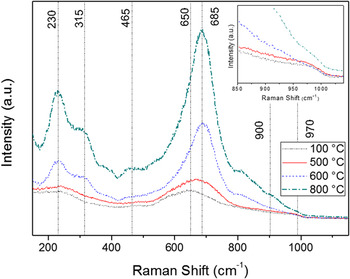
Figure 2 shows the Raman spectra of the samples treated at different temperatures. It can be seen that the sample dried at 100 °C showed a broad band with low intensity centered at 650 cm−1 characteristic of Nb2O5 amorphous phase. Reference Jehng and Wachs30 At 500 °C it is possible to observe a shift of this band to 685 cm−1 which corresponds to the lower distortion vibrations present in the TT-Nb2O5 phase related to its higher order. Reference Herval, Von Dreifus, Rabelo, Rodrigues, Pereira, Gobato, de Oliveira and Godoy29,Reference Jehng and Wachs30 Also, the broad band could be associated to the presence of the amorphous phase according to the XRD results. The weak shoulder at 970 cm−1 also identified at this calcination temperature is assigned to the small concentration of Nb=O surface groups. In the sample calcined at 600 °C, the intensity of the band centered at 685 cm−1 increased and also, additional Raman bands in the low wavenumber region of 230 and 310 cm−1 are found, characteristic of the bending modes of the Nb–O–Nb linkages, corresponding to the T-Nb2O5 phase (orthorhombic structure). Reference Jehng and Wachs30,Reference Ikeya and Senna31 There are few differences between the Raman bands of the samples treated at 600 °C and 800 °C. The main difference is related to the sample treated at 800 °C which shows two small bands centered at 465 and 900 cm−1 which are the characteristic of a monoclinic phase having a slightly distorted octahedral structure. Reference Graca, Meireles, Nico and Valente12,Reference Nico, Soares, Rodrigues, Matos, Monteiro, Graça, Valente, Costa and Monteiro32
Raman spectra of the Nb2O5 nanoparticles as a function of the thermal treatment temperature.

TEM micrographs of the synthesized nanoparticles are shown in Fig. 3. A disordered three-dimensional number of nanoparticles, having smaller unitary dimensions lower than 20 nm and with electron-diffraction analyses of a typical electron amorphous phase, are clearly observed in the sample dried at 100 °C [Fig. 3(a)]. After calcining at 500 °C [Figs. 3(b)] and 600 °C/1 h [Fig. 3(c)], larger nanoparticle agglomerates are observed, as is expected after a thermal treatment, with sizes between 20 and 100 nm. In the electron-diffraction analysis of the sample calcined at 500 °C, a typical diffuse pattern for an intermediate state of crystallinity is observed. It presents small crystals of a typical pseudohexagonal Nb2O5 phase (JCPDS No. 00-007-0061), as previously observed by XRD, while the sample treated at 600 °C shows the standard polycrystalline sample of an orthorhombic Nb2O5 phase (JCPDS No. 00-030-0873).
TEM images of the synthesized Nb2O5 samples dried at 100 °C (a), and calcined at 500 °C/1 h (b) and 600 °C/1 h (c).

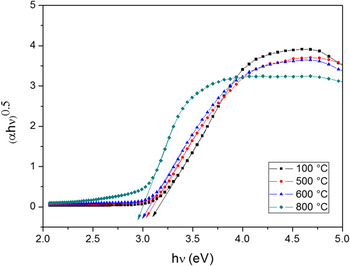
UV–Vis diffuse reflectance measurements of the samples obtained at different temperatures were carried out. Figure 4 shows the band gap energy determined by the Tauc representation for an indirect semiconductor. The band gap for the as prepared samples is around ∼3.1 eV and decreases at higher calcination temperatures up to ∼2.9 eV. This red-shift of the optical absorption could be associated to the formation of the monoclinic Nb2O5 phase at 800 °C, but also to the generation of defects, as oxygen vacancies, with the thermal treatments. According to this, the Nb2O5 samples absorb in the UV range and, therefore, photocatalytic measurements were performed under ultraviolet radiation.
Tauc representation of the UV–Vis spectra obtained from the samples at different temperatures. The arrows indicate the band gap value calculated by extrapolation.

The degradation of MB was used as probe reaction to evaluate the photocatalytic activity of the obtained nanoparticles. The adsorption experiments carried out in the dark prior to irradiations evidenced a scarce adsorption of the dye (less than 1.2% of initial MB concentration) on all materials.
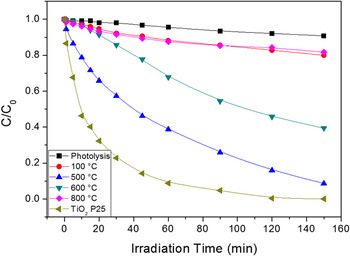
Figure 5 shows the kinetic curves obtained for the dried and calcined samples. As a reference, the degradation profile of MB obtained with the commercial TiO2-P25 is also included for comparison purposes. As it can be seen, the sample calcined at 500 °C (TT phase) presents the highest photocatalytic activity, followed by the sample calcined at 600 °C (T phase). However, the samples dried at 100 °C (amorphous) and calcined at 800 °C (T + monoclinic phases) show a significantly lower photocatalytic activity.
Kinetic curves of the photocatalytic methylene blue degradation using synthesized Nb2O5 samples dried at 100 °C and calcined at 500 °C, 600 °C, and 800 °C/1 h and TiO2-P25.

To get further information to explain these results, the SSA of the samples was measured, obtaining 81 ± 8, 36 ± 4, 22 ± 2, and 13 ± 1 m2/g for the samples dried at 100 °C and calcined at 500 °C, 600 °C, and 800 °C, respectively. The surface area decreases with increasing temperature, as can be expected. It is possible to calculate the particle size considering the BET surface area measurements. The calculated particle sizes are about 16 nm for the powder dried at 100 °C, and 36, 59, and 100 nm for powders calcined at 500, 600, and 800 °C, respectively. However, although the surface area decreases with increasing temperature, the optimum photocatalytic activity is obtained at 500 °C which has a low surface area, so that it is evidenced that the photocatalytic activity of the Nb2O5 samples is not a direct function of the specific surface area. Taking into account the results shown in Figs. 1–3, it seems that the crystalline phase is the parameter that more directly affects the photocatalytic activity. Accordingly, in this case, the TT phase (indexed as a pseudohexagonal crystal structure) appears to be the most photoactive followed by the T phase (orthorhombic structure). It has been previously reported that the most distinctive feature of TT phase in comparison to other Nb2O5 phases is the presence of some pentagonal and hexagonal bipyramids (NbO7 and NbO8), besides the common distorted octahedra (NbO6). Reference Valencia-Balvín, Pérez-Walton, Dalpian and Osorio-Guillén28 This specific characteristic cannot straightforwardly be related to the highest photoactivity; however, the TT phase is also characterized by the presence of stabilizing groups such as OH−, which can play a positive role in the photocatalytic process through the formation of oxidant ·OH radicals. Reference Lopes, Paris and Ribeiro10 The increase of the crystallinity observed by the enhancement of calcination treatment from 500 °C to 600 °C might improve the photocatalytic activity. However, a decrease in photoactivity for MB degradation is observed, which might be related to both the lower SSA and also to the total crystallization of the T-phase with the concomitant loss of the above mentioned hydroxyl surface groups. Finally, the comparison of SSA of the samples dried at 100 °C (amorphous structure) and calcined at 800 °C (monoclinic structure) points out to some photocatalytic activity of the latter crystalline phase.
In all cases the photocatalytic activity of Nb2O5 was lower than the results of TiO2-P25. This higher photocatalytic activity of commercial TiO2 can be associated, among other factors, to the better dispersion of this material in the medium, leading to a greater number of available active sites and consequently to an enhancement of the photocatalysis process. However, in this case, the aim of studying the photocatalytic activity of Nb2O5 materials in the powder form was to evaluate the most photoactive phase of Nb2O5. One of the main drawbacks in photocatalysis is the difficult recovery of the photocatalyst in the powder form. In this context, a plausible alternative investigated in this work is the use of films, where the nanoparticles were impregnated in the form of a thin film on a glass substrate.
B. Thin film preparation and characterization
To improve the adhesion to the substrate and the dip-coating performance, the suspensions used for dipping were prepared in ethanol. The isoelectric point of Nb2O5 in water of the synthesized nanoparticles occurs at pH ∼5. Reference Falk, Borlaf, Bendo, Novaes de Oliveira, Rodrigues Neto and Moreno19 To preserve the stability of the particles in ethanol, nitric acid was added to pH 3. At this pH the particle size distribution (not shown) revealed the presence of only one Gaussian peak with sizes between 40 and 80 nm. This means that the particles redispersed in ethanol maintain stable and without agglomeration.
Before starting the dip-coating experiments, a preliminary study of the withdrawal rate was performed ranging from 0.5 to 4 mm/s. It was possible to observe that the homogeneity of the film was better at lower rates between 0.8 and 1.1 mm/s. Based on that and also taking into account the photocatalytic results obtained for the powders, the thin films were prepared at a withdrawal speed of 1 mm/s and after the drying process, calcined at 500 °C/1 h. The so obtained films were characterized by ellipsometry obtaining a thickness of 230 ± 10 nm and a RI of 1.82, lower than the theoretical value (2.4) probably due to the thin film porosity.
Figure 6 shows AFM images of the thin film calcined at 500 °C/1 h. A general view of the topography of the thin film was recorded, showing that there are at least two different origins of roughness: big walls of 60–100 nm and smaller ones of 10 nm. In the case of the thin film, the topography shows a homogeneous coating with regular spherical granules with sizes ranging from 20 to 80 nm, which is in good agreement with the particle size measurements.
AFM images (topography channel) of the Nb2O5 thin film calcined at 500 °C/1 h.

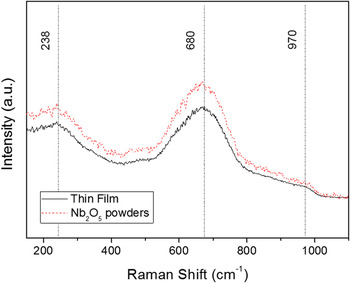
To verify that the thermal treatment of the thin films allows one to obtain the TT phase, for which the best photocatalytic activity was achieved in the Nb2O5 powders, Raman measurements of the powder and the thin film calcined at 500 °C/1 h are shown in Fig. 7. It can be seen that the Raman spectrum of the thin film is in accordance with that of the xerogel calcined at 500 °C/1 h, presenting three major bands centered at wavelengths of 238, 680, and 970 cm−1 corresponding with vibration modes present in the TT-Nb2O5 phase. This demonstrates that the heat treatment performed on the thin films was sufficient to obtain the desired Nb2O5 phase.
Raman spectra of the Nb2O5 thin film and Nb2O5 powders calcined at 500 °C/1 h.

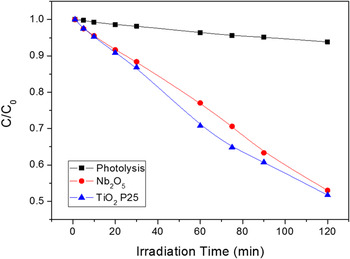
In Fig. 8 the photocatalytic activity of the Nb2O5 thin film for MB degradation is displayed. For comparison purposes, a thin film of commercial TiO2-P25 was prepared and tested under the same conditions. Comparing both samples it can be appreciated that their kinetics are quite similar and, after 120 min, almost one half of MB was degraded. Taking into account not only the high photocatalytic activity of the TiO2-P25 sample, which is customarily taken as a reference in many photocatalytic experiments, but also the differences between both materials in terms of SSA, particle size, and structure, we can conclude that the Nb2O5 thin film prepared in this work, which corresponds to the TT crystal phase obtained after calcination at 500 °C/1 h, has an excellent photocatalytic activity, comparable to that of titania P25. This evidences the great capabilities of Nb2O5 for applications in the field of photocatalysis.
Kinetic curves of the methylene blue degradation using the Nb2O5 and commercial TiO2-P25 thin films prepared under similar conditions.

IV. CONCLUSIONS
It has been shown that amorphous Nb2O5 nanoparticles with an average particle size of 40 nm can be successfully obtained by microwave-assisted hydrothermal synthesis in a simple, soft, fast, and energy efficient manner. The process is carried out in water and needs only 180 °C and less than 20 min, whereas the conventional colloidal sol–gel process reported for the synthesis requires 100 h.
The calcination of the obtained nanoparticles at 500 °C/1 h provokes the crystallization of the TT phase, with a pseudohexagonal structure, showing the highest photocatalytic activity. Higher temperatures lead to the formation of other Nb2O5 crystalline phases such as orthorhombic and monoclinic, but these phases have a poorer activity.
Thin films of Nb2O5 were prepared by dip-coating and calcination at 500 °C/1 h. Photocatalytic experiments confirmed the high photocatalytic activity of this material which shows a MB degradation kinetics curve similar to that of a TiO2-P25 thin film prepared under similar conditions.
ACKNOWLEDGMENTS
This work was supported by Ministerio de Economía y Competitividad (Government of Spain) and FEDER Funds under the Grant no. MAT2015-67586-C3-2-R and CTM2015-69246-R. The authors thank the resources provided by CAPES under the International Cooperation Program Science without Borders for Special Guest Researcher, PVE (MEC/MCTI/CAPES/CNPQ/FAP/71/2013), Project No. A011/2013.