INTRODUCTION
The ability to balance the risk of predation with the costs associated with anti-predator behaviour constitutes a clear advantage for prey species (Lima & Dill, Reference Lima and Dill1990), but to achieve this, prey must be able to accurately assess this risk. In the terrestrial environment, visual and auditory cues appear to be employed more often in predator detection than in the aquatic environment, where chemical cues are a more reliable information source (Chivers & Smith, Reference Chivers and Smith1998; Kats & Dill, Reference Kats and Dill1998). This kind of signal is particularly important in areas that are densely vegetated or where the water is turbid (Pollock et al., Reference Pollock, Chivers, Mirza and Wisenden2003), but also if predators are cryptic, hunt at night, have ambush strategies, or are highly mobile relative to prey (Godard et al., Reference Godard, Bowers and Wannamaker1998; McCarthy & Fisher, Reference McCarthy and Fisher2000).
Risk can be detected through kairomones, chemical cues that indicate the presence of predators (see Dicke & Sabelis, Reference Dicke and Sabelis1988 for definition). Many species can also perceive the predation act, through some chemical released by another prey individual that either detected a predator or was effectively caught (Mirza & Chivers, Reference Mirza and Chivers2002). The most common chemical-alarm cue, the damage-released alarm signal, is released at the moment of capture, due to the physical injury caused by the predator's handling and ingestion of prey (Chivers & Smith, Reference Chivers and Smith1998).
One of the factors that may influence recognition is the phylogenetic relationships of the species (Hazzlet & McLay, Reference Hazlett and McLay2005). But co-occurring species that share predators and that are able to recognize both conspecific and heterospecific alarm substances will be better informed about the predation risks (Mirza & Chivers, Reference Mirza and Chivers2001). This represents the predicted scenario for the prey–guild hypothesis, and given the generalized diet of many predators it is reasonable to predict that prey would be selected to utilize any information that indicates an elevated risk of predation. Another factor influencing recognition is learning, which is directly affected by the potential opportunities of association between risk and cues (Mirza et al., Reference Mirza, Fisher and Chivers2003; Pollock et al., Reference Pollock, Chivers, Mirza and Wisenden2003). In this case, the efficiency of a microhabitat as a refuge against predators, and the co-occurring prey will directly affect the existence of alarm signalling and how broad the recognition will be.
The intensity of the response may depend on the age or size of the animal. Animals of the same age or size as the emitter may respond more strongly to their cues than to those released by older conspecifics, although still recognizing their alarm signal (Mirza & Chivers, Reference Mirza and Chivers2002). The occurrence of this recognition and the resulting behavioural response may also be affected. Predation pressure may vary in different life stages, since many species undergo ontogenetic shifts in habitat and/or diet during their life cycle. This alteration is particularly clear in fish that change their diet from one based on invertebrates, to piscivory. In this case, the same signal identified by young fish as an alarm signal can become a foraging cue for adults (Brown et al., Reference Brown, LeBlanc and Porter2001). This shift is expected when any survival advantage gained from antipredator response is outweighed by potential foraging benefits (Golub & Brown, Reference Golub and Brown2003).
This kind of risk assessment among both conspecifics and heterospecifics is especially expected in those species that possess considerable chemoreception potential and are highly exposed to predation, especially if sublethal damage is frequent. This is the case for brittle stars (Echinodermata: Ophiuroidea), which have an extensive list of predators and in which the regeneration of lost parts is a common feature (e.g. Bowmer & Keegan, Reference Bowmer and Keegan1983; Sköld & Rosenberg, Reference Sköld and Rosenberg1996; Pomory & Lawrence, Reference Pomory and Lawrence2001). Brittle stars are considered to be the echinoderms with the highest chemoreception potential, both in variability and distance from the source (Sloan & Campbell, Reference Sloan, Campbell, Jangoux and Lawrence1982). When feeding, most brittle stars have either their entire body or their arms exposed to predators, and arm loss is frequent (Sköld & Rosenberg, Reference Sköld and Rosenberg1996). Therefore, the potential trade-off between foraging and risk of predation is evident, and the occurrence of efficient escape responses and/or other defensive traits can be expected (Sköld, Reference Sköld1998).
Damage-released alarm signals have been observed in other members of the Echinodermata, especially sea urchins (e.g. Campbell et al., Reference Campbell, Coppard, D'Abreo and Thudor-Thomas2001; Hagen et al., Reference Hagen, Andersen and Stabell2002; Vadas & Elner, Reference Vadas and Elner2003) and sea stars (e.g. Sloan & Northway, Reference Sloan and Northway1982; Lawrence, Reference Lawrence1991). Such signals may be a widely distributed anti-predatory strategy in the phylum (Rosenberg & Selander, Reference Rosenberg and Selander2000); however, they have only rarely been observed in brittle stars (viz. Amphiura filiformis, Rosenberg & Selander, Reference Rosenberg and Selander2000). In this group, several other characteristics are considered to be anti-predatory traits, related to morphology, behaviour and habitat choice, such as cryptic habit, burrowing, negative phototaxis, and nocturnal activity (Fell, Reference Fell and Boolootian1966; Hendler, Reference Hendler1984; Sköld, Reference Sköld1998). Chemical defences that deter predation, especially by fish, have also been suggested (Bryan et al., Reference Bryan, McClintock and Hopkins1997), as has the association with chemically defended biological substrates (Hendler, Reference Hendler1984).
In this study we addressed four questions. The first refers to the existence of a damage-released alarm signal in four species of brittle stars: Amphipholis squamata (Delle Chiaje, 1828), Ophionereis reticulata (Say, 1825), Ophiactis savignyi (Muller & Troschel, 1842) and Ophiothrix angulata (Say, 1825). The second question is related to the range of concentrations to which brittle stars can respond to a damage-released alarm signal, and the third to heterospecific recognition of the signal. The last question concerns the influence of microhabitat on the response to a damage-released alarm signal, and this question was tested in two populations of O. savignyi.
MATERIALS AND METHODS
Sampling and laboratory maintenance
The brittle stars were collected in the São Sebastião Channel, São Paulo, Brazil (23°50′S 45°24′W). Individuals of Amphipholis squamata (Amphiuridae), with the longest arm between 2.4 and 7.5 mm, were collected from the alga Amphiroa beauvoisii Lamouroux, 1816 (Corallinaceae). Individuals of Ophiothrix angulata (Ophiotrichidae) were collected under rocks (longest arm between 18.5 and 40 mm) and Ophionereis reticulata (Ophionereididae) were found buried among the rubble below these rocks (longest arm between 49.3 and 74.2 mm). Adults of Ophiactis savignyi (Ophiactidae) (longest arm between 14 and 30 mm) were collected in the sponge Amphimedon viridis (Duchassaing & Michelotti, 1864) (Haplosclerida, Niphatidae). To assess the effect of microhabitat on the alarm-signal recognition of O. savignyi, smaller individuals (longest arm between 3.5 and 13 mm) were also collected from this sponge, to reflect the size of those collected from the alga A. beauvoisii, where larger individuals were absent.
After they were collected, all the brittle stars were kept in individual aquaria (static systems) with aerated seawater on a 14:10 h light:dark cycle for at least three days prior to the experiments. Salinity was stable, and temperature varied from 19 to 25°C during the first experimental period of July through to August 2005, and from 18 to 25°C during the second experimental period of July through to August 2006. Only undamaged individuals, i.e. without recently broken arms, were used.
Stimulus preparation
Fish predate upon brittle stars by breaking them into smaller pieces by vigorous swallowing and spitting, before they ingest the prey (A. Majer, personal observation). Therefore, to test the occurrence of a damage-released alarm signal, the stimulus was prepared by homogenizing the brittle stars. This procedure would be ecologically meaningful because it would release the same pool of compounds as would a predator fish. For each 0.1 g of brittle-star tissue (wet weight), 1 ml of filtered seawater was added to allow maceration. To avoid any kind of mechanical stimulation, the homogenate was then centrifuged for 20 minutes at 2000 rpm. The pellet was discarded, and the supernatant (stimulus D0) was diluted into five additional concentrations: D1, 25.00%; D2, 12.50%; D3, 6.25%; D4, 3.12%; and D5, 1.56%, to test for the lowest concentration that produced a significant response compared to the control (filtered seawater only). The stimulus solutions were divided into small fractions (1 ml) and frozen at –20°C until the tests.
Experimental protocol
The methodology used to test the stimuli was adapted from Sköld (Reference Sköld1998), because the same difficulties in acclimation were observed. The species showed different behavioural responses when they were being habituated, ranging from crawling into a corner of the aquarium (A. squamata and O. reticulata) to climbing the wall and remaining outside the water (O. savignyi). Therefore, in each test, a brittle star was gently dropped into the central region of the aquarium (Petri dish for A. squamata and smaller O. savignyi; all the containers were static systems). Immediately after the brittle star reached the bottom, the stimulus solution was released with a syringe directly over the right edge of the animal, to allow it to perceive the stimulus before the solution became further diluted. A volume of 0.1 ml of stimulus solution was used, except for A. squamata and smaller O. savignyi, where the amount was 0.05 ml because of their smaller size. The elapsed time from the release of the stimulus until the brittle star completed two pronounced arm strokes was recorded, and defined as the duration of the escape response, therefore combining speed and reaction time (Sköld, Reference Sköld1998). Preliminary trials were performed to determine the limit of the time taken for 90% of the tested animals to complete two arm strokes (A. squamata, 45 seconds; O. reticulata and O. angulata, 60 seconds; and O. savignyi, 105 seconds). Trials in which the brittle stars took longer than this predetermined time to respond were discarded.
Preliminary trials on conspecifics, to determine the concentration range in which a damage-released alarm signal was recognized, were performed with ten individuals of A. squamata, eight of O. reticulata, six of O. angulata, and six adults of O. savignyi collected from sponges, according to the availability of individuals of each species. Trials were performed with 30 individuals of each species, except for O. angulata, where 25 animals were used. Each brittle star was tested only once per night, but was submitted to different stimuli during the experimental period. In the tests concerning the effect of microhabitat on O. savignyi, the concentration trials were performed with 30 individuals, and therefore corresponded to the conspecific tests. The heterospecific tests were applied similarly as to the other species tested. During the experiment, observations were made under red light, to avoid phototactic responses (Fell, 1996).
Statistical analysis
The difference in time spent during the escape response was tested by a two-way ANOVA, considering the stimuli and species tested. When the results were significant, a Dunnet test was used for each species, to compare the control with treatments (dilutions or conspecific and heterospecific stimuli) (Dunnet, Reference Dunnet1955). Because the data did not meet the criteria for normality or homoscedasticity, a logarithmic transformation was applied.
RESULTS
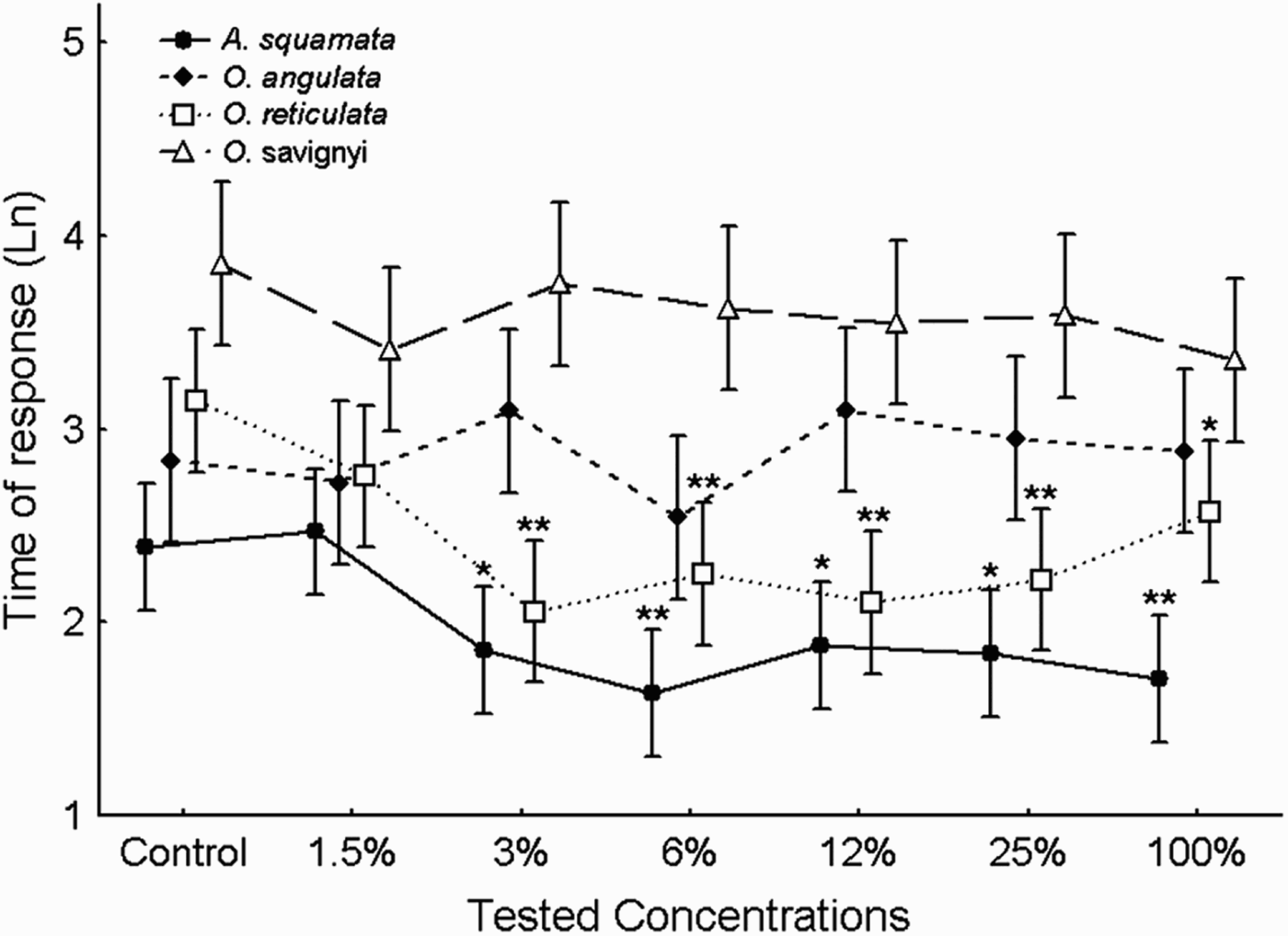
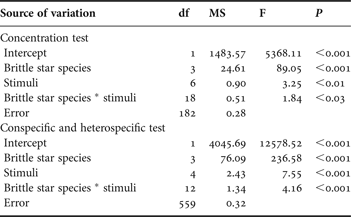
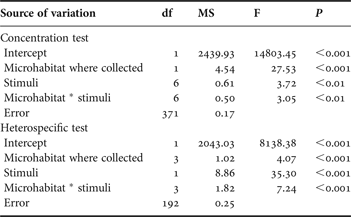
With regard to the time taken by the brittle stars to respond to the tested concentrations, an effect of both species and dilution, with an interaction between these two factors, was observed (Table 1). A significant alarm response occurred in only two of the species, Amphipholis squamata and Ophionereis reticulata. In both species, a rapid reaction was observed from the concentrated supernatant until the fourth dilution tested (Figure 1). Therefore, in the additional conspecific tests performed with these species, the concentration selected was the lowest one that elicited a significant response (D4, 3.12%). A higher concentration (D2, 12.5%) was subjectively selected for the species without recognition and heterospecific tests. Larger individuals of Ophiactis savignyi collected from sponges, and also Ophiothrix angulata, did not respond to any of the dilutions tested (Figure 1).
Time of response (log-transformed) to different concentrations of conspecific damage-released alarm signal. Bars represent confidence interval, and * indicates significance level related to control (*, P ≤ 0.05 and **, P ≤ 0.001).

Results of the two-way ANOVA comparing the time of response (seconds, log-transformed) of brittle star species (Amphipholis squamata, Ophiothrix angulata, Ophionereis reticulata and large Ophiactis savignyi individuals collected from sponge) to conspecific dilutions (concentration test: control X dilutions) and conspecific and heterospecific signals.

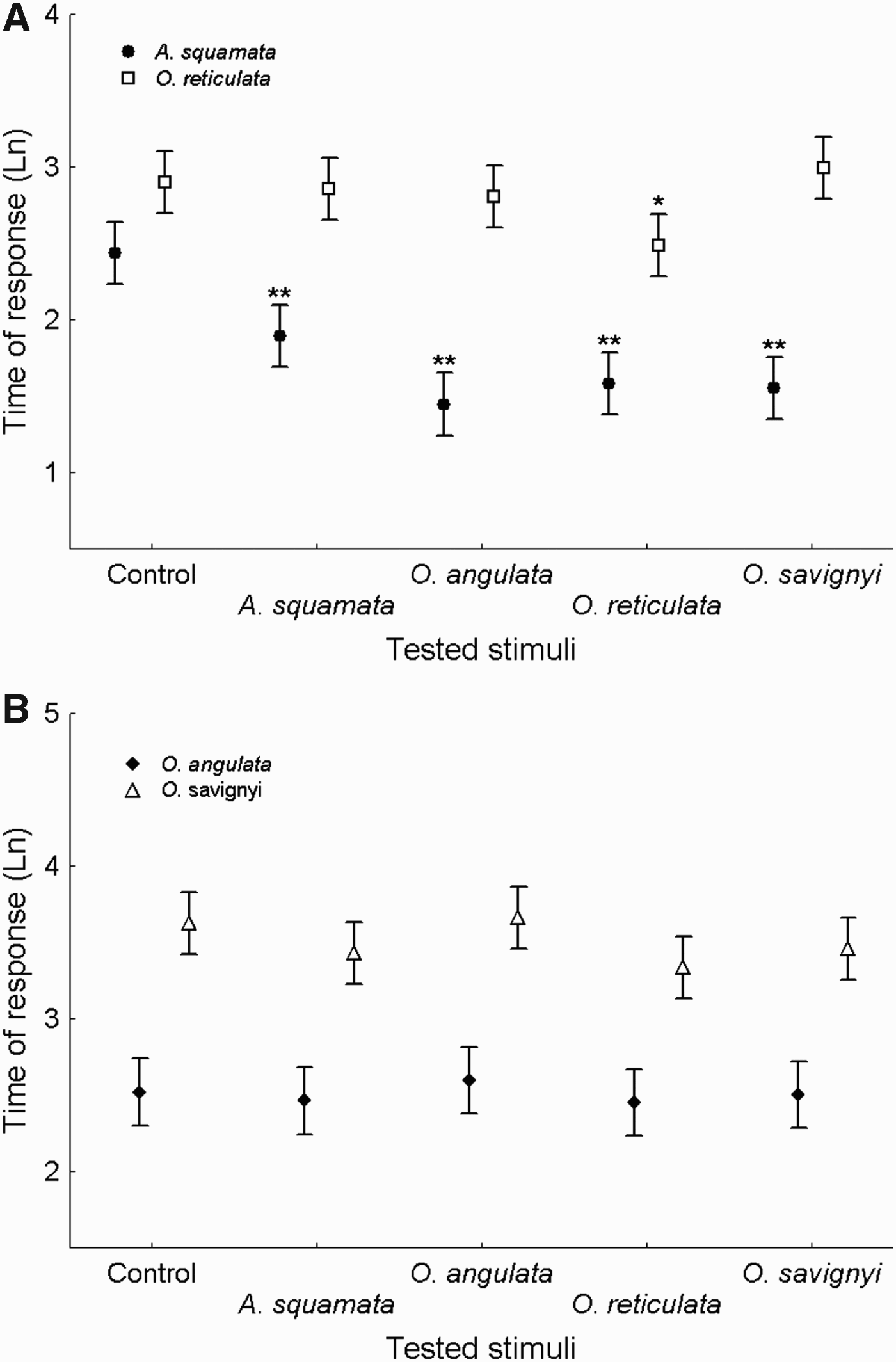
The subsequent conspecific tests were in accordance with the concentration assay, in which O. angulata and larger individuals of O. savignyi did not respond to conspecific stimuli, whereas A. squamata and O. reticulata both showed an alarm response (Table 1; Figure 2). In the heterospecific tests, only A. squamata showed a positive response, reacting to the stimuli of all species (Figure 2).
Time of response (log-transformed) to conspecific and/or heterospecific damage-released alarm signal. (A) Amphipholis squamata and Ophionereis reticulata; (B) Ophiactis savignyi and Ophiothrix angulata. Bars represent confidence interval, and * indicates significance level related to control (*, P ≤ 0.05 and **, P ≤ 0.001).

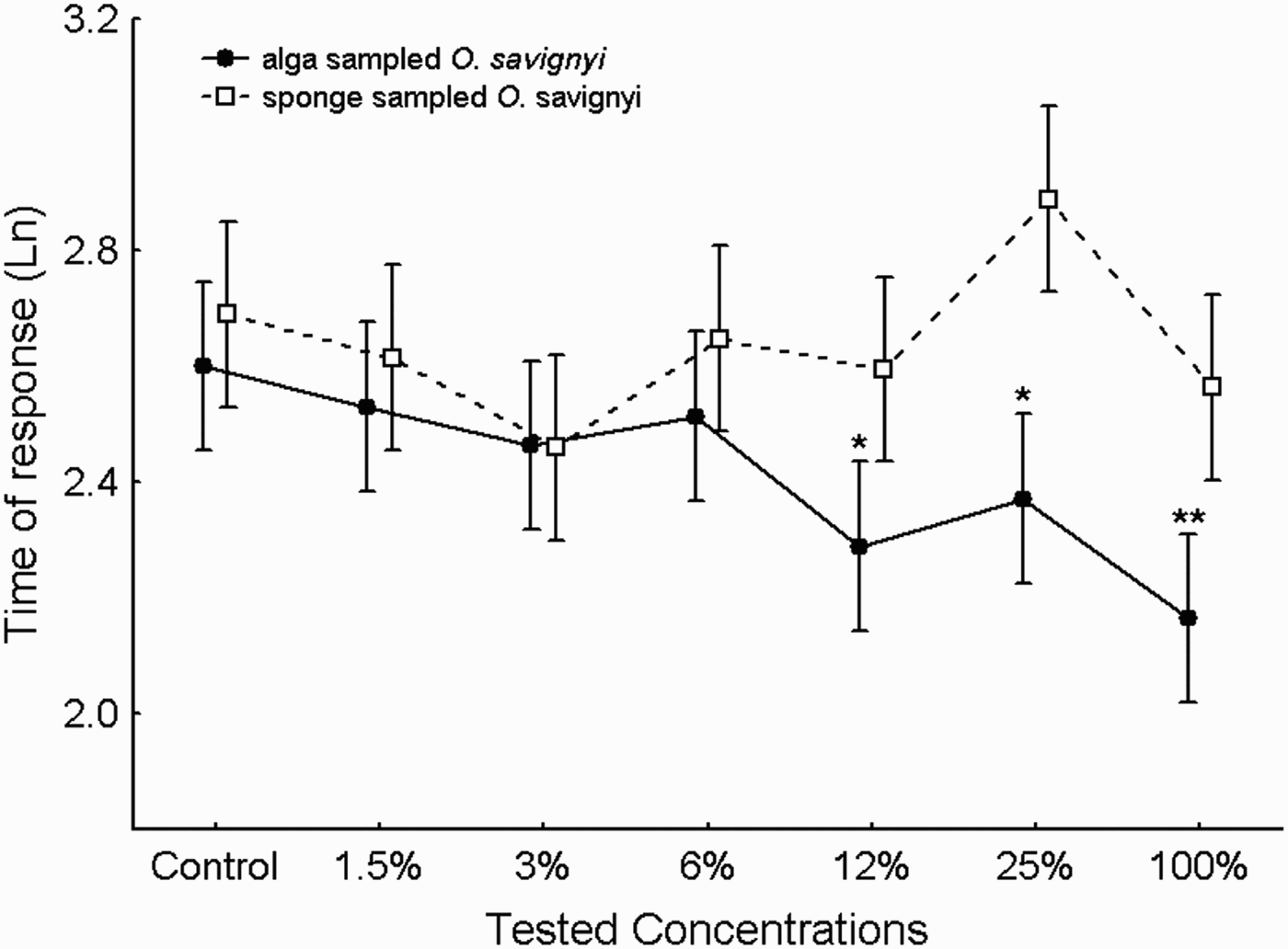
An interaction between microhabitat and dilution was observed when testing the time of response to stimuli shown by smaller individuals of O. savignyi collected in the alga and sponge (Table 2). In this case, the individuals collected in sponges showed no response. In contrast, O. savignyi collected in algae showed a conspecific alarm reaction until the second dilution (12.5%) (Figure 3). Therefore, in the heterospecific tests for this group, concentration D2 (12.5%) was selected for use.
Time of response (log-transformed) of individuals of Ophiactis savignyi collected from an alga or sponge, to different concentrations of conspecific damage-released alarm signal. Bars represent confidence interval, and * indicates significance level related to control (*, P ≤ 0.05 and **, P ≤ 0.001).

Results of the two-way ANOVA comparing the time of response (seconds, log-transformed) of individuals of Ophiactis savignyi collected from a sponge or alga to conspecific stimuli (concentration test: control X dilutions) and heterospecific signals.

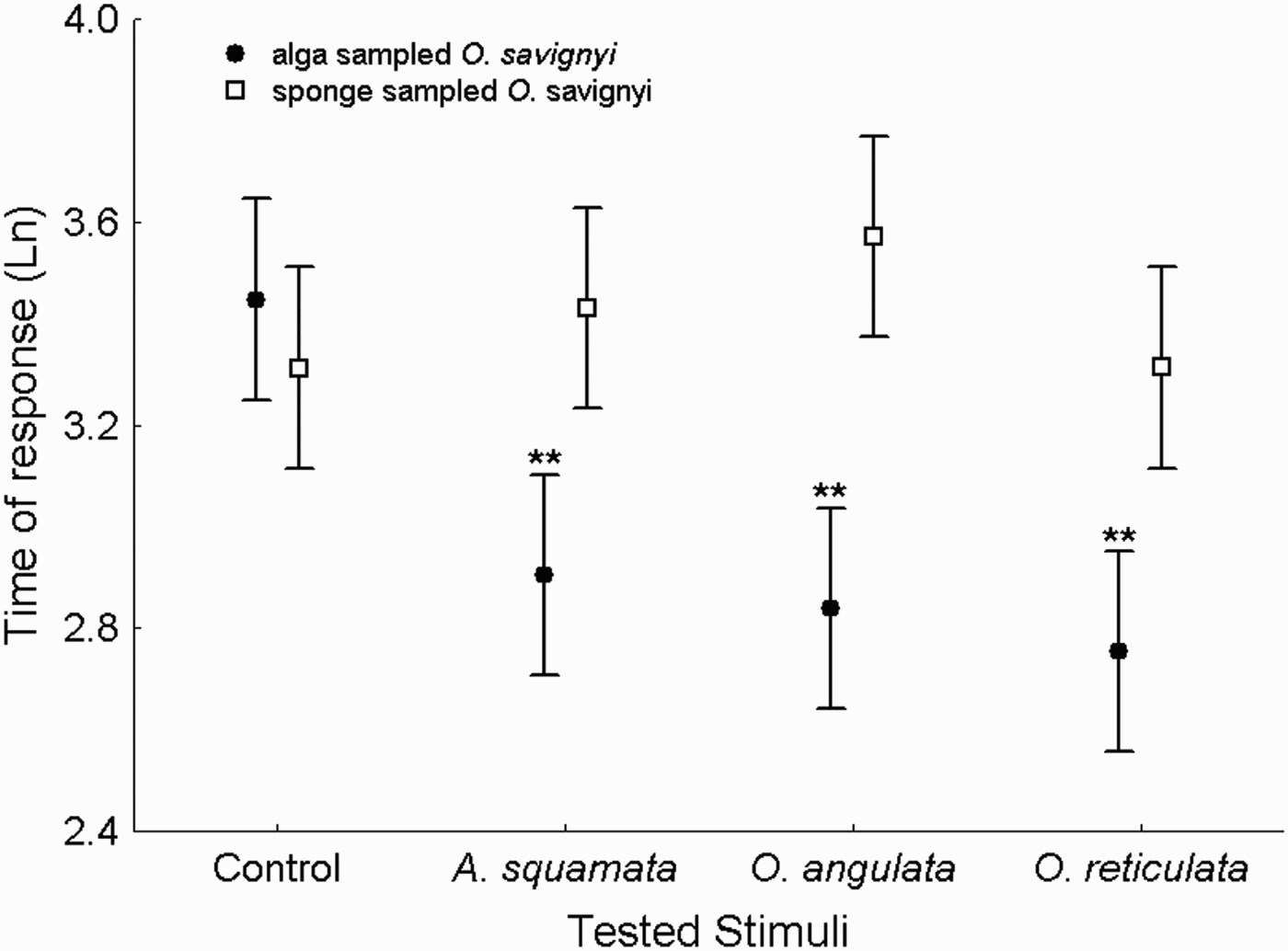
The effect of microhabitat on the heterospecific alarm-signal recognition was clearly demonstrated by individuals of O. savignyi collected from the coralline alga Amphiroa beauvoisii. In this case, as observed for A. squamata collected from the same species of alga, a broad response to all stimuli was observed (Table 2; Figure 4). In contrast, same-sized O. savignyi individuals collected from sponges did not respond to any of the stimuli (Figure 4).
Time of response (log-transformed) of individuals of Ophiactis savignyi collected from an alga or sponge, to conspecific and/or heterospecific damage-released alarm signal. Bars represent confidence interval, and * indicates significance level related to control (**, P ≤ 0.001).

DISCUSSION
In this study, an obvious escape adaptation signalled by chemical cues was observed for three of the species tested (Amphipholis squamata, Ophionereis reticulata and Ophiactis savignyi). The smallest species, A. squamata, showed the widest range of recognition, responding to stimuli from themseves and all the other species. Amphipholis squamata is often found sharing habitats with other ophiuroids, for instance juveniles of O. savignyi and Ophiothrix angulata (Majer et al., in preparation). Brittle star predators are usually unspecialized, and the relatively small size and co-occurrence would make all three species (O. savignyi and O. angulata as juveniles) a shared resource for local predators, or members of the same prey guild (Mirza & Chivers, Reference Mirza and Chivers2003; Mirza et al., Reference Mirza, Fisher and Chivers2003). Therefore, cross-species recognition of alarm cues is likely to be evolutionarily favourable.
This is not the case for the recognition of the O. reticulata stimulus. In our collections, this species was not found together with A. squamata even as juveniles and it is described as occurring in different microhabitats (Hendler et al., Reference Hendler, Miller, Pawson and Kier1995). In addition, O. reticulata is the largest of the tested species, with a large difference in body size from A. squamata, which makes it improbable that the two share the same predators. However, O. reticulata is an occasional cannibal and predator on other brittle stars (Yokoyama, Reference Yokoyama2005). Therefore, it is possible that the signal recognized by A. squamata acts not as a damage signal, but as a kairomone, an indicator of a predator that can trigger the same escape behaviour. Alternatively, such a cross-response could also indicate a common signalling pathway in different species. However, in this case, it would be expected that every species that recognizes its own alarm signal would also recognize the cues of all the others. This was not observed in O. reticulata, which responded only to its own stimulus.
The recognition in O. savignyi was clearly influenced by microhabitat. The population collected from the alga showed a broad recognition, like that observed in A. squamata which was collected from the same microhabitat. For these two species, experiences of interactions with both predators and guild members seem to be responsible for this wide recognition. On the other hand, in its sponge host, O. savignyi does not really co-occur with other brittle-star species, since when these are present, they are usually found in the outer layer of the sponge and not in the inner folds as is this brittle star. The same occurs with crabs, which are brittle star predators (Boffi, Reference Boffi1972) and although they are also found associated with sponges, are usually in the area where the basal lamina of the sponge attaches to the rock (unpublished data). Therefore, sponges appear to be an efficient physical refuge for O. savignyi, and therefore these animals may not be so exposed to predation unless their association is temporary or occasional, which does not seem to be the case. Although there are no studies about the host fidelity of O. savignyi, the congener Ophiothrix lineata is closely associated with the sponge Callyspongia vaginalis (Henkel & Pawlik, Reference Henkel and Pawlik2005). Assuming fidelity to the host, O. savignyi could be physically sheltered from predators, even for its entire life. This would represent an extreme reduction in predation pressure, and could explain its failure to recognize an alarm signal. Additionally, the escape behaviour to alarm signals or kairomones has an associated cost that may affect survival, reproduction and growth (Peckarsky et al., Reference Peckarsky, Cowan, Penton and Anderson1993). Therefore, this kind of recognition would not be expected unless it provided a survival improvement or at least were neutral. For this reason, a flexible recognition mechanism would be advantageous, since the costs of associated defence would only be incurred when the threat of predation was high, in this case in the alga and not in the sponge host.
Since the sponge and alga occur in the same area, and not unusually as a continuum, and considering that O. savignyi reproduces sexually with a larval phase, because of their proximity it seems probable that the gametes of individuals from both sponge and alga hosts will fertilize each other. This cross-fertilization would result in individuals with similar responses to alarm signals if this kind of recognition is genetically based, which is not the case. An alternative mechanism usually associated with alarm-signal recognition is learning, which may be responsible for the observed response in O. savignyi. In this case, the occurrence of alarm signalling will depend on the learning opportunities, which will be directly influenced by predation pressure (Pollock & Chivers, Reference Pollock and Chivers2004). On the other hand, considering the close co-occurrence of predators such as crabs in the occupied alga and surrounding rocks, O. savignyi collected in algae would be exposed to many learning opportunities, like other members of its prey–guild. This would explain the broad recognition of both conspecific and heterospecific signals. A similar result in terms of intensity has been observed for the fish Culea inconstans, however towards a kairomone. In this case, individuals from populations that frequently encountered predators typically showed stronger antipredator response than did individuals from populations that rarely experienced predation (Gelowitz et al., Reference Gelowitz, Mathis and Smith1993).
Differences in habitat may also explain the lack of a heterospecific response by O. angulata. However, the absence of conspecific recognition raises two possibilities: (1) other countermeasures and low predation pressure; or (2) influence of population density. As a differential adaptation, O. angulata possesses only the arm spines characteristic of the genus, with disputable anti-predation capability (see Hendler et al., Reference Hendler, Miller, Pawson and Kier1995). Other details, such as cryptic habit and coloration, are common to all the species tested. Although it is not common to find regenerating individuals, arm spines are an item found in stomachs of diurnal fish in the area (Santos, Reference Santos2005), indicating that O. angulata is indeed exposed to lethal predation. Therefore, the most plausible cause for this lack of response appears to be its random distribution and lower frequency of occurrence. All the other species are usually found clumped, sometimes in extremely high densities. This would provide the perfect conditions for the association of chemical cues with predation risk, whereas the scattered distribution pattern and much lower densities of O. angulata may prevent it. It has been demonstrated that, at least in the learning process of heterospecific cue recognition, the density of a species is determinant (Pollock & Chivers, Reference Pollock and Chivers2004).
It is clear that recognition of cues indicating the risk of predation, such as damage-released alarm signals, results in benefit to prey. Animals receive early warning of the presence of a predator and are able to avoid an encounter, leaving the area or reducing movement and becoming cryptic (Kiesecker et al., Reference Kiesecker, Chivers, Marco, Quilchano, Anderson and Blaustein1999; Chivers et al., Reference Chivers, Mirza and Johnston2002; Pollock et al., Reference Pollock, Chivers, Mirza and Wisenden2003). Despite the benefits, the perception of predation risk also represents a cost, acting as a sublethal effect (e.g. Fraser & Gilliam, Reference Fraser and Gilliam1992; Peckarsky et al., Reference Peckarsky, Cowan, Penton and Anderson1993; Nakaoka, Reference Nakaoka2000). In fact, individuals may take fewer risks in the presence of predators, changing microhabitat use or behaviour in such a way that their food intake is reduced, consequently affecting survival, reproduction and growth (Peckarsky et al., Reference Peckarsky, Cowan, Penton and Anderson1993; Nakaoka, Reference Nakaoka2000). This trade-off can be regulated by the intensity of the stimulus, with positive responses only after concentration thresholds are reached. Two of the brittle stars that showed a conspecific positive response, A. squamata and O. reticulata, continued to react until the second-lowest dilution tested (3.12%). Primarily, this suggests that the lowest concentration that produced a response is plausible in the natural environment, considering the slow water currents in the area where the animals were collected. Even if lower concentrations are reached by subsequent dilution, this signal could still indicate damage to nearby conspecifics. Because of the trade-off, it would be expected that a prey organism will adopt an anti-predatory behaviour only if the benefits outweigh the potential costs (Chivers & Smith, Reference Chivers and Smith1998). Consequently, lower concentrations would be translated as a more distant danger, which may not be enough to trigger the alarm response. On the other hand, for O. savignyi this recognition occurred until the 12.5% dilution, and in A. squamata and O. reticulata recognition occurred until 3.12%. This difference may be a result of the frequent asexual reproduction of O. savignyi, which takes place, as in other fissiparous brittle stars, through the middle of the disc, separating the brittle star into two halves. The healing of the torn parts in Ophiocomella ophiactoides, another fissiparous brittle star, proceeds while fission is underway. This separation is apparently completed within 24 hours, but may take longer if the animal is disturbed (Mladenov et al., 1983). This process seems similar in O. savignyi, and during fission it is probable that at least some internal contents are released to the exterior, which would probably be similar to the tested stimulus. Therefore, since asexual reproduction occurs throughout the year and would be constantly releasing a small amount of these compounds, it may be that fissiparous species respond only to higher concentrations of the alarm signal than do those with other reproductive strategies.
It is clear that the release and detection of alarm signals have important implications for brittle stars and their interactions with predators. Areas with different predation pressure could result in different intensities of behavioural responses (Ferner et al., Reference Ferner, Smee and Chang2005), which could have considerable consequences for brittle stars and other organisms. However, for a better understanding of the predator–prey dynamics, more information is needed about several issues: for instance, about predator perception and how responses to predators compare between prey populations (Covich et al., Reference Covich, Crowl, Alexander and Vaughn1994); how prey switch responses under different combinations of predators (Sih et al., Reference Sih, Englund and Wooster1998); and how prey respond in complex environments with multiple chemical cues (Chivers & Smith, Reference Chivers and Smith1998). Our study demonstrated that brittle stars can show a variety of responses to some of these events. Because of their availability, easy maintenance, and relatively simple physiology, these organisms can contribute as models to elucidate some of these questions.
ACKNOWLEDGEMENTS
The authors thank Silvana G. Leite, Adriana P. Guedes, Camila H.S. Queiroz, Débora A. Carvalho and Nara G. Mendonça for technical support during field trips, Professor Renato C. Pereira and Dr Paulo E.C. Peixoto for reviewing the manuscript and Dr Janet W. Reid for reviewing the English text. Financial support was provided by a CNPq fellowship to A.P.M. and a FAEPEX–UNICAMP grant (Process No. 110804) to L.F.L.D. Our collections and experiments complied with the current Brazilian laws (IBAMA license No. 171/05). This work is part of the PhD dissertation of A.P.M. in the Pós-Graduação em Ecologia, Instituto de Biologia, UNICAMP.