Introduction
With the projected growth in the number of older adults over the next few decades, accommodation options that bridge the needs of individuals between independent living and residential care will be in demand. Community-based accommodations that support individuals as they age can preserve autonomy and independence, and for some individuals may possibly replace the need for residential care (Darton et al., Reference Darton, Baumker, Callaghan, Holder, Netten and Towers2012). Providing an enjoyable community environment in these varied accommodation options will ensure the maintenance of a high quality of life for individuals residing in them (Mitchell & Kemp, Reference Mitchell and Kemp2000). In Canada, assisted living (AL) offers a community-based, semi-independent housing option for older adults with the central philosophy being to enable individuals to remain self-reliant and engaged in the broader community by providing the minimal level of assistance necessary. AL is based on a social model that emphasizes autonomy: it offers hospitality services plus personal assistance for adults who can direct their own care but require regular help with some activities of daily living, such as assistance with medication management (Lieto & Schmidt, Reference Lieto and Schmidt2005).
In British Columbia, there are approximately 200 registered AL residences consisting of more than 6,800 suites, of which about 64 per cent are publicly subsidized (British Columbia Ombudsperson, 2012). British Columbia has legislation specific to AL, including a mandate for the provision of “social and recreational opportunities for tenants” (Province of British Columbia Ministry of Attorney General, 2002). AL sites vary in the recreational programming options offered, but can include activities such as social events, exercise classes, or off-site outings. Although British Columbia is the first Canadian province to mandate the requirement, social and recreational programming is utilized by AL sites throughout Canada and in other countries to foster an enjoyable community environment and to maintain a high quality of life for tenants (Mitchell & Kemp, Reference Mitchell and Kemp2000). Therefore, regardless of geographical boundaries, social and recreational opportunities may be determining factors that facilitate an older adult’s socialization in an AL community, and an important opportunity for physical activity.
Research evidence supports the role of physical activity in healthy aging. Hatch and Lusardi (Reference Hatch and Lusardi2010), for example, found that exercise can be effective in an AL setting, resulting in positive outcomes such as preservation of functional status and fewer falls. Furthermore, exercise can be an effective intervention for older adults, with benefits for strength, flexibility, and balance (Chou, Hwang, & Wu, Reference Chou, Hwang and Wu2012; Sung, Reference Sung2009). In addition to providing many physical benefits, physical activity is also associated with an improved sense of well-being, life satisfaction, decreased loneliness (McAuley et al., Reference McAuley, Blissmer, Marquez, Jerome, Kramer and Katula2000), and the prevention of cognitive decline (Denkinger, Nikolaus, Denkinger, & Lukas, Reference Denkinger, Nikolaus, Denkinger and Lukas2012). These benefits to physical and mental health contribute to maintenance of personal independence (Lexell, Frändin, & Helbostad, Reference Lexell, Frändin and Helbostad2010) which is particularly relevant for AL tenants. Research also highlights the finding that older adults who engage in more activities stay longer in AL and, therefore, do not transition to more-intensive levels of care, such as nursing homes (Tighe et al., Reference Tighe, Leoutsakos, Carlson, Onyike, Samus and Baker2008).
Yet despite many known physical, social, and mental benefits of activity participation, older adults in AL may not be as physically active as they should be, regardless of the policies and programs in place. Research has found that AL tenants spend little time in moderate- to vigorous-intensity activity (Resnick, Galik, Gruber-Baldini, & Zimmerman, Reference Resnick, Galik, Gruber-Baldini and Zimmerman2011) despite guidelines for 150 minutes of physical activity each week (Canadian Society for Exercise Physiology, 2011; Physical Activity Guidelines Advisory Committee, 2008), making AL tenants a vulnerable population for mobility disability (Rosenberg, Bombardier, Hoffman, & Belza, Reference Rosenberg, Bombardier, Hoffman and Belza2011) and related detrimental health outcomes.
We used the Social Ecological Model (Stokols, Reference Stokols1996) to assist in conceptualizing factors across multiple levels that contribute to older adults’ abilities to be active in their community, including elements at the individual, community, and societal levels. A key consideration for implementing physical activity strategies in AL is determining the existing capacity and local context of AL sites. Included are factors at the tenant, site, and organizational levels that might influence physical activity programming, which align with the Social Ecological Model and may allow for the identification of multiple points for intervention (Mihalko & Wickley, Reference Mihalko and Wickley2003) to enhance physical activity opportunities. Program implementation must account for contextual forces, staff skills, and organizational structure that influence the feasibility and uptake of program initiatives; our previous experience with program sustainability identified the importance of understanding this local capacity for health interventions (Hanson & Salmoni, Reference Hanson and Salmoni2011).
With such knowledge, strategies can be identified to enhance existing opportunities as well as to develop and implement strategic social and recreational programming where it is most advantageous for older adults. Therefore, we initiated a three-phase investigation to understand social and recreational opportunities in AL, with particular emphasis on understanding existing and planned opportunities for physical activity in advance of implementing future strategies to increase physical activity among AL tenants. Working with managers and administrators of publicly funded AL sites, we aimed to characterize existing opportunities and gather insights and perceptions on the factors that influence the planning and delivery of activities for AL tenants.
Method
Context
This investigation targeted AL staff and administrators from 51 publicly funded AL sites in two of five local health authorities in British Columbia. Twenty-four sites comprised a mix of publicly funded units and privately paid units in the same facility, while the remaining 27 sites had all publicly funded units. Of the 51 sites, 20 were located in Health Authority 1 (HA1) and were primarily in urban settings; 31 sites were in Health Authority 2 (HA2), where the catchment area was more suburban in nature and spread across a wider geographic area. The two participating health authorities were those represented on our research team, and thus demonstrated a high degree of engagement and readiness.
Design
This was an explanatory mixed-methods study incorporating three components to understand social and recreational programming in AL. We recognize the importance of including key perspectives; thus, a priori we used an integrated knowledge translation (iKT) framework (Gagnon, Reference Gagnon, Strauss, Tetroe and Graham2009) to guide this research. The three components were (a) a document review of monthly social and recreational opportunities within AL sites; (b) an electronic survey of AL site managers and recreational coordinators to describe existing program design and delivery; and (c) two interactive, adapted World Café group discussions with AL site staff across two health authorities to gain greater insight into barriers, facilitators, and next steps for health promotion in AL. The components of this multistage strategy were selected to provide a system-level overview of the current social and recreational programming in AL to determine what was being offered and by whom, and to understand why and how the programming developed. A schematic of the study components is depicted in Figure 1.
Component methods utilized in the three-phased investigation to understand the factors impacting social and recreational programming in assisted living (AL)

Phase 1 – Activity Calendar Document Review
We began our investigation with a document review of monthly social and recreational activity calendars to determine the scope of the existing planned social and recreational programming opportunities available to AL tenants. This document review was used as a starting point to better understand the organized opportunities for social and recreational activities that were planned by AL staff, and we recognized at the outset that it would not include tenant-initiated activity or spontaneous group activities. We requested activity calendars for the months of June 2010, October 2010, and January 2011 from all sites (n = 51); we selected these months to capture potential seasonal differences. We categorized the programming by activity type, with the number of programming opportunities tabulated to determine the total number of offerings per month.
We categorized monthly activities into three activity types: (a) social activities (i.e., opportunities to be socially connected with other people); (b) active recreational opportunities such as physical activity or exercise classes (i.e., bodily movements using large-muscle groups that require energy expenditure); and (c) outings (i.e., off-site activities or trips). We tabulated each category to determine the total number of activities per month.
Phase 2 – Survey of AL Staff on Social and Recreational Opportunities
We invited a representative from each AL site to participate in a web-based survey focused on the physical activity and exercise opportunities offered to tenants; our goal was to specifically survey the staff involved in planning and/or delivering social and recreational programming at each site. Survey questions addressed site and respondent characteristics, the development and evaluation of activities, characteristics of exercise classes offered, and the barriers and facilitators to social and recreational programming. In advance, we pilot tested the survey through two iterative rounds with members of the project team and made changes to improve clarity. Following this, we invited a representative from each of the 51 AL sites to complete the electronic survey through an email invitation and letter of information. Participation was anonymous but as a gesture of thanks for sharing their time, respondents could opt to enter their name into a drawing for a gift certificate to a craft store to enhance a current or upcoming recreational activity. Participant names were not linked to survey responses.
Phase 3 – World Café Discussions
In the final phase, we sought feedback on the factors that enhance and limit social and recreational programming through an interactive discussion format. We held two half-day events to bring together individuals involved in the planning and/or delivery of recreational programing to discuss the factors that enhance and limit social and recreational programming. The events used an adapted World Café format (Brown & Isaacs, Reference Brown and Isaacs2005), a process to engage participants in small group discussions through evolving rounds of questions on a topic area. This strategy allowed participants to contribute their own responses to the dialogue as well as build upon the comments of others. The process has been utilized effectively across multiple health research contexts (Burke & Sheldon, Reference Burke and Sheldon2010; Emlet & Moceri, Reference Emlet and Moceri2012; McAndrew, Warne, Fallon, & Moran, Reference McAndrew, Warne, Fallon and Moran2012). The goal of our small group discussion was to explore the factors that affect the planning, delivery, and uptake of social and recreational programming in AL.
During each of the two sessions, attendees circulated around the room, sharing experiences and perceptions on topics relevant to planning and delivering recreational programming to older adult tenants. The topics were developed in collaboration by the authors (M.C.A., H.M.H., A.D.W.) based on questions that were raised during Phases 1 and 2 and the desire to determine future interest in collaborative efforts, keeping with our iKT approach to this work. The topics included (a) facilitators and barriers to recreational programming, (b) program planning and delivery, (c) perspectives on active living, and (d) partnerships for moving forward. Each table had a discussion moderator who remained at the table during all discussion rounds and a table scribe who rotated through the room with attendees. Data that were collected included the point-form notation of key discussion topics, discussion notes taken by table scribes, and theme summaries generated by the table moderators and event facilitator. Verbatim recordings were not collected; however, key phrases or attendee quotes were written verbatim and identified by scribes and table discussion moderators with quotation marks.
Analysis
Each phase of this investigation was reviewed by the study team during team meetings. In addition to offering direction on the overall design and methods of the subsequent phases, this review aided in sharing preliminary discoveries with our knowledge partners. Quantitative data from Phases 1 and 2 were analyzed for descriptive summary statistics (mean; standard deviation). Quantitative analyses were conducted using a statistical data analysis package (IBM SPSS software version 19.0). Phase 2 open-ended questions were grouped by theme, with minor editing to collapse duplicate responses and preserve respondent anonymity. In Phase 3, one author (H.M.H.) analyzed the data for emerging themes using an iterative process and following a contemporary content analysis approach (Schwandt, Reference Schwandt2007). The interpretation and thematic categories were then confirmed with the table moderators and event facilitators to ensure accurate and complete representation of the data. At the completion of the project, the findings from Phases 1, 2, and 3 were synthesized to identify and understand the key themes that emerged across the study components. The synthesis was initiated by one author (H.M.H.) with successive iterations informed by consultation with, and reflections of, the research team. All work was approved by the local hospital, health authority, and university research ethics boards, and participants provided informed consent.
Results
Phase 1
Eligible activity calendars were submitted by 40 AL sites. Thirty-six sites were able to supply the June 2010 calendar, 38 supplied the October 2010 calendar, and 39 supplied the January 2011 calendar, with 34 sites providing all three of the requested months. Sites did not appear to fluctuate in the number of activities across seasons, as the maximum difference was ±4 opportunities per category per month. Averaged across the three months, the number of planned recreational opportunities ranged from 16 to 194 opportunities per month (M = 104.2, SD = 41.8). Approximately 72 per cent of the opportunities available were determined to be social activities, 24 per cent were physical activity or exercise classes, and 4 per cent were outings.
We observed consistency across sites and health authorities. Cards and games (bingo) were frequently offered social opportunities, as were movie showings, and coffee/tea times. Common physical activity and exercise options included walking programs, tai chi, and group physical activities such as shuffleboard and bocce ball. Off-site activities, while less frequent across sites in general, also had some common types of opportunities, including trips to shopping centres and visits to other communities for lunches.
Phase 2
A total of 38 AL staff members completed the electronic survey to provide information on the social and recreational programming offered at the site with which they were affiliated. We received equal participation from the two health authorities. Respondents were affiliated with a minimum of 27 different AL sites (in an effort to afford respondents anonymity, respondents could, but were not required to, disclose the site from which they were responding).
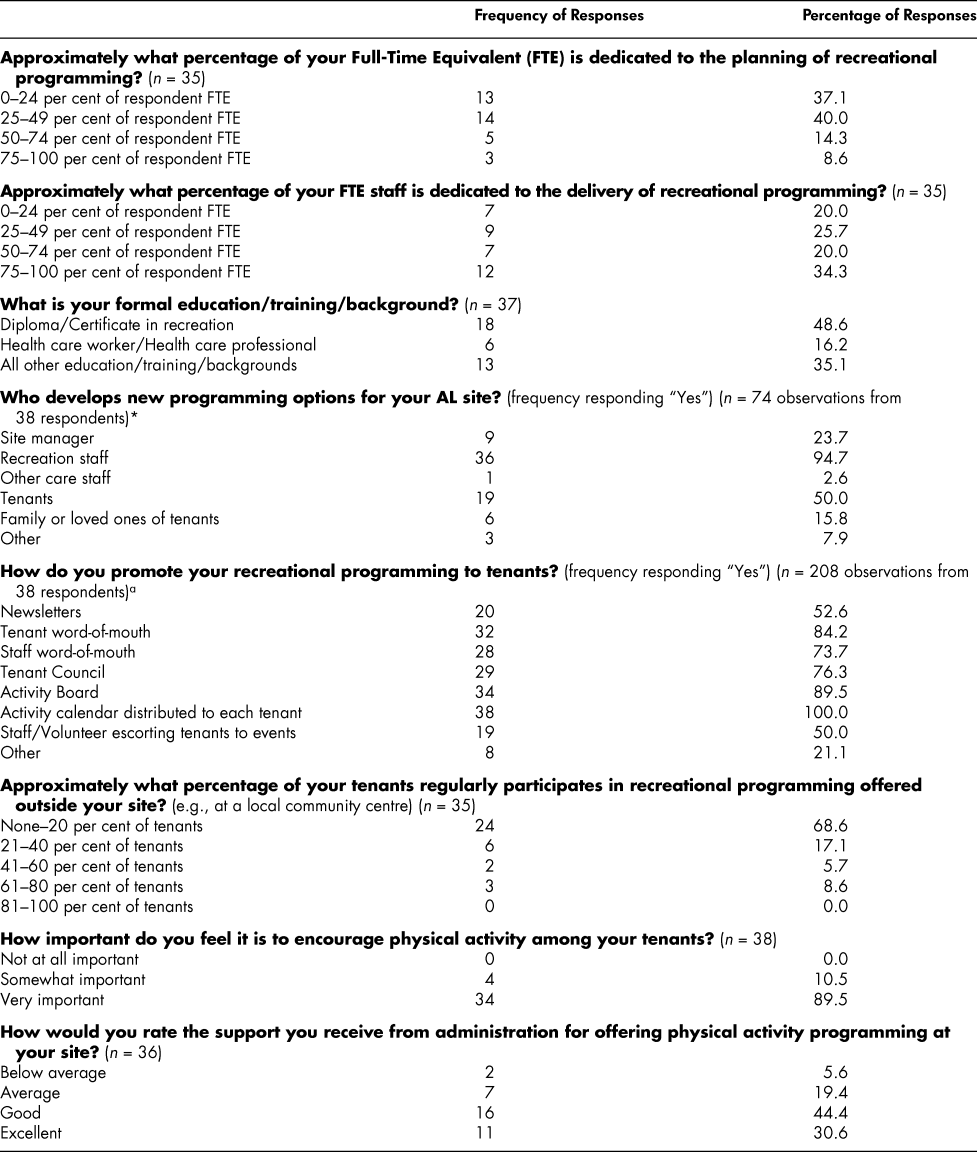
Respondents were quite varied in the amount of their full-time equivalent that was dedicated to the planning and/or delivery of social and recreational programming, but in general had more time dedicated to the delivery than to the planning of activities and programming. In contrast, respondents were less varied in their perceptions of support. Specific to offering physical activity programming at their site, almost three-fourths of respondents reported the support received from other site staff was either good or excellent. Similar perceptions were held for support received from administration, with just over 75 per cent of respondents rating administrative support for physical activity programming to be good to excellent. The importance of encouraging physical activity among tenants was high, with approximately 90 per cent of respondents from both health authorities identifying the conviction that encouraging tenants to be physically active was very important (Table 1).
Frequency and percentages of responses for the Phase 2 Survey of Assisted Living Staff (n = 38) on social and recreational opportunities at their sites
a Respondents could respond to more than one item
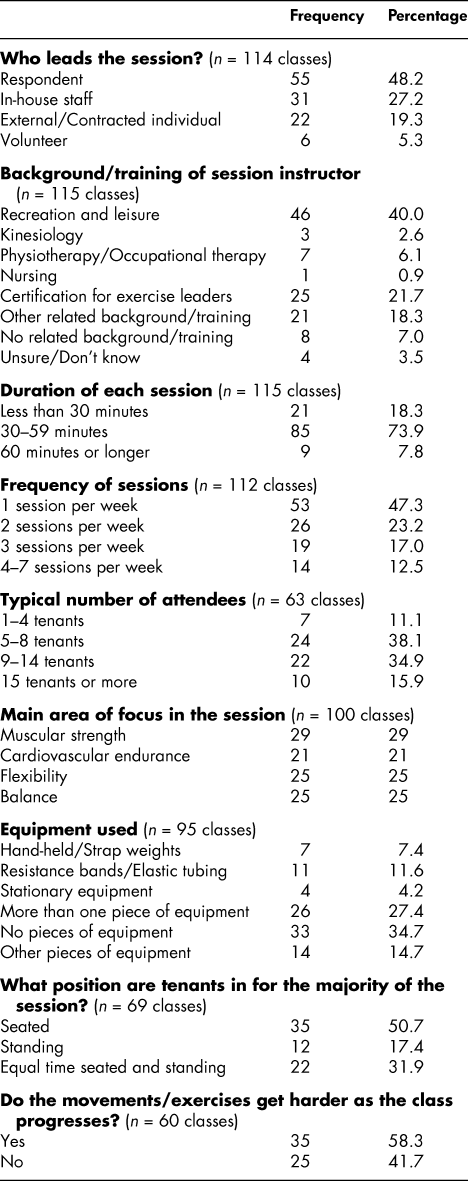
Respondents provided detailed information on the exercise classes run at their sites, defined as those classes that specifically aimed to increase the heart rate/breathing of those attending in order to capture target activities that meet or exceed a moderate intensity level (Canadian Society for Exercise Physiology, 2011).
Details were provided for a total of 115 exercise classes (see Table 2). The majority of classes (73.9%) lasted between 30–59 minutes in duration and were run in a group format ranging from 5 to 14 tenants (73.0%). Only 29.5 per cent of classes were offered at a frequency of three or more times per week. Less than one third of the classes were delivered by an instructor who held a certification for exercise leaders or was a physical/occupational therapist/kinesiologist. Twenty-nine per cent of classes targeted muscular strength as the main focus, with slightly fewer classes focusing on flexibility or balance (25.0% each) and cardiovascular endurance (21.0%). Half of all exercise classes were conducted with tenants remaining in the seated position (50.7%). Tenants spent equal time sitting and standing in 31.9 per cent of exercise classes, and only 17.4 per cent of classes were reported to spend the majority of the session in the standing position. For exercise progression, 58 per cent of reported classes included progression of exercises.
Frequency and percentages of responses for the Phase 2 Survey of Assisted Living Staff (n = 38) reporting on 115 exercise classes conducted at their sites (respondents could report on more than one class, as long as it met the inclusion criteria)
Phase 3
Sixty attendees, including AL administrators and staff, practitioners, and researchers, participated in the interactive symposia events. Attendees represented 32 AL sites, both health authorities, and two large universities. A number of themes emerged from the small group discussions, both within and across table topics, crossing the four broad categories of (a) physical activity, (b) social activity and active living, (c) social and mental well-being, and (d) challenges for program delivery and tenant engagement. The key findings, discussed below, reflect enabling and restricting factors at the individual, site, and organizational levels (see Figure 2).
Key factors found to impact the planning and delivery of social and recreational programming in assisted living (AL)
Physical Activity. Attendees identified physical activity as a key area for maintaining and improving the health of the tenants. However, this was countered by some of the assumptions held about the aging process and the role of AL. Attendees perceived that many tenants were not very active; some tenants were content “just to sit”, as AL does a very effective job of taking care of the majority of their day-to-day needs. Education and awareness of an active lifestyle and clarification of the role of service provision were potential strategies for addressing these tenant assumptions.
Social Activity and Active Living. It was emphasized that social activities were typically well attended by a diverse representation of tenants, but fewer tenants elected to take part in physical activities, such as formal exercise programming. This opened the discussion around incorporating a physical activity, or active living, component into other dimensions of the social and recreational programming options. Purposeful activities, such as gardening, group walking programs, and off-site outings were cited as examples of where an active living component was built into the social activity, thereby providing physical activity. A general view of attendees was that any programming that gets tenants out of their suite is beneficial, whether it be to take part in a social tea or birthday celebration, group outing, or exercise class. Enjoyment within programming was a recurring topic in these discussions.
Social and Mental Well-being. A prominent theme was the role that recreational programming plays in the social and mental well-being of tenants. Many attendees believed that recreational opportunities served an important role for tenants’ social contact. However, attendees consistently commented on the need to further address tenant social isolation and mental health. Meeting tenants’ emotional needs, including creating personal connections and caring relationships, and addressing isolation, were areas expressed by attendees as having priority for the tenants’ overall well-being. The value of recreational programming was routinely underscored; attendees stated that social and recreational opportunities provided meaningful activities for tenants with holistic health benefits while contributing to the social environment and sense of community at each site. Many believed that the social and recreational program at their site was the ideal vehicle for fostering a sense of community, both within the AL site and in connection to the broader community.
Challenges for Program Delivery and Tenant Engagement. Encouraging participation in programming opportunities presented challenges; attendees stated that they believed they were often walking a fine line between reminding people of events and nagging them. This balance between promoting activities, and respecting individual autonomy and the choice-based philosophies central to AL, was an important distinction. Some attendees reported success in emphasizing tenant-led initiatives and offered tenants avenues in which to express their needs and ideas. Finding individual motivations was often helpful in increasing engagement, and linked opportunities to personal history or previous hobbies. Yet attendees expressed the view that time constraints limited the ability to meet individually with tenants to determine motivating factors even though social and recreational programming was perceived as having high importance and administrative support.
Table topic discussions emphasized that AL staff have a high level of dedication for planning and delivering quality programming, yet barriers exist. For example, financial resources available for delivering social and recreational programs were often a challenge. The funding structure for recreational programming differed slightly in the two health authorities, yet attendees from both sites reported that a lack of financial resources limited the scope of their overall programming. Staffing issues were also a commonly cited obstacle. Some sites that relied heavily on volunteers were concerned about burnout, while other sites noted challenges in recruiting volunteers. Furthermore, physical space constraints presented barriers as not all sites had permanent space in their facility for recreational activities, which meant that they had to deliver activities in common areas such as sitting areas and dining rooms. This was especially challenging when using the site’s dining space for classes, as the time between the clearing of one meal and set-up for the next offered a very short window of availability with resultant scheduling conflicts.
Finally, a frequently cited barrier to programming was factors related to tenants. Limited mobility and forgetfulness were commonly viewed as restricting factors in getting tenants to take part in the programs offered. The personal interests of tenants were also cited, as many sites were challenged to find activities that interested the majority of tenants. And the overall physical health of tenants was cited as a limitation, particularly when more one-on-one assistance was needed or the staff believed that they were not equipped to address the complex health status of some tenants.
Discussion
In this three-phased investigation, we gained insight into factors that influence planned social and recreational programming in AL. Sites reported that social opportunities were better attended than exercise classes, and believed that such activities met the holistic health needs of tenants by fostering a sense of community and providing a mechanism for socialization, both of which were felt to meet the emotional needs of tenants and maintain mental well-being.
The importance of physical activity was a recurring discussion point. Staff commented on the low levels of physical activity among some tenants, reinforcing previous research findings on high amounts of sedentary time and low moderate- to vigorous-physical activity (Resnick et al., Reference Resnick, Galik, Gruber-Baldini and Zimmerman2011) among AL tenants, making them a vulnerable population for mobility disability (Rosenberg et al., Reference Rosenberg, Bombardier, Hoffman and Belza2011) and related detrimental health outcomes. However, low levels of physical activity are also observed in the community-dwelling older adult population. For example, using the Canadian Community Health Survey, researchers noted that only 23 per cent of older adults with chronic conditions engaged in sufficient weekly physical activity (Ashe, Miller, Eng, Noreau, and Physical Activity & Chronic Conditions Research Team, 2009). One group at greatest risk of inactivity was women aged 80 and older where only 7.4 per cent met recommended guidelines for physical activity (Ashe et al., Reference Ashe, Miller, Eng and Noreau2009). However, this relationship is complex, as some literature has found that increasing severity of co-morbid conditions can cause older adults to replace physical activity with less socially or physically active pursuits (Zimmer, Hickey, & Searle, Reference Zimmer, Hickey and Searle1995). Therefore, a comprehensive and multidimensional perspective is needed to accurately capture a more complete picture of social and recreational opportunities in AL.
Our findings from Phase 2 asked about exercise opportunities. Many of the activities offered specifically as exercise classes were delivered with participants remaining in a seated position for the majority of the class duration. Such classes may not be taking advantage of the potential to challenge the balance of those participating, or to offer similar benefits that would be afforded by maintaining an upright position such as preserving or improving lower body strength. Accordingly, there is a potential loss of related health benefits, such as falls prevention and maintenance of mobility.
The interplay between older adults’ health and interest has been noted in previous literature. For example, older adults, particularly those with existing health issues or concerns, can be hesitant to engage in physical activity, citing misconceptions, warnings, or advice against physical activity (Hirvensalo, Heikkinen, Lintunen, & Rantanen, Reference Hirvensalo, Heikkinen, Lintunen and Rantanen2005; King, Reference King2001) or fears of injury and falls (Murphy, Williams, & Gill, Reference Murphy, Williams and Gill2002; Yardley, Donovan-Hall, Francis, & Todd, Reference Yardley, Donovan-Hall, Francis and Todd2006). A recent systematic review investigating motivators and barriers to physical activity in the oldest old reported limited evidence for adults aged 80 and older (Baert, Gorus, Mets, Geerts, & Bautmans, Reference Baert, Gorus, Mets, Geerts and Bautmans2011). Baert et al. noted that personal barriers included health and fear of falling, as well as weather, environmental issues, and lack of social support. However, the benefits of physical activity have been found to include reduced falls risk (Gardner, Robertson, & Campbell, Reference Gardner, Robertson and Campbell2000) with walking presenting one low-risk, safe physical activity option for older adults (Ory et al., Reference Ory, Resnick, Jordan, Coday, Riebe and Ewing2005). On the basis of their systematic review, Baert et al. (Reference Baert, Gorus, Mets, Geerts and Bautmans2011) suggested that health care workers could be involved in encouraging more physical activity within the nursing home setting. Resnick et al. (Reference Resnick, Galik, Gruber-Baldini and Zimmerman2011) tested this model by engaging AL care workers in encouraging more physical activity with tenants with their everyday activities of daily living. As a result, at 12 months, AL tenants receiving the intervention engaged in more activity (as measured by accelerometry) (Resnick et al., Reference Resnick, Galik, Gruber-Baldini and Zimmerman2011).
Important considerations related to increasing the exercise class options included tenant health and perceptions of preparedness. Our findings shed light on the perceived self-efficacy of staff in delivering exercise classes, with staff reporting a lack of expertise in both addressing tenants’ complex health needs and in delivering a safe, yet challenging, class. Although greater numbers of formal exercise classes with adequate staff support might seem the most obvious solution to increasing tenants’ physical activity, we do not know the ideal mix of programming that is most resource effective while simultaneously offering tenants a variety of options and enjoyment. While tailoring activities to personal preferences may increase adherence (Dattilo, Martire, & Proctor, Reference Dattilo, Martire and Proctor2012), AL staff reported time constraints. One opportunity to consider is using social activities to increase physical activity. In addition to providing benefits in its own right, participation in social programming can also result in the positive by-product of increased light- to moderate-intensity physical activity. Potential avenues for future investigation could be to capitalize on the high engagement rates of social activities and build elements into the programming that are designed to increase physical activity or offer meaningful physically active recreation opportunities (Porter, Shank, & Iwasaki, Reference Porter, Shank and Iwasaki2012) such as gardening. In addition, the utilitarian or instrumental walking (Gauvin et al., Reference Gauvin, Riva, Barnett, Richard, Craig and Spivock2008; Joseph & Zimring, Reference Joseph and Zimring2007) that is required to get to and from activities may also be an important source of physical activity generated by social and recreational programming. For example, tenants typically have to leave their suites and walk to the social programming, which itself provides a source of physical activity.
Although challenges exist, AL staff maintained that physical activity was of high importance. In a continuing care context, Harris-Kojetin, Kiefer, Joseph, and Zimring (Reference Harris-Kojetin, Kiefer, Joseph and Zimring2005) used management perceptions as a proxy for the level of commitment to encouraging physical activity. They also found that levels of support for, and importance placed on, physical activity translated into higher physical activity levels among retirement community residents. In the present study on AL, the parallel would be promising as it would extrapolate to a high level of commitment for furthering physical activity efforts and the potential for collaborations regarding future interventions.
The findings support our original application of the Social Ecological Model as appropriate for guiding our understanding of the factors that can contribute to older adults’ activity patterns. As diagrammed in Figure 2, barriers and enablers to the planning and delivery of social and recreational opportunities exist at the individual, site, and organizational levels. By recognizing and understanding the multiple levels of influence, effective strategies can be developed and implemented to positively influence the type and quality of programming offered to AL tenants.
An unexpected finding of this investigative work was the challenge staff expressed when trying to find a balance between their efforts to engage tenants and being perceived as pressuring or strong-arming tenants to participate. The choice-based philosophy central to AL allows tenants their rightful free will, with the personal autonomy to choose, or not, to participate in services or events offered at their site. Staff reported that they typically felt like they were “walking a fine line” between reminding tenants of the opportunities available and nagging them to take part.
We recognize some limitations to this work. First, we used self-reports to obtain details on the exercise classes. While other methods, such as direct observation, would have provided the ability to objectively measure the specific characteristics of programming (such as the intensity and duration of exercise classes or attendance rates, across multiple sites and varied class schedules), this was not a feasible data collection option. Second, although we were able to collect some details on the characteristics of the exercise classes, we cannot speak to the quality of delivery, which might influence tenants’ perceptions of benefit and enjoyment, factors that should be considered when developing future programming options. It is also likely that the participating AL staff reflected the perspectives of individuals who were particularly motivated to offer high-quality programming. Further, by reviewing prepared activity calendars, we captured only organized social and recreational opportunities within our document review and not the physical activity tenants engage in outside the activity calendar’s organized opportunities. Our results may therefore underestimate the total physical activity levels of tenants and the challenges associated with program delivery in AL. However, the comprehensiveness of this work offsets these limitations and provides detailed information on the planning and delivery of recreation in AL.
Conclusion
Our study characterized key factors associated with the planning and delivery of social and recreational opportunities offered by publicly funded AL sites in British Columbia. Although barriers certainly exist, AL care providers are doing what they can within the restrictions they experience to deliver enjoyable and effective programming for their tenants. Thus, this work provided an understanding of the enabling and limiting factors for social and recreational programming. In line with the Social Ecological Model, avenues to address the barriers to social and recreational programming could include interventions targeted at the individual, site, or organizational levels. Interventions of this type would go part of the way in meeting Mihalko and Wickley’s (Reference Mihalko and Wickley2003) call for multiple points of intervention within the AL setting. By increasing physical activity levels, we would be taking a literal and metaphorical step towards the overall goal of improving the health and quality of life of AL tenants.