In the German city of Hamelin, there is no getting away from it. Everywhere in the old town, there are reminders of the story of the pied piper, who, on a fateful day in June 1284, played tunes so sweet that 130 enchanted children followed him outside the city gates to disappear into a mountain and never to be seen again. Yet if modern Hamelin trades heavily on its reputation as the pied piper's city, this is not such a recent phenomenon as we might imagine. Travellers’ accounts tell us that, as early as the sixteenth century, references to the children and the piper could be found everywhere. People had sculpted and stained glass images of the pied piper in their homes, inscriptions on houses and public buildings referred to the tale and local people were reported to obey the ban on drumming and piping in the street through which the children were believed to have left. The event had been so momentous, travellers and chroniclers recounted, that the people in Hamelin even dated events using their own calendar, which started in the year of the children's disappearance.Footnote 1
Although from the mid-seventeenth century there emerged sceptics who dismissed the story as a fable, far more numerous have been those who tried to find an explanation for what could actually have happened in this small city for such a tale to emerge. Philosopher Gottfried Wilhelm Leibniz believed the tale related to a children's crusade.Footnote 2 Other eighteenth-century scholars explained it with reference to a battle in which many Hamelin youngsters could have died, or sought links with St Vitus dances, and with natural disasters in the area. And while early modern scholars connected the tale to the migration of young Germans to Transylvania or even the New World, modern ones have suggested the children were Ostsiedler, migrants who had left for Bohemia or Pomerania.Footnote 3
In his 2005 book, In Search of the Pied Piper, the Romanian-American scholar Radu Florescu surveys these explanations, and comes out in favour of one of them. He tells how local Hamelin historian Hans Dobbertin persuaded him that the tale originated in the move by a thirteenth-century nobleman by name of Nicholas von Spielenberg to recruit young Hamelers to settle in his family lands in Pomerania; they themselves wanted to flee their rat-infested city.Footnote 4 Yet Florescu also asks whether this knowledge really matters. Because ultimately, Florescu argues, ‘the history of Count Nicholas von Spielenberg’ is ‘of interest only to local historians’.Footnote 5 The story would never have gained the worldwide popularity that it did, had it not been for its legendary and mythical aspects. Of course, he is quite right about this, but this article will argue that this cannot be the whole story. Because not all myths and legends have as successful and lasting a career, after all, as the pied piper story. What does it take for a myth to live on, and be remembered generation after generation? We will see that for a tale like this to have persisted and to have made it beyond the world of Hamelin, it needed not only mythical characteristics, it also needed the flavour of authenticity that is provided by historical activity and the practice of memory.
Students of myth and legend have taught us that cultures develop recurring narrative and explanatory patterns that crop up again and again when people mentally and culturally try to structure their world. The archetypes or ‘motifs’ which twentieth-century folklorists and mythologists identified appear everywhere. Familiar tales of origin and deliverance, of failure and success, of gender and generations, and of the relationships between humans and the divine, appear in new settings. Such cultural patterns structure the way we tell stories, and thus also how we remember.
But myth is not history, and until quite recently, scholars have treated the two not only as very different, but also as mutually exclusive habits of thought.Footnote 6 Historians used to think of myths as deplorable things that other people believe in, and wrongs which are for them to right. History in its modern incarnation is a way of engaging with the past that distinguishes between past and present, deploys a timeframe, follows clear habits of reasoning and is based on an assessment of available evidence. Myth, on the other hand, is usually hazy about timeframes, more often than not depends on a suspension of disbelief and approaches evidence as something that is explained by a story, rather than used to test that story's reliability. That is not just true for the supernatural stories that scholars used to insist were ‘real’ myths, but also for what we call ‘legends’, popular but unlikely tales about humans that are located in time and space.Footnote 7
Once upon a time, scholars believed that in the longue durée of human development, history had replaced myth. Myth, they argued, was something that belonged to a primitive, pre-literate and pre-scientific way of life, not to the modern world. Today, scholarship has abandoned the ‘myth of mythlessness’, the notion that a world ruled once by myth has had to give way to a world ruled by reason.Footnote 8 Scholars from Roland Barthes to Marina Warner have pointed out that today's world actually continues to be pervaded by myth.Footnote 9 Even so, few myths can hold an epistemological monopoly; they are likely to coexist with other ways of thinking about the world, and some of those ways are historical.
Of course, distinctions between myth and history are not always clean and clear. Myths and legends can take on shapes that look, and indeed are, quite historical, while histories often acquire mythical features. In some instances, we can follow this process fairly closely. Since 2008, a research team under my direction has been studying war memories of the Dutch Revolt in the seventeenth-century Low Countries.Footnote 10 When we surveyed the transmission of eyewitness tales about the Dutch Revolt, we found that diarists who were writing contemporaneously often expressed their fear, anger and frustration about the pointlessness of events as they unfolded. At best, they referred to them quite generically as God's punishment for a decadent society.Footnote 11 Yet, a few decades after the events, few of the tales which people told each other about their own war experiences were ‘pointless’. Rather, war experiences had been framed in narrative formats that either helped to give some sort of providential or moral significance to the tales, or that suggested some form of control. Such stories told how villagers and townspeople had outwitted their military opponents with cunning and deceit, escapes were miraculous, sacrifices rewarded. In the process, many of these historical experiences had therefore become the stuff of legend, and had acquired mythical characteristics. Individual experiences which could not be framed in such a mythical way, such as those relating to defeat, loss and shame, were much less likely to be remembered.Footnote 12 Mythmaking, then, was an essential stage in the development of social memories of the Dutch Revolt; such myths were not the product of fading and failing memories, as some have thought, but intrinsic to the production of social memory itself.Footnote 13
Yet we also noted something else: for such myths and legends to catch on and survive, a good story alone was not enough. These stories continued to thrive only when they were framed historically and/or supported by material evidence. Stories apparently need an association with a place or a date, an object or a person, to be believed, and to be transmitted, even if such stories can also be transplanted to another context when that suits the needs of the storyteller. In early modern Europe, such evidence need not necessarily be that precise – the ability to point to place in the landscape could be adduced as ‘proof’ for an event to have taken place there. Myths without such a supporting framework of time, space and evidence might easily be dismissed as ‘fables’ and old wives’ tales – although that did not necessarily stop early modern antiquarians from repeating them.Footnote 14 Yet if and when a decent frame was in place, mythical tales and legends had a better chance than most of ‘catching on’ and of capturing the historical imagination.
Students of legends and folktales are familiar with this effect. ‘Legends’, as Timothy R. Tangherlini has put it,
are best characterized as historicized narrative. The process of historicization may be likened to diachronic ecotypification [the way in which cultural practices, including narratives, will adapt to suit a new environment]. The believability of the narrative is underscored by the historicization of the account.Footnote 15
This paper explores how such a historicisation of narrative operated in early modern Europe. Of course, the practice of history changed considerably in this period. There was growing scepticism about some myths, as we can see in the Hamelin case. Moreover, standards of evidence changed, and techniques for assessing its value and authenticity were refined and improved. But we will see that this did not necessarily endanger the survival and spread of myths and legends; quite the opposite, often it was actually modern historical and antiquarian methods and techniques that were used to strengthen, embellish and support them.
We will see that in the dynamic between myth and history an important mediating role was played by what students of memory call memory practices. The field of memory studies tells us that remembering is as much about ‘practice’ as about thought.Footnote 16 In Hamelin, people in the sixteenth century practised memory not only by storytelling, but also in observing the taboo on dancing in one of the streets, in the commissioning of and exhibiting of memorial inscriptions and images, and even, allegedly, by a new form of timekeeping. By doing so, they maintained a powerful presence for the story in the urban landscape; this in turn persuaded visitors and historians that there had to be ‘something in it’. In that way, memory practices like those in Hamelin helped to authenticate myth, and so functioned as a mediator between mythical and historical ways of thinking about the past. I will explore this dynamic further by discussing two Dutch tales, both of which also happen to involve children, before returning to the children of Hamelin.
Baby, cat and cradle
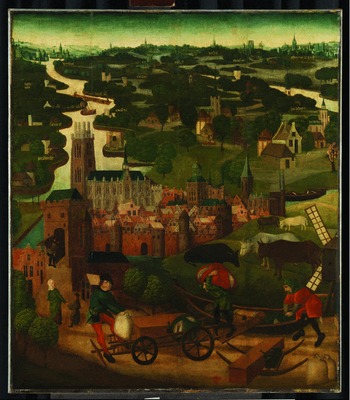
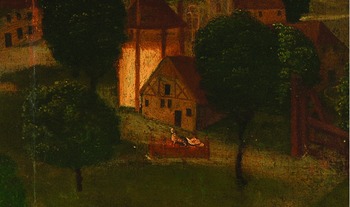
On the night of 18–19 November 1421, the so-called St Elizabeth flood swallowed the better part of the South-Holland area that was known as the Grote Waard. Much of the land was lost for good; part of the area became a marshland area which today is called the Biesbosch. Many villages were never rebuilt and the city of Dordrecht became an island, as it still is today. Two thousand people may have died, and the event made a big enough impression for people to remember it well into the sixteenth century. In 1560, a seventy-two-year-old man named Theeus Aspersoon recalled that his father and a great-uncle who had lived to age ninety had told him about the drowning of the village of Wieldrecht.Footnote 17 Such memories were supported by material remains. An early sixteenth-century witness claimed that when sailing through the area, he had seen the vestiges of the towers of the drowned village churches sticking out over the waters.Footnote 18 We also possess a remarkable pictorial representation of the flood; sometime around 1490 people from the drowned village of Wieldrecht and their descendants commissioned an altarpiece for the altar of St Elizabeth, whose name day at that time fell on 19 November. For the outer panels they ordered two images commemorating the event. These showed not only the drowning of their village and the villagers’ flight to the safety of Dordrecht, but also included a remarkable detail. On the top middle on the left altar panel we see a small cradle afloat, containing a baby and a cat (Figure 1a and b).Footnote 19 A historical account from 1514 gives us the background story: on the waters raised by the flood, a cradle had drifted into Dordrecht, which contained a male baby who had a cat for company.Footnote 20 Floating infants are a well-known narrative motif in European folktales; in the motif-index there is a special category reserved for ‘future hero found in boat’.Footnote 21 Sometime between 1421 and 1470, a tale with a similar motif had apparently been born in Dordrecht.
Master of the St Elizabeth Panels, Outer Left Wing of an Altar Piece with the St Elisabeth's Flood, 18–19 November 1421, c. 1490, SK-A-3147-A Published with permission of the Rijksmuseum Amsterdam

Detail of Figure 1a, showing baby, cat and cradle afloat

This was by no means the only mythical tale to originate from the flood. By 1500, for instance, it was said that as many as seventy-two villages had been lost in the event.Footnote 22 The actual number had been much lower, yet seventy-two is a number associated in the Bible with the number of peoples at the Tower of Babel, and the number of disciples sent out by Christ among the nations in Luke 10:1. This may be the reason why the number took hold of the imagination; it was probably no accident that witness Theeus Aspersoon was reported to be seventy-two years of age. The figure was also repeated on commemorative inscriptions, like the one that appeared above a city gate in Dordrecht in 1609.
At the time the gate was built, there were already many doubts about this figure. Yet while scholars debated how many villages had actually disappeared, the inscription resolved this problem by invoking the authority of a ‘chronicle’ to support its claim. The figure of seventy-two has been recurring until well into the twentieth century.Footnote 24
Other mythical elements disappeared much faster. In 1588, humanist Hadrianus Junius claimed that the flood had been the result of human intervention. A man had been so angry with his neighbours that he had made a breach in the sea dike that protected their land, thus provoking the flooding of the Grote Waard. The man was said to have suffered great remorse about the unexpected consequences of this act of spite.Footnote 25 Yet this tale did not catch on, and disappeared from view. The same happened with an earlier sixteenth-century tale, which explained the flood as the punishment for the pennypinching of the owners of the land, who had failed to pay their labourers their dues.Footnote 26 A late seventeenth-century author, who produced one of the most emotive descriptions of the flood, saw it as a providential punishment for the decadence of the area's prosperous inhabitants.Footnote 27 Even this tale made one appearance only.
However, the tale of the infant who survived the flood turned out to have a remarkable staying power. It has been suggested that it may have been someone who was associated with the tale of the cradle and the cat who insisted on the inclusion of the cradle in the altar panels in 1490; perhaps descendants of a survivor. This idea is supported by the fact that other early paintings of the flood did not include the cradle.Footnote 28 But however that may be, it seems that the tale was initially limited to a smallish circle. That the tale of the cradle survived at all, and that all accounts of the flood after 1600 were to include it, had everything to do with the intervention of a learned author. In a book that Erasmus's humanist friend, Martin Dorpius, published in 1514, he included a description of the County of Holland, allegedly written by Chrysostomos Neapolitanus and recounting the tale of a baby boy who had floated to safety with a cat in his cradle during the 1421 flood. There are indications that the author may have been using a pseudonym, and that the true author, probably the humanist Cornelis Aurelius, had all meant it as a bit of joke; nevertheless, its humanist setting lent it a veracity that greatly helped to authenticate the story in subsequent historiography and pictorial representations.Footnote 29
One sign of this is that the account appears to have influenced local memory culture. In 1635, an eighty-year-old Haarlem widow called Lysbeth Pieters signed an affidavit to the effect that she had often heard her grandmother tell how the latter's grandfather, Pieter van Nederveen, had miraculously floated to safety during the great flood of 1421. There was no mention of a cat in her account, but she said that the baby had worn a coral ‘paternoster’ necklace, with a pendant displaying a coat of arms and his name. Because of this, the boy had been recognised as a nobleman and brought up accordingly. Lysbeth made her statement at the request of a distant cousin, named Moses Jans van Nederveen, who lived in Dordrecht and who made gunpowder for a living. Moses may have been interested in the story because it would support claims to a higher social status, yet he may have also tried to stake his family's claim to the story because in Dordrecht there were other claimants around.Footnote 30 By the seventeenth century, the Dordrecht family of Roerom had apparently also started to claim a connection with the baby in the cradle. Local historian Matthijs Balen in the 1670s was the first to mention this connection and name the child in print. He included a reference to the cat, but in this version of the tale, the baby had undergone a sex change. Balen claimed that the child had been a girl, and identified her as a woman named Baete, who had eventually married a man called Jakob Roerom. Baete had been nicknamed Beatrix, ‘felicitous’, and it was under this name that she was from now on to be known. Through the offspring of her marriage with Jakob Roerom, Beatrix had become the great-great-grandmother of a series of elite families. Balen listed them carefully, and demonstrated the connection a second time in the genealogical tables which he included in his book. Balen allowed for other survivors and also mentioned a family who had survived the flood by clinging on to a wooden beam, yet he did not mention the Nederveen family.Footnote 31 Apparently, he knew nothing about the alternative claims of the descendants of Pieter van Nederveen. Yet however that may be, it is evident that by the seventeenth century the tale of the baby in the cradle had become a tale of origin. Since then, there has been a steady stream of individuals who claim descent from the rescued infant. Mostly, they mentioned Beatrix, but some also continued to maintain that the baby had been a boy. In 1885, an ‘old’ painting of cradle, baby and cat was sold at auction, which had been kept as evidence of a family association with Beatrix, together with a coral necklace with a gold locket that was said to have been found together with the baby.Footnote 32 It may have been an echo of the claims about the coral paternoster made by the Nederveen family, which in another version of the family history before 1800 had added details about the jewelry, and now also claimed that the baby had been accompanied by a cat.Footnote 33 In a 1698 version of the tale there was also mention of jewels which were associated with the baby.Footnote 34 Descendants of survivors continue to live to this very day. In 2007, a woman came forward in Dordrecht to tell the tale of her descent from Beatrix. Meanwhile, the Nederveen family has also been active in reappropriating the story for their family, through a local history journal, a published family genealogy and a strategic gift of a copy of their ancestor's affidavit to Dordrecht archive.Footnote 35
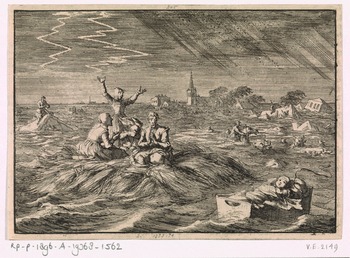
Yet it was not just individual stakeholders who spread the tale. From the eighteenth century there was a trend towards broader appropriation of the story. The myth proved capable of moving in time and space. Scholars have found references to at least three other medieval and early modern Netherlandish floods in which the tale of the cradle, cat and baby reappears; the early modern stories appear to have been inspired by a version of the tale from Dordrecht.Footnote 36 The tale was included in a print of the flood made by Romeyn de Hooghe in 1675, and in an influential print which Jan Luyken made of such a tale in Groningen the baby even took centre stage (Figure 2).Footnote 37 Its appeal has not waned; the tale of a floating baby is central to the plot of a Dutch film De Storm from 2009, which is set during the great floods of 1953.
Jan Luyken, Flood in Groningen in 1686, 1698, RP-P-1896-A-19368–1562.
Published with permission of the Rijksmuseum Amsterdam

The story of the baby, cat and cradle was in itself modelled on an archetypal mythical tale of delivery, that of Moses. This may well explain its appearance and its attraction in fifteenth-century Dordrecht. A story like this was probably shaped by the existence of an archetype about the providential rescue of floating babies, and their special mission; and that was also the reason why it stuck and survived. It had more potential than other rescue tales, in that it concerned a baby, suggested miraculous delivery and special divine favour; and this in turn also made it attractive to be associated with it. At the same time, it was essential for the long-term survival and career of the myth that it was coupled with an identifiable event and that there was supporting evidence to authenticate that event and its enormity. The flood of 1421 was only the first of a series, and at the time of their happening, these undoubtedly generated tales of their own. Yet, in the longer term, all flood stories came to be associated with the flood of 1421. This telescoping effect is quite well known among students of memory. It is significant in that it helped to reinforce an appearance of precision, which was necessary to support the absorption of memories into learned and popular historical tales. In this process, memory practices were an important catalyst; the painting and the inscription, the family tales, the jewels, have fired the interplay between myth and history, personal and public versions of the story. Oral, written and material evidence served mutually to support and reinforce one another.
In all this, the role of the cat in the story remains something of an enigma. The cat seems to have become more important for the tale when, from the late seventeenth century onwards, it was not just said to have been present, but also to have been instrumental for the rescue of the baby, by making sure that the cradle remained well-balanced.Footnote 38 In tales of other Dutch floods, the cat was also always included in tales about floating babies. The cat was first dismissed in 1808 by the poet Reyer van Someren, who explained that in his lengthy poetic account of the tale, he had ‘left out the cat because it is an unpoetic being’.Footnote 39 Much more than earlier observers, Van Someren seemed to think that one might divorce the myth from the historical evidence. He did this without wanting to diminish the importance of either, because it was he himself who, in an appendix to his poem, explained and documented exactly how he had handled the historical facts. This points to a division of labour between myth and history in nineteenth-century culture, in which the role of myth was not necessarily to be historically true, but rather to lend a spiritual or psychological significance to a tale and, crucially, also to testify to its antiquity. As we will see, this had also been happening in Hamelin. Even so, its historical dimensions also remained important. In the nineteenth century, the tale of baby, cat and cradle was adopted as a typonomical explanation for the Kinderdijk (or children's dike) which people claimed owed its name to the finding of Beatrix's cradle there. Subject of fierce debate and competition, and eventually disproven with considerable solemnity, the tale of this association was to become especially popular, and is still used today to enhance Kinderdijk's status as a quintessentially Holland tourist attraction.Footnote 40
Mythologising history
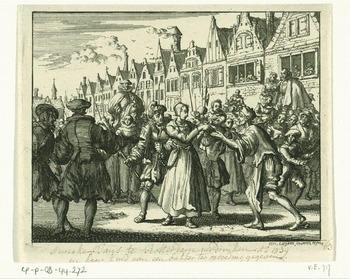
Yet if memory practices and histories can help to perpetuate and authenticate myths, early modern myth also helped to perpetuate historical memories, as we can see in another tale of deliverance. In 1685, an unknown editor was completing work on the second, extended edition of a very influential book, which is known in English as the Martyrs’ Mirror. This scholarly Mennonite martyrology had first been published by Thieleman van Bracht two decades earlier, and was now being updated. Just as he was ready to go to press, the editor was contacted by a man who said he was a great-grandson of a woman called Anneke Jans, one of the sixteenth-century martyrs who was celebrated in this book.Footnote 41 Anneke had been executed in Rotterdam on 24 January 1539. Her crime was that she rejected infant baptism, and had been rebaptised. Like many martyred heretics, Anneke had left a ‘testament’, in which she testified to her resolve to die for the faith.Footnote 42 It was addressed to her son Esaiah and commenced: ‘Hear my son, the teachings of your mother, and open your ears to hear the speech of my mouth. Behold, today I am going the way of the prophets, apostles and martyrs, to drink the cup that they have drunk.’ Soon after her death, it appeared in print as a song.Footnote 43 A prose version of the testament had been printed for the first time in 1562 in a famous collection of martyrs’ testimonies called Het offer des Heeren or The Sacrifice of the Lord. It had also been included in the first edition of the Martyrs’ Mirror. The existence of Anneke's son was thus already well known. But Anneke's great-grandson now produced new material: an extract from the court records detailing the verdict, a letter by Anneke to her son, copied in the hand of his grandfather Esaiah, and a great deal of information regarding the life of her son. The great-grandson explained that Esaiah had been a baby of fifteen months old when his mother received her death sentence. On her way to be executed, she had called upon the bystanders and asked if one of them would be prepared to look after her son. She had had a purse with some money ready for his support, which she would give to anyone who would promise to raise him as their own son. A poor baker, who already had six children to support, had stepped forward to take on this charge, and promised that he would do as she asked. She handed the child over to him ‘in the name of the father, son and holy spirit’, and proceeded to her martyr's death by drowning.
When the baker came home with the child, his wife was at first very angry, yet soon it emerged that God's ‘blessing which he had hoped for by accepting this child’ started to flow freely. The baker's business thrived, and he eventually bought himself a brewery (a big social step up for a baker) and left his children much wealth. His foster child Esaiah also became a brewer and eventually even made it to be burgomaster of Rotterdam. So prominent did Esaiah become that he had acted as godfather to a daughter of the city's pensionary and later statesman Johan van Oldenbarnevelt, while Oldenbarnevelt had done the same for his son. The man who had denounced Anneke, by contrast, had come to a terrible end. As he left the place where she had been drowned, a bridge which he was crossing collapsed, and he himself died, too, by drowning. All of his family ended up in utter destitution.Footnote 44
The tale as it was told here had a number of very satisfactory mythical elements; the baker had to overcome resistance from his wife but did the right thing and was rewarded; Anneke's son was clearly divinely favoured. The traitor, on the other hand, had not only been punished, but deservedly died the same death that she had had to endure so unjustly. This beautiful symmetry was carefully maintained in the transmission of the tale. Esaiah's grandson apparently failed to mention that Esaiah had had to leave Rotterdam in 1602 because his brewery had gone bankrupt; one of his sons had already been bankrupted in 1598.Footnote 45 Moreover, neither he nor the martyrologist wanted to spell out that, in a religious sense, the story did not quite work. No Anabaptist or Mennonite could have become burgomaster of Rotterdam. Moreover, if the Reformed city pensionary and later statesman Oldenbarnevelt was involved in the baptism of Esaiah de Lint's children, these cannot have been adults at the time, but would have been baptised as infants and in accordance with the Reformed rite, rather than that of the Mennonite successors to the Anabaptists. In a confessional, denominational sense, then, the tale was not as satisfactory as it might have been. Yet Esaiah's grandson had taken a great deal of trouble in offering precise information to enhance its authenticity. The story was supported by details about Anneke's arrest, the age of her child, the names of the breweries of the baker and Esaiah and the precise location of the collapsing bridge. And as a morality tale it was apparently so irresistible that the editor of the Mennonite Marter's Mirror not only thought he should include it, but also chose to have it illustrated. Like in the case of the floating cradle, it was an image by Jan Luyken that greatly enhanced the profile of the story (Figure 3).Footnote 46
Jan Luyken, Anneke Jans, Condemned to Death, Hands her Son, the Later Esaias de Lind, over to a Baker, 1539, 1698, RP-P-OB-44.272
Published with permission of the Rijksmuseum Amsterdam

As a consequence, the tale of Anneke Jans became one of the most famous Mennonite martyrs’ tales, also internationally; she inspired poems and a popular historical novel. She was, moreover, also appropriated both as a Rotterdam and as a Reformed heroine.Footnote 47 The De Lint family, in the meantime, continued to support their links to the story with a silver tazza, which has a later inscription suggesting that it was given to the family by Johan van Oldenbarnevelt as a pillegift, a gift for his godchild at the occasion of his baptism.Footnote 48 When it came to Museum Boymans van Beuningen in 1996, a press release underlined its importance with reference to its links with Oldenbarneveld and Anneke Jans, as well as its long transmission in the De Lint family.Footnote 49 Again, we see how important it is for a memory career that the mythical and the historical claims mutually support each other, and how essential memory practices are for creating evidence; oral traditions, written tales and material culture intermingle to create a tale which benefits both from a transcendent message and historical plausibility.
Scholars as mythmakers
In this process, an interesting role is being played by learned authors, who not only play a crucial part in the authentication of myths, but also in their amplification. By collecting and listing both direct and circumstantial evidence, and by deciding which parts of a tale they choose to believe and which ones to dismiss, they do not only enable stories to grow and expand, but also to fix these new versions. An excellent example of this process we can find in the tale of the pied piper of Hamelin.
In 1654, the pastor Samuel Erich wrote a book entitled the Exodus Hamelensis, in which he surveyed the arguments in favour of the story of the pied piper.Footnote 50 He quoted at length from a whole series of chronicles which recounted versions of the tale, pointed to the abundant existing material evidence in the city and concluded that even though there was no written evidence for the story for the years between the thirteenth and the sixteenth centuries, both the popularity and continuity of the tale suggested that it had to be genuine. Moreover, even though he had not had the opportunity to see the council's records for themselves, other authors suggested that these also confirmed the story.
The fact that Erich wanted to write this book at all, of course, points to the existence of scepticism. A year earlier, Hamelin burgomaster Gerhard Reiche had already reported that he considered the story a ‘fable’; there was no mention of it in the archives, a fourteenth-century chronicler from the city had not considered in worth mentioning and there was contradictory evidence on the location, the year in which it had happened and so on.Footnote 51 Erich's attempt to rescue that story did not have the desired effect. In 1655, Hamelin senator Sebastian Spilker listed a range of the objections to Erich's book, and in 1659 the Dutch scholar Martin Schoock published a lengthy tract entitled Fabula Hamelensis, in which he demolished Erich's arguments in favour of the tale, which he dismissed as ‘pathetic’. He cited a range of late medieval chronicles that had reported many similar stories, but which had been silent about the piper. While Schoock conceded that there might be reason to believe tales which had been transmitted from one century to the next, as long as these were in accordance with reason, this was simply not true for the story of the piper, which could boast only about 150 years of transmission and was unbelievable to boot.Footnote 52
The dispute between Erich and Schoock turned the issue into something of an academic cause célèbre – it became a popular topic for university disputations.Footnote 53 And the sceptics seemed to have a good point. There was no evidence for the antiquity of the tale. All there was, but that was in itself remarkable, was material evidence and a whole range of sixteenth- and early seventeenth-century sources, both published and unpublished, that reported the tale. Among those reporting were some reputable intellectuals, notably Johan Weyer, best known today for his scepticism about the witch hunts, and the Jesuit scholar Athanasius Kircher, as well as the prolific Catholic propagandist Richard Verstegan. Visitors to the city itself were all told about the tale, and reported about its many representations as well as the existence of the ‘Drummerfree’ street. They were told that the people of Hamelin used their own calendar, which started with the year in which the children disappeared, and found evidence for that on a 1556 inscription in the New Gate, which did indeed state that the gate had been built 272 years after the disappearance of the children.Footnote 54
It is clear that up to around 1650, the people of Hamelin were quite proud of their tale. That they could be so was apparently because they did not attach the same moral to the story that we tend to do; in the sixteenth century, this was not a salutary tale about the fate of those who refused to pay the pied piper what was his due for the destruction of the city's rats, and who had so triggered the rat catcher's terrible revenge. Rather, the piper was identified with the devil, and the tale presented as a warning to keep a close watch on one's children.Footnote 55 In that sense, it fitted well with the vogue for demonology and social disciplining that came with the Reformation, which had turned Hamelin into a Lutheran city.Footnote 56 That a text about the children was inscribed on a city gate, and that it was burgomaster Popperdieck who paid for a stained glass image of it to be put up in the local church in 1572, also suggests that in the sixteenth century it suited the local elite agenda.Footnote 57 New elements frequently appeared in the story. From the mid-sixteenth century, the sources started to mention a connection with rats; the piper had now become a rat catcher.Footnote 58 Speculation about the fate of the children similarly evolved. From around 1600, several sources suggested that the children had resurfaced in Transylvania; a century later, the New World was also mentioned.Footnote 59
Yet in the course of the seventeenth century, as demonology went out of vogue among the educated, the tale seems to have become unpopular with the authorities. As we have seen, burgomaster Reiche and senator Spilker found the story an embarrassment, and in 1660 the church window was removed. That might, indeed, have been that. Yet what the sceptics had not really been able to explain, of course, is how the story could have become so popular in the first place. Moreover, since the tale continued to circulate in scholarly texts, some of them demonological, others relating to natural history, visitors to Hamelin and other curious scholars continued to ask after the tale. As a consequence, the rationalists of the early Enlightenment did not forget about the children of Hamelin, quite the opposite. Soon, they came to see it as their challenge to explain the existence of the tale by looking for its historical roots.Footnote 60 People who wanted to dismiss the role of the devil turned to the evidence to try and come up with a better alternative. Bits of evidence, some of them new, materialised and continued to be scrutinised. A copy of the council book had a version of the tale on the cover that was long considered credible, but no one can say when that originated. The archives of Hamelin yielded two letters in which Jews were given permission to settle in the town, and which were dated, like the new gate, with reference to the children's disappearance. By the late nineteenth century, they were proven to be forgeries.Footnote 61
But most importantly, scholars began to believe that the existence of mythical accretions to the story was no reason to dismiss it. In fact, the mythical characteristics confirmed them in their belief that the tale had to be transmitted orally and so had to be old. As such, and as a legend, it was included by the Grimm brothers in their collection of fairy tales, and found its way into the oeuvre of the European romantic movement. Yet, side by side with its ever-growing fame as a legend, scholars also continued to make it their business to unpack the tale and find its historical kernel.
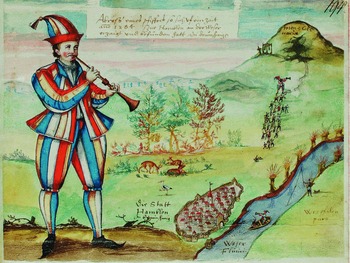
In 1936, two of them found they had struck gold. In a fourteenth-century manuscript that was kept in the city of Lüneburg, they found an addition in a later hand, written some time between 1430 and 1450, which not only included a version of the tale, and a reference to the use of a new calendar, but also mentioned the name of an eyewitness, the daughter of one of the burgomasters, who in 1284 had apparently ‘seen the children go’. Since that name could be matched with existing evidence, it may just be that this version of the tale, without rats, goes back to the fourteenth century.Footnote 62 This does not in itself do anything to answer the question of what, if anything, happened to the children from Hamelin and why. Still, for a new generation of scholars it was the impetus to go on searching, and indeed to continue using evidence that was produced centuries after the ‘event’, if it did happen at all, was said to have taken place. Polish phonebooks were traced for the presence of Hamelin names in Pomerania. As evidence for his theory about the noble piper, Hans Dobbertin refers to the stags on an image produced in 1592, which he believes refer to the coat of arms of this noble family (Figure 4).Footnote 63 Even Florescu, who has made it his life's work to think about legends, seems to assume that the rats must have a place in the origins of the story, simply because they emerged in it in the course of its transmission. Scholars have become the mythographers of the pied piper tale.
The pied piper, in Augustin von Mörsperg, Reisechronik, fol. 193f, c. 1592
Published with the permission of the Schlossmuseum Sondershausen

Conclusion
For the defender of the Hamelin story, pastor Samuel Erich, it was self-evident that fables could not survive for long. If a story was to be believable it needed supporting detail. As he explained, a statement such as ‘it is said that a certain woman has been elected pope somewhere’ could easily be dismissed as a fantasy. Yet if one were to say
In the year of our Lord 853, during the reign of emperor Lotharius the Pious, a certain woman named Joan was exercising the dignity of pope in Rome, it is immediately evident that this tale is not a fantasy but rather a truthful history, especially when witnesses agree on it.Footnote 64
Mundane as Erich's reasoning was, he was quite right, of course, that stories are much more likely to be believed if they are firmly anchored in supporting detail. They need to be set in a time and a place, they need a ‘friend of a friend’ who has heard it himself and they are helped along by the existence of spatial and material markers; this is how a narrative is ‘historicised’. In this article, I hope to have shown how in early modern Europe such a historicisation of narrative could come about, and could be transformed into history. The agents of this process of historicisation could be manifold. Much depended on the presence of stakeholders, people like the Nederveen and Roerom families in Dordrecht, the descendants of Anneke Jans or the elite and the local historians of Hamelin. Yet the process also depended on the interplay of myth, memory and history, and the interaction of stakeholders with authoritative mediators, many of whom were scholars.
In his 2003 book on Mythistory Joseph Mali has argued that myth plays a larger role in the historical discipline than is usually allowed for. Writing in an intellectual history tradition, Mali sees Giambattista Vico as the godfather of the realisation that myth is fundamental to the writing of history. The cases I have discussed suggest that underlying such theoretical reflections on the relationship between myth and history, there may have been a historical practice in which historians already knew how to make myth productive.Footnote 65
Myth and history have often been presented as subsequent phases in a linear development, but it seems that for most of Western history myths and mythical patterns of explanation have had to coexist with other ways of structuring knowledge about the past, and thus with history. The spread of literacy has undoubtedly affected the nature of that coexistence. As Carrie Benes and Adam Fox have shown for medieval Italy and early modern England respectively, in pre-modern literate societies there was much interaction between written and oral culture; written texts did as much to spread and perpetuate myths as did villagers spinning their tales.Footnote 66 But there is more at stake here than the traffic of ideas and motifs between literate and oral cultures. We have seen that when it comes to the transmission of collective memories, myth and history actually feed off one another in an even more fundamental sense. Rather than to think of myth and history as each other's opposites, as different paradigmatic idealtypes of engaging with the past, or as successive phases in the history of historical consciousness, it is more helpful to explore them as two forms of engagement with that past that are in fact closely interrelated and indeed interdependent.
Some scholars have seen this coexistence, and the blurring of history and myth which it entails, as a typically contemporary and postmodern phenomenon.Footnote 67 I think this is unnecessary. The three tales I have explored suggest that the blurring of history and myth is not a postmodern phenomenon only; in fact, it has been common practice for at least five centuries. Does that mean, then, that this blurring is typical for the ‘early modernity’ of the period under discussion? Where early modernists have seen myth and history coexist, they have sometimes read this as a sign that myth was ‘already’ beginning to lose its sway, and increasingly needed the backup of historical evidence if it was to be taken seriously.Footnote 68 Yet the evidence I have discussed here does not really support such assumptions about a linear development away from myth and towards the use of evidence. Folklore studies suggest that to be successful mythical tales about the past have always needed the support of things in the here and now; they need references to names of places and people, to objects in the material world, to features in the landscape or days in the calendar, or testimony that is passed on orally or in writing. The study of early modern memory practices helps us to understand how such references could come into existence, how they achieved authority and how they changed over time. In early modern Europe the transmission of tales was definitely affected by the appearance of new media, new figures of authority and new notions about evidence. Yet the application of new criteria for historical evidence from the seventeenth century did not necessarily result in the decline of myths. Quite the opposite, by declaring such stories mythical, and by using the existence of memory practices as evidence of this, scholars soon found reasons to go on taking them seriously as an object of study, and of historical enquiry.