Introduction
Radiodonta Collins, Reference Collins1996, including anomalocaridids and their allies, were remarkable stem-group euarthropods in the Paleozoic marine faunas (e.g., Whittington and Briggs, Reference Whittington and Briggs1985; Chen et al., Reference Chen, Ramsköld and Zhou1994). As one of the two main lineages of Radiodonta, Hurdiidae Lerosey-Aubril and Pates, Reference Lerosey-Aubril and Pates2018 is characterized by a tripartite head sclerite complex and frontal appendages with pectinate ventral spines. This family includes Peytoia Walcott, Reference Walcott1911, Hurdia Walcott, Reference Walcott1912, Pahvantia Robison and Richards, Reference Robison and Richards1981, Zhenghecaris Vannier et al., Reference Vannier, Huang, Charbonnier, Wang and Chen2006, Schinderhannes Kühl et al., Reference Kühl, Briggs and Rust2009, Stanleycaris Pates et al., Reference Pates, Daley and Ortega-Hernandez2017 (Caron et al., Reference Caron, Gaines, Mángano, Streng and Daley2010), Aegirocassis Van Roy et al., Reference Van Roy, Daley and Briggs2015, Tauricornicaris Zeng et al., Reference Zeng, Zhao, Yin and Zhu2017, Ursulinacaris Pates et al., Reference Pates, Daley and Butterfield2019a, and Cambroraster Moysiuk and Caron, Reference Moysiuk and Caron2019 and was diverse and successful in different ecological niches in the middle Cambrian (Miaolingian) and later (e.g., Daley and Budd, Reference Daley and Budd2010; Van Roy et al., Reference Van Roy, Daley and Briggs2015; Lerosey-Aubril and Pates, Reference Lerosey-Aubril and Pates2018; Moysiuk and Caron, Reference Moysiuk and Caron2019; Liu et al., Reference Liu, Lerosey-Aubril, Audo, Zhai, Mai and Ortega-Hernández2020). The genus Cambroraster, first discovered from the Burgess Shale (Moysiuk and Caron, Reference Moysiuk and Caron2019), is readily distinguishable from other hurdiid taxa by its central head sclerite with deep posterior notches, a rounded anterior margin, and posterolateral processes bearing multiple spines. These characteristics set it apart from not only the classic teardrop-shaped Hurdia-type central element, but all other radiodonts from which central elements are known, showing that it represents a new group of hurdiids.
Here we describe new specimens of Cambroraster based on a characteristic central element, two lateral elements, and a possible appendage endite from the Upper Shale Member of the Mantou Formation (uppermost Wuliuan) in the Longgang section, Shandong Province, North China (Fig. 1) that can be assigned to Cambroraster cf. C. falcatus, a similar species to the type species. This extends the paleogeographic distribution of this genus outside of Laurentia to North China, suggesting that Cambroraster had great dispersal ability. Cambroraster also represents the first discovery of a hurdiid radiodont in North China, further indicating a global distribution of this group in the Cambrian seas, which emphasizes the success of their evolution.
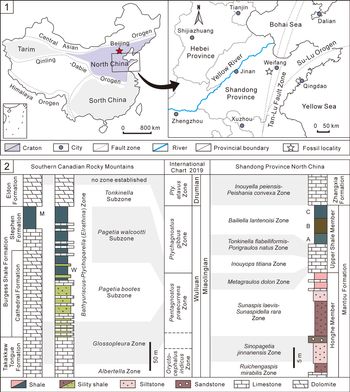
Location and geological setting of the Longgang Section. (1) Location map of the Longgang Section of central Shangdong Province in North China. (2) Stratigraphic column and fossil horizons of the Longgang Section and the stratigraphic correlation between Shandong province and British Columbia (stratigraphic classification and correlation according to Fletcher and Collins, Reference Fletcher and Collins1998, Reference Fletcher and Collins2003; Caron et al., Reference Caron, Gaines, Aria, Mángano and Streng2014; Geyer, Reference Geyer2019). A–C = Beds A, B, and C; W = Walcott Quarry; M = Marble Canyon, type locality of Cambroraster. The alternative spelling of Zhangxia is ‘Changhia.’

The discovery of exceptionally preserved fossils in the Upper Shale Member, Mantou Formation in recent years (e.g., Sun et al., Reference Sun, Wang and Yuan2015, Reference Sun, Zeng and Zhao2020; Wang et al., Reference Wang, Fatka, Sun, Budil and Gao2018) has drawn attention to the middle Cambrian Konservat-Lagerstätten in North China and their relations to the Burgess Shale (Sun et al., Reference Sun, Zeng and Zhao2020). The discovery of the wonderful Burgess Shale–type hurdiid radiodonts will further add to the evidence for such phenomenon.
Geological setting
The fossils described here were collected from the Upper Shale Member of the Mantou Formation (Bailiella lantenoisi Zone, corresponding to the Ptychagnostus gibbus Zone, uppermost Wuliuan) in the Longgang section, Linqu County, Shandong Province, North China (Fig. 1.1) (Sun et al., Reference Sun, Zeng and Zhao2020). The Mantou (alternative spelling ‘Manto’) Formation is widely distributed in North China and is subdivided into the Shidian Member, the Lower Shale Member, the Honghe Member, and the Upper Shale Member in Shandong Province (Zhang and Liu, Reference Zhang and Liu1996). The Mantou Formation covers an extended period from the Redlichia chinensis Zone (corresponding to the lower part of Cambrian Stage 4) to the Bailiella lantenoisi Zone (corresponding to the uppermost Wuliuan) and diverse offshore depositional environments (Chough et al., Reference Chough, Lee, Woo, Chen, Choi, Lee, Kang, Park and Han2010; Yuan et al., Reference Yuan, Li, Mu, Lin and Zhu2012).
Burgess Shale–type fossils in the Longgang section occur in three distinct fossiliferous shale beds called Beds A, B, and C in an ascending order (Fig. 1.2) (for details see Sun et al., Reference Sun, Zeng and Zhao2020). Cambroraster was found in Bed A along with Sidneyia, trilobites, bivalved euarthropods Tuzoia and Isoxys, brachiopods, algae, and worm-like animals. Hurdiidae indet. was found in Bed B along with bivalved euarthropods Tuzoia, sponges, chancelloriids, and worm-like animals (Sun et al., Reference Sun, Zeng and Zhao2020). On the basis of biostratigraphic correlation (e.g., Fletcher and Collins, Reference Fletcher and Collins1998, Reference Fletcher and Collins2003; Geyer, Reference Geyer2019; Zhu et al., Reference Zhu, Yang, Yuan, Li, Zhang, Zhao, Ahn and Miao2019), the Upper Shale Member of the Mantou Formation is one trilobite zone younger than the Burgess Shale (Fig. 1.2).
Materials and methods
Photographs were taken under cross-polarized light using a Nikon D810 camera fitted with a Nikon AF-S Nikkor 105 mm lens. Images were processed using Adobe Photoshop to adjust tone, contrast, and brightness. The morphological terminology about head sclerites used in this paper mainly follows Zeng et al. (Reference Zeng, Zhao, Yin and Zhu2017) and Moysiuk and Caron (Reference Moysiuk and Caron2019), and the terms describing the frontal appendages are from Daley et al. (Reference Daley, Budd and Caron2013). Measurement directions are expressed, respectively, as sagittal (sag.), exsagittal (exs.) and transverse (tr.).
Repository and institutional abbreviation
All the materials described in this paper are housed in the Nanjing Institute of Geology and Palaeontology, Chinese Academy of Sciences (NIGPAS), Nanjing, China.
Systematic paleontology
Superphylum Panarthropoda Nielsen, Reference Nielsen1995
Order Radiodonta Collins, Reference Collins1996
Family Hurdiidae Lerosey-Aubril and Pates, Reference Lerosey-Aubril and Pates2018
Genus Cambroraster Moysiuk and Caron, Reference Moysiuk and Caron2019
Type species
Cambroraster falcatus Moysiuk and Caron, Reference Moysiuk and Caron2019 from the upper part of the ‘Thick’ Stephen (Burgess Shale) Formation, Cambrian (Miaolingian Series, Wuliuan Stage), Tokumm, British Columbia, Canada.
Cambroraster cf. C. falcatus Moysiuk and Caron, Reference Moysiuk and Caron2019
Figure 2.1–2.8
- Reference Moysiuk and Caron2019
Cambroraster falcatus Moysiuk and Caron, p. 2, figs. 1, 2, sup. figs. 1–7.
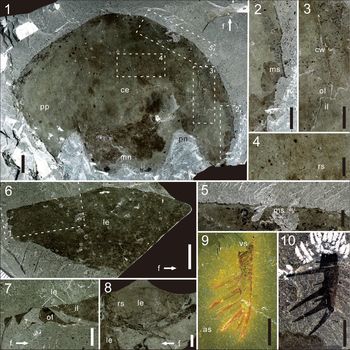
(1–8) Cambroraster cf. C. falcatus Moysiuk and Caron, Reference Moysiuk and Caron2019 (NIGPAS 171703–171705). (9) Hurdiid indet. (NIGPAS 171706). All are from the Cambrian (Miaolingian, Wuliuan) Upper Shale Member, Mantou Formation (Bailiella lantenoisi Zone) in the Longgang section, Weifang, Shandong Province, North China. (10) Endite of ‘appendage F’ from the Burgess Shale (USNM 240968). (1) Nearly complete central element, NIGPAS 171703. (2) Close-up of marginal spines of posterolateral process. (3) Close-up of double cuticle layers and compression wrinkles. (4) Close-up of reticulate structure. (5) Close-up of marginal spines of front margin. (6) Lateral elements, NIGPAS 171704a. (7) Close-up of counterpart of (6) showing the double cuticle layers, NIGPAS 171704b. (8) Nearly complete lateral element, NIGPAS 171705. (9) Part of endite of frontal appendage, NIGPAS 171706. (10) Part of an endite of ‘appendage F’. (1, 6) Scale bar = 10 mm; (2–5, 7–10) scale bars = 5 mm. Arrows indicate sediments between the double cuticle layers. as = auxiliary spine; ce = central element; cw = compression wrinkle; f = front; il = inner cuticle layer of sclerite; mn = medial notch; ms = marginal spine; le = lateral elements; ol = outer cuticle layer of sclerite; pn = posterolateral notches; pp = posterolateral process; rs = reticulate structure; vs = ventral spine.

Type specimen
Almost intact specimen (catalog number ROMIP 65078).
Occurrence
Upper part of the ‘Thick’ Stephen (Burgess Shale) Formation (Cambrian Miaolingian Series, Wuliuan Stage), British Columbia, Canada. Upper Shale Member of Mantou Formation (Cambrian Miaolingian Series, Wuliuan Stage), Longgang section, Shangdong province, North China.
Description of new material
The nearly complete central element is mushroom-shaped, 93 mm long and 135 mm wide, and divided into an axial and a pair of lateral areas by two obvious posterolateral notches (equivalent to the ‘posterior notches’ in Hurdia) (Fig. 2.1). The frontal margin of the sclerite is smooth and has no anterior tip. The axial area is rounded anteriorly; its posterior portion is divided into two lobes by a shallow medial notch. The lateral areas extend into posterolateral processes that project to near the posterior end of the axial area. Anterior margin of the sclerite and outer margin of these processes are adorned with spines that vary in length and generally decrease in size anteriorly (Fig. 2.2, 2.5); spines are serrated and of similar sizes in the front of the sclerite (Fig. 2.5) and are differentiated in sizes in the posterior of the processes (Fig. 2.2); large spines are 11 mm in spacing and 4 mm in size. The sclerite has double cuticle layers separated by sediment (Fig. 2.3). The surface of the sclerite is smooth and has no obvious relief, although some compression wrinkles are present on the right side of the posterolateral process, suggesting its original convexity (Fig. 2.3). The soft-tissue layers have a reticulate structure that is not well-preserved, and the reticulate cells are on average 3.1 mm long and 2.7 mm wide (n = 6) (Fig. 2.4).
The lateral elements are long semicircular to lenticular sclerites (Fig. 2.6) with reticulate structure and double cuticle layers separated by sediment (Fig. 2.7), as in the central element (Fig. 2.8). Only isolated sclerites were preserved. The reticulate structure is clear on a smaller sclerite (Fig. 2.8), with an average length of 2.4 mm and width of 2.7 mm (n = 7), similar in size to this structure on the larger specimen (Fig. 2.6). The ventral margin is smoother and thicker than the dorsal margin, and the anterior and posterior ends are not preserved. The dorsal margin is slightly curved and not distinct.
Mouthparts, convincing frontal appendages, and other body parts have not been found.
Materials
A central element (NIGPAS 171703) and two lateral elements (NIGPAS 171704, 171705), illustrated in Figure 2.1–2.5.
Remarks
The new specimens possess the characteristic morphological structures of Cambroraster Moysiuk and Caron, Reference Moysiuk and Caron2019, including a rounded anterior margin and spinous backward-projecting posterolateral processes (Fig. 2.1), double-layered head sclerites (Fig. 2.3, 2.7), reticulate structure (Fig. 2.4, 2.8), and large posterior notches. The latest feature distinguishes new specimens from other similar hurdiids such as Hurdia and Pahvantia, and the shape of the posterolateral processes and axial area assigns the new specimens to Cambroraster rather than Zhenghecaris Zeng et al., Reference Zeng, Zhao, Yin and Zhu2017. New specimens exhibit an obviously greater length-to-width ratio compared with the type specimens of C. falcatus from the Burgess Shale, but this is not sufficient for assigning the Shandong specimens to a new species of this genus. Although the lengths of most central-element specimens of C. falcatus, including the type specimens, are greater than their widths, a few specimens exhibit the opposite (Moysiuk and Caron, Reference Moysiuk and Caron2019, figs. 1j, S1a), and since these specimens are smaller in size, these differences could be attributed to ontogeny or to the angle of burial. These wide central elements of C. falcatus from the Burgess Shale are very similar to the Shandong specimens in size, outline, and length–width ratio. Given these similarities, the Shandong specimens are at least a similar species to the type species C. falcatus, and considering that the reticulate of the new specimen is also obviously shorter along the sagittal axis, we consider that the difference in the length-to-width ratio of the new specimens is most likely due to taphonomic deformation, specificly, from depositional compression of the shield into the sediment plane in a forward tilted posture.
Hurdiidae indeterminate
Figure 2.9
Occurrence
Upper Shale Member of the Mantou Formation, Cambrian Miaolingian, Wuliuan, in the Longgang section, Shangdong province, North China.
Description
Endite long, thin, and straight, about 13 mm long (sag.) and 3 mm wide (tr.). More than eight pectinate auxiliary spines are slightly inclined to the endite. Auxiliary spines are thin and straight and alternate in length between adjacent ones, with the longest auxiliary spine having a length (tr.) that is twice the width (tr.) of endite. Larger auxiliary spines have an average length of 5 mm, and the spacing between them is about 2 mm.
Material
An incomplete ventral spine of the frontal appendage (NIGPAS 171706).
Remarks
The partial endite shows that the endites of this frontal appendage had auxiliary spines of differentiated size, a feature found in Hurdia (Daley et al., Reference Daley, Budd and Caron2013, fig. 12; Moysiuk and Caron, Reference Moysiuk and Caron2019, fig. 3e, f), Cambroraster (Moysiuk and Caron, Reference Moysiuk and Caron2019, fig. 2d), and some appendages assigned to Peytoia (Daley and Budd, Reference Daley and Budd2010, fig. 8). The main differences between the endites of these genera are the length and spacing between adjacent large auxiliary spines. When comparing appendages with endites of width 3 mm, the spacing of the auxiliary spines in Cambroraster is about 2 mm while in Hurdia and ?Peytoia it is about 3 mm (although the auxiliary spines of the latter are shorter than those of the former two). From the perspective of the spacing of large auxiliary spines (about 2 mm), the Shandong specimen is closest to Cambroraster, but considering that this appendage is incomplete, its identity remains questionable. This fragment may also be the distal ends of Sidneyia appendages, considering that this taxon is also known from this site (Sun et al., Reference Sun, Zeng and Zhao2020), but the absence of podomere boundaries does not support this identification. Note that some specimens classified as ‘appendage F’ from the Walcott Quarry of the Burgess Shale (Fig. 2.10, USNM 240968) and an unnamed appendage type from the Spence Shale (Conway Morris and Robison, Reference Conway Morris and Robison1988, fig. 26.1; Kimmig et al., Reference Kimmig, Strotz, Kimmig, Egenhoff and Lieberman2019, fig. 4i, KUMIP 204777) are very similar to the Shandong material. It therefore remains possible that the Shandong appendage and these unattributed appendage specimens belong to a group of hurdiids that has not been systematically studied.
Discussion
Although the new specimens are slightly different from the type specimen of C. falcatus in morphology, the Shandong specimens can still be assigned to a similar species to C. falcatus by comparison with other specimens of the type species in various taphonomic conditions. This extends the paleogeographical distribution of this genus beyond the Burgess Shale and even Laurentia, suggesting that although Cambroraster is considered a nektobenthic sediment-sifting feeder (Moysiuk and Caron, Reference Moysiuk and Caron2019), these animals had dispersed over a wide range. In addition, Cambroraster represents the first discovery of hurdiid radiodonts in North China. This group has been found previously in Laurentia (e.g., Briggs et al., Reference Briggs, Lieberman, Hendricks, Halgedahl and Jarrard2008; Daley et al., Reference Daley, Budd, Caron, Edgecombe and Collins2009, Reference Daley, Budd and Caron2013; Caron et al., Reference Caron, Gaines, Mángano, Streng and Daley2010; Pates et al., Reference Pates, Daley and Ortega-Hernandez2017, Reference Pates, Daley and Lieberman2018, Reference Pates, Daley and Butterfield2019a, Reference Pates, Daley, Edgecombe, Cong and Liebermanb; Lerosey-Aubril and Pates, Reference Lerosey-Aubril and Pates2018; Kimmig et al., Reference Kimmig, Strotz, Kimmig, Egenhoff and Lieberman2019), South China (e.g., Liu, Reference Liu2013; Zeng et al., Reference Zeng, Zhao, Yin and Zhu2017; Liu et al., Reference Liu, Lerosey-Aubril, Audo, Zhai, Mai and Ortega-Hernández2020), West Gondwana (e.g., Van Roy and Briggs, Reference Van Roy and Briggs2011; Van Roy et al., Reference Van Roy, Daley and Briggs2015), and Baltica (e.g., Chlupác and Kordule, Reference Chlupác and Kordule2002; Daley and Legg, Reference Daley and Legg2015). The discovery of a hurdiid in North China indicates that this group as a whole had a good dispersal ability, which could have contributed to its successful colonization in various ecological niches (Daley and Budd, Reference Daley and Budd2010; Vinther et al., Reference Vinther, Stein, Longrich and Harper2014; Van Roy et al., Reference Van Roy, Daley and Briggs2015; Lerosey-Aubril and Pates, Reference Lerosey-Aubril and Pates2018; Moysiuk and Caron, Reference Moysiuk and Caron2019).
The discovery of Sidneyia cf. S. inexpectans in North China suggested a link between Konservat-Lagerstätten in the Upper Shale Member of the Mantou Formation and the Burgess Shale (Sun et al., Reference Sun, Zeng and Zhao2020), and this is further supported by the discovery of Cambroraster cf. C. falcatus from the same section and fossiliferous layer. Given that paleogeographic reconstructions place North China far from Laurentia in the middle Cambrian (e.g., Álvaro et al., Reference Álvaro, Harper and Servais2013; Hally and Paterson, Reference Hally and Paterson2014; Torsvik and Cocks, Reference Torsvik, Cocks, Torsvik and Cocks2017), the discovery of these common taxa provides three implications. It could suggest that Cambroraster and Sidneyia (at least in the larval stage) were particularly good dispersers, that the biological features of the carbonate platform in different regions were relatively uniform at that time, or that North China and Laurentia were linked by ocean currents (Ross, Reference Ross1975). Testing these hypotheses will require more detailed comparison of Miaolingian Burgess Shale–type Lagerstätten outside of Laurentia.
A series of exceptionally preserved fossil deposits have been reported from North China, such as the Lower Shale Member (upper Cambrian Stage 4 to lower Wuliuan) (Lin, Reference Lin1995; Huang, Reference Huang2012; Huang et al., Reference Huang, Wang, Gao and Wang2012; Zhu et al., Reference Zhu, Lerosey-Aubril and Esteve2014) and Upper Shale Member (uppermost Wuliuan) of the Mantou Formation (Resser and Endo, Reference Resser, Endo, Endo and Resser1937; Liu et al., Reference Liu, Huang and Gong2012; Sun et al., Reference Sun, Wang and Yuan2015, Reference Sun, Zeng and Zhao2020; Wang et al., Reference Wang, Fatka, Sun, Budil and Gao2018) and the Panchegou Member (lower and middle Drumian) of the Zhangxia (alternative spelling ‘Changhia’) Formation (Wang et al., Reference Wang, Huang and Lieberman2010). The Upper Shale Member of the Mantou Formation spans a short time range (corresponding to the upper Ptychagnostus gibbus Zone) and is relatively thin (shale unit less than 10 m thick), but it is a stable lithostratigraphic unit that can be consistently recognized. This paper along with other recent studies (Sun et al., Reference Sun, Zeng and Zhao2020) shows that the North China is a very promising area for exploring new fossils similar to the Burgess Shale biota.
Acknowledgments
This research was supported by the Strategic Priority Research Program (B) of the Chinese Academy of Sciences (XDB26000000), the National Natural Science Foundation of China (41921002, 41902014), and the State Key Laboratory of Palaeobiology and Stratigraphy (20181105, 20192111). We thank J. Moysiuk, S. Pates, and one anonymous reviewer for constructive comments and suggestions. We also thank D.H. Erwin and M. Florence for facilitating access to the Burgess Shale collections at the National Museum of Natural History, USA, and R.-R. Xing for help in the fieldwork and for collecting some specimens described in this study.