Families process state, market and personal resources to negotiate their particular household mix of productive and reproductive activities, yet only recently have we begun to compare the household division of labour and its effect on family outcomes across societies. One body of work looks at policy effects on gender equity within the home (Cooke, Reference Cooke2007a; Stier and Lewin-Epstein, Reference Stier and Lewin-Epstein2007), while another assesses the impact of gender equity in the household division of labour on fertility (Cooke, Reference Cooke2004; Oláh, Reference Oláh2003; Torr and Short, Reference Torr and Short2004). Economists such as Gary Becker (Reference Becker1981, Reference Becker1985) argue these two are at cross-purposes, with any increase in women's employment predicted to decrease women's desired number of children. A growing group of theorists across disciplines, however, argue instead that equity is the only sustainable gender order in the post-industrial world of less sta employment and more diverse families (Fraser, Reference Fraser1997; McDonald, Reference McDonald2000; Oppenheimer, Reference Oppenheimer1997).
When analysed at the aggregate or household level, the evidence in support of either hypothesis of gender equity effects on fertility remains inconclusive. Until recently, aggregate fertility was higher in countries where women's aggregate employment was lower, but the sign of that relationship reversed in the 1990s (Sleebos, Reference Sleebos2003). At the individual level – where couples actually negotiate a division of labour and have children – effects vary in context. Among US couples, the most gendered and most egalitarian housework arrangements are both positively associated with fertility, although odds are slightly greater among the more egalitarian couples (Torr and Short, Reference Torr and Short2004). For German couples, male breadwinner families are more likely to have a second child, but father's greater participation in childcare also increases the odds (Cooke, Reference Cooke2004). In Sweden and Hungary, the likelihood of second birth is greater when couples share family responsibilities as compared with couples with more gendered divisions of paid and unpaid labour (Oláh, Reference Oláh2003).
Equity effects on fertility appear to vary by the degree to which policy or cultural elements reinforce women's responsibility for unpaid care work. (West) German policies historically reinforced women's responsibility for the private sphere and economic dependence on a male breadwinner (Cooke, Reference Cooke2004). Socialist Hungary and social-democratic Sweden historically provided a web of services and policies supporting full employment of all able-bodied adults (Oláh, Reference Oláh2003). In the liberal US regime, policy has supported equal education and employment opportunities for women through Title VII of the Civil Rights Act of 1964, but remains silent regarding how demands from the private sphere are met (Cooke, Reference Cooke2007a). Taken together, this evidence suggests that the more policy encourages greater equity in the division of paid and unpaid labour, the more gender equity enhances family fertility.
McDonald (Reference McDonald2000) offers a structural argument for this covariation between policy and equity effects on fertility. He claims fertility declines most sharply where there is conflict between gender equity in individual-level versus family-level institutions. To date, however, there are no suitable institutional measures with which to assess this claim. Instead, the analysis here focuses on examining whether individual gender equity effects on fertility differ across two countries with similar institutional structures vis-à-vis gender equity. Italy and Spain are Mediterranean countries that industrialised later than their northern neighbours; both rely on extended kinship networks in the provision of individual welfare (Ferrera, Reference Ferrera2005), as of 2000 had similar female labour force participation rates (OECD, 2007) and have experienced a dramatic decline in fertility rates since the 1960s (Kohler et al., Reference Kohler, Billari and Ortega2002). Yet the countries also differ slightly in terms of women's returns to education, the structure of female employment and the gender earnings gap (OECD, 2002, 2004, 2007). Using seven waves of the European Community Household Panel (ECHP), we explore whether the slight differences in gender equity across the 1990s in these two countries yielded differences in equity effects on fertility.
Family in the state
Individual-level theories of the gendered division of household labour model it as a negotiation based on each partner's relative resources, with earnings and education key sources of relative power (Blood and Wolfe, Reference Blood and Wolfe1960). These models predicted women's rising employment would lead to a revolution in domestic gender roles, a revolution that failed to occur. Breen and Cooke (Reference Breen and Cooke2005) suggest this is because a given woman's individual resources are not sufficient to shift the gendered division; what is necessary is that the proportion of economically autonomous women must be sufficiently high to change men's beliefs about what a partner would expect in the domestic sphere: in other words, greater aggregate equity begets greater individual-level equity. A broad range of policies – including education, labour and family law, social insurance and public and private transfers – shapes aggregate gender equity (Cooke, Reference Cooke2007a). Assessing these dynamics using US and German panel data, Cooke (Reference Cooke2007a, Reference Cooke2007b) found women's individual resources predicted very little shift in men's housework hours, although some structural factors predicted that men will increase their housework hours. Individual as well as structural factors predicted significant differences in women's housework hours. Where policies enhance women's aggregate resources, they spend fewer hours in domestic tasks. Together this evidence supports the importance of policy effects on gender equity in paid and unpaid labour, as argued by Breen and Cooke.
Yet specialisation and trading models of family (Oppenheimer, Reference Oppenheimer1997) posit that women's greater equity in employment incurs an ‘opportunity cost’ of children that predicts lower fertility (Becker, Reference Becker1981, Reference Becker1985). Such a negative relationship is worrisome for welfare states, as it forces them to choose between bolstering the current tax base via women's employment versus the future tax base via children, reflecting the Achilles heel of welfare state ‘familialism’ (Esping-Andersen, Reference Esping-Andersen1999: 70). This familialism stems from state reliance on the family as the welfare provider of first resort (Esping-Andersen, Reference Esping-Andersen1990), and women's unpaid care work under a male breadwinner model (Lewis, Reference Lewis1992).
Fraser (Reference Fraser1997) notes, however, that these policy assumptions about the gender order centred on the ideal of a family wage. Beginning in the nineteenth century, trade unions and the working class bargained for wages enabling a working man to support a dependent wife and several children, with first welfare state provisions in most countries providing some type of insurance for interruptions in the male wage (Pierson, Reference Pierson1998). These ideals experienced their last hurrah during the welfare state expansion and baby boom through the 1950s and 1960s. Fraser (Reference Fraser1997) argues a family wage system is no longer tenable within highly competitive, liberalised labour markets that denote post-industrial societies. As male employment becomes more precarious, particularly for new labour market entrants, women's employment enhances family economic flexibility (Oppenheimer, Reference Oppenheimer1997). US evidence supports this assertion: employed US women are now more likely to marry than unemployed women (Sweeney, Reference Sweeney2002), and US marriage rates have been declining at a faster rate among the least-educated women (Moffitt, Reference Moffitt and Waite2000).
During the transition from industrial to post-industrial societies, the observed relationship between aggregate female employment and fertility also shifted. While historically the correlation between the two across OECD countries had been negative, in the 1990s it became positive (McDonald, Reference McDonald2000; Sleebos, Reference Sleebos2003). Welfare state provisions in the Scandinavian countries and market services in the English-speaking countries supportive of maternal employment are credited for this trend reversal (Brewster and Rindfuss, Reference Brewster and Rindfuss2000; Sleebos, Reference Sleebos2003). During the same time period, however, very low fertility spread rapidly in southern Europe (Kohler et al., Reference Kohler, Billari and Ortega2002).
McDonald (Reference McDonald2000) argues these trends reflect the degree of institutional conflict between gender equity achieved in education and the labour market, and equity as related to the family – including the degree of flexibility in employment, extent of supportive services such as public day care and maternity leave − and within family members’ roles. Policies upholding a male breadwinner model block the evolution in gender equity that proves adaptive as nations move from industrial to post-industrial economies. Male breadwinner policies are prevalent within corporatist-conservative welfare regimes reinforcing other status hierarchies as well, such as between skilled and unskilled workers (Esping-Andersen, Reference Esping-Andersen1990). As male employment has become more precarious over the past few decades, corporatist-conservative regimes deepened insider–outsider cleavages by protecting secure positions of older, privileged male workers at the expense of job security among new labour market entrants (Esping-Andersen, Reference Esping-Andersen1999). In addition to facing a protracted youth-to-adult transition, today's young adults are also more likely to face fixed-term contracts and part-time rather than full-time employment (Taylor-Gooby, Reference Taylor-Gooby2004). So now, corporatist-conservative regimes can no longer offer the secure employment necessary to a male breadwinner model and have minimal supports in place for the female employment that enhances family economic flexibility. As a result, aggregate levels of female labour force participation rates and total fertility rates are lower in regimes with male breadwinner policies such as Germany, Belgium and the Netherlands, than in Scandinavia or the English-speaking countries (Brewster and Rindfuss, Reference Brewster and Rindfuss2000; Sleebos, Reference Sleebos2003).
The female employment/fertility trade-off under the male breadwinner model becomes more acute the greater the precariousness of male employment, which explains why female employment and fertility tend to be lower in the southern versus northern European countries (Adsera, Reference Adsera2003). In Italy and Spain, for example, traditional gender roles and women's responsibility for the domestic sphere were institutionalised in authoritarian state structures prior to the late industrialisation that began in the 1960s in Italy (Bernardi and Nazio, Reference Bernardi, Nazio, Blossfeld, Mills, Klijzing and Kurz2005) and 1970s in Spain (Jurado Guerrero and Naldini, Reference Jurado Guerrero and Naldini1996). As detailed in the next section, macro-economic factors since that time have made male employment extremely precarious. These simultaneous factors intensify the trade-off between female employment and fertility because traditional male breadwinner families are institutionally supported but no longer economically feasible, while dual-earner families are the most economically viable yet are not institutionally supported. Consequently, Italy and Spain have among the lowest female labour force participation and total fertility rates of all OECD countries (OECD, 2007; WHOSIS, 2002). At the same time, however, policy and cultural differences in gender equity also exist, which should predict some variation in equity effects on fertility across the two countries. The institutional factors affecting the family's division of labour and fertility in Italy and Spain are described next. Given the data window of the ECHP, the focus will be on the sociopolitical contexts in the second half of the twenty-first century.
Italy and Spain
Gender equity in employment
Between 1945 and 1975, southern Europe experienced a remarkable expansion of industrial sector employment, but the supply of these jobs remained lower than in northern European countries (Ferrera, Reference Ferrera2005). During this period, Italy and Spain put in place highly protective employment policies for people working in the public sector and large industrial enterprises, creating a segmented labour market in terms of job security and working conditions. Rigid hiring and termination rules, job stability and good wages tied to seniority characterised the core employment sector. In contrast, flexible entry and exit rules, job instability and greater wage inequality characterised the peripheral sector (for example, small enterprises, building sector and so on). A substantial informal black market exists as well, estimated to produce between 15 and 30 per cent of total gross domestic product in these countries (Ferrera, Reference Ferrera2005). The polarisation among workers sharpens the insider/outsider distinction in southern Europe as compared with northern corporatist-conservative states. The distinction is also gendered, in that the micro-solidarity of extended family defining Mediterranean social life relies heavily on women's unpaid care work. When women seek work, they are more likely than men to find it in peripheral or black market sectors (Barbera and Vettor, Reference Barbera, Vettor, Behning and Pascual2001).
The 1973–74 oil crises resulted in a rapid rise in inflation and job precariousness. By the mid-1980s, unemployment was above 8 per cent in all four Mediterranean countries, highest in Spain at 20 per cent and most acute among young people. More than one-third of Italian and almost half of Spanish youth were unemployed during the latter part of the 1980s, figures that did not change very much through the 1990s (Bernardi and Nazio, Reference Bernardi, Nazio, Blossfeld, Mills, Klijzing and Kurz2005; Noguera et al., Reference Noguera, Martin, Bonmati, Blossfeld, Mills, Klijzing and Kurz2005). Under the high levels of unemployment, labour unions increasingly defended existing employees’ rights, so deregulation efforts to boost employment apply mainly to new labour market entrants (Bernardi and Nazio, Reference Bernardi, Nazio, Blossfeld, Mills, Klijzing and Kurz2005). Temporary contracts were introduced, with young persons often offered a series of these rather than permanent employment (de la Rica and Iza, Reference de la Rica and Iza2003; Escobedo, Reference Escobedo, Behning and Pascual2001). This deepens the insider–outsider labour markets favouring older males, extending the time young persons depend on and reside with their parents and delaying the onset of marriage and childbearing (Bernardi and Nazio, Reference Bernardi, Nazio, Blossfeld, Mills, Klijzing and Kurz2005; de la Rica and Iza, Reference de la Rica and Iza2003; Kohler et al., Reference Kohler, Billari and Ortega2002). Consequently, there is a marked generational and gender dimension to the insider/outsider cleavage in southern Europe that affects gender equity as well as the ability to form new families. Policy reinforcement of these differentials, however, varies across the countries.
In Italy, the principles of equal pay and treatment of women and men in employment were part of the 1948 Constitution, although the Constitution also defined women in terms of their ‘essential’ family role. Until the late 1970s, Italian welfare state debates contained a simultaneous discourse of gender difference and equality, supported by the unusual bedfellows of left-wing political parties and Catholic cultural traditions (Barbera and Vettor, Reference Barbera, Vettor, Behning and Pascual2001). Until the 1950s, women were legally barred from the best jobs and higher employment ranks and could be fired once they married or became pregnant (Saraceno, Reference Saraceno1994).
In 1961, explicit gender discrimination in the labour market was banned, including the trade union practice of classifying women's and men's work separately in collective bargaining agreements (Barbera and Vettor, Reference Barbera, Vettor, Behning and Pascual2001). Even greater equity gains for women were won in the 1960s when the trade union organisations adopted the egalitarian principle of equal pay to protect the less skilled and lower paid workers, categories over-represented by women. As a result, Italian gender wage differentials by the end of the 1990s were among the lowest in Europe. Italian women without upper secondary qualifications averaged just 69 per cent of the earnings of men with similar education, but this was higher than the OECD average of 60 per cent (OECD, 2004). Among all full-time workers, the 1999 ratio of women's to men's median earnings was 91 per cent, similar to Australia and Sweden (OECD, 2002). In contrast to these latter two countries, however, Italian occupational gender segregation was also among the lowest in OECD countries and women's full-time employment more prevalent than part-time (OECD, 2002).
Italian women's rather striking wage and occupational sector equity exists against the backdrop of low female labour force participation. In 2000, Italy's female employment rate was just 47 per cent, as compared with the OECD average of 67 per cent. In contrast to women in Australia, Britain and Germany, Italian women seldom work part-time: 71 per cent of Italian dual-earner couples with small children both work full-time, as compared with an average of 67 per cent across the original 12 European Union member states (Franco and Winqvist, Reference Franco and Winqvist2002).
In Spain, the stringent reinforcement of gender inequality under Franco persisted until his death in the 1970s. The 1938 Fuero del Trabajo legal statement on work aimed to exclude married women from the labour market. The Fuero de los Espanoles in 1945 revoked the Republican legislation on civil matrimony and divorce, instead claiming the indissolubility of marriage and reinstating the 1889 Civil Code confirming male authority (Nash, Reference Nash, Bock and Thane1991). The family allowances and bonuses introduced in 1938 and 1945, respectively, were construed as wage supplements and paid directly to a male breadwinner. All workers had a right to family allowances, with the exception of workers engaged in either home work or domestic services, those occupations dominated by women (Nash, Reference Nash, Bock and Thane1991).
The employment security provided under Franco's economic system excluded women from the workforce, with the assumption of female unpaid care embedded in social regulations and function of main public services such as health, schools and so on. (Escobedo, Reference Escobedo, Behning and Pascual2001; Noguera et al., Reference Noguera, Martin, Bonmati, Blossfeld, Mills, Klijzing and Kurz2005). Because of this institutional reinforcement of women's responsibility for the domestic sphere, Spain had one of the largest gender employment gaps among persons aged 15–64 (OECD, 2002). Despite rhetorical compliance with European Union gender mainstreaming objectives, disparities persisted. Collective bargaining agreements through the 1990s contained gender biases such as male and female categories for the same work, and women remained over-represented in low wage sectors (Caprile and Escobedo, Reference Caprile, Escobedo, Magnusson, Mosesdottir and Pascual2003). The Spanish gender employment gap as of 2000 was 33 percentage points, the largest of the OECD countries except for Mexico (OECD, 2004). As in Italy, however, married women's employment tended to be full-time: as of the late 1990s, 83 per cent of couples in Spain reported that both adults in dual-earner households worked full-time, versus a 67 per cent average across the original 12 European Union member states (Franco and Winqvist, Reference Franco and Winqvist2002). Yet in 1995, the gender pay gap among full-time Spanish workers was almost 28 per cent, among the highest wage gaps in the OECD (Caprile and Escobedo, Reference Caprile, Escobedo, Magnusson, Mosesdottir and Pascual2003).
Gender equity in the family
Italian and Spanish women's lower labour force participation stems in large part from the difficulty in balancing work and family under the extended kinship model that relies on women's unpaid care work. There is little public provision of childcare for children under the age of three, although it is extensively available in both countries once children reach that age (OECD, 2001, 2004). Sources of private care are also underdeveloped. As of the late 1990s, only 6 per cent of Italian children and 5 per cent of Spanish children under the age of three were in either public or private formal care (OECD, 2001). The lack of childcare encourages employed women to delay childbirth, which has negative effects on the ability to achieve larger family sizes (Kohler et al., Reference Kohler, Billari and Ortega2002).
This lack of formal care options leads to Italian and Spanish women relying on familial networks, particularly female relatives of the mother's family, to provide care (Caprile and Escobedo, Reference Caprile, Escobedo, Magnusson, Mosesdottir and Pascual2003; Jurado Guerrero and Naldini, Reference Jurado Guerrero and Naldini1996; Tobio, Reference Tobio2001). At the same time, any older relatives requiring care are also expected to find it first within the family. Care is distinctly feminine in the Mediterranean: Italian fathers as of the 1980s spent among the least amount of time in childcare compared to fathers in other countries (Gershuny, Reference Gershuny2000), and time use studies conducted in 1996 reveal a similar situation in Spain (Escobedo, Reference Escobedo, Behning and Pascual2001).
Because of the labour market situation, other family-flexibility options are not taken. For example, maternity policies through the 1990s were fairly generous in both countries. As of 1999, Italian mothers were entitled to a maximum of 65 weeks of maternity leave, 30 weeks of which were paid; Spanish mothers were entitled to 164, but only 16 of which were paid (Jaumotte, Reference Jaumotte2003: 31). Taking extended leave in a market with high unemployment, however, puts the quality of future full-time employment at risk. So although take-up of maternity leave in the public sector as of the late 1990s was universal, it was lower among women working in the private sector or with temporary contracts (Escobedo, Reference Escobedo, Behning and Pascual2001; European Commission, 1998). Yet the small Italian and Spanish welfare states mean there are fewer public sector employment opportunities as compared with northern European countries (Adsera, Reference Adsera2003). So despite Italian women's slight equity advantage in employment during the 1990s, institutional support for greater equity in the home and care work appears more similar across the two countries. We next assess the extent to which these differences in aggregate equity result in differing effects of some measures of individual-level equity on the likelihood of second births during the 1990s.
Method
Data and analytic technique
A woman's work hours and the likelihood of having a child vary across her life course, making event history analysis of longitudinal data the most suitable way to assess these dynamic relationships (Allison, Reference Allison1984). Waves 1 through 7 (1994 to 2000) of the European Community Household Panel (ECHP) are used to analyse the likelihood of second births within married person households in Italy and Spain. Despite the limited time frame, the advantage of using the ECHP over more detailed national datasets is that the data are comparable across the countries. The advantages of the ECHP over the United Nations Family and Fertility Surveys are that the data are gathered annually rather than retrospectively, and the ECHP contains more information on couples’ care responsibilities and options, income, education, employment characteristics and other factors to be explored in the context of gender equity effects on fertility.
In the first wave, 1994, approximately 130,000 adults aged 16 years and over were interviewed in the 12 European Union Member states. Overall, 83 per cent of original sample households have been retained between 1995 and 1999, the last year for which such statistics are available. From Wave 1, all married persons in Italy and Spain where the woman is less than 43 years of age and the couples have one child are selected and followed through the 2000 wave or attrition from the panel. This yields a sample of 582 Italian and 504 Spanish couples. A separate observational record is created for each year a couple is in the data set prior to a second birth, yielding a total analytic sample of 2,439 Spanish and 2,781 Italian couple-years, reduced to 1,396 in Spain and 1,983 in Italy after listwise deletion of missing data, caused by absence of data for a given year for couples. Analyses of missing data effects indicate no significant differences in results presented here. Robust standard errors clustering on a unique couple identification number are used to control for the correlation in the error terms stemming from using multiple yearly observations for each couple.
Dependent variable
The dependent variable is an indicator variable for whether a second birth occurs in a given year (0 = no; 1 = yes). Once the second birth occurs, couples are dropped from the analysis. During the panel, 218 Italian and 179 Spanish couples had a second child. The likelihood of second rather than first birth is chosen because although the likelihood of any birth has declined somewhat across OECD countries, the most dramatic drop affecting the fertility rate is the much lower likelihood of second and subsequent births (Kohler et al., Reference Kohler, Billari and Ortega2002; Sleebos, Reference Sleebos2003). In addition, the only domestic time measures in the European Community Household Panel are hours in childcare, which are applicable only after a couple has at least one child. The likelihood of a second birth is modelled with variables measuring some elements of individual-level gender equity, along with control variables.
Gender equity variables
The standardisation of the questionnaires in the European Community Household Panel allows for identical variable construction for Italy and Spain. Education is measured with three indicator variables: one when the wife has less than secondary schooling, one each when she or her husband has tertiary education. The referent is secondary education. Gender equity in employment is captured with one variable indicating a wife's weekly employment hours and another for her labour earnings as a percentage of total household labour earnings. The model was also run using a woman's hourly wages instead of her relative earnings, but the latter proved a slightly better fit. A third variable is an indicator for when the wife is employed in the public sector, which might provide greater job flexibility or security that enables women to better balance work and family demands (Adsera, Reference Adsera2003).
Measures of gender equity within the family include care work available from others as well as the division of care between mothers and fathers. One family care strategy common in the Mediterranean is to rely on other adults, either paid domestic servants or relatives, so an indicator variable is included for when a third adult resides in the household. This does not, however, control for care provided by relatives living outside of the household. An indicator variable is included for those families paying for childcare, against a referent of those who do not. Because the availability of childcare is most important for dual-earner couples, an interaction term is created indicating when the wife is employed and the couple pays for childcare. Couples increasingly find themselves sandwiched between care demands from children as well as ageing relatives. To control for the latter, an indicator variable is included for when wives spend time each week caring for an adult.
To assess equity in the division of care between husbands and wives, three measures are created. The first is a percentage indicating father's share of the total couple time spent in childcare. Within the countries’ institutional environments lacking both public and private support for maternal employment, fathers' share should be more important for working mothers, so an interaction term is created for fathers' share of childcare when mothers are employed. This same institutional reinforcement of women's care responsibilities, however, suggests that any positive effect of fathers' share of care might not be linear: it might be detrimental at some point as his share continues to increase. This dynamic would be evident if the square of his percentage share of childcare is negative, so the square is included here.
Controls include mother's age at first birth, years since first birth, total household income and its square, and time in the panel. The two household income measures were selected to best capture the competing income effects of ‘costly’ (positive effect of household income) versus ‘quality’ (negative effect of household income squared) children.
Results
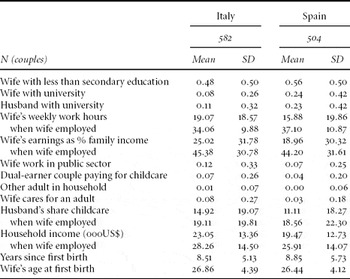
As evident in the descriptive statistics presented in Table 1, although almost half the women in both countries have only secondary schooling or less, similar proportions of women and men in both countries have tertiary education. Twice as many Spanish women and men have some tertiary education as compared with Italian men and women. These results are consistent with aggregate data on educational attainment in the two countries (OECD, 2004).
Descriptive statistics for married Italian and Spanish couples with wife under age 43 as of 1994 and one child, from waves 1 through 7 of the European Community Household Panel

Notes: Based on couple-year file, so means over observed years of marriage for couples, not a cross-section in a given year.
Despite this evidence of education equity, gender equity in employment is low but slightly greater in Italy than Spain, with wives’ average weekly work hours 19 in Italy and 16 in Spain. These numbers result from the large share of wives in both countries who are out of the labour force: 44 per cent of Italian and 57 per cent of Spanish wives are not employed at some time during the panel. Wives who are employed tend to work full-time, with Spanish women working slightly more hours than Italian women (37 versus 34 hours, respectively). Working wives contribute almost half of the household income. That a larger proportion of Italian wives are employed and contribute a slightly larger share to their family's income despite working fewer weekly hours is evidence of slightly greater gender employment equity in Italy than in Spain during this time period.
Gender equity pertaining to the family is also low in both countries. A small percentage of wives spend some time each week caring for an elderly person, although almost three times as many Italian wives report doing so (8 per cent as compared with 3 per cent among Spanish wives). Only 7 per cent of Italian and 4 per cent of Spanish couples with a child are dual-earners who pay for childcare. Husbands’ share of childcare is modest: 15 per cent in Italy and 11 per cent in Spain. These percentages do not alter much when wives are employed, with fathers in both countries then contributing just 19 per cent.
Gender equity effects on likelihood of second births
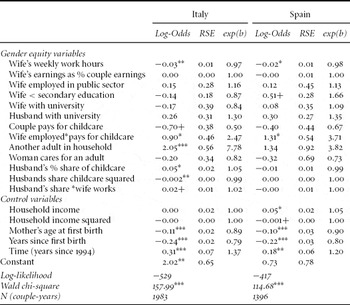
The effects of individual gender equity on the likelihood of second birth are presented in Table 2. In both Italy and Spain, each hour increase in a wife's employment significantly decreases the likelihood of second birth, although the effect in Italy is 50 per cent larger than in Spain (log-odds of –0.03 versus –0.02). When a wife works full-time, these effects indicate that the likelihood of second birth is reduced by 120 per cent in Italy and 80 per cent in Spain. On the other hand, her relative earnings prove insignificant, so it is not her financial opportunity cost but time availability that decreases the likelihood of having more children. The overall child cost-versus-quality trade-off is only evident in Spain, where greater household income increases the likelihood of a second birth, while its square decreases the likelihood.
Logistic regression coefficients for the likelihood of second births among married couples in Italy and Spain
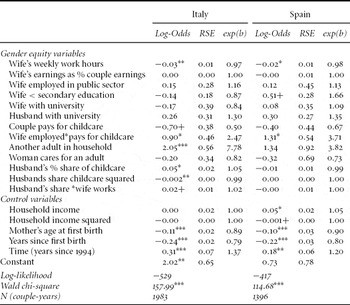
Notes: + p<.10. *p<.05. **p<.01. ***p<.001. (two-tailed tests).
Although very few couples have another adult in the household, this person's presence greatly increases the likelihood of having a second child, but the effect only reaches statistical significance in Italy. Controlling for this in-home support, which includes live-in domestic help, dual-earner couples paying for childcare are more likely to have a second child, although effects in Italy are more muted given the sign and significance of the main effect. Women's care responsibilities for another adult slightly reduce the odds of having a second child, but the effect is not significant in either country.
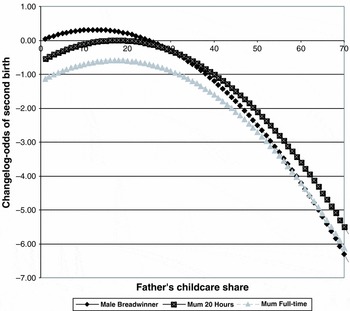
Fathers' share of childcare has no effect on the likelihood of a second birth in Spain. In Italy, however, the magnitude of the effect countervails the negative effect of Italian mothers’ work hours. Each additional percentage point share an Italian father contributes to childcare increases the odds of second birth by 5 per cent. When the mother is employed, his greater share further increases the odds by 2 per cent, although this latter effect is just marginally significant. The squared term is also significant, supporting that the effect of fathers' share of care is curvilinear. As plotted in Figure 1 using predicted probabilities, the effects of father's relative time in childcare on the likelihood the couple will have a second child vary depending on mother's employment intensity. When mothers are out of the labour force, men's relative childcare increases the likelihood until his share exceeds about one-quarter, after which the likelihood of having a second child declines sharply. When mothers are employed part-time, they are less likely than stay-at-home mothers to have a second child until fathers' share exceeds 30 per cent, at which point the plotted lines cross. When a mother works full-time, her relative odds of having a second child are lower than for other mothers until father's childcare share exceeds 60 per cent, at which point the log-odds are slightly higher than for stay-at-home mothers. But at this care division, all Italian couples are so unlikely to have a second child that this small victory for more non-traditional gender roles among employed mothers seems rather hollow.
Predicted effects of Italian father's share of childcare on log-odds of second birth by mother's employment status

Discussion and conclusions
A growing body of evidence indicates that gender equity varies in context, with more egalitarian divisions of domestic tasks observed in countries with greater policy support for gender equity (Breen and Cooke, Reference Breen and Cooke2005; Cooke, Reference Cooke2007b; Stier and Lewin-Epstein, Reference Stier and Lewin-Epstein2007). Effects of gender equity on fertility also vary in context, with higher fertility associated with more egalitarian domestic divisions in countries such as Sweden where policies support maternal employment (Oláh, Reference Oláh2003) or remain silent regarding the domestic sphere such as in the United States (Torr and Short, Reference Torr and Short2004). In contrast, a gendered division of labour predicts higher fertility in countries with historical support for male breadwinner families such as the former West Germany (Cooke, Reference Cooke2004). Here we use the European Community Household Panel to assess whether differences in equity effects on fertility are evident across two countries with similar institutional reliance on extended kinship networks and women's unpaid care work, but distinct, albeit small, differences in gender employment equity during the 1990s.
Gender equity in employment is low in both Italy and Spain, with about half of the wives with one child out of the labour force at some time during the seven years of the panel. Wives who were employed tended to work full-time, with the gender earnings gap smaller in Italy than in Spain. Wives’ hours of work in both countries reduced the likelihood of a second birth, with the effect more acute in Italy. The presence of another adult in the household increased the likelihood of having a second child, although the effect only reached statistical significance in Italy. Dual-earner couples that paid for childcare were more likely to have another child, with the net effect appreciably greater in Spain than in Italy. Both of these sources of care were available to just a small number of couples in the countries, so an obvious policy solution to the low fertility in the two countries would be to expand infant childcare availability. The macro-economic factors that blunted employment, however, also reduced available tax dollars or disposable income for such public or private investment. So, ironically, the same contextual factors that undermined a male breadwinner model also prevented the alteration of it. Since the 1990s, childcare availability has been expanding, but primarily for children aged three to five (León, Reference León2007).
Despite the limited external care options, however, only in Italy did fathers' assumption of more caring responsibilities significantly increase the likelihood of a couple having another child, particularly within dual-earner couples. The magnitude of the effect was five times that found by Cooke (Reference Cooke2004) in her analysis of German couples. Yet when Italian fathers assumed more than one-quarter to one-third of childcare, the likelihood began to decline sharply. These findings suggest, first, that women's greater aggregate employment equity predicts not only modestly greater equity within households, but positive effects of equity on family outcomes. Consequently, although we have not realised the revolution in gender roles predicted by women's rising labour force participation, the evidence here suggests the evolution helps couples meet productive and reproductive challenges in post-industrial societies.
When Italian couples venture too far from traditional domestic roles, however, the likelihood of second birth declines sharply. Whether this reflects ‘maternal gatekeeping’ on the part of Italian mothers or Italian fathers' resistance to assuming more of the care tasks cannot be assessed with these data. Maternal gatekeeping is a term used by Allen and Hawkins (Reference Allen and Hawkins1999) referring to working US mothers who actively managed fathers' access to children. In a more recent analysis, Sayer (Reference Sayer2005) found that although US women still retain primary responsibility for childcare, US men's childcare hours have also increased since the 1960s, and they have taken on a significantly larger share of housework. The ECHP has no measures of housework with which to compare whether Italian or Spanish men are similarly performing more housework as compared with childcare. More qualitative cross-country comparisons are needed to unravel who in the family actively structures the household division of domestic labour.
On the other hand, no paternal care effects were found for Spanish couples. This might result from the lower levels of gender equity in employment in Spain as compared with Italy. More Spanish wives were out of the labour force and the gender wage gap is among the largest in OECD countries. To the extent aggregate gender equity in employment results in women's greater ability to negotiate more egalitarian divisions of domestic tasks as argued by Breen and Cooke (Reference Breen and Cooke2005), this ability is lower in Spain than in Italy. The findings here support the growing body of evidence that policy support for greater gender equity in the public sphere leads to greater gender equity within the domestic sphere, which in turn countervails some of the negative fertility effect associated with women's labour force participation (Cooke, Reference Cooke2004; Oláh, Reference Oláh2003; Torr and Short, Reference Torr and Short2004).
There are limitations to the study. First, defining childcare remains challenging. Is time spent playing with a child considered care, or is it equivalent to tending to a sick child in the middle of the night? Australian time diary data reveal that mothers are far more likely to be home alone with their children and responsible for their physical care, whereas Australian fathers spend more time with their children in play (Craig, Reference Craig2003). If this is the case, increases in paternal time may not be reducing mothers’ time in care, although undoubtedly children benefit from this extra parental time. Second, the ECHP limits analyses to the 1990s, so we are unable to see effects of policy changes since that time. As noted above, childcare is expanding in Spain, and more recent employment data suggest gender equity in that sphere is more similar now across the two countries (OECD, 2007). Future research will need to assess whether these policy changes have shifted the effects of individual equity factors on fertility within Italy and Spain.
Despite the limitations, the findings reported here support that a gendered division of labour appears increasingly inflexible and detrimental to modern families. It exacerbates the historical negative relationship between women's employment and fertility during a time when women's earnings are crucial to family economic flexibility. The findings also underscore the importance of fathers' childcare participation even in cultures with strong reinforcement of women's responsibility for care work. Finally, the results highlight the importance of assessing gender equity writ large, in terms of employment opportunities, structures and the variety of care solutions families use to fashion solutions for balancing work and family in post-industrial societies.
Acknowledgements
This research was funded by a grant from the European Commission and the Ministry for Culture, Higher Education and Research of Luxembourg under the Transnational Access to Major Research Infrastructures, contract HPRI-CT-2001-00128, hosted by IRISS-C/I at CEPS/INSTEAD, Differdange, Luxembourg. The author wishes to thank Fabrizio Bernardi, Frank Castles, Maurizio Ferrera, Teresa Jurado, Chiara Saraceno and participants at the International Sociological Association RC19 meeting in Paris, 2–4 September 2004, for policy information or feedback on earlier versions of this paper, Philippe van Kerm at CEPS/INSTEAD for technical advice, and two anonymous JSP referrees for suggesting clarifications.