Aortic stenosis can be defined as narrowing of the aortic valve, which can range from mild to severe. It can have the following four aetiological causes: congenital malformation of the valve, secondary calcification of congenital bicuspid valves, age-related degenerative calcification of normal aortic valves, and rare rheumatic inflammation with fusion of the cusps. Congenital aortic stenosis, which does not include the bicuspid aortic valve, refers to conditions present at the time of birth. This condition is extremely rare. Congenital stenotic valves will develop secondary calcification, starting from the base of the valve, as the individual ages. This condition is uncommonly found in the medical examiner’s office, as its diagnosis has usually been already made and treatment administered.Reference DiMaio and DiMaio 1 Aortic stenosis does not always produce symptoms; if they do appear, they depend on the degree of valvular stenosis. It should be noted that most patients with mild-to-moderate aortic stenosis do not report any symptoms.
Sudden death is frequently observed among symptomatic aortic stenosis patients who have not undergone any operation, with an incidence ranging from 8 to 34%.Reference Matthews, Barritt and Keen 2 , Reference Chizner, Pearle and deLeon 3 Regardless of this fact, sudden death appears only occasionally in asymptomatic subjects.Reference Ross and Braunwald 4 – Reference Pellikka, Nishimura and Bailey 6 It has been hypothesised that malignant ventricular arrhythmias may be responsible for the high incidence of sudden death in aortic stenosis patients, as well as in those who suffer from coronary artery disease or cardiomyopathy. If multiple factors are involved, however, such as asymptomatic aortic stenosis in association with arrhythmia-provoking agents, do they then prove sufficient to explain sudden unexpected death?
In addition, many factors can potentiate the risk for arrhythmia, and one of the most common is being a female – for instance, the average QTc interval is longer in women compared with men. Women are also at an increased risk of QTc prolongation and arrhythmia induced by drugs. A number of studies have reported that ~70% of drug-associated torsades de pointes occurs in women.Reference Makkar, Fromm, Steinman, Meissner and Lehmann 7 – Reference Antzelevitch and Shimizu 9 Age is also a common risk factor. In the elderly, the re-polarisation reserve is reduced, and the risk of drug-induced QTc prolongation and torsades de pointes is higher because polypharmacy is more frequent within this age group.Reference Heist and Ruskin 10 Risk amplifiers also include hypokalaemia, hypomagnesaemia, bradycardia, and underlying structural heart disease, particularly ventricular congestive heart failure and hypertrophy.Reference Roden 11 – Reference Roden, Woosley and Primm 14
Taking all these data into account, the aim of this study was to investigate whether the association of arrhythmia-provoking agents and asymptomatic aortic stenosis in young adults can offer sufficient evidence to explain sudden unexpected death.
Material and methods
Autopsied patients
Among circa 5600 autopsies, only sudden unexpected deaths in young individuals under 40 years of age, without any reported symptoms or medical history of cardiac disease, were observed. Congenital and bicuspid aortic stenosis was found in eight cases (0.14%). All deceased patients were young adults ranging from 22 to 36 years of age (mean age: 27.63), none of whom had ever reported any symptom that could be related to aortic stenosis. Gender distribution was equal (four females , four males). None of them had a family history of sudden unexpected cardiac death. Full autopsies have been performed on all cases.
Young depressive woman
A 28-year-old woman was diagnosed with depression and prescribed amitriptyline, which she took for 6 days. She was found dead in her kitchen on the 7th day by her ex-husband.
Young user of terfenadine
A 25-year-old man was using terfenadine as a treatment for his runny nose and sneezing, as well as his red, irritated, itchy, and watery eyes. After 5 days of drug application, he died in his office.
Young boxer
A 25-year-old boxer died suddenly in his home. His brother reported that he was self-administering furosemide in order to reduce the water content in his body and tone his muscles for an upcoming competition.
Young construction worker
A 24-year-old male construction worker, who was wearing a protective helmet and full complement safety equipment, was working in the open air and in direct sunlight at a temperature near 40°C. He complained to his colleagues that he was extremely thirsty, but did not want to refresh himself until the job was finished. Suddenly, he collapsed. He was found dead when his body was lowered to the ground and the ambulance arrived.
Young woman with dysmenorrhoea
A 31-year-old woman died on the way to the pharmacy. She was suffering from dysmenorrhoea, extensive menstrual bleeding, vomiting, and diarrhoea for 3 days before her death.
Young student
A 22-year-old woman was studying for an examination. In order to stay awake, she consumed six cans of an energy drink – circa 1200 ml in total, a can of this beverage contains 250 mg of caffeine per 1 L. After she passed her examination successfully, she was found dead in her room early in the afternoon.
Young alcohol consumer
A 36-year-old man experienced serious financial troubles and began to drink heavily 2 days before he was found dead on the street.
Young participant in the car accident
According to the observer on the scene, a 30-year-old woman died several minutes after a severe car accident. The subsequent autopsy showed that she suffered only slight injuries – abrasions of the head and face and a few contusions of the arms.
Forensic measurement and calculation
In each autopsied patient, the normal ranges of the aortic valve’s diameter and circumference were calculated by using data from the study by Capps et alReference Capps, Elkins and Fronk 15 , which predicted the aortic valve’s diameter on the basis of the body surface area, which itself was calculated according to Haycock’s formula.Reference Haycock, Schwartz and Wisotsky 16 Aortic stenosis was diagnosed if the measured value was below the predicted value. Using this method, we cannot provide a precise severity scale; however, as all deceased patients had never reported any symptoms that could be related to aortic stenosis, we presume that all of them were low grade.
DNA testing
DNA testing for channelopathies was performed on ethylenediaminetetraacetic acid blood.Reference Basso, Burke and Fornes 17 The following genes were testedReference Basso, Carturan, Pilichou, Rizzo, Corrado and Thiene 18 : KCNQ1, KCNH2, and SCN5A for long-QT syndrome; KCNQ1, KCNH2, and KCNJ2 for short-QT syndrome; SCN5A for Brugada syndrome; and RyR2 and CASQ2 for catecholaminergic polymorphic ventricular tachycardia.
Toxicological testing
Comprehensive toxicological testing was performed by standard analytical techniques – liquid chromatography with tandem mass spectrometry, high performance liquid chromatography with photo-diode array detector, flame photometer, etc.
Results
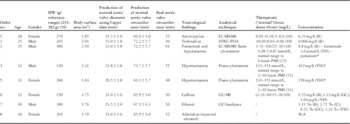
Notable autopsy findings, as well as the results of DNA and toxicological testing, are presented in Table 1.
Toxicological findings in autopsied young adults with congenital asymptomatic aortic stenosis.

B=blood; GC=gastric content; HPLC-PDA=high performance liquid chromatography with photo-diode array detector; HW=heart weight; LC/MS/MS=liquid chromatography with tandem mass spectrometry; PMI=post-mortem interval; U=urine; VH=vitreous humour
* Autopsies were performed 6–7 hours subsequent to death
Autopsy showed neither significant cardiovascular atherosclerosis nor any signs of rheumatic diseases, except for sporadic slight calcifications at the base of the valves. Heart diseases such as congenital anomalies of the coronary arteries, arrhythmogenic right ventricular cardiomyopathy, hypertrophic cardiomyopathy, myocarditis, and mitral valve prolapse were excluded both macroscopically and microscopically. In seven of eight autopsied patients, the heart weight was within the reference range of 233 to 383 g.Reference Molina and DiMaio 19 Only the deceased young boxer had an enlarged heart (HW=480 g), not due to cardiomyopathy but due to athletic heart syndrome.Reference Fagard 20
The autopsied young alcohol consumer had microscopic findings of myocardial hypertrophy.
Among all, one patient had a unicommissural valve, one had a dome-shaped valve, and six others had congenital bicuspid valves, determined by the position of coronary orifices and the commissure. All of them were considered to be congenital in nature.
DNA testing for channelopathies did not confirm any mutation in any of the autopsied patients.
In addition, as shown in the Table 1, toxicological testing did not find any significant alteration, and all results have been set up within the therapeutic range of concentrations.
Discussion
In patients with hypertrophic cardiomyopathy, the rate of ventricular tachycardia ranges between 40 and 82%.Reference Fananapazir, Tracy and Leon 21 , Reference Anderson, Stinson and Derby 22 In addition, in some cases, left ventricular hypertrophy could be the substrate for malignant ventricular arrhythmias and sudden death, not depending on the respective aetiology thereof. In aortic stenosis in adults, sudden death occurs in 15–20%, at an average age of 60 years.Reference Ross and Braunwald 4 Among symptomatic patients who have not undergone surgical intervention, sudden death is found to occur with a prevalence of 8–34%.Reference Matthews, Barritt and Keen 2 , Reference Chizner, Pearle and deLeon 3 Sudden death in asymptomatic patients is quite rare; its incidence is between 0 and 5% in adults and 7.5% in children.Reference Ross and Braunwald 4 – Reference Pellikka, Nishimura and Bailey 6 None of the deceased presented here, however, had developed any hypertrophic cardiomyopathy.
The mechanism of sudden death in aortic stenosis has not been fully explained until now, although a considerable amount of data suggest the possible role of malignant tachyarrhythmias or abnormal Bezold–Jarisch reflex accompanied by bradyarrhythmias and hypotension.Reference Von Olshausen, Witt and Pop 23 , Reference Nikolic, Haffty and Bishop 24 The prolongation of the QTc interval – long-QT syndrome – is associated with a potentially fatal form of polymorphic ventricular tachycardia – torsades de pointes. Acquired forms of QTc prolongation and arrhythmia are often related to drug effects, not only caused by the particular drug’s property or dosage but also by drug–drug interactions, as well as specific characteristics of the patient – such as age, gender, the presence and severity of the primary heart disease, and genetic predisposition. In addition, blocking of sodium channels that trigger the prolongation of the QRS interval is an important cause of arrhythmias induced by drugs.Reference Schulz, Iwersen-Bergmann, Andersen and Schmoldt 25
A number of medications such as antibiotics, H1 antihistamines, antidepressants, and antipsychotics can cause arrhythmia. The greatest risk for QTc prolongation and torsades de pointes is just associated with the Class III of antiarrhythmic drugs – sotalol, dofetilide, ibutilide, and azimilide.Reference Schulz, Iwersen-Bergmann, Andersen and Schmoldt 25
Amitriptyline
Amitriptyline is the prototype of tricyclic antidepressants, whose main mechanism of action is non-selective inhibition of noradrenaline (NA) and 5-hydroxytryptamine uptake by monoaminergic nerve terminals in the central nervous system. According to the relevant literature, cardiac dysrhythmias, usually atrial or ventricular extra systoles, are common, but sudden death caused by ventricular fibrillation has also been described. It is most likely that enhanced NA effects on the heart are the main mechanism of dysrhythmias. The young depressive woman mentioned above used amitriptyline for 6 days. Although the serum level of this drug (0.23 mg/L) was within the therapeutic range,Reference Schulz, Iwersen-Bergmann, Andersen and Schmoldt 25 its pro-arrhythmic effect in association with aortic stenosis might have been enough to cause the sudden death.
Terfenadine
When terfenadine is used as monotherapy at standard clinical doses, it possess relatively low QTc prolongation potential and also lower risk of arrhythmias, although it has been reported to be associated with some cases of lethal torsades de pointes.Reference Pratt, Hertz, Ellis, Crowell, Louv and Moye 26 – Reference Monahan, Ferguson, Killeavy, Lloyd, Troy and Cantilena 28 On the other hand, CYP3A4 activity in the liver can be inhibited by a wide range of drugs, which are often used in clinical practice, including some antibiotics, antifungals, fluoxetine, cimetidine, and amiodarone.Reference Honig, Woosley, Zamani, Conner and Cantilena 29 – Reference Honig, Wortham, Zamani, Conner, Mullin and Cantilena 31 In such circumstances, systemic levels of terfenadine increase several fold, leading to marked QTc prolongation and an elevated risk of torsades de pointes. The young man investigated in this study used terfenadine at a recommended dose in order to treat allergic rhinitis. It might be possible that even the minimal potential of this drug to induce QTc prolongation acted synergistically with the pre-existing aortic stenosis and caused sudden unexpected death.
Furosemide
The use of diuretics such as furosemide may cause hypokalaemia and hypomagnesaemia, which can prolong QTc interval and predispose one to arrhythmia within the setting of a pro-arrhythmic agent; however, hypokalaemia merely by itself can be a factor sufficient to induce arrhythmia. In the case of the young boxer presented in this study, blood analyses showed furosemide doses that were, depending on the author,Reference Schulz, Iwersen-Bergmann, Andersen and Schmoldt 25 in range of therapeutic or above therapeutic levels, but not toxic. Even though potassium levels do rise during the post-mortem periodReference Mihailovic, Atanasijevic, Popovic, Milosevic and Sperhake 32 , our findings in the vitreous humour suggest hypokalaemia. Nevertheless, on the basis of congenital aortic stenosis and athletic heart syndrome, we can speculate that this was sufficient to cause sudden death.
Electrolytes
An electrolyte imbalance such as hypernatraemia is often the sign of dehydration. Both the young construction worker and the young woman with dysmenorrhoea had slightly elevated vitreous sodium levels. It has been determined that levels of sodium in the vitreous humour are relatively stable during the early post-mortem period and similar to levels found in the serum of living subjects. Abnormalities in ante-mortem serum sodium concentrations are reflected in post-mortem vitreous values, which make it possible to diagnose hyponatraemia or hypernatraemia at the time of death.Reference Mihailovic, Atanasijevic, Popovic, Milosevic and Sperhake 32 The elevated sodium levels as the circumstantial data – sweating at high temperatures and extensive menstrual bleeding, vomiting, and diarrhoea – indicate the loss of fluid. On the basis of congenital aortic stenosis, the electrolyte imbalance in association with dehydration could cause an arrhythmia and might lead to unexpected sudden death in these young subjects.
Caffeine
Caffeine is a pharmacologically active, naturally occurring methylxanthine, whose mechanism of action is inhibition of phosphodiesterase with resultant increase in cyclic adenosine monophosphate in the central nervous system and peripherally. Energy drinks can contain up to four times the amount of caffeine than a typical soda, and are used to provide sustenance, boost performance, improve endurance as well as concentration, and to enhance metabolism. The main active ingredients of energy drinks include varying amounts of caffeine, guarana extract, taurine, and ginseng. Amino acids, B vitamins, and carbohydrates are also usually added to enhance the beverage’s effects.Reference Palmiere and Mangin 33 , Reference Higgins, Tuttle and Higgins 34 A can (a serving of 8.4 oz.) of “Guarana™ – No Sleep” energy drink contains 62.5 mg of caffeine (250 mg/L), twice as much as a can (a serving of 12 oz.) of Coca Cola classic.Reference Gunja and Brown 35 Di Rocco et al have reported two cases of atrial fibrillation in healthy adolescents after energy drink intake.Reference McCusker, Goldberger and Cone 36 Excessive consumption of caffeine may cause intoxication, resulting in tachycardia, vomiting, cardiac arrhythmias, seizures, and death.Reference Klatsky, Hasan, Armstrong, Udaltsova and Morton 37 Patients frequently report palpitations even after usual caffeine ingestion, and, in order to avoid arrhythmias, physicians advise them to keep away from caffeinated coffee.Reference Denison, Jern, Jagenburg, Wendestam and Wallerstedt 38 The unfortunate young student investigated in this study drank around six cans of the energy drink. In the presence of congenital aortic stenosis combined with the psychological and physical stress of exam taking and sleep deprivation, the consumed amount of energy drink might have been more than enough to provoke a fatal arrhythmia.
Alcohol
Various biological findings suggest the harmful effect of high alcohol intake on normal heart rhythm, including well-known hyperadrenergic status,Reference Denison, Jern, Jagenburg, Wendestam and Wallerstedt 38 impairment of the vagal tone,Reference Maki, Toivonen, Koskinen, Naveri, Harkonen and Leinonen 39 direct effect on the myocardial structure,Reference Preedy, Siddiq, Why and Richardson 40 and different electrophysiological changes in myocytes, such as a negative inotropic effect through calcium-channel inhibition in the ventricular cells, reduction in the refractory period, and an increase in intra-atrial conduction time.Reference Marcus, Smith and Whiteman 41 – Reference Habuchi, Furukawa, Tanaka, Lu, Morikawa and Yoshimura 43 Buckingham et alReference Buckingham, Kennedy and Goenjian 44 found that cardiac arrhythmias are presented more commonly in intoxicated individuals who already have an underlying organic heart disease(s). The young man presented in this study had both congenital aortic stenosis and high, but not lethal, blood alcohol levels that could have easily led to fatal arrhythmia.
Stress
Stress can play a very important role in the pathogenesis of ventricular arrhythmias, as in Takotsubo cardiomyopathy. Data from the study by Liu et alReference Liu, Wang, Shan and Guo 45 have shown that complex stimuli can induce acute stressful reactions and decrease cardiac electrophysiological stability. Cardiac disease may sometimes be a predisposing factor, although it may be insufficient by usual anatomic criteria to be considered as the conclusive cause of death. Sudden unexpected death is reported to be closely related in time to a number of psychologically stressful events such as during an episode of extreme personal danger, threat of injury, after receiving news of the death of a close one, or a forthcoming loss of a close person. The presence of pre-existing cardiovascular disease, depression, or exertion would seem to increase the risk of fatal cardiac arrhythmias associated with emotional triggers.Reference Itabashi 46 Post-mortem assays of serum catecholamines, however, cannot be used in practice to demonstrate ante-mortem stress,Reference Hirvonen and Huttunen 47 neither the adrenaline/noradrenaline quotient can be used to conclude the cause of death and length of agony in individual forensic cases.Reference Wilke, Janssen and Fahrenhorst 48 Therefore, there are still no conclusive and reliable methodologies for evaluating short-lasting ante-mortem stress. The young participant in the car accident described in this study could be an example of a stressful event inducing a post-traumatic catecholamine surge as a pro-arrhythmic factor, although it was not possible to prove the previously stated hypothesis by toxicological evidence. In the presence of congenital aortic stenosis, this condition was most likely enough to cause the sudden death.
As the number of cases was not large enough to provide a reliable scientific conclusion and there are no published papers dealing with this issue, we only present a hypothesis on the relationship between asymptomatic aortic stenosis and the pro-arrhythmic agents.
Even though almost all the sudden unexpected death cases were under some kind of medication or influence of substance, it is still possible that the circumstances at the time of death did not need the interaction between drug and aortic stenosis to cause sudden cardiac death. In all cases, there was an added stress factor – depression, fatigue, dehydration, allergy, etc. – which could have possibly been sufficient to cause added stress, even without the usage of medication related to the condition. The number of cases was not large enough to exclude that aortic stenosis, even without drug interaction, would not cause sudden cardiac death.
Conclusion
Knowing that the incidence of sudden death in asymptomatic aortic stenosis is very low and bearing in mind that various substances and/or conditions have arrhythmogenic potential, the question that needs to be answered is whether asymptomatic aortic stenosis without cardiac hypertrophy can be the cause of death on its own. Results presented in this study, similar to data from the relevant literature, suggest the negative answer. By excluding any other macroscopical, microscopical, and DNA findings, the most probable cause of sudden unexpected death in young adults presented in this study seems to be the asymptomatic congenital aortic stenosis associated with pro-arrhythmic agents and/or circumstances. On the basis of these results, it can be concluded that toxicological analysis in sudden unexpected death in young adults with congenital aortic stenosis should be mandatory.
Acknowledgements
The authors thank Assistant Professor Natasa Popovic, MD, PhD, Department of Physiology, Medical School of the University of Montenegro, for the assistance in translating the manuscript into English.
Financial Support
This research received no specific grant from any funding agency or from commercial or non-profit sectors.
Conflicts of Interest
None.
Ethical Standards
The authors assert that all procedures contributing to this work comply with the relevant institutional, national, and international ethical standards. During the research, Dr Radojevic was a fellow of Fogarty International Center of the National Institutes of Health’s “Research Ethics Education in the Balkans and Black Sea Countries” (Award Number R25TW008171), provided by Icahn School of Medicine at Mount Sinai, New York, United States of America and School of Medicine University of Belgrade, Serbia. Ethical principles conducted during the research were influenced by the education acquired. The content is solely the responsibility of the authors and does not necessarily represent the official views of the National Institutes of Health.