


1. Introduction
Artificial intelligence (AI) has transformed from a laboratory phenomenon to an AI governance actor in Asia’s legal landscape at a pace that has been outpaced by governance measures (Păvăloaia and Necula, Reference Păvăloaia and Necula2023, p. 15). In India, algorithms determine the amount of welfare payments, and in China, systems predict crime patterns, while in Singapore, AI is being used in tribunals. AI isn’t just a tool for policy; it is also a player in the social exchange, learning from, adapting to, and influencing the humans it interacts with. The transition from AI-as-object to AI-as-relational-agent will pose challenges for governance that current regulations, which focus on discrete acts and identifiable decision-makers, are ill suited to address (Sun, Reference Sun2025, p. 18).
The peculiar feature of the contemporary AI development is its co-development. In contrast to the earlier rule-based or static models, co-developed AI systems are in a state of continuous development in a conversation with human users and environments that they will be used in (Olabiyi, Akinyele and Joel, Reference Olabiyi, Akinyele and Joel2025, p. 1). These systems acquire relational properties through iterative learning, feedback, and adaptation processes; they are knowledgeable of emotions, predict preferences, and change behaviour in response to patterns of interaction. These systems do not just react, they co-evolve with human beings and shape as well as become shaped by the trust networks, norms, and values into which they are intertwined. This change is especially relevant in the Asian context because societies in which it is taking place already value relationality, be it in the hierarchy of families, community-enhancing ethics, or group decision-making styles. This not only changes in transactional to relational human–machine communication; however, it turns the whole legal systems upside down (Krakowski, Reference Krakowski2025). The existing regulatory strategies frame AI as an object of regulation something that can be licenced, regulated, or supervised. However, as AI is turned into a participant of the relational interactions, namely, learning on human, influencing emotions, and exercising a form of distributed, context-sensitive influence over human decision-making environments, these methods become insufficient (de Almeida, dos Santos and Farias, Reference de Almeida, dos Santos and Farias2021, p. 505).
This article employees doctrinal methodology of research and addresses that gap through a normative-comparative method grounded in relational sociology (Singh, Paxton and Auclair, Reference Singh, Paxton and Auclair2025). Jurisdictional materials such as legislation, regulatory frameworks, case practices, and governance documents from China, Singapore, Japan, and India are not treated here as self-contained policy inventories (Spiegler, Hoda and Pant, Reference Spiegler, Hoda and Pant2026). They serve instead as socio-legal sites through which relational governance is enacted and contested (Papagiannidis, Mikalef and Conboy, Reference Papagiannidis, Mikalef and Conboy2025). The analysis moves from description to normative critique: each jurisdiction is examined not only for what its frameworks say but also for whether, and how effectively, those frameworks mediate real conflicts between administrative power and individual communicative rights in practice (Cajueiro and Celestino, Reference Cajueiro and Celestino2026, p. 77).
This paper fills this gap by using a socio-legal approach based on relational theory. It tries to answer the following three questions:
-
1. What are “relational protocols” in human–machine communication?
-
2. How do Asian legal, cultural, and constitutional systems influence these protocols?
-
3. Do the normative and legal frameworks emerging in Asian jurisdictions genuinely resolve conflicts between administrative power and individual communicative rights, or do they redescribe those conflicts in more acceptable relational terms?
By answering these questions, the paper attempts to expose the process of how law, society, and technology co-produce norms of interaction in the new world of human–machine co-learning and co-evolution.
The analysis proceeds as follows. Section 2 establishes the relational theoretical framework. Section 3 examines the legal architectures of the four jurisdictions. Section 4 situates these architectures within their sociocultural contexts. Section 5 interrogates the normative challenges of transparency, accountability, and geopolitical fragmentation. Section 6 analyses relational dispute resolution as a practical test of these frameworks. The conclusion draws together the comparative findings and proposes a normative agenda for Asian AI governance.
2. The relational paradigm: rethinking AI through socio-legal interaction
The modern legal space is undergoing a paradigm shift commonly referred to as the relational turn, which attempts to get beyond the atomism individualism of traditional jurisprudence. The significance of this change can be traced especially within the framework of the Asia-Pacific region, where collectivism and interconnectedness, not the isolated legal subject, have been the primary social unit in indigenous social institutions (Perlman, Reference Perlman2019, p. 245). With the application of co-developmental AI systems, i.e. systems that are self-formed through constant feedback and interaction with human users, there has been a growing need to adopt “relational protocols” to regulate human–machine conversation (Göndöcs, Horváth and Dörfler, Reference Göndöcs, Horváth and Dörfler2025). Such protocols are not just a technical standard but also the normative and legal limits of a new social order in which the “I” is necessarily connected to a digital “we.” This can be strongly investigated through relational sociology that was developed by Pierpaolo Donati (Donati, Reference Donati and Deflem2007, p. 159). According to Donati, society is defined by relationships which have emergent properties and powers that are not dependent on individual actors. At first, there is the relation; social relations are social facts. When applied to AI governance, it implies that the machine is not only a tool but also an object of relationships or a kind of a quasi-member of society (Doya et al., Reference Doya, Ema, Kitano, Sakagami and Russell2022, p. 542). The relationship between a human and an AI agent has produced a relational good and an indivisible good such as mutual understanding or trust, which would be defeated if the relationship is terminated or not managed in an optimal way.
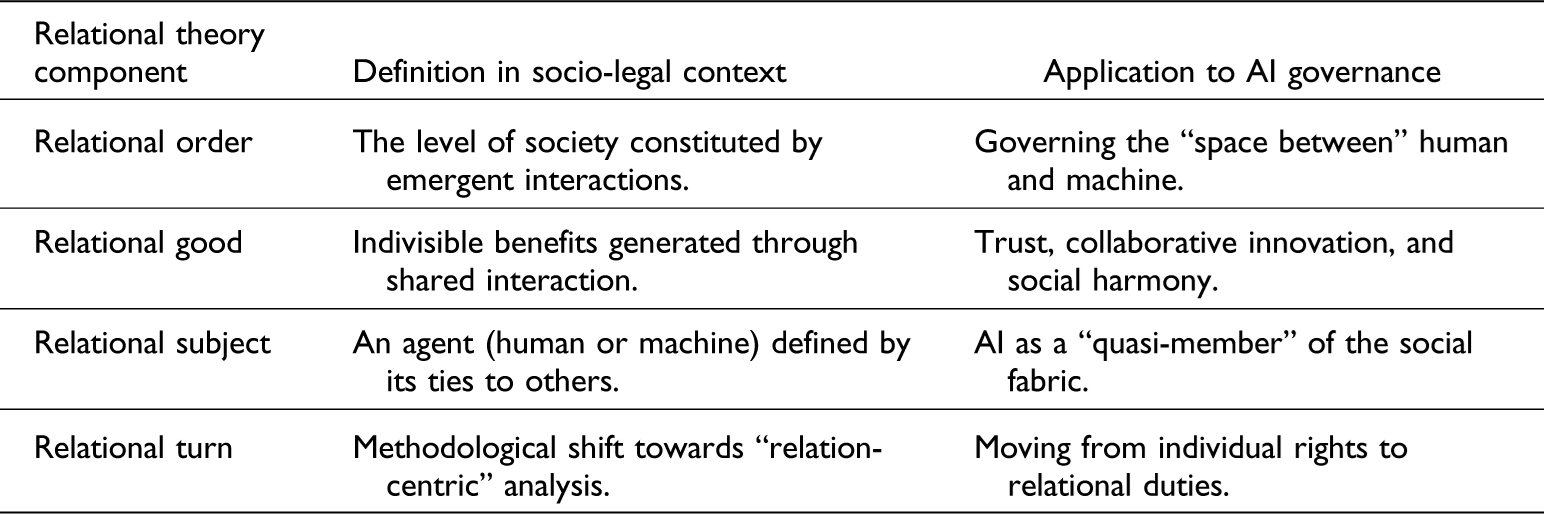
It is important to distinguish between these related but distinct concepts. Relationality, as a descriptive social fact, is the observation that social agents including AI systems exist in webs of interaction that shape their behaviour and identity. Relational protocols, by contrast, are normative designs: they specify how those interactions should be structured, what obligations arise from them, and who is accountable when they misfire. Relational governance is the broader regulatory technique of deploying such protocols as instruments of administrative ordering. The critical question this article raises, following the distinction drawn by relational legal theorists, is whether the relational framing functions primarily as a genuine accountability mechanism or whether it operates as relational justification: a discursive resource that makes the exercise of administrative power more palatable without substantively constraining it (Table 1).
Relational paradigm

Table 1. Long description
A table with three columns and four rows. The columns are labeled ‘Relational theory component’, ‘Definition in socio-legal context’, and ‘Application to AI governance’. The rows are labeled with different relational theory components and their definitions and applications. Row 1: Relational order, The level of society constituted by emergent interactions., Governing the “space between” human and machine. Row 2: Relational good, Indivisible benefits generated through shared interaction., Trust, collaborative innovation, and social harmony. Row 3: Relational subject, An agent (human or machine) defined by its ties to others., AI as a “quasi-member” of the social fabric. Row 4: Relational turn, Methodological shift towards “relation-centric” analysis., Moving from individual rights to relational duties.
Asian continent is a special location to study these processes because of its relationship-focused cultures such as Chinese Guanxi (关系) (PON Staff, 2026) or Japanese Society 5.0 (Ashta et al., Reference Ashta, Stokes, Hughes and Visser2025, p. 307). These traditional structures of networks have been intensified in the digital age, which has given rise to what other scholars refer to as a relational civilisation. Co-developmental AI is a transformative force in this civilisation, changing the paradigm of unilateral human control to distributed agency (Kurihara and Kobayashi, Reference Kurihara and Kobayashi2024, p. 1). India, Singapore, Japan, and China are shaping legal regimes and the sociocultural practice to cope with the flaws of this human–machine coexistence.
3. Legal regimes and the architecture of relational governance
Legal regimes in Asia are shifting towards regulation of risks and opportunities of AI, though the trend is towards agile governance and soft law models than the high-risk, inflexible approach characteristic of legal frameworks such as the European Union. It is this flexibility that permits legal systems to keep pace with the swift development of so-called agentic AI, the systems that are able to think and plan independently.
3.1. China: from algorithm recommendation to mainstream values
The alignment requirement invites a critical distinction between relational coordination and relational capture (Sheehan, Reference Sheehan2023; Hao, Reference Hao2022). A relational coordination norm would specify communicative standards that both the state and citizens could invoke to hold AI systems accountable, for example, a right to contest an algorithmic recommendation that distorts one’s access to government services (Yang and Tang, Reference Yang and Tang2018, p. 1). The Chinese framework, on the other hand, sets standards for communication that the state sets, and the citizen has to accept. The Cyberspace Administration of China (CAC) registration system offers administrative transparency for regulators but not epistemic transparency for users (citizens) as they cannot access, challenge, or seek redress against the algorithmic decisions that impact them (China Law Translate, 2022; Bird & Bird, 2023; Roberts et al., Reference Roberts, Cowls, Morley, Taddeo, Wang and Floridi2021, p. 59). In this sense, the “relational” architecture of Chinese AI governance is not a protocol of mediation but an administrative override in a “relational” idiom. The relational good of “social harmony” is not created through mutual interaction, but instead it is an “outcome” defined by state, which AI systems must produce.
3.2. Singapore: the vanguard of agentic AI frameworks
The conceptual vision and legal nature of the Singapore framework is actually the most analytical interest (Infocomm Media Development Authority, 2026). The Model AI Governance Framework (MGF) sets out a more complex idea of relationally accountable, one that distributes accountability to the developers, deployers, and end users and requires humans to make decisions at crucial points (Aw and O’Leary, Reference Aw and O’Leary2026; Ministry of Digital Development and Information, 2026). However, as a voluntary document, it does not provide any rights for citizens to take action or obligations for operators to comply. It is a soft law nature due to intentional governance decision: Singapore’s administrative tradition values adaptive flexibility and industry partnership over prescriptive rights-based regulation. Thus, the relational protocol that is developed is one in which relational trust is primarily built at the institutional level between government and industry and not at the level of individual citizens and AI systems (Beltrão et al., Reference Beltrão, Goh, Sousa and Lamas2025). This institutional trust may not lead to the person who is misidentified by an independent financial screening process actually having a better chance of protection, and the same might be true for the litigant whose case is summarised by an AI tool that they are unable to interrogate (Thio, Reference Thio2019, p. 204).
3.3. Japan: society 5.0 and the elimination of analogue constraints
The Japanese model is a unique form of relational governance which needs to be analysed (Cabinet Office, Government of Japan, 2015; UNESCO, 2019). Japan has been revising 98% of its analogue laws to allow for roles that could be handled by actual human judgement now being performed by AI. This is described in official documentation as removing obstacles to innovation. It is also, analytically, a removal of the human points of accountability at which citizens could previously assert rights or seek remedies (Habuka, Reference Habuka2025). Wright has questioned whether Japan’s human-centric framing constitutes a form of “ethics-washing Society 5.0”: the language of dignity and inclusion may function as relational justification for deregulation rather than as a genuine commitment to human oversight (Wright, Reference Wright2024, p. 117). The AI Promotion Act’s emphasis on well-being and dignity as aspirational principles, rather than as enforceable rights, does not resolve this concern. The relational protocol that Japan is constructing may be genuinely human-centric in its cultural orientation while remaining structurally thin in its rights-protective capacity (Wittmann and Meynhardt, Reference Wittmann and Meynhardt2025).
3.4. India: the Seven Sutras and multilingual equity
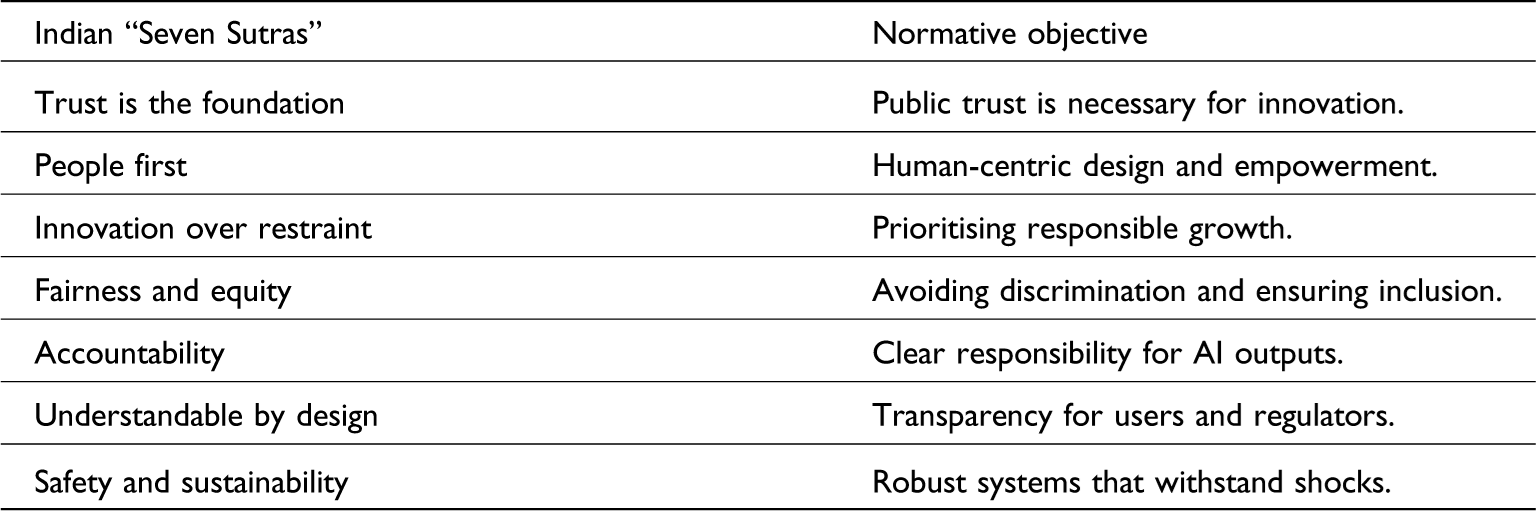
The AI governance of India is informed by the AI Governance Guidelines (2025) (Ministry of Electronics and Information Technology, 2025) that underline a people-first policy with seven main principles or Sutras. These concepts are enumerated in Table 2 (Mandal, Neema and Jain, Reference Mandal, Neema and Jain2025; Table 2).
Indian Seven Sutras

Table 2. Long description
A table titled ‘Indian Seven Sutras’ with two columns and seven rows. The first column lists the seven principles of AI governance, and the second column lists their corresponding normative objectives. Row 1: Trust is the foundation, Public trust is necessary for innovation. Row 2: People first, Human-centric design and empowerment. Row 3: Innovation over restraint, Prioritising responsible growth. Row 4: Fairness and equity, Avoiding discrimination and ensuring inclusion. Row 5: Accountability, Clear responsibility for AI outputs. Row 6: Understandable by design, Transparency for users and regulators. Row 7: Safety and sustainability, Robust systems that withstand shocks.
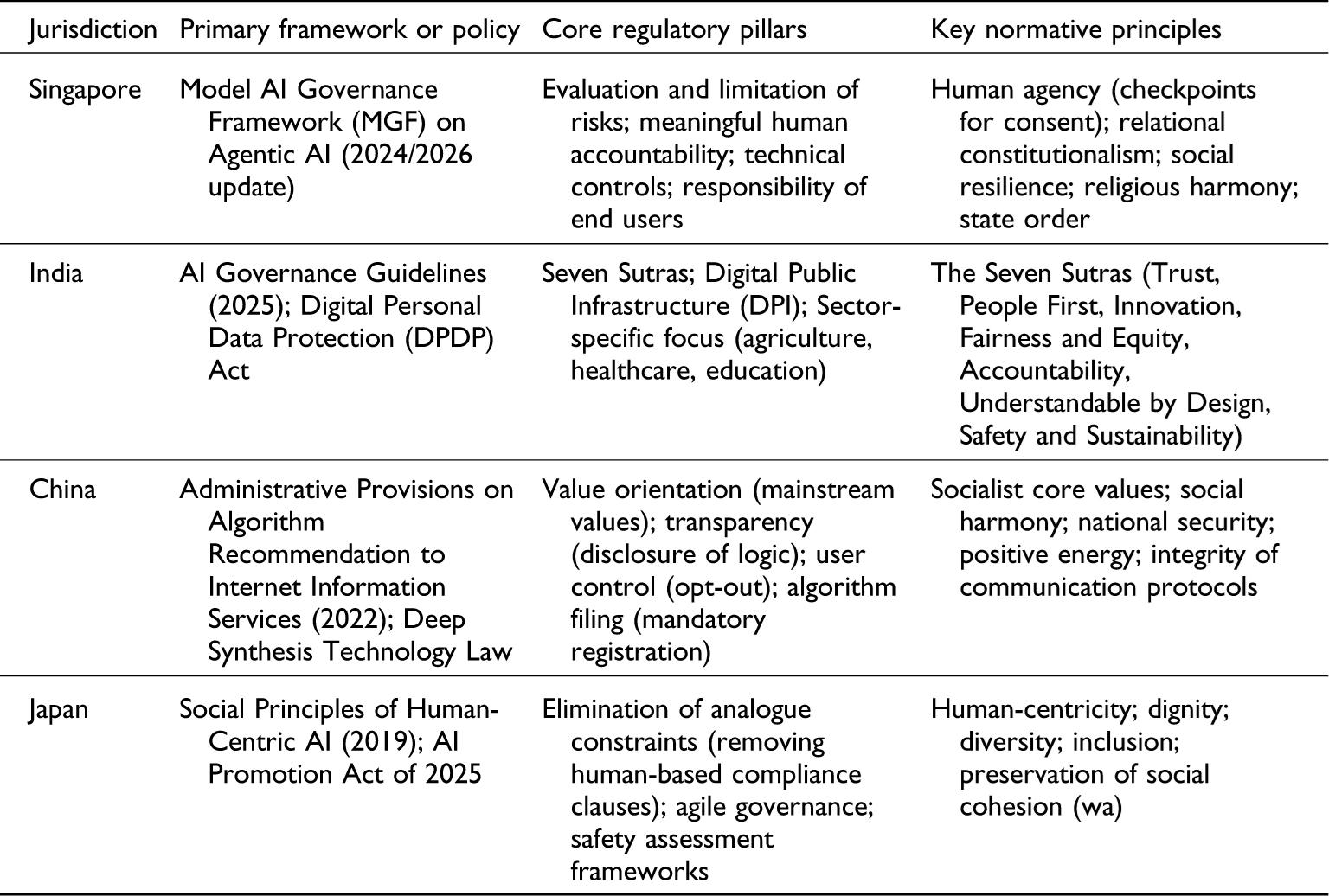
The Seven Sutras framework is analytically significant not merely as a policy instrument but also as a test of whether relational governance can be reconciled with a rights-based constitutional order. India’s Supreme Court has established a robust jurisprudence of informational privacy (Justice K.S. Puttaswamy v. Union of India, 2017) and fundamental rights under Articles 14, 19, and 21 of the Constitution (National Institute for Smart Government, 2025). The DPDP Act (MeitY, 2023) introduces the concept of data principal rights, consent obligations, and fiduciary duties, which potentially brings the same constitutional logic to the field of AI governance. But the non-binding nature of the AI Governance Guidelines also leaves an outside realm for the relational protocol of human–AI interaction, such as in predictive policing or welfare distribution. The danger is not only technical but structural: the aspirational notion of “People First” and “Understandable by Design” normalises the use of AI in high-stakes public-sector settings in the absence of the legal framework to protect rights. Bhashini is an illustration of this ambivalence. It is a relational tool for linguistic inclusion; it carries the ethos of “AI for All” and is also a data collection tool that is based on the language of underserved populations, which raises issues of consent, ownership, and redistributive benefit that are not addressed in the existing guidelines (NITI Aayog, 2018; Ministry of Finance, 2026; Table 3).
Legal regimes in different jurisdictions

Table 3. Long description
A table comparing AI governance frameworks across different jurisdictions. The table has four rows and three columns. The columns are labeled ‘Jurisdiction’, ‘Primary framework or policy’, ‘Core regulatory pillars’, and ‘Key normative principles’. Row 1: Jurisdiction, Singapore; Primary framework or policy, Model AI Governance Framework (MGF) on Agentic AI (2024/2026 update); Core regulatory pillars, Evaluation and limitation of risks; meaningful human accountability; technical controls; responsibility of end users; Key normative principles, Human agency (checkpoints for consent); relational constitutionalism; social resilience; religious harmony; state order. Row 2: Jurisdiction, India; Primary framework or policy, AI Governance Guidelines (2025); Digital Personal Data Protection (DPDP) Act; Core regulatory pillars, Seven Sutras; Digital Public Infrastructure (DPI); Sector-specific focus (agriculture, healthcare, education); Key normative principles, The Seven Sutras (Trust, People First, Innovation, Fairness and Equity, Accountability, Understandable by Design, Safety and Sustainability). Row 3: Jurisdiction, China; Primary framework or policy, Administrative Provisions on Algorithm Recommendation to Internet Information Services (2022); Deep Synthesis Technology Law; Core regulatory pillars, Value orientation (mainstream values); transparency (disclosure of logic); user control (opt-out); algorithm filing (mandatory registration); Key normative principles, Socialist core values; social harmony; national security; positive energy; integrity of communication protocols. Row 4: Jurisdiction, Japan; Primary framework or policy, Social Principles of Human-Centric AI (2019); AI Promotion Act of 2025; Core regulatory pillars, Elimination of analogue constraints (removing human-based compliance clauses); agile governance; safety assessment frameworks; Key normative principles, Human-centricity; dignity; diversity; inclusion; preservation of social cohesion (wa).
3.5. Comparative matrix
Across the four jurisdictions, a structurally convergent but normatively divergent pattern emerges, wherein relational language positions human–machine interaction as a site of social coordination rather than mere technical regulation. However, these legal regimes maintain fundamentally different principles regarding how they allocate power within this coordination. China’s hard law framework leaves no contestatory rights for individual users, assigning the state the sole authority to define relational terms and masking administrative power under the idiom of state-enforced “social harmony.” Conversely, India’s “Seven Sutras” framework offers a robust rights vocabulary theoretically supported by the DPDP Act, yet the non-binding nature of its guidelines fails to operationalise this rhetoric, risking the normalisation of high-stakes public AI deployments in the absence of enforceable legal protections. Occupying intermediate positions, Singapore and Japan deploy flexible soft law architectures that prioritise adaptive administrative agility over prescriptive, justiciable rights. Singapore’s MGF distributes accountability across institutional developers and deployers but stops short of creating actionable individual remedies for citizens. Meanwhile, Japan’s Society 5.0 paradigm eliminates 98% of analogue constraints to foster innovation, removing embodied human points of accountability while using aspirational cultural principles like wa and human dignity as a relational justification for deregulation. Ultimately, this spectrum demonstrates that Asian relational protocols procedurally manage administrative friction rather than fully resolving structural conflicts surrounding individual communicative rights.
4. Sociocultural practices: cultural coding and digital subjectivity
The relational turn in Asia cannot be understood as a legal phenomenon only, but this trend has its strong base in the sociocultural practices that are the way people understand and approach AI. These practices involve the continuance of traditional relational norms, such as guanxi, AI usage to overcome language barrier, and the rise of relational privacy in domestic and educational environments (Zheng et al., Reference Zheng, Babu, Metreveli, Dey and Koufopoulos2026).
4.1. Linguistic inclusivity and the Bhashini protocol
In India, the main cultural and social barriers to digital participation are language. A critical relational protocol to bridge these divides is the Bhashini platform (MeitY, 2022), which is an important AI-based language translation tool (IMPRI, 2025). Offering voice-first solutions in 23+ languages, Bhashini provides citizens in rural and underserved regions with an opportunity to get access to the government services and information in their native language (Ministry of Culture, 2025). It is not merely a technical tool but a co-creation AI platform that promotes collaboration between the government, academic institutions, and the general population. The mission promotes citizen input in language information provision, acknowledging that efficient AI should be trained on indigenous data of everyday regional application. This participatory governance makes sure that human–machine communication will be culturally based and non-English speakers are not marginalised.
4.2. Digital guanxi and the substitution of rules for networks
Historically, the so-called guanxi (developing personal relations to help each other) in China has served as a gateway through the bureaucracy or rather an informal one (Barbalet, Reference Barbalet2023, p. 70). These informal networks are starting to be replaced by digital rules, which are brought about by the introduction of AI and big data. Studies indicate that the AI policy in China is working by decreasing the “relational expenditure” and substituting physical collateral with digital credit rating, which motivates youth entrepreneurs (Gao, Knight and Ballantyne, Reference Gao, Knight and Ballantyne2012, p. 456). Nevertheless, it can be seen how the AI is built into the traditional grid management in the Yuelu Model of community risk governance (Gao and Liu, Reference Gao and Liu2024). This model leverages big data platforms to determine the complaints raised by communities, as a form of Social Safety Valve, and the model serves a stress-reducing, alarming, and integrative role. This re-establishing of social trust through rebuilding social connections based on elements of authoritarianism mixed with neoliberal principles on local autonomy is what is referred to as relational governance (Lin, Reference Lin2025, p. 289).
4.3. Cultural tendencies in generative AI
The interrelation aspect of AI can be seen in the cultural values that are incorporated in Large Language Models. Comparative analyses of the GPT AI and the ERNIE Bot provided by Baidu indicate that the models have different cultural orientations depending on the language of communication. Using GPT in Chinese also has a much more interdependent or collectivist social orientation than its independent or individualistic responses in English (Fenech-Borg et al., Reference Fenech-Borg, Meznaric-Kos, Lekovic-Bojovic and Hentze-Djurhuus2025).
These results imply that there is nothing like a culturally neutral dialogue between humans and machines; the machine uses the cultural mask of the language it communicates in. This supports the need to have culturally sensitive AI communication modalities to make sure that electronic communications do not cause the alienation of users to their own social identities or the worsening of the so-called cultural cocoon.
5. Normative challenges: transparency, accountability, and distributed agency
A shift to co-developmental AI presents significant normative issues, especially in the context of transparency of algorithmic decisions and responsibility distribution in systems with distributed agency.
5.1. The explainability–accountability gap
Conventional legal responsibility is based on the human-in-the-loop model, in which a human operator has to certify particular actions. But the human factor becomes ornamental as AI systems get more sophisticated and independent, which is a safety measure that does not offer meaningful human control (Crootof, Kaminski and Price, Reference Crootof, Kaminski and Price2022). This would generate an accountability gap whereby the mistakes or biases within the system would not be readily attributable to one human decision-maker. The normative issue revolves around how to redefine transparency (Al-Busaidi et al., Reference Al-Busaidi, Raman, Hughes, Albashrawi, Malik, Dwivedi, Al-Alawi and AlRizeiqi2024). Although, the opaque neural networks cannot be technically explained, the principle of “Understandable by Design” in the Indian guidelines and the Singapore Framework is concerned with relational transparency. This is a process of telling the user not how the AI thinks, but what its limitations are and who is accountable to its outcomes.
Relational transparency, which tells users not how the AI calculates but who is responsible for its outcomes, partly addresses the accountability gap. However, “responsibility” in a distributed agency framework remains contested: Singapore’s MGF assigns it to “principals” (developers and deployers) but with no statutory enforcement; India’s Sutras assign it aspirationally; China’s CAC registration assigns it to platform operators in a state-centric accountability chain. All of these frameworks leave out a clear line of responsibility to the citizen from the AI decision-maker. Relational transparency can become procedural legitimation, a form of accountability, but it is not substantive. This is not an academic issue because, when AI systems are used to determine access to welfare, credit, or legal services, there is a real constitutional right to an explanation that is missing.
5.2. Relational privacy and multi-user domains
Relational privacy is an emerging concept that is becoming a critical normative concept of AI in multi-user domestic and educational settings. It is found that students differentiate between their immediate classroom (in which they feel comfortable with sharing data with teachers) and the larger school (in which they feel uncomfortable with the thought of data being shared with principals) in research on classroom AI (the so-called Community Builder or CoBi) (Karran et al., Reference Karran, Charland, Trempe-Martineau, Ortiz de Guinea Lopez de Arana, Lesage, Sénécal and Léger2025; Lim, Gottipati and Cheong, Reference Lim, Gottipati and Cheong2025). Relational privacy takes into consideration that information is not a personal property, but it belongs to a certain social connection. These norms of contextual integrity should be taken into consideration by AI governance such that the introduction of AI does not breach the trust that is involved in local relationships.
5.3. Relational governance as power management: mediating or masking administrative dominance?
The United Nations’ global dialogue on AI governance highlights a significant normative conflict over power restructuring, polarised by China’s state-sovereignty approach representing the Global South and the United States’ preference for private-sector leadership (UN, 2025; Olugbade, Reference Olugbade2025, p. 139). At the same time, the challenge for Asian nations is to create interoperability in the respective incompatible regulatory regimes without compromising their own sovereignty. The region has a wide range of efforts to reconcile the different pressures, such as the Hiroshima AI Process (The Government of Japan, 2024) and other governance efforts in ASEAN that try to capture the new norms, while supporting technological innovation and regional stability.
This prompts an important question: do relational protocols really provide a venue for negotiation between the sphere of administration and the sphere of rights or are they a masking and procedural blunting of that structural tension? At the government level, this is seen as different governmental styles across jurisdictions: China (Ministry of Foreign Affairs of the People’s Republic of China, 2023) adopts relational harmony to ensure compliance to the state; India is using digital frameworks as a gesture towards rights, but it lacks a concrete implementation; Singapore is using trusted and collaborative public–private partnership; and finally, Japan is focusing on soft laws through consensus. As a result, a spectrum can be drawn, from China, who cloaks administrative power, to India, who does not operationalise its rights rhetoric, and Singapore and Japan, who sit somewhere in the middle. This continuum does not undermine the relational way of thinking; instead, it sets a clear agenda for future normative development. Ultimately, a genuinely rights-protective relational framework requires independent oversight, justiciable rights to explanation and contestation, and culturally sensitive yet non-paternalistic accountability mechanisms (Wang et al., Reference Wang, Milne, Hu and Khan2024, p. 1; OECD, 2023).
6. Relational dispute resolution: AI as the “fourth party”
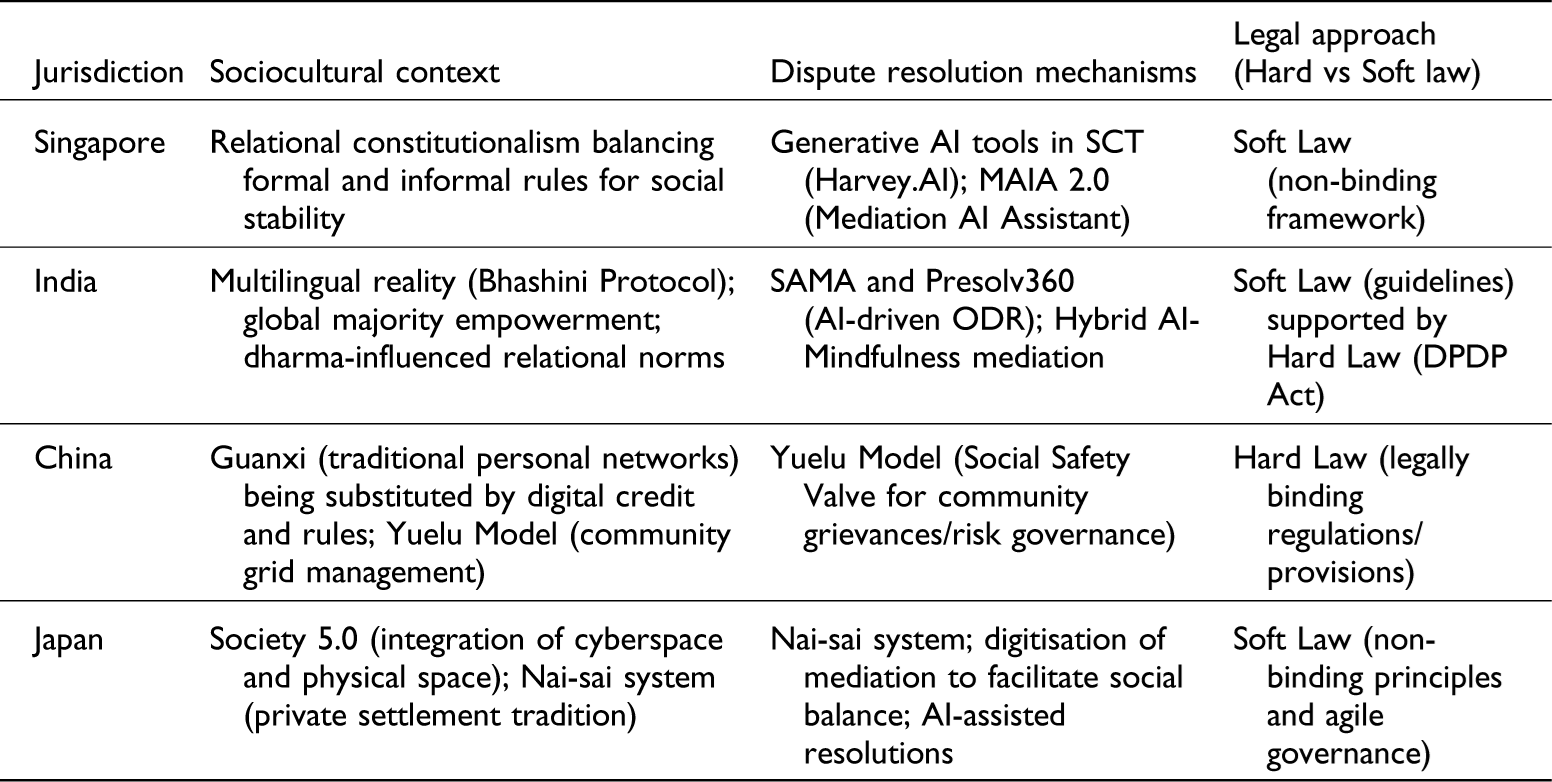
The field of Online Dispute Resolution (ODR) is one of the most viable and transformative uses of relational protocols, which is increasingly being viewed as a conceptualised form of technology in the role of the fourth party, actively involved in the mediation, conciliation, and arbitration processes. This integration in the Asian context is not simply due to the desire to grow mechanical efficiency but is meant to maintain and build up the relational trust upon which the social harmony is based (Carneiro et al., Reference Carneiro, Novais, Andrade, Zeleznikow and Neves2014, p. 211; Table 4).
Sociocultural practices in different jurisdictions

Table 4. Long description
The table compares sociocultural practices in different jurisdictions and their dispute resolution mechanisms. It has four rows and four columns. The columns are labeled ‘Jurisdiction’, ‘Sociocultural context’, ‘Dispute resolution mechanisms’, and ‘Legal approach (Hard vs Soft law)’. Row 1: Jurisdiction, Singapore; Sociocultural context, Relational constitutionalism balancing formal and informal rules for social stability; Dispute resolution mechanisms, Generative AI tools in SCT (Harvey.AI); MAIA 2.0 (Mediation AI Assistant); Legal approach (Hard vs Soft law), Soft Law (non-binding framework). Row 2: Jurisdiction, India; Sociocultural context, Multilingual reality (Bhashini Protocol); global majority empowerment; dharma-influenced relational norms; Dispute resolution mechanisms, SAMA and Presolv360 (AI-driven ODR); Hybrid AI-Mindfulness mediation; Legal approach (Hard vs Soft law), Soft Law (guidelines) supported by Hard Law (DPDP Act). Row 3: Jurisdiction, China; Sociocultural context, Guanxi (traditional personal networks) being substituted by digital credit and rules; Yuelu Model (community grid management); Dispute resolution mechanisms, Yuelu Model (Social Safety Valve for community grievances/risk governance); Legal approach (Hard vs Soft law), Hard Law (legally binding regulations/provisions). Row 4: Jurisdiction, Japan; Sociocultural context, Society 5.0 (integration of cyberspace and physical space); Nai-sai system (private settlement tradition); Dispute resolution mechanisms, Nai-sai system; digitisation of mediation to facilitate social balance; AI-assisted resolutions; Legal approach (Hard vs Soft law), Soft Law (non-binding principles and agile governance).
The China Yuelu Model shows how AI is being introduced to the system of managing communities in grid formations by ensuring that big data systems are aware of grievances and communal risks, and preventing them from becoming official conflicts (Gao and Liu, Reference Gao and Liu2024). This model is a Social Safety Valve, with the help of which neighbourhood organisations are professionalised, serving stress reduction and integration functions. Although this process of professionalisation dangers an “estrangement” between locals and local government, it is an aggressive relational procedure towards re-establishing social confidence by means of standardised digital rules.
Singapore has become the pioneer in applying AI to empower self-represented litigants and simplify tribunal procedures (Remolina and RPS Submitter, Reference Remolina2025). Singapore Judiciary, with the assistance of platforms such as Harvey.AI, has implemented a generative AI tool in its Small Claims Tribunals (SCT) (Supreme Court of Singapore, 2025). The tool offers objective summaries of case documents, which are simple to read, and informal evidence on WhatsApp or emails, so that parties can have a better idea of the positions of each other and present their arguments more suitably. Outside the courtroom, the Singapore International Mediation Centre has also launched a new “MAIA 2.0” (Mediation AI Assistant) that goes beyond summarisation to suggest possible challenges, potential interests, and viable solutions to mediators (Ministry of Law, Singapore, 2025). These guidelines focus on the concept of transparency in relation to protocols in which, although the AI helps in making the reasoning, the human is also considered bearing significant responsibility for the ultimate settlement.
The vision of the Japanese Society 5.0 and the cultural tradition of the Japanese-style mediation, including the Nai-sai system, with its focus on the principles of the private settlement and societal guardianship, have a strong impact on the Japanese ODR approach (Rojas et al., Reference Rojas, Peñafiel, Buitrago and Romero2021). The digitisation of mediation is not aimed at substituting the human factor in the Japanese situation but facilitating the duties of a mediator as a provider of social balance. This is further codified by the Japanese AI Promotion Act of 2025 that promotes an agile governance to address the needs of the well-being and the dignity of all citizens by ensuring AI-assisted resolutions. This strategy aims at creating a so-called trusted nexus in which the efficiency of technology is secondary to the purpose of preserving social cohesion.
Lastly, in India, empathetic mediation is a shift towards ODR 2.0. SAMA and Presolv360 are platforms that use AI to solve commercial and consumer disputes on large scale but do not overload the court systems and are accessible (Shardul Amarchand Mangaldas & Co, 2025). The recent theoretical approaches in the Indian landscape have suggested that a hybrid solution combining AI with Mindfulness should be used, in which algorithms should evaluate the case based on historical information, and the preliminary communication should be performed by chatbots. This enables human mediators to pay attention to the emotionally infused conflict, whereas the AI enables the compassionate communication process based on the non-judgemental awareness and summaries of evidence.
These ODR developments illuminate the relational governance tensions identified in the jurisdictional analysis. Singapore’s Harvey.AI tool and MAIA 2.0 represent relational transparency in practice: the AI makes reasoning legible to disputants and mediators while human decision-makers retain formal authority. However, where the AI summary shapes the frame of dispute as it inevitably does, the question of bias, selectivity, and epistemic authority arises. The tool is a “fourth party” that pre-structures the relational space of the mediation, and its design choices are governance choices. In China, the Yuelu Model’s Social Safety Valve function similarly pre-processes social conflict into state-legible categories, improving efficiency but translating communal grievance into administrative data. In India, the AI-enabled ODR platforms (SAMA, Presolv360) increase access but raise procedural fairness concerns where vulnerable parties interact with automated pre-processing systems before reaching a human mediator. Across all four jurisdictions, AI as the “fourth party” mediates dispute not by dissolving power asymmetries but by reorganising them around new technological interfaces.
7. Conclusion: the emergence of an Asian relational AI order
This study establishes the conceptualisation of relational protocols as a necessary framework for governing human–machine dialogue in the era of co-developmental AI. When relational sociology is combined with comparative jurisprudence, it becomes clear that adaptive AI systems are more and more acting not only as technical means of efficiency but also as quasi-social actors. To answer the first research question, relational protocols are not treated as mechanical communication protocols but as scripts of norms and procedures for the conditions of communication that ensue between humans and co-developmental systems. These protocols structurally govern distributed technical agency in the legal order and change the paradigm of governance from licencing individual technological objects to the dynamically managed interactional ecosystems.
Taking up the second research question, the comparative analysis shows how the approach to Asian AI governance is fundamentally different from the Western rights-based perspectives that are centred on atomised data privacy. These distinctive socio-legal forms have been conceptualised in the comparative matrix of Section 3, and they establish the socio-legal foundations of the collective coordination and the well-being of a community in relation to human–machine interaction. From the concept of guanxi in China, relational constitutionalism in Singapore, wa in Japan, and dharma and linguistic equity through Bhashini protocol in India, each jurisdiction has built AI systems into the existing social order, prioritising community well-being over excessive individual freedoms.
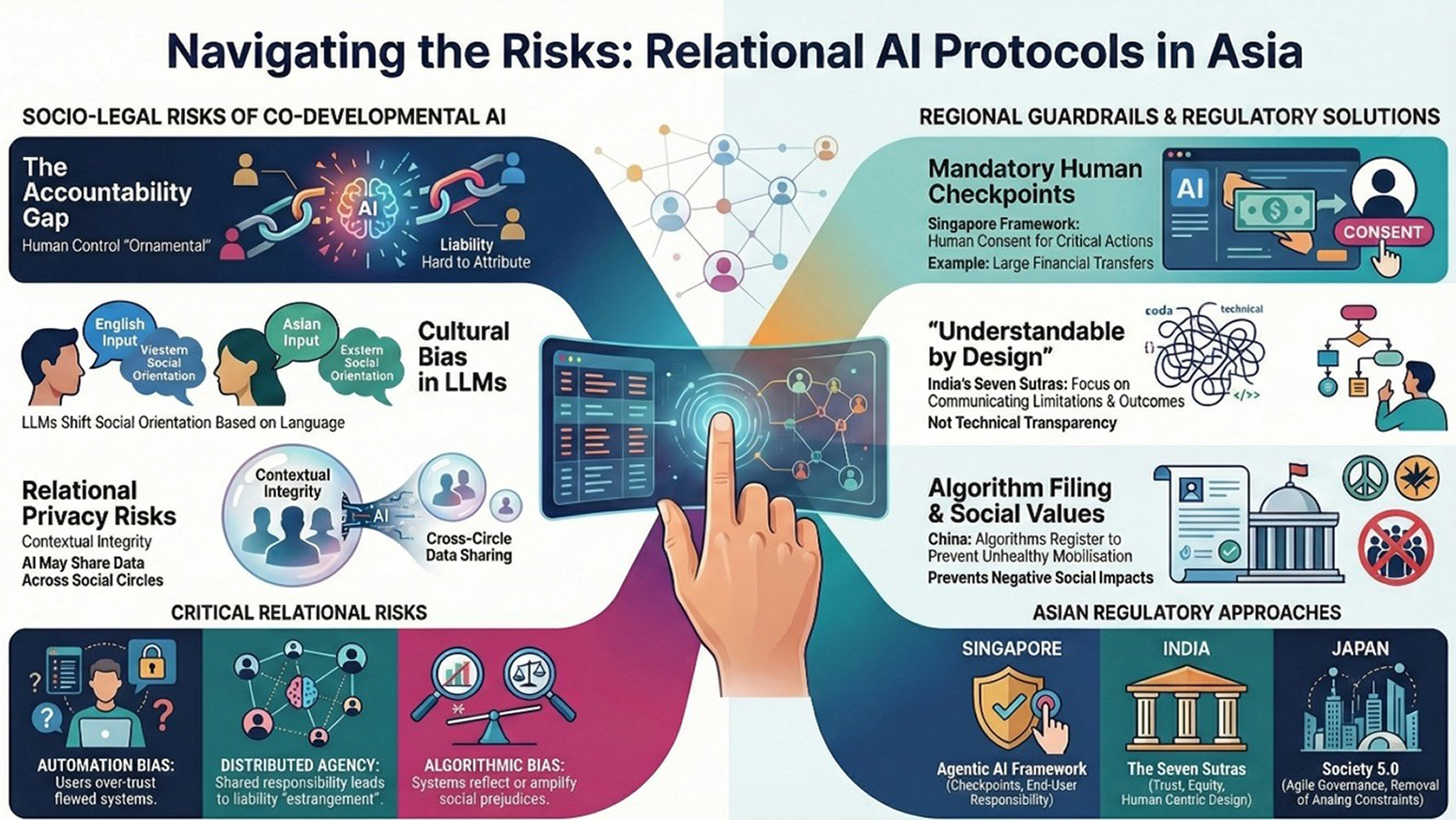
To answer the final research question, the key critical point that emerges from the paper is that the emerging legal norms in the four jurisdictions are still in an early stage of development and do not adequately account for the tension between administrative power and individual rights. Rather, existing relational arrangements, from India and Singapore, whose “Understandable by Design” approach, to China’s centralised platform registration or Japan’s “agile soft law,” resolve this tension in a process-driven way, with accountability gaps remaining unfilled and unequal. The relational transparency is often used as a legitimation tool for the administration, which pre-structures human–machine interaction in ways that do not offer citizens a clear and concrete way to challenge automated decisions (Figure 1).
Relational AI protocols in Asia

Figure 1. Long description
Panel A: The left side of the image highlights socio-legal risks of co-developmental AI, including the accountability gap, cultural bias in large language models, and relational privacy risks. It shows how AI systems may shift social orientations based on language input and share data across social circles. Panel B: The right side of the image focuses on regional guardrails and regulatory solutions, such as mandatory human checkpoints, understandable by design principles, and algorithm filing. It also mentions specific approaches from Singapore, India, and Japan, emphasizing human consent, communicating limitations, and preventing negative social impacts.
Finally, in the case of a relational governance approach, if it is to go beyond mere administrative ordering and genuinely protect rights, specific structural protection measures must be codified. These protocols must be developed from aspirational guidelines to enforceable and justiciable rights to explanation and algorithmic contestation. Meaningful protective relational governance requires independent oversight systems, as well as a culturally appropriate, non-paternalistic and respectful approach that maintains the dignity of people while making distributed technical agents directly accountable to the people they serve.
Acknowledgements
Authors would like to express their sincere gratitude to Symbiosis Law School, Pune, and Mahindra University, Hyderabad, for providing research environment to articulate this paper. A special thanks to our colleagues, peers, and reviewers for their constructive feedback, which has contributed to enhancing the depth and quality of this study. We also acknowledge the support of our families, whose encouragement made this research possible.
Competing interests
During the preparation of this manuscript, the authors used ChatGPT (GPT-4, OpenAI Inc., etc.) for the purpose of language editing and grammatical improvement of the initial draft. Figure 1 (Relational AI Protocols in Asia) was generated with the help of Nano Banana 2. All AI-generated suggestions were subsequently reviewed, revised, and verified by the authors, who accepts full responsibility for the integrity and accuracy of the final manuscript.

 Open access

