Introduction
Local anaesthesia of the external auditory canal and tympanic membrane can be achieved through the use of topical or injectable agents. Both are effective but have limitations. Topical anaesthetic creams require application, under direct microscopic vision, onto the tympanic membrane and ear canal skin. They require 20–30 minutes to work, so must be applied at a separate pre-operative session. Injectable local anaesthetics work much more quickly, but require subcutaneous infiltration of the agent. This can be uncomfortable for the patient, and can cause swelling which can obscure access. Both of these techniques require a clinician with experience in using a microscope.
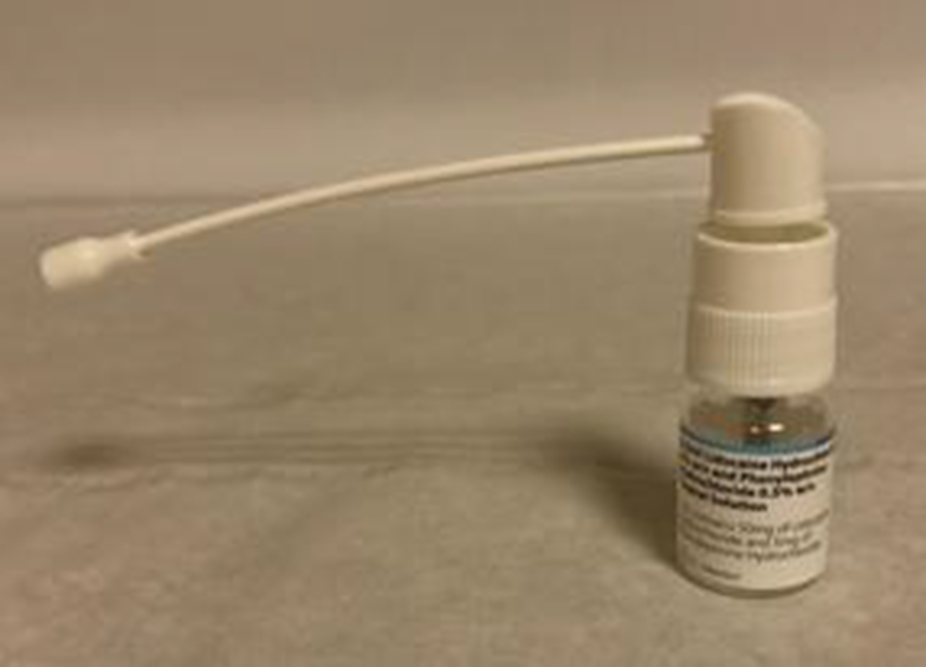
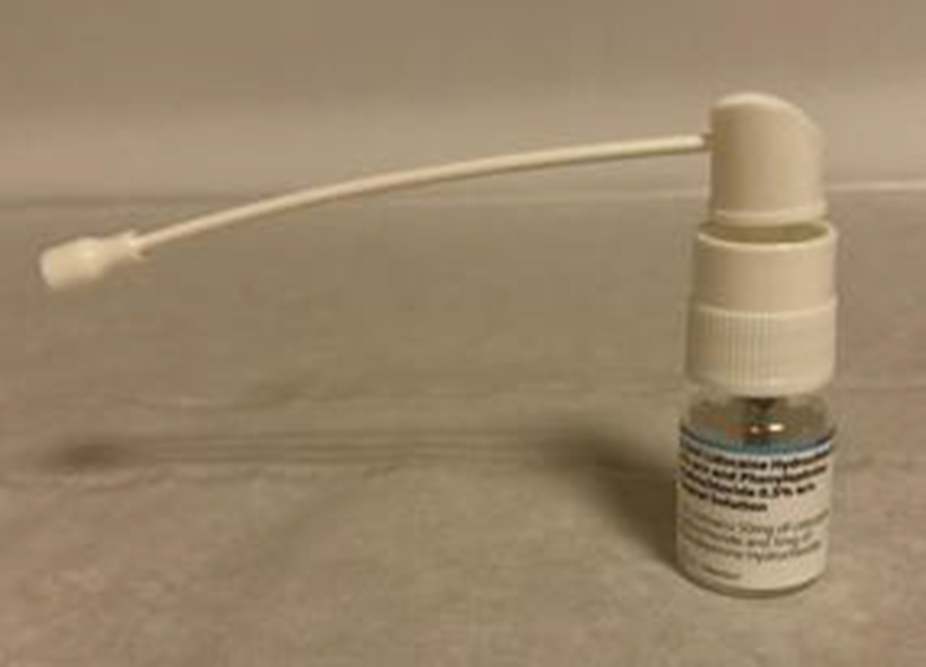
The authors have found the use of lidocaine (5 per cent) and phenylephrine (0.5 per cent), or Co-phenylcaine™ spray (Aurum Pharmaceuticals, Romford, UK) (Figure 1), available in most out-patient clinics, to be very effective in achieving quick anaesthesia of the external auditory canal, without use of a microscope. Substantial further local anaesthesia can be obtained with Co-phenylcaine-soaked micropatties applied to the tympanic membrane.
Co-phenylcaine spray.
Pharmacological actions
Lidocaine is a rapidly acting local anaesthetic. Lidocaine reversibly binds to sodium channels, blocking the entry of sodium to nerve fibres, resulting in depolarisation.Reference Weinberg, Peake, Tan and Nikfarjam1 Lidocaine also has antiarrhythmic properties, and care must be taken regarding the dose given and the method of administration.
Phenylephrine is a selective alpha-1 adrenoreceptor agonist with sympathomimetic effect, causing vasoconstriction and thus decongestion of mucosa.2
Technical description
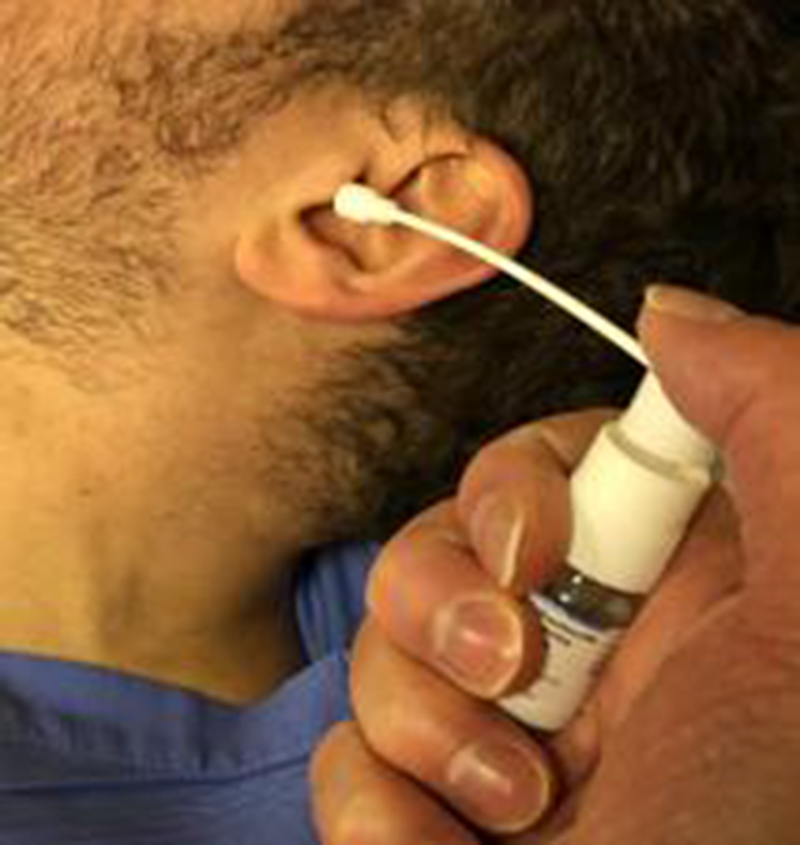
The supine patient lies with their head turned with the ear upwards. Co-phenylcaine spray is applied to the external auditory canal using the applicator tip supplied by the manufacturer (Figure 2). Five to six pumps of the spray are used to achieve coverage of the tympanic membrane and the deep ear canal (Figure 3). The authors find that anaesthesia occurs within a few minutes, giving the surgeon time to scrub.
Co-phenylcaine spray being applied to the external ear canal with applicator tip.

Annotated diagram of Co-phenylcaine liquid sitting in the ear canal, against the tympanic membrane.

Using the microscope, the Co-phenylcaine is sucked away ready for instrumentation. The Co-phenylcaine is easily removed, and, unlike local anaesthetic cream, does not leave residue that may obscure landmarks or pathology.
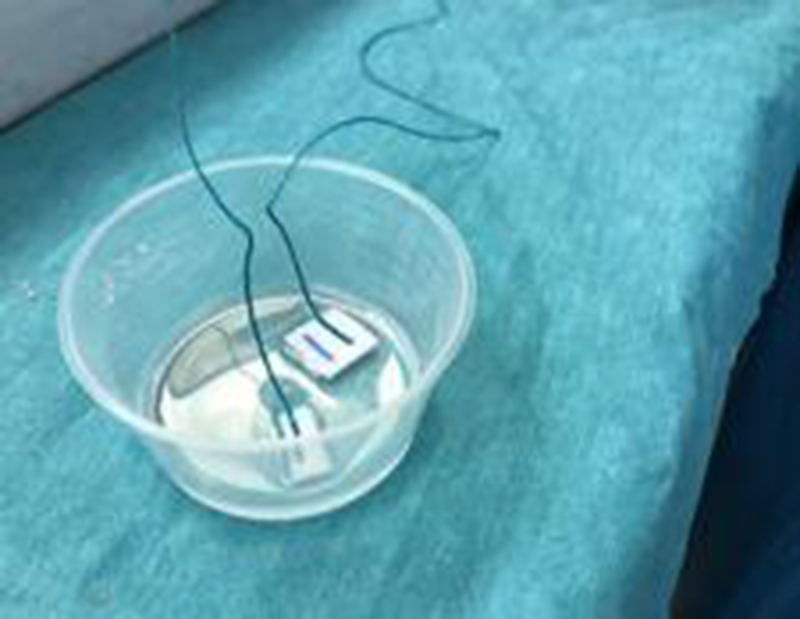
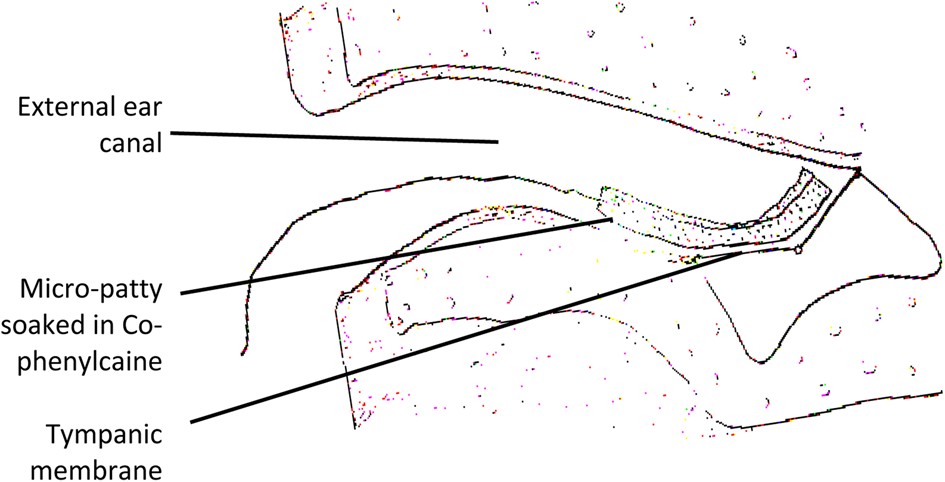
Significant additional local anaesthesia can be achieved by Co-phenylcaine-soaked micropatties placed on the tympanic membrane (Figures 4 and 5). This additional step requires the microscope, but works in minutes so it can be carried out at the time of surgery. This is sufficient for procedures such as grommet insertion.
Co-phenylcaine soaked micropatties.
Micropatty soaked in Co-phenylcaine lying on the tympanic membrane.
Discussion
Co-phenylcaine spray allows for rapid and effective anaesthesia of the external auditory canal. Application of the liquid does not require direct vision or painful injections. This technique can be used in the operating theatre, the clinic or ward treatment rooms, and is well tolerated by most patients. The fact that the spray is a liquid means that it contacts all surfaces, without bubbles or defects, unlike a cream.
The spray also acts much more quickly than a cream, and avoids the discomfort and swelling seen with injections. When used in patients with deeper or impacted foreign bodies (Figure 6), the liquid can also bypass the object to reach the tympanic membrane and provide anaesthesia to aid in removal. The liquid also has a softening effect, which can help with the removal of an impacted wax bolus or keratin from an attic retraction pocket. The phenylephrine has a vasoconstrictive effect, so can reduce swelling and bleeding locally.
Foreign body lying near the tympanic membrane in the external ear canal.

The exact mechanism of action is not entirely understood, as aqueous liquid topical local anaesthetics are well absorbed by mucosa but poorly absorbed by the skin. For skin absorption, other formulations are normally required, such as Emla topical numbing cream (Astra USA, Westborough, Massachusetts, USA). Emla cream contains a mixture of local anaesthetics (lidocaine and prilocaine) in an oil and water emulsion.3
However, the authors’ experience using the described method of local anaesthesia has been effective, perhaps because the skin of the deep external ear canal and the tympanic membrane is extremely thin.
In summary, the authors have found that Co-phenylcaine is an effective and rapidly acting anaesthetic for use in the external auditory canal. It is easy to apply, avoids obscuring landmarks with residue or swelling, and is well tolerated by patients.
Acknowledgement
The authors thank Prof Yogesh Bajaj for his permission to use the photograph in Figure 6.
Competing interests
None declared