Introduction
The sesquiterpene lactones (STLs) are a stable subfamily of terpenoids, a class of plant lipophilic secondary metabolites. STLs are 15-carbon (15-C) compounds that consist of three isoprene (5-C) units and a lactone group (cyclic ester) and are almost exclusively derived from Asteraceae. These compounds can be categorized, based on their carboxylic skeleton, into several different groups such as guaianolides, germacranolides or melampolides.
Various biological activities for sesquiterpene lactones have been reported, including anti-tumor (Lee et al., Reference Lee, Hall, Mar, Starnes, ElGebaly, Waddell, Hadgraft, Ruffner and Weidner1977; Zhang et al., Reference Zhang, Won, Ong and Shen2005; Ghantous et al., Reference Ghantous, Gali-Muhtasib, Vuorela, Najat, Saliba and Darwiche2010), anti-inflammatory (Recio et al., Reference Recio, Giner, Uriburu, Máñez, Cerdá, de la Fuente and Ríosm2000) and gastric cytoprotective effects (Giordano et al., Reference Giordano, Pestchanker, Guerreiro, Saad, Enriz, Rodriguez, Jauregui, Guzman, Maria and Wendel1992; Penissi et al., Reference Penissi, Fogal, Guzmán and Piezzi1998).
It has been shown previously that a sesquiterpene lactone from the guaianolide group, dehydroleucodine (DhL), that was isolated and purified from the aerial parts of Artemisia douglasiana Besser, selectively induced a dose-dependent transient arrest in G2 of both meristematic cells (López et al., Reference López, Giordano and López2002) and vascular smooth muscle cells (Cruzado et al., Reference Cruzado, Castro, Fernández, Gómez, Roque, Giordano and López2005). Furthermore, treatment with DhL of Rhinella arenarum fully grown oocytes arrested in G2, at the beginning of meiosis I, was seen to induce inhibition of spontaneous and progesterone-induced maturation in a dose-dependent manner (Sánchez-Toranzo et al., Reference Sánchez-Toranzo, Giordano, López and Bühler2007).
In amphibians, fully grown ovarian oocytes are arrested at the beginning of meiosis I, in the G2/M stage of the cell cycle. Under hormonal stimulus, this meiotic arrest is released and meiosis progresses to metaphase II, a process termed as oocyte maturation (Fortune et al., Reference Fortune, Concannon and Hansel1975; Schuetz, Reference Schuetz and Browder1985). Meiotic maturation, which represents the transition from G2 to the M phase of the cell cycle, is induced by progesterone (Zelarayán et al., Reference Zelarayán, Oterino and Bühler1996).
In meiosis in amphibian oocytes, the transition from G2 to M phase is regulated by maturation promoting factor (MPF), a complex of the cyclin-dependent kinase p34/cdc2 and cyclin B. (Masui & Clarke, Reference Masui and Clarke1979; Lohka et al., Reference Lohka, Kyes and Maller1987). In immature oocytes, the inactive complex (pre-MPF) is present, in which cdc2 is phosphorylated on both the Thr-161 and the Thr-14/Tyr-15 residues. The dephosphorylation of Thr-14/Tyr-15 is necessary for the start of MPF activation and this step is induced by the activation of Cdc25 phosphatase (Perdiguero & Nebreda, Reference Perdiguero and Nebreda2004; Dekel, Reference Dekel2005).
For Rhinella arenarum fully grown oocytes arrested in G2/M, treatment with DhL or the hydrogenated derivative of DhL, 11,13-dihydro-dehydroleucodine (2H-DhL), in which the α-methylenelactone function was inactivated, has been shown to induce inhibition of progesterone-induced maturation in a dose-dependent manner (Sánchez-Toranzo et al., Reference Sánchez-Toranzo, Giordano, López and Bühler2007). These results suggested that the inhibitory effect on meiosis progression of DhL does not only depend on the functional activity of α-methylenelactone, as its hydrogenated derivative, 2H-DhL, in which this function has been inactivated, caused similar effects on amphibian oocytes (Sánchez-Toranzo et al., Reference Sánchez-Toranzo, López, Zapata-Martínez, Gramajo Bühler and Bühler2009). Similarly, Schmidt (Reference Schmidt2006) reported that the α-methylene-γ-butyrolactone ring is not the only active group, but that other groups such as the epoxide, aldehyde, and α-β-unsaturated carbonyl groups also have reactivity.
The purpose of this work was to evaluate whether sesquiterpene lactones from the germacranolide and melampolide groups might act as G2/M inhibitors on the meiosis of amphibian oocytes in vitro.
Materials and methods
Animals
Adult specimens of Rhinella arenarum were collected in the northwestern area of Argentina and kept at 15°C until use.
Hormones and reagents
For the plant material, the sesquiterpene lactones were isolated from different plants of the Asteraceae family. Uvedalin, enhydrin and polimatin B were isolated from Smallanthus sonchifolius (Poepp. & Endl) H. Robinson, in accordance with Mercado et al. (Reference Mercado, Coll Aráoz, Grau and Catalán2010). Minimolide was isolated from Mikania minima (Baker) B.L. Rob in accordance with Cuenca et al., (Reference Cuenca, Kokke and Catalán1990) and Bach et al. (Reference Bach, Díaz, Bach and Catalán2011). Deoxyelephantopin (and 2-epideoxyelephantopin) were isolated from Gochnatia palosanto (Cabrera) in accordance with Ybarra et al. (Reference Ybarra, Catalán, Guerreiro, Gutiérrez and Herz1990). Glaucolide A was isolated from Vernonia squamulosa (Hook. & Arn) in accordance with Catalán et al. (Reference Catalán, de Iglesias, Kavka, Sosa and Herz1986). Polymatin A was isolated from Smallanthus macroscyphus (Baker) A. Grau in accordance with de Pedro et al. (Reference de Pedro, Cuenca, Grau, Catalán, Gedris and Herz2003). The purity of all lactones was 98.0% as determined by high pressure liquid chromatography (HPLC). The aerial parts of Asteraceae specimens are deposited in the Herbarium of the Miguel Lillo Institute of the Universidad Nacional de Tucumán, Tucumán, Argentina. STLs were dissolved in dimethyl sulphoxide (DMSO) and various doses were added to the culture medium. Progesterone (Sigma Chemicals) was dissolved in ethanol and added directly to the culture medium to give a final concentration of 2.5 μM.
In vitro culture of denuded oocytes
Experimental manipulation and culture were performed at room temperature (22–25°C) in amphibian Ringer solution (AR; 6.6 g NaCl/l, 0.15 g CaCl2/l and 0.15 g KCl/l) that contained penicillin G-sodium (30 mg/l) and streptomycin sulphate (50 mg/l), pH 7.4.
Denuded fully grown oocytes were obtained in accordance with Lin & Schuetz (Reference Lin and Schuetz1985). Follicle cells were removed by gentle shaking (100 oscillations/min) (Zelarayán et al., Reference Zelarayán, Oterino and Bühler1995).
Randomized samples of 20 oocytes were distributed into separate wells that contained 2 ml of AR; the lactones (5 μl) were added directly to the culture medium. Oocyte maturation was assessed 24 h after hormone or lactone addition. Meiosis reinitiation was scored by both the presence of a transient white spot in the animal pole and by the absence of germinal vesicle breakdown (GVBD) after dissection of the oocytes fixed in trichloroacetic acid.
Toxicity
Impaired cell viability was measured using the reversibility assay based on the ability of viable cells to reinitiate meiosis. Briefly, oocytes were exposed for 1 h to STLs (24 μM), washed twice in AR and then incubated with progesterone (2.5 μM) in AR for at least 24 h at 25ºC.
Statistical analysis
Results are expressed as means ± standard error of the mean (SEM). Comparisons among different treatments were carried out using Student's t-test. A value of P < 0.05 was considered to be statistically significant.
Results and Discussion
Effect of lactones from the germacranolide group (deoxyelephantopins – a mixture of analogues of deoxyelephantopin and 2-epideoxyelephantopin, glaucolide A, and minimolide)
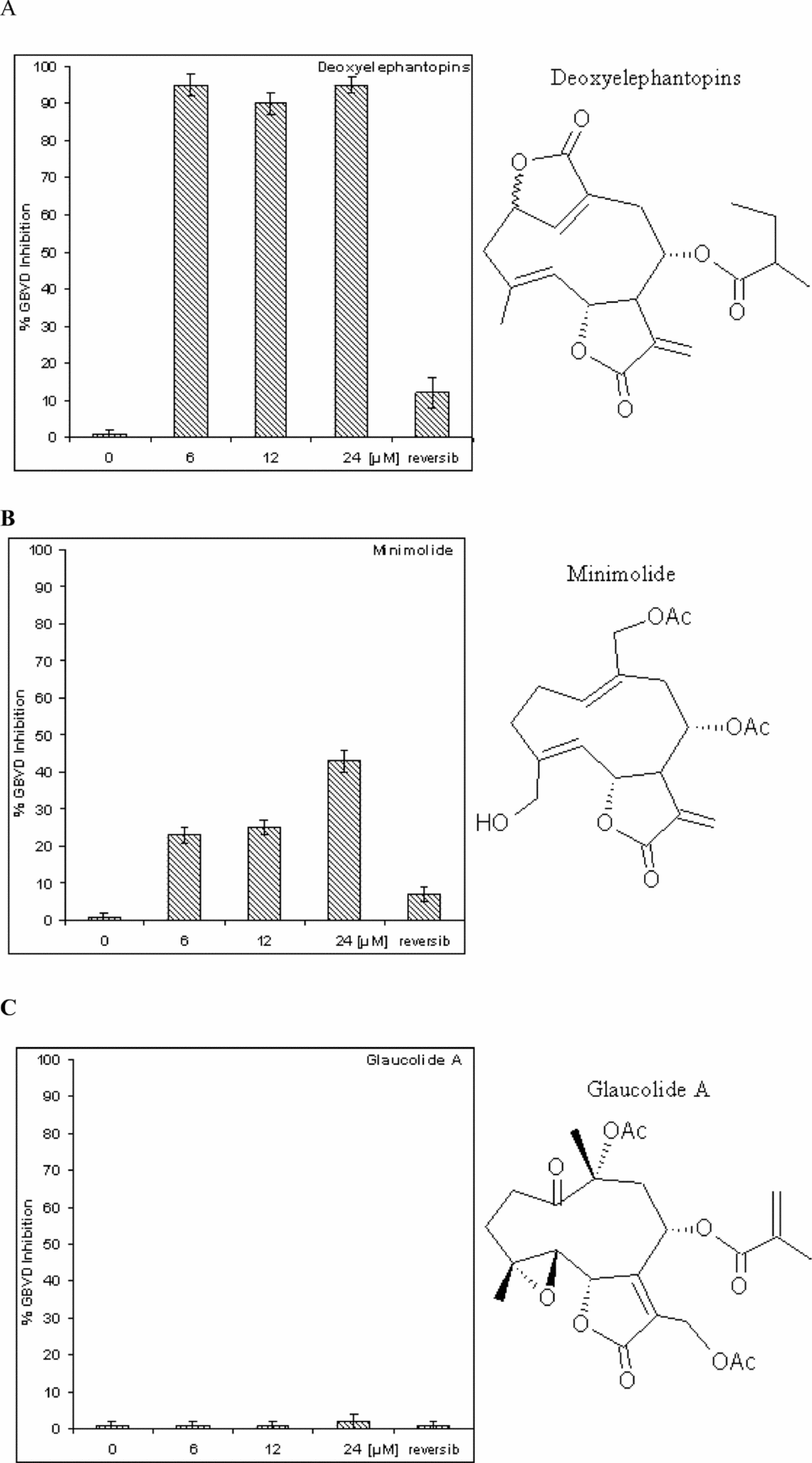
To determine whether some lactones of the germacranolide group affected oocyte maturation, fully grown denuded oocytes of Rhinella arenarum were cultured in AR for 60 min with different doses of deoxyelephantopins, glaucolide A or minimolide (0, 6, 12 or 24 μM respectively) before the addition of progesterone 2.5 μM. The results indicated that, under our experimental conditions, the addition of deoxyelephantopins caused a high percentage of GVBD inhibition (97, 90 or 97% with doses of 6, 12 or 24 μM respectively) (Fig. 1 A).
Effect of deoxyelephantopin or minimolide inhibition or glaucolide A on progesterone-induced oocyte maturation. (A) The effect of deoxyelephantopin inhibition on progesterone-induced maturation. (B) The effect of minimolide inhibition on progesterone-induced maturation. (A, B) Oocytes not competent to mature spontaneously were preincubated in amphibian Ringer solution (AR) with (A) deoxyelephantopin (0–24 μM), or (B) minimolide (0–24 μM), for 60 min before progesterone addition (2.5 μM). (C) Effect of glaucolide A on progesterone-induced oocyte maturation. Denuded oocytes not competent to mature spontaneously were cultured in AR with different doses of glaucolide A (0–24 μM) 60 min before the addition of progesterone (2.5 μM). The respective reversibility column is added to the graphic: for the reversibility test, the oocytes were incubated with lactone (24 μM) for 60 min and then washed three times in AR. Germinal vesicle breakdown (GVBD) was scored after 24 h of incubation. Values are the mean ± standard error of the mean (SEM) of four experiments. Each experiment was performed on a different animal.

Minimolide is an exo-methylene-γ-lactone with an –OH group in C-14 and acetyloxy groups on C-8 and C-14 that showed a moderate inhibitory effect (23, 26 or 44%) at the concentrations assayed (6, 12 or 24 μM respectively) (Fig 1 B).
Glaucolide A, which has the lactone double bond in position 7, 11 (within the γ-lactone ring), was inactive, i.e. did not inhibit the reinitiation of meiosis (Fig. 1 C). This finding suggests that in order to observe activity the presence of the exo-methylene-γ-lactone group is necessary.
The reversibility assay showed that treatment with germacranolides at the assayed dose (24 μM) did not affect the viability of the oocytes and suggested that these lactones are minimally toxic under our experimental conditions.
Is interesting to note that in nasopharynx carcinoma cells (Kupchan et al., Reference Kupchan, Eakin and Thomas1971), it has been established that it is the exocyclic, but not the endocyclic, α-methylene-γ-lactone that causes cytotoxicity. However, other studies have shown that in some lactones, such as helenalin analogs, an endocyclic α,β-unsaturated ketone might cause more cytotoxicity than the exocyclic α-methylene-γ-lactone (Lee et al., Reference Lee, Huang, Piantadosi, Pagano and Geissman1971, Reference Lee, Hall, Mar, Starnes, ElGebaly, Waddell, Hadgraft, Ruffner and Weidner1977).
Effect of lactones from the melampolide group (uvedalin, enhydrin, polymatin A, polymatin B)
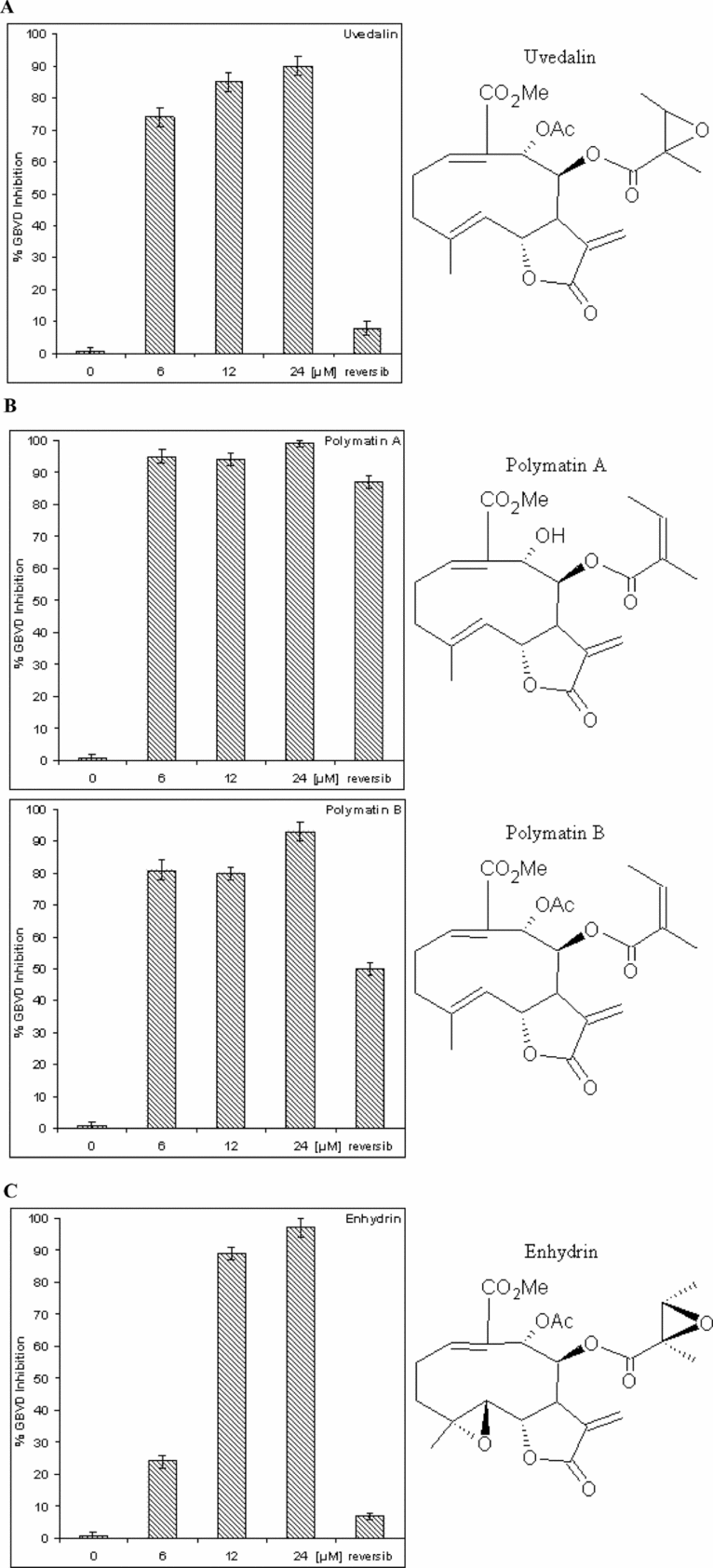
Rhinella arenarum denuded oocytes were cultured in AR for 60 min with different doses (0, 6, 12 or 24 μM) of uvedalin, enhydrin, polymatin A or polymatin B before the addition of progesterone (2.5 μM). GVBD was scored after 24 h of culture. Results indicated that uvedalin effectively inhibited meiosis resumption in a dose-dependent manner (74, 85 and 92%) at concentrations of 6, 12, and 24 μM respectively (Fig. 2 A).
Effect of uvedalin, polymatin A or polymatin B inhibition or enhydrin on progesterone-induced oocyte maturation. (A) Effect of uvedalin inhibition on progesterone-induced maturation. (B) Effect of polymatin A and polymatin B inhibition on progesterone-induced maturation. (A, B) Oocytes not competent to mature spontaneously were preincubated in amphibian Ringer solution (AR) with (A) uvedalin (0–24 μM), or (B) polymatin A or polymatin B (0–24 μM), for 60 min before progesterone addition (2.5 μM). (C) Effect of enhydrin on progesterone-induced oocyte maturation. Denuded oocytes not competent to mature spontaneously were cultured in AR with different doses of enhydrin (0–24 μM) for 60 min before the addition of progesterone (2.5 μM). The respective reversibility column is added to the graphic: for this test of reversibility, the oocytes were incubated with the lactone (24 μM) for 60 min and then were washed three times in AR. Germinal vesicle breakdown (GVBD) was scored after 24 h of incubation. Values are the mean ± standard error of the mean (SEM) of four experiments. Each experiment was performed on a different animal.

Oocytes treated with polymatin A clearly showed a potent inhibition of the cell cycle (G2/M arrest) that was independent of the dose (97, 96 and 99%). Polymatin B showed a potent inhibitory effect similar to that of uvedalin (82, 81 or 94%) at 6, 12 or 24 μM respectively (Fig. 2 B).
The reversibility assay indicated that polymatin A and B lactones are toxic, because they cause about 40–50% death in the treated oocytes. This finding suggests that the inhibitory effect observed with these lactones is related to their high toxicity.
In the case of enhydrin (Fig. 2 C) and uvedalin, the results showed these compounds had an inhibitory effect at the higher concentrations assayed (89% with 12 μM, and 98% with 24 μM). However, in the reversibility assay, enhydrin showed low toxicity with 7% of dead oocytes.
It is important to point out that the inhibitory effects of polymatin A and polymatin B is counteracted by their toxic effects, while uvedalin and enhydrin present limited toxicity, based on the reversibility assays performed.
In summary, our results indicated an inhibitory effect on meiosis progression of lactones from the melampolide and germacranolide groups. In this way, they were able to inhibit progesterone-induced maturation of Rhinella arenarum oocytes by blocking the G2/M stage of the cellular meiotic cycle. This inhibitory effect does not depend on the group to which they belong, i.e. not on the carbon skeleton, but probably depends on the arrangement and type of group functionality present in the molecules. With respect to cytotoxicity, all the lactones in the germacranolide group assayed showed limited cytotoxic effect. In contrast, important differences in cellular toxicity were observed in the lactones from the melampolide group. Whereas enhydrin and uvedalin showed low cytotoxicity, polymatin A and B were highly toxic.
Acknowledgements
This work was supported by a grant from the Science Council of the National University of Tucumán (CIUNT) and the National Agency for Promotion of Science and Technology (FONCYT).