Implications
Intensive pig production systems are associated with welfare problems for pigs that have serious ethical and economic implications. Supplementation of the pigs’ diet with a mineral-rich marine extract with bioavailable magnesium (Mg) reduced unwanted aggressive, harmful and sexual behaviours, skin lesions in females and salivary cortisol concentration. Thus, supplementation of the diet with Mg from an organic source has the potential to improve pig welfare in intensive production systems.
Introduction
Growing pigs in commercial production systems perform a variety of undesirable behaviours that are either indicative of reduced welfare or cause poor welfare. These include belly-nosing, tail- and ear-biting (Blackshaw, Reference Blackshaw1981; Breuer et al., Reference Breuer, Sutcliffe, Mercer, Rance, O'Connell, Sneddon and Edwards2005), aggression (Andersen et al., Reference Andersen, Andenaes, Boe, Jensen and Bakken2000) and mounting behaviour performed by entire males (Boyle and Bjorklund, Reference Boyle and Bjorklund2007; Conte et al., Reference Conte, Boyle, Lawlor and O'Connell2010). These behaviours can directly result in injury, lameness, infection and abscessation (Wallgren and Lindahl, Reference Wallgren and Lindalh1996; Rhydmer et al., Reference Rydhmer, Zamaratskaia, Andersson, Algers and Lundstrom2004; Turner et al., Reference Turner, Farnworth, White, Brotherstone, Mendl, Knap, Penny and Lawrence2006) and are often associated with chronic stress (de Jong et al., Reference De Jong, Prelle, van de Burgwal, Lambooij, Mechiel Korte, Blokhuis and Koolhaas2000) and immunosuppression (de Groot et al., Reference De Groot, Ruis, Scholten, Koolhaas and Boersma2001). The resulting poor health and performance can also have serious economic implications. Housing conditions affect the development and expression of behaviour in pigs (e.g. Wemelsfelder et al., Reference Wemelsfelder, Haskell, Mendl, Calvert and Lawrence2000), and the barren, highly stocked environments inherent to intensive production systems are major risk factors for these behavioural problems (Rushen et al., Reference Rushen, Lawrence and Terlouw1993; de Jong et al., Reference De Jong, Ekkel, van de Burgwal, Lambooij, Korte, Ruis, Koolhaas and Blokhuis1998; Turner et al., Reference Turner, Ewen, Rooke and Edwards2000; Van de Weerd et al., Reference Van de Weerd, Docking, Day, Breuer and Edwards2006; Street and Gonyou, Reference Street and Gonyou2008).
Barren environments in particular cause pigs to inappropriately channel the exploratory and foraging behaviour that dominates their behavioural repertoire towards their pen-mates (Rushen et al., Reference Rushen, Lawrence and Terlouw1993), often leading to tail- and/or ear-biting. However, provision of rooting substrates can create problems for liquid manure management in slatted systems, and there is poor availability of substrates such as straw in many pig-producing regions. Chains, or rubber and plastic ‘toys’, do little to stimulate and maintain the pigs’ interest (Van de Weerd et al., Reference Van de Weerd, Docking, Day, Avery and Edwards2003), and other solutions, such as an increase in space allowance (Barnett et al., Reference Barnett, Cronin, McCallum and Newman1993; Turner et al., Reference Turner, Ewen, Rooke and Edwards2000; Street and Gonyou, Reference Street and Gonyou2008), are unlikely to be implemented because of economic constraints. Thus, other solutions to reduce behavioural problems in pigs need to be investigated.
One option is to modify the pigs’ diet. This could probably offer more immediate benefits and be easier to implement than changes to the housing environment. Supplementing the diet of grower gilts with tryptophan led to lower activity levels, less aggression and more lying (Poletto et al., Reference Poletto, Meisel, Richert, Cheng and Marchant-Forde2010a). Conversely, supplementation with ractopamine, which increases activity in pigs, is associated with increased oral–nasal behaviour and aggression (Poletto et al., Reference Poletto, Meisel, Richert, Cheng and Marchant-Forde2010b). A limited number of studies demonstrate welfare benefits probably arising from a reduction in negative behaviours associated with supplementing pig diets with magnesium (Mg) because of what appears to be its ‘calming’ effect (Kuhn et al., Reference Kuhn, Nowak, Otto, Albrecht, Gassmann, Sandner, Przybilski and Zahn1981; Peeters et al., Reference Peeters, Neyt, Beckers, De Smet, Aubert and Geers2005 and Reference Peeters, Driessen and Geers2006). Thus, there is the potential for Mg supplementation to also help reduce the performance of negative behaviours.
Peeters et al. (Reference Peeters, Neyt, Beckers, De Smet, Aubert and Geers2005) suggested that Mg supplementation improved the pigs’ ability to cope with the stress of vibration by blocking the sympathetic pathways of the autonomic nervous system. Meanwhile, Kietzmann and Jablonski (Reference Kietzmann and Jablonski1985) reported lower plasma corticosteroids, plasma catecholamines and neuromuscular stimulation in pigs supplemented with Mg. Improving the ability of pigs to cope with stress in modern production systems should result in calmer/less active pigs. Given the relationship between activity levels and the performance of abnormal behaviours (Statham et al., Reference Statham, Green, Bichard and Mendl2009), we hypothesise that this will be reflected in a reduction in the performance of negative behaviours.
The source of dietary Mg influences an animal's ability to absorb and utilise it and hence its efficacy (D'Souza et al., Reference D'Souza, Warner, Dunshea and Leury1999 and Reference D'Souza, Warner, Leury and Dunshea2000). Inorganic forms of Mg are often less available to the animal compared with sources that originate from organic sources (Coudray et al., Reference Coudray, Rambeau, Feillet-Coudray, Gueux, Tressol, Mazur and Rayssiguier2005). A mineral-rich marine extract obtained from the skeletal remains of a red marine alga, Lithothamnion calcareum, was used in this study. This alga grows in the Atlantic waters off the southwest of Ireland and the northwest coast of Iceland. Minerals from seawater are accumulated in the alga frond, which breaks off and falls to the ocean floor from where they are harvested. The mineralised fronds are separated from extraneous materials, sterilised, dried and milled. A commercial product is derived from this alga, reducing gastric ulceration in pigs (Kluess et al., Reference Kleuss, Fledderus, Bikker and Llamas-Moya2006), which could be related to stress reduction.
A lot of the focus of recent studies has been on the effect of Mg supplementation on welfare around slaughter and on subsequent meat quality (D'Souza et al., Reference D'Souza, Warner, Dunshea and Leury1999; Apple et al., Reference Apple, Maxwell, deRodas, Watson and Johnson2000 and Reference Apple, Kegley, Maxwell, Rakes, Galloway and Wistuba2005), but there have been no studies of its potential to improve welfare on farm. This study investigated whether supplementation of the diet with Mg from an organic source could improve the welfare of pigs during the growing period. We hypothesised that supplemented pigs would express fewer harmful (tail-biting, belly-nosing and ear-biting) and aggressive behaviours, have lower aggression-induced body lesion scores and have lower salivary cortisol levels compared with unsupplemented pigs. We also hypothesised that supplemented male pigs would perform less mounting compared with unsupplemented male pigs.
Material and methods
The study was conducted using the Teagasc integrated 250 sow research herd based at Moorepark, Fermoy, Co. Cork, Ireland. All procedures were reviewed and agreed by Teagasc's Animal Ethics Committee.
Dietary treatments
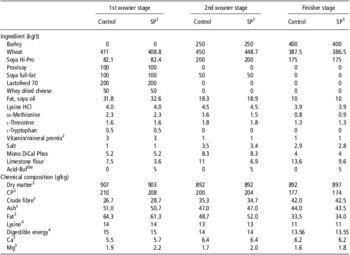
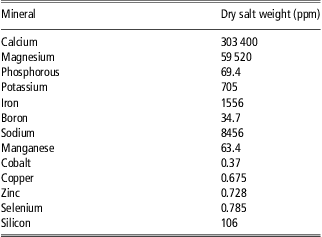
Animals were offered a standard, pelleted, commercial diet ad libitum (Vigour, Nutec, Naas, Co. Kildare, Ireland) from multi-space feeders during the 1st week post weaning. From 1 week post weaning, all pigs were switched to a home compounded, pelleted diet (Table 1) with treatment groups being supplemented with the product Acid-Buf™ (Celtic Sea Minerals, Currabinny, Carrigaline, Co. Cork, Ireland), described in Table 2 (Supplement), at a rate of 0.05%.
Ingredient and chemical composition of the diets fed at each of three production stages

1SP represents a diet supplemented with a commercially available dietary supplement extracted from a mineral-rich marine extract.
2Premix provided per kilogram of complete diet: Cu, 15 mg; Fe, 24 mg; Mn, 31 mg; Zn, 80 mg; I, 0.3 mg; Se, 0.2 mg; vitamin A, 2000 IU; vitamin D3, 500 IU; vitamin E, 40 IU; vitamin K, 4 mg; vitamin B12, 15 mg; riboflavin, 2 mg; nicotinic acid, 12 mg; pantothenic acid, 10 mg; vitamin B1, 2 mg; and vitamin B6, 3 mg.
3Analysed values.
4Calculated values.
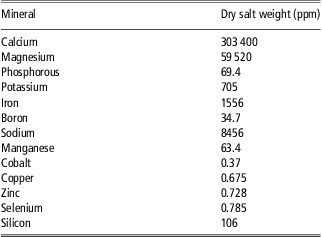
Typical mineral composition of the mineral-rich marine extract used to supplement pigs in this study
Animals and housing
A total of 448 undocked entire male and female piglets, born from Large White × Landrace sows, were used. On day 28, piglets were weaned, ear-tagged and weighed and assigned to single-sex pens in groups of 14 pigs (n = 32 pens; first-stage weaner accommodation). Feed intake at the pen level was recorded daily. Water was available ad libitum from a single bite-drinker in each pen. Each pen was furnished with a metre length of a natural fibre (manila) rope suspended from the pen partition and a length of plastic piping through which a chain was passed and fixed at both ends to the wall to contribute towards the environmental enrichment requirements of the pigs.
The second-stage weaner accommodation consisted of pens (1.32 m × 3.82 m) with plastic slatted flooring furnished with a Bite Rite™ enrichment device (Ikadan System, Ikast, Denmark) consisting of a plastic cone with four protruding lengths of plastic (length 20 cm, diameter 1 cm) suspended from the ceiling at pig head level in the middle of the pen. There were also two chains hanging from the pen walls.
The finisher accommodation consisted of pens (2.32 m × 4.73 m) with fully slatted, concrete floors and furnished with a ‘home made’ rubber enrichment device suspended by a chain at pig height in the middle of the pen, and two chains hanging from the pen walls. The enrichment device consisted of a 1 m-long and 300 mm-wide rubber mat designed as a covering for concrete slats (EasyFix™ Rubber Products, Persse Business Park, Ballinasloe, Co. Galway, Ireland), which was fixed in a circular shape by two steel bolts.
Treatments/experimental design
On day 27, all piglets were subjected to a back test as described by Hessing et al. (Reference Hessing, Hagelso, van Beck, Wiepkema, Schouten and Krukow1993). Briefly, each piglet was placed on its back in a v-board and then restrained in this position for 1 min. One hand was placed lightly over the throat of the piglet and another restrained the hind legs. Each series of wriggles that the piglet made without pausing was classified as a single escape attempt. The total number of escape attempts was considered the back test score. At weaning, pigs were assigned on the basis of sex and weight to one of four experimental treatments: (1) male control, (2) male Supplement, (3) female control and (4) female Supplement. A balanced incomplete block design was used.
On day 56, pigs were weighed and then remixed (0930 h) into the second-stage weaner accommodation. Seven pigs from each first-stage pen were selected on the basis of their back test score (two high scores (6 ± 1 attempts), two low scores (0 ± 1 attempts) and three mid scores (3 ± 2 attempts)) and weight and were then mixed with seven pigs from another pen of the same sex and treatment, yielding 16 groups of 14 pigs (n = 4 groups/treatment). This was in order that a similar number of pigs with different coping strategies would be included in each group, as back test scores are associated with the level of aggression and coping strategies (Geverink et al., Reference Geverink, Schouten, Gort and Wiegant2002; Bolhuis et al., Reference Bolhuis, Schouten, Schrama and Wiegan2005). One high-scoring pig and one low-scoring pig from each first-stage weaner accommodation pen were selected as focal pigs, providing four focal pigs in each second weaner stage pen. The remaining pigs from each of the pens in the first-stage weaner accommodation were not used in the study. On day 92, pigs were weighed and moved in the same groups to the finisher accommodation. The trial ended when the pigs were about 120 days of age or of ∼60 kg live weight.
Measurements
Behaviour
Behaviour was recorded directly in each pen on 1 day/week in the morning (between 0930 and 1230 h) and in the afternoon (between 1430 and 1630 h) when pigs were 62 ± 1, 68 ± 0, 76 ± 1, 83 ± 1, 89 ± 1, 96 ± 1, 104 ± 1 and 118 ± 1 days old (8 observation days). Two trained observers collected all of the behaviour data and they were balanced across treatments and pens. Observation times were also balanced across treatments and pens so that observations for each pen were distributed approximately equally across the recording periods.
Focal pig behaviour
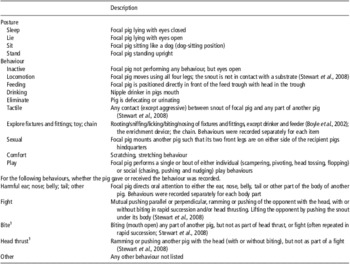
Focal pigs in each pen (n = 4) were observed continuously for 5 min each morning and afternoon, according to the ethogram in Table 3. The behaviours were recorded using behavioural observation software (The Observer, Noldus Information Technology, version 3, 1994, Wageningen, The Netherlands) downloaded from a personal computer to a hand-held computer (Psion Organiser LZ64, London, England). Focal pigs were marked individually with a black stock marker on the morning of each observation day. Both the frequency and duration of all behaviours were recorded, except for ‘head thrust’ and ‘bite’.
Ethogram of behaviours observed during continuous observations of the focal pigs

The frequency and duration of all behaviours were recorded, except for ‘head thrust’ and ‘bite’, for which only frequency was recorded.
1Behaviours were considered instantaneous, and counted (duration was not recorded).
Group behaviour
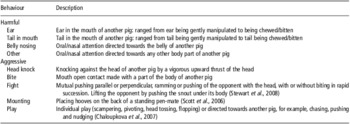
Observation sessions alternated between that of a focal pig and that of the group as a whole. As there were four focal pigs, four observation sessions, each 2 min in duration, were conducted for the group as a whole. This process was conducted in the morning and afternoon. All incidences of harmful and aggressive behaviours, mounting and play were recorded (Table 4).
Ethogram of behaviours collected by all-occurrence behaviour sampling recorded by continuous observation of each pen of pigs

The frequency of each behaviour was recorded.
Health inspections
Tail lesions
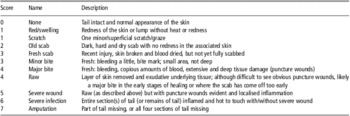
The tails of all pigs were examined at 63 ± 1, 69 ± 1, 77 ± 1, 84 ± 1, 91 ± 1, 99 ± 0, 106 ± 0 and 120 ± 0 days. Each pen of pigs was removed to an area where pigs could be penned individually and examined. Four parts of the tail were scored according to the system described in Table 5: the distal 1/3, the mid 1/3, the caudal 1/3 and the tail tip. Pigs with fresh wounds to the tail were treated with wound healing ointment (Stalosan® ointment, Stormøllen A/S, Denmark, O'Connor Group, Demesne, Newmarket, Co. Cork, Ireland). If tail damage was severe (loss of a part of the tail or deep bite wounds with inflammation), antibiotics were also administered at this time.
Tail lesion scoring system

A score was given to each of the following four sections of the tail: distal, mid or caudal 1/3 and tip.
Skin lesion scores
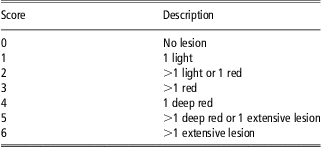
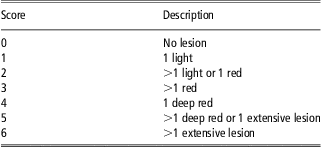
Skin lesion scores were recorded for the four focal pigs in each pen at the same time as their tails were examined. The back, left and right hind quarters, flanks, shoulders and ears were scored according to severity (Table 6). Scores from all areas (left and right sides of the body) were summed to provide a total lesion score for each pig (i.e. maximum score of 54). In addition, scores from the shoulders and ears were summed separately.
Skin lesion scoring system
General health
In addition to the weekly individual inspections, all pigs were checked daily by farm and technical staff for signs of illness and tail-biting. When an acute outbreak of tail-biting was observed, the biter was identified, removed from the home pen with an unbitten pen-mate and kept separate from the group for a period of at least 24 h, after which they were reintroduced to the home pen. At the time of reintroducing the pigs, a metre length of manila rope was also provided to the group for 24 h in order to distract both the biting pig and the pen residents from fighting with the reintroduced pigs. All causes of pig deaths or removal from the pen were also recorded.
Salivary cortisol
In the first-stage weaner accommodation between days 46 and 56, the focal piglets were habituated to the saliva collection procedure by handling and interacting with them on a daily basis (∼15 min/pen). Thereafter, saliva samples were collected from the four focal pigs in each pen between 1000 and 1100 h on the same day as, but before, the tail lesions were scored. Saliva was collected by allowing pigs to chew on a large cotton bud (Salivette, Sarstedt, Wexford, Ireland) until it was thoroughly moistened (about 30 to 60 s/sample). The buds were placed in tubes and centrifuged for 10 min at 400 × g and then stored at −20°C until analysed by an enzyme-linked immunosorbent assay (Salivary Cortisol Kit, Salimetrics Europe Ltd, Suffolk, UK). The minimum detectable concentration of cortisol that could be distinguished from 0 was <0.003 μg/dl. The intra- and inter-assay CVs based on controls were 2.7% and 4.9%, respectively.
Performance
Feed intake was recorded at group level on a weekly basis throughout the trial by recording the weight of the feed supplied to each pen of pigs and the residuals at the end of each production stage. All the animals were weighed at weaning (day 28), before remixing on transfer to the second-stage weaner accommodation (day 56), at transfer to the finisher accommodation (day 92) and at the end of the trial (day 120). From these data, growth rate variation and feed intake were determined.
Statistical analysis
Data were analysed using the Statistical Analyses System (SAS, V9.1.3, SAS Institute Inc., 1989). Data were tested for normality before analysis by examination of box and normal distribution plots, and transformed when necessary.
Focal pig behaviour was also analysed using the Mixed procedure. Data collected from the four focal pigs in each pen were averaged for each morning and afternoon session, providing two values per pen per day. Because of the infrequency of the behaviours, the components of exploratory behaviour (fixtures and fittings, toy and chain) and harmful behaviour (tail-in-mouth, belly-nosing and ear-biting) were averaged to provide a single mean duration for each behaviour per pen per stage (second-stage weaner accommodation and finisher accommodation). Diet, sex, experimental day (or stage), time of day (am or pm) and replicate were included in the model as fixed effects. Time of day, nested within experimental day (or stage), was considered as a repeated effect.
The frequency of behaviours recorded at group level was initially analysed using the Mixed procedure. For the analysis of total aggressive and harmful behaviours (the sum of all aggressive and the sum of all harmful behaviours), the four recordings from each morning and afternoon recording period on each day were adjusted for the number of pigs in each pen and then averaged. Diet, sex, experimental day, the number of pigs/pen, time of day (am or pm) and replicate were inserted into the model as fixed effects. Time of day, nested within the experimental day, was considered as a repeated effect. For the analysis of mounting, play and each separate harmful behaviour (belly-nosing, tail-in-mouth, etc.) and aggressive behaviour (fights, head knocks, etc.), the average value of all recordings during the second weaner and early finishing stages was adjusted for the number of pigs/pen and then averaged to provide a single value for each pen for each stage. Fixed effects were diet, sex (for analysis of mounting behaviour only male pens were used), stage (second weaner stage or finisher accommodation), the number of pigs in each pen and replicate. Stage was considered a repeated effect.
Tail lesion scores for each of the four locations on the tail were added to provide a total score for each pig on each experimental day. Data could not be normalised, and thus scores for all the pigs in a pen on each experimental day were averaged to provide a single value for each pen. On the basis of plots of the raw tail lesion data, it was clear that acute tail-biting ‘outbreaks’ had occurred sporadically. These were retrospectively defined as an occasion in which the average pen tail score was >4. Data were analysed using the Mixed procedure. Diet, sex, experimental day, whether there was a tail-biting outbreak during that week and replicate were included in the model as fixed effects. Experimental day was considered as a repeated effect. Fisher's exact test was used to compare the number of pigs in each dietary treatment that experienced at least one amputation during the trial.
Total and ear/shoulder lesion scores were analysed using the Mixed procedure. Diet, sex, experimental day, whether the pig was a high or low responder to the back test and replicate were included in the model as fixed effects. Experimental day was considered a repeated effect.
Salivary cortisol concentrations were analysed using the Mixed procedure. Diet, sex, experimental day, whether there was a tail-biting outbreak during that week, whether the pig was a high or low responder in the back test, and replicate were included in the model as fixed effects. The ELISA plate was considered a random effect, and experimental day was considered a repeated effect.
Live weight and live-weight gain were analysed using the Mixed procedure. Diet, sex and their interaction, and replicate were inserted into the model as fixed effects. For the analysis of live weight, stage (weaning, end of first weaner stage accommodation, end of second weaner stage accommodation and the end of the experimental period) was also included as a fixed and repeated effect.
All mixed models included interaction terms where relevant. When significant effects were found, Tukey's test was used to establish pairwise differences. Statistical differences were considered significant at P ⩽ 0.05. Tendencies towards significance (0.05 ⩽ P ⩽ 0.10) are also presented. Data are presented as least squares means ± standard errors. Model fit was determined in all analyses by choosing models with the minimum finite-sample-corrected Akaike Information Criteria (AIC).
Results
Behaviour
Focal pig behaviour
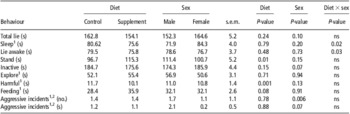
The effects of diet and sex are described in Table 7. There was no effect of diet, sex or interaction on overall time spent lying down. There was an interaction between sex and diet both for lying asleep (F 1, 63.3 = 5.48; P < 0.05) and lying awake (F 1, 84.7 = 5.07; P < 0.05; Table 7). Control female pigs spent more time lying asleep than did control males (91.6 ± 5.6 s v. 69.7 ± 5.6 s; P = 0.05), whereas there was no difference between female (77.1 ± 5.6 s) and male (74.2 ± 5.6 s) Supplement pigs. Supplement pigs tended to spend more time feeding than did control pigs (F 1, 62.4 = 3.11; P < 0.1).
Effect of diet and sex on the behaviour (mean ± s.e.m.) of focal pigs

ns = non-significant.
1In cases where transformed data were used in analysis, P-values refer to transformed data, but means and s.e.m. are calculated using raw data.
2Aggressive incidences include head knocks, bites and fights.
Male pigs performed more aggressive behaviours compared with females (F 1, 64.9 = 8.17; P < 0.01) and tended to spend longer time engaged in aggression (F 1, 16.9 = 3.71; P < 0.1; Table 7). There was no effect of diet on the number of incidents of aggression (sum of fights, bites and head knocks) or on the time pigs spent engaged in aggression (Table 7).
There was no effect of either diet or sex on overall time spent in exploratory behaviour (Table 7) or on the time spent performing tail-in-mouth, belly-nosing or ear-chewing behaviours. However, there was an effect of diet on the sum of the duration of these behaviours, with Supplement pigs spending less time performing harmful behaviours (Table 7).
Group behaviour
There was no effect of diet or sex on the frequency of tail-in-mouth, belly-nosing, ear-chewing or other harmful behaviours. More tail-in-mouth behaviour was recorded during the second weaner stage than during the early finishing period (0.022 ± 0.002 v. 0.014 ± 0.002 instances of tail-in-mouth behaviour/pig per min; F 1, 14 = 5.4; P = 0.05). There was no effect of diet or sex on the total frequency of harmful behaviours.
There was no effect of diet or sex on the number of fights, head knocks or bites. However, the total number of aggressive interactions was higher in control (0.124 ± 0.007/pig per min) compared with Supplement pigs (0.102 ± 0.007/pig per min; (F 1, 82.2 = 5.07; P < 0.01), and male pigs (0.148 ± 0.006/pig per min) were more aggressive than female pigs (0.077 ± 0.010/pig per min; (F 1, 84.5 = 46.77; P < 0.001). There was no interaction between diet and sex.
More mounting behaviour was observed in control male (0.014 ± 0.002) pigs than in Supplement male (0.005 ± 0.002; (F 1, 3.5 = 31.75; P < 0.01) pigs, and in the early finishing stage (0.012 ± 0.001) compared with the second weaner stage (0.007 ± 0.001; (F 1, 7.47 = 7.36; P < 0.05).
Health inspections
Tail lesions
Five outbreaks of tail-biting occurred where one pig had to be removed from the pen because of the severity of damage to tails. There was no more than one outbreak per pen where a pig had to be removed. For four out of the five outbreaks, the pig that was removed was reintroduced to the pen after 24 h, and in the fifth case the removed pig was reintroduced after 48 h. Overall, there were 12 outbreaks of tail-biting where the average tail lesion score of the pen was >4: Supplement male, n = 3; Supplement female, n = 4; Control male, n = 2; Control female, n = 3.
There was no effect of diet or sex on tail lesion scores, and no interaction between sex and diet. Tail lesion scores during acute outbreaks of tail-biting were higher (8.39 ± 0.42) than during weeks where there was no outbreak (1.10 ± 0.20; F 1, 44.1 = 48.5; P < 0.001).
Skin lesion scores
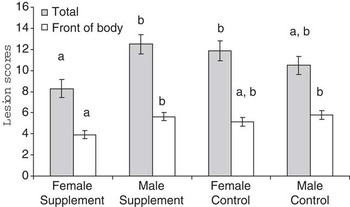
There was no effect of diet on skin lesion scores, but males tended to have higher scores (11.5 ± 0.6) compared with females (10.1 ± 0.6; F 1, 84.2 = 3.08; P = 0.08). There was an interaction between diet and sex (F 1, 84.6 = 7.22; P < 0.01). Skin lesion scores of female Supplement pigs were lower than those of female control pigs (P < 0.05) and of male Supplement pigs (P = 0.01; Figure 1). There was also an effect of week (F 7, 311 = 8.03; P < 0.001). In general, skin lesion scores increased until day 99 and decreased thereafter to the level recorded at the beginning of the study.
Skin lesion scores (mean ± s.e.) of male and female pigs fed either a control diet or diet supplemented with a mineral-rich dietary supplement (S) taken at weekly intervals between 63 and 120 days of age. Total scores of the back, left and right hind quarters, flanks, shoulders and ears were calculated according to severity (Table 6) and then summed (maximum score of 54). ‘Front of body’ refers to the sum of scores from the shoulders and ears (maximum score of 24). Differing superscripts within each skin lesion category indicate significant differences.

Control pigs tended to have higher skin lesion scores for the ears and shoulders (5.5 ± 0.3) compared with Supplement pigs (4.8 ± 0.3; F 1, 103 = 2.97; P = 0.09), and male pigs had higher scores (5.7 ± 0.3) than did female pigs (4.5 ± 0.3; F 1, 103 = 1.72; P < 0.01) for these areas. Female Supplement pigs had lower skin lesion scores for the ears and shoulders than did control and Supplement male pigs (P < 0.01, P < 0.05, respectively).
Salivary cortisol
Supplement pigs had lower salivary cortisol concentrations than did control pigs (1.30 ± 0.09 ng/ml v. 1.47 ng/ml; F 1, 143 = 7.1; P < 0.01). There was no effect of sex or interaction between sex and diet.
Performance
There was no effect of diet on pig live weight, feed intake or average daily gain. There were a total of 21 pig deaths during the experiment (Supplement, n = 11; Control, n = 10). The causes of death were as follows: hernia, n = 3; oedema, n = 17; pneumonia, n = 1.
Discussion
This study illustrates that Supplementation of the diet with Mg from an organic and therefore bioavailable source might have a role to play in improving pig welfare in intensive production systems. A multidisciplinary approach to the measurement of welfare was used in this study, which included health as well as behavioural and physiological indicators. Mg is important for monoamine neurotransmitter synthesis and receptor binding in the brain, and its deficiency has been associated with behavioural changes in rodents, such as increased defensive (Izenwasser et al., Reference Izenwasser, Garcia-Valdez and Kantak1986) and reduced offensive aggression (Kantak, Reference Kantak1988), depression and anxiety-related behaviour (Singewald et al., Reference Singewald, Sinner, Hetzenauer, Sarton and Murch2004). Aggressive behaviour and behaviours indicative of stress (such as harmful behaviours) can occur in intensively housed pigs. Thus, we hypothesised that provision of supplementary Mg from a bioavailable source could help ameliorate the expression of such negative behaviours.
We found that supplementation had beneficial effects on the frequency of aggressive and sexual behaviours, and it also appeared to reduce the time that pigs spent engaged in harmful behaviour. However, there was no effect on either tail-in-mouth behaviour or on tail injury scores, which were used as indicators of tail-biting. Nevertheless, the concurrently lower salivary cortisol levels recorded in supplemented pigs suggest that behavioural improvements were accompanied by a reduction in stress compared with control pigs.
The two behaviour recording methods that we used (all occurrence sampling at group level and continuous observations of focal pigs) allowed us to compare differences in behaviours that can be both discrete and short in duration, as well as longer lasting (e.g. tail-in-mouth behaviour, aggressive incidents). We wanted to detect both the overall occurrence of incidents of harmful and aggressive behaviour and also how long pigs spent performing them. The underlying motivation and the outcome of performance of different types of harmful or aggressive behaviours can be different. For instance, lots of quick tail ‘bites’ during a tail-biting ‘outbreak’ can cause much tail damage, whereas tail-in-mouth behaviour where one pig holds and manipulates the tail of another pig in its mouth for a prolonged period of time might not cause obvious damage to the tail but could predispose tails to damage during future outbreaks of tail-biting (Taylor et al., Reference Taylor, Main, Mendl and Edwards2010).
Even though there was a highly significant effect of supplementation on the time spent performing harmful behaviour by focal pigs, the data translated into a difference of only ∼1.6 s of behaviour out of a total of 5 min. However, it is important to note that when this time is multiplied by 24 h, and considered at pen level (14 pigs/pen), it translates into ∼1.75 extra hours of harmful behaviour performed by unsupplemented pigs each day. Admittedly, the amount of harmful behaviour performed at night is probably much less than during the day, and there was no difference in the frequency of harmful behaviour observed at group level. Nevertheless, if the duration spent in each harmful behaviour is shorter for supplemented pigs, the effect of supplementation on time spent performing harmful behaviour could be biologically meaningful.
Although the control pigs spent more time engaged in harmful behaviour than did pigs on the supplemented diet, there was no effect of diet on the incidence of harmful behaviours or on tail-biting outbreaks. The longer time spent standing by supplemented pigs could help explain why they spent less time engaged in harmful behaviour. The nature of belly-nosing means that certainly the recipient, and often the belly-nosing pig, is lying down. Similarly, ‘tail-in-mouth’ behaviour generally occurs when the recipient pig is either lying or sitting (Schrøder-Petersen et al., Reference Schrøder-Petersen, Heiskanen and Ersboll2004). Both the tail and the ears are in general less ‘available’ for chewing while pigs are standing.
There was no effect of supplementation on the performance of ‘tail-in-mouth’ behaviour. The absence of an effect of dietary treatment on the tail lesion scores or on the numbers of pigs that had part of their tails amputated suggests that this supplement did not prevent tail-biting. Moreover, the presence of tail injuries in a high proportion of pigs in most pens each week reflects persistently high levels of tail-directed behaviour.
Acute tail-biting outbreaks were a problem across both dietary treatments, particularly in the second weaner stage. It is possible that an underlying Escherichia coli infection that was present in the second-stage weaner accommodation, and that caused several deaths from oedema, was partly to blame (Taylor et al., Reference Taylor, Main, Mendl and Edwards2010). This theory is supported by the significant reduction in tail lesion scores between the second weaner and early finisher stages. Even under the conditions of this experiment, which was conducted on a well-managed unit, and with the provision of two forms of enrichment and a tail-biting management and treatment protocol, almost 35% of pigs suffered partial removal of the tail because of tail-biting. Thus, strict enforcement of EU legislation prohibiting routine docking means that the most severe outcome of tail-biting, amputation, is likely to become more common, unless more appropriate forms of enrichment than used in this study are provided within slatted pens.
Peeters et al. (Reference Peeters, Driessen and Geers2006) found that Mg supplementation reduced loin lesions in slaughter pigs and suggested that this was because pigs fought less as they were calmer. This is somewhat in agreement with what we found: fewer incidents of aggression at group level in supplemented pigs, and lower skin lesion scores in the front of the body in female supplemented pigs. Aggression is one of the most serious welfare problems for pigs of all ages in intensive pig production systems, and therefore the finding that it might be reduced through Mg supplementation is significant.
Although the reduction in aggression was seen at group level in both male and female supplemented pigs, it only translated into a reduction in skin lesion scores in females, particularly when the lesion scores for the ears, neck and shoulder were considered separately. These parts of the body are the most likely to be affected when pigs perform reciprocal aggressive behaviour (Turner et al., Reference Turner, Farnworth, White, Brotherstone, Mendl, Knap, Penny and Lawrence2006). We found that male pigs performed approximately twice as many aggressive behaviours as did females. Hence, it is possible that males in both treatments had a much higher number of lesions than do females. Our method of evaluating skin lesions put a lot of emphasis on the quality of a small number of lesions but not on the actual quantity of lesions, and therefore it may not have been sensitive enough to detect treatment effects when pigs had a large number of lesions. If this is not the explanation as to why there was no reduction in skin lesion scores of Mg-supplemented pigs, then it would only appear to reduce skin lesions when levels of aggression are low, which is a potential limitation. Male and female pigs are usually managed in mixed-sex groups on farms, and aggression can be lower in such groups compared with single-sex groups of entire males (Boyle and Bjorklund, Reference Boyle and Bjorklund2007). Thus, the effect of supplementation should also be investigated in such systems.
The reduction in incidents of aggression associated with Mg supplementation may have contributed indirectly to the reduction in mounting behaviour seen in the male supplemented pigs, as the two behaviours are linked. Testosterone production in boars is linked to, and increased by, aggressive behaviour (Edquist et al., Reference Edquist, Einarsson, Larsson and Lundström1980; Giersing et al., Reference Giersing, Lundstrom and Andersson2000). Increased testosterone production in turn has a stimulating effect on sexual development and consequently results in an increase in mounting behaviour (Giersing et al., Reference Giersing, Lundstrom and Andersson2000). Mounting by entire male pigs is a serious welfare and production concern (Fabrega et al., Reference Fabrega, Velarde, Cros, Gispert, Puarez, Tibau and Soler2010), and research on management strategies to reduce it has been of limited success (Conte et al., Reference Conte, Boyle, Lawlor and O'Connell2010 and Reference Conte, O'Connell, Lawlor and Boyle2012). It is likely that the production of entire male pigs may increase in the future, as restrictions on surgical castration are foreseen in the EU. Although immunocastration is promising (e.g. Cronin et al., Reference Cronin, Dunshea, Butler, McCauley, Barnett and Hemsworth2003; Fabrega et al., Reference Fabrega, Velarde, Cros, Gispert, Puarez, Tibau and Soler2010), there are concerns about consumer acceptance of the practice. Thus, other methods to reduce mounting are required. Our results provide interesting preliminary data regarding Mg supplementation, and further work measuring testosterone levels, as well as longer and more detailed behavioural measurements, could help elucidate the underlying mechanisms.
Salivary cortisol was collected at the same time each day, because basal levels of salivary cortisol follow a circadian pattern of secretion. Previous studies found either one (e.g. Ruis et al., Reference Ruis, Te Brake, Engel, Dinand Ekkel, Buist, Blokhuis and Koolhaas1997) or two (e.g. Hillman et al., Reference Hillman, Schrader, Mayer and Gygax2008) peaks in concentration per day. In either scenario, a peak generally occurs in the morning, and this is therefore a good time to compare differences between experimental treatments. Salivary cortisol concentrations reported in both treatments were similar to those in the literature where pigs were managed under similar conditions (Ruis et al., Reference Ruis, Te Brake, Engel, Dinand Ekkel, Buist, Blokhuis and Koolhaas1997; de Jong et al., Reference De Jong, Ekkel, van de Burgwal, Lambooij, Korte, Ruis, Koolhaas and Blokhuis1998; de Jong et al., Reference De Jong, Prelle, van de Burgwal, Lambooij, Mechiel Korte, Blokhuis and Koolhaas2000). However, cortisol concentrations were significantly lower in both male and female supplemented pigs. Barnett et al. (Reference Barnett, Cronin, McCallum, Newman and Hennessy1996) reported that a reduction in aggression is associated with lower levels of cortisol in pigs, which could partly explain our findings. It is also possible that the lower frequency of mounting behaviour could also have contributed to a calmer environment in which stress levels were lower. Lower circulating concentrations of cortisol in pigs could also help explain the reductions in gastric ulceration previously reported in pigs supplemented with this compound (Koolhaas et al., Reference Koolhaas, Korte, de Boer, Van der Vegt, van Reenen, Hopster, De jong, Ruis and Blokhuis1999; Kluess et al., Reference Kleuss, Fledderus, Bikker and Llamas-Moya2006).
Conclusions
Supplementation with a mineral-rich marine product reduced aggressive and harmful behaviours in both sexes, sexual behaviour in entire males and skin lesion scores in females, thereby offering improvements to the welfare of growing pigs in an intensive production system. This is supported by the lower concentrations of salivary cortisol found in supplemented pigs. Further work should be conducted to investigate pigs in mixed-sex groups that could benefit from supplementation.
Acknowledgements
The authors gratefully acknowledge the technical assistance of Tomas Ryan and all the staff of the pig unit for their care of the experimental animals. We also thank Peadar Lawlor for his assistance in diet formulation, and Dayane Lemos Teixeira for her help in running the experiment.