Few chant manuscripts from German-speaking Europe have attracted as much scholarly attention as the mid-twelfth-century gradual, Graz, University Library, MS 807,Footnote 1 one of the earliest such sources from the region with neumes on staves.Footnote 2 Not only are the place of copying and provenance uncertain, but also the question of which particular liturgical custom it represents has remained open until fairly recently.Footnote 3 A consensus has emerged that it reflects the use of the canonesses of KlosterneuburgFootnote 4 whereas earlier scholarship assigned it to different Augustinian communities in southern Germany and Austria.Footnote 5
The contents of Graz 807 are fairly conventional. Comprising twenty-one well-preserved quaternions, which survive in much the same form as when they were copied, it contains Masses from Advent I to the Sundays after Pentecost (fols. 1v–162v); alleluias for the Common of Saints and the Dedication of the Church (162v–167r); introit tropes for Christmas, St Stephen, St John and Holy Innocents (167r–168r); and a Mass for St Vincent added by the main scribe to the formerly void closing folio (168v). Yet Graz 807 also contains a number of errors, corrections and omissions that have themselves drawn scrutiny. Besides the alterations to its chant melodies, which Hubert Sidler identified in 1950,Footnote 6 Jacques Froger noted a number of oversights and corrections in his introduction to the 1974 facsimile edition.Footnote 7 Among these was the omission of the Mass for St Vincent from the Sanctorale and its addition on the manuscript's final folio, with a corresponding marginal note on fol. 32v where it should have been copied. Froger also identified nearly thirty less serious copying errors, with the missing texts and sometimes music subsequently added to the margins. Most puzzling is the unusual placement of the Mass for the Dedication of the Church between the Masses for the Purification on 2 February and St Agatha on 5 February, which will be discussed at the end of this article.
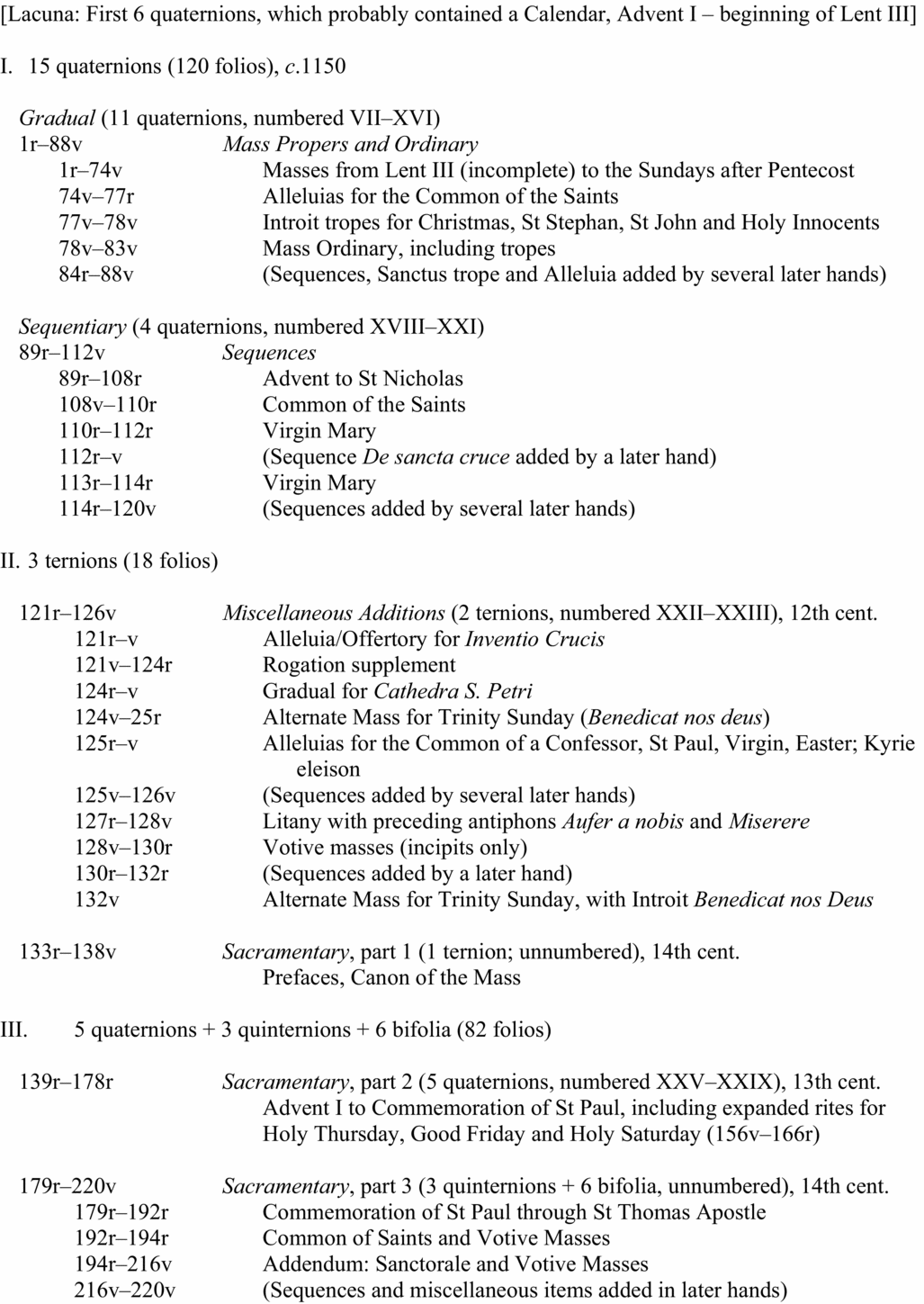
Often paired with Graz 807 in the scholarly literature is another twelfth-century gradual, Vienna, Austrian National Library, latin 13314, putatively connected with Klosterneuburg. Purchased in 1855 from the town of Perchtoldsdorf some sixteen kilometres southwest of Vienna,Footnote 8 it has a more confused provenance than Graz 807 due to its complex composite structure, which challenges description and permits varying partitions. Franz Karl Praßl divided the volume into three sections – a gradual, a sequentiary and a sacramentaryFootnote 9 – but this division obscures the two supplementary gatherings which separate the gradual from the sacramentary. In line with Robert Klugseder's more recent description,Footnote 10 I also divide the manuscript into three sections but according to the structure of its gatherings (see Fig. 1).
Structure and contents of Vienna, Österreichische Nationalbibliothek, MS lat. 13314.

Yet even this division is not fully satisfactory as it ignores both the chronology that governed the manuscript's compilation and the internal relationship of its parts. It is, in fact, a multilayered document comprising two sections: a twelfth-century section including the gradual, sequentiary and supplements, all with unheighted German neumes, followed by a sacramentary in two parts, the first from the fourteenth century containing prefaces and the canon of the Mass, the second from the thirteenth and fourteenth centuries containing collects, post-communion prayers and secrets. Like Graz 807, scholars had assigned Vienna 13314 to different south German and Austrian Augustinian communities,Footnote 11 but most now agree that the gradual and sequentiary reflect the use of Klosterneuburg's canons;Footnote 12 the use of the sacramentary has yet to be identified.
The Rogationtide processions
The corpus of antiphons for the Rogationtide processions is well documented.Footnote 13 With respect to sources under consideration here, Froger noted that six Rogationtide antiphons in Graz 807 also found in A-KN 588, a fourteenth-century gradual associated with the canonesses of Klosterneuburg, are absent in other Klosterneuburg chant books.Footnote 14 In 2008, Klugseder noted that twelve antiphons for the Rogationtide processions shared between Graz 807 and Vienna 13314 are lacking from most other Klosterneuburg manuscripts.Footnote 15 There is more to this, however.
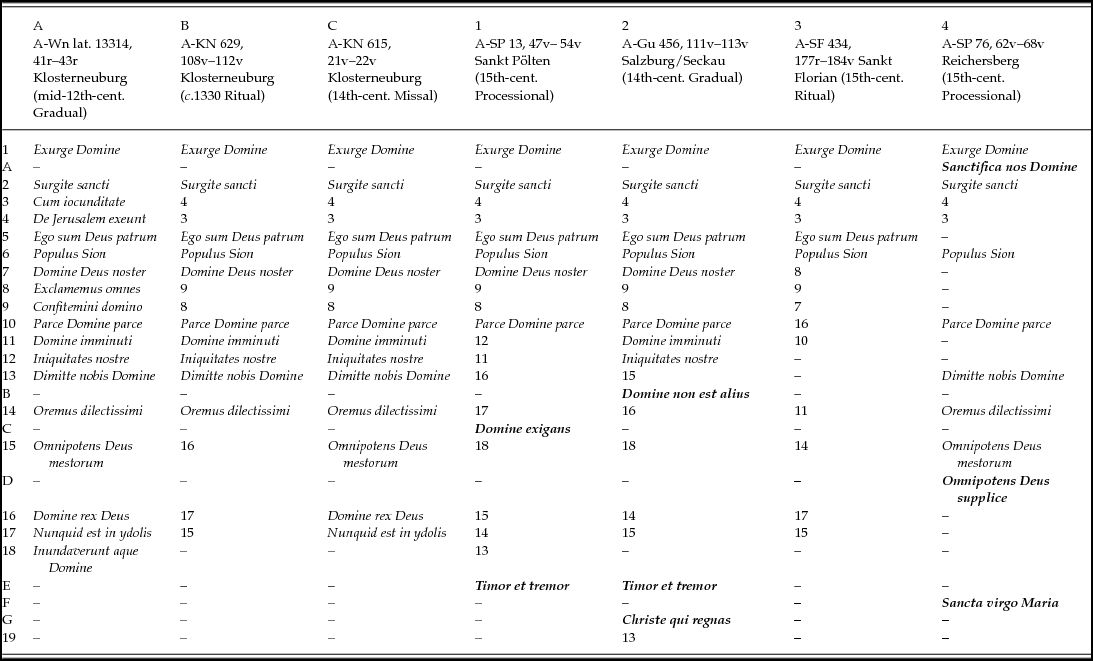
Table 1 lists the Rogationtide antiphons in the gradual section of Vienna 13314 (column A) along with those in two fourteenth-century Klosterneuburg manuscripts (columns B–C) and four sources from other south German and Austrian Augustinian houses (columns 1–4). The list of Rogationtide antiphons in Vienna 13314 for the most part conforms to those of the later Klosterneuburg manuscripts though the order differs here and there. The other south German and Austrian Augustinian sources surveyed in Table 1 generally contain fewer Rogationtide antiphons than the Klosterneuburg sources, though they typically include one or more chants not found in Klosterneuburg series.
Rogationtide antiphons in Austrian Augustinian manuscripts.
Note: bold indicates items not found in the Klosterneuburg series.
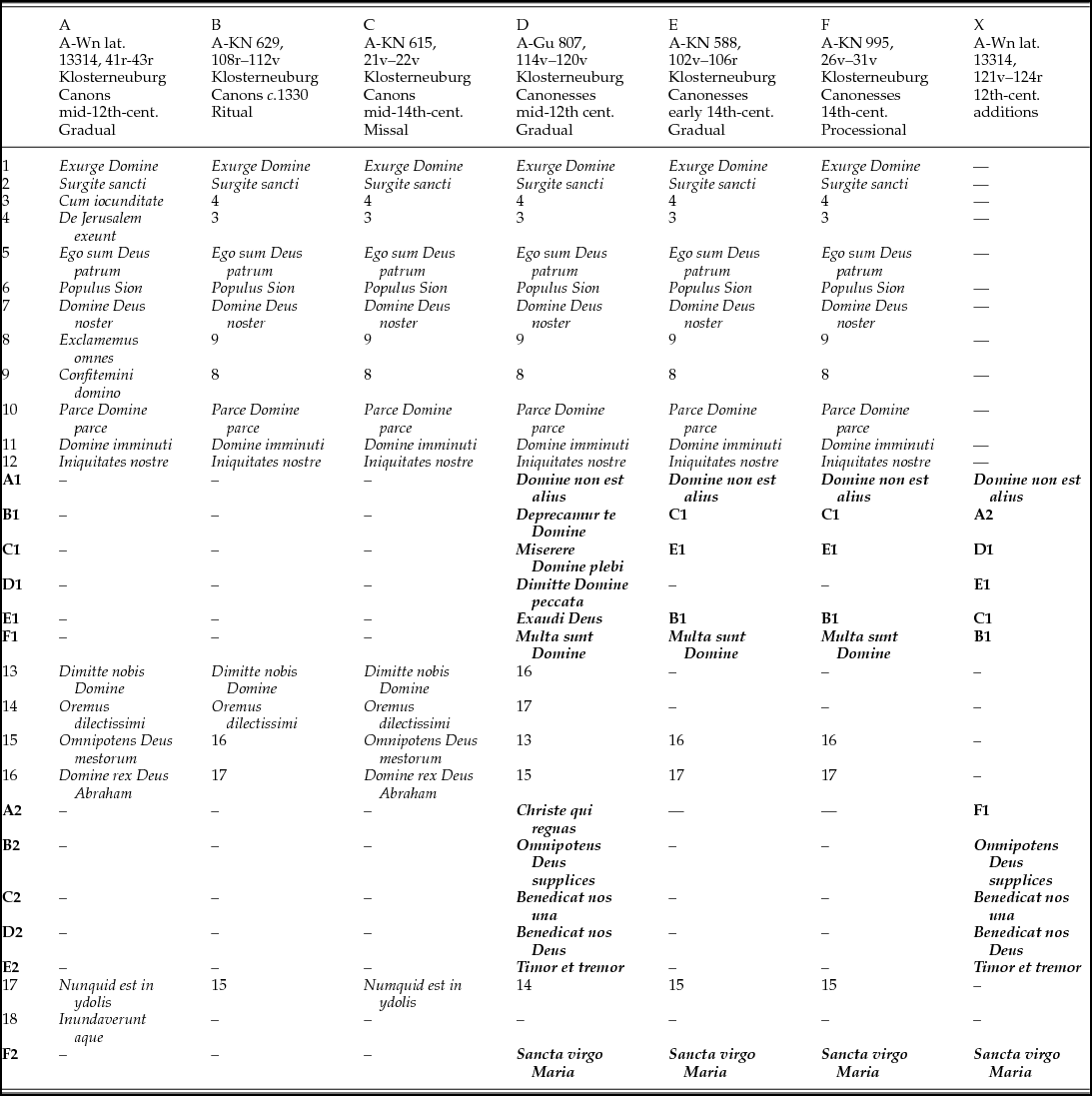
By contrast, Graz 807, intended for Klosterneuburg's canonesses, contains more Rogationtide antiphons than chant books for the canons’ use. Table 2 compares antiphons of Klosterneuburg's canons with those in Graz 807 and other sources safely assigned to Klosterneuburg's canonesses, namely A-KN 588, a fourteenth-century gradual (long associated with the canonesses thanks to the opening initial which depicts a praying nun) and A-KN 995, a fourteenth-century processional.Footnote 16
Rogationtide antiphons in manuscripts for the Klosterneuburg canons (including additions to A-Wn lat. 13314) and canonesses.
Note: bold indicates items unique to the canonesses.
Note that Graz 807 (Table 2, column D) contains twelve Rogationtide antiphons found neither in the canons’ series (Table 2, columns A–C) nor in any of the other south Germany and Austrian Augustinian sources (Table 1, columns 1–4). Of the twelve antiphons, one group of six is situated after the twelfth item in the men's series (Table 2, A1–F1); a second group (A2–F2) is inserted at the end. The first group is more or less retained in later manuscripts connected with the canonesses (Table 2, columns E–F) – note the reordering as well as the absence of Dimitte Domine peccata (D1). The second group is lacking save for Sancta virgo Maria (F2), which concludes the series.
An intriguing finding of Table 2 is the inclusion of all twelve Graz 807 antiphons in the first twelfth-century supplement to Vienna 13314, a book originally intended for the canons (Table 2, column X). These concordances further solidify these manuscripts’ connections with Klosterneuburg, and further suggest that the supplement's scribe had knowledge of Graz 807 or another manuscript unknown to us but with nearly identical content. To examine the question of where these manuscripts may have been brought together, a closer look at the sacramentary of Vienna 13314 is in order.
The Vienna 13314 sacramentary
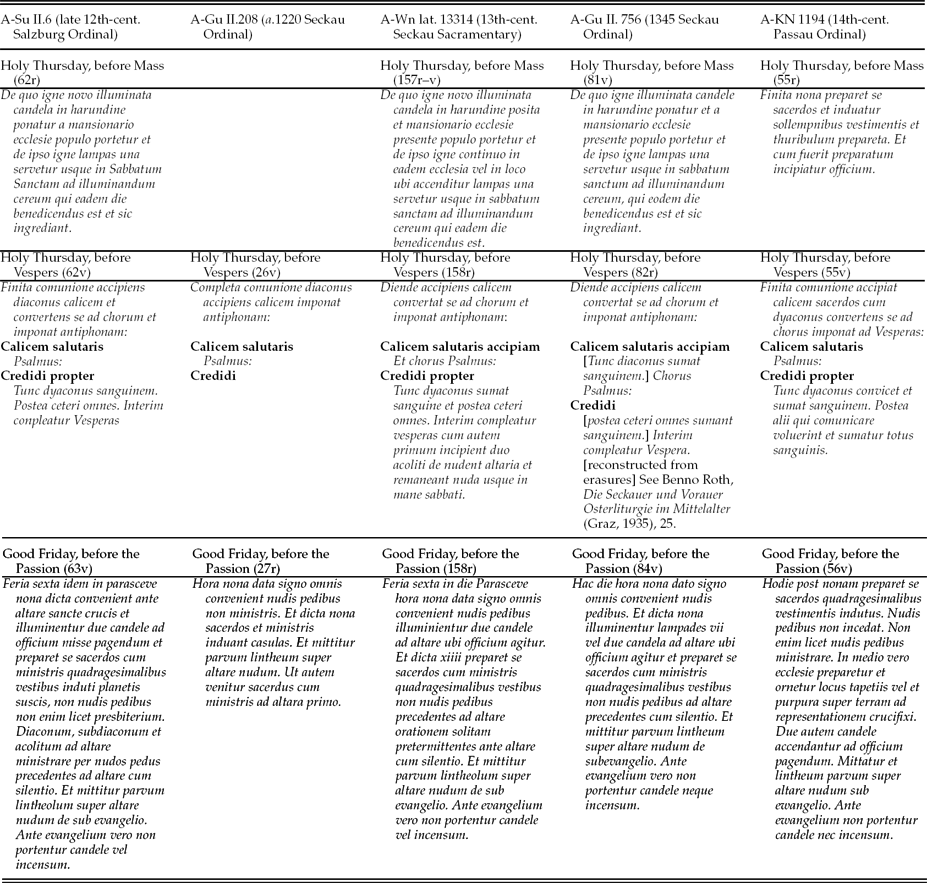
As noted above, the sacramentary of Vienna 13314 has two large divisions (Fig. 1). The first, copied in the fourteenth century, comprises prefaces and the canon; the second contains collects, secrets and post-communion prayers. The second section, which appears well used with many marginal notations, is divided into two parts. The first, copied in the thirteenth century, extends from the first Sunday of Advent to the middle of the Commemoration of St Paul. The second, copied in the fourteenth century and presumably replacing worn-out or damaged leaves, picks up with the Commemoration of St Paul and carries forward through the Sundays after Pentecost and the Common of Saints, with a number of supplementary items appended. The rites for Holy Thursday, Good Friday and Holy Saturday are given expanded treatment in the midst of the thirteenth-century section. The rubrics here mostly follow those of ordinals from the cathedral in Salzburg, as shown in Table 3, which compares several rites from Holy Thursday and Good Friday described in Vienna 13314 with to those in the earliest ordinal from Salzburg cathedral, two ordinals from Seckau, and an ordinal representing the use of the cathedral of Passau.
Correspondence between ordines for Holy Thursday and Good Friday in Salzburg, Seckau and Passau ordinals.
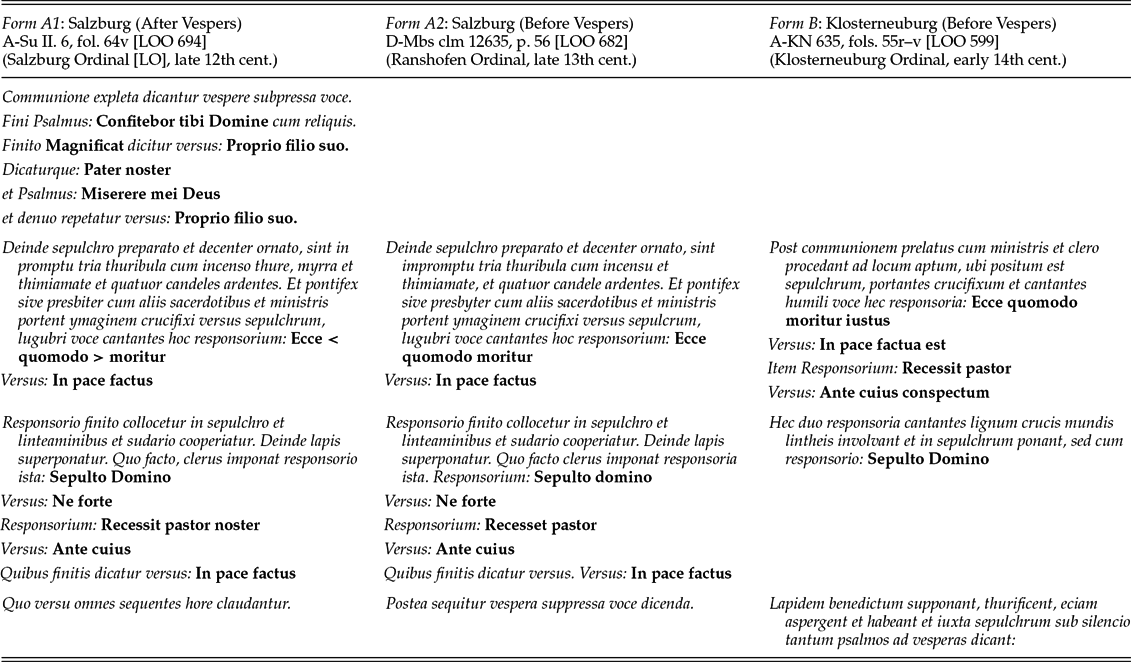
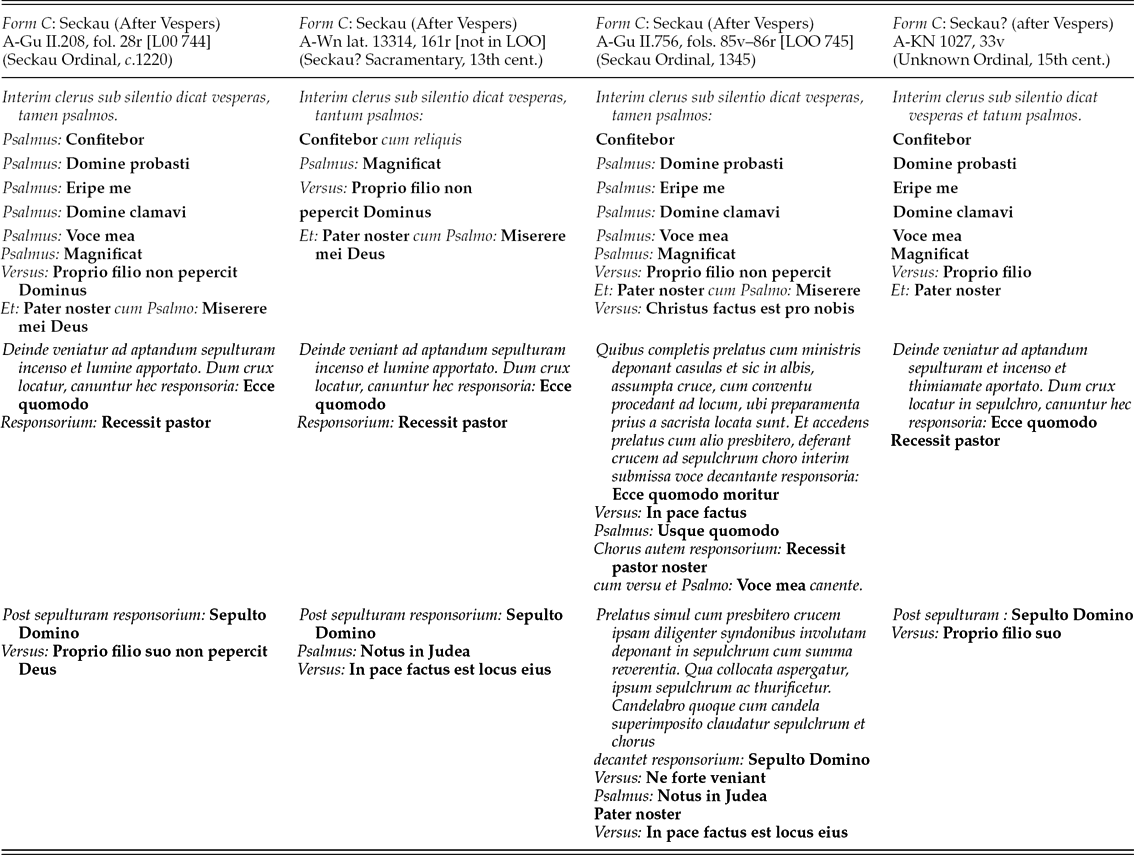
Included among the expanded rites of Holy Week is a previously unacknowledged setting of the Depositio crucis on Good Friday, the first in a series of sepulchre rites that typically culminated with the Visitatio sepulchri on Easter morning.Footnote 17 The Depositio crucis was associated with second Vespers on Good Friday in south German and Austrian Augustinian houses.Footnote 18 Like ordines for the Elevatio crucis and Visitatio sepulchri on Easter, the Depositio varied greatly, such variability in turn helping connect ceremonies to specific communities. While most south German and Austrian Depositio ordines (including those from Passau and other institutions) adopt the form found in Salzburg ordinals, ordines from the Augustinian communities of Klosterneuburg (diocese of Passau) and Seckau (diocese of Salzburg) are particular to these institutions. Table 4a compares ordines from Salzburg Cathedral and elsewhere (A1, A2) and those from Klosterneuburg (B). (In Salzburg, the rite was celebrated either before Vespers (A1) or afterwards (A2).) Table 4b gives ordines from Vienna 13314: two Seckau ordinals (Graz 208 from the early-thirteenth centuryFootnote 19 and Graz 756 copied in 1345Footnote 20), and a fifteenth-century ordinal of uncertain use, namely A-KN 1027.Footnote 21
Depositio crucis, forms A1, A2 (Salzburg) and B (Klosterneuburg).
Depositio crucis, form C (Seckau).
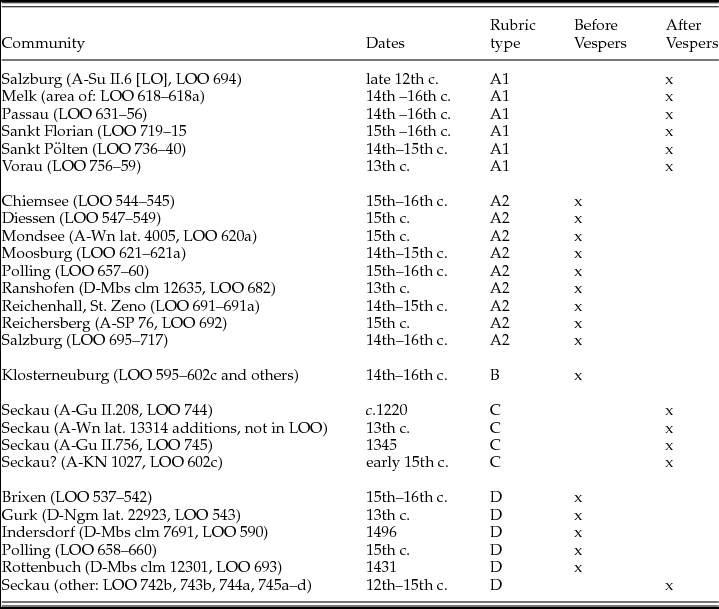
Table 5 presents the placements for the Depositio crucis in south Germany and Austrian manuscripts as given in Walther Lipphardt's Lateinische Osterfeiern und Osterspiele. These are divided into five groups depending on whether the rite was performed before or after Vespers and according to the rubrics that describe them. The manuscripts listed under rubric form D contain either a unique set of rubrics or rubrics too insufficient to categorise.
Rubrics and placement of the Depositio crucis in south German and Austrian manuscripts.
Distinguishing the Seckau Depositio crucis is the rubric that announces Vespers (‘Interim clerus sub silencio dicat Vesperas’) followed by the rubric that introduces the Depositio itself (‘Deinde veniatur ad aptandam sepulturam’), both of which are unique to these manuscripts (although the latter phrase is missing from Graz 756).
The Holy Week rites in the sacramentary are consistent with those in both the early and the later Seckau ordinals, but it is not clear when the sacramentary was appended to the twelfth-century Klosterneuburg gatherings and its supplements. Praßl speculated that the manuscript was intended as a missal at the outset and that the sacramentary reflects a twelfth-century core.Footnote 22 But the gathering numbers added to the twelfth-century gradual and to the thirteenth-century portion of the sacramentary suggest that the sacramentary may not have been added until the following century (see Fig. 1).
The Dedicatio ecclesiae of Graz 807
Situating the liturgy expressed by Graz 807 geographically would likely be a settled issue were it not for the placement in early February of the Mass for the Dedication of the Church. Froger was unable to find any church whose dedication fell between 2 and 5 February,Footnote 23 and while many have experimented with assigning the manuscript to churches whose manuscript tradition was sparse,Footnote 24 none have found a convincing solution.
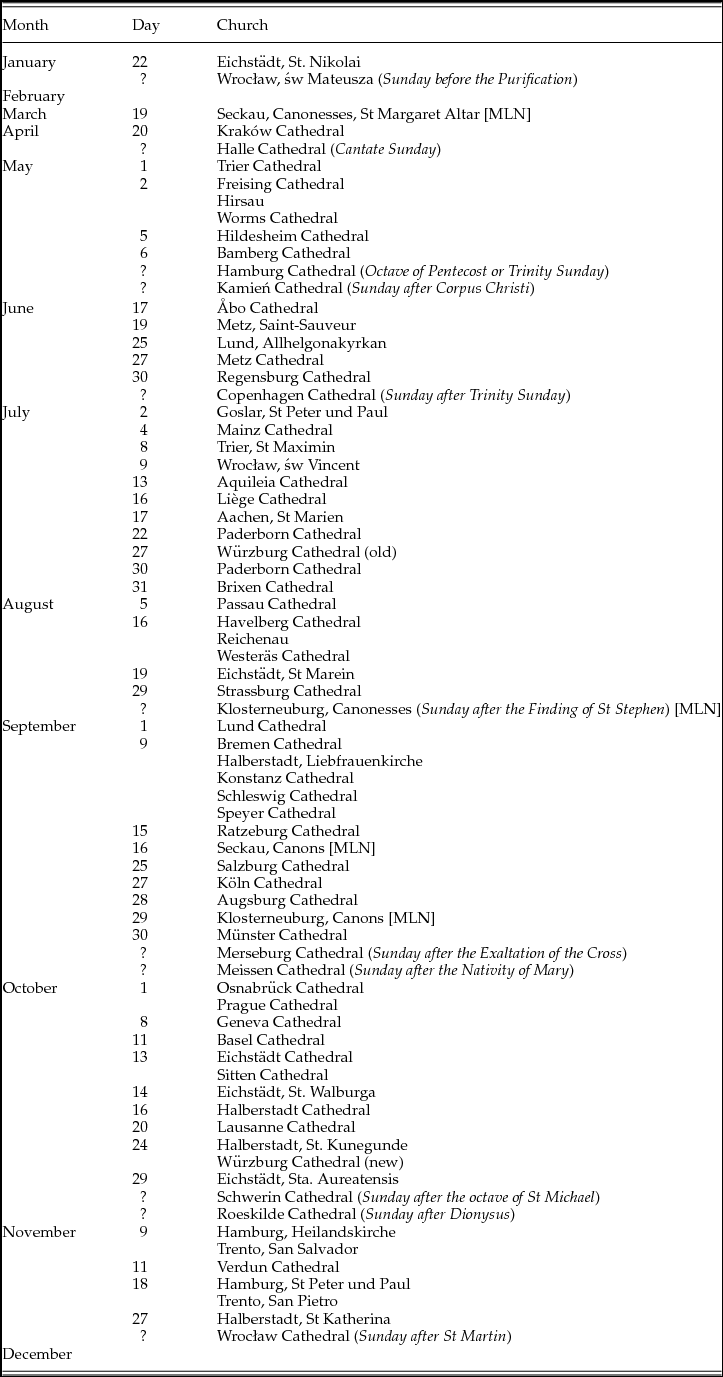
Locating the rite for the Dedication of the Church in early February is problematic for two reasons. First, the typical placement for the Mass for the Dedication in most Austrian and all Klosterneuburg graduals is 13 May, corresponding to Pope Boniface's consecration of Sancta Maria ad Martyres in Rome on 13 May 609 (when the Mass Terribilis was introduced), placing the Mass in these manuscripts just before the Vigil of the Ascension.Footnote 25 Second, and more to the point, early February is an odd time for a church dedication. Given the vicissitudes of winter across much of Europe, especially within or north of the Alps, and the assemblage of persons required to attend such an event, scheduling a consecration in early February would perhaps have been ill-advised. Indeed, church dedications were almost never commemorated in wintertime, as indicated in Table 6, which is based mainly Hermann Grotefend's compilation with added dates from Klosterneuburg and Seckau.Footnote 26 Although the lists of calendars on which Grotefend relied skew towards episcopal cities and is based largely on evidence gathered from fifteenth- and sixteenth-century printed liturgical books, the pattern is clear and probably representative of the broader complex of medieval churches: most dedications are celebrated between Easter and Advent, with only two in the heart of winter. These were celebrated in episcopal cities where the practicalities of travel would not have proven so burdensome.
Dates for church dedications ([MLN]: Klosterneuburg and Seckau).
If the feast of the dedication was not placed to coincide with the anniversary of the church's consecration, then why insert it between the feasts of the Purification and St Agatha? It might have been an error, a scribal mistake serious enough to lower its utility for the women of Klosterneuburg but leaving the manuscript valuable enough to offer up to others. It is also possible that the scribe placed the Mass of the Dedication after that of the Purification intentionally. If the manuscript were destined for a church dedicated to St Blaise, for example, placing the Mass for the Dedication to correspond to his feast on 3 February might make sense. If this were the case, though, we might expect to find a Mass for St Blaise in Graz 807, but there is none. Other possibilities exist. Aside from the association of Mary's purification with the consecration of a house of female religious, the feast of the Purification also served as an appropriate date for the profession of nuns, as both Huglo and Klugseder have noted,Footnote 27 thus offering an evocative juxtaposition of the purification of the Virgin, the purification (consecration) of virgins and the consecration of the sacred space within which they dwell.
The Path to Seckau
In summary, the twelfth-century cores of both Graz 807 and Vienna 13314 reflect the liturgical uses of the canonesses and canons of Klosterneuburg respectively. The two manuscripts were likely held together in the twelfth century. The most likely location where these manuscripts would have been housed from the mid-twelfth until some point in the fourteenth century was the Augustinian monastery (and later cathedral) at Seckau. The unusual placement of the Dedication of the Church in Graz 807, which has proven the only impediment for accepting the canonesses of Klosterneuburg as the source for the liturgy expressed, may have been an error. It may, however, have been deliberately situated there to enhance the resonance of merging the rite of the Purification of the Virgin with the rite for the purification of virgins (the rite of profession) and the rite for the consecration of sacred space.
How then did these manuscripts find their way to Seckau? Froger, following the speculations of Maria Mairold and Pius Fank, librarians at Graz and Vorau respectively, speculated that Graz 807 might have been brought to Seckau as a gift when the church was dedicated in September 1164.Footnote 28 While the evidence to support this may have been weak, Froger had good reason to think along these lines, having already shown a strong connection between the liturgy of Graz 807 and that in other Klosterneuburg manuscripts. Moreover, both Bishop Hartmann of Brixen, who dedicated the new church, and Archbishop Konrad II of Salzburg, in whose stead Hartmann was acting, had strong ties to Klosterneuburg. Hartmann had served as the first prior of Klosterneuburg,Footnote 29 while Konrad, a son of Klosterneuburg's founders, had likely spent his youth there during Hartmann's tenure.Footnote 30 Given these connections, I would extend Froger's speculation by proposing that Vienna 13314 and Graz 807 were offered to the canons and the canonesses at Seckau as a set by their counterparts at Klosterneuburg some time between the first founding of the community in 1140Footnote 31 and the dedication of the canons's church on 16 September 1164. This, of course, I cannot prove, and there are any number of counter-arguments that could be raised against it. The hypothesis does, however, have the virtue of simplicity. At the very least, it makes plausible the story of the genesis and exodus of these two important graduals from twelfth-century Austria.
* * *
On a personal note I regret having not known Michel Huglo beyond a few brief encounters. My knowledge of him comes instead from his extraordinary body of work, a collection of such magnitude that any one of his contributions, as David Hiley recently observed, would consume a lifetime for the rest of us.Footnote 32 Graz 807 was of particular interest to him, and that inspired me to contribute this study.