INTRODUCTION
Plants are subjected to natural defoliation as a result of herbivore attack (Dirzo Reference DIRZO, Dirzo and Sarukhán1984, Marquis Reference MARQUIS1984) and mechanical damage due to storms and branch fall (Álvarez-Clare & Kitajima Reference ÁLVAREZ-CLARE and KITAJIMA2009, Clark & Clark Reference CLARK and CLARK1989). More than 10% of plant productivity in natural systems can be consumed annually by herbivores (Coley Reference COLEY1983), and because defoliation results in the loss of biomass and photosynthetically active tissue, it has the potential to reduce growth and fitness (Crawley Reference CRAWLEY1989). In response to defoliation, plants may compensate for lost tissue by increasing growth relative to non-defoliated plants to compensate for lost tissue (i.e. compensatory growth) (McNaughton Reference MCNAUGHTON1979). For example, seedlings of tropical woody species subjected to experimental defoliation have been shown to exhibit compensatory growth of biomass, stems, leaves and height, relative to control plants (Boege Reference BOEGE2005, Massey et al. Reference MASSEY, PRESS and HARTLEY2005). Similar responses have been reported for other tropical woody, herbaceous and palm species (Canto et al. Reference CANTO, PARRA-TABLA and GARCIA-FRANCO2004, Oyama & Mendoza Reference OYAMA and MENDOZA1990, Parra-Tabla et al. Reference PARRA-TABLA, RICO-GRAY and CARBAJAL2004). Numerous studies have addressed responses to defoliation, but it is still unclear how the degree of compensatory growth is related to resource availability (Hawkes & Sullivan Reference HAWKES and SULLIVAN2001, Strauss & Agrawal Reference STRAUSS and AGRAWAL1999, Wise & Abrahamson Reference WISE and ABRAHAMSON2005).
We studied three models that predict compensatory growth responses in plants. The first model argues that compensatory growth of plants in response to herbivory should be greater in low-resource environments relative to high-resource environments because plants in low-resource environments are often growing well below their maximum potential growth rates (Hilbert et al. Reference HILBERT, SWIFT, DETLING and DYER1981). This model has been called the growth rate model (GRM) (Hicks & Turkington Reference HICKS and TURKINGTON2000), and has been primarily utilized in predicting growth responses to grazing in grasslands (McNaughton Reference MCNAUGHTON1979). In contrast to the GRM, the compensatory continuum hypothesis (CCH) (Maschinski & Whitham Reference MASCHINSKI and WHITHAM1989), predicts that herbivory should lead to a greater increase in compensatory growth over control plants under higher resource availability than lower resource availability, because greater resource availability would facilitate replacement of lost tissue. It is notable that the predictions of these two models are based on only one resource. Therefore, the recently proposed limiting resource model (LRM) (Wise & Abrahamson Reference WISE and ABRAHAMSON2005), addresses compensatory growth responses to herbivory for two resources: a focal and an alternative resource. The LRM shows that plants may display greater, equal, or lower, compensatory growth in high- compared with low-resource environments, leading to seven possible scenarios. According to the LRM, as the availability of the focal resource increases, plant compensatory responses to herbivory may become increasingly limited by an alternate resource. This study evaluates the responses of two lowland tropical forest plant species to experimental defoliation along a light resource gradient, within the theoretical framework of these three models.
Although most studies of the responses of plants to herbivory have focused on the role of nutrient availability (Wise & Abrahamson Reference WISE and ABRAHAMSON2007), light is often the limiting resource in forest understorey environments (Chazdon Reference CHAZDON1988). When a forest gap is created, understorey light availability increases, favouring the growth of light-limited plants (Denslow Reference DENSLOW1987). Therefore, changes in light availability driven by gap dynamics could influence the compensatory growth capacity of plants in the face of potential defoliation events, because it has been shown that tropical plant species increase growth with greater light availability (Iriarte-Vivar & Chazdon Reference IRIARTE-VIVAR and CHAZDON2005, Lopez-Toledo et al. Reference LOPEZ-TOLEDO, MARTÍNEZ, VAN BREUGEL and STERCK2008, Poorter Reference POORTER1999). Although light is a fundamentally different resource relative to the below-ground resources of nutrients and water, we expected compensatory growth responses to defoliation to function within the conceptual framework of these three models. We tested this prediction with seedlings of two woody species from Calakmul, Mexico, Brosimum alicastrum and Vitis tiliifolia. We hypothesized that: (1) in B. alicastrum and V. tiliifolia, light will have a positive effect on growth responses to defoliation; (2) in response to defoliation, B. alicastrum and V. tiliifolia will increase physiological components of relative growth rate (RGR) in high light and morphological components of RGR in low light; (3) responses to defoliation can be predicted by the CCH and the LRM.
METHODS
Study site and species
The study was conducted in seasonally dry lowland tropical forest at Calakmul Biosphere Reserve (Reserva de la Biósfera de Calakmul; RBC), in the state of Campeche, Mexico (18°19′N, 89°52′W). The climate is tropical, with summer rains, a mean annual precipitation of 1141 mm, and mean annual temperature of 25 °C (García Reference GARCÍA1988). Estimates of total plant richness in Calakmul range from 1569 to 1600 species in the 723,185-ha reserve (Carabias-Lillo et al. Reference CARABIAS-LILLO, PROVENCIO, DE LA MAZA-ELVIRA and RODRÍGUEZ DE LA GALA MÉNDEZ2000, Martínez et al. Reference MARTÍNEZ, SOUZA and RAMOS-ÁLVAREZ2001).
We collected seeds from four adult plants of Vitis tiliifolia Humb. & Bonpl. (Vitaceae) and Brosimum alicastrum C.C. Berg (Moraceae) from medium-height semi-evergreen tropical forest. Vitis tiliifolia is a fast-growing liana species that can reach the top of the forest canopy and up to 20 cm in stem diameter (Adams Reference ADAMS1972) and is distributed from Mexico to Colombia, Venezuela, Peru and Ecuador (Lombardi Reference LOMBARDI2001). There are reports of chewing and scraping herbivory on this species from lowland forest in Panama (Van Bael et al. Reference VAN BAEL, AIELLO, VALDERRAMA, MEDIANERO, SAMANIEGO and WRIGHT2004). Brosimum alicastrum is a shade-tolerant co-dominant evergreen canopy tree species reaching 20–45 m height, and up to 1.5 m in diameter (Martínez et al. Reference MARTÍNEZ, SOUZA and RAMOS-ÁLVAREZ2001). It is native to tropical forests of the Americas, and is distributed from southern Mexico to Colombia, Peru and Venezuela, as well as Caribbean islands. It suffers defoliation from mammals, insects (gall-makers, miners and leaf-chewers), and parasites (De La Cruz & Dirzo Reference DE LA CRUZ and DIRZO1987). We chose these two plant species because they are both very common at the study site and appear susceptible to herbivores in natural conditions (Ballina-Gómez et al. Reference BALLINA-GÓMEZ, IRIARTE-VIVAR, ORELLANA and SANTIAGO2008).
Experimental treatment
The experiment was conducted in the botanical garden of the Centro de Investigación Científica de Yucatán (CICY), Merida, Mexico, which has a similar temperature compared to RBC, but is slightly drier with a mean annual precipitation of 940 mm. Seeds were germinated in an open greenhouse on plastic trays in a 3:1 mix of soil from the seed collection site at RBC and perlite. Germination took place under a photosynthetic photon flux density (PPFD) of 11.67 mol m−2 d−1 (16% full sun) measured with a quantum sensor (Li-250A, Li-Cor, Lincoln, NE, USA). Average daytime temperature and relative humidity were 33.6 °C and 52%, respectively, and were measured with a digital thermohygrometer (Model 4096, Control Company, Friendswood, TX, USA).
Once seedlings were 17 wk old, they were transplanted to black polyethylene bags using the same substrate mix. All seedlings were watered every 2–3 d, based on a visual inspection of soil humidity. Seedlings were placed in the botanical garden in sites that matched the canopy openness, forest type and structure of the forest where seeds were collected. By controlling for canopy openness, we simulated two replicates of each of three different midday light availability levels (1%, 9% and 65% of full sun) within the botanical garden. Each site had an east-to-west orientation parallel to daily sun movement. Within each replication of light availability, we placed three seedlings for each defoliation level (0%, 50% and 90%) per species. The resulting design constituted a split-plot design, for which the light effect was the main plot and the defoliation effect was the subplot. A total of 54 seedlings was used for each species. Each light treatment replicate physically consisted of a 2-m long by 1-m wide by 1.5-m high structure covered by white mesh in order to exclude potential herbivores. For all three light levels, PPFD, temperature and relative humidity measurements were taken every 2 h between 06h00 and 18h00 at the end of the dry season (March) and at the beginning of the wet season (June). Light treatments were: (1) Low (1% PPFD, 0.57 mol m−2 d−1) with a temperature of 33 °C and relative humidity of 70%; (2) Intermediate (9% PPFD, 4 mol m−2 d−1), with a temperature of 33 °C and relative humidity of 62%; (3) High (65% PPFD, 30 mol m−2 d−1) with a temperature of 36 °C and relative humidity of 64%. Diurnal light measurements were taken during clear days, and percentages were calculated relative to PPFD in a nearby clearing.
The defoliation treatment levels imposed on 17-wk-old seedlings were: 0% (control), 50% and 90% leaf removal. For the control treatment, we did not remove any leaves from the seedlings. In the 50% treatment, every second leaf was removed starting with the second youngest leaf. In the case of the 90% treatment level, except for the youngest leaf, all other leaves were removed. Total leaf area, and leaf area removed were verified with an area meter (Li-3000A, Li-Cor). We utilized a broad range of defoliation values based on observations at Calakmul, where mammalian herbivory can remove up to 100% of leaf area in Brosimum alicastrum (Ballina-Gómez et al. Reference BALLINA-GÓMEZ, IRIARTE-VIVAR, ORELLANA and SANTIAGO2008). Because different herbivores damage leaves in contrasting ways, we were not logistically able to replicate this variation, so entire leaves were removed as a way of standardizing defoliation.
Growth analyses
For each of six seedlings per species, we recorded initial height, diameter (2 cm above the soil), number of new leaves, foliar area, and leaf, stem, petiole and root biomass. All measurements were performed at the beginning of the experiment and upon harvest. Structures were dried at 55 °C for 48 h or until constant mass. Root collection was performed by submersion in water to soften and separate soil from root tissue. Remaining seedlings were harvested after 50 d. By using initial and harvest measurements, it was possible to calculate the relative growth rate of biomass (RGRB), leaf area (RGRLA), leaf area ratio (LAR), specific leaf area (SLA), leaf weight ratio (LWR) and net assimilation rate (NAR) (Hunt Reference HUNT1978).
In addition we calculated the leaf production rate (LPR = (final leaves – initial leaves)/initial leaves).
Data analyses
Prior to analysis, the data were log-transformed to meet assumptions of normality. After transformation, the data showed a normal distribution and satisfied the assumptions of homoscedasticity and sphericity. Split-plot ANOVA was conducted for each species to determine the effects of defoliation and light availability on growth indices: RGRB, RGRLA and LPR, and the morphological (LAR, SLA, LWR) and physiological (NAR) components of RGRB. We utilized post hoc pairwise mean comparisons (Tukey tests) to compare treatment-level means for significant factors in the ANOVA. To examine the contribution of intraspecific changes in LAR, SLA, LWR and NAR to changes in RGRB in response to resource availability, we calculated Pearson correlation coefficients between RGRB and its components across the treatment combination of light × defoliation. All statistical analyses were performed in Systat 11.0 for Windows and SPSS 11.5.0 for Windows.
RESULTS
In Brosimum alicastrum, initial plant biomass was 2.6 ± 0.1 g (mean ± 1 SE) and final biomass ranged from 4.3 ± 0.6 g under 90% defoliation to 7.7 ± 0.8 g in control treatments. Initial leaf number for Brosimum alicastrum was 4.6 ± 0.5, and final leaf numbers ranged from 5.8 ± 0.6 under 90% defoliation to 13.9 ± 1.1 in control treatments. In Vitis tiliifolia, initial plant biomass was 2.0 ± 0.1 g, and final biomass ranged from 2.9 ± 0.3 g under 90% defoliation to 4.4 ± 0.2 g in control treatments. Initial leaf number for Vitis tiliifolia was 6.6 ± 0.7, and final leaf numbers ranged from 15.9 ± 0.8 under 90% defoliation to 23.2 ± 1.5 in control treatments.
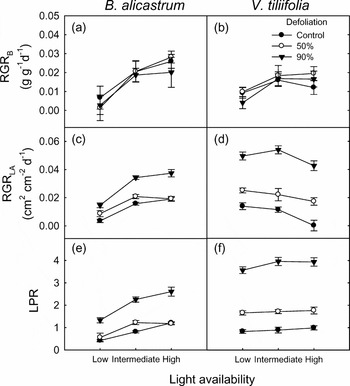
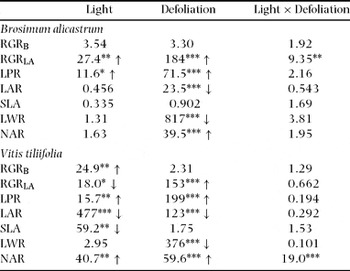
We observed significant effects of defoliation and light availability on growth parameters of both species. In B. alicastrum, RGRB was not affected by light or defoliation (Figure 1a), whereas light and defoliation had significant positive effects with significant interactions on RGRLA (Table 1). RGRLA was higher in defoliated seedlings than non-defoliated seedlings, and the increase was greater at intermediate and high light intensity (Figure 1c). In addition, LPR increased significantly with increasing light intensity, and defoliated seedlings increased LPR significantly more than non-defoliated seedlings, but the light × defoliation interaction was not significant (Figure 1e, Table 1). In V. tiliifolia, RGRB was significantly and positively affected by light availability only (Table 1, Figure 1b), whereas light showed significant negative effects on RGRLA and positive effects on LPR (Figure 1d, f), with no significant interactions (Table 1).
Effects of light availability (low = 1%, intermediate = 9%, and high = 65%, of full sun) and defoliation on the relative growth rate of biomass (RGRB) (a, b), the relative growth rate of leaf area (RGRLA) (c, d) and leaf production rate (LPR) (e, f) of seedlings of the tree Brosimum alicastrum and the liana Vitis tiliifolia (values are mean ± 1 SE).

Results from the split plot two-way ANOVA using defoliation (Control, 50% and 90%) and light availability (low, intermediate and high) as main factors influencing relative growth rate of biomass (RGRB) and leaf area (RGRLA), leaf production rate (LPR), leaf area ratio (LAR), specific leaf area (SLA), leaf weight ratio (LWR), and net assimilation rate (NAR). Analyses were conducted separately for each species. Arrows indicate positive (↑) or negative (↓) response of the parameter to experimental treatment. Statistical significance: *P ≤ 0.05, **P ≤ 0.01, ***P ≤ 0.001.

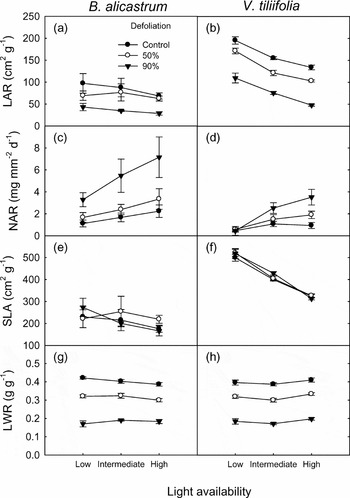
In B. alicastrum, defoliation, but not light availability, showed significant negative effects on LAR, and LWR (Table 1; Figures 2a, g), and significant positive effects on NAR (Table 1; Figure 1c), whereas no significant effects were detected on SLA. In V. tiliifolia, LAR significantly decreased with increasing light availability and was lower with greater defoliation (Table 1; Figure 1b). SLA showed only a negative response to light availability (Figure 2f), and LWR showed only a negative response to defoliation in V. tiliifolia (Table 1; Figure 2h). In contrast, the physiological variable NAR showed significant positive effects of both light and defoliation, as well as a significant interaction indicating an increasing role of the physiological component of growth with increasing light availability (Table 1; Figure 1d).
Effects of light availability (low = 1%, intermediate = 9%, and high = 65%, of full sun) and defoliation on (a, b) leaf area ratio (LAR), (c, d) net assimilation rate (NAR), (e, f) specific leaf area (SLA) and (g, h) leaf weight ratio (LWR) of seedlings of the tree Brosimum alicastrum and the liana Vitis tiliifolia (values are mean ± 1 SE).

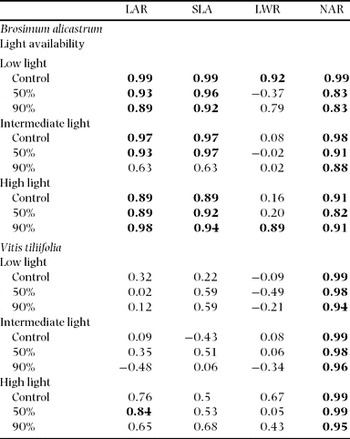
In B. alicastrum, Pearson correlation coefficients showed that LAR, SLA and NAR contributed significantly and positively to RGRB across the combination of light and defoliation treatments, whereas in V. tiliifolia, NAR was most related to variation in RGRB across the light and defoliation treatments (Table 2).
Pearson correlation coefficients between relative growth rate of biomass (RGRB) and its morphological (LAR, SLA, LWR) and physiological (NAR) components within each treatment combination light × defoliation for seedlings of Brosimum alicastrum and Vitis tiliifolia. Significance (P ≤ 0.05) indicated in bold type.

DISCUSSION
Defoliation and light availability showed substantial morphological and physiological effects on growth response variables in seedlings of both study species. Compensatory growth in response to defoliation was observed in both species, with a greater compensatory leaf area growth response in high versus low light-availability treatments in B. alicastrum. In contrast, in V. tiliifolia, compensatory growth responses to defoliation did not vary with light availability suggesting that the levels of light in this study do not limit growth responses to herbivory in this species (Wise & Abrahamson Reference WISE and ABRAHAMSON2005). Morphological and physiological components of growth were a major factor in contributing to compensatory growth responses, but in different ways depending on species and environment. Morphological and physiological components of growth, including LAR, SLA and NAR, played a role in the RGRB responses of B. alicastrum, whereas it was almost exclusively the physiological component of growth, NAR, that was related to RGRB in V. tiliifolia. Overall, it appears that growth responses to herbivory may vary with the components of growth measured, the degree of resource availability and limitation, and the growth form of the focal plant species. Understanding how these factors interact will improve our ability to predict the responses of plants to defoliation, help determine the evolutionary constraints on plant response to herbivory, and aid in developing general theories of plant defence (Coley Reference COLEY1983, Strauss & Agrawal Reference STRAUSS and AGRAWAL1999, Wise & Abrahamson Reference WISE and ABRAHAMSON2007).
The relationship between NAR and RGRB, even in low light in both species, is notable considering that we expected NAR to become more important as light increases and morphological changes such as SLA and LAR to become more important in deep shade (Coomes & Grubb Reference COOMES and GRUBB2000). In V. tiliifolia, NAR increased strongly with increasing light availability and SLA and LAR were greater in low light (Figure 2), consistent with expectations. But NAR was also an important component of RGRB even in low light for both species (Table 2). Thus our data suggest that although the magnitude of NAR is likely to increase as light availability increases, variation in this parameter can be an important component of growth even in low light.
We considered three models that have been proposed in the literature to explain the relationship between resource availability and compensatory growth responses to herbivory. By comparing our experimental results with these three opposing models, the LRM was the most useful in that it offers an explanation for all possible experimental outcomes by directly considering the effects of environmental differences in resource availability. Therefore, our results are consistent with the conclusion of Hawkes & Sullivan (Reference HAWKES and SULLIVAN2001) that neither the GRM nor the CCH can provide possible explanations for interactions between resource availability and herbivory in all circumstances. Although the GRM and CCH are extremely informative theoretical frameworks for describing the mechanisms of compensatory growth responses when specific results are obtained, the LRM provides a more integrated approach that could be more useful considering the complex biotic interactions that are often observed in tropical forest ecosystems.
Considering the CCH, plants in high-resource environments should have a greater ability to respond to herbivory than those growing in low-resource environments (Maschinski & Whitham Reference MASCHINSKI and WHITHAM1989). Our results showed that only the RGRLA of B. alicastrum support the CCH. However, this observation was also consistent with two possible scenarios of the LRM, suggesting that herbivory affected the resource acquisition of light or an alternate resource, causing growth response to defoliation to become limited at low resource availability (Wise & Abrahamson Reference WISE and ABRAHAMSON2007). Because leaves are the sole source of carbon gain in most plants, a reduction in leaf area is expected to negatively affect the acquisition of light energy, consistent with the predictions of LRM. This result is also consistent with the results of a meta-analysis which examined 11 studies of compensatory growth responses to herbivory along a light gradient, and found that in 10 instances, results were consistent with predictions of the CCH, but none of these studies was consistent with the predictions of GRM (Wise & Abrahamson Reference WISE and ABRAHAMSON2007). Whereas numerous studies have addressed herbivory responses to below-ground resources by varying nutrients, water or competition (Gassmann Reference GASSMANN2004, Lee & Bazzaz Reference LEE and BAZZAZ1980, Lim & Turner Reference LIM and TURNER1996, Simms Reference SIMMS1985), light is the most limiting resource in the tropical forest understorey (Chazdon Reference CHAZDON1988), and has fundamentally different effects on plant stress compared with below-ground resources (Chapin Reference CHAPIN1991). Further studies that fully account for below-ground resource levels in combination with light availability in tropical forest are likely to elucidate the role of alternate resources in structuring the responses of understorey plants to herbivory in relation to predictions of the LRM. Furthermore, our defoliation treatments represent general approximations of plant leaf loss to herbivory. We suggest that experimental treatments that replicate specific types of herbivore damage will refine our knowledge of model predictions in particular plant–herbivore systems.
Our results are consistent with previous studies on the effects defoliation on growth responses of tropical woody plants. Experiments on seedlings of a dominant canopy Shorea species in Borneo demonstrate that growth responses following herbivory were greater in gaps than in the understorey (Blundell & Peart Reference BLUNDELL and PEART2001), illustrating a positive effect of light availability on compensatory growth responses consistent with the CCH. Similarly, anti-herbivore exclusion experiments in lowland tropical moist forest in Panama have shown that herbivory is a greater agent of mortality for regenerating seedlings in the understorey than in gaps (Howe Reference HOWE1990), suggesting that opportunities for compensatory growth following herbivory are greater with increasing light availability. Furthermore, complete defoliation decreased annual growth rate of seedlings of a woody species in Brazil, but also stimulated leaf production (Nascimento & Hay Reference NASCIMENTO and HAY1994), analogous to our results for B. alicastrum where RGRB was unchanged in response to herbivory, but RGRLA and LPR increased. These results support the idea that the nature of light limitation in tropical forests is likely to produce compensatory growth responses to herbivory that are better predicted by the CCH than the GRM, the former having been primarily used to predict the responses of grasses to grazing (McNaughton Reference MCNAUGHTON1979).
Overall, our results illustrate the impact that defoliation may represent for future growth in two neotropical species. By examining such responses along a light-resource availability gradient, we have also shown that variation in allocation patterns has the potential to shift responses to defoliation and resource availability, and emphasizes that defoliation responses are likely to vary among contrasting plant species or growth forms. Comparison of our results to predictions of three models indicated that the LRM should be most appropriate for the diverse species and herbivore interactions of tropical forests, and when light is limiting, as in the tropical forest understorey, the CCH offers greater explanatory power than the GRM, as has been found in other studies. Although further studies that address resource-herbivory interactions among the diverse array of tropical plant species are needed, our study highlights the contribution of morphological and physiological variables that drive compensatory growth responses.
ACKNOWLEDGEMENTS
We thank L. Salinas and A. González for field assistance, V. Parra-Tabla, J. M. Dupuy, H. Paz, S. Peraza, J. L. Andrade, K. Silvera, C. Stripe and S. Pasquini for useful corrections and suggestions, J. Montero for assistance in statistical analysis, P. Simá and S. Mercado for administrative and logistic support. This research was supported by a fellowship Consejo Nacional de Ciencia y Tecnologia awarded to H. S. Ballina-Gómez (CONACyT No. 183267), and a Postdoctoral Fellowship to L.S. Santiago (NSF No. 0310103).