1. Introduction
Co-compounds (sometimes termed “copulative compounds” or “dvandva compounds”) are compounds whose elements are of equivalent status and which can be glossed as having coordinated meaning (usually linked by and, but occasionally, in some languages, by or). Here the term co-compound is used as the superordinate term for a range of different types of compounds that fit this general description. For a description of the various types of co-compounds found cross-linguistically, and also for some indication of the confusing terminology in this area of linguistic description, see Wälchli 2005 and Bauer 2008a.
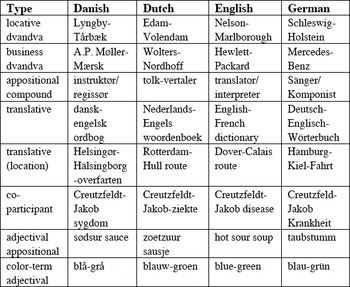
Although co-compounds appear to have been a feature of Proto-Indo-European, they scarcely figure in the early Germanic languages. There seems to be general agreement that Old Saxon gisunfader ‘son and father’ is a remnant of an Indo-European type, and that co-compounding has no role in early Germanic (Carr 1939). Meillet (1937:218) considers the compounds in modern Germanic to be the result of “la structure nouvelle de la langue” rather than inherited ways of creating vocabulary. Standard grammatical descriptions make no mention of co-compounds in Gothic or in Old Icelandic. The fact that some types of co-compounds are found across many Germanic languages today must thus be seen as an innovation, and it is scarcely odd that similar types are found across several languages. To illustrate this general point, consider the (attested) examples in table 1, which not only illustrate the degree of shared inno-vation, but also indicate something of the range of co-compounds found in the modern Germanic languages.
Comparison of co-compound types in Germanic.

This unity, however, is in some cases more apparent than real. The main goal of this paper is to consider the differences that exist between the co-compounds in Danish, English, and German. Implicitly, this also provides information on areas where I believe the usage of a particular co-compound type is relatively invariable across these languages, as for instance in the case of business dvandvas and co-participant compounds.
2. The Semantic Types of Co-Compounds
Renner (2008) surveys the semantic types of co-compounds found in English and proposes three types of noun-noun co-compounds:
- (1)
a. multifunctional (an X.Y is an X which is also a Y): owner-occupier, student-athlete
b. additional (an X.Y is an X plus a Y): fridge-freezer, penny-farthing
c. hybrid (an X.Y is midway between or a mixture of (an) X and (a) Y): wolf dog, ape-man
Of these, only the first type is endocentric, according to Renner, being a hyponym of both its elements, and neither of the other types can be endo-centric (see Bauer 2008b for more on exocentric compounds). The additional type has some subtypes:
- (2)
a. collective (an X.Y is either an X or a Y): Anglo-Saxon
b. hypernymic (an X.Y is an X and a Y plus their co-hyponyms): sol-fa, Mon-Khmer
c. tautological (X and Y are quasi-synonyms): courtyard, pathway
Renner (2008) lists two types of adjective-adjective co-compounds, the first being additional (to be X.Y is to be X and Y), as in bitter-sweet or deaf-mute.
There are some subtypes to be considered here:
- (3)
a. alternate (to be X.Y is to be alternately X and Y): manic-depressive
b. adversative (to be X.Y is to be X but Y): shabby-genteel
c. tautological (see also the classification of nouns): squiggly-wiggly, teeny-tiny
The second type of adjectival co-compounds is the hybrid type, for instance, blue-green or medium-rare.
Finally, Renner groups verb-verb co-compounds into three cate-gories:
- (4)
a. asynchronous (X.Y is to X and then to Y): drop-kick
b. synchronous (X.Y is to X and Y simultaneously—with a subtype of alternate action): sleepwalk (alternate: stop-start)
c. disjunctive (X.Y is to X or to Y): pass-fail
Renner notes that some of the verb-verb compounds function as adjectives.
This classification provides a useful basis for a description of the co-compounds in Germanic, although it also gives rise to some problems. I believe that some of the types that Renner includes as additional co-com-pounds are actually subordinative. Thus, for me, verb-verb compounds such as freeze-dry and stir-fry are right-headed because they denote methods of drying and frying, respectively, while for Renner (2008:611) they are asynchronous co-compounds. I understand Renner's approach in this case, but do not share it. However, this problem is of little importance here, as long as the class of additional verb-verb compounds is accepted.
More problematic for this paper is that Renner's classification is not fine enough. For example, we also need to consider forms such as Greek-English and Paris-Rome, which belong to the additional type and which Renner does not specifically mention. Bauer (2008a) terms these “translative.” They are usually used as adjectives (a Greek-English dictionary, the Paris-Rome flight), though they are subtypes of Renner's additional noun-noun set.
3. Noun-Noun Compounds
3.1. Multi-Functional
In English, a person described as a singer-songwriter is a person who is both a singer and a songwriter, and who carries out both professions simultaneously. While some individual items like singer-songwriter escape into everyday usage, the type is generally rather rare, occurring most often in the press and in advertisements for jobs, where the economy of form presumably plays a role in their popularity. The type is productive, though, even in spoken registers.
(5) businessman-donor (Radio New Zealand National, Morning Report, February 18, 2008)
Similar forms appear to exist in a range of other Germanic languages, as shown in 6.Footnote 1
- (6)
a. Danish
Instrukt⊘r/Producer/Direkt⊘r ‘director-producer-director’
b. Norwegian
Sanger/komponist/tekstforfatter ‘singer-composer-writer’
c. German
Musiker/Sänger/Komponist ‘musician-singer-composer’
Speakers of these languages often find these expressions odd, at least in conversational styles.
Mellenius (1997:22) points out that in Swedish, inflected words can be co-ordinated by this process. She cites the Swedish form bonden-advokaten ‘the farmer-the lawyer’. She subsequently states that in “Swedish orthography, hyphens as connectors are used between words, not between other units” (p. 23), so that the implication is that bonden-advokaten is not a word of Swedish and thus not a compound. Swedish speakers I have consulted find this particular example odd, at least in pragmatic terms if not in grammatical ones. However, similar examples exist in Danish.
(7) Hvis klienten kommer til advokaten/revisoren og fremlægger er klart afgrænset problem …
‘if the client comes to the lawyer/the accountant and presents a clearly limited problem …’
The only examples of this type I have found, though, have the two nouns as alternatives. Advokaten/revisoren refers not to one person with both functions, but to a choice between a lawyer and an accountant. These constructions are more like English pass-fail in pass-fail test, where you either pass or fail, and these are the only alternatives. Seman-tically, these are different from the singer-songwriter type and do not belong to a type which Renner (2008) recognizes for English.
An example like Musiker/Sänger/Komponist yields a large number of examples using Google, but nearly all of them are separated by commas rather than by hyphens or slashes. That is, in the majority of cases the construction is perceived as syntactic: a matter of coordination with no overt coordinator. While such instances are found in English too, the hyphenated compound reading seems to be rather more common. Even with an unexpected combination such as musician-lawyer we find several examples, including:
(8) Many of the illustrations were drawn from the world of classical music, and as a musician/lawyer, I found them particularly relevant and interesting.
The following example is very illuminating, since it seems to indicate that the writer feels these constructions to be left-headed—against all theoretical expectations about English compounds.
(9) “I am a lawyer-musician, not a musician-lawyer,” he says. “My calling is in the law.”
3.2. Additional
All the relevant languages seem to have at least two types of locative co-compounds. First, there is the Schleswig-Holstein dvandva type, where Schleswig-Holstein is made up of the whole of Schleswig and the whole of Holstein. Second, there is the directional, translative type, where London-Newcastle is a route or direction. There is a third type illustrated by Hamburg-Schenefeld or Leipzig-Mölkau, where Mölkau is a suburb of Leipzig. While these appear parallel to the others, they are semantically distinct, and probably not co-compounds. Although the types exist, they are not equally exploited in all of the languages, and the reasons behind some of the usages are obscure.
Locative dvandas are rare, presumably because the political events or the geographic coincidences that give rise to the relevant names are also rare. Nevertheless, they appear to be accepted formations in German, which also has Elsaß-Lothringen and Baden-Württemberg. Although English borrows such words (note the German form Schleswig-Holstein in English), it appears not to create them. Even though Birmingham and Wolverhampton are adjacent cities with no green belt between them, there is no Birmingham-Wolverhampton in English. Any such com-pounds are preferentially interpreted as being translative locatives.
There are a small number of apparent exceptions. The first exception concerns two cities with hyphenated names, one in the United States (10a) and one in Britain (10b).
- (10)
a. Minneapolis-Saint Paul is the most populous urban area in the state of Minnesota, United States.
b. Newcastle (on the north bank of the River Tyne) and Gateshead (on the south bank) have been transformed into a single visitor destination called NewcastleGateshead.
While the first of these usages is well established, the latter is new. Such forms are extremely rare in English, and the Tyneside example sounds rather forced, the output of a marketing campaign rather than the output of normal linguistic patterns. The pattern with an overt conjunction seen in Brighton and Hove seems to be the default in English. In New Zealand, surprisingly, more of these structures are found: Nelson-Marlborough, Otago-Southland, Napier-Hastings. The reason for this localized usage is not clear.
The second apparent exception concerns airport names, where it seems to be permissible to name an airport after two adjacent cities. We find Dallas-Fort Worth and Leeds-Bradford in English or Leipzig-Halle in German. These are something of a puzzle. Dallas-Fort Worth is not made up of the whole of Dallas and the whole of Fort Worth; rather, it is designed to serve both Dallas and Fort Worth. It is as though Dallas-Fort Worth is a compound premodifier whose head (airport) has been clipped or elided in current usage. While this does not explain the formation of the compound modifier, it helps explain the unusual semantics associated with this type. We must assume that similar premodifiers could be formed for other types of shared entity, but pragmatically, nouns that denote facilities, such as airport, seem to be commonly used in this kind of formation.
The contrast between English and Danish is striking. While Birmingham-Wolverhampton would have to be interpreted as a translative, Ålborg-N⊘rresundby (whose elements denote towns on either side of the Limfjord, as in 11a) is preferentially interpreted as a locality with two centers, that is, as a dvandva. The orthography in these cases frequently prefers a slash to a hyphen, but the interpretation is clear. Even when the centers named are some distance apart, this interpretation seems to be the preferred one in Danish, as in 11b.
- (11)
a. Re: MC klub i Aalborg/N⊘rresundby
‘Re: M[otor] C[ycle] club in Aalborg / N⊘rresundby’
b. find alle de bedste link til dine reservedele, bestil online, find din lokale … Viborg / Herning
‘find all the best links to your spare parts, order online, find your local … Viborg / Herning’
Translative locational compounds, which exist in all three languages, also work differently in English from the way in which they work in the continental languages. The London–Glasgow railway line runs between London and Glasgow (the extremes of the journey), or the London-Glasgow train runs between the two cities. In either case, London-Glasgow appears to function as a compound adjective—it is always used attributively. A similar usage is found in German (12a,b) and in Danish (12c).
- (12)
a. Rhein-Main-Donau-Kanal
‘Rhine-Main-Danube canal’
b. Der Donau-Oder-Elbe-Kanal
‘the Danube-Oder-Elbe canal’
c. 3 km N.f. Odense-Bogense landevej,
‘3km north of the Odense-Bogense main road’
It seems odd that this construction is used so consistently with the names of canals in German, since it is rare in other contexts. The Danish construction illustrated in 12c, while clearly grammatical, is also un-usual. Much more widely used is the construction illustrated in 13.
- (13)
a. Dagligt k⊘rte jeg strækningen Viborg-Herning-Viborg
‘I travelled the route Viborg-Herning-Viborg every day.’
b. Fra Sjælland benyttes færgen R⊘dby/Puttgarten eller Gedser-Rostock. Såfremt i er en gruppe på min. 20 personer, kan i selv være medbestemmende vedr …
‘From Zealand you take the ferry from R⊘dby to Puttgarten or from Gedser to Rostock. If you are a group of at least 20, you can decide for yourselves …’
In these examples, the translative form is not used attributively, but post-nominally, where it seems to carry an adverbial force, as shown by my translations with a prepositional phrase in some of the examples above. The post-nominal adverbial usage is the more common one in German and Danish, while the attributive, adjectival usage is more common in English. This point is illustrated in 14 taken from a Danish website, where the Danish construction has been used in English.
(14) The vessel was designed for Scandlines A/S for the route R⊘dby-Puttgarten.
Also of interest in this connection is the following Swedish example, where there is variability between the postposed translative compound and the more overt prepositional phrase.
(15) Det går att välja endera Öresundsbroförbindelsen eller färja Helsingborg-Helsingör. Vidare färjan mellan R⊘dby-Puttgarten och slutligen Calais-Dover.
‘You can choose either the Oeresund bridge connection or the ferry from Helsingborg to Elsinore. Then the ferry between R⊘dby-Puttgarten and finally Calais-Dover.’
The Leipzig-Mölkau type, which is common in German, does not appear to exist in Danish or English: there is no *Viborg-Overlund, *Århus-Viby, *Leeds-Headingly, or *Newcastle-Jesmond. Again, airport names in English, such as London-Gatwick, London-Heathrow, etc. are an apparent exception. Semantically, however, these seem to be slightly different, meaning “the airport that services London but is at Gatwick,” etc.
3.3. Hybrid
Hybrid noun-noun co-compounds are found in all three languages being dealt with here. This can be illustrated by coverage in the press of the same story.
- (16)
a. Meet Eclyse–The Zebra Horse
Meet Eclyse, the result of a relationship between a zebra and a horse, who's celebrating its first birthday at Safariepark Zoo in the city of Schloss Holte-Stukenbrock, Germany. While most zebra-horse cross-breeds sport stripes across their entire body, Eclyse only has two such patches on its face and rear.
b. Den et år gamle zebra-hest Eclyse, som nu er stjerne-attraktion i en tysk dyrepark, er resultatet af en stormende forelskelse på en norditaliensk hestefarm.
‘The one-year-old zebra-horse Eclyse, who is now the star attraction in a German zoo, is the outcome of a stormy love affair on a northern Italian stud farm.’
c. Das Ergebnis dieser skurillen Liebe ist das kleine Zebra-Pferd ‘Eclyse’
‘The result of this ludicrous love affair is the little zebra-horse Eclyse’.
However, one significant detail about this story is that only in English is the animal also referred to as a zorse.
(17) A zorse or zebrula is the offspring of a zebra stallion and a horse mare; the rarer reverse pairing is sometimes called a hebra.
The term zebra-horse seems to be preferred in attributive usage, as in 18, but not necessarily as a head noun. This is not an isolated example.
- (18)
a. “Tigoner” (tigerl⊘ve) er en krydsning mellem en hantiger og en hunl⊘ve, hvorimod “lingre” (l⊘vetiger) er en krydsning mellem en hanl⊘ve og en huntiger.
‘“Tigons” (tiger-lions) are a cross between a male tiger and a female lion, while “lingre” (lion-tigers) are a cross between a male lion and a female tiger.’
b. Ein Liger-Tiger / Löwe
‘A liger-tiger/lion’
c. Die Tigon-Mischlinge kommen in freier Wildbahn nicht vor, da Tiger und Löwen unterschiedliche Lebensräume haben.
‘Tigon-crosses do not occur in the wild since tigers and lions have different habitats.’
What is interesting here is that at least the word tigon is clearly borrowed from English, since the form is not appropriate as a blend in Danish or German, and the Danish text makes what can only be an error with the word linger. Although the hybrid forms occur in all of the languages, in English they seem to be used preferentially in attributive position, and blends seem to be preferred as nouns. In Danish and German no such distinction is possible (since if one of these compounds was used attributively, it would simply make a larger compound), and the full compound (not the blend) seems to be the preferred variant.
A similar pattern is shown by the examples in 19.
- (19)
a. the zoo had the choice of breeding lion-tiger or lion-leopard hybrids as they had a good breeding record for all three species. Because other zoos had successfully bred ligers and tigons, they decided on lipards (lion/leopardess) or leopons (leopard/lioness).
b. nicht nur Liger und verschiedene Zebroide, sondern auch Cama (Kamel-Lama) und Leopon (Leopard-Löwe).
‘not only ligers and various zebroids, but also camas (camel-llama) and leopons (leopard-lion)’
The interesting thing about example 19b is that the link was to the original article in written in English, where the form leopon is explicable.
Finally, note the example in 20 from Danish, where an apparently parallel formation actually refers to a choice between a leopard and a lion.
(20) Jeg bliver ved med at se det l⊘ve/leopard-lignende dyr og er voldsomt bange.
‘I keep seeing the animal that looks like a lion or a leopard (literally, the lion/leopard-resembling animal) and I'm extremely frightened.’
4. Adjective-Adjective Compounds
4.1. Additional
There are a number of adjective compound types whose elements appear to be of equal status, and yet their classification may be in doubt. Paul (1920:7) includes adjectives like bittersüß ‘bittersweet’ and süßsauer ‘sweet sour’ in his examples, but their semantics is not entirely clear. Wälchli (2005:78) states that they are intersective, since the food so described is both bitter and sweet, but although that may be true of the noun modified by the adjective, it is not clear to me that we must read the adjective in the same way. It seems to me that bittersweet does not denote the intersection of bitter and sweet, but rather the quality of being both bitter and sweet. If this argument holds, such constructions are dvandvas and not appositional compounds, but clearly the matter is a difficult one. Furthermore, in purely descriptive terms this does not matter much: the type can be observed.
In any case, while such adjectives exist in all three languages, they are rare. While English has bitter-sweet, it has sweet and sour, deaf and dumb, but borrows hot sour from Chinese. Marchand (1969:88) cites a number of examples from Shakespeare that sound odd today (heavy-thick, valiant-young). However, examples like phonetic-phonological, comical-historical (perhaps thanks to Shakespeare), semantic-syntactic, economic-historical, etc. are certainly common, as are their equivalents in German and other languages (see 21).
- (21)
a. Norwegian
En historisk-filosofisk introduksjon.
‘A historical-philosophical introduction’
b. Danish
en detaljeret historisk-filosofisk analyse af informationsbegrebet i molekylærbiologien
‘a detailed historical-philosophical analysis of the concept of information in molecular biology’
c. German
Um allen Schülerinnen und Schülern eine breite, noch nicht durch Spezialisierungen eingeschränkte Basis zu vermitteln, sind die im Nachmittagsbereich stattfindenden Angebote des Additums 3 Schwerpunkten (künstlerisch, natur-wissenschaftlich-technisch und sprachlich-historisch-philosophisch) zugeordnet.
‘In order to offer all pupils a wide basis, not yet restricted by specialization, the additional options taking place in the afternoon session are grouped into three thematic areas (artistic, scientific-technical, linguistic-historical-philosophical).’
Compounds made up of three elements as in 21c are much more common in German than in English, though there is no reason to suppose that they are not grammatical in English. Indeed, I found an example using Google (whose site was taken down by May 2009): Socio-Cultural/Historical/Philosophical Perspectives.
4.2. Hybrid
A problem of interpretation also holds with compounds like Dutch roodbruin ‘red-bown’, which Geerts et al. (1984:368) and de Haas & Trommelen (1993:432) classify as parallel to lichtblauw ‘light blue’. While lichtblauw is clearly right-headed, denoting a shade of blauw, the case is not nearly as clear with roodbruin. While we can interpret it as naming basically a type of bruin, we can also interpret it as denoting a mixture of rood and bruin, with the two elements contributing (more or less) equally to its meaning.
Where color-term adjectives are concerned, Olsen (2001:302) points out that there are two types in German. The first we can illustrate with examples like schwartz-weiss or schwartz-rot-gold, where every element is stressed. When such co-compounds modify a noun the interpretation is that the object denoted by the noun has all of the colors named by the adjective. The other type is illustrated by blau-grau has a single stress and denotes a mix of the two colors (which is one color, not the presence of two distinct colors). Dutch seems to work the same way. Roodbruin, cited above describes a mixed color, while rood-wit-blauw or rood-groen denotes something that has more than one color (Geerts et al. 1984:369).
Swedish uses a compound adjective blå-gul ‘blue-yellow’ to refer to the colors of the Swedish flag. Mellenius (1997:22) translates this as ‘blue yellow’, which seems to show misunderstanding of the English construction.
The case in English is different. Green-blue (with phrasal stress) denotes a mix of green and blue, and there is no equivalent of schwartz-weiss. Instead we have to say black and white, or red, white, and blue, etc., with syntactic coordination. The difference is very clear if we search the net for such examples. For blue-green, the first hit is given in 22.
(22) Blue-green is a name for a color with a mixture of blue and green.
For German blau-grün, on the other hand, the overwhelming tendency is to interpret it as naming both colors, as in 23.
(23) Finden Sie Ralph Lauren-Spielanzug Gr. 24M-blau/grün gestreift in Baby
‘Find Ralph Lauren–playsuit size 24M–blue/green striped in Baby’
Only occasionally do we find clear cases where a single mixed color is unambiguously intended. Even the following example is not entirely clear, as suggested by the scare quotes round blau-grün in 24.
(24) Alle Bilder im Photoshop CS3 plötzlich “blau-grün”!
‘all pictures in Photoshop CS3 suddenly “blue-green”’
In Danish we also find both patterns, with the alternative pattern probably the more common.
- (25)
a. Blå-gr⊘n turmalin fra Smykkebutikken. Vi opk⊘ber turmalin på Madagaskar, Afrika og Brasilien.
‘blue-green tourmaline from the jewelry shop. We buy in tourmaline from Madagascar, Africa and Brazil.’
b. Delfin-Blå/gr⊘n/klar, > GLAS delfiner. Pris: DKK 49,00
‘Dolphin-blue/green/clear > glass dolphins. Price 49.00 Kroner’
In sum, while the English adjective-adjective construction for color terms is predominantly a hybrid construction, the apparently matching constructions in the other languages cited above are primarily additional constructions, with the hybrid interpretation being a minor one.
5. Verb-Verb Compounds
Compound verbs are rare in Germanic, and co-compound verbs are even rarer. Bauer (2009) lists none for Danish. Fleischer (1975:306–307) lists a handful for German, as does Motsch (2004:145–146). The type is clearly productive in German, particularly in literary or technical genres. Examples from these sources are given in 26.
- (26)
a. fluchbeten ‘swear-pray’, rollrasseln ‘roll-rattle’, knirschkauen
‘crunch-chew’, grinskeuchen ‘smirk-wheeze’
b. presspolieren ‘press-polish = die-burnish’,
schmelzschweißen ‘melt weld = fusion-weld’;
mähdreschen ‘mow-thresh = harvest with a combine harvester’
c. kennenlernen ‘to know-to learn = to get to know’
The last type, where the first element is not just a stem but an infinitive, is not productive. Most of the technical words seem to derive from nouns by back formation. For example, mähdreschen derives from Mäh-drescher ‘mow-thresher = combine harvester’.
As was mentioned earlier, there is room for dispute about some of the compound verbs that Renner (2008) lists for English. In fact, there are relatively few clear-cut cases. Sleepwalk could have a noun in the first element and represent ‘to walk in one's sleep’; pass-fail is said by the OED to be made up of nouns; the verb drop-kick is either created by conversion from the homophonous noun, or formed by back formation from drop-kicking. While there are lexicalized examples of verb-verb co-compounds in both German and English, the pattern seems to be a productive method of word formation only in a limited register in German.
6. Conclusion
Although many of the patterns of co-compounding can be found in Danish, English, and German, there are often subtle differences in the usage of those patterns. This has implications for fields as disparate as language teaching and linguistic typology. Where language teaching is concerned, the apparent match of categories should not be taken to imply that there is nothing to teach in this corner of vocabulary studies. Where linguistic typology is concerned, the more general point is that a typology that is based purely on form can be misleading: The detailed semantics and the function of the resultant forms also need to be taken into consideration. This general point is made forcibly by Wälchi (2005), but on the basis of different data. This paper provides extra support for Wälchi's position, and can be read as a plea for typologists to consider more than just forms. From a historical point of view, there would be some interest in tracing the development of the varying usages. The fact that many of the differences seem to separate English from Danish and German, despite the genetic relationships, is easily explained in terms of language contact. The development of different usages would seem to arise from slightly different interpretations of natural coordination (Wälchli 2005) rather than from adoption of external models. The main conclusion is that superficial similarities may mask a huge range of differences.
APPENDIX
Example number followed by internet source is provided below.
(6b) www.kalleklev.no/artist_files/artist_bio.php?id=11; accessed March 11, 2008.
(6c) www.korg.de/d1200mk2-produktinfo-2.html; accessed March 11, 2008.
(7) http://72.14.253.104/search?q=cache:LSQQLfpsTicJ:www.jur.ku.dk/njm/31/31_25.pdf; accessed January 20, 2008.
(8) www.amazon.com/review/R175ENQA1QLV3Q; accessed March 11, 2008.
(9) members.chello.nl/cvanderlely/pearls/articles/lawjournal.html; accessed March 11, 2008.
(10a) http://en.wikipedia.org/wiki/Minneapolis-St._Paul; accessed January 20, 2008.
(10b) www.visitnewcastlegateshead.com/; accessed January 20, 2008.
(11a) www.mcinternet.dk/mc/klub/aalborg/n⊘rresundby/motorcykel/id.114021; accessed March 11, 2008.
(11b) http://www.linkworld.dk/motor_autodele.htm; accessed January 20, 2008.
(12c) http://www.kirkefondet.dk/kirkefondet/pegasus.nsf/31842926b5bbc6a8c1256915003ad6db/ef812e6b4bcc8ed0c125714100422574/$FILE/vejk06e_oerne.pdf; accessed January 20, 2008.
(13a) naturriget.tvmidtvest.dk/?page_id=2; accessed January 20, 2008.
(13b) www.jellingrejser.dk/aeldrerejser/europa/holland.htm?m=0_5_6; accessed March 11, 2008.
(14) www.knudehansen.com/264-147-ferries__ro-pax_vessels.htm; accessed January 14, 2009.
(15) http://www.vt.se/nyheter/artikel.aspx?ArticleID=2368348; accessed January 14, 2009.
(16a) http://xo.typepad.com/blog/2007/06/meet-eclyse—t.html; accessed January 13, 2009.
(16b) http://www.bt.dk/article/20070629/NYHEDER/70629033/1828; accessed January 13, 2009.
(16c) http://www.lieblingtier.tv/30,Aktuelles/1168,+_Kind_der_Liebe_Zebra-Pferd_Eclyse_zieht_in_den_Safaripark_Stukenbrock_+_.html; accessed January 13, 2009.
(17) http://en.wikipedia.org/wiki/Zorse; accessed January 13, 2009.
(18a) www.pornospasserforum.dk/forum/showthread.php?t=19090&page=3; accessed January 13, 2009.Footnote 2
(18b) http://fatnmad.teamplay.de/blog/?p=40; accessed January 13, 2009.
(18c) http://www.science-at-home.de/lexikon/lexikon_det_00200401000004.php; accessed January 14, 2009.
(19a) http://www.messybeast.com/genetics/hyb-leopxlion.htm; accessed January 14, 2009.
(19b) http://www.zoopresseschau.info/presseschau-2006-07-27.html; accessed January 14, 2009.
(20) http://lysstrejfet.dk/index.php?option=com_content&task=view&id=33&Itemid=83; accessed January 14, 2009.
(21a) kilden.forskningsradet.no/c16877/publikasjon/vis.html?tid=51531&strukt_tid=16877; accessed January 14, 2009.
(21b) www.nbi.dk/∼natphil/kur/stof/reflist.FVT.2004.html; accessed January 14, 2009.
(21c) www.dipf.de/gfpf/publikationen/Gf2004n1.pdf; accessed January 14, 2009.
(22) en.wikipedia.org/wiki/Blue-green; accessed March 11, 2008.
(23) cgi.ebay.at/Ralph-Lauren—Spielanzug-Gr.-24M—blau%2Fgrün-gestreift_W0QQitemZ140209997254QqcmdZViewItem; accessed March 11, 2008.
(24) hopwww.psd-tutorials.de/modules/Forum/11_photoshop/41565-alle-bilder-im-photoshop-cs3-ploetzlich-blau-gruen.htm; accessed March 11, 2008.
(25a) smykkebutikken.com/product.asp?product=1366&sub=9; accessed March 11, 2008.
(25b) www.azurit.dk/product.asp?product=560&sub=0&page=1; accessed March 11, 2008.