Implications
Dietary supplementation of rumen buffers, that is, AcidBuf, sodium bicarbonate and sea algae at 0.4% to the total mixed rations (TMR) of lambs improved their feed efficiency, carcass quality and rumen characteristics. Sheep producers and feed manufacturers are invited to use rumen buffering agents, not only limited to sodium bicarbonate, in the TMR designed for growing lambs.
Introduction
Several strategies have been undertaken to improve the ruminant production especially in those areas of the world where there are scarce feed resources (Alhidary et al., Reference Alhidary, Abdelrahman, Alyemni, Khan, Al-Mubarak and Albaadani2016a and Reference Alhidary, Abdelrahman, Alyemni, Khan, Al-Saiady, Amran and Alshamiry2016b). Total mixed rations has been reported to improve the animal performance and meat quality in fattening lambs (Zhong et al., Reference Zhong, Fang, Zhou, Sun, Zhou and He2018); however, the risk of rumen acidosis due to the increased production of volatile fatty acids (VFAs) may be one of the major constraints (Alhidary et al., 2017). The continuous use of TMR may lead to severe metabolic disorders such as laminitis, liver abscess, ruminal parakeratosis and disturbance in the acid–base balance (Blanco et al., Reference Blanco, Giráldez, Prieto, Benavides, Wattegedera, Morán, Andrés and Bodas2015). In addition, the use of TMR may disrupt the epithelial barrier in the intestines leading to the entry of the toxins into the body leading to severe secondary health problems (Liu et al., Reference Liu, Xu, Liu, Zhu and Mao2013). Further, the use of TMR in the diet of ruminants may lead to severe rumen pigmentation, which is usually not accepted by consumers (Alhidary et al., Reference Alhidary, Abdelrahman, Alyemni, Khan, Al-Mubarak and Albaadani2016a). In order to minimize the risk factors of rumen acidosis and related disorders, it is essential to search for alternatives which can maintain the rumen pH (Nagaraja et al., Reference Nagaraja, Newbold, Van Nevel and Demeyer1997; Aschenbach et al., Reference Aschenbach, Penner, Stumpff and Gäbel2011; Owens and Basalan, Reference Owens and Basalan2016). One such alternative is the application of rumen buffers (Russell and Chow, Reference Russell and Chow1993; Kang and Wanapat, Reference Kang and Wanapat2013 and Reference Kang and Wanapat2018; Mao et al., Reference Mao, Huo, Liu, Zhang and Zhu2017). The dietary buffer can stabilize the pH of the rumen by neutralizing the acidity of increased production of VFAs; however, the consequences may be different in different animals depending upon the type and dose of the buffer (Tripathi et al., Reference Tripathi, Santra, Chaturvedi and Karim2004; Sen et al., Reference Sen, Santra and Karim2006). A variety of dietary buffers such as sodium bicarbonate, sodium bentonite, calcium carbonate and calcified seaweed have been added in the TMR to improve the productivity and health status of ruminants (Hutjens, Reference Hutjens1991; Allen, Reference Allen1997; Enemark, Reference Enemark2008; Alhidary et al., 2017). Sodium bicarbonate has been previously added to the concentrate diets of both large and small ruminants; however, conflicting results have been recorded (Tripathi et al., Reference Tripathi, Santra, Chaturvedi and Karim2004; Bodas et al., Reference Bodas, Rodríguez, López, Fernández, Mantecón and Giráldez2007; Jallow and Hsia, Reference Jallow and Hsia2014). AcidBuf is a natural product produced from seaweed and has been reported to have more than twice the buffering capacity of sodium bicarbonate probably due to the presence of a variety of different minerals including calcium, magnesium and all trace minerals which are released slowly in the ruminal environment (Beya, Reference Beya2007; Enemark, Reference Enemark2008; Cruywagen et al., Reference Cruywagen, Taylor, Beya and Calitz2015). Promising results were reported on the buffering capacity of calcareous marine algae (Bernard et al., Reference Bernard, West, Mullis, Wu and Taylor2014; Cruywagen et al., Reference Cruywagen, Taylor, Beya and Calitz2015; Wu et al., Reference Wu, Bernard and Taylor2015) and calcified seaweed (Aga et al., Reference Aga, Koski and Stern2000; Melo and Moura, Reference Melo and Moura2009; Montanez-Valdez et al., Reference Montañez-Valdez, Pinos-Rodríguez, Rojo-Rubio, Salinas-Chavira, Martíneztinajero, Salem and Avellaneda-Cevallos2012) in cattle but no available information regarding their buffering effects in small ruminants. In addition, in the review of the literature, most of the studies have reported the efficacy of any single buffer agent as described above. There is no information available regarding the comparative efficacy of these buffers in lambs on a TMR feeding system. This study was realized to compare the effect of different buffering agents on the animal performance, rumen acidity and rumen histology of growing male Awassi lambs.
Material and methods
Animals, diets, management and experimental design
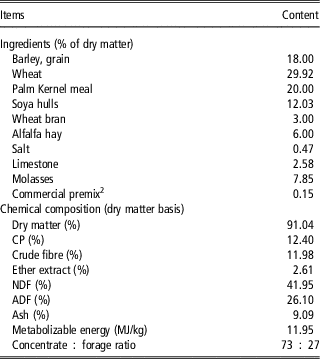
This study was undertaken at The Experimental Farm Animal Centre, Department of Animal Production, King Saud University, Riyadh, Saudi Arabia. Fourteen days before the study start, sixty 4 to 5-month-old growing male Awassi lambs (27.5±2.5 kg mean BW; approximately 42 mm wool length) were moved into the Experimental Station of Animal Production Department, College of Food and Agriculture Sciences, King Saud University, Riyadh. On arrival, lambs were immediately weighed, ear tagged, vaccinated against clostridial diseases and treated for internal and external parasites. Thereafter, lambs were individually housed in shaded pens (1.5 m long×1.0 m wide). Each pen was equipped with a feed trough and a 10-l plastic water bucket. Over a 14-day period before the start of the study, lambs were adapted to the pens and the basal diet. All lambs were offered the same commercial TMR (the basal diet; WAFI, ARASCO, Riyadh, Saudi Arabia) containing 11.95 MJ of metabolizable energy, and 12.40% CP/kg (dry matter (DM) basis; Table 1) twice daily at 0800 and 1500 h. Water was available ad libitum.
Ingredients and chemical composition of the basal diet for growing male Awassi lambsFootnote 1

1 The basal diet was provided as a total mixed ration (WAFI, ARASCO).
2 Contained per kilogram, 10,000 IU vitamin A, 1000 IU vitamin D, 20 IU vitamin E, 300 mg Mg, 24 mg Cu, 0.6 mg Co, 1.2 mg I, 60 mg Mn, 0.3 mg Se, 60 mg Zn.
At the beginning of the experiment (day 1), lambs were randomly assigned to one of five dietary treatments which were: (1) the basal diet without supplementing any sources of buffers (control group), (2) the basal diet plus 0.4% AcidBuf (Buf1; Celtic Sea Minerals, Carrigaline, County Cork, Ireland), (3) the basal diet plus 0.4% AcidBuf plus sodium bicarbonate, 50 : 50 (Buf2), (4) the basal diet plus 0.4% calseapowder (Buf3; Calcified Seaweed; Redox Pty Ltd, Sydney, Australia) or (5) the basal diet plus 0.4% WMC Seaweed (Buf4; Utva Lactuca extra; Parchem, New Rochelle, NY, USA). Each basal diet was mixed with its special buffer before the commencement of the study (i.e. during feed manufacturing).
At the end of the experiment (day 98), ten lambs from each treatment were first deprived of feed for 16 h and then slaughtered, using the Islamic method (cutting jugular and carotid vessels with a sharp knife) for evaluating carcass characteristics and meat quality.
Sampling and measurements
Feed from each treatment was sampled before the study and weekly during the study, and was frozen at –20°C. At the end of the study, feed samples were pooled and analyzed for nutrient composition. The DM content was determined by drying the samples in an oven at 105°C for 24 h; whereas ash content was determined by incinerating the samples at 550°C for 3 h in a muffle furnace. Crude protein content was measured for each stuffed using an elemental analyzer (MACRO CHNS; Elementar Analysensysteme GmbH, Hanau, Germany). Neutral-detergent fiber and ADF were determined according to methods described by Van Soest et al. (Reference Van Soest, Robertson and Lewis1991) and the Association of Official Analytical Chemists (AOAC, 1990) (method no. 973.18C, 1990), respectively (Table 1).
The weights of offered feed and feed refusals were measured weekly and then feed intake was calculated on a DM basis. Lambs were weighed, using an electronic small animal scale for lambs, before morning feeding at 0730 h on day 1 of the study and then every week until the end of the study. Gain-to-feed ratio for each animal was calculated and expressed as BW gain per kg of dry matter intake (DMI).
Rumen fluid samples (50 ml) from each lamb were collected, using an oral stomach tube and custom-designed stomach pump at 0, 2, 4 and 8 h after morning feeding on days 1, 45 and 98. At each collection, rumen fluid samples were analyzed immediately for pH values, using a microprocessor pH-meter (Model pH 211; Hanna Instruments, Woonsocket, RI, USA), and then strained through four layers of cheesecloth and transferred into plastic tubes and acidified with 2 ml of concentrated sulfuric acid and frozen at −20°C for fermentation products. Rumen concentrations of VFAs (including total VFAs, acetate, propionate, butyrate, valeric and isovaleric) were analyzed using an Agilent series gas chromatograph with HP6890 injection, 30 mm × 0.53 mm × 1.0155 µm capillary column (Agilent Technologies Inc., Wilmington, DE, USA), based on the methodology described by Supelco Inc. (1975). Ammonia-N concentrations in rumen fluid and serum were analyzed according to the method described by Smith and Murphy (1993).
After slaughter, rumen tissues from all lambs were immediately washed three times with phosphate-buffered saline and then placed on an ice bucket. The subsamples of rumen and reticulum tissues (1 cm2; five replications from each animal) were taken and dehydrated with 4% formalin solution and ethanol for evaluating the morphology of rumen papillae. The color of rumen tissues was determined by using a Minolta Chroma Meter (Konica Minolta, CR-400, Tokyo, Japan) with a CIELAB Color System for the color values (L*=value designates lightness, a* value designates redness and b*=value designates yellowness, color coordinates).
The length and width of papillae were measured using a light microscope (IX71 Inverted Olympus Microscope, Olympus NV, Aartselaar, Belgium) with software analysis (Cellsens Digital Imaging Software for Research Application), while the papillae density (the number of papillae per cm2 mucosa) was estimated by a video camera. The total surface of papillae per cm2 mucosa was calculated following the equation described by Alhidary et al. (Reference Alhidary, Abdelrahman, Alyemni, Khan, Al-Mubarak and Albaadani2016a) as follow: the total surface of papillae per cm2 mucosa=papillae length×papillae width ×2×papillae density.
The hot carcass and organs including livers, kidneys, hearts, stomachs and tails were collected immediately after slaughter and weighed. After 24 h of slaughter, cold carcasses (4°C) were weighed again to determine the dressing percentage for each carcass.
For evaluation of the meat quality, the 6th to 13th ribs were separated from the right side of each carcass. The back-fat thickness (6th and 10th ribs) was measured using a ruler. The longissimus thoracis (LT) muscle (12th rib) area for each carcass (left side) was measured using a planimeter, and the meat color of this area was determined by using a Minolta Chroma Meter with a CIELAB Color System for the color values (L*=value designates lightness; a* and b*= color coordinates). At the same point on the LT muscle, the initial pH (pH0h) was measured within 45 min post-slaughter and then taken again after 24 h of slaughtering to measure ultimate pH values (pH24h) using a microprocessor pH-meter (Model pH 211). The LT samples (right side of carcasses) were divided into five sub-samples for the measurement of meat quality.
The sub-samples were put into heat-resistant polyethylene bags and cooked in a water bath at 80°C (Ecoscan Temp JKT; Eutech Instruments Pte Ltd, Ayer Rajah Crescent, Singapore) for 45 min and then cooled under running water for determination of the cooking loss.
The cooked samples used for determining the cooking loss were used to evaluate the shear force according to Hopkins et al. (Reference Hopkins, Toohey, Warner, Kerr and van de Ven2010). Briefly, the samples were cooled to room temperature (21°C), then 1.27 cm in diameter round cores were removed from each muscle sample parallel to the longitudinal orientation of the muscle fibers. Cores were obtained using a handheld coring device.
Shear force was determined as the maximum force (kg) perpendicular to the fibers using Texture Analyzer (TA-HD-Stable Micro Systems, Surrey, England) equipped with a Warner-Bratzler attachment. The crosshead speed was set at 200 mm/min.
The water-holding capacity (WHC) was determined based on the technique described by Wilhelm et al. (Reference Wilhelm, Maganhini, Hernández-Blazquez, Ida and Shimokomaki2010). Two replicates of about 2 g were collected from the LT muscle of each sample and cut into cubes. Then, the sample was placed between two filter papers and two Plexiglas and left under a 10-kg weight for 5 min. Afterward, the sample was weighed and WHC was determined as the difference between the initial and final weights.
Myofibril fragmentation index for meat samples was determined following the method described by Al-Owaimer et al. (Reference Al-Owaimer, Suliman, Sami, Picard and Hocquette2014).
Statistical analysis
All data were analyzed using repeated measures and the Proc Mixed model (SAS Institute Inc., Cary, NC, USA). The model included treatment (sources of buffer), lambs within treatment, the day of measurement and the interaction of treatment ×measurement day, with the dietary treatment as the main effect. The effects of the time (0, 2, 4 and 8 h after morning feeding on days 1, 45 and 98) were added to the model for analysis of the ruminal pH value. Lambs within treatment were set as a random variable and the error term for the main effect. Data are presented as the least square mean µ±SE and differences were considered significant at P<0.05.
Results
Productive performance
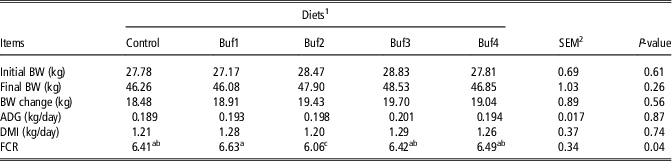
No significant difference was found in initial BW, final BW, BW change, average daily gain and DMI (Table 2). The feed conversion ratio (FCR) was lower (P<0.05) in Buf2 compared to the control and other treatments.
Growth performance and feed efficiency of growing male Awassi lambs fed complete pelleted diets containing different sources of buffers for 98 days

ADG=average daily gain; DMI=dry matter intake; FCR=feed conversion ratio.
1 Control=basal diet only; Buf1=basal diet+0.4% of AcidBuf (Celtic Sea Minerals); Buf2=basal diet+0.4% of AcidBuf and sodium bicarbonate (50 : 50); Buf3=basal diet+0.4% of calseapowder (Calcified Seaweed); Buf4=basal diet+0.4% of WMC Seaweed (Utva Lactuca extra).
2 SEM=data are presented as the least square mean µ±SE (n=12 animals).
a,b,cWithin a row, means without a common superscript differ (P<0.05).
Rumen fermentation profiles
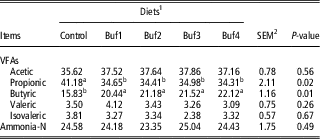
The propionic acid was lower (P<0.05) in the treated groups compared to the control. In contrast, the butyric acid was higher (P<0.05) in the treatment groups compared to the control (Table 3).
Ruminal concentrations of volatile fatty acids (VFAs; g/100 g total VFAs) and ammonia-N (mg/dl) of growing male Awassi lambs fed complete pelleted diets containing different sources of buffers for 98 days

1 Control=basal diet only; Buf1=basal diet+0.4% of AcidBuf (Celtic Sea Minerals); Buf2=basal diet+0.4% of AcidBuf and sodium bicarbonate (50 : 50); Buf3=basal diet+ 0.4% of calseapowder (Calcified Seaweed); Buf4=basal diet+0.4% of WMC Seaweed (Utva Lactuca extra).
2 SEM=data are presented as the least square mean µ±SE (n=12 animals).
a,bWithin a row, means without a common superscript differ (P<0.05).
pH values of ruminal fluid
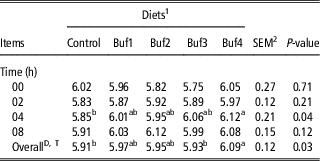
The rumen pH was higher (P<0.05) in Buf4 compared to the control at 4 and 8 h (Table 4).
Ruminal fluid pH of growing male Awassi lambs fed complete pelleted diets containing different sources of buffers for 98 days

D=diet×time interaction effect (P<0.05); T=time effect (P<0.05), rumen fluids were collected on days 1, 45 and 98.
1 Control=basal diet only; Buf1=basal diet+0.4% of AcidBuf (Celtic Sea Minerals); Buf2=basal diet+0.4% of AcidBuf and sodium bicarbonate (50 : 50); Buf3=basal diet+0.4% of calseapowder (Calcified Seaweed); Buf4=basal diet+0.4% of WMC Seaweed (Utva Lactuca extra).
2 SEM=data are presented as the least square mean µ±SE (n=12 animals).
a,bWithin a row, means without a common superscript differ (P<0.05).
Morphology and color components of ruminal tissue
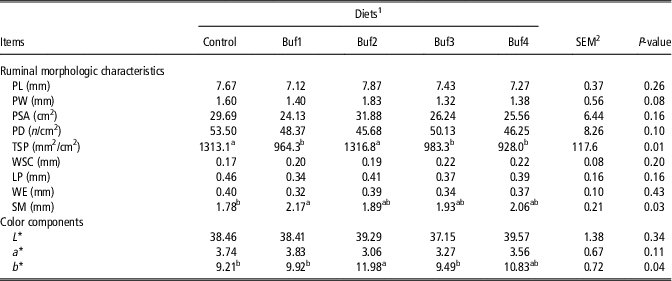
The results showed no significant difference (P>0.05) on rumen morphological characteristics, except the total surface of papillae which was (P<0.05) lower in Buf1, Buf3 and Buf4 compared the control, and the submucosa papillae which was (P<0.05) higher in Buf1 compared to the control (Table 5). Rumen tissue chroma was yellower (P<0.05) with Buf2 compared to control, Buf1 and Buf3 treatments (Table 5).
Morphometric measurements of the rumen papillae and color values of rumen tissues of growing male Awassi lambs fed complete pelleted diets containing different sources of buffers for 98 days

PL=papillae length; PW=papillae width; PSA=papillae surface area; PD=papillae density; TSP=total surface of papillae; WSC=width of stratum corneum; LP=lamina propria; WE=width of epithelium; SM=submucosa; L*=lightness; a*=redness; b*=yellowness.
1 Control=basal diet only; Buf1=basal diet+0.4% of AcidBuf (Celtic Sea Minerals); Buf2=basal diet+0.4% of AcidBuf and sodium bicarbonate (50 : 50); Buf3=basal diet+0.4% of calseapowder (Calcified Seaweed); Buf4=basal diet + 0.4% of WMC Seaweed (Utva Lactuca extra).
2 SEM=data are presented as the least square mean µ±SE (n=12 animals).
a,bWithin a row, means without a common superscript differ (P<0.05).
Carcass characteristics and meat quality
The hot carcass and cold carcass weights were higher (P<0.05) in Buf4 compared to Buf1 (Table 6). Table 7 illustrates the effects of different rumen buffering agents on meat quality of growing lambs. Administration of Buf4 improved the lean% and rib eye area (cm2) compared to the control and Buf1 treatments. In contrast, the fat percentage was decreased with Buf2 and Buf4 treatments compared to the control one. Regarding meat chroma, it was lighter (L*) with all treatment groups and yellower (b*) with Buf1 and Buf4 compared to the control.
Carcass characteristics of growing male Awassi lambs fed complete pelleted diets containing different sources of buffers for 98 days

1 Control=basal diet only; Buf1=basal diet+0.4% of AcidBuf (Celtic Sea Minerals); Buf2=basal diet+0.4% of AcidBuf and sodium bicarbonate (50 : 50); Buf3=basal diet+0.4% of calseapowder (Calcified Seaweed); Buf4=basal diet++0.4% of WMC Seaweed (Utva Lactuca extra).
2 SEM=data are presented as the least square mean µ±SE (n=10 animals).
a,bWithin a row, means without a common superscript differ (P<0.05).
Meat quality of growing male Awassi lambs fed complete pelleted diets containing different sources of buffers for 98 days

KKC fat=kidney knobs channel fat; MFI=myofibril fragmentation index; WHC=water-holding capacity; Non-carcass components=internal organs+visceral depot fats+head+gastrointestinal tract; L*=lightness; a*=redness; b*=yellowness.
The rack rib part was cut from 4th to 8th ribs.
1 Control=basal diet only; Buf1=basal diet+0.4% of AcidBuf (Celtic Sea Minerals); Buf2=basal diet+0.4% of AcidBuf and sodium bicarbonate (50 : 50); Buf3=basal diet+0.4% of calseapowder (Calcified Seaweed); Buf4=basal diet+0.4% of WMC Seaweed (Utva Lactuca extra).
2 SEM=data are presented as the least square mean µ±SE (n=10 animals).
a,b,cWithin a row, means without a common superscript differ (P<0.05).
Discussion
It is well known that the TMR feeding regimen may improve the feed efficiency in ruminants; however, there are chances of the occurrence of some rumen disorders (Alhidary et al., Reference Alhidary, Abdelrahman, Alyemni, Khan, Al-Mubarak and Albaadani2016a). In the past, some studies have reported the positive impact of the supplementation of buffer on the animal performance and rumen environment in ruminants (Cruywagen et al., Reference Cruywagen, Taylor, Beya and Calitz2015; Wu et al., Reference Wu, Bernard and Taylor2015); however, the comparative effects of different buffers in small ruminants have not been fully investigated.
The lamb performance parameters were not changed except the FCR which was improved in lambs supplemented with AcidBuf compared to other treatment groups. AcidBuf is a natural product, derived from sea algae and has been reported to have a double buffering capacity compared to that of sodium bicarbonate (Beya, Reference Beya2007). However, the effect on the BW and DMI in the current study was not significant among the control and the treated groups. In line with our findings, Wu et al. (Reference Wu, Bernard and Taylor2015) reported that calcareous marine algae failed to improve the DMI in dairy cows during the prepartum and postpartum period.
The concentration of propionic acid decreased; while of butyric acid increased in the treated groups compared to the control. Russell and Chow (Reference Russell and Chow1993) reported that supplementation of sodium bicarbonate increases animal’s water intake resulting in the dilution of the rumen contents and flow of starch from the stomach causing a reduction in the propionic concentration. In agreement with our findings, Erdman et al. (Reference Erdman, Hemken and Bull1982) reported that sodium bicarbonate decreases propionate concentration in the rumen. In our study, butyrate concentration increased in the supplemented groups as compared to the control. In agreement with our study, Davis et al. (Reference Davis, Brown and Beitz1964) reported that supplementation of sodium bicarbonate in cows fed with high concentrate diet decreased the concentration of propionate and increased the butyrate. In contrast to our findings, Bilik et al. (Reference Bilik, Strzetelski, Furgał-Dierżuk and Śliwiński2014) did not find any difference in the concentration of VFAs in response to supplementation of AcidBuf in dairy cows fed with a concentrate diet. It seems that the rumen concentration of different VFAs is affected by the composition of diet, dose and concentration of buffering agents and experimental protocol.
The pH of the rumen in the treated animal increased after 4 h of feeding. In addition, the overall pH was higher in the 0.4% of WMC seaweed. It is a well-known fact that animals receiving TMR-based diet showed a lower pH probably due to the faster fermentation and the higher production of VFAs (Bodas et al., Reference Bodas, Rodríguez, López, Fernández, Mantecón and Giráldez2007; Blanco et al., Reference Blanco, Giráldez, Prieto, Benavides, Wattegedera, Morán, Andrés and Bodas2015; Alhidary et al., Reference Alhidary, Abdelrahman, Aljumaah, Alyemni, Ayadi and Al-Saiady2017). Cruywagen et al. (2004) reported that dairy cows treated with high AcidBuf increased the rumen pH. In another study, Cruywagen et al. (Reference Cruywagen, Taylor, Beya and Calitz2015) found that AcidBuf is more effective in stabilizing the rumen pH compared to sodium bicarbonate. Similar findings were also reported by Beya (Reference Beya2007) who reported that rumen pH is decreased slowly in case of AcidBuf supplementation due to slow release of the minerals in the rumen. AcidBuf is composed of different kinds of minerals which has the ability to increase the pH of the rumen under the conditions when the animal has been fed with high concentrate diet (Cruywagen et al., 2004) leading to the improved feed efficiency. It has been previously claimed that calcareous marine algae work better when combined with the sodium bicarbonate (Wu et al., Reference Wu, Bernard and Taylor2015).
The buffers supplementation increased the submucosa thickness but decreased the total surface of papillae in the treatment groups. There are conflicting reports regarding the dimensions of histology in response to different feeding systems. Several authors have reported that rumen papillae are more influenced by the concentrated diet due to the higher production of propionic and butyric acids (Álvarez-Rodríguez et al., Reference Álvarez-Rodríguez, Monleón, Sanz, Badiola and Joy2012; Liu et al., Reference Liu, Xu, Liu, Zhu and Mao2013; Cavini et al., Reference Cavini, Iraira, Siurana, Foskolos, Ferret and Calsamiglia2015). In other studies, higher dimensions of rumen papillae have been reported when the feed was supplemented with some forage such as alfalfa (van Ackeren et al., Reference Van Ackeren, Steingaß, Hartung, Funk and Drochner2009; Alhidary et al., Reference Alhidary, Abdelrahman, Alyemni, Khan, Al-Saiady, Amran and Alshamiry2016b) probably due to the physical fill effects of roughage on rumen development. To the best of our knowledge, no report is available dealing with the effect of calseapowder and WMC seaweed on the histological structures of the rumen. The lower papillae measurement in the control group may be due to the disruptive effect of the higher production of VFAs in the rumen, whereas in the treated groups, the lower dimensions may be due to the neutralizing effects of the buffers.
The values of meat color (L* and b*) were higher in Buf1 and Buf4 compared to the control. There is a relationship between meat color and feeding system (Archimède et al., Reference Archimède, Pellonde, Despois, Etienne and Alexandre2008). Partially similar results were reported by Alhidary et al. (Reference Alhidary, Abdelrahman, Alyemni, Khan, Al-Saiady, Amran and Alshamiry2016b) and others (Carrasco et al., Reference Carrasco, Ripoll, Sanz, Álvarez-Rodríguez, Panea, Revilla and Joy2009; Jacques et al., Reference Jacques, Berthiaume and Cinq-Mars2011). Tissue color is affected by the feeding system of the animals. Lee et al. (Reference Lee, Kouakou and Kannan2008) reported that the yellowness and brightness were higher when goats were fed with concentrate diet and hay compared to the concentrate diet alone. The cold and hot carcass weights were higher in lambs treated with WMC seaweed (Buf4). In a similar study, Sen et al. (Reference Sen, Santra and Karim2006) did not find any difference in cold and hot carcass composition in lambs fed with high concentrated diet and sodium bicarbonate at different concentrations. The reason of higher hot and cold carcass in WMC treated lambs in our study could be due to the corresponding higher slaughter weight and dressing percentage in this group.
The percentage of the lean meat increased in WMC seaweed, whereas fat percentage decreased in the same group (Buf4). This effect of this buffer is beneficial since the excess carcass fat in the control group is less desirable from the consumer point of view and reduces the carcass value (Sen et al., Reference Sen, Santra and Karim2006). Similarly, the rib eye area also increased in WMC seaweed supplemented group. This increase is simply related to the higher carcass weight in this group. In addition, the fat percentage in the rack, as well as visceral depot (total), decreased in the treatment groups. A diet composed of full concentrates produces a higher concentration of VFAs, which stimulate the secretion of insulin and synthesis of fat.
Conclusions
The results indicate that the addition of different sources of buffers to lamb diets improved the feed efficiency, carcass quality and rumen characteristics. These include acidbuf, sodium bicarbonate and sea algae. Different levels of each buffer should be considered to determine the most efficient level of each buffer supplementation for sheep in order to gain much productivity.
Acknowledgements
The authors extend their appreciation to the Deanship of Scientific Research at King Saud University for funding this work through research group No (RG-1436-021).
Declaration of interest
The authors declare no conflicts of interest.
Ethics statement
All procedures followed the Implementing Regulations of the Law of Ethics of Research on Living Creatures (Saudi Arabia National Committee of Bio-Ethics) with the approval of the King Saud University Animal Ethics Committee.
Software and data repository resources
None of the data were deposited in an official repository.