


In February of 1952 the celebrity preacher and self-help writer Norman Vincent Peale appeared before the Congressional Committee on Interstate and Foreign Commerce to lobby for a suite of aggressive new legislation. Peale was testifying on behalf of ongoing efforts to severely restrict the circulation of liquor advertising. He began by stipulating that the proposed bills would assuage a source of considerable popular resentment and frustration. “It seems to me, gentlemen, that the attitude of the American people has been quite liberal, even generous, with respect to the liquor traffic since the repeal of the eighteenth amendment,” he began. “However, there is a point of forebearance beyond which they lose patience.” Peale went on to posit that this collective openness to the alcoholic beverage industry stopped at the door of the family home. He continued: “there is still an old-fashioned notion in this land that a man’s home is his castle and that it is a place of retreat from the world and a sanctuary for man and wife and their little children. The liquor people, I believe, are on dangerous ground in this ill-considered invasion of the home with their ads.”Footnote 1 In this testimony, Peale presents advertisements for liquor, wine, and beer as intrusive and immoral disrupters of the nation’s most beloved institution, the heteropatriarchal family. His statement echoes the many activists and organizers who lobbied avidly to silence the liquor industry’s loudest mouthpiece, claiming that it threatened to drown out the meeker voices of sober parents and pastors.
The postwar years saw a substantial uptick in what contemporaries called “dry sentiment,” or religious objection to the sale and consumption of alcoholic beverages. Efforts to legally limit the circulation of liquor, wine, and beer advertising were central to this understudied movement.Footnote 2 This paper describes and interprets postwar Protestant legal activism against liquor advertising, arguing that these efforts represented religious attempts to monitor and control the increasingly consuming world of mass media. Chastened by the failures and complexities of national Prohibition, postwar temperance activists wagered that they could dramatically curtail the consumption of alcohol by targeting advertising, a key mechanism for stoking its appeal. For nearly a decade, these activists lobbied for legislation that would not ban the production of liquor advertising (a clear First Amendment violation) but prevent advertisements for liquor, wine, and beer from moving across state lines. If passed, this legislation would have functionally prevented nationally circulating periodicals and national broadcasters from accepting any advertising for liquor, wine, and beer. The postwar temperance movement’s favored legislation thus betrays their twin motives: to diminish the popularity of recreational drinking, and simultaneously place a moral check on the ostensibly amoral media industries that unscrupulously accepted advertising from any paying entity.
In 1947, 1948, 1950, 1952, 1954, 1956, and 1958, temperance organizers successfully pressured national lawmakers in both the House and the Senate to consider a series of bills banning the interstate movement of liquor advertisements. Each version of the proposed bills included some variation on the language quoted below, drawn from the legislation put forward in 1947:
It shall be unlawful for any distiller, brewer, vintner, manufacturer, wholesaler, or retailer or for the agent, broker, or factor of any of them, engaged in the sale of alcoholic beverages to cause to be transported in the mails or otherwise from any State or Territory or the District of Columbia to any other State or Territory or the District of Columbia any newspaper, periodical, news reel, photographic film, or record for mechanical reproduction advertising alcoholic beverages or containing the solicitation of an order for alcoholic beverages.Footnote 3
Further sections of the bill went on to specify that broadcasters, publishers, and the postmaster general could all be subjected to fines of up to $1,000 if they facilitated the interstate movement of any media bearing “solicitations” to purchase or consume alcoholic beverages. The legislation effectively prevented all nationally circulating mass media from carrying liquor advertising. Nine years later, in 1956, the temperance movement’s proposed bill was nearly identical despite significant developments in media technology. The prohibition against interstate circulation effectively encompassed television as easily as it had accounted for periodicals and could have dealt an equally harmful blow to both. Temperance activists knew that advertising, and specifically and increasingly alcohol advertising, underwrote the magazines, newspapers, radio programs, and television shows that comprised postwar public life.
In harmony with this legislative activism, opponents of liquor advertising sought to shame and influence particular media organizations. Temperance activists organized boycotts and letter-writing campaigns to rebuke media outlets that benefited from their despised ads. Time Incorporated, the then-ubiquitous publisher of Time, Life, and Fortune magazines and the March of Time radio and cinema newsreels, received particular attention, thanks to the chairman and co-founder Henry R. Luce’s missionary background and well-known Protestant commitments. Temperance activists printed thousands of pamphlets demanding that Christian readers stop consuming Time and Life, on the basis that Luce benefited directly from the drunkenness and immiseration caused by liquor advertising. Some drys tore liquor advertisements out of their magazines and mailed them back to corporate headquarters bearing stickers that blared “Liquor Ads Must Go!” Others wrote Luce personal, heartfelt appeals imploring him to honor his temperate, missionary parents’ legacy by refusing ads for liquor, wine, and beer. During the late 1940s and early 1950s, such angry letters from temperance activists comprised between 5 and 10 percent of the corporation’s total mail.Footnote 4
The archives of mid-century activism against liquor advertising deepen and complicate histories of commercial mass media and Christian commitment in the mid-twentieth-century United States. A body of work in US religious studies shows how Christianity became particularly and thoroughly conflated with mass media during the years immediately following World War II. Pivoting on examples including the American Advertising Council’s “Religion in American Life Campaign,” the runaway success of celebrity clerics like Peale, Fulton Sheen, and Billy Graham, and the lavish production of biblical epic films, this literature highlights a series of mutually beneficial collaborations among Christian interests and corporate media conglomerates.Footnote 5
Many works on Christianity and media in the postwar period emphasize that mass-mediated Christianity expressed Cold War–era political anxieties. Animated by their common investment in galvanizing US publics against the so-called “godless communists,” corporate media conglomerates and activist clergy clamored to convince their shared audiences of the United States’ singular national piety. In the words of Kevin Kruse, canny collaborations between anti-communist clergy and capitalist media makers meant that “political culture and popular culture sang from the same hymnal.”Footnote 6 Johnathan Herzog emphasizes the top-down nature of post–World War II religiosity, positing that collaborations between elite religious actors and mass media makers constituted “an orchestrated makeover painting a veneer of faith across the social and cultural landscape.”Footnote 7 Both of these works, and many others, tell stories of close collaboration and smooth collusion, wherein conservative clergy and corporate media institutions effectively “orchestrated” a moment of anti-communist national piety.
These literatures leave out the postwar period’s profound and pervasive cultural ambivalence about what new mass media made possible. After World War II, prominent social scientists and cultural critics published bestsellers publicly lamenting the superficial, homogenizing effects of corporate-controlled mass media. Observers across the political spectrum worried that the postwar years’ proliferation of drive-in theatres, television sets, consumer trends, and glossy magazines threatened to degrade popular tastes and subsume individuals into unthinking, unsophisticated masses. William Whyte’s The Organization Man, for example, diagnosed the alarming rise of a bureaucratized culture that rewarded consumerism, conformity and status-seeking. In another particularly relevant example, Vance Packard’s The Hidden Persuaders argued that contemporary advertising was unethically manipulative. The media historian Susan Smulyan describes the postwar years as a moment when “middle-class Americans recognized an increasingly ubiquitous mass culture, worried about its implications, and began to accept a quite restricted role in its production, becoming primarily consumers.”Footnote 8
Temperance activists, for their part, were not content to accept the role of passive, manipulable media consumers. They insisted that mass media did not reflect Christian standards of sobriety and good behavior, and lobbied ardently for policy that would make such media conform to their desired moral norms. In his 1947 treatise, Some Notes on the Alcohol Problem, the leading temperance organizer Deets Pickett attributed popular intemperance to the expanding world of communications technology. He observed, “The increased facilities of transportation and communication have widened the horizon immeasurably, and they have increased the influence of metropolitan civilization. This civilization is lustrous but it is not founded upon the ideals of the church or the standards of personal conduct with which we have heretofore identified Christian morality.”Footnote 9 Peale echoed this sentiment in the 1950 hearings, when he wrote a letter bemoaning how “radio, magazine and newspaper materials have a proven effect in the moral deterioration of American youth.”Footnote 10 Pickett and his colleagues’ approach to mass media was thus closer to Vance Packard’s than Cecil B. DeMille’s. Rather than using television, radio, cinema, advertising, or mass market magazines to popularize their cause, they systematically advanced legislation intended to quiet the media that was out of step with their own particular standards of bodily comportment and moral behavior.
Postwar drys also rejected or ignored the era’s favored mass-mediated religious discourses. Some temperance activists glibly dismissed popular anti-communism. During the 1947 senate hearings, J. Warren Hastings, the pastor of Washington, D.C.’s National City Christian Church, complained that “Last week we had a woman who made some sort of a reference to communism in our high school out here. We rose up in arms. We had a big investigation. We carried it on the United and AP wires across the United States. We do not want our young people to hold anything in particular about communism. And yet we tell them all sorts of lies about liquor.”Footnote 11 Seven years later, at the 1954 Senate hearings, the Olympic runner Glen Cunningham made a similar point, suggesting that anti-communism was a distraction from the urgent cause of insulating youth from liquor advertising. “My belief is we are so worried about communism, and we have begun to hear a great deal about that just recently,” he observed, “and I believe the advertising of alcoholic beverages and the enticing of our youth to use alcoholic beverages will undermine the morals and spiritual values of our coming generation until it is a far greater danger than communism could ever hope to pose.”Footnote 12 In 1958, one activist garnered media attention for claiming that vodka was Russia’s most dangerous export.Footnote 13 All these statements downplay the threat of communism, instead critiquing the forces that made communism a topic of national fixation. The implication was that the powerful forces controlling mass media posed a more meaningful threat to US culture and values.
Although postwar temperance activists occasionally dismissed anti-communist anxieties, they were in no sense antagonistic to Cold War–era aspirations and cultural formations. A vast literature has shown that the Cold War was waged on foreign and domestic fronts, against communist states abroad and nonconformist subjects at home. In addition to the suppression of left and left-leaning political actors, the Cold War included various programs to promote and naturalize the single-breadwinner, procreative, nuclear family.Footnote 14 This multi-sited project upheld the family as both a moral and an economic unit, necessary to powering the United States’ booming consumer economy and to producing the right kinds of future citizen-subjects. As Hasting’s and Cunningham’s testimonies make clear, and as I will discuss at length throughout this paper, postwar drys were obsessed by the project of insulating youth—and the domestic spaces where youth ostensibly resided—from corrupting influence. While postwar temperance activists did not circulate the Cold War–era anti-communist discourses many histories describe, their project of protecting the procreative family home from dangerous, mass-mediated influence was deeply embedded in adjacent Cold War–era cultural projects.
The youth and families that captivated drys’ attention were implicitly white and decidedly Protestant. Some studies of the postwar period posit the “tri-faith” nature of postwar religiosity. Kevin Schultz and others argue that following World War II, long-standing assumptions about the United States’ Protestant identity shifted, resulting in statements affirming that the United States was indeed a “religious nation” but one that made room at the center for Catholics and Jews.Footnote 15 Insofar as “tri-faith” religiosity was, in Schultz’s words, an “image,” it was not an image that compelled the postwar temperance movement. Jewish groups were entirely absent from the dry coalition, and Catholic participation was extremely scarce.Footnote 16 In the very rare cases when temperance activists even alluded to non-Protestant actors, they betrayed the anti-Catholicism and antisemitism that characterized older iterations of their movement.Footnote 17 For example, during the 1952 Senate hearings, one Washington, DC pastor claimed that temperance legislation might be more successful if fewer Jews controlled national liquor legislation.Footnote 18 In another instance, a letter from a temperance activist to Henry R. Luce blustered that the Protestant media mogul could only be printing liquor advertising because of the insidious influence of his Catholic wife.Footnote 19 In both these cases, temperance activists alluded to long-standing conspiracy theories about Jewish and Catholic influence on elite structures. In her discussion of Jews and Prohibition, Marni Davis writes that “Anti-Semitism and prohibition provided parallel ideological settings for Americans to express alarm about economic stratification and the increasingly commercial nature of the American economy.”Footnote 20 While anti-Catholicism and antisemitism were not pervasive within the postwar temperance movement, mid-twentieth-century drys likely shared their predecessors’ prejudices and attendant conspiratorial thinking around expanding commercialism and entrenched class hierarchies. In the postwar period, this manifested as diatribes against advertisers and advertising.
When tri-faith unity and Christian anti-communism do appear in the archives of mid-century temperance organizing, these discourses were espoused by liquor and advertising interests. Starting in the mid-1950s, the “wet” coalition (advertisers and media executives, brewers and brewery workers, distillers and vintners) began to make strong showings at the drys’ House and Senate hearings. In their arguments, which ultimately prevailed, wets frequently claimed that the proposed clampdown on advertising was “Russianlike” or “communistic.” In only one instance, an opponent of the temperance movement pulled on tri-faith aspirations, claiming that drys’ proposed ban on the interstate circulation of “solicitations” would violate religious freedom by preventing Catholic priests from ordering sacramental wine and Jews from contacting kosher wine suppliers.Footnote 21
The ways in which anti-communist and tri-faith discourses appear—and do not appear—throughout the mid-century temperance movement provides a reminder of which voices and archives have received the most attention from scholars of mid-century US religions. Works on the postwar period have consistently paid attention to the producers of national discourse, with less attention to outliers and critics. Here, we see media entities and their allies repeating the well-known lines, while temperance activists dissented from dominant tropes.
The temperance movement’s indictment of postwar mass culture has not yet been well described. Many current studies of Christianity, media, and economy in the postwar period forget that Christian actors have been motivated to censure and decry mass media almost as often as they have wielded it toward evangelistic ends.Footnote 22 Like many other critics of postwar mass culture, temperance activists were troubled by the rapid proliferation of magazines, radio shows, television commercials, and outdoor advertising. They responded by attempting to exert some control over what that media could say. They insisted that advertisements for liquor, wine, and beer were fundamentally deceitful and that corporate executives in the alcohol and advertising industries trespassed into forms of moral instruction that should rightly be left to the family and the church.
The following four sections of this article look closely at postwar temperance activists’ actions and arguments. The first section describes the movement’s tactics, detailing how a cohort of small, poorly resourced Protestant church and lay organizations captured the time and attention of national lawmakers. The next section historicizes the movement, tracing how postwar drys both channeled and deviated from earlier temperance movements. The following two sections map the priorities that animated the mid-century temperance movement via the two advertising campaigns they most abhorred. First, I address the temperance movement’s critique of Lord Calvert’s “Men of Distinction” campaign, which featured “distinguished” gentlemen endorsing Lord Calvert’s whiskey. I use temperance activists’ vociferous dislike of the campaign to illuminate the class politics that shaped their objections to alcohol advertising writ large. Finally, I interpret and contextualize drys’ objections to the United States Brewers Foundation’s “Home Life in America” campaign. This series of beer advertisements featured cheerful paintings of families gathered with rounds of beer, alongside the slogan “Beer Belongs!” Temperance campaigners raged against these ads, using them to argue that brewers and their corporate allies sought to permanently reshape the norms of traditional white Protestant domesticity. Taken together, the mid-century temperance movement’s objections to these two campaigns indicate a profound anxiety about the deepening and expanding influence of a corporately controlled commercial mass culture. Their activism against these ads was an attempt to grasp control.
Dry Tactics: Organizing Against Liquor Advertising
Postwar drys abandoned the headline-grabbing tactics that defined earlier iterations of the temperance movement. Instead, they focused on quietly and steadily mobilizing state power toward their desired ends. In the words of a 1956 Cosmopolitan article, these campaigners “tread so softly in sophisticated circles and in bailiwicks outside the immediate center of local campaigning that most people don’t even realize they’re gamboling around.”Footnote 23 One of those “bailiwicks” was the Methodist Building on Capitol Hill. Located just one block from the Supreme Court, it was erected during Prohibition with the hope of securing continued temperate and Protestant influence in the halls of power.Footnote 24 Throughout the late 1940s and 1950s, the years under investigation here, the Methodist Building hosted the National Prohibition and Temperance Council (NPTC), an umbrella organization that connected long-standing temperance organizations, including the Women’s Christian Temperance Union (WCTU) and the Anti-Saloon League, with many smaller, local church groups.
These organizations were regionally and denominationally diverse, representing both old mainline institutions and would-be allies of the burgeoning Christian right. Methodist and Baptist parachurch groups made up the NPTC’s core constituency. Large urban Methodist church groups were well represented, as were small rural Baptist communities. Presbyterians (United and Reformed), Quakers, Lutherans, Congregationalists, Seventh-Day Adventists, the Assemblies of God, and Christian Scientists were also among the NPTC’s national network. In her research on the postwar temperance movement, the historian Pamela E. Pennock concluded that “no identifiable regional patterns” could be discerned among the church and lay groups who lobbied to curtail liquor advertising.Footnote 25
The chair of the NPTC, the Methodist Episcopal bishop Wilbur E. Hammaker, lived at the Methodist Building, where he worked year-round to build relationships with senators and congressional representatives sympathetic to dry ideals. Anti-advertising legislation was endorsed by cultural conservatives in both parties. Western Republicans took leadership roles, with early iterations of the bills named for Arthur Capper, a Republican senator from Kansas, and later versions named after William Langer, a Republican from North Dakota. Some Southern Democrats also organized with the NPTC, including the noted segregationist Strom Thurmond from South Carolina. Hammaker and his allies always hoped that their hearings would rouse new support, and their ambitions were not entirely misplaced. Dry representatives had held the majority in Congress as recently as the 1930s, and many of those lawmakers remained active in the late 1940s.Footnote 26
Hammaker and his allies benefited from the temperance movement’s deep roots. The NPTC drew its strength from a network of local WCTU chapters, Methodist Board of Temperance offices, and local parachurch organizations that had existed since the turn on the twentieth century. The campaign against liquor advertising was pushed by many of the same people and groups who had championed Prohibition decades earlier. The NPTC’s core of Washington-based activists frequently circulated petitions and pamphlets to maintain connections with a well-organized national network of local temperance groups. At strategic moments, the NPTC organized for activists from across the country to provide testimonies and pack hearing rooms.
Every year in January, the NPTC convened a large conference where sympathetic legislators met with temperance activists from around the country to mingle and strategize. Officially, the NPTC believed that national Prohibition should be reinstated, but they never publicly advanced that cause. Instead, they worked behind the scenes to advance subtle, incremental policies meant to dry up the nation’s pervasively wet culture. The NPTC lobbied for bills to restrict access to alcohol in the armed forces and to create new, draconian licensing requirements for restaurants, hotels, and bars. None of these efforts were as popular as the campaign to ban the interstate circulation of liquor advertising, which was the only temperance legislation capable of attracting endorsements from luminaries like Peale.Footnote 27
The semiannual Senate hearings for this legislation were a rare instance when postwar temperance organizing went public. These hearings, which happened before the Senate Commerce Committee in 1947, 1948, 1950, 1952, 1954, 1956, and 1958, and before the House Commerce Committee in 1954 and 1956, presented activists with an opportunity to demonstrate their movement’s vital purpose and sound argumentation. Bishop Hammaker, who had cultivated the relationships necessary to stage each hearing, represented the dry coalition. He curated testimonies from individuals who evoked his movement’s popularity and prominence, including Peale and Cunningham. Other testimonies, including those from local youth pastors and housewives who organized with the WCTU, represented the movement’s piety and wholesomeness. The few journalists who reported on these hearings described crowds of temperance activists that “overflowed the largest hearing room” and a mood in which “wet witnesses received no applause.”Footnote 28
Despite these shows of strength, no bill banning the interstate circulation of liquor advertising ever passed. In some cases, the drys lost by only a slim margin. At the beginning of 1953, the NPTC told their constituency that the series of anti-advertising bills proposed in 1952 were only one vote away from moving beyond the Commerce Committee.Footnote 29 In no instance, however, did a majority of lawmakers vote to enshrine temperance activists’ desired legislation into law. Even with the drys’ canny organizing and heated rhetoric, federal lawmakers were reticent to place strictures on the promotion of legal substances and were weary of alienating prestigious and lucrative industries.
Although postwar temperance organizing never succeeded and received very little attention in its time, the movement had a palpable effect on the industries it sought to rebuke. After the repeal of Prohibition in 1933, liquor interests and the advertising entities who represented them moved slowly and cautiously for fear of organized outrage. As of November 1955, the Distilled Spirits Institute (a professional organization representing most major US distillers) still maintained a 1930s-era code of conduct baring members from advertising on radio and television or placing advertisements in periodicals published on Sundays. This same code stipulated that women and athletes should never appear in advertisements for hard liquor.Footnote 30 Benefiting from the perception that their products were less dangerous, beer and wine advertisers ventured more confidently into the world of broadcasting and occasionally depicted women in their ads. Nonetheless, brewers and vintners took pains to present their products as safe, sophisticated, and benign. In 1947, when the United States Brewers Foundation published a pamphlet on the “Dos and Don’ts” of beer advertising, the first “Do” was to present beer as “a beverage of moderation.”Footnote 31 While they would scarcely admit it, these acts of self-regulation were an acknowledgment of the temperance movement’s palpable cultural influence and long-standing political power.
“More Than a Wisp out of the Past”: Liquor Advertising and the Long Protestant Temperance Movement
In 1947, Life magazine (which was then a central target of Protestant temperance organizing) covered a rare example of public-facing WCTU activism. A two-page photo spread at the center of the magazine showed a large group of elderly white women crowded into a Pasadena, California tavern. Each woman wore a white plaque bearing a temperance slogan and conveyed an attitude of grim determination. The men seated at the bar continued drinking, undeterred. Life’s coverage situated this scene within the context of the temperance movement of decades past. “These marching grandmothers will seem strange to many younger Americans,” the first line of copy read. “But to older people, who can recall the violent days of hatchet-wielding, saloon-smashing Carry Nation, they seem like nothing more than a wisp out of the past.” Although reminiscent of older movements, contemporary temperance activists were taking a different tack: “Like members of other dry organizations who are becoming active again,” the article observed, “they are advocating for measures short of an immediate campaign for outright prohibition.”Footnote 32 Life’s analysis of the Pasadena WCTU demonstration anticipated Cosmopolitan’s insights nine years later. In a 1956 article on contemporary drys, the women’s magazine remarked that “the Drys’ New Look” was based on “erosion, instead of explosion.”Footnote 33 In both articles, contemporaries observed that while postwar organizing shared a lineage with the late nineteenth- and early twentieth-century Protestant temperance movement, it advanced new causes and adopted new strategies. In this section, I show how postwar drys mobilized the long temperance movement’s accumulated power toward decidedly mid-twentieth-century goals.
The post–World War II movement against liquor advertising shared considerable institutional and ideological continuity with the nineteenth- and early twentieth-century temperance movement. From the late nineteenth century through to the late 1950s, their basic tactic was to enforce unpopular moral reforms by advancing national legislation.Footnote 34 Like the late nineteenth- and early twentieth-century temperance movement, postwar drys succeeded by connecting churchwomen and pastors nationwide to lawmakers on Capitol Hill. Like their predecessors, post–World War II activists also fashioned themselves as the moral guardians of the nation and insisted that the federal government act on their behalf. Publications like Life often noted the advanced age of temperance activists.Footnote 35 In the 1940s and ’50s, some of the most ardent activists were old enough to have lobbied for Prohibition themselves.
Both the Victorian and mid-twentieth-century temperance movements were galvanized by the ideal of separate, gendered spheres. In “Temperance and Home Protection,” a defining address of the nineteenth-century temperance movement, the WCTU president and co-founder Frances Willard proclaimed that alcohol threatened domestic tranquility and was thus antithetical to the interests of women. This speech, delivered in 1876 at the Third Annual Convention of the Women’s Christian Temperance Union in Newark, New Jersey, observed that drinking made men angry and violent, rendering them unreliable providers. Willard proclaimed that men’s intemperate behavior undermined women’s ability to act on their God-given domestic proclivities, stating, “God has indicated woman, who is the born conservator of home, to be the Nemesis of home’s arch enemy, King Alcohol.”Footnote 36 Women’s continued leadership in political organizing remained premised on the assumption that Willard articulated: that women’s divinely ordained charge to safeguard the hearth must provide a necessary check on the dangers of male drunkenness. For her and for others, actually enforcing temperance required women’s enfranchisement. Her convention address went on to argue stridently for women’s suffrage, asserting that women’s needs would not be respected until they had access to the ballot. In the words of the historian Catherine Gilbert Murdock, at the turn of the twentieth century “both male drinking and male politics required female intervention.”Footnote 37 Murdock and others have demonstrated that women’s temperance organizing ultimately catalyzed women’s suffrage. Organized objection to recreational drinking launched Victorian women into the public sphere, to advocate on behalf of the private home.Footnote 38
Mid-century activists shared in the conviction that women were best suited to the domestic sphere, but they lacked their predecessors’ investment in expanding women’s political participation. Postwar temperance activism reflected notions of gendered domesticity that pervaded the postwar period. In her classic study of mid-century family life, Elaine Tyler May argues that domesticity was valorized as a process of “containment.” Echoing political discourses stipulating that communism could not be eradicated but only “contained,” mid-century US Americans viewed the home as a space where virtue and personal satisfaction could be “contained” from the acids of a rapidly changing modernity.
This logic of containment galvanized the mid-century movement against liquor advertising. In temperance activists’ formulations, the physical space of the home and the women and children who operated within it needed to be protected from the insidious influence of mass circulation advertising. For example, at the 1947 Senate hearings, Reverend O. R. Miller of Albany, New York complained that “Liquor advertisements pour into the home in radio programs, the newspapers, magazines, and journals.” If this situation were to endure, he continued, “too many mothers, wives and sisters to whom society looks for refuge and sanity and health in an age of moral laxity, will instead become derelicts, meriting at the worst disgust and at the best, pity.”Footnote 39 Here, Miller stipulates that, when the home is permeated by mass culture, women’s characteristic moral facilities are indelibly compromised. Three years later, another witness worried that advertisements for liquor, wine, and beer would draw women outside of the home, to the detriment of their families. Dr. R. H. Sherwood, a pediatrician and temperance activist from Niagara Falls, New York, argued that because of “advertisements which make drinking glamorous and fashionable … many young mothers may be found perched on stools in cocktail bars when they ought to be home getting supper for their children.”Footnote 40 Like their Victorian predecessors, these mid-century temperance activists acted on the conviction that women were inherently suited to the labors of the home. Unlike their forebearers, however, temperance activists of the postwar period insisted that they remain contained therein.
If nineteenth-century temperance activists believed that the home must be protected from men’s irresponsible alcoholism, postwar drys believed that it needed to be protected from unscrupulous advertisers. The mid-century temperance movement’s particular focus on advertising reflected new realities that had set in after World War II. At the 1954 congressional hearings, D. C. Emanual Carlson, executive director of the Baptist Joint Committee on Public Affairs, diagnosed the drys’ daily conundrum, lamenting that, “A kind of psychological pressure fills the air. From billboards, from the newspaper and magazine columns, from radio and from television we are hounded by the voice of the brewer and of his distribution until we are almost made to believe that we are wrong to even want to lead sober lives.”Footnote 41 Throughout their hearings before the Senate and House committees, Carlson and his collaborators repeatedly insisted that advertising was becoming more ubiquitous, more sophisticated, and more persuasive. They complained about being “constantly bombarded” with advertisements, swore that contemporary advertising was becoming remarkably more “colorful and seductive,” and protested that, between television, radio, magazines, outdoor billboards, and in-store displays, no one could possibly escape liquor advertising, no matter how hard they tried.
They were correct. The postwar consumer boom stimulated a massive expansion of advertising. In 1946, The New York Times remarked that the quantity of text dedicated to advertising in New York area newspapers had increased by almost 30 percent in the months immediately following the end of the war.Footnote 42 This calculation was representative of massive expansions in the advertising industry as a whole. During the five years after World War II, gross total advertising expenditures nearly doubled, from $2.9 billion spent nationally in 1945 to $5.7 billion in 1950. In 1947, the advertising agency J. Walter Thompson was celebrated for its record-breaking $100 million in annual billings. Less than five years later, in 1951, four major agencies were billing over $200 million annually, with only further growth in sight.Footnote 43 This growth was so steady and so significant that a keynote speaker at a 1955 meeting of the American Association of Advertising Agencies predicted that the entire advertising industry—the number of firms, employees, and advertisements produced—would grow threefold by 1970.Footnote 44 Advertisers were excited and emboldened. Flush corporations were dedicating large budgets to promoting their wares, and the effects were felt nationwide.
This money was spent not only on producing advertisements but also on innovating new styles and forms of advertising. In 1949, temperance activists took note that Four Roses Whiskey was creating elaborate in-store displays that included real roses frozen in bricks of ice.Footnote 45 These elegant displays, they worried, would surely pique the curiosity of consumers. Gimmicks like this one look superficial when compared to the sophisticated new strategies that advertisers were using to promote their clients’ products. The postwar years saw a slew of novel approaches to capturing consumers’ attention and compelling them to make purchases. Advertisements appeared in more and more places. In 1947 the New York Herald Tribune reported a marked increase in outdoor billboard advertising and predicted that the trend would continue over the next several years.Footnote 46 Private, interior spaces were also hosting more advertisements. In 1951, the Tribune observed that direct mail advertising was up 13 percent from 1950.Footnote 47 In 1958, Printer’s Ink featured a long report on product packaging. Reflecting on a decade’s worth of innovative packing designs (including Kleenex boxes and aerosol cans), the authors noted that effective packaging acted as advertising that lived indefinitely in the consumer’s home.Footnote 48
Advertisements were becoming more varied and more sophisticated. One remarkable postwar development was the popularization of “motivation research,” or the use of psychological principles and social scientific strategies in the conceptualization of advertising campaigns. Motivation research stipulated that advertisers should tap into consumers’ deepest psychological drives to stoke desire for their products. Among the innovators of this approach was Ernest Dichter, a student of Freudian psychoanalysis. Dichter’s bestselling The Strategy of Desire insisted that mobilizing psychology to make sales was entirely practical and ethical. “Motivation research” typically began with canvassing consumers and convening focus groups. Advertisers in search of psychological insights became so ubiquitous that a 1948 Newsweek columnist quipped that “The odds are getting better all the time that when the doorbell rings, a well-trained young lady will be standing there to say, ‘We are making a survey.’”Footnote 49 Once this data was gathered, Dichter and his many protégés plumbed the responses for aspirations, insecurities, and longings that advertisers could appeal to in their campaigns. Thanks to the widespread popularization of this approach, soap advertisements increasingly subsumed discussions of hygiene within warnings against inadequate mothering, and beer ads promised fun and friendship over and above smooth taste.Footnote 50 When Emanual Carlson of the Baptist Joint Committee on Public Affairs testified that “a kind of psychological pressure fills the air,” he correctly identified one of advertisers’ favorite new tactics. Under the supervision of experts like Dichter, advertisements increasingly tapped into consumer’s psychological “drives,” an approach that temperance activists took note of and vociferously critiqued.
One space where advertising’s tremendous expansions and innovations were evident was, of course, liquor advertising. After the repeal of Prohibition in 1933, many media outlets refused to carry advertisements for alcohol. By the end of World War II, however, nearly all those bans had been dropped and alcohol industries poured resources into self-promotion. One national advertising agency reported that liquor, wine, and beer producers increased their spending on advertising by 120 percent in the five years between 1948 and 1953.Footnote 51 In 1948, Pabst Blue Ribbon’s advertising budget became the largest of any brewer in the entire world. The company dedicated their enormous resources to hiring celebrities (including Bob Hope and Gary Cooper) for their print advertisements, commissioning 20,000 large posters and billboards for display in high-traffic commercial areas, and purchasing spots on 146 local radio stations.Footnote 52 Another record was broken several years later, when Lord Calvert mounted the largest commercial display ever installed in a public transit hub, an 18-foot-high rotating statue of a white-gloved hand holding a glass of whiskey in New York City’s Penn Station.Footnote 53 These spectacles indexed the growth of advertising as a whole, and the liquor industry’s increased confidence that their desired publics would accept their appeals. By 1958, even The Saturday Evening Post, a traditionally Protestant and temperate national magazine, had decided that it was acceptable to print advertisements for liquor, wine, and beer.Footnote 54 The sum effect of these changes was that cannily crafted advertisements for liquor, wine, and beer flowed into homes through radio, magazines, newspapers, and television, transforming even the most sober homes into spaces where the desire for alcohol could percolate.
Scholars of Cold War-era architecture and media describe this period as a moment when public and private spaces were consistently confused and conflated. In the words of the media scholar Lynn Spigel, “the domestic environment was filled with visual spectacles previously associated with public life, and the home itself was designed as a space for looking.”Footnote 55 The drive-in theater was sold as a living room, while living-room picture windows let the neighborhood in.Footnote 56 Temperance activists bemoaned what this might mean for their sobriety and the future sobriety of their children. Caradine R. Hooton, a Washington, DC-based Methodist youth pastor, captured the core complaint of the temperance movement when he testified at the 1950 congressional hearings. He lamented teenagers’ inability to enjoy contemporary media without interference from the seduction of liquor advertisers, and implored the government to act on their behalf:
Our homes and our churches are havens of protection from the hell of the public house. In them, they love good music and superb programs on television and radio. When we seek the security of our homes and the beauty of our sanctuaries for training young people in the pure enjoyments of the truly temperate life, does not the great American Government owe to us the unfettered freedom from those private rights, without the molestation of invasion by a known destroyer?Footnote 57
Hooton’s statement combines nineteenth-century rhetoric (“the hell of the public house”) with twentieth-century anxieties. Thanks to the explosive growth of advertising, contemporary homes could no longer be completely sheltered from the seductions of a decidedly wet mass culture. The obvious permeability of private homes challenged the temperance movement’s long-standing commitment to gendered divisions of private and public space. Postwar drys’ focus on advancing national reform echoed the Victorian social gospel tradition. In Hooton’s formulation, it was the duty of the state to enforce moral behavior, creating a situation wherein sober homes could remain contained from the intemperate aspects of mass culture without forgoing its pleasures. Contemporary young people should not have to go without the “superb programs on television and radio.” Rather, the government should take the side of sober families by limiting the powerful liquor, wine, and beer industries’ ability to promote themselves.
Contesting Corporate Influence: Lord Calvert Whiskey’s “Men of Distinction” Campaign
Activism against liquor advertising raised concerns in corporate circles. In April of 1946, executives at Time Incorporated asked the corporation’s general council to compile a report on organized efforts to limit liquor advertising. The resulting correspondence included a telling aside. After laying out potential legal threats to the free flow of liquor advertising, Time Inc.’s council remarked on the executives’ own drinking habits. “My final remark, an entirely gratuitous one,” he wrote, “is that TIME INC. staff could do with a bit of mild Christian moderation in its lunch-time drinking. The single most noticeable change on my return from the army was the acceptance of cocktails as normal lunch procedure.”Footnote 58 He went on to speculate that if the highest rungs of corporate leadership dialed back their daytime drinking, then heavy drinking might recede within the rest of the organization. Smuggled into this formal correspondence was the observation that everyday drinking habits were shaped by social aspirations and that the choice to imbibe was influenced by the pressures of status and class.
Opponents of liquor advertising perceived a similar dynamic playing out on a national scale. Throughout their Senate hearings, pamphlets, and protest letters, drys charged advertisers with circulating the false promise that wealth and glamour accompanied the appropriate drink. These critiques posited that those who occupied spaces like Time Inc.’s boozy, lunchtime tables could not be trusted to influence the next generation of US citizens. They pointed to advertising’s dishonest insinuations to argue that the best-resourced actors were not necessarily the best suited to influence public morals. This line of argumentation frequently coalesced around Lord Calvert whiskey’s “Men of Distinction” campaign. Overseen by Ernest Dichter himself, the campaign was designed to amplify men’s existing sense that whiskey had something to do with “group status” and to tap their desire to emulate prestigious individuals.
Temperance activists’ discourse around the “Men of Distinction” campaign discloses their investment in reigning in, and even disciplining, the communications industry elites who they believed exerted undue cultural influence. Drys repeatedly pointed to this campaign to demonstrate that liquor advertising was fundamentally dishonest, and that unscrupulous advertisers needed to be checked and censured. They frequently hurled the term “man of distinction” sarcastically at their detractors to call out hypocrisy and faulty morals.
Lord Calvert’s “Men of Distinction” campaign ran in major national magazines throughout the late 1940s and early 1950s. Each advertisement featured a portrait of a man who was “distinguished” in his field, accompanied by a caption implying that “men of distinction” chose Lord Calvert whiskey above all other brands. For example, one Lord Calvert advertisement that circulated in the summer of 1955 depicted a smiling white man in a captain’s hat and gleaming white suit, standing on the deck of a yacht, holding a tall, golden drink (Figure 1, left). Behind him was an expanse of bright blue water, marked by the sails of colorful boats. The caption introduced him as “Mr. Ralph Robinson, President of Precision Metal Workers Corp., Chicago, head man of various other interests and Commodore of the Oconomowoc Lake Club. Leading Industrialist … Gracious Host … Man of Distinction!”Footnote 59 In this example, the whiskey highball emerges as a necessary accoutrement to financial success and masculine elegance. Other advertisements were replete with similar images of elite masculinity. The author Robert L. Smith sat amid leather-bound volumes, a British lord stood assertively behind a neat wooden desk (Figure 1, right), and the “distinguished author, explorer and world traveler” Hassoldt Davis was shown pouring over complex maps, highball in hand. With these advertisements, Lord Calvert effectively conjured an aspirational universe of wealth, achievement, and cosmopolitanism. The clear suggestion was that selecting the right whiskey could provide entrée into this vaunted domain.
Lord Calvert’s “Men of Distinction” campaign. The industrialist Ralph Robinson (left) appeared in the summer of 1955; the Right Honorable Earl Lloyd George of Dwyfor, a member of the British House of Lords, cirrculated during the spring of 1950. Source: The advertisement on the left appeared in Life, July 11, 1955, p. 133. The advertisement on the right appeared in Life, June 12, 1950, p. 153.

It was precisely this aspirational mode, forged through the new practice of motivation research, that postwar opponents of liquor advertising found so egregious. Lord Calvert’s suggestion that drinking whiskey could convey “distinction” emerged to them as clear evidence that advertisers and their clients were disingenuous, amoral actors who would gladly deceive and manipulate their audiences for financial gain. Drys stated again and again that drinking did not lead to glamour but immiseration, and they used dramatic rhetoric and satire to make this point. In the early 1950s, for example, a small Washington temperance organization erected a large billboard outside Seattle that blared “The Man of Distinction may become a Man of Extinction. Don’t be Fooled by Liquor Ads” and paired a spoof of the Lord Calvert’s campaign with an image of pigs being led to slaughter.Footnote 60 During their Senate hearings, drys juxtaposed the “Men of Distinction” advertisements with what they believed to be the real effects of drinking, foregrounding advertisers’ deceptive nature. During the 1954 hearings before the Senate Commerce Committee, Dr. Gordon Edmund Jackson, a professor at the United Presbyterian Seminary of Pittsburgh, protested, “At least in all fairness the liquor industry ought to be required to show the alcoholic as well as the glamour girl, the crumpled body of the mother on the highway as well as the man of distinction, the dirty, hungry, neglected children as well as the bubbling glass.”Footnote 61 He concluded by reminding the Committee that it was their duty to defend against immoral business practices, not protect industry’s right to profit. Visual and discursive rhetoric like the Seattle billboard and Gordon’s testimony positioned the temperance movement as the necessary, moral check on greedy advertisers running wild.
Legislative activism against liquor advertising was a mechanism for a relatively small, poorly resourced movement to exert control over society’s most powerful actors. Contemporary sociological literature suggests that not only was recreational drinking represented as an elite activity but it was in fact more common in educated, metropolitan, middle- and upper-class milieus. A 1947 study out of Rutgers University, for example, found that “prosperous” individuals were roughly 30 percent more likely to participate in recreational drinking than “the poor.” The same study found that 77 percent of respondents living in urban or metropolitan areas identified as regular or occasional drinkers, while only 46 percent of respondents in farming communities claimed to drink, and that higher levels of educational achievement corresponded positively with drinking habits.Footnote 62 The first major sociological study of drinking among college students, published in 1953, echoed this general trend. The authors found that students from wealthy communities imbibed considerably more than those from poor or middle-class backgrounds.Footnote 63
Further evidence of the prevalence of drinking in affluent settings came in 1960, when Fortune magazine, a Time Inc. publication aimed at the business community, issued a somber appraisal of alcoholism among executives. The piece noted that the trappings of high-powered professions encouraged and enabled alcoholism: “The executive’s mobility and the privacy often make it easy for him to cover up his drinking. He can keep a bottle in his desk drawer or slip over to his club in the middle of the morning for a few steadying shots.”Footnote 64 At the same time, in 1952, the NPTC, the national locus of activism against liquor advertising, operated on a shoestring annual budget of only $150, acquired through small donations and annual dues paid by member organizations.Footnote 65
Class dynamics inflected drys’ critiques of wet culture. In his 1955 study of the WCTU, the sociologist Joseph Gusfield concluded that the contemporary organization was shaped by activists’ changing class status. His research showed that, from the 1880s to 1950s, the WCTU’s membership became increasingly dominated by lower-income women. With this change in demographics came a different line of argumentation and political action. The WCTU of the 1950s, Gusfield found, had abandoned its historic investment in advocating for “the underprivileged” alcoholic, immigrant, or housewife. Instead, the post–World War II organization was fueled by “moral indignation directed at the middle-class moderate drinker.”Footnote 66
Temperance writing in the postwar period consistently connected drinking to middle- and upper-class cultural mores. In April of 1947, The Christian Century published a piece titled “How to Refuse a Cocktail,” which narrated the experience of several Protestant abstainers who resisted regular inducements to drink. One was Betty Y., who told the Century that she and her husband had found their sobriety challenged when they “prospered and joined the ‘sophisticated’ set in the community,” where “cocktails and highballs were regular features of virtually every social affair.”Footnote 67 In another example, the leading temperance activist Deets Pickett’s Some Notes on the Alcohol Problem postulated that drinking was becoming ever more socially acceptable because “new sets of values overemphasizing the importance of glamour and wealth have displaced the old ideals.”Footnote 68 The class dynamics expressed here sat just below the surface of drys’ heated dislike of Lord Calvert’s “Men of Distinction” campaign. Their sneering rejoinders to these advertisements convey their conviction that temperate behavior, and not class status, was the marker of real “distinction.”
This attitude pervaded the NPTC’s organizing. The group dedicated substantial time and effort to calculating who profited from the proliferation of liquor advertising and how much they stood to gain. Temperance activists scoured advertising trade journals at their local libraries to find the financial figures behind their despised ads. To discern total expenditure on liquor advertising, they tallied how many ads appeared in various publications and radio shows and multiplied the figures from the trade journals by the number of advertisements they counted. Every year at their annual conference a subcommittee presented the findings of this research. The sums they arrived at ranged from $14 million to $35 million per year, truly staggering amounts in the 1940s and 1950s. These massive figures stood on their own as clear indictments of the liquor, media, and advertising industries. Temperance activists’ calculations pointed to the uneven power dynamics at play, and demonstrated the gains made through advertising’s deceptive tactics.Footnote 69
In some instances, NPTC’s figures were used to take aim at specific figures. A pamphlet decrying the Time Inc. chairman Henry R. Luce contrasted his calculated profits from liquor advertising with the toll of alcohol consumption on everyday people. “Drink is a major cause of our fearful toll of murders, rapes, divorces—in fact nearly every evil thing that befouls and imperils the life of our nation,” the pamphlet claimed. “Of all this, Mr. Luce and his associates know nothing. Or, do they, knowing the truth, willingly strike hands with the big distillers and brewers?”Footnote 70 This charge appeared again in the revealingly titled “Does Luce’s $12,7000,000 Intake from Liquor Render Him Immune to Decency and Conscience?” by Ernest Gordon of Princeton Theological Seminary. In this essay, published in the WCTU’s house newspaper, The Union Signal, Gordon performed a close-reading of twenty-four recent issues of Life, concluding that the magazine’s frequent depiction of people drinking alcohol (at college sporting events, at summer barbecues, and at stylish cocktail parties) revealed that Luce’s personal profits from the sale of alcohol advertising were so huge that he could not resist covertly attempting to recruit new drinkers through his magazine’s editorial content.Footnote 71 In these texts, temperance activists constructed the authors of mass culture as greedy and amoral misers, guided only by the bottom line. While parents and pastors struggled to raise children into temperate adults, these executives promoted and proliferated a mass culture that prioritized the will to profit over any meaningful moral values.
One letter from a temperance activist to Time Inc. referenced Lord Calvert’s “Men of Distinction” campaign to capture the movement’s core arguments and claims. On February 10, 1950, Pastor Albert E. Simms of Newport News, Virginia, wrote Time Inc. rejecting the offer of a clerical subscription rate for Life magazine, on the basis that it included liquor advertising. Like the temperance activists who appeared before the Senate Committee on Interstate Commerce, Pastor Simms pinned his concerns about liquor advertising on the outsized power and influence of amoral industries. He wrote:
You know and I know and the distillers and brewers know that pictures represent one of the most effective ways of getting across a message. There are no pages in Life which are more colorful, more appealing, more indicative of painstaking preparation and superior technical performance, more eye-catching and more ‘memory-holding’ than those which advertise alcoholic beverages. … gentlemen, to my mind there is too great a chance that the distillers and brewers will put across their fallacious and hypocritical message and that my son—my namesake—my own flesh and blood, will come to think that liquor does help make the man of distinction—that it is indispensable to business success—that it will give a man wealth, comfort and friends. The danger is too great that, thinking all this, he will drink liquor, wine or beer and become their victim.Footnote 72
Pastor Simms’s letter draws together many of the anxieties that informed temperance activists’ critiques of Lord Calvert’s “Men of Distinction” campaign. First, he rejects the offer of a discounted Life subscription because he does not trust the magazine’s pages to positively influence his offspring, channeling the larger temperance movement’s investment in protecting ostensibly vulnerable minds from a bankrupt mass culture. Echoing other activists’ claim that the “Men of Distinction” campaign obscured alcohol’s true effects, Simms suggests that appealing images could confuse a young person’s ability to perceive the realities of drinking and drunkenness, to potentially deleterious ends. What is more, he finds particular risk in advertisers’ “painstaking preparation and superior technical performance,” alluding to the immense resources and shrewd strategies at their disposal.
Finally, by declining to purchase a subscription, Simms attempts to exert influence on the entities he mistrusts. Mid-century sociological literature suggests that temperance activists frequently hailed from and identified with less privileged backgrounds. The wide circulation of Lord Calvert’s “Men of Distinction” campaign was not only reflective of a mass culture that idealized the tastes and habits of economic elites but was also material evidence of those elites’ capacity to control pervasive, popular discourses. Through their legislative activism and boycott of the Luce publications, temperance activists like Simms sought to regain a modicum of control over the content and tenor of mass culture.
“Beer Does Not Belong!”: Mothers, Beer, and the “Home Life in America” Campaign
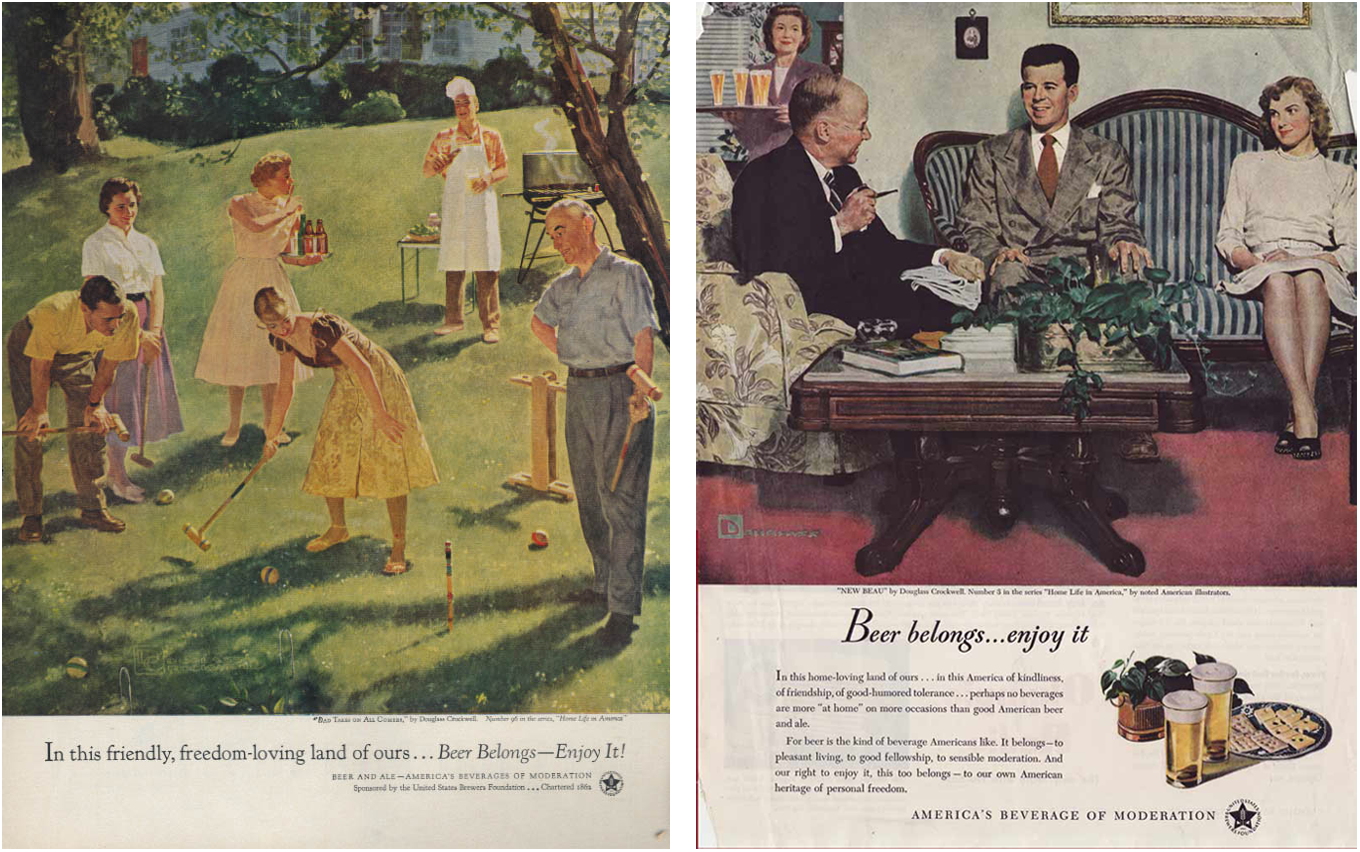
Another campaign that sparked the ire of temperance activists was the United States Brewers Foundation’s “Home Life in America” campaign. This campaign, which ran from 1945 to 1956, featured Norman Rockwell-esque paintings of white families enjoying rounds of beer in domestic settings. Each one was an original painting with a title and number. The ninety-sixth image in the series, for example, was titled “Dad Takes All Comers” (Figure 2, left). The image shows six adults enjoying a lush, green backyard. One man oversees the grill and looks on happily while the others enjoy a game of croquet. One young woman wields her mallet; another passes around frosty green and brown bottles of beer. The forty-ninth image in the series, titled “Thanksgiving Dinner,” foregrounds a table richly set with lace linens and a large, amber turkey. A gray-haired woman in a black frock with a lace collar places frothy glass goblets of beer at each place setting. These images of archetypical white, middle-class domesticity were captioned with statements situating beer as a wholesome companion to traditional family life. Every advertisement in the series included a caption that blared “In this friendly, freedom-loving land of ours…. Beer Belongs!—Enjoy It!” Below this slogan, in a smaller font, sat the United States Brewers Foundation’s slogan: “Beer and Ale—America’s Beverages of Moderation.” Mid-century temperance activists were predicably appalled.
Advertisements from the “Home Life in America” campaign. Left: no. 96, “Dad Takes All Comers,” by Douglas Crockwell, ran in the summer of 1954; right: no. 3, “New Beau,” also by Douglas Crockwell, appeared in 1947. Source: The advertisement on the left appeared in Life, July 5, 1954, p. 74. The advertisement on the right appeared in Life, May 5, 1947, p. 71.

If criticisms of the “Men of Distinction” campaign revealed who temperance campaigners sought to discipline, their critiques of the “Home Life in America” series disclose who they hoped to protect and defend. This campaign, which ran at the height of the United States’ postwar “domestic boom,” was a clear attempt to sell beer as a natural adjunct to the ubiquitously celebrated joys and virtues of family life. It thus cut directly against drys’ long-standing conviction that recreational drinking was antithetical to tranquil, traditional domesticity. In an echo of their cynical references to “men of distinction,” temperance activists frequently sneered that “beer does not belong.” They repeatedly mentioned the “Home Life in America” campaign to argue that liquor advertising presented grievously distorted images of the family, the nation’s most sacred and crucial institution. They insisted that depictions of beer drinking as safe, benign, and familial set a particularly perilous example for children and young mothers. They argued that sober homes were crucial to peopling the nation with moral, Christian adults and that if women, the presumed stewards and guardians of the home, were effectively seduced by these beer advertisements the moral constitution of the nation would crumble in turn. This section contextualizes drys’ discussions of the “Home Life in America” campaign amid mid-century changes in middle-class drinking patterns. I show that their critiques tacitly bemoaned the increasingly common practice of heterosocial at-home imbibing.
Postwar era drinking habits presented a direct rebuke to drys’ long-standing desires and presumptions around drink, gender, and domesticity. For many decades, the temperance movement figured the home and the saloon as gendered opposites, in which safe, pious, and feminine private homes were imperiled by the masculine, public saloon. By the postwar period this binary was completely and thoroughly out of date. Lori Rostkoff describes the years following World War II as a period when drinking was increasingly “domesticated,” meaning that domestic space became a primary locus of recreational drinking.Footnote 73 This was not an entirely new phenomenon. Families drank together at home during the nineteenth century, and Prohibition pushed many drinking rituals into domestic space.Footnote 74 The postwar years, however, saw an acceleration and open glorification of this trend, with women taking center stage. Women’s magazines instructed housewives in hosting the perfect cocktail party and selecting the right wine for a dinner with friends. Movies, television, magazines, and, of course, advertisements depicted barbecues and picnics as perfect occasions for a beer. Advice literature for new brides recommended that they know which glasses were appropriate for red wine, white wine, beer, and cocktails, and to make sure that they had several of each on hand.Footnote 75 In his ode to cocktail culture, the critic Bernard DeVoto mused that “the Americans are a home-loving people and the best place for the devotions proper to their autochthonous liquors is the home.” DeVoto also emphasized the heterosocial nature of at-home imbibing, refuting the “widespread notion that women cannot make martinis.”Footnote 76 The domestication of drink not only meant that drinking was happening in the space of the home but that women, the supposed guardians of the home, facilitated it.
When “The Home Life in America” advertisements ran, beer drinking in particular was becoming domesticated. For the first time, beer was being consumed at home more frequently than at restaurants and bars. Starting in the late 1940s, beer manufactures began expanding their selections of canned and bottled beers for individual consumers. In 1949, profits from the sale of packaged beer began to overtake profits from sales of kegs to bars and restaurants, prompting brewers to push more aggressively into the consumer market.Footnote 77 In 1951, sales of packaged beer to consumers reached an all-time peak, eclipsing total sales to bars and restaurants. That same year, a consumer survey found that 62.2 percent of families purchased beer with their weekly groceries.Footnote 78 The “Home Life in America” series was a clear attempt to glorify and naturalize this new state of affairs. The Brewers Foundation’s slogan contrasted beer with harder-hitting distilled spirits, while the campaign’s images and copy presented beer as a natural enhancement to the pleasures of traditional US family life.
Highly aware of the reality that women were chiefly responsible for the family shopping, brewers actively courted them as consumers. In one dubious example, some beer manufacturers promoted their products as low-calorie meal replacements.Footnote 79 In other instances, advertisers worked to make beer appear tasteful and cosmopolitan, a commodity that bore the coveted mark of good taste. A smarter appeal to middle-class women shoppers occurred in October of 1954, when the United States Brewers Foundation hosted a lavish, gourmet meal for leading food critics and recipe writers. Days later, the women’s pages of numerous local and national newspapers gushed about the event, reprinting recipes from the enviable meal and situating beer makers in the vanguard of sophisticated cuisine.Footnote 80 In keeping with the approach in the “Home Life in America” campaign, the publicity around the Brewers Foundation dinner positioned beer and its manufacturers as welcome complements to the modern home. These appeals indicated brewers’ understanding that, if beer were to remain on 62.2 percent of US Americans’ shopping lists, women would have to find it appealing.
Representing women in beer advertising was perhaps the most controversial aspect of this multi-sited effort to win them as consumers. Immediately after the repeal of Prohibition, the liquor industry began creating advertisements representing women drinking and courting women consumers.Footnote 81 These advertisements drew immediate, vociferous backlash from Christian activist groups. As they often did, advertisers and their clients chose to mediate this outrage through self-censorship. In 1935, the Distilled Spirits Institute adopted measures to ban the presentation of women in their print and radio advertisements. The National Broadcasters Association followed suit, banning liquor ads from the radio, and moving to keep women’s voices out of radio advertisements for wine or beer. When television became common, the National Broadcasters Association updated this policy to ban any televised advertising for hard liquor and to exclude women from television commercials for wine and beer. While beer advertisements did appear on radio and television (drys derisively called programs supported by beer advertising “beercasts”), these advertisements never featured women serving or consuming beer.Footnote 82 Advertisers’ high level of caution around representing women and alcohol indexes the enduring influence of the long temperance movement. Reticent to incite organized outrage, representatives of the liquor, wine, and beer industries most often accepted that advertisements representing women drinkers betrayed long-standing moral norms. Despite the advertisements’ overtly bucolic and jovial presentation, the United States Brewers Foundation’s decision to depict women in this campaign was meaningfully subversive.
When temperance activists discussed the “Home Life in America” campaign before the Senate Commerce Committee, they argued that these charming, saccharine representations of domestic drinking not only were in poor taste but threatened the future of the nation. They claimed that the campaign undermined sober mothers’ efforts to raise the next generation of wholesome, temperate adults. One strong statement of this case came at the 1947 hearings. Henry M. Johnson, a member of the NPTC from Louisville, Kentucky, read a written statement from mothers in his community. Their letter came attached to two examples of the campaign, which Johnson displayed as he read their appeal:
Even worse yet is this new series put out by the United States Brewers Foundation because it is seeking to undermine her own resistance and invade her home with her consent—‘Home Life in America.’ See these: ‘Family musicale’ by Meade Schaeffer and ‘New Beau’ by Douglas Crockwell. See that darling young girl and the fine young man with whom her father is getting acquainted. And see who is bringing in the first glass of beer that may end eventually in an alcoholic’s grave—mother. Gentlemen, if you have any regard for America, if you really want us mothers to bring up the kind of fine young people who can face the difficulties of our present day and keep America what it has been in the past, forbid the alcoholic beverage traffic to make this unscrupulous use of innocent and misleading things.Footnote 83
The Brewers Foundation’s clear intention was to mitigate objections to beer drinking by slotting it into wholesome scenes. Temperance activists’ responses to the campaign, however, suggest that the traditional, family setting was exactly what made the advertisements so threatening. In this statement, the women of Louisville portrayed the “Home Life in America” campaign as a devious perversion of an otherwise decent scene. In “New Beau” (see Figure 2, right), a father chats casually with his daughter’s formally dressed new boyfriend, while a woman stands in the background with a tray of beers. For the authors of this statement, the inclusion of a mother serving beers transformed a benign image into a betrayal of basic decency. Activists held that women should rightly stand as guardians against intoxicating substances, and these cloying images threatened to erode their resistance to domestic drinking. For them, the stakes were tremendously high. If advertisements continued to sanction and naturalize the domestication of drink, the home could not serve as a safe space for the cultivation of ideal citizens.
For temperance activists, these distorted images of domesticity threatened the future of sober family life. During the 1954 hearings before the Senate Commerce Committee, Mrs. Albert F. Leonhard, then president of the Pennsylvania WCTU, worried explicitly about how exposure to the “Home Life in America” campaign would influence children’s perceptions of home and family life. “Not too many years ago our home was our castle and we could let the rest of the world go by,” she complained. “We could implant in the minds of our children the seeds of righteousness and clean living. Now magazines carry colorful and misleading advertisements. The youth of America are being conditioned by the beautiful home series ads carried by leading women’s magazines to believe that beer belongs.”Footnote 84 Mrs. Leonhard’s use of the word “conditioning” betrays the assumption that advertisements could shape impressionable people’s core beliefs, values, and assumptions. Her worries about what types of subjects advertising might produce echoed both the women of Louisville, Kentucky and the Virginia pastor who wrote to Time Inc. Taken together, these statements served as rejoinders against the forces that would sanction and circulate the “Home Life in America” campaign. For all these activists, the moral constitution of the nation’s future citizens was imperiled because national media organizations unscrupulously accepted deceptive and seductive advertisements.
By testifying before national lawmakers, temperance activists attempted to censure images that celebrated and naturalized wider social changes that they could scarcely manage or control. During the postwar years, older imaginings of the private, feminine home and the public, masculine saloon fell apart. Advertisements for liquor, wine, and beer could not be kept away from the home. At the same time, drinking was increasingly accepted as an at-home activity, implicating women in the consumption of intoxicating drinks. The United States Brewers Foundation’s “Home Life in America” campaign indexed these changes. While temperance activists could not stop their neighbors from serving beer with dinner, they could work to reprimand the media and advertising organizations that promoted this increasingly popular habit.
Conclusion
On June 21, 1954, Caradine Hooton, executive secretary of the Methodist National Board of Temperance, stood before an audience of congressional representatives, advertising executives, brewery workers, distillery owners, and fellow temperance activists. To wrap up his excoriation of liquor advertising, he appealed to the value of human life itself: “Of how much value are human beings?” he asked. “How precious in the sight of God and men are the possibilities awaiting development in growing personalities? Yet, we are now permitting a destructive practice which allows the beverage alcohol industry to misuse public advertising media for stampeding American homelife with impassioned sales promotion of a product that is now destroying more American lives than war itself.”Footnote 85
Hooton’s description of media’s disastrous role in national and religious life is dramatically different from the sensibility portrayed in many histories of the postwar period. During the late 1940s and the 1950s, mass media made Christian conviction and Cold War–era capitalist triumphalism into mutually reinforcing logics. Celebrity clerics graced magazine covers, churches appeared in drive-in theaters, and Bible stories emerged as anti-communist cinema spectacles. Protestant temperance activists, however, abstained from this powerful assemblage. They viewed television, radio, and magazines as spaces captured by amoral elites, motivated by profit alone, and they insisted that moral sanction of these actors was demanded from righteous, traditional Protestants like themselves. Their efforts to ban the interstate circulation of liquor advertising aimed to censure and control mass media, rather than benefit from its proliferation.
The drys ultimately lost their fight to curtail liquor advertising. Throughout the 1950s the wets consolidated their offense. Hammaker’s congressional hearings grew increasingly crowded with advertising executives, distillers, restaurant owners, brewery workers, and magazine publishers. All of them made arguments that lawmakers ultimately found convincing. Many argued that alcoholic beverages were both legal and regulated, so there was no reason to prevent their promotion. Some made “slippery slope” arguments, claiming that one law regulating the circulation of advertising would inevitably lead to many more, ultimately hobbling a booming and celebrated industry and all the other industries it aided. Proponents of alcohol advertising frequently alluded to the still relatively recent failures of Prohibition, framing the Eighteenth Amendment as an example of disastrous government overreach and warning against similar moves. In some cases, the wets’ arguments resonated with popular religious discourses of the time, stipulating that freer markets made for freer subjects.
Developments beyond the hearing room also damaged the drys’ cause. During the same decades as the anti-advertising campaign, physicians, researchers, and social workers increasingly reframed excessive drinking as a biological proclivity rather than a moral failing. If only a minority of the population was prone to alcoholism, lawmakers reasoned, federal policies to limit the promotion of drinking did not make sense. At the same time, large-scale changes within the political cultures of white Protestantism drew energy away from temperance lobbying. The NPTC represented both mainline Protestants and cultural conservatives. In the second half of the 1950s, both cohorts found new causes. Some mainline Protestants aligned themselves with progressive political causes, while more conservative members of the dry coalition channeled their energies into anti-communism and other perceived threats to the heteropatriarchal, procreative family.Footnote 86 In 1956, the lawmakers who typically supported the NPTC exhibited increasing reticence about holding a hearing on anti-advertising bills.Footnote 87 The following year, the drys were unable to obtain an audience. The last hearing on bills to bar the interstate circulation of liquor advertising occurred in 1958.
Efforts to contain the movement of liquor advertisements were efforts to assert control over the commercial forces that increasingly pervaded daily life. By looking at the specific advertisements that temperance activists criticized, we can see who they hoped to censure and who they hoped to defend. In their critiques of Lord Calvert’s “Men of Distinction” campaign, temperance activists named and lambasted the elite actors who controlled mass media. Their objections to the United States Brewers Foundation’s “Home Life in America” campaign disclosed their commitment to insulating the idealized white family home from outside influence. The temperance movement’s attempts to manage the movement of particular images provide potent insight into the religious tensions that attended the expansion of mass media at mid-century.