Following publication of hand hygiene guidelines by the Centers for Disease Control and Prevention in 2002Reference Boyce and Pittet 1 and the World Health Organization in 2009, 2 use of alcohol-based hand rubs (ABHRs) by healthcare workers (HCWs) has increased dramatically. The US Food and Drug Administration recently issued a proposed amendment to the regulations covering healthcare skin antiseptics, which requests additional data on safety and efficacy of active ingredients, including alcohol (ethyl alcohol and isopropyl alcohol). 3 One specific request was for studies to determine how much of the active ingredient penetrates the skin, leading to measurable systemic exposure. The Food and Drug Administration has suggested that a “maximal use” trial be conducted by industry in which volunteers would be exposed by dermal administration of ABHR under maximal use conditions. We conducted a review of published literature and analyzed several recent studies that utilized electronic monitoring of hand hygiene compliance to better define the range of “usual” and “maximal” ABHR usage frequencies by HCWs (with emphasis on nurses).
METHODS
PubMed searches for English language articles included the following search terms: hand hygiene events, hand hygiene monitoring, hand hygiene electronic monitoring, hand hygiene compliance, frequency of hand hygiene, and alcohol-based hand rub. For this analysis, a hand hygiene event (HHE) is defined as an episode during which an HCW performs hand hygiene using an ABHR. This is distinguished from a hand hygiene opportunity, which reflects when hand hygiene is indicated on the basis of World Health Organization guidelines. 2 We were primarily interested in establishing the rate at which individual nurses are exposed to ABHR, expressed as the number of HHEs/nurse/12-hour work shift and number of HHEs/nurse/hour. For articles reporting data in this manner, the methods for determining ABHR usage frequency were noted. Studies utilizing electronic counting devices to report only frequency of dispenser usage were not included because HHEs were not attributed to individual HCWs. In addition to publication review, data from 2 relatively recent studies that utilized badge-based hand hygiene electronic compliance monitoring (ECM) systems were analyzed with respect to ABHR usage frequency by nurses.Reference Boyce, Cooper, Lunde, Yin and Arbogast 4 , Reference Monsalve, Pemmaraju and Thomas 5
RESULTS
Analysis of World Health Organization Hand Hygiene guideline
Part I, Section 16.1, of the World Health Organization Guidelines states that observational studies have shown that HCWs clean their hands on average 1.7–15.2 times per hour, but when controlling by setting, HCWs clean their hands on average 0.72–30 times per hour. 2 As the text states, “the average frequency of hand hygiene episodes fluctuates with the method used for monitoring and the setting where the observations were conducted.” HHE observations were often made over short periods (eg, 20 minutes per session),Reference Pittet, Mourouga and Perneger 6 , Reference Hugonnet, Perneger and Pittet 7 which may not accurately represent hand hygiene practices throughout an entire work shift. The guideline also cites studies that reported that intensive care unit (ICU) personnel may have an average of 30 hand hygiene opportunities per hour.Reference Hugonnet, Perneger and Pittet 7 Because multiple HCWs provide care for a patient in any given hour,Reference Cohen, Hyman, Rosenberg and Larson 8 auditors most likely counted hand hygiene opportunities per hour of care by multiple HCWs caring for one or more patients, not for a specific individual HCW. If a single nurse performed hand hygiene 30 times per hour (every 2 minutes) throughout an entire shift, there would be little time left to care for patients. In fact, several studies found that nurses performed 9 to 12 direct care tasks per hour, but spent only approximately 40% of their time on direct and indirect care.Reference Westbrook, Li, Georgiou, Paoloni and Cullen 9 , Reference Westbrook, Duffield, Li and Creswick 10 To better understand how frequently nurses use ABHRs, we reviewed additional publications on the topic.
Review of published literature
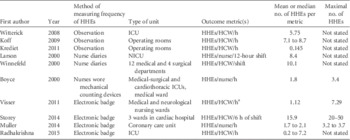
The PubMed searches yielded a total of 3,487 nonduplicate citations. A review of retrieved citations was conducted by one of the authors (J.M.B.). A review of article titles excluded most citations, which were considered unlikely to present data on ABHR usage frequency by nurses, resulting in 576 remaining articles for further review. Abstracts were not available for 9 citations. Review of abstracts of the remaining 567 articles excluded an additional 241 citations. The text of the remaining 326 articles was reviewed. Only 12 articles provided data on the number of HHEs performed by individual HCWs per shift or per hour. However, 2 of the 12 were excluded from the analysis. One study in 1994 reported only 5 or 6 ABHR HHEs among 35 HCWs over a period of several months and is unlikely to reflect current practices.Reference Meengs, Giles, Chisholm, Cordell and Nelson 11 The other study reported HHE frequency among nurses in 2011, but the article did not clearly state how many hours of nursing time were included in the study.Reference Levchenko, Boscart and Fernie 12 Furthermore, the HHE rate reported (6.42 HHE/h) is unlikely to influence the design of the maximal use trial. Findings of the 10 studies included in the final analysis, and the methods to determine the frequency of ABHR use, are summarized briefly in Table 1.Reference Witterick, Stuart, Gillespie and Buist 13 – Reference Radhakrishna, Waghmare and Ekstrand 22
Published Studies Reporting HHEs/HCW/Shift or HHEs/HCW/Hour

NOTE. HCW, healthcare worker; HHE, hand hygiene event; ICU, intensive care unit; NICU, neonatal ICU.
a Our estimate was based on the published data.
Observational method
In 1 small study, a single intensivist physician used an ABHR 23 times over a period of 4 h, for an average of 5.75 times/h.Reference Witterick, Stuart, Gillespie and Buist 13 A study conducted in operating rooms found that the mean use by attending physicians was 7.1 HHEs/HCW/h when wearable ABHR devices as well as dispensers on walls and anesthesia carts were available, with mean use for other HCWs of 8.7 HHEs/HCW/h.Reference Koff, Loftus and Burchman 14 This would yield the equivalent of 104.4 HHE/HCW/12-hour shift. Another study conducted in operating rooms reported the low rate of 0.145 HHEs/HCW/h.
Diaries maintained by nurses
Two studies had nurses record the number of HHEs/shift using daily diary entries. One study reported a mean number of ABHR HHEs of 8.4/nurse/12-hour shift, whereas the other reported a mean use of ABHR of 10.11 HHEs/HCW/shift (duration of shift was not stated).Reference Larson, Silberger and Jakob 16 , Reference Winnefeld, Richard, Drancourt and Grobb 17
Mechanical counting devices worn by nurses
In a study conducted in 2 ICUs and a medical ward, each volunteer nurse was given a small counting device to record the number of times he or she performed hand hygiene with soap and water or with an ABHR.Reference Boyce, Kelliher and Vallande 18 Nurses recorded an average of 1.8 ABHR HHEs/nurse/h, which would yield the equivalent of 21.6 HHE/nurse/12-hour shift. The maximal use was 3.4 HHEs/nurse/h, equivalent to 40.8 HHEs/nurse/12-hour shift.
Electronic personnel badges
Specialized electronic badges worn by HCWs were used to record use of ABHR in several published studies. One investigator provided nurses with finger accelerometers and electronic badges worn on their forearms to detect when nurses were involved in “wet work.”Reference Visser, Behroozy, Verberk, Semple and Kezic 19 Wet work included the use of ABHR, which occurred a mean (range) of 2 (0–13) times/subject during an average observation period of 107 minutes (1.783 h), yielding an average frequency of 1.12 HHEs/HCW/h. A 6-week badge-based study involving 67 HCWs in an acute cardiac hospital reported that the mean number of HHEs/HCW/6-hour period during which badges were worn ranged from 9.5 to 14.2 (range, 0–50).Reference Storey, FitzGerald and Moore 20 The maximum would result in an estimated 100 HHEs/HCW/12-hour shift (based on 50 ABHR HHEs/HCW/6-hour period). A 16-week study involving 10 nurses working in a coronary care unit reported that the median number of HHEs/nurse/h was 1.7 to 2.1 during 2 different periods, with a range of 0.5 to 3.7.Reference Muller, Levchenko, Ing, Pong and Fernie 21 The average number of HHEs/nurse/shift would be predicted to be 20–25 times/12-hour shift. If a nurse with the maximal number of HHEs/h (3.7) continued this rate for an entire shift, this would result in a maximum of 44.4 HHEs/nurse/12-hour shift. Another study involving badged HCWs in an ICU yielded a mean of 0.2 to 7.2 ABHR HHEs /HCW/h.Reference Radhakrishna, Waghmare and Ekstrand 22 If 7.2 HHEs/HCW/h were performed every hour for an entire shift, this would yield 86.4 HHEs/HCW/12-hour shift.
Analysis of additional electronic hand hygiene monitoring studies
In addition to the 3 studies cited above that used electronic badges to record ABHR usage frequency, 2 other badge-based studies conducted in different settings provide further data on nurses.
One study was a prospective 13-week trial of an ECM system conducted between December 2011 and March 2012 in a surgical ICU (SICU) and a general medical ward.Reference Boyce, Cooper, Lunde, Yin and Arbogast 4 Only data for SICU nurses, who had both higher hand hygiene opportunities and HHEs than nurses on the other ward, were included in the present analysis. Fifty SICU nurses who participated were each given an electronic badge to be worn throughout the trial period. Sensors were placed in ABHR dispensers such that each dispenser actuation was recorded and attributed to a specific HCW badge.
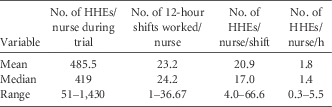
A total of 25,337 HHEs were recorded for nurses during the entire 13-week trial period. The number of shifts and hours worked per week and corresponding badge counts were available for the equivalent of 1,160.7 12-hour shifts. The overall averages of HHEs by individual nurses during the entire 13-week trial period, the number of 12-hour shifts worked, the estimated number of HHEs/nurse/12-hour shift, and number of HHEs/nurse/h are summarized in Table 2. The total number of times that individual nurses used an ABHR during the entire 13-week study period varied greatly from 32 HHEs to 1,430 HHEs, with an average of 437 HHEs (median, 386). The maximal number of HHEs/nurse during a single week was 213, which would yield an estimated average of 71 HHEs/nurse/12-hour shift. To obtain an estimate of “usual” usage by the SICU nurses, the 50 nurses were arbitrarily divided into quartiles on the basis of the average number of HHEs/shift, and usage by the middle 2 quartiles (Q2 and Q3) was reviewed. This analysis showed that the 25 nurses with “usual” usage averaged 9.8 to 26.5 HHEs/nurse/shift and 0.8 to 2.2 HHEs/nurse/h during the trial.
Data on HHEs for 50 SICU Nurses During the 13-Week Trial Period

NOTE. Table is based on weekly summary data from an electronic compliance monitoring system and nursing work schedules, Hospital of Saint Raphael. HHE, hand hygiene event; SICU, surgical intensive care unit.
To identify maximal usage patterns, data for 2 nurses who were credited by the ECM system as having the greatest number of HHEs during the 13-week trial were further analyzed. The total number of HHEs was 1,409 for 1 nurse (nurse A) and 1,430 for another nurse (nurse B). During 1 week, nurse A was recorded as having 213 HHEs, the maximal number of HHEs/nurse/week recorded during the trial period. Nurse A was recorded as having an average of 41.4 HHEs/12-hour shift, but was credited with 163 HHEs/shift during one 12-hour shift (mean of 13.6 HHEs/h during that shift). This represented the maximal number of HHEs/nurse/shift recorded during the trial, and occurred during only 1 (0.09%) of the 1,160 12-hour shifts worked by nurses. Nurse B was recorded as having an average of 44.7 HHEs/shift, with 104 HHEs during one 12-hour shift (mean of 8.7 HHEs/h during that shift). These data suggest that even in extreme cases where use for 1 day is extremely high, such extreme use does not repeat over the course of multiple days.
A 10-day prospective observational study conducted at the University of Iowa Hospital and Clinics utilized a custom-built, automated hand hygiene ECM system to determine whether HCWs performed hand hygiene on entering and exiting patient rooms in a medical ICU (MICU).Reference Monsalve, Pemmaraju and Thomas 5 , Reference Monsalve, Pemmaraju and Polgreen 23 Electronic “motes” or badges worn by HCWs communicated with motes installed in ABHR dispensers. HHEs with a relative signal strength index greater than 35.8 were attributed to ABHR use by a nearby HCW.
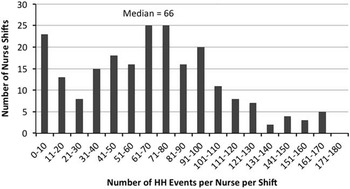
For the purposes of this review, only data from nurses were analyzed. During the study, nurses worked a total of 138 nurse-shifts during 10 daytime shifts, and a total of 82 nurse-shifts during 9 nighttime shifts (total 220 nurse-shifts). Overall, 14,599 HHEs were recorded during the 220 nurse-shifts. The number of HHEs/nurse/shift varied for individual nurses from 0 to 166, with a median of 66 HHEs/nurse/shift (Figure 1). During 95% of the 220 nurse-shifts, nurses performed 141 or fewer HHEs/shift. During only 5 (2.3%) of the 220 nurse-shifts was a nurse recorded as performing 161–166 HHEs during a single shift.
Frequency distribution of the number of hand hygiene (HH) events per nurse per shift during 220 nurse shifts in a medical intensive care unit, University of Iowa Hospital.

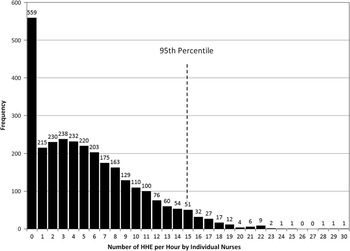
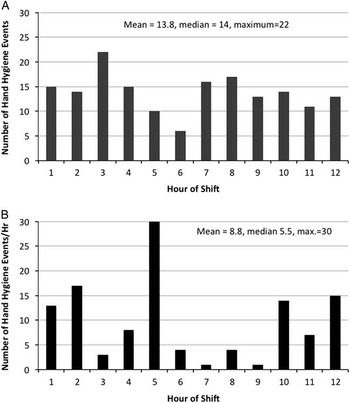
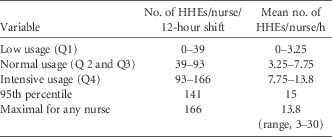
The number of HHEs/nurse/h also varied greatly among nurses (mean [range], 5.5 [0–30], 95th percentile=15 HHEs/nurse/h). The mode of HHEs/nurse/h was zero and occurred 559 times (Figure 2). A few nurses experienced extreme use. One nurse was recorded as having the maximal number of HHEs (N = 166) during a single shift. For this nurse, the range of HHEs/h varied from 6/h to 22/h, with a median of 14/h (Figure 3A). However, it is likely that these data represent overestimates of actual usage. On 10 occasions during her shift, she was attributed as having 2 HHEs within 20 seconds of each other recorded at 2 different dispensers on each occasion. On 3 occasions during her shift, she was attributed as having 2 HHEs with exactly the same time stamp (ie, within 0.36 seconds of each other) recorded at 2 different dispensers on each occasion. The data set from this study also has additional examples of duplicate counts. These most likely occurred when a badged nurse near a dispenser was credited with using a dispenser when a nonbadged HCW or visitor used the dispenser. Another nurse was recorded as having 105 HHEs during a shift, with the number of HHEs/h ranging from 1/h to 30/h, the maximal number/h encountered in our analysis (Figure 3B). On 8 occasions during the shift, the nurse was credited as having 2 HHEs from 2 different dispensers within 10 or fewer seconds. Once again, this strongly suggests that the ECM system may have overestimated the number of HHEs that occurred with some nurses. If one separates the data into quartiles and arbitrarily categorizes each of them as low (Q1), normal (Q2 and Q3), and intensive (Q4) use to gain a better appreciation of the spectrum of “usual” HHE frequency among the MICU nurses, the results are shown in Table 3.
Frequency distribution of the number of hand hygiene events (HHEs) per hour by individual nurses during 220 nurse-shifts in a medical intensive care unit, University of Iowa Hospital.

A, Number of HHEs during each hour of 12-hour shift for 1 nurse with a total of 166 HHEs during her 12-hour shift in a medical intensive care unit, University of Iowa Hospital. B, Number of HHEs/h during each hour of 12-hour shift for 1 nurse with the greatest number of HHE/h (N = 30) during the study in a medical intensive care unit, University of Iowa Hospital.

Frequency of Use of ABHR by MICU Nurses, by Quartile, University of Iowa Hospital

NOTE. ABHR, alcohol-based hand rub; HHE, hand hygiene event; MICU, medical intensive care unit; Q, quarter.
DISCUSSION
Our literature review and analysis of 2 additional studies utilizing ECM systems revealed that the frequency with which nurses are exposed to ABHRs varies tremendously, owing in part to the clinical setting and the method of recording ABHR use. The number of hand hygiene opportunities and HHEs are routinely higher in ICUs than in general medical or surgical wards.Reference Pittet, Mourouga and Perneger 6 , Reference Steed, Kelly and Blackhurst 24 The most conservative estimates of ABHR usage have been derived from studies using direct observations, use of nurse diaries, and manual counting devices worn by nurses.Reference Witterick, Stuart, Gillespie and Buist 13 , Reference Koff, Loftus and Burchman 14 , Reference Larson, Silberger and Jakob 16 – Reference Boyce, Kelliher and Vallande 18 All 3 of these methods probably underestimate the frequency of ABHR by nurses. Observational methods may not accurately reflect ABHR use because such a small proportion (often <1%-2%) of all hand hygiene opportunities and HHEs can be recorded using observations by auditors.Reference Fries, Segre and Thomas 25 – Reference Magnus, Marra and Camargo 28 Use of daily diaries and mechanical counting devices worn by HCWs rely on busy nurses remembering to record each time they access an ABHR dispenser. Because systems that utilize badges worn by HCWs can attribute ABHR use to nurses specifically and record many more events than observational methods,Reference Muller, Levchenko, Ing, Pong and Fernie 21 it is likely that the best estimates are provided by electronic badge-based systems.
We found that within a given ICU, usual and maximal exposure to ABHR varies from shift to shift and, as reported by others, from one nurse to another.Reference Muller, Levchenko, Ing, Pong and Fernie 21 For any specific nurse, the number of HHEs performed with ABHR varies from day to day, and most likely depends in part on the level of acuity of the patient for whom the nurse is providing care,Reference Kinsella, Thomas and Taylor 29 and varies from hour to hour, often with a peak frequency during 1 hour (Figure 3).
The ECM system trial in the SICU had a number of limitations. Not all of the nurses working in the SICU agreed to participate, which may have biased the results. Some nurses worked several shifts during a week but had no HHEs recorded for their badges, suggesting that they did not wear their badges during that week. More importantly, several of the investigators observed that the ECM system, which relied on line-of-sight communication between dispensers and nurse badges, did not always record use of ABHR by a nurse. As a result, data from this trial most likely represents an underestimate of the frequency of ABHR use by some of the SICU nurses.
The electronic badge-based system conducted in a MICU in Iowa provided the highest estimates of both “usual” and maximal ABHR use by nurses. In that study, average use was 66 HHEs/nurse/12-hour shift, with substantial variability between nurses. The maximal (perhaps one could say “extreme”) number of times that a nurse used an ABHR during the Iowa study was from 161–166 times during a 12-hour shift, which occurred in only 2.3% of shifts. The most frequent number of HHEs/h in the MICU trial was zero, which is consistent with the fact that nurses spend only approximately 40% of their time on direct and indirect patient care.Reference Westbrook, Li, Georgiou, Paoloni and Cullen 9 , Reference Westbrook, Duffield, Li and Creswick 10 In 95% of the hours worked, nurses used ABHR 15 or fewer times/h (Figure 2). Two nurses were recorded as having used ABHR 39 times and 49 times, respectively, during a 1-hour period. However, analysis of these nurses’ records revealed multiple episodes in which the ECM system credited them with using ABHR from 2 different dispensers within intervals ranging from less than 1 sec to 10 sec. Because these results were likely erroneous, these 2 data points were excluded from analysis of the use of ABHR/h. It is likely that the ECM system used during the Iowa study may on some occasions have falsely attributed HHEs to nurses who were near a dispenser activated by a nonbadged person, resulting in overestimation of the frequency of ABHR usage by nurses. With continued improvements in the accuracy of ECM systems, future multicenter studies involving HCWs equipped with individual-specific badges should provide the best estimates of how frequently HCWs are exposed to ABHRs.
In conclusion, nurses and other HCWs frequently use ABHRs for hand hygiene, with widely varying levels of exposure. The data provided by the current study is useful in conducting additional studies designed to confirm the safety of very frequent use of ABHR by HCWs. It has been suggested that such a maximal use trial be performed to determine detectable blood ethanol levels among frequently exposed volunteers. Our findings suggest that such a maximal use trial target application of ABHR approximately 140 times during a 12-hour period, which represented the 95th percentile of frequency of use in the Iowa study. Before conducting a maximal use trial, it may be reasonable to perform a study to assess the skin tolerability of such a high frequency of exposure to ABHR. Consideration should also be given to exposing volunteers to a peak frequency (eg, 15 applications/h) during 1 hour, with fewer applications per hour during the remaining 12-hour period. If a trial is conducted over several days, maximal usage should occur on only 1 day, which would simulate patterns of maximal use of ABHR that occasionally occurs among HCWs.
ACKNOWLEDGEMENTS
We appreciate input by Antonio Quinones-Rivera and Steve Colvis.
Financial support. None reported.
Potential conflicts of interest. J.M.B. reports that he is a consultant to GOJO Industries, 3M, Clorox, and Diversey Care. P.M.P. reports that he has received research support from GOJO Industries. D.R.M. and J.W.A. report that they are employees of GOJO Industries. M. M. reports no conflicts of interest relevant to this article.