INTRODUCTION
International studies continue to highlight the extent of workplace violence and its negative consequences for employees and their organisations (Chappell & Di Martino, Reference Chappell and Di Martino2006; Kelloway, Barling, & Hurrell, Reference Kelloway, Barling and Hurrell2006; European Agency for Safety and Health at Work, 2010). In contrast to trends for other forms of violence in society, research indicates that workplace violence is increasing in many countries (Estrada, Nilsson, Jerre, & Wilkman, Reference Estrada, Nilsson, Jerre and Wilkman2010). A recent review by the UK Government Office for Science described workplace violence as one of the principal occupational hazards for many people at work and ‘a serious threat to human capital in the contemporary workplace’ (Leather & Zarola, Reference Leather and Zarola2008: 2). Similarly, the European Agency for Safety and Health at Work (2010), forecasts workplace violence to be one of the important emerging issues facing managers as they manage for a healthy and safe workforce, and workplace.
In common with other countries, New Zealand managers must deal with the potential and actual risk of workplace violence. Several high-profile incidents of workplace violence have put the issue in the minds of employers, employees, government agencies and the public. The recent murder of Auckland taxi driver, Hiren Mohini, received considerable media attention and resulted in the New Zealand Government enacting a law change requiring taxi companies to operate a 24 hr call centre, and taxi cabs to have installed an operating security camera (www.nzherald.co.nz). Despite this sort of attention, research into the nature and extent of workplace violence in New Zealand is only just emerging.
This paper attempts to address this situation through an examination of data collected from New Zealand organisations on their workplace violence experience. The study has the following aims: (1) to determine the incidence and nature of cases of workplace violence among a sample of New Zealand organisations from a variety of industry sectors; (2) to identify the major sources of violence for participating industry sectors; and (3) to identify key risk factors for workplace violence from the perspective of different sectors. The study was the second such survey to be undertaken by these authors (Catley, Bentley, & Jackson, Reference Catley, Bentley and Jackson2011), providing the opportunity to compare reported levels of violence across the different sectors involved (although it should be noted that the two studies did not have the same sample of participating organisations). Following the approach of the original New Zealand workplace violence survey (Catley, Bentley, & Jackson, Reference Catley, Bentley and Jackson2011), the 2011 survey differs from most research approaches to workplace violence by adopting an organisational level focus in contrast to the typical focus at the level of the individual employee. It also reports on data collected from across a range of occupational groups rather than a more typical approach of a survey of a particular occupational group (Waddington, Badger, & Bull, Reference Waddington, Badger and Bull2005).
Alongside an examination of violence in the New Zealand context, this paper also turns its attention to organisational efforts to manage the risk of workplace violence. Importantly, as Jones, Robinson, Fevre, and Lewis (Reference Jones, Robinson, Fevre and Lewis2011) write, explanations for workplace violence are more likely to be found in the nature of workplaces, rather than in the individual characteristics of victims or perpetrators. Consequently, management can take actions to mitigate and manage their organisation's exposure to workplace violence. Unfortunately, research into the effectiveness of organisational practices to manage workplace violence is rare (Wassell, Reference Wassell2009). The paper provides a contribution in this area by examining workplace violence control measures presently employed by organisations in this sample that may offer insights for other organisations for whom managing violence is a challenge.
The problem of workplace violence
Workplace violence has been conceptualised and operationally defined in many different ways. Physical acts of violence are the general focus of the literature relating to workplace violence (Catley & Jones, Reference Catley and Jones2002; Catley, Reference Catley2004), with some researchers operationalising workplace violence to include only physically aggressive behaviours such as assaults. Others have broadened the scope of their studies to include threats of violence and psychological aggression. So while it is acknowledged that there are alternative ways to understand violence, the focus of this paper is on physical acts of violence to reduce conceptual ambiguity around behaviours such as harassment and bullying which are more commonly conceptualised as ‘psychological violence’.
Conceptual and measurement issues aside, the extent of workplace violence reported in international studies suggests a significant concern in all countries where data are collected on this phenomenon. Studies reporting workplace violence prevalence rates indicate a prevalence range of ∼1.5–5% of workforces surveyed. Examples include: 13 per 1,000 in the United States (Hartley, Biddle, & Jenkins, Reference Hartley, Biddle and Jenkins2005); 2% of Canadian Public Service Employees (Kelloway, Barling, & Hurrell, Reference Kelloway, Barling and Hurrell2006), 5% of workers in Europe (Parent-Thirion, Fernández Macías, Hurley, & Vermeylen, Reference Parent-Thirion, Fernández Macías, Hurley and Vermeylen2007) and 4.9% of UK workers (Jones et al., Reference Jones, Robinson, Fevre and Lewis2011). Importantly, the risk of exposure to workplace violence is not evenly distributed across industries with employees in health, public administration, education, transportation and hospitality typically most at risk (Chappell & Di Martino, Reference Chappell and Di Martino2006; Schat, Frone, & Kelloway, Reference Schat, Frone and Kelloway2006; European Agency for Safety and Health at Work, 2010; Jones et al., Reference Jones, Robinson, Fevre and Lewis2011).
Despite a number of high-profile incidents of workplace violence in recent years in New Zealand, there has been little work to establish the nature and extent of the problem. According to the New Zealand Crime and Safety Survey, 18% of all assaults and threats of violence reported by respondents occurred in workplaces (Mayhew & Reilly, Reference Mayhew and Reilly2007). Moreover, Coggan, Hooper, and Adams (Reference Coggan, Hooper and Adams2002) found that 41% of respondents to a household survey reported an injury and that physical violence accounted for 4% of all injuries. Of these, 14% involved violence at work. In a specific study of workplace violence in the New Zealand context, Catley, Bentley, and Jackson (Reference Catley, Bentley and Jackson2011) reported 397 cases of reported violence or attempted violence in the 63 organisations surveyed incurred at a rate of between ∼0.3 and 33 per 1,000 employees. Consistent with international findings, Catley, Bentley, and Jackson (Reference Catley, Bentley and Jackson2011) found that rates of workplace violence varied considerably between industry sectors with the highest rates observed for employees working in education, health, public transport and postal services.
Derived from early work by the California Occupational Safety and Health Administration, a common approach is to classify workplace violence in terms of the relationship between the victim and the perpetrator (Bowie, Reference Bowie2002; Wassell, Reference Wassell2009; Estrada et al., Reference Estrada, Nilsson, Jerre and Wilkman2010). Despite the persistence of the stereotype of the ‘disgruntled employee’, the perpetrator of workplace violence is more likely to be a member of the public than a vengeful colleague (Schat, Frone, & Kelloway, Reference Schat, Frone and Kelloway2006). In a survey of a representative sample of UK employees, Jones et al. (Reference Jones, Robinson, Fevre and Lewis2011) reported that 78% of respondents who experienced assault identified ‘clients’ as the perpetrator. In a survey of municipal workers in the United States, Hoobler and Swanberg (Reference Hoobler and Swanberg2006) reported that customers were more likely to be the perpetrators of verbal abuse and physical assaults on employees. A similar conclusion, that the majority of workplace violence events involve individuals external to the organization, has been drawn by a number of researchers (Jenkins, Reference Jenkins1996; VandenBos & Bulatao, Reference VandenBos and Bulatao1996; Laden & Schwartz, Reference Laden and Schwartz2000; Chappell & Di Martino, Reference Chappell and Di Martino2006; Kelloway, Barling, & Hurrell, Reference Kelloway, Barling and Hurrell2006; Barling, Dupré, & Kelloway, Reference Barling, Dupré and Kelloway2009).
Incidents of workplace violence result in injury to the victim and economic losses to the organisation. For the individual, alongside the obvious physical damage, exposure to workplace violence can result in increased levels of fear and perceived vulnerability; increased symptoms of depression; increased reporting of physical and somatic symptoms; increased reporting of symptoms associated with post-traumatic stress disorder (Chappell & Di Martino, Reference Chappell and Di Martino2006; European Agency for Safety and Health at Work, 2010). At the organisational level, incidents of workplace violence can result in a number of direct and indirect costs in the form of lower productivity, job satisfaction, increases in absenteeism and staff turnover, and legal expenses (Chappell & Di Martino, Reference Chappell and Di Martino2006; European Agency for Safety and Health at Work, 2010). Furthermore, the individual costs are not isolated to the victim and can have a negative impact on family, friends and colleagues. As Chappell and Di Martino (Reference Chappell and Di Martino2006: 136) write, workplace violence can ‘pervade the entire workplace, the family of the victim and the community in which they live’.
Preventing workplace violence
The physical, emotional and economic costs of workplace violence have provided ample motivation for preventive efforts. High-profile incidents of workplace violence that attract substantial media attention, as exemplified by the case of Hiren Mohini, creates further pressure to ‘do something’. The result has been a considerable body of research literature that has investigated the individual, organisational and situational risk factors for workplace violence.
Chappell and Di Martino (Reference Chappell and Di Martino2006) presented a conceptual model showing the interactive role of a combination of individual, workplace, contextual and societal risk factors in the aetiology of workplace violence risk. Individual risk factors included factors related to the perpetrator (e.g., violent history, age and sex, alcohol and drug use, mental health) and victim factors (e.g., appearance, experience, health, skills, gender, personality). Workplace risk factors included workplace environment (e.g., physical features, organisational setting, managerial style, culture, external environment) and task situation factors (e.g., working alone, with public, with valuables, with people in distress). Contextual factors included wider issues such as globalisation, technological change and job insecurity. The present study draws on the Chappell and Di Martino (Reference Chappell and Di Martino2006) model in seeking to determine the relative contribution of individual, environmental and organisational risk factors in the experience of workplace violence in New Zealand.
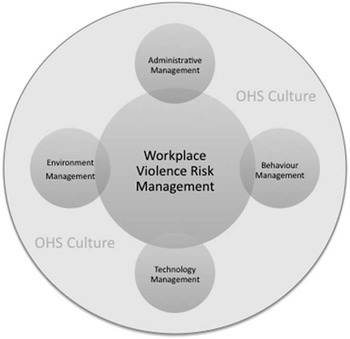
In the New Zealand context, Catley, Bentley, and Jackson (Reference Catley, Bentley and Jackson2011) developed a conceptual model for workplace violence risk and control intended to support managers undertaking risk management (risk identification, assessment and control) on potential violence hazards. The systems model (see Figure 1) included four key areas of violence management or control that managers have at their disposal. According to Catley, Bentley, and Jackson (Reference Catley, Bentley and Jackson2011), model, workplace violence can be controlled through means associated with: (1) behaviour – managing the behaviour of people in and around the workplace; (2) technology – including surveillance and other technology solutions; (3) administrative controls – notably shift scheduling and workload management; and (4) environmental design – including factors such as the use of lighting, guards to isolate vulnerable employees from dangerous situations, and workplace layout factors.
Factors in workplace violence control (adapted from Catley, Bentley and Jackson, Reference Catley, Bentley and Jackson2011)

Importantly, Catley, Bentley, and Jackson (Reference Catley, Bentley and Jackson2011) model recognises that managers in organisations from different industry sectors have differing ability to exercise control over these four variables, meaning careful consideration is required when selecting and balancing violence interventions. For example, in high-violence risk sectors such as health and public transport, control over the working environment may be limited where employees are working in the community. Moreover, people working in these sectors are more likely to encounter unstable individuals, as a result of mental disorder, extreme stress, drugs or alcohol, meaning control over people's behaviour is reduced. In these cases, argue Catley, Bentley, and Jackson (Reference Catley, Bentley and Jackson2011), administrative controls and technology play a more important role, for instance, ensuring that individuals have back up when required or are roistered on in pairs. Conversely, in the case of public sector workers, another high-risk group, protection may involve all four areas of control with only limited constraints on management action to manage risk. Furthermore, a number of researchers have argued that to enhance the chances of effectiveness, injury prevention systems must be embedded in a positive safety culture (Reason, Reference Reason1998; Cooper, Reference Cooper2000; Hopkins, Reference Hopkins2006; Bentley & Tappin, Reference Bentley and Tappin2010).
The modern workplace violence literature describes some intervention evaluations, while many other interventions have been adopted because of an urgent need to address the problem but are untested and unproven (Wassell, Reference Wassell2009). Despite a limited number of published intervention studies (Wassell, Reference Wassell2009), many of which focus on training and the health sector, there is relatively little information in the literature on organisational attempts to manage the workplace violence problem, suggesting this is an area requiring considerable further research. The present study makes a further original contribution to understanding in this field by focusing a range of question items on the issue of violence prevention activity, and seeks to determine which factors best predict the application of violence prevention activity.
METHOD
Sample
The sample for the 2011 New Zealand Workplace Violence Survey was drawn largely from two sources: the New Zealand Safeguard Forum (an e-mail-based forum for OHS professionals hosted by the Safeguard magazine), and members of the Human Resource Institute of New Zealand. Respondents accepted an invitation to participate in the survey posted on the Safeguard Forum site and to Human Resource Institute of New Zealand members while a number of others were referred from people who became aware of the survey through colleagues. Approximately 440 individuals subscribe to the Safeguard Forum, while Human Resource Institute of New Zealand has ∼640 members. As it is unknown how many of these individuals are practicing OHS professionals, or work in related fields, it is not possible to determine an accurate response rate.
Procedure, data treatment and analysis
A web-based survey was developed and, with the agreement of the site administrators, e-mailed to the two respective memberships inviting individuals to respond to the survey. Individuals were asked to respond if they either worked in an OHS function in an organisation, or operated as a consultant or advisor attached mainly to one organisation. The invitational message included a brief information section outlining the background and aims of the study, and details of the university's ethical approval procedures. Respondents were informed that the survey would take ∼15 min to complete, although some recorded data would need to be retrieved from the organisation's records. Respondents were also informed that their responses were confidential and no individual or organisation would be identified in the findings of the study. They were also told they could withdraw from the survey at any point. Completion of the online survey was considered to be consent to participate.
Once respondents had completed and submitted the survey the data were automatically transferred to an Excel spreadsheet, where it was cleaned and prepared for analysis. Analysis of the qualitative data was conducted in SPSS for Windows version 18. Analysis involved descriptive analysis of all variables, including cross-tabulations between key variables, and conversion of incident counts and employee data into incidence rates (per 1,000 employees) to provide standard comparisons between variables, notably industry sector comparisons. A qualitative thematic content analysis of the narrative data reported in the open-ended survey questions was also conducted, with a one researcher identifying themes and a second checking each theme warranted inclusion.
Survey design
The online survey was divided into four sections: basic respondent and organization details; reports of workplace violence recorded by the organisation, the respondent's views on risk factors for workplace violence in their organisation (divided into four main scales containing a total of 36 items), and the organisation's risk management practices relating to workplace violence. The risk factor items from this section were informed by Chappell and Di Martino's (Reference Chappell and Di Martino2006) model and the survey instrument of Catley, Bentley, and Jackson (Reference Catley, Bentley and Jackson2011) and included items related to the individual, organisation and physical environment risk factors. Hence, questions included Likert-type items that required the respondent to note their level agreement to the relative importance of a wide range of risk factors, examples being: alcohol and drug use; prejudice and/or harassment; mental instability/distress (all examples of individual factors); workloads and time pressure; waiting time (organizational factors); workspace layout; cash on the premises; lighting/illumination of work area (environmental factors).
RESULTS
Sample demographics
Some 96 organisations participated in the workplace violence survey. Participating organisations ranged from the very small to the very large by New Zealand standards (range: 6–13,500 employees) with a mean organisational size of 964 employees. The total number of staff (by headcount) employed by these 96 organisations was reported as 76,297.
Participating organisations were mainly located in the main New Zealand cities and population centres, including Auckland (24% of organisations), Waikato (8.3%), Bay of Plenty (10.4%), Wellington (10%) and Canterbury (8.3%). Almost one-half of the sample was comprised from organisations operating in three industry sectors: manufacturing, public administration and safety, and health.
The survey respondent was most frequently the health and safety manager, advisor or coordinator (50%), with the remainder identifying themselves as the human resource manager or advisor (25%) and the health and safety consultant working within the organisation (9%). Respondents had moderate to high experience in their current role with a mean time in role of just under 6 years (SD = 6).
Reported levels of workplace violence across the sample
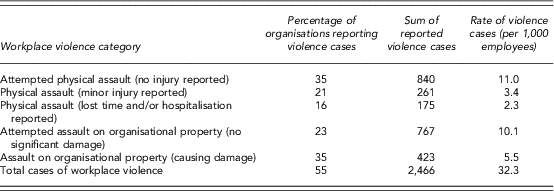
Table 1 provides an overview of the cases of workplace violence recorded by the organisations surveyed. The table shows data for the five different categories of violence employed by the study, with three levels of physical assault and two levels of property damage.
Reported level of workplace violence for participating organisations
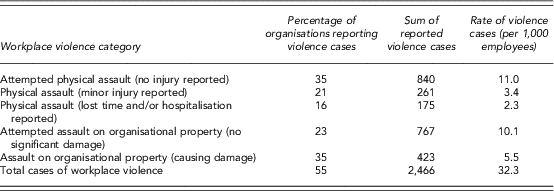
Just over one-half of the organisations participating in the study reported cases of workplace violence with a roughly even split between physical assault and property-related violence. A total of nearly 2,500 cases of workplace violence were reported, and therefore formally recorded, by the 96 organisations participating in the survey. The highest incidences of workplace violence were reported in the ‘attempted physical assault’ (840 cases) and ‘attempted assault on organisational property’ (767 cases) categories. A total of 436 cases were recorded that involved some form of physical injury (18% of all reported cases).
The 175 lost time and/or hospitalisation cases reported resulted in a total of 572 lost days, at an average of ∼3.3 days per case. The 572 days of lost time represented 2.3% of lost time from all forms of injury and ill-health, in the organisations surveyed. The incidence rate for all violence cases (32.3 per 1,000 employees) is very high compared with internationally reported rates (Hartley, Biddle, & Jenkins, Reference Hartley, Biddle and Jenkins2005; Kelloway, Barling, & Hurrell, Reference Kelloway, Barling and Hurrell2006; Parent-Thirion et al., Reference Parent-Thirion, Fernández Macías, Hurley and Vermeylen2007; Jones et al., Reference Jones, Robinson, Fevre and Lewis2011). However, the 32.3 rate reported in the present study includes attempted assault and property assault cases along with violence to persons. The rate for physical assaults was inline with international samples at 16.7 per 1,000 employees. The findings from the present study show a higher incidence of physical violence than observed for the 2007 workplace violence survey of Catley, Bentley, and Jackson (Reference Catley, Bentley and Jackson2011), although comparisons between the present data, 2007 findings, and the international studies reported above should be treated with considerable caution as the 2007 and 2009 surveys had different samples, while operational definitions and methodologies for measuring workplace violence cases and incidence vary greatly.
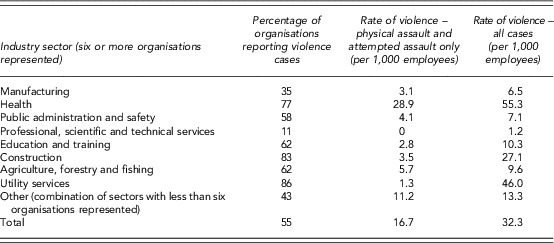
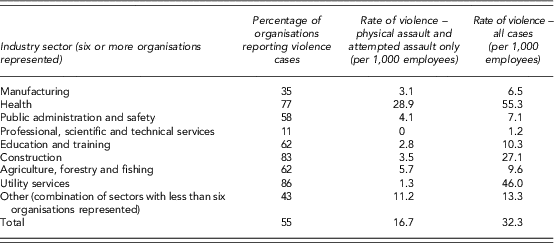
Reported rates of workplace violence by industry sector
Table 2 shows the reported incidence of violence by industry sector for those sectors with representation in the survey from at least six responding organisations. It is clear that the health sector experiences the highest rate of workplace violence, excluding those sectors (utilities, construction and professional, scientific and technical services) for which the great majority of cases were property-related violence or attempted assault only. Indeed, the health sector had a physical assault rate of approximately five times the magnitude of the next highest sector (excluding professional, scientific and technical services). These findings are in-line with the 2007 survey of Catley, Bentley, and Jackson (Reference Catley, Bentley and Jackson2011), where assaults resulting in injury to workers in the health sector were far greater in number than for any other sector surveyed.
Reported cases of assault during 2010
Sources of workplace violence
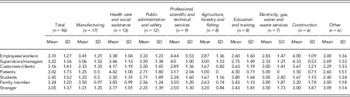
Table 3 shows mean ratings of importance as a source of violence in respondents’ organisations, as measured on a 5-point Likert-type scale. Overall ratings were approximately even for all sources of violence, although these figures are more meaningful when considered independently for each industry sector. Health organisations, for example, rated patients, customers/clients and family members as of particularly high importance as a source of violence. In the education sector, patients and students were highest rated. While workplace violence is often represented in terms of co-worker violence, co-workers were highest rated as the most important source by just two sectors: manufacturing and professional, scientific and technical services.
Perceived importance of various sources of violence (measured on 1–5 scale, 1 = ‘not important’; 5 = ‘very important’)

Perceived risk factors for workplace violence
Respondents were asked to rate the importance of a set of 29 possible risk factors for workplace violence that were derived from the literature and a conceptual model of workplace violence risk constructed by Chappell and Di Martino (Reference Chappell and Di Martino2006). Risk factors included in the list were related to the broad work system, and covered interpersonal factors (mean: 3.66; SD: 0.93), environmental factors (mean: 2.45; SD: 0.99) and organisational factors (mean: 3.03; SD: 1.02). The highest mean ratings were reported for interpersonal factors. Specific factors with the highest mean ratings were related to exposure to unstable persons, including: alcohol and drug use (mean: 4.06; SD: 1.17), prejudice and/or harassment (mean: 3.80; SD: 1.28), and mental instability/distress (mean: 3.76; SD: 1.24). Interestingly, workloads (mean: 3.53; SD: 1.21) and time pressure (mean: 3.45; SD: 1.19) also received relatively high ratings, suggesting work-related stress increases the perceived risk of violence in the workplace.
The relatively low rankings for the environmental risk factors, notably vehicle design (mean: 2.10; SD: 1.19), cash on the premises (2.31; 1.35) and lighting/illumination of work area (mean: 2.40; SD: 122), are likely to reflect the fact that, for many organisations, these factors were a non-issue – that is they did not feature in the work of their employees. For the health sector, however, issues such as building design and layout were rated relatively highly, reflecting the impact such design aspects can have on the organisation of work and interactions with the public. Organisational factors were rated as particularly high for the health, professional, scientific and technical services, education and training, and construction sectors. This high ranking may reflect the high levels of psychological demand in these sectors and stress outcomes, which may increase the likelihood of psychosocial problems such as violence and bullying.
Managing workplace violence
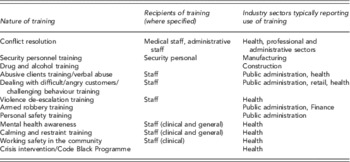
The survey questioned respondents on their organisation's health and safety management system with respect to workplace violence. Workplace violence was reported as being formally identified as a hazard in 50% of organisations, with 34% having a specific risk management plan for workplace violence, and a further 32% having a general hazard management plan that included workplace violence. A moderate proportion of respondents (38%) reported that at least some of their employees had received specific training regarding workplace violence or related aspects of security. Training programmes provided to staff were mainly secondary prevention measures (rather than primary preventive methods that remove or reduce the risk presented by the hazard), and focused largely on addressing interpersonal factors in workplace violence, notably the management of individuals presenting risk through their behaviour or through verbal abuse. Training dealing with primary or tertiary prevention was not mentioned by respondents. Table 4 illustrates the different forms of training employed and industry sectors that reported using certain training to prevent or manage workplace violence.
Overview of training on workplace violence used by responding organisations

Respondents were also asked to describe measures additional to training that had been put in place in their organisations for the prevention and control of workplace violence. While some of these measures, for example policy and hazard management, were generic in nature, a range of specifically designed measures to control and manage workplace violence were reported. Many of these measures were organisational and administrative in nature, including the use of anti-harassment policies, zero tolerance to violence policies, emergency plans and company risk registers. Other interventions were mainly technical, including personal alarms, panic buttons, customer surveillance and security barriers. Several organisations used security firms and/or worked to developed good relationships with the police. While approximately two-thirds of respondents listed at least one prevention measure (when training is included), these tended to focus on a single area of control, mostly commonly training to manage behavioural factors and technology countermeasures. Interestingly, this figure also included organisations that did not report any actual violence incidents.
DISCUSSION
The extent of the problem
The 2011 New Zealand Workplace Violence Survey has identified a moderately high level of workplace violence by international standards in the sample of organisations that responded to the study. Indeed, one-half of responding organisations had experienced cases of workplace violence during the preceding 12-month period. The implication for management is, therefore, that violence in the workplace is a real problem for New Zealand organisations, and provisions for its control must be made even where no cases of violence have been formally identified in the past.
As different studies operationalise the measurement of workplace violence in different ways, comparisons between findings reported in this paper and those in the international literature are problematic. Moreover, the organisational-level data collection employed in this study cannot be readily compared with findings of individual-level surveys. Indeed, it is very likely to under-represent the extent of workplace violence in New Zealand workplaces as data were only collected on cases sufficiently escalated to be recorded in organisational records. In contrast, most other studies ask individuals whether they have been exposed to violence, regardless of whether this was formally reported or recorded by the organisation.
Violence a key concern for the health sector
What this study does clearly highlight is a significant workplace violence problem across some industry sectors, notably health. This findings is consistent with our earlier survey and those of most international studies of workplace violence experience (e.g., Jones et al., Reference Jones, Robinson, Fevre and Lewis2011) and illustrate why most research effort in the violence field has been undertaken in the health sector context. The 175 lost time and/or hospitalisation cases reported by participating organisations resulted in a total of 572 lost days, the majority of which were for health sector employees. In dollar terms this represents a significant cost to industry, especially when extrapolated across the entire New Zealand workforce and indirect costs such as training, litigation and compensation are taken into account.
Sources of violence and risk factors
Consistent with many international studies of workplace violence, this study provides further evidence that co-workers are not the major source of violence (Laden & Schwartz, Reference Laden and Schwartz2000; Catley, Reference Catley2004; Howard, Reference Howard2001). As found by others (e.g., Jones et al., Reference Jones, Robinson, Fevre and Lewis2011), perpetrators of violence were perceived to most commonly be clients, customers and patients, depending on the sector, suggesting a clear focus for intervention.
This study has sought to determine how a broad range of risk factors impact on violence for the different industry sectors represented in the study. Clearly, greatest perceived concern is around patients, students and other clients, and relate most strongly to mental instability, stress, and drug and alcohol use. The relatively high ratings for work organisation factors such as workload and time pressures are also noteworthy, and give support to the so called ‘work environment hypothesis’, which identifies stress and poorly organised work as precursors to psychosocial problems such as bullying and violence (Stogstad, Torsheim, Einarsen, & Hauge, Reference Stogstad, Torsheim, Einarsen and Hauge2011). This information will be useful in the development of countermeasures to prevent the occurrence of workplace violence, and further challenges managers to develop healthy and well-organised workplace environments.
Violence control measures and implications for management
The major implication for management of this study is that workplace violence is a form of psychosocial hazard all organisations must manage through appropriate intervention targeting those areas of risk most relevant for their organisation. The survey identified the measures currently used by participating organisations to manage workplace violence. While respondents identified an impressive array of interventions, it is of concern that just 50% formally recognised violence as a hazard in the workplace. This is a concern as risk management efforts to identify, assess and control workplace violence hazard are unlikely to proceed where the organisation does not formally recognise violence as a hazard. Moreover, of the 25 different interventions reportedly used by organistions to manage workplace violence, the large majority addressed just two risk factor areas from the Chappell and Di Martino (Reference Chappell and Di Martino2006) model, these being largely individual level measures such as training to manage abusive clients, along with some technological measures such as alarms, cameras and panic buttons. No organisations appeared to address violence from the perspective of administrative controls or work organisation, beyond the implementation of policy, and no mention was made of cultural awareness for employees.
Directions for further research
Further research should examine the extent and nature of workplace violence across a larger number of organisations in New Zealand and Australia, providing an improved evidence base for prioritising prevention. Furthermore, in-depth qualitative investigations of hazard/risk management practices, along with quantitative studies targeting management actions to prevent violence and other psychosocial factors, are needed to identify the hazard/risk management practices of managers associated with workplace violence in high-risk sectors such as health, public sector, public transport and education. It is also important to further advance the intervention evaluation literature for the prevention of workplace violence and other psychosocial risks. Only with improved data on intervention to manage workplace violence will organisations be able to effectively manage the risk to their employees working in vulnerable work situations.
Acknowledgements
The authors would like to thank those individuals who gave of their time to participate in this survey. They are also grateful to Safeguard magazine and Human Resource Institute of New Zealand for providing access to their forum members.