As one of the more peculiar textures of late thirteenth- and fourteenth-century music, the hocket (hoquet, hoquetus) has attracted considerable scholarly attention in the past;Footnote 1 most of this attention, however, has been focused on its nature as a rhythmic or contrapuntal device and on its discussion by theorists. Until recently, there has been little discussion about the coordination of hockets with texts.Footnote 2 This article focuses on precisely this issue: How, if at all, did composers, scribes and singers coordinate verbal text with the fragmented musical ‘line’ that is the hocket?
Let us summarise briefly what defines a hocket.Footnote 3 As a device of composed polyphony,Footnote 4 it arose in the thirteenth century with the advent of a system of notation which made it possible for the first time to define the length and location of notes and rests – first in modally notated discant and then from the late thirteenth century onwards more precisely and on several rhythmic levels through mensural notation. Notes and rests of two or more voices are staggered in a ‘mutual stop-and-go’ patternFootnote 5 – one voice filling the gaps where the other rests and vice versa. In its pure (but rare) form, the hocket is strictly complementary, with no overlap between voices; elsewhere, particularly in passages where more than two voices are involved, several voices may sound at the same time. The device can either appear on its own – most notably in the two principal late thirteenth-century motet sources MontpellierFootnote 6 and BambergFootnote 7 – or it can appear as a section of a longer piece. It has always been viewed as something out of the ordinary, from contemporaries such as Johannes de Grocheo – for whom the technique is only ‘attractive to cholerics and young people on account of its mobility and velocity’Footnote 8 – to modern-day scholars such as William Dalglish, who describes it as ‘a performance practice characterized by willfulness and ostentation’.Footnote 9
That the hocket regularly appears with as well as without a text is evidenced by the musical sources and confirmed by theorists such as Walter of Evesham in his De speculatione musice (‘But there is another kind of discant – with words or without words – in which while one sings the other is silent and vice versa, and it is therefore called “truncated song” because that accords with the matter; this is also called “hocket”’)Footnote 10 or the ‘Anonymous of St. Emmeram’ in his De musica mensurata of 1279 (‘You should know therefore that hocketing occurs either by cutting up the notes or without cutting them up. If there is no cutting up, it will be in two ways, either with words or without’).Footnote 11
Three types of hoquetus can be excluded from the ‘texted’ category. First, of course, there are the wordless, self-contained hoqueti. Secondly, within more extended compositions, many hocket passages must effectively be considered untexted even where words are supplied in the sources: where the text of the voice in question is only indicated by a label-incipit at the beginning, or where (as frequently happens) the hocketing passages (interludes or postludes) are left untexted or are bridged by melismas. The third and least obvious category to be excluded is the onomatopoetic hocket, where the texture mimics natural or man-made sound: animal cries, shouts, signal instruments, hunting calls, etc.Footnote 12 Most notably, this appears in French chaces and virelais with hocket sections at points of climax – such as in the anonymous Tres dous copains where the ‘hunting’ character and the trumpet calls are represented by the breathless succession of one-note segmentsFootnote 13 – or, with humorous intent, in some Trecento madrigalsFootnote 14 and Central European song-motets.Footnote 15 But as Elizabeth Eva Leach has stressed, the whole point of these hockets is that they set non-verbal sounds,Footnote 16 underscoring their disorganised, ‘illiterate’ nature. Verbal text, in contrast, according to the contemporary music theorist Marchettus of Padua, who himself follows the grammarians of late antiquity, is defined as an utterance which has to submit to human reason and to being written down: ‘Vox articulata et litterata est que intelligi et scribi potest.’Footnote 17 The sounds of the onomatopoetic hockets are ‘litterata’ – because an approximation of their sound can be recorded in writing – but ‘inarticulata’: without rational meaning.Footnote 18 The association of such utterances with the hocket produces music which itself could have been seen as ‘inarticulate’ (some theorists, such as Jacques de Liège, commented that it was virtually impossible for human reason or human senses to perceive and ‘understand’ its quick succession of fragmented notes).Footnote 19 By definition, therefore, questions of ‘texting’ are not applicable to this repertory as there is no ‘text’ in an accepted sense.
Additionally, this study will limit itself to considering passages where the stop-and-go alternation of notes and rests unfolds in at least two voices (as opposed to the numerous ‘imperfect hockets’ where only one voice part – usually the contratenor – is broken up), and is of at least two bars in length. Likewise excluded are the ‘voice exchange’ hockets where the alternation is really not of brief ‘truncated’ segments, but of short phrases (which are themselves matched to short text phrases). This type of alternation is fairly common in the Notre-Dame repertory,Footnote 20 but rare from the latter decades of the thirteenth century onwards; as Karl Kügle has pointed out, it makes a return in the early fifteenth century when the enthusiasm for the strongly fragmented ‘stop and go’ quality of the hocket proper appears to be on the wane.Footnote 21
Even with all these qualifications in place, a preliminary survey of the extant polyphony from the period in question, mostly from the principal editions, has produced a list of about 115 compositions with cum littera hockets from the late thirteenth to the mid-fifteenth century, out of c. 300 pieces with any kind of hocket (see Appendix). Motets make up the lion's share of these – 79 of 115. There are also numerous mass Ordinary movements with hockets (which by the definition of some contemporaries are subsumed under ‘motets’ in any caseFootnote 22), but the majority of them are sine littera – as untexted or melismatic codas to a movement or section. In secular music as well, hockets mostly appear in the above-mentioned onomatopoietic fashion or as untexted/melismatic interludes or as codas. In motets, on the other hand, texted hockets are widespread throughout the period. They are found in a number of compositions from the Ars antiqua repertory in Bamberg and Montpellier and even more consistently in the Ars nova, for example in nineteen of twenty-four motets by Guillaume de Machaut and ten of twenty-seven by Philippe de Vitry (if one includes the less securely attributed works).Footnote 23 Even towards the end of the century and into the next one, there is no sign of declining popularity of the hocket, though fewer appear cum littera: six of fifteen motets from the codices Chantilly and Modena A,Footnote 24 and two out of ten by Ciconia. The Turin manuscript still contains thirteen hocketed motets out of a total of forty-one.Footnote 25 This close association of the hocket with the motet is further confirmed by the anonymous Italian author of a brief treatise on the genres of texted music, commonly known as De vocibus applicatae verbis and probably from the 1330s: ‘sic utendo uchettis et pausis videntur motizzando cantare’ (‘if one uses hockets and pauses in this way, one appears to sing in the manner of a motet’).Footnote 26
Theologians' and theorists' views
Contemporary writings about music provide some clues about texts in hockets, but few specific ones.Footnote 27 Many writings from an ecclesiastical context throughout the Middle Ages are concerned with the integrity of cantus – which by definition or implication included text and melody;Footnote 28 anything that distorted the true, clear and calm delivery of the cantus was viewed with scepticism or hostility. What started as a general polemic of twelfth- and thirteenth-century churchmen – from Bernard of Clairvaux and John of Salisbury to Roger Bacon – against the ‘cutting’ (secare)Footnote 29 or ‘breaking up’ (frangere)Footnote 30 of the cantus turns in the fourteenth century into explicit criticism of the technical innovations of composed polyphony. A particular villain in this regard was the hocket, which cut words and tunes into small pieces, unacceptably compromising the clarity and intelligibility of their delivery. The statues of the Cistercians from 1320, for example, defend the ‘old form of singing’ against the ‘ridiculous modernisms’ manifesting themselves in the ‘syncopation of notes and also hockets … because such things taste more of dissolution than of devotion’,Footnote 31 and Pope John XXII's famous constitution Docta sanctorum patrum of 1324/5 again targets the hocket as ‘dismembering’ ecclesiastical song.Footnote 32 The theorist traditionally known as Jacques de Liège, but according to Margaret Bent's recent research likely to be identified as a Spanish author (‘Jacobus de Ispania’),Footnote 33 echoes some of the same sentiments in his Speculum Musicae, also from the early fourteenth century, where he chastises singers because they ‘sing polyphonically in an overly lewd manner, they gratuitously multiply the voices. Some of them hocket too much, break up their parts into consonances too much, rise up and divide.’Footnote 34
How much of an impact the papal proscription of the hocket – which found its way into the Corpus iuris canonici around 1500, thus remaining valid at least notionally until 1917 when the Corpus was purged of obsolete laws – had on actual musical practice remains uncertain,Footnote 35 although some of the more conservative writers on music continued to uphold the validity of Docta sanctorum.Footnote 36 But in any case, these blanket prohibitions of course supply no clues about the correct way to text a hocket: if it was considered abusive, there was no way to ‘get it right’. One might conclude, however, that hocketing which left the words intact would have been less offensive than hocketing which didn't – a view made explicit by John of Tewkesbury in his Quartum Principale from the second half of the fourteenth century: ‘Et super omnia etiam cavendum est ne per truncationes fiat decisio alicujus dictionis in cantilenis’ (‘And one has to take care above all that no cutting up of a word occurs in songs as a result of these truncations’).Footnote 37
Many music theorists, on the other hand, were fascinated with the new device because it demonstrated like no other the precision with which mensural notation was capable of defining the length of notes, rests and their mutual relationships within one voice part and between voice parts.Footnote 38 Whether hockets came with or without text was a secondary concern in this context – hockets cum littera were a commonplace occurrence, but not a matter for discussion. Many authors (such as Franco of Cologne) do not even mention text, or merely acknowledge its potential presence (such as Walter of Evesham). Only some, such as the ‘Anonymous of St. Emmeram’, go into slightly more detail:Footnote 39

But for the information that, in principle, hockets in all modes can appear cum littera, the author again concentrates on the contrapuntal and rhythmic aspect: hockets which include a resecatio vocum only rarely appear texted. Resecatio vocum, the ‘cutting up’ of the notes, refers to hocketing on the semibreve, i.e., the level below the regular modal rhythms of long and breve.Footnote 40 As individually texted semibreves are exceptional in the Ars antiqua in any context (with the motet Povre secours,Footnote 41 the author has indeed chosen a rare example), this does not go a long way in telling us how contemporaries intended the texting of the hocket to unfold.
To conclude from a lack of theoretical discussion that texting ‘did not matter’, however, would be fallacious; texting of ‘normal’ polyphony from the period is not discussed by the theorists either, but that does not mean it was unimportant or arbitrary. Indeed, recent years have seen a substantial number of studies on the coordination of words and music from this time, primarily discussing structural correspondences of musical phrase and text phrase,Footnote 42 and of rhythmic or metrical patterns in the music matching (or not matching) rhythmic patterns in the verbal text.Footnote 43 It is now the consensus that quite firm links existed between the textual and musical structure and the rhythm of late medieval polyphony (as in chant and monophonic song). Discussion of text underlay or text declamation, if it does appear at all, is usually relegated to general writings on music pedagogy or singing manuals (instructions on the proper execution of chant, for example), most often in the form of a set of general instructions, rarely going beyond admonitions to sing in a manner which is appropriate to the text, obscuring neither its form nor its content.Footnote 44 One of the principal reasons for this lack of theorisation is the fact that within the liberal arts, musica is part of the mathematical arts of the quadrivium (with arithmetic, geometry, astronomy), language on the other hand part of the trivium (grammar, rhetoric, dialectic). Musica, therefore, if concerned with actually existing music at all – as opposed to musica mundana, speculative music theory concerned with the order of the universe – primarily concentrated on aspects of music which could be measured, counted and explained within a system, such as hexachords, counterpoint, mensuration or intervals. Texting was not ‘measurable’; instead, it was an aspect of compositional and performance practice which was based not on mathematical precepts, but on plausible congruence, on common consent, on ‘rules of thumb’.Footnote 45 There is no reason to assume that such rules should not have existed for the hocket as well, and it is these that the remainder of this article will discuss.
Unbroken texting
The principal characteristic of a hocket is the consistent fragmentation of the musical line and its interruption by rests – and herein also lies the crucial difference from a ‘normal’ line of music with regard to texting: how does one align words with snippets of often no more than one or two notes? According to John of Tewkesbury – and indeed according to most modern scholars and editors – word boundaries and phrase segments in the individual voice parts should ideally be coordinated in such a way that no word is interrupted by a rest.
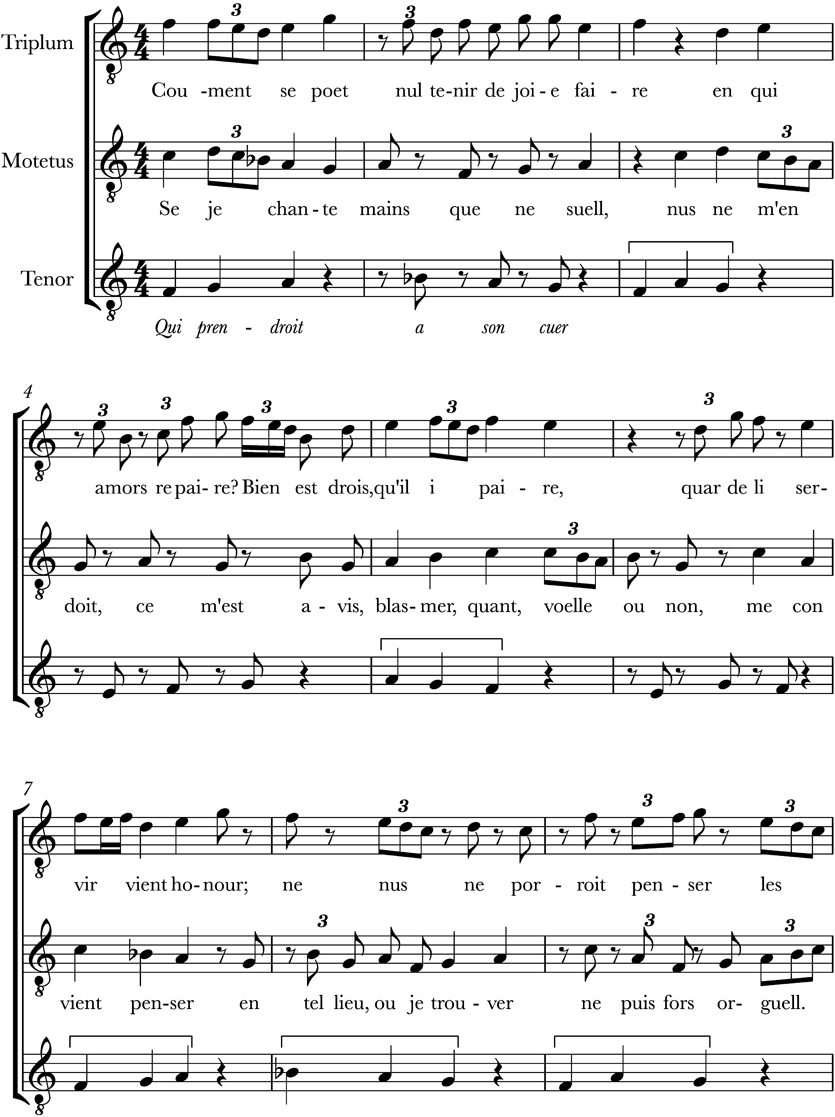
This expectation is in fact met in the vast majority of Ars antiqua motets with texted hockets. Motet no. 277 from fascicle VII of the Montpellier codex, Coument se poet nul tenir/Se je chante mains que ne sueil/Qui prendroit (Example 1),Footnote 46 is an instance of this. The tenor is structured into three ordines of twenty-four perfections divided into units of four perfections each, each ordo presenting the identical tune segment of eighteen notes (exactly three per unit) in slightly varied rhythmical guise. In the first ordo, the tenor itself participates in the hocket and each unit ends with a rest; in the second, the hocketing notes are replaced by regular longs; in the third, the final rest of every unit is replaced by a repeat of the third note. Above this, however, two texts unfold in a free poetic form, fifteen non-stanzaic lines in the triplum and eleven in the motetus. The two poems contain a truly exceptional number of monosyllabic or disyllabic words – which in turn gives rise to an equally exceptional setting: the hocket is virtually pervasive, and where in the first section the triplum does not participate in it (partly as a result of longer words, partly as a result of compositional choice), the tenor, as mentioned, steps into the breach. Word boundaries and the hocket segments (mostly single notes) align almost perfectly, with the single exception of ‘porroit’ in bars 8–9 of the triplum, which is split in two.Footnote 47
Motet Coument se poet nul tenir/Se je chante mains que ne sueil/Qui prendroit (Montpellier Codex, no. 277)
Ars antiqua motets with such pervasive hocketing are rare, but the principle also applies when hocketing is limited to individual passages. Crucially, the texture is not deployed in a structural or systematic fashion; rather, the very nature of the musical and poetic style of the motets from this period allowed composers to apply it with a great degree of flexibility. They either seized the opportunity when it presented itself by virtue of a ‘hocketable’ text passage – that is, one with a succession of short words in the upper voice or voices (against an untexted tenor which could be segmented accordingly to create the stop-and-go effect) – or they sought out this opportunity by selecting or writing such passages. This flexibility is made possible by the freedom of the melodic and rhythmic phrasing of the upper voices, if over a very rigidly structured repetitive tenor; the poetic texts themselves are usually non-strophic and irregular in line length.Footnote 48
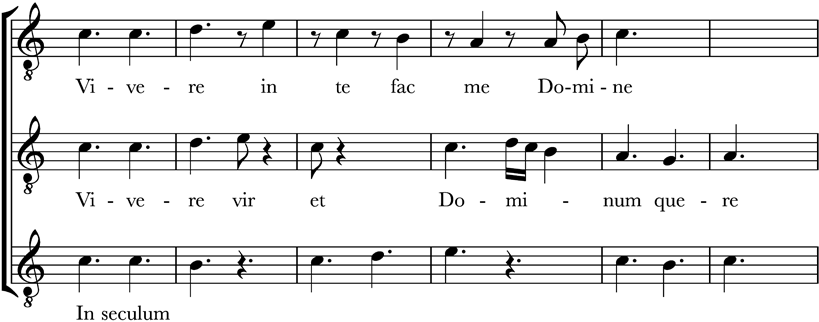
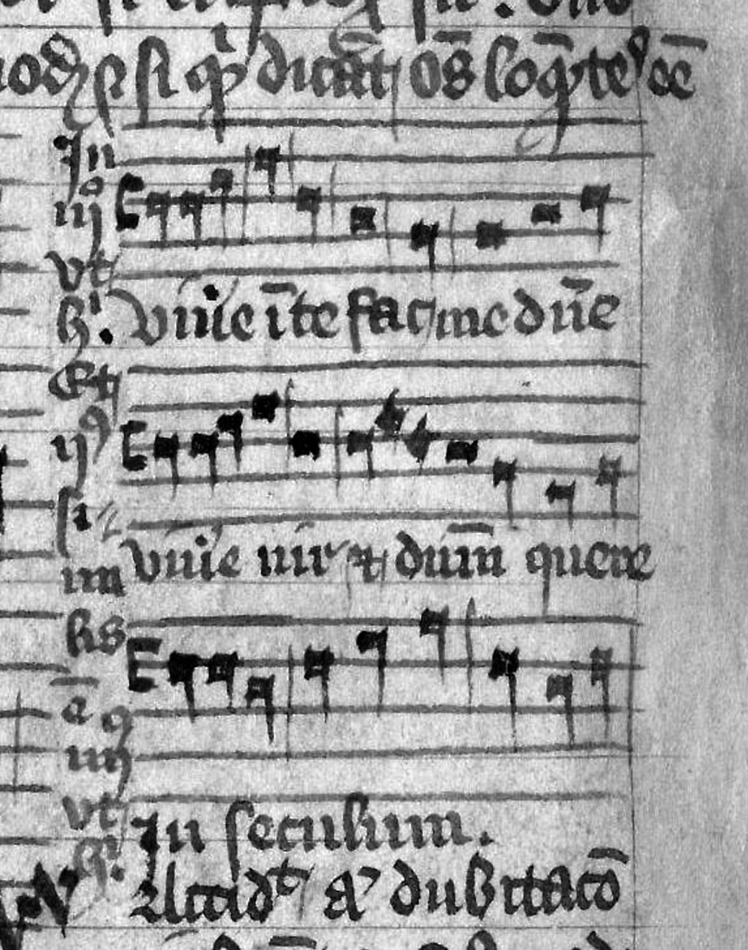
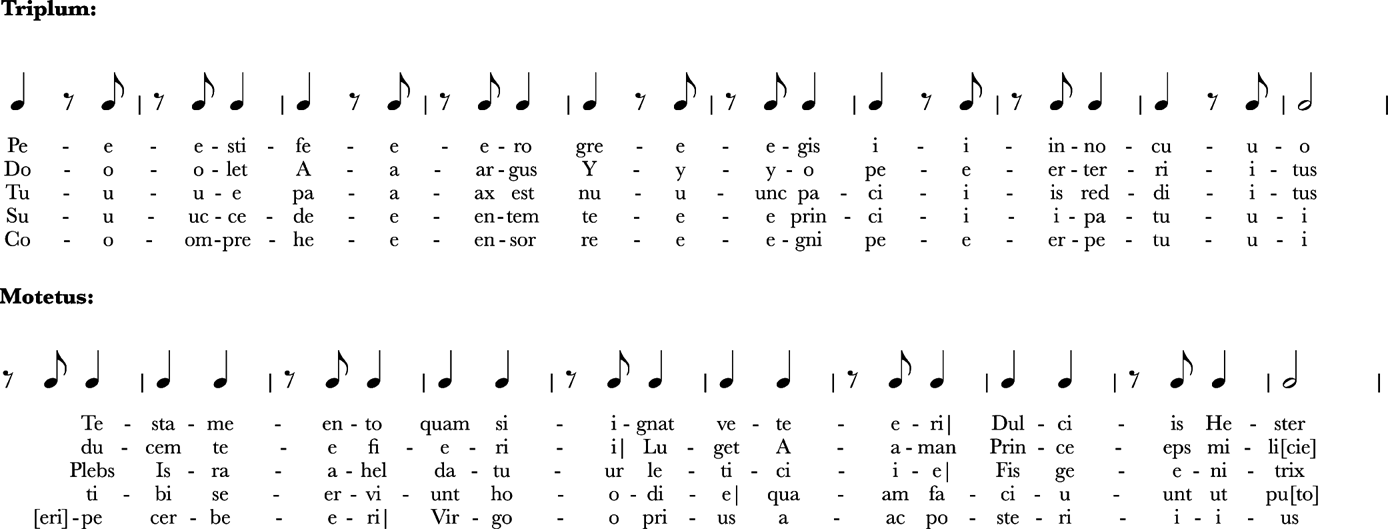
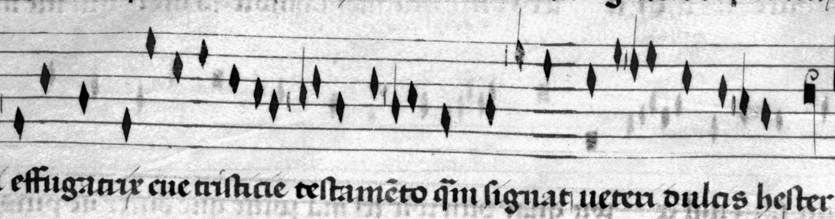
This principle of the ‘unbroken hocket’ is further underscored by one of the few texted specimens extant in a theoretical treatise: Walter of Evesham's De speculatione musica contains in its sixth part (the treatise on discant) a number of examples for hockets in various modes. All of them are untexted, with the single exception of the example demonstrating the third or fourth mode (Example 2 and Figure 1). This is a variant of the beginning of one of the most famous and widespread hockets of the late thirteenth century, the In seculum longum, appearing in the Bamberg, Madrid, and Montpellier codices.Footnote 49 The version as it appears in Walter's treatise is closest to the hocket no. 104 from Bamberg, albeit with some variants and errors.Footnote 50 In the only extant copy of Walter's treatise containing the section on the hocket – Cambridge, Corpus Christi College, MS 410 – words to the two upper parts are supplied (the tenor carrying the usual label-incipit). The texting is almost completely syllabic, and more importantly, the single notes of the hocket correspond to monosyllabic words; not a single word has to be broken up. Particularly striking in this regard is the top voice with its four monosyllabic words in succession: Vivere | in | te | fac | me | Domine. It cannot be proven from the source whether Walter adopted the example from an (otherwise lost) already texted version of the piece or whether he devised the text specifically for his example – or the fifteenth-century scribe might have added the words on his own initiative. On the evidence of the text itself, however, it seems more likely that the words resulted from an initiative by Walter or the Cambridge scribe: both voices ‘set’ words not known from any other source, and they seem to be brief free-standing aphorisms (‘Lord, make me live in thee’ / ‘Live, man, and seek out the Lord’) rather than openings of longer texts. As such, they appear to have been written or selected for the express purpose of demonstrating the hocket with unbroken texting, to fit the specific requirements of the music example.
Three-voice In seculum longum, from Walter of Evesham, De speculatione musice (Ccc 410, fol. 35v)
Cambridge, Ccc 410, fol. 35v: Walter of Evesham, De speculatione musice, detail of ch. 6
This approach to hocketing cum littera is easy enough to implement when the upper voices are rhythmically and poetically free – when text and music can be adapted to one another with some flexibility. However, things change radically with the advent of ‘isorhythm’Footnote 51 in the motet of the early fourteenth century. Here, hocket passages become an integral part of the recurring structure, serving to emphasise through their audible ‘otherness’ important points, such as the end (or more rarely the beginning) of talea sections – thus highlighting the essentially strophic nature of the genreFootnote 52 – or the end of a piece, as a postlude or coda. And to make them stick out even more, hocket sections are consistently pan-isorhythmic from the outset. This change of approach to musical structure corresponds to changed poetic structures as well; the strophic nature of the talea structure is mirrored by the equally strophic nature of the texts, and the two are regularly aligned with one another.Footnote 53 For composers who wanted to maintain the traditional alignment of word boundaries with hocket segments, this posed a challenge. If a hocket sections returned at the end of every isoperiodic section and, by implication, at the same position within every strophe of the poem, they had three options:
1. Choose or write a poem with exact correspondence of word boundaries between strophes;
2. adapt the text underlay (possible in musical settings which are not entirely syllabic);
3. modify the music, i.e., the hocket itself, to match the text.
One might think that, given the substantial hurdles of finding or devising a text whose word boundaries fulfil the conditions of the first option, this would be the least favoured. However, the opposite is true: of the numerous compositions of the fourteenth and early fifteenth centuries where the principle of ‘unbroken’ texting in hocket passages is upheld, the vast majority does in fact achieve this. It is perhaps unsurprising that the works in question are primarily those where composer and text author are identical: Philippe de Vitry and Guillaume de Machaut. Indeed, even where this is not documented, we must in such cases assume either the identity of composer and text author or at the very least a close collaboration. It seems unreasonable to propose a scenario where a poem simply happened to have its word boundaries coincide from strophe to strophe to correspond with the isorhythmic hockets of the music.
A striking example of a strophic hocket with unbroken texting has already been pointed out by Georg Reichert and analysed in depth by Margaret Bent:Footnote 54 Machaut's motet no. 18, Bone pastor Guillerme, one of the earliest known works by the composer, probably written in 1324 or 1325 in Reims.Footnote 55 As is often the case, the hocket is limited here to the second half of the composition, where the tenor appears in diminution (from b. 96). The corresponding latter sections of the triplum and motetus poems are reproduced below, with the hocketed passages in bold:
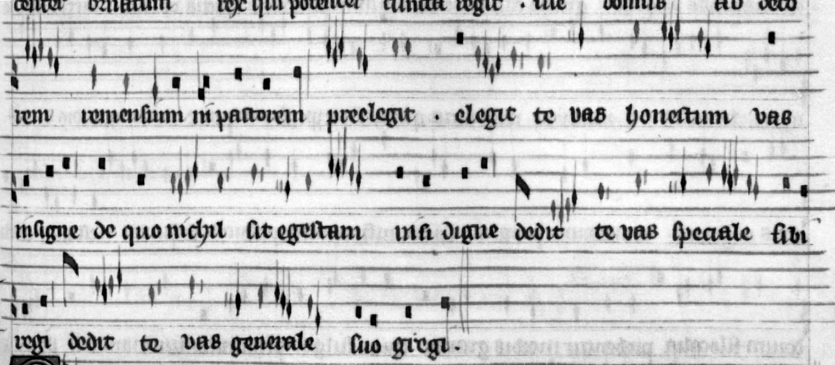
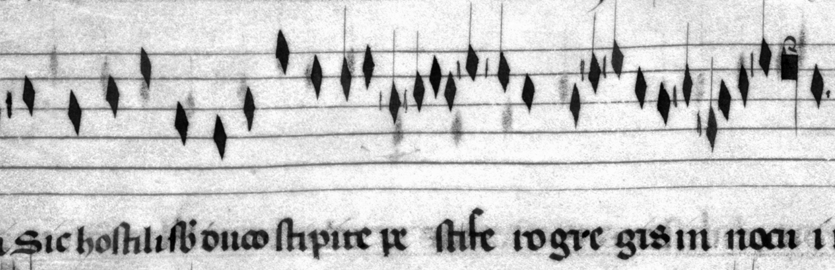
Several aspects are worth mentioning in this context (as already discussed by Bent). First of all, the word boundaries are arranged in such fashion that no words have to be split up into syllables in any of the four hocketing sections which correspond to the beginning of each of the four poetic stanzas. Of particular note are the two monosyllabic words at the beginning of the second line in the triplum and the single monosyllabic word in the middle of the first line in the motetus – all essential to correspond to the single notes in the hocket. Also of significance is that elsewhere – that is, where it is not necessary to accommodate the hocket – the word boundaries are irregular, which makes the regularity of the hocketing lines appear even more intentional. If we look at the remainder of the text in the second half of the motet, we find words of 2+4, 3+3 and 1+2+3 syllables for the six-syllable third line of the triplum, 2+2+3, 2+5 and 3+4 for the fourth line, 1+3 and 4 for the fifth; the same applies to the remaining line of the motetus (1+3 or 2+2). On the other hand, there is one small break in this regularity which brings us to the above-mentioned option 2: in the motetus stanzas, the monosyllabic word is either the fourth or the fifth syllable of the line.Footnote 56 In the first stanza, it could be either, although the text underlay in the manuscript Vg clearly indicates that the ‘te’ and not the ‘vas’ is to be sung to the single d′ (see Figure 2). Clearly, thus, Machaut took advantage here of the freedom afforded by the slightly melismatic setting; while he no doubt would have been capable of writing a poem that corresponded exactly to the requirements of regular syllable deployment, he saw no reason to straitjacket himself in that fashion for the sake of consistency when it was not technically necessary. While Machaut and his contemporaries did treat isorhythmic and poetic structure as congruent and mutually contingent, they did so in a creative and imaginative rather than a mechanical fashion.Footnote 57
Guillaume de Machaut, MS Vg, fol. 278r: Bone pastor Guillerme, detail of motetus
Where the setting is syllabic, this freedom is of course restricted or removed entirely. This can be observed in a second example, Philippe de Vitry's Vos qui admiramini/Gratissima virginis species/Gaude gloriosa – apparently one of his most popular works, transmitted in no fewer than five sources.Footnote 58 Again, the hocket limits itself to the second half of the motet, where the talea appears in proportional diminution. A synopsis of the latter halves of the two poems shows the alignment of the hocket with the word breaks:
The completely syllabic and very regular hocket passages require both texts to supply three times two segments each of 1+3 syllables in an identical position in the poetic structure. In the triplum, this is the last line of every stanza; in the motetus – rather ingeniously – the first of these two four-syllable segments in fact concludes a stanza whereas the second one opens the next one. The hocket pattern thus cuts across the poetic structure, but does so consistently – an instance of Reichert's Phasenverschiebung. Again, in all non-hocketing passages, the word boundaries in the text are, as one would expect, irregular. Similar observations could be made about the other unbroken texted hockets, such as Machaut's motet no. 9, Fons tocius superbiae/O livoris feritas/Fera pessima: only the triplum is fully texted, but in it, every single stanza but the first one (which is set as an introitus outside the isorhythmic structure) opens with a 2+1+2 hocket pattern faithfully mirrored by the word boundaries of the poem.Footnote 59
Broken or ‘hiccup’ texting – etymology and practice
John of Tewkesbury would have approved of these hockets, and as he knew and quoted Vitry's Vos qui admiramini,Footnote 60 his observations are probably based on this very repertory. If all composers had observed this ‘rule’, my study could come to an end here – the criticisms levelled by the contemporaries against the fractio vocis resulting from the hocket texture would seem groundless or at least exaggerated, and later sensibilities of ‘correct’ texting would likewise be unaffected. However, the reality is different. While Machaut and Vitry – poets and composers of the first rank – were able artfully to combine text and music in this way, indeed must have enjoyed this additional challenge, and while instances of hockets with unbroken texting appear as late as Ciconia, the majority of texted hockets do necessitate the ‘cutting up’ of words into syllables. In these compositions, no degree of effort on the part of the medieval scribe or modern editor will produce an underlay which ‘resolves’ all questionable passages. Scholarly authors have chastised composers and/or scribes for ‘senselessly tearing apart’ words in hocket passages, thereby obscuring the text and destroying its integrity.Footnote 61 And scholarly editors have been similarly unhappy with the situation – either, without much conviction, underlaying the text according to what they found in the source(s) or aligning the words as best as possible with the short segments of music.Footnote 62 But the sources themselves provide evidence that singing the hockets with ‘broken’ text was not only inevitable, but intentionally and skilfully applied. What is more, a solution to underlaying words across rests in the texted hocket can be proposed which not only is consistent in itself, but conforms to the evidence of the sources and is appropriate to the original meaning of the word ‘hocket’. The remainder of this essay will be devoted to proposing and demonstrating this solution.
First of all, an excursion into the etymology of ‘hocket’ is called for. Apart from a now largely discredited Arabic origin of the word,Footnote 63 two conflicting roots of the term hocket/hoquet/hoquetus/(h)oketus have been proposed, one from Latin, one from French.Footnote 64 The former traces the word back to the Latin word ‘occare’ or its post-classical intensive form ‘occitare’, meaning ‘to harrow’ or ‘to cut’. This origin (with an initial ‘h’ acquired somewhere along the way) is made explicit in one of the earliest sources to mention hocketing at all: Magister Lambertus' pseudo-Aristotelian Tractatus de musica of c. 1270 defines the device as ‘resecata musica, id est ipsa hoccitatio’.Footnote 65 Furthermore, this proposed etymology factually corresponds to the ‘cutting off’ or ‘cutting up’ that is so characteristic of the texture, and a number of contemporary music theorists define the ‘cutting’ (‘resecare’, ‘abscidere’) or ‘chopping’ (‘truncare’) as its essential nature. Franco of Cologne speaks of the ‘truncatio, vel oketus quod idem est’,Footnote 66 and John of Tewkesbury ‘de truncationibus sive quae hoketis vocantur’.Footnote 67 For Walter of Evesham, it is a type of discant which ‘cantus truncatus dicitur a rei convenientia, qui et Hoquetus dicitur’;Footnote 68 according to Johannes de Grocheo, his contemporaries classified mensural music in three categories, ‘motetos, organum et cantum abscisum, quem hoquetos vocant’.Footnote 69
However, the majority of contemporaries patently considered the term to be not a Latin, but a French one. Lambertus himself, although the only author explicitly proposing the Latin etymology, situates the word in a vernacular context as ‘quadam armonia resecata que, quantum ad nos, hokectus vulgariter appellatur’ (‘a certain cut-off concord called, as far we are concerned, “hocket” in the vernacular’).Footnote 70 For Anonymous IV, the word is explicitly a French one: ‘le hoket Gallice’ (‘in French: le hoket’).Footnote 71 This is further corroborated by a wealth of references outside the realm of theory: in French vernacular poems from the second half of the thirteenth century onwards, thus contemporaneous with or even pre-dating the theorists. Significantly, all these poems or songs are about the process of music-making, such as one by Adam de Halle who, in his motet Entre Adan et Hanikel/Chief ben seantz/Aptatur (Montpellier, no. 258),Footnote 72 relates the story of four young men performing a hocket and stamping their feet at the same time (triplum, vv. 5–6: ‘Quant il hoquetent | Plus tost clapetent’). Frequently, the hocket is referred to (apparently without the need of further definition) as a type or genre alongside motets, chansons, virelais, rondeaux, etc. Instances of this from the first half of the fourteenth century abound, such as the anonymous estampie Dame bone et saige (vv. 43–7: ‘a donc chanterai | ai ai | et si troverai chansonettes | hokes et notes nouvelles’),Footnote 73 Jehannot de l'Escurel's dit Gracïeus temps est, quant rosier (v. 1.5–6: ‘En chantant .i. nouviau hoquet | M'alai jouer’),Footnote 74 Gervais du Bus's Roman de Fauvel (book 2, vv. 1345–7: ‘Et tout entour y avoit paintez | Chançons, lois et baladez maintez, | Hoqués, motés et chançonnetes’),Footnote 75 Machaut himself (Prologue V, vv. 11–14: ‘A faire dis et chansonettes | Pleinnes d'onneur et d'amourettes | Doubles hoquès et plaisans lais | Motès, rondiaus et virelais’),Footnote 76 and finally Gace de la Buigne's Roman des deduis of 1359–71, where the cries of hunting dogs are likened several times to the performing of a hocket, the term apprearing both in the form of a noun and as a verb of action (vv. 8081–2: ‘Les uns vont chantans le motet, | Les autres font double hoquet’; vv. 10547–8: ‘Maiz j'ai dit qu'i scevent chanter | Tresbles, motés et hoqueter’; vv. 10633–4: ‘Qu'ils ne puissent chanter motés | Et rondeaux et faire hoqués’).Footnote 77 This evidence strongly supports a French origin of the term. The Latin etymology is entirely a preference of the theorists, and mostly an implied one even there. Very possibly, Magister Lambertus, a scholar of the University of Paris,Footnote 78 only referred to the Latin verb hoccitare to lend respectability to a vernacular term without classical credentials and without an obvious Latin root.
Etymological research into Old and Middle French further supports a French origin. The most recent etymological dictionary of Old French, the Dictionnaire étymologique de l'ancien français (DEAF), has proposed a common origin of ‘hoquer’ with ‘hoch(i)er’, first found in the twelfth century and meaning – then as now – ‘shake’, ‘rattle’ or ‘tremble’.Footnote 79 As a noun, therefore, a ‘hochet’/‘hoquet’ is a blow, impulse or impact – resulting in later meanings such as ‘throwing of dice’ or ‘baby rattle’. This would be analogous to the musical phenomenon of the ‘hoquet’ in terms of its lively, impulsive way of vocal delivery, rather along the lines of Johannes de Grocheio's characterisation of the hocket's ‘mobility and velocity’ or Adam de la Halle's hocketing and dancing youths.
In modern French, however, ‘hoquet’ means ‘hiccup’. Walther von Wartburg, in 1952, postulated a common origin of the words ‘hoquer’ and ‘hocher’ in the sound particle ‘hic’ or ‘hoc’, which mimics a variety of physical impulses (including shaking or rattling), but primarily the contraction of the diaphragm and the resulting momentary closing of the vocal cords.Footnote 80 To be sure, the earliest written evidence in French texts for the resulting ‘hoquet’ or ‘hiquet’ meaning ‘hiccup’ stem from the fifteenth century – which has led to the exclusion of this etymology from DEAF – but it is widely documented from then onwards.Footnote 81 It is impossible to answer with certainty the question whether the word ‘hoquet’ only acquired the meaning of ‘hiccup’ at that later time or whether it was merely undocumented in written form before that. To be sure, however, the absence of written documentation for the physical manifestation might be due to the fact that a limited context existed for it. Most medical and anatomical treatises in medieval France, where one would be most likely to expect it, were in Latin and correspondingly use the Latin term ‘singultus’. The Old/Middle French noun derived from the Latin – ‘sangloit’/‘seglout’/‘sanglot’ – can mean ‘hiccup’ as well, but this meaning, rather than the more common ‘sob’/‘sobbing’ and ‘death rattle’, is itself scarcely documented before the fifteenth/sixteenth centuries.Footnote 82
Taken together with the fact that the physical manifestation of the hiccup does interrupt speech in a highly similar fashion to the musical hocket, it remains plausible to postulate that this analogy gave rise to ‘hoquet’ as a musical term, even if that means that the word in a musical sense is documented in written form earlier than the human utterance on which it is based. This approach receives additional support from two more texts on the musical hocket which are not in French but in Latin. The constitution of the Order of the Carmelites from the year 1357 puts it as follows:Footnote 83
The context of similar injunctions (see above) and the fact that it is once again mentioned together with motets makes clear that ‘hiccup’ (here represented by the unusual, otherwise scarcely attested onomatopoetic noun ‘upatura’) can only refer to a hocket here.Footnote 84 Even more explicit is the Dutch cleric Johannes Boen in his Musica of c. 1355:Footnote 85
As a good Latinist, Boen uses the classical noun singultus for the hocket, but surely realised that his readers might not make the connection; he thus goes on to explain that the word in common usage (‘quos … dicimus’) is in fact the vernacular oketus. Boen thus not only demonstrates that for him, in any case, the hocket was analogous to a hiccup, but that he considered the term itself to be of non-Latin origin as well.
The analogy is a very direct one in the onomatopoetic hockets, which are apt to depict, besides animal sounds, various types of interrupted speech (stuttering, sobbing, gulpingFootnote 86) or interrupted action (stumbling or fumbling around). However, more important for the repertory under examination here is the more fundamental analogy between the way of singing and the ‘hiccup’, regardless of textual content or implication: the abrupt and recurrent interruption of vocal utterance. If a ‘hocket’, like a hiccup, is a series of sudden physical events cutting off the flow of speech, this would be made most evident in a musical composition not by aligning the words and the snippets of music, but precisely by interrupting the words themselves. Indeed, the ‘hiccup effect’ would be most palpable if this interruption made itself felt not between syllables, but in the middle of a syllable, that is on the vowel itself.
If we accept this as a working hypothesis for the moment, the practical consequences of this would be as follows. In hockets with segments of two notes or more, syllable or word breaks would fall in the middle of the segment, which could be represented like this:

By extension, single notes between rests would receive no separate syllable at all, but continue the vowel of the preceding syllable rather than beginning the next one since logically, for a new syllable to begin, at least two notes would be required in this pattern, one to end the preceding syllable and another one to begin the subsequent one. The resulting representation would look like this:

Conversely, if a hocket contained a segment of three notes between rests, the first note would conclude the syllable from before the rest, the next one would receive its own syllable in a normal fashion, and the third one would start yet another syllable, to be interrupted by the next ‘hiccup’ rest:

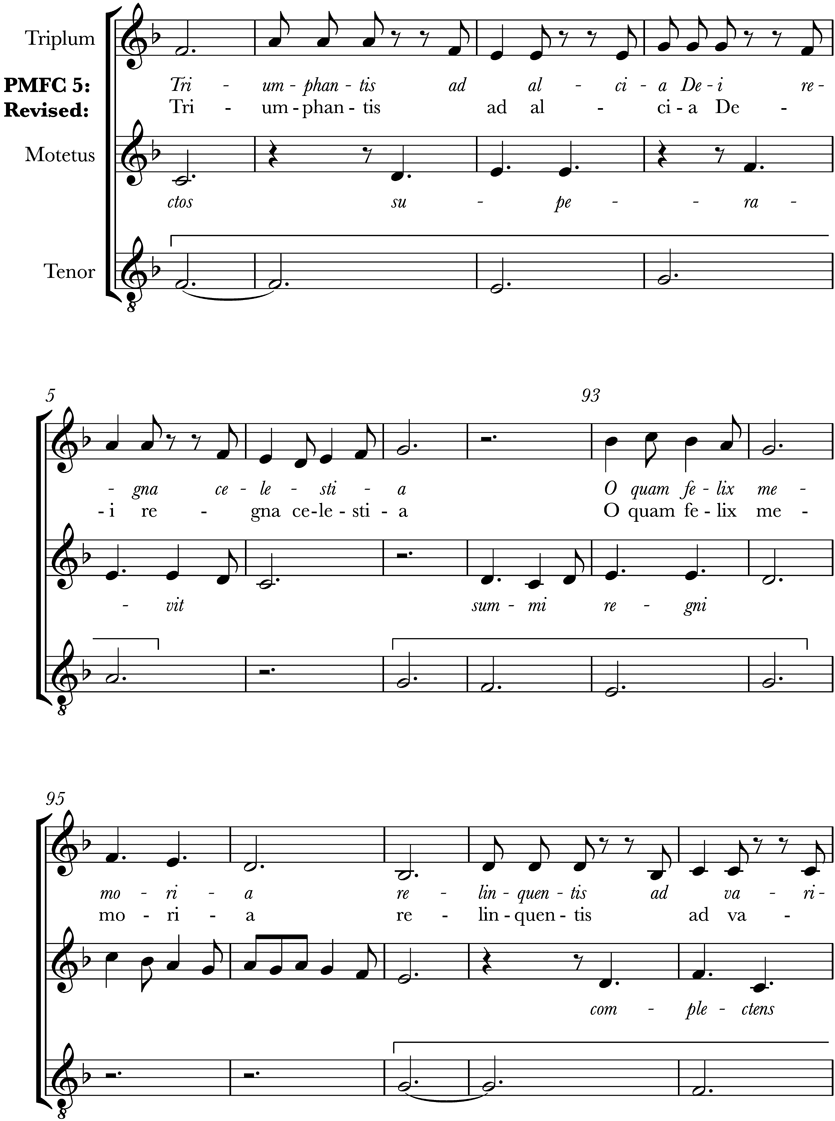
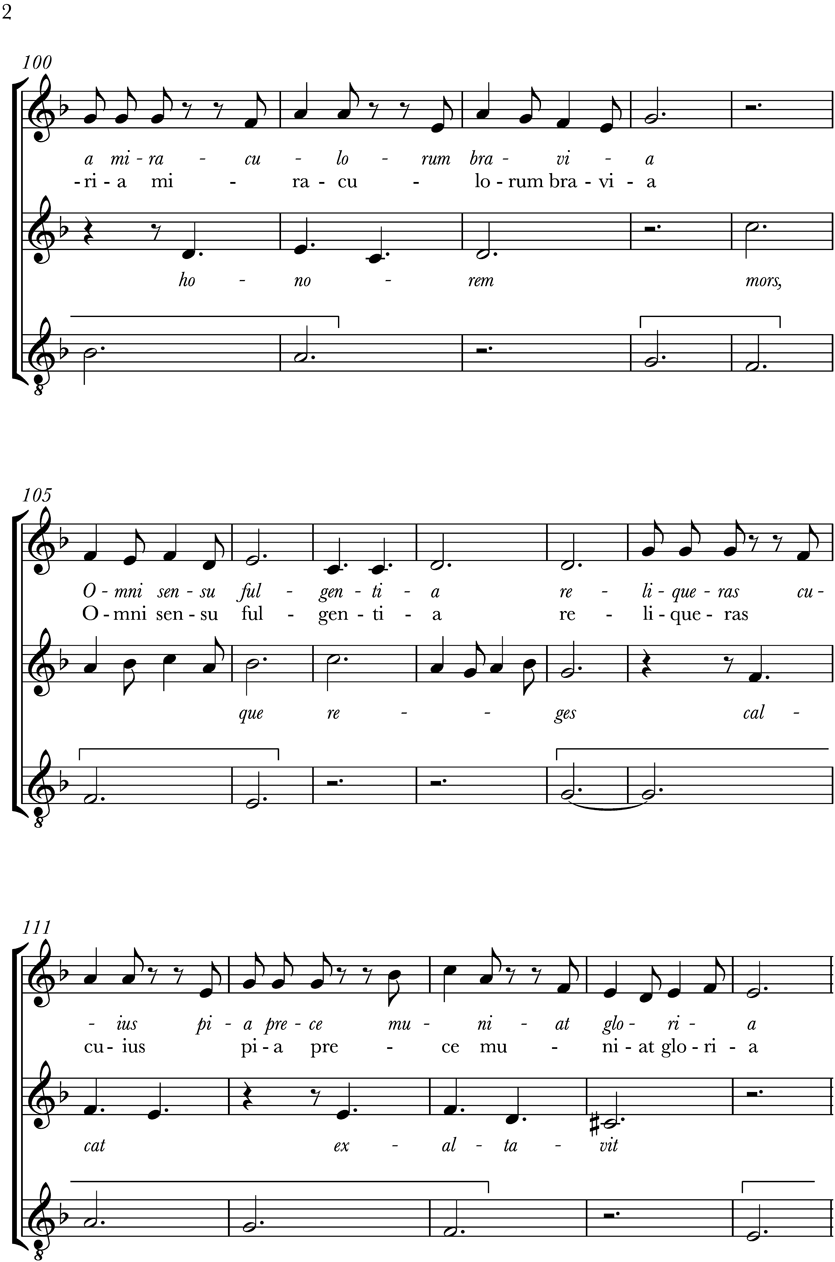
Let us test this hypothesis on an actual motet: Flos ortus inter lilia/Celsa cedrus/Quam magnus pontifex, transmitted in several mid-fourteenth-century sources and now generally accepted to be a work of Philippe de Vitry.Footnote 87 The motet is divided into two sections, each setting three and a half taleae, the second section in diminution. In that second section, every talea ends with a pan-isorhythmic hocket in both upper parts, fully texted, but not in a fashion that suggests or even allows unbroken texting (Example 3). The futility of any attempt to match word boundaries and hocket segment becomes apparent in the edition in PMFC (the top text line in the example); while the underlay is straightforward in the preceding, unhocketed section, with its customary correspondence of clear musical phrases with verse structure, and of verse rhythm with alternating semibreve–minim rhythms, there is no such consistency in the hocket section itself. This is particularly noticeable in the more densely texted triplum. The beginning of each phrase suggests that an unbroken underlay is intended, with a four-syllable word followed by a rest beginning every stanza; but this pattern subsequently breaks down, and with it the corresponding underlay, with longer words like ‘alcia’ in the first passage or, worse still, with ‘miraculorum’ in the second. However, applying the ‘hiccup underlay’ – seen in the bottom text line in the example – results in a perfect correspondence of syllables and notes in all three stanzas: rests are bridged by vowels, word breaks fall in the middle of segments. A further side effect of this solution is that at the end of every phrase there are exactly as many syllables left as are necessary to conclude the line to finish in syllabic declamation, thereby matching words and music in the alternating rhythmic pattern that had characterised the non-hocketed sections of this motet (and that is typical for this style generally).
[Philippe de Vitry], Flos ortus/Celsa cedrus, bb. 85–125, with texting from PMFC 5 (top line) and ‘hiccup’ texting (bottom line) (transcription of music based on PMFC 5)
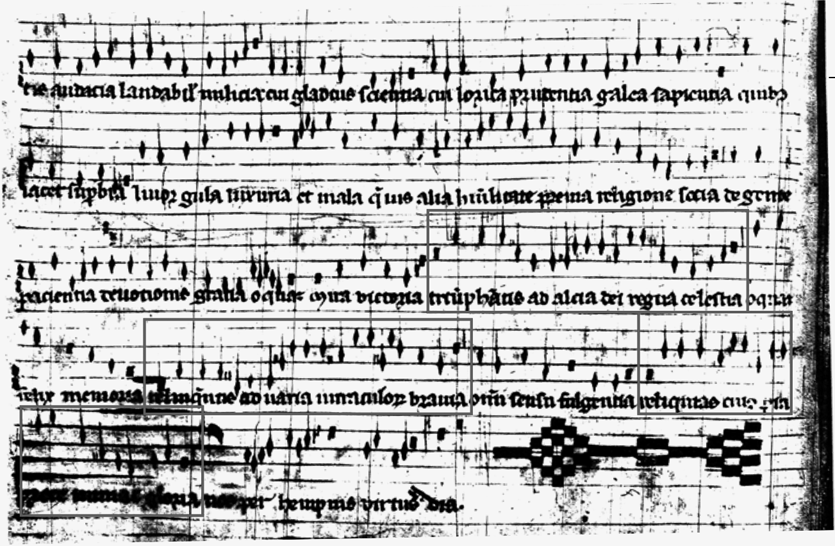
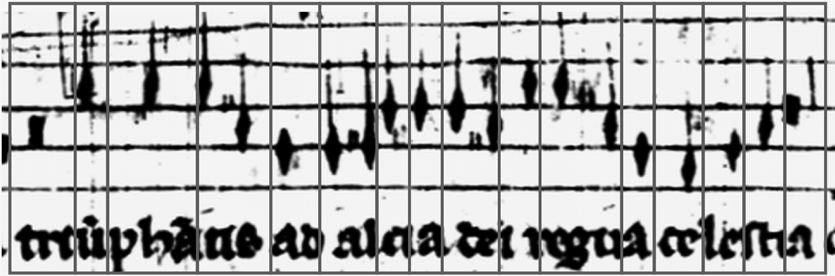
The manuscript transmission itself corroborates these findings. The only complete copy of Flos ortus inter lilia/Celsa cedrus is found in the Ivrea codex on fols. 9v–10r. Figure 3a shows the last four lines of the triplum with the end of the first section and the complete second section, the hocket passages highlighted in boxes. As in most manuscripts from the period, the text was entered first and the music then overlaid, and the Ivrea copyist apparently did this with some care.Footnote 88 The notes of short melismas are spaced very closely together to indicate their allocation to a specific word or syllable; and in syllabic passages the individual notes are positioned directly over the words in question, with such precision that often not only the syllable as such, but the vowel of the syllable is vertically aligned as closely as possible with the note. In the hocket passages, however, what one finds on top of the syllable more often than not is a rest surrounded by notes rather than a note as such.Footnote 89 In Figure 3b, this is indicated by boxes surrounding the syllables of text and the corresponding notes and rests: one can see the correspondence with particular clarity on the last syllable of ‘triumphantis’, and after that on the first syllables of ‘alcia’, ‘dei’ and ‘regna’ respectively. The most likely explanation is that the Ivrea scribe saw the rest itself as the primary point of reference for these given syllables – or, more precisely, the notes and the rest taken together. Text and music fit together so smoothly when aligned in this fashion that it seems hard to imagine a lack of intention on the part of the scribe (and by implication, the composer).
Ivrea, fol. 9v: [Ph. de Vitry], Flos ortus/Celsa cedrus, triplum
Ivrea, fol. 9v: [Ph. de Vitry], Flos ortus/Celsa cedrus, detail of triplum
To establish this ‘hiccup declamation’ as a principle one would have to find it at work in more compositions in a similar or identical fashion. In fact, such examples abound – take for example the anonymous Rex Karole/Leticie pacis/Tenor from the Chantilly Codex.Footnote 90 Its talea structure operates without proportional diminution, and all five sections end with an extended and fully texted panisorhythmic hocket between triplum and motetus. Again, the ‘hiccup principle’ leaves no loose ends. This is assisted by the regularity of the text: every one of the hocket passages sets exactly ten syllables in the triplum and fourteen in the motetus (the former one decasyllabic verse each, the latter segment occupying variable positions in the equally decasyllabic poem). Only the last hocket passage has a mere thirteen syllables because the motetus text ends with a nine-syllable instead of a ten-syllable line (surely because this last line is a quotation from the Marian antiphon Alma redemptoris mater which the composer wanted to leave unchanged), but this does not affect the texting of the hocket. Since the preceding passage consists of ten semibreves in both voice parts, which are invariably set in a syllabic fashion, there is never a question on which syllable the hocket begins (see Example 4).
Anon., motet Rex Karole/Leticie pacis/Tenor, rhythms and text of the motetus and triplum in the hocketed passages
Both voice parts are exceptionally regular rhythmically. The triplum consists of four identical rhythmic units of semibreve–minim rest–minim–minim rest–semibreve, each unit accommodating according to the ‘hiccup principle’ exactly two syllables. Together with the final two perfections, this takes care of the ten syllables in the same fashion every time – regardless of word-breaks, which are in fact different in every one of the five verses (with the exception of the standard caesura in the French-style décasyllabe after the fourth syllable). The motetus follows a different yet complementary pattern: in it, the recurring unit is one of minim rest–minim–three semibreves, thereby accommodating three instead of two syllables each. Again, together with the two syllables which belong to the final two perfections at the end of the phrase, the fourteen syllables (4×3 plus 2) fall into place in identical fashion every time.
It may seem counterintuitive to begin the phrase in the motetus with a vacant (untexted) minim which follows the rest that begins the hocket section; but this is not only consistent with the ‘hiccup principle’ and borne out by the remainder of the passage where the corresponding rests are bridged by syllables within the phrase, but also once again by the texting of the source (see Figures 4a and 4b). Like the Ivrea scribe, the copyist wrote down the text first and then the music. However, he did not always copy the words continuously, but occasionally split words into syllables or left gaps in the text where he knew that melismas would require additional space for the music.Footnote 91 This enabled him to align notes and syllables very precisely; and again, the notes and rests are matched to the text in such a fashion that individual syllables ‘bridge’ the rests above them. In the motetus, for example, the ‘te-’ of ‘testamento’ is clearly allocated to the second note g after the minim rest, and the syllables ‘-men-’, ‘si-’, ‘-te-’ and ‘-cis’ equally clearly sit under the minim rests and not under the notes around it. In the triplum, the clearest indication as to the scribe's intention in this regard is the fact that the words are split up in the hocket passage (and only here), in anticipation of the music that was to be placed above them. These gaps are necessary because the syllables in question need to accommodate the sequence of semibreve–minim rest–minim–minim rest–minim, far more than could be squeezed above each one if the text were notated continuously. And it is significant that this required space is left within the word, not between the words, in the same way as the rests have to be accommodated within the word. The precision and specificity with which this is implemented by the Chantilly scribe is remarkable and again leaves little doubt as to the intention of texting.
Chantilly, fol. 65v: Anon. motet Rex Karole/Leticie pacis/Tenor, detail of triplum
Chantilly, fol. 66r: Anon. motet Rex Karole/Leticie pacis/Tenor, detail of motetus
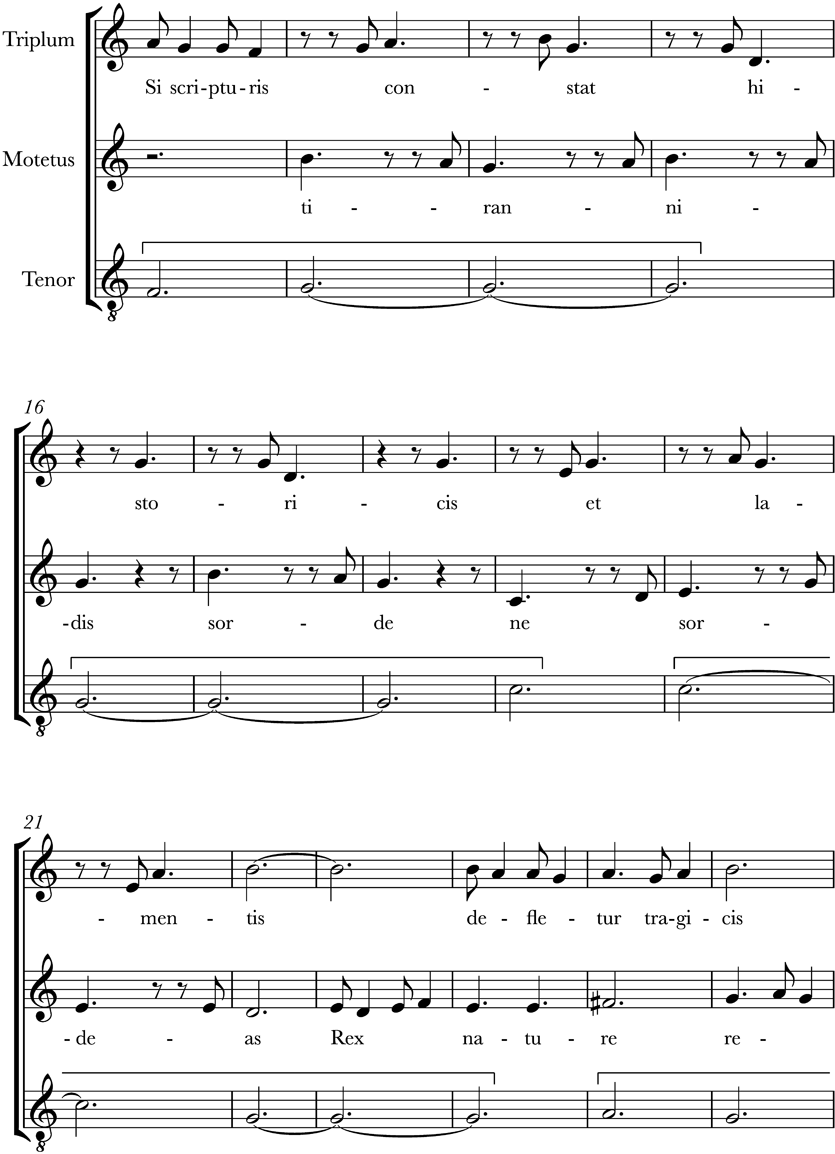
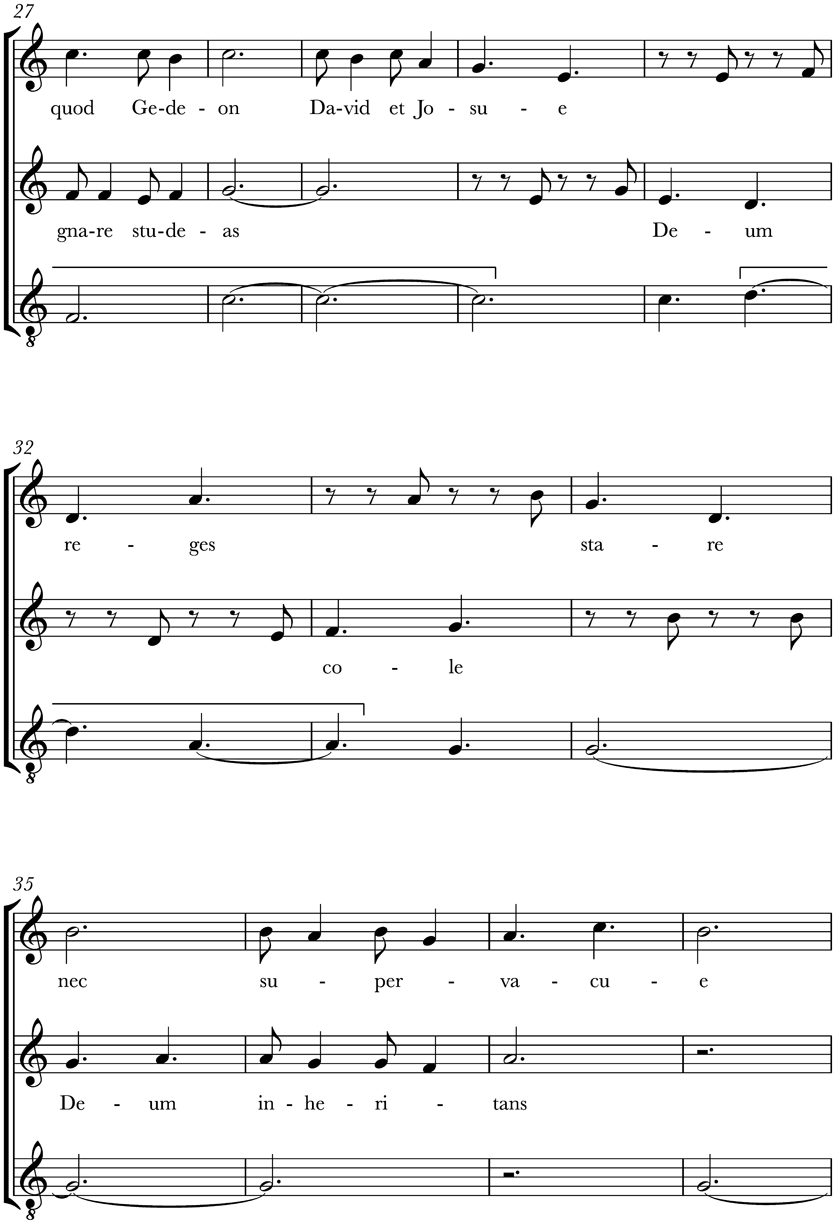
One final example will suffice here – the anonymous motet O Philippe Franci qui generis/O bone dux indolis optime/Tenor,Footnote 92 uniquely transmitted again in Ivrea. Like Rex Karole/Leticie pacis, it operates without proportional diminution; and each of the four sections contains not one, but two substantial hocket passages which are even more heavily segmented than in the compositions previously examined. Example 5 presents only the hocket passages of the first of these sections. As usual, only these passages are pan-isorhythmic, but the remainder of the texted upper voices is sufficiently consistent in its overall delivery to result in a regular and recurrent positioning of the hockets within the poem: one and a half verses of the triplum (consistent with the paired-verse structure in the first two sections, but cutting across it in the third and fourth) and a full verse of the motetus for each of the first, longer passages, plus half a verse each for the latter ones:
Anon., motet O Philippe Franci qui generis/O bone dux indolis optime/Tenor, bb. 12–38 (transcription of music based on PMFC 5)
The application of the ‘hiccup principle’ to this motet yields many of the expected results, yet requires us to think about its use in a slightly different fashion. If we take the first passage (bb. 12–22) as an example, we see that the motetus phrase begins with the word ‘tirannidis’ on the single perfect semibreve b′ and ends – assuming the ‘normal’ hiccup underlay – on the equally perfect semibreve g′. The following note is again a single note b′ – but the only pragmatic solution in the context of the entire phrase is not to ‘swallow’ or bridge this note in the above-mentioned manner, but to underlay it with a new syllable, beginning the following word ‘sorde’. The same applies to the perfect semibreve beginning bar 19, on ‘ne’. In the triplum, the isolated perfect semibreves g′ in bars 16 and 18 – on ‘hi–sto–ri–cis’ – also have to receive their own syllables to make the passage work.
However, if the ‘hiccup principle’ is to retain its validity, the explanation has to go beyond mere pragmaticism. Word boundaries are apparently not a consideration – while the motetus might suggest that at first glance (both isolated perfect semibreves begin a new word), the triplum underlay necessarily breaks up the polysyllabic ‘historicis’. A more convincing explanation can be found in the practices of mensural polyphony. A look at the previous examples shows that all the notes following rests bridged by the hiccup principle had been minims on ‘weak beats’, resulting from of a resecatio of the perfect semibreve, to use the terminology of the Anonymous of St. Emmeram (see above). The beginnings of perfections, conversely, had always received their own syllable in Flos ortus/Celsa cedrus and Rex Karole/Leticie pacis, if simply because they had followed the resecationes. Furthermore, given the extent to which the perfection was privileged by the discant theorists as a cornerstone of polyphonic concord,Footnote 93 it seems less likely that such note values would have been swallowed or passed over in texting, even when preceded by a rest. Jonathan King and Graeme Boone have argued the close correlation in texting of the principium perfectionis (within the context of the typical modal long–short alternation that characterises much of the repertory) with the ‘strong’ syllables of the rhythmic verse that is being set;Footnote 94 by extension of this principle, the case can be made for supplying perfections with their own syllables as a matter of course in texted hockets. Support for this hypothesis is gained by the fact that its application once again yields an underlay where words and music match effortlessly and without the need to accommodate surplus notes or syllables.
A further effect of this solution in this particular passage is a very clear alternation of texted and untexted breve bars out of which (and only out of which) emerges the kind of interactive ‘polyphony of texts’ which Margaret Bent and others have described as a defining feature of the polytextual motet of the fourteenth and early fifteenth century,Footnote 95 here highlighting a series of disyllabic words with particular clarity and without interference from the other texted part, by virtue of the ‘swallowed’ untexted minims: ‘Deum – reges – cole – stare – Deum’ (bb. 30–5), or in the third corresponding passage: ‘cole – pede – quorum – calca – remos’ (bb. 120–5). A retexting of hockets according to the proposed principles promises a wealth of further findings in this regard.
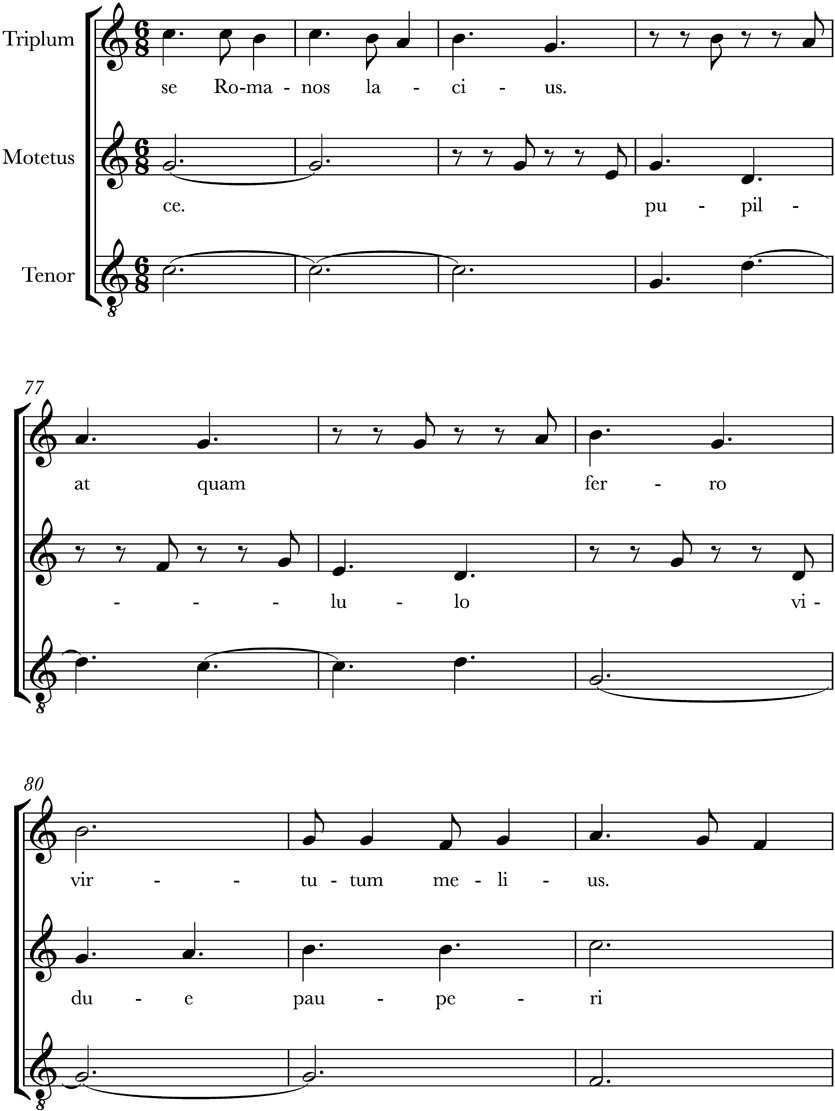
And yet again, the source tends to confirm the proposed underlay. The Ivrea scribe – like the Chantilly scribe – had to stretch the text to accommodate the music in these passages, and like the latter, he decided to split words into syllables rather than leaving spaces between words, to create room for the hocket figures. In the first hocket passage of the first talea (bars 13–23), the scribe's apparent intention is to coordinate the syllables ‘ti-ran-ni-’, ‘sor-’, ‘ne’ and ‘sor-de-’ each with the semibreve–two minim rests–minim figure (the last two slightly displaced for lack of space), the syllables ‘-des’ and ‘-de’ with a semibreve followed by a rest. Again, the vowels are placed with some consistency under the respective rests, not the notes. The second example is taken from the motetus of the second hocket passage of the second talea (bars 73–82) (Example 6). The scribe once more splits words into syllables, but here the spacing of the text does not appear to take the music into account very effectively, for example with an unnecessarily wide gap between ‘pu’ and ‘pi’ and a correspondingly wide gap between the semibreves above, the previous minims and rest instead squeezed tightly. The scribe had reason to be confused, however, as the syllables and notes do not match up in the accustomed fashion. The previous phrase and verse of the motetus clearly come to an end on a perfect long g′ in bar 73; the phrase itself begins on a hocket, but subsequently concludes on a non-hocketed passage which accommodates only five syllables on four perfect semibreves and a closing breve (bars 80–2), leaving five syllables for only four perfect semibreves in the hocket itself (as opposed to the other taleae, where the passage following the hocket is further broken up into imperfect semibreves and minims which accommodate the necessary six syllables, thus also reflected by the copyist). The scribe – perhaps after first planning to begin the first syllable ‘pu-’ on one of the the two weak minims at the beginning of the phrase, which would account for the space left in the text subsequent to it – in the end decided to allocate, exceptionally, the fifth syllable ‘vi-’ to the last minim in bar 79. Another solution would have been to elide the last two syllables of the word ‘vi-du-e’ into ‘vi-due’, but that would have gone against grammar and metre at the same time.
Anon., motet O Philippe Franci qui generis/O bone dux indolis optime/Tenor, bb. 73–82 (transcription of music based on PMFC 5)
The same principle can be applied to practically all the compositions in the repertory, with only minor variations. The anonymous motet Apta caro/Flos virginum/Alma redemptoris, for example, mixes broken and unbroken hocket passages, to the point that some of them can be underlaid either in an (almost) unbroken fashion or indeed applying the hiccup principle, a situation which apparently left even the scribes of the various manuscripts puzzled as they offer an uncommonly wide variety of solutions for this piece.Footnote 96 A similar situation applies to Vitry's Petre clemens/Lugentium siccentur, where, as Anna Zayaruznaya has shown, most of the hocket passages can be turned into untexted melismas by moving the text forward into the subsequent non-hocketed passage.Footnote 97 They work at least as well, however, if the hiccup principle is applied (which is what the Ivrea scribe seems to assume as well); and the fact that in at least one section (bb. 54–60), the text has to be broken up (unless one assumes a scribal error) because there are not enough notes in the following passage, suggests that this is perhaps the more plausible solution.
Both in French-texted and in Latin-texted works, text and music thus come together in a strikingly consistent fashion. The degree of consistency is in fact higher in the hocket passages cum littera than it is in texted passages which are not hocketed. This may seem counterintuitive, given the regular coincidence of rhythmic patterns and clear phrasing in both text and music in this repertory. But since pan-isorhythm is rare outside the hockets themselves, both rhythms and phrasing are somewhat freer there, resulting in a variety of declamatory solutions: some syllabic, some mildly melismatic; some strictly alternating, some isochronic, some a mixture of the two. Conversely, the rhythmic pattern in the pan-isorhythmic hocket passages themselves is strict: a text which is also almost invariably stable (with the same number of syllables, very often corresponding to a specific line or lines within the strophic structure of the poem) is matched to a rhythmic pattern which is repeated for as many times as there are taleae. Whatever necessary adjustments there are result from irregularities of the surrounding non-hocketing and non-panisorhythmic upper voices, not from the hocket itself. This means that the texted hocket is most definitely ‘declamatory’;Footnote 98 every syllable has its place. A fresh look at the entire repertory seems to be required.
So the criticism of the clerics was justified, from their point of view: the hocket does break up the cantus, and not only the music, but also the text. Specifically with regard to the words, this criticism is backed up by the poet of the musicians' motet Musicalis sciencia, where we read in the triplum ‘cupio | ne sit erroris motio | in dominam rethoricam, | neque contra grammaticam; | lingua secans incomplexa | sit in silentio nexa’ (‘I desire that there be no motion of error against Lady Rhetoric nor against Grammar; let the tongue that cuts simple things be bound in silence’), and in the motetus ‘quod maxima corruptio | fit a multis canentibus | in nostris dictaminibus. | Nam dividunt simplicia, | faciendo suspiria’ (‘that the greatest corruption is committed by many singers in our poems. For they divide single [words] by making sighs’).Footnote 99
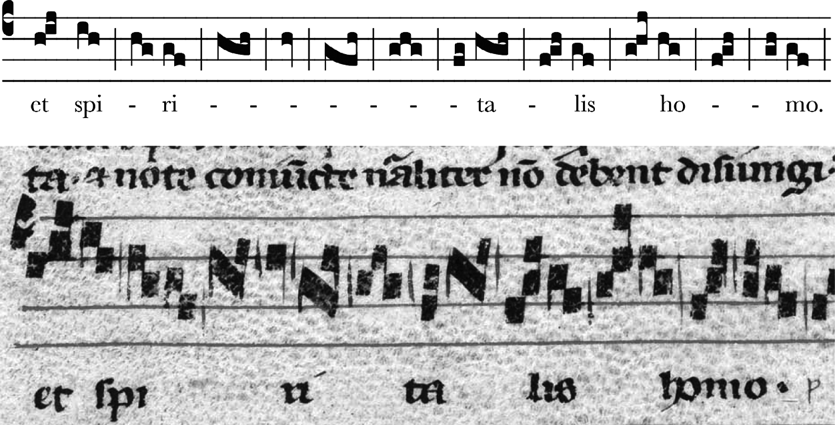
However, aside from the fact that the authors in question, by censuring the practice, indirectly confirm its existence, the composer of Musicalis sciencia sidesteps the issue by leaving his hockets without text, as does Jacobus in the hocket A lentrade d'avrillo in book 7 of his Speculum.Footnote 100 But words bridging rests are perfectly commonplace in melismatic music, and there is positive evidence advocating the practice from an unexpected source. The short Practica artis musicae written by the English monk Amerus or Aluredus in 1271Footnote 101 deals, as the title implies, with questions of practical music (as opposed to the speculative musica theorica), primarily with the familiar elements of chant pedagogy: the systems of pitches and intervals, the modes, the psalm tones, the hexachords. Only a single passage – inserted between the hexachord-based theory of intervals and the psalm tone differences – deals with the delivery of text, if utterly out of context and without reference to either the preceding or the subsequent argument. One can only speculate about the motivation of the author (or the scribes) to include the passage and to place it where it appears in the text – although it is perhaps not without significance that one of the two known complete copies of the treatise is bound with a collection of motets and hockets in the Bamberg codex. In any case, it is highly relevant to the question at hand. It reads as follows:Footnote 102
This is illustrated by a music example, reproduced as Figure 5 (from the Bamberg exemplar). Amerus addresses an issue more of performance practice than of notation – prescribing where the singer is allowed to draw breath and where not; however, while the example does illustrate that issue, it does so in a fashion which seems more applicable to polyphony. The square notation is identical to that of the remaining plainchant examples in the treatise, but the sequence of ligatures and multiple rests suggests more than anything else a line of a modally notated piece of discant. The rests in particular suggest a line from a hocket, not unlike the ones found in the music bound with the treatise; and the example is supplied with words which have been broken up into syllables by the scribe. It is straightforward to apply the rule as established by Amerus in his treatise: if there are several notes over one syllable, a singer may pause/breathe between notes, but not between syllables (‘keeping the remaining notes with the syllable on which they began’), and he may not break up ligatures in doing so. Put another way, this means that the singer may not begin a new syllable on a note/ligature directly following a rest (that is, after taking a breath), but has to wait until the subsequent note/ligature – unless that is again preceded by a rest. The transcription emphatically illustrates this principle (see Figure 5).
Bamberg, fol. 67v: Amerus/Aluredus, Practica artis musice, detail
The application of Amerus's rule to the example provides a perfect match between the musical line and the words, with no syllables or notes left over; it is not entirely clear whether the Bamberg scribe (or the scribe of the second extant copy, Trier, Bibliothek des Bischöflichen Priesterseminars 44, who underlays the example in a very similar fashion, perhaps working from the same exemplar) understood this correctly, as the third syllable ‘-ri-’ is in a completely wrong place while all others roughly reflect Amerus's instructions. But more importantly: the result also corresponds exactly to the ‘hiccup principle’ proposed above for the broken hocket. One must not read too much into a single testimony from a theorist; but Amerus does provide evidence of three things: first, that contemporary pedagogues did think about the placement of pauses within a musical phrase (whether as a breath or as a notated rest) and did not leave this issue entirely up to the singers' intuition; secondly, that the interruption of a word by a pause was a reality both in chant and in polyphony (whether it met with approval or not is another matter); and thirdly, that the most apt place to insert such a pause was – at least for some – in the middle of a syllable rather than between syllables.
In summary, the proposed model combining text and music in hocket passages may go against long-cherished ideals of ‘correct’ declamation, and it certainly would not have pleased all contemporaries either. However, the combination of the evidence provides the first plausible and consistent paradigm for texting the broken hocket (the unbroken hocket being self-evident in this regard). The model is underpinned by the etymology of the word ‘hocket’; it conforms most closely to the underlay in musical sources, which in general are proving to be more reliable witnesses in these matters than has long been assumed; and perhaps most importantly, the texting ‘adds up’ insofar as the number of notes and rests and the number of syllables overwhelmingly match, without a random number of notes and/or syllables ‘left over’ or unaccounted for. In a repertory in which all other rhythmic, structural and textual parameters are so highly organised, it is only fitting that the texting of the hocket should not fall short in this regard.
APPENDIX
Polyphonic Compositions with Texted Hockets
This list does not claim to be complete, but to provide an overview based on widely available published sources for easy reference. In particular, the recent and ongoing discoveries of (fragmentary or complete) new compositions or concordances of Ars nova polyphony by Margaret Bent, Michael Scott Cuthbert, Jason Stoessel and others have not systematically been included, nor have hockets or hocket passages from theoretical treatises.
A ‘texted’ hocket, for the purposes of this list, is defined as a composition where it is possible to conclude, either from the underlay in the sources or from the amount of text relative to the music, that a deliberate correlation of syllables to notes is necessary or intended. Excluded are thus the instances (about equal in total number to the ones listed here) of completely textless compositions, of texted compositions where the hocket passages are left deliberately without words (as a type of interlude), where they are bridged by lengthy melismas, or where the texting is so rudimentary that no specific attempt at syllable-to-note coordination can sensibly be attempted. Needless to say, this is partly a judgement call by the author and indeed the scribes of the original manuscripts (who do not necessarily take identical approaches to texting), but it is hoped that basic patterns of distribution can emerge nevertheless. A hocket is labelled ‘unbroken’ where there is consistent correlation of word breaks and rests, ‘broken’ where words are split by rests (usually triggering the hiccup underlay discussed in the article) and ‘mixed’ where the two principles appear together or where the evidence is insufficient to decide whether one or the other definitely applies.
Abbreviations:
Texting:
- F
fully texted
- P
partly texted
- Dis
Discantus
- Mot
Motetus
- Tr
Triplum
Type of texting:
- U
unbroken
- B
broken
- M
mixed (broken and unbroken)
Editions:
- CMM
Corpus Mensurabilis Musicae
- EFCM
Early Fifteenth-Century Music (=CMM 11), ed. G. Reaney, 7 vols. (Neuhausen-Stuttgart, 1955–83)
- LudwigM
Guillaume de Machaut, Musikalische Werke, ed. F. Ludwig, 4 vols. (Leipzig, 1926–43)
- PMFC
Polyphonic Music of the Fourteenth Century, ed. K. von Fischer and I. Bent, 24 vols. (Monaco, 1956–91)
- TischlerM
The Montpellier Codex, ed. H. Tischler (Recent Researches in the Music of the Middle Ages and Early Renaissance, 2–8; Madison, Wis., 1978–85)