In what is perhaps the largest research program in the discipline of international relations, scholars continue to explore the determinants of war and interstate military conflict. Quantitative models in this research program commonly use a dyad-year unit of analysis and almost always include a variable for joint alliance membership. Indeed, this variable represents a key part of what has become the “standard model” of interstate military conflict,1
The other variables in the so-called “standard model” of interstate military conflict are democracy, trade interdependence, contiguity, relative military power, and economic growth, although this last variable is increasingly not included in the model specification (see, for example, Oneal, Russett, and Berbaum 2003) because it has rarely produced any statistically significant results.
Oneal and Russett 1997.
Despite its regular inclusion in statistical models of military conflict, the quantitative literature has undertheorized its joint alliance variable.3
This is not to say that the discipline lacks theory about military alliances. To the contrary, a rich body of theory explores alliances as a dependent variable; see Schroeder 1976; Waltz 1979; Walt 1987; Christensen and Snyder 1990; Morrow 1991; Schweller 1994; Gaubatz 1996; Reiter 1996; Weitsman 2004. For reviews of theory about how alliances affect the propensity for military conflict with third parties, see Maoz 2000; and Gibler 2000. But there is much less corresponding theory focusing directly on how alliances affect the propensity for military conflict among member-states.
This perspective—treating alliance membership as an indicator for common interests—is not necessarily wrong, but it is theoretically narrow. It certainly does not offer a strong justification for the joint alliance variable as part of the standard model of interstate military conflict, especially now that the discipline has created other, and arguably better, operational measures for dyadic interests and preferences. Has the joint alliance variable simply become a superfluous control variable for common dyadic interests?
In this article, we argue that it has not. Building from institutionalist theory, we submit that there is a much stronger justification for the joint alliance variable as an integral part of the standard model of interstate military conflict. As Keohane once wrote: “alliances are institutions.”4
Keohane 1989, 5 (emphasis in the original). On alliances as institutions and regimes, see also Wallander 2000; Haftendorn, Keohane, and Wallander 1999; McCalla 1996; Hellman and Wolf 1993; and Duffield 1992. For a counterargument that most alliances do not qualify as meaningful international regimes, see Jervis 1983.
Weitsman 1997, 165.
Krebs 1999.
Bueno de Mesquita 1981.
Our article thus focuses on two related research questions. First, do alliances actually reduce military conflict among member-states? In justifying the joint alliance variable as only an indicator of common dyadic interests and preferences, quantitative scholars are effectively arguing that alliances themselves are not doing any causal work. Stated differently, alliances as international security regimes may have little independent effect on member-state behavior once we more directly control for dyadic interests and preferences.
Second, if alliances do help reduce military conflict among member-states once properly controlling for dyadic interests and preferences, then how do they produce their pacific effect? In other words, what is the underlying causal mechanism? This is the central theoretical question currently facing institutionalist scholars in international relations: explaining more precisely how international regimes and institutions affect state behavior in an anarchic international system.8
This question is best answered in a “high” political issue area, such as national decisions about the use of military force.9Mearsheimer 1994/95.
Addressing the first research question, we demonstrate that the unconditional effect of a joint military alliance diminishes significantly when we control more directly for dyadic interests and preferences. This demonstration shows why the empirical results for this variable have been empirically inconsistent. When scholars fail to control for common interests, the joint alliance variable absorbs this effect, producing a statistically significant pacific effect. When variables more directly capturing dyadic interests are added to the model, unconditional (that is, noninteractive) joint alliance effects are greatly diminished. Superficially, this result would seem to suggest that alliances as international security regimes have no real effect in reducing member-state military conflict. In other words, the joint alliance variable could simply be a superfluous control variable for common interests.
Although it may be attractive for certain realist scholars, we will also demonstrate that this conclusion is almost certainly wrong. Addressing the second research question, we develop the logic about how alliances as international security regimes can reduce military conflict between member-states through their internal provision of information concerning national military capabilities. Bargaining models of war have consistently shown a lack of information about relative military capabilities to function as an important cause of war.10
Following Leeds, who posited that alliances provide information to external actors, we argue that alliances even more strongly provide information to internal participants.11Leeds 2003.
This internal information effect, however, is a conditional one. Following Reed, we argue that the information provided within the alliance matters most for dyads at or near power parity, that is, the cases where states are most uncertain about who would prevail if a military conflict did emerge.12
Reed 2003a.
Our theory of internal information makes an additional testable hypothesis. Based on bargaining theories of war, Reed showed how the common finding that power preponderant dyads are more peaceful than those at power parity is likely due to the informational problems and uncertainty associated with power parity.13
Ibid.
Thus our research makes both an important theoretical and empirical contribution. First, it develops the causal story linking alliances as international institutions to more peaceful relations among member-states. This strengthens the theoretical foundations for the joint alliance variable, which has become (and, indeed, should remain) a key part of the “standard model” of interstate military conflict. Second, the results offer additional empirical support for bargaining theories of war. Despite the major theoretical advances offered by bargaining models, empirical support for their predictions has been slow to emerge.15
Reiter 2003.
The remainder of this article is divided into three parts. The first considers the very real possibility that the joint alliance variable is only measuring common dyadic interests. The second presents the theory of internal information and then tests it empirically. The third part discusses these results.
Has Joint Alliance Become a Superfluous Control Variable for Common Interests?
Although we will later demonstrate that it is false, we want to begin by seriously considering the proposition that the effect of a joint alliance in reducing military conflict between member-states is only due to common security interests. In many ways, this proposition functions as a conventional wisdom, at least in the quantitative literature, because scholars in this tradition have not advanced or developed any other causal story to explain the sometimes observed pacific effect of the joint alliance variable. Indeed, one of the most extensive discussions of the variable was provided by Oneal and Russett, who simply wrote: “Alliances express a commitment to common interests that generally include but extend beyond those derived from trade and similar political systems. Common security interests vis-à-vis potential adversaries can be expected to inhibit conflict between allies, whether by mutual restraint or as a result of enforcement by the dominant power in the alliance.”16
Oneal and Russett 1999a, 221. In discussing their joint alliance variable, Russett, Oneal, and Davis 1998, 453, also mentioned “institutional mechanisms for resolving conflict at lower levels.” But they did not discuss any specific alliance institutional mechanism, nor how and when it might operate.
Although it may be uncomfortable for many liberal scholars to acknowledge, this conventional wisdom is quite consistent with the traditional realist argument about the epiphenomenal nature of international institutions and regimes. This realist argument can be simply summarized: basic causal variables—namely relative power and national interests—explain state behavior in an anarchic international system, especially with regards to “high” political decisions about the use of military force. States may make common regime commitments with other states that share their national interests, but international regimes have little to no independent causal effect and function simply as an intervening variable. Regimes are intervening in the sense that while they may correlate with common interests and certain types of state behavior, they cause neither. Interests and power cause state behavior, and if we cannot directly measure an important theoretical concept like “interests,” then we can capture it indirectly through regime choice. As Farber and Gowa wrote on this topic, “[b]ecause no more direct measure of interest exists or can be constructed, alliances are often used to proxy common interests.”17
Farber and Gowa 1997, 401.
This logic was concisely expressed by Krasner in his famous diagram, reproduced as Figure 1.18
Krasner 1983, 5.

International regmes as an intervening variable
Indeed, adding such variables directly addresses the endogenity problem that scholars face when investigating the relationship between alliance membership and military conflict. As many methodologists have observed, endogeneity is a form of omitted variable bias:19
See King, Keohane, and Verba 1994, 189–91.
However, Gartzke introduced a useful common interest variable (labeled affinity) based on the similarity of the two states' voting patterns in the United Nations (UN) General Assembly.20
Gartzke 1998.
Oneal and Russett 1999a.
Quantitative modelers now tend to view the two separate democracy measures as an improvement over the single joint democracy measure that had been previously used. For a discussion of the problems associated with the earlier measure, see Oneal and Russett 1997 and 1999a.
To explore the hypothesis that the pacific effect of a joint alliance should disappear as we add variables more directly measuring dyadic interests and preferences, we use the sample and statistical model from Oneal and Russett where the pacific effect of alliances was shown to be strong.23
Oneal and Russett 1997.
Lemke and Reed 2001 found little evidence of measurement error and selection bias when sampling on politically relevant dyads (that is, contiguous pairs and those involving a major power). Furthermore, Clark and Nordstrom 2003 have shown that overexpansive samples in studies of international conflict may create unobserved treatment effects, leading to faulty statistical inference. Their findings argue against using all dyads and in favor of the more restricted politically relevant sample.
Their choice of independent variables completes the now “standard model” of interstate military conflict mentioned in the introduction.25
We refer readers to Oneal and Russett 1997 for a more extensive discussion of variable construction and data sources.
This variable was labeled capability ratio in Oneal and Russett 1997. We relabel it as power preponderance here because the original variable name is not descriptive of what higher and lower values indicate in terms of relative military power. This point will become more important later.
Singer and Small 1968.
Beck, Katz, and Tucker 1998.
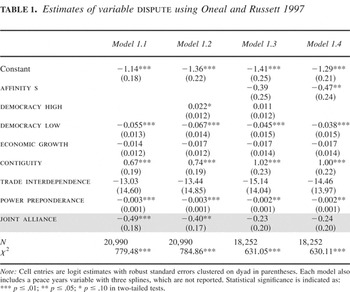
Model 1.1 effectively reproduces the results from Oneal and Russett.29
With the addition of the peace years correction and robust standard errors clustered by dyad, economic rowth and trade interdependence lose statistical significance. Otherwise, there are no statistically significant differences from the estimates shown in Oneal and Russett 1997, 278, tab. 2, eqn. 1.
The affinity variable was calculated using Signorino and Ritter's 1999 s statistic instead of the Spearman's ρ as used in Gartzke 1998.
Because affinity s is missing for all dyads where one or more states are not a member of the UN, we lost 2,738 observations by including it in the model. For those readers who are concerned that the insignificant joint alliance coefficient in Model 1.3 is due more to a change in the statistical sample than in controlling for common interests, we reestimated Models 1.1 and 1.2 using only the 18,252 observations from Model 1.3. While the full results are not reported for space considerations, the reestimate of Model 1.1 shows a joint alliance coefficient of −0.38 (p < .049). The reestimate of Model 1.2 shows a joint alliance coefficient of −0.31 (p < .092). Thus the results are consistent using both the larger and smaller samples.
These results demonstrate that if we want to estimate the independent, as opposed to the intervening, effect of a joint military alliance, then we need to absorb the impact of common dyadic interests through additional control variables. When we add these control variables, the unconditional independent effect of a joint alliance appears relatively weak. Superficially, we might now conclude that joint alliance is nothing more than a superfluous control variable for common security interests.
But these results do not mean that alliances as international security regimes necessarily have no conditional, or interactive, effect on the propensity of member-states to engage in military conflict. As Brambor, Clark, and Golder have observed, our theories “typically produce conditional, rather than unconditional, hypotheses. Indeed, it could be argued that any causal claim implies a set of conditions that need to be satisfied before a purported cause is sufficient to bring about its effect.”32
Brambor, Clark, and Golder 2006, 64.
Simmons and Martin 2002, 205.
A Theory of Internal Information Provided by Military Alliances
Our theoretical argument proceeds in three steps. First, the lack of information about military capabilities is an important cause of war. Second, military alliances provide such information to institutional participants, thus mitigating certain informational problems that might lead to war between alliance member-states. But, third, this internal information effect is a conditional one. A joint military alliance should produce a strong pacific effect at power parity; however, this effect will diminish with greater power preponderance.
Theory
We take the first step in our argument largely as given because bargaining models of war have logically shown that incomplete information about military capabilities and resolve is an important cause of war. As Fearon demonstrated, “rational leaders may be unable to locate a mutually preferable negotiated settlement due to private information about relative capabilities or resolve and incentives to misrepresent such information.”34
Fearon 1995, 381 (emphasis in original).
Our theory focuses on informational problems of the first type, those concerning the distribution of power, or relative military capabilities. Powell modeled both types of information problems, concluding that “crises due to uncertainty over the distribution of power seem likely to last longer and entail more fighting than those growing out of uncertainty over costs [the second type]. Indeed, there may be little or no fighting in the latter case if states can make offers quickly.”35
Powell 2004, 351.
To the extent that there remains an internal information problem concerning military resolve, there would still be some intra-alliance military conflict. This understanding could nicely explain Greek-Turkish conflict within the North Atlantic Treaty Organization (NATO), for example.
Given that a lack of information about national military capabilities is regularly identified as an important cause of war, even by nonformal theorists,37
See Walt 1999, 27–28.
Leeds 2003.
Alliances provide information about national military capabilities to institutional participants because they are often more than just verbal understandings or paper agreements. Alliances often include joint defense planning, sometimes within formal institutional structures for national military leaders. Alliance commitments sometimes include joint exercises as rehearsals for potential coordinated military operations. Finally, alliance commitments, when honored, have involved actual joint operations, where national militaries fight together in real combat situations.
While third parties may obtain some limited information from observing (usually clandestinely) an alliance's joint rehearsals and actual combat operations, it is clearly member-states who obtain the most information from such alliance structures and activities. This information potentially includes not only the numerical size of other member-states' armed forces (something that may already be more-or-less public knowledge), but also their training, readiness, and battlefield tactics (usually more private information). These alliance structures and activities may also provide internal information about military equipment, technology, and base facilities, as well as how these resources might be used if an actual military conflict were to emerge between member-states.
Examples of alliance information-sharing structures and activities are numerous. To demonstrate this fact, it is natural to begin with the post–World War II superpower alliances. In addition to political organs such as the North Atlantic Council, the North Atlantic Treaty Organization (NATO) has several military organs, including the Military Committee, with permanent military representatives from the member-states, and the Defense Planning Committee, where member-states defense ministers typically meet twice per year. The Warsaw Treaty Organization was also highly structured, with several political organs (the Political Consultative Committee and the Permanent Committee of Foreign Ministers) and military organs (most notably the Committee of Defense Ministers and the Joint Command). In terms of information-sharing activities, NATO and Warsaw Pact member-states regularly discussed burden-sharing responsibilities and engaged in joint military exercises.
Another notable example in this regard is the 1955 Baghdad Pact, also known as the Central Treaty Organization (CENTO).39
This alliance included Iraq, Turkey, Iran, Pakistan, and the United Kingdom, although Iraq withdrew in 1959. The United States was never formally a member of CENTO, but it had bilateral military agreements with every member-state and was treated as a de facto member-state.
Hadley 1971, 7.
Ibid., 8.
Many minor power alliances also include information-sharing structures and activities. The 1950 Convention of the Arab League created a Joint Defense Council and Permanent Military Commission.42
MacDonald 1965, 224–40.
More recent examples include the Gulf Cooperation Council (GCC), whose member-states began conducting regular joint military exercises in 1983 and formed a joint defense command where national defense leaders meet several times a year.44
Anthony 1996.
Nakhleh 1986, 23.
Lentini 2004.
With these examples in mind, it is important to address the argument from bargaining theory that states have incentives to misrepresent, or exaggerate, their military capabilities. Bargaining models show that as opposing states reach a potential military crisis, it will be hard for them to communicate credibly their true military capabilities. Strong states will appear militarily capable because they are so. Weak states will also make efforts to appear militarily capable because strength would improve their bargaining leverage. So how do alliances communicate member-states' true military capabilities when an internal crisis emerges?
Our answer is that alliance activities provide information about member-states' military capabilities in advance of a potential crisis, when the incentives to misrepresent one's true capabilities are greatly reduced. To understand why this is true, it is useful to remember that military alliances are often created to counter external threats. To make their balancing more effective, alliance member-states engage in joint defense planning, training, and military exercises as discussed above. During these activities, member-states do not have an incentive to exaggerate their national military capabilities. To the contrary, they have incentives not to misrepresent because exaggerating national military capabilities may lead alliances partners to provide less of their own capabilities to the joint effort in balancing against third parties. In this sense, exaggeration would only exacerbate the burden-sharing problem that alliance member-states are trying to reduce.47
Olson and Zeckhauser 1966.
When alliance partners are informed about each other's true military capabilities in advance of a crisis, it becomes difficult to misrepresent one's strength during an internal crisis. Attempts to exaggerate national military capabilities at this point in time should be readily apparent to alliance partners as bluffs. Crisis bargaining within an alliance would therefore be relatively efficient because the challenger “knows” how much the defender will concede to avoid a fight and, similarly, the defender “knows” how much it must give up, based on relative military capabilities.48
The term “knows” refers to being in the state of full, or complete, information about relative military capabilities, which specifies the odds for either side winning a military contest.
It should now be more clear to the reader how our theory of internal information fits within Weitsman's theory of alliance formation,49
although the dependent variables are completely different. Following Schroeder, who described how military alliances may be tools for the management of internal conflict,50Schroeder 1976.
Weitsman 2004, 23. This quote also reveals how her theoretical argument differs from ours in other places. Her theory of alliance cohesion argues that tethering alliances generally have very low cohesion, with cohesion defined as the member-states' ability to agree on and to achieve their goals. Because the goal of a tethering alliance is to manage internal conflict and tethering alliances tend to be noncohesive, the theory seems to suggest that they would not be effective at reducing military conflict among member-states. In fact, this argument is offered as an explanation for Bueno de Mesquita's 1981 finding that alliance members frequently fight each other; see Weitsman 2004, 2, 5, 13, 170. On this point, we argue the contrary: institutionalized alliances, including but not limited to tethering alliances, should be quite effective at reducing military conflict among member-states.
Indeed, the underdeveloped nature of the causal relationship between alliance information and peace has led other scholars to dispute the basic logic. Krebs, for example, argued that while “alliance membership improves the quality of data on the other state's capabilities,” such transparency can even increase conflict among member-states “when improved information reveals that one's ally has formulated aggressive designs.”52
Krebs 1999, 355.
Our response to this argument comes from the aforementioned bargaining models of war, which argue that states do not fight simply because they have different preferences, although the lack of common interests may be a necessary condition for war. Since war is costly, states have strong incentives to negotiate for peace. Bargaining theory has shown that states fight due to negotiation failure, which often stems from private information about military capabilities. Thus even if alliance structures and activities cannot create common interests among member-states (and we are not arguing that they do), our causal argument is that they still contribute to peace by providing information to facilitate efficient bargaining.
Having clearly identified our causal story and its place in the literature, we now take the third step in our theoretical argument: specifying the conditions under which such information is mostly likely to have a significant pacific effect. We expect that the pacific effect of a joint military alliance will be the greatest in situations where informational problems leading to war are the most severe. As Reed demonstrated, dyads at or near power parity suffer more severe informational problems than those with power preponderance.53
Reed 2003a.
Ibid., 637.
When states are more unequal in terms of observable military power, certain informational problems leading to war are reduced. In extremely power-preponderant dyads, there is little to no uncertainty about which state would ultimately prevail in a armed conflict, based at least on relative military capabilities. Even without significant information about their troops, training, readiness, tactics, equipment, technology and bases, few could doubt the United States would defeat Trinidad and Tobago, for example, in a military contest, holding constant variables such as resolve. Thus while more power-preponderant dyads with a military alliance still obtain internal information about national capabilities, this information simply has a lesser pacific effect given greater observable relative power.
Hypotheses
Our internal information theory of military alliances thus clearly advances two main hypotheses:
H1: A joint military alliance will reduce military conflict for dyads at or near power parity, even when controlling for common dyadic interests and preferences.
H2: The pacific effect of a joint military alliance will diminish for more power preponderant dyads.
To avoid any confusion, readers should understand that H1 compares the following two groups: power parity dyads with a joint alliance and power parity dyads without an alliance. Likewise, H2 compares increasingly power preponderant dyads with a joint alliance to the same without an alliance. These hypotheses are not comparing different types of alliance dyads. We will offer a third hypothesis below, making such intra-alliance comparisons.
To test these hypotheses, we start with Model 1.3 from Table 1 (which included all the control variables for common dyadic interest and preferences) and then add a new interaction term (power preponderance * joint alliance), as shown in equation (1) below.

Estimates of variable dispute using Oneal and Russett 1997

With the interaction term, the effect of the dichotomous joint alliance variable on a dispute is now given by two coefficients and the value of the power preponderance term: B2 + B3 * power preponderance. To make the interpretation of these coefficients more straightforward, we subtract the value of 1 from power preponderance so that complete power parity has a value of 0 instead of 1.55
In the Oneal and Russett 1997 data set, power preponderance (or capabilities ratio) measures the observable military capabilities of the stronger state in the dyad relative to that of the weaker state. Its minimum value is 1 (power parity), maximum value is 7893, and mean is 163. This variable has a huge positive skew with a modal value of only 21. Subtracting the value of 1 from power preponderance reduces all of these descriptive statistics also by 1, hence minimum = 0, maximum = 7892, mean = 162, and mode = 20.
Our internal information theory also makes a third hypothesis about the effect of relative power on military disputes, and it has two parts:
H3a: Greater power preponderance will be negatively correlated with military disputes outside an alliance due to the informational problems associated with power parity, but
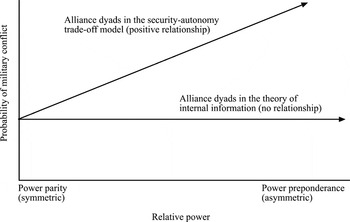
H3b: Relative power will have no effect on military conflict inside an alliance due to the internal information provided by alliance structures and activities.
H3a follows directly from Reed,56
Reed 2003a.
Wittman 1979.
Wagner 2000, 470.
H3b is important because it clearly distinguishes our theory of internal information from the one presented by Morrow concerning alliance asymmetry.59
Morrow 1991.
Altfeld 1984.
This possibility would seem to suggest that the security-autonomy trade-off model makes a hypothesis identical to our H1. But this is not the case for the following reason. The trade-off model implies that symmetric power parity alliance dyads should be more peaceful than power parity dyads without an alliance because the alliance pairs have more common interests. If common interests were the only important factor, then any differences between these two groups should disappear when we control for common interests. But we are making a different hypothesis: a joint military alliance will reduce military conflict for dyads at or near power parity, even when controlling for common dyadic interests and preferences.
Larger states have more security due to their greater military capabilities. Thus they tend to form military alliances for greater autonomy and control over smaller states in the international system, including those with less common interests. Smaller states are often willing to join such control alliances because of the associated security benefits in being partnered with a larger state, and Morrow labeled these alliances as “asymmetric” because the parties have different goals for their military agreement. These alliances also tend to be asymmetric in terms of relative military power, allying states with different military capabilities; thus asymmetric alliances are more likely to include power preponderant dyads.
While primarily a theory about alliance formation, the security-autonomy trade-off model made a specific prediction concerning the probability of military conflict within alliance dyads. As Morrow hypothesized, war between allied states would be more likely to occur with asymmetric alliances because symmetric alliances are formed by states with more common interests.62
Morrow 1991, 929.
The security-autonomy trade-off model makes no specific prediction about the relationship between relative power and military conflict for dyads without a joint alliance.

Different predictions about military conflict within alliance dyads
We can also test the third set of hypotheses using equation (1). With the interaction term, the effect of power preponderance on a dispute is given by two coefficients and the value of joint alliance: B1 + B3 * joint alliance. For dyads outside a military alliance (joint alliance = 0), the effect of power preponderance is simply B1, which H3a expects to have a negative sign. For dyads inside an alliance (joint alliance = 1), the effect of power preponderance is B1 + B3. If B1 has a negative sign, then our theory of internal information predicts that B3 must have a positive sign with about the same absolute value. This relationship would make the conditional coefficient for power preponderance when joint alliance=1 close to 0, or B1 + B3 ≈ 0, consistent with the expectations of H3b.
Empirical Testing
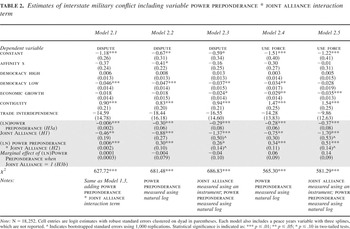
Equation (1) is first estimated as Model 2.1 in Table 2, and all hypotheses receive strong empirical support. Consistent with H1, the joint alliance component term has a negative coefficient with strong statistical significance (p < .007). Consistent with H2, the interaction term has a statistically significant positive sign. Following H3a, the power preponderance component term is statistically significant with a negative sign. Following H3b, the conditional coefficient for power preponderance when joint alliance = 1 (0.0001) is statistically indistinguishable from 0.64
This conditional coefficient has a p value of .81, meaning that it is statistically different from 0 with only 19 percent confidence.
Estimates of interstate military conflict including variable power preponderance * joint alliance interaction term

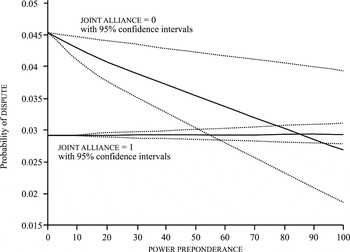
The substantive effects of a joint alliance are illustrated in Figure 3. Holding all other variables at their mean or modal values, the probability of a dispute at power parity (power preponderance = 0) is 2.9 percent with a joint alliance. Without an alliance, the probability grows to 4.5 percent; this represents a 55 percent increase, which qualifies as substantively significant. Figure 3 also shows how the pacific effect of a joint alliance (given by the vertical distance between the two bolded lines) diminishes with greater power preponderance. When power preponderance ≈ 50, its pacific effect statistically disappears. On this point, however, it is important to note that due to the skewed nature of the power preponderance variable, more than 60 percent of the dyad-year observations in the Oneal and Russett data set have a value < 50. Finally, Figure 2 also shows how power preponderance has no measurable effect on the probability of a dispute given the information provided by a joint alliance. This result accords with the prediction made by our theory of internal information, but not with the security-autonomy trade-off model (see Figure 2).65
We certainly do not wish to claim that this result refutes the security-autonomy trade-off model because its prediction about military conflict within alliances was simply an auxiliary hypothesis. Its main predictions, especially those about alliance duration, appear well supported by the empirical evidence; see Bennett 1997.

Predicted probability of a dispute
In Model 2.2, we consider the possibility that some of these results could be due to skewed nature of the power preponderance term.66
power preponderance has a skewness value of 6.24. A normally distributed variable would have a skewness value of 0.
See, for example, Oneal, Russett, and Berbaum 2003. lnpower preponderance has a skewness value of 0.31.
This conditional coefficient has a p value of .96, making it is statistically different from 0 with only 4 percent confidence. Thus we can say that the coefficient is not different from 0, as hypothesized, with 96 percent confidence.
For readers who remain concerned about an endogeneity problem despite our control variables for common dyadic interests and preferences,69
To the extent that affinity s and democracy high are good operational measures for dyadic interests and preferences, endogeneity should not be a problem in our model. But if these measures are inadequate to the task, then endogeneity may bias our results. We cannot, of course, completely rule out this possibility, so we also present our results using an instrument for joint alliance.
See, for example, those described in Lai and Reiter 2000, 214.
The security-autonomy trade-off model of alliance formation argues that larger states form alliances to obtain greater autonomy, as discussed earlier. Thus our first-stage equation also includes, as separate variables, the GDP of each state in the dyad. These two “economic size” measures additionally capture the idea that governments can obtain security through internal balancing as an alternative to alliances, with larger states having a greater internal balancing capacity.
For these reasons, we treat the regional dummies, year dummies, and the GDP measures as causally prior, or exogenous, to a joint alliance. Indeed, their relationship with the alliance variable cannot be easily explained in the reverse direction, that is, alliances do not cause geography and time, for example. Furthermore, a dispute also cannot “cause” geography and time in any meaningful sense of the term, which is another important consideration in building an appropriate instrumental variable.72
In theory, a country's GDP could be “caused” by military conflict, but when we modeled GDP, we found dispute to be a statistically insignificant independent variable.
The full results available from the authors on request.
The second-stage equation using this joint alliance instrument is reported as Model 2.3. Since the instrument was estimated in a separate equation, then also used to calculate the interaction term, both variables are considered to be “generated regressors.” Accordingly, we use a bootstrap procedure to calculate the standard errors of joint alliance and its interaction term in the dispute equation. The results are quite consistent with those in the previous column, indicating that endogeneity was not a problem in our earlier estimates. This is certainly reassuring, but it is also useful to consider some alternative specifications for our model of interstate military conflict to assess its robustness.
Careful readers may have noted that the dependent variable dispute is not ideally suited for testing arguments made from bargaining theories of war. The principal problem concerns its overly broad definition of interstate military conflict. Bargaining theory specifies the conditions under which states are expected to use (or not to use) military force. But such theory is not particularly concerned with threats or displays of force, provided that they do not escalate into the actual use of force. Indeed, our theory acknowledged that alliance dyads may occasionally experience threats or displays of force, but this hostile behavior will be accurately viewed as an attempt to bluff and not escalate further, given sufficient information about military capabilities provided by alliance structures and activities.
Thus to be more consistent with our theory we reestimate the model using a more appropriately restricted definition of interstate military conflict. The new dependent variable use force is coded as 1 if one of the states in the dyad used force or fought a war with the other during a given year; otherwise 0. These estimates are shown as Model 2.4, and the results offer further support for our theory of internal information. Finally, to demonstrate that there is also not an endogenity problem concerning the use force dependent variable, we report a similar set of results as Model 2.5 using the previously described joint alliance instrument.74
Although the full results are not reported in Table 2 for space considerations, we also estimated this model with fixed effects. A reviewer expressed concern that the standard model leaves a lot of unexplained variance, which might be absorbed by including fixed effects on the right-hand side. On this point, however, Beck and Katz 2001 have shown that fixed effects often have pernicious effects in models where the dependent variable is dichotomous and where the independent variables of interest are relatively stable over time. Both of these conditions describe the standard model of interstate military conflict. Indeed, with dyad and year fixed effects, we lost more than 80 percent of the observations due to separation: dyads not experiencing any military conflict must be dropped from the sample. As an alternative, we used country and year fixed effects, which present less of a separation problem. In this model specification, all of the coefficients of interest (lnpower preponderance, joint alliance, and lnpower preponderance* joint alliance) remain statistically significant at the .05 level with the correct sign.
Differentiating Among Alliances
Having sharpened our dependent variable, it is now useful to do the same for our main independent variable. Of course, our theory is not about military agreements in general; instead, it applies to institutionalized alliances, those with structures and activities that provide information about the military capabilities of member-states. Thus, it becomes important to consider some less-aggregated measures for a joint military alliance.
Until recently, this was not feasible because the COW data set, even in its updated version,75
Gibler and Sarkees 2004.
The COW alliance data only distinguished military alliances in terms of their type: defense pact, neutrality pact, or entente. For reasons described earlier, we might expect defense pacts to be the most institutionalized alliance type and the category most likely to include joint defense planning and military contact. If this is true, our hypothesized relationships should be the strongest for defense pacts, and weaker for neutrality pacts and ententes. Our statistical estimates, which are not shown here for space considerations, confirm this expectation.
Leeds et al. 2002. Available at 〈http://www.ruf.rice.edu/∼leeds/atop.html〉. Accessed 15 March 2006.
Available at 〈http://www.cidcm.umd.edu/inscr/polity/index.htm〉. Accessed 15 March 2006.
Gleditsch 2002.
McDonald 2004.
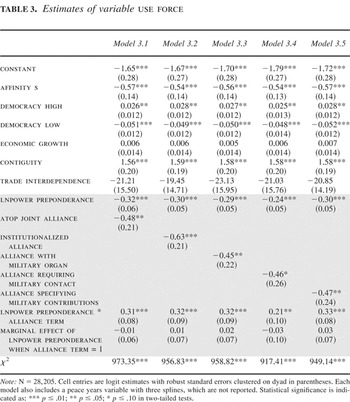
We begin our statistical analysis using these new data by first estimating our use force model with an aggregated atop joint alliance dummy to demonstrate that our basic statistical results do not change in shifting from the COW alliance data to those provided by ATOP 3.0. These results are presented as Model 3.1 in Table 3.
Estimates of variable use force

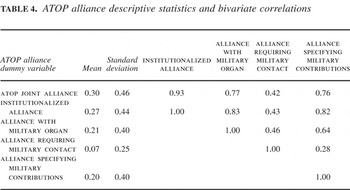
Next we replace the aggregate joint alliance measure with an institutionalized alliance dummy variable, which is coded as 1 if the dyad is covered by a joint alliance with any formal organization associated with the written agreement. As the descriptive statistics in Table 4 indicate, most alliances in the post–World War II period have some formal structure, or organization.81
Table 4 also shows that there is a high correlation between our various dummy variables for alliance institutionalization and activity, so we present our estimates in separate models rather than combining them in a common model with five alliance terms and five alliance interaction terms.
ATOP alliance descriptive statistics and bivariate correlations

The ATOP data set also specified the purpose of the different alliance institutions and organizations. So we take this opportunity to restrict the alliance term even further by coding alliance with military organ because this is the formal alliance structure that our theory most clearly associated with the provision of internal information about national military capabilities. The statistical results in Model 3.3 using this dummy variable again conform to our theoretical expectations. Although the results are not reported here for space considerations, we also explored the effect of other political and economic organs that may be nested within a military alliance. Controlling for the presence of a military organ, we find that a political organ has a weaker, but marginally significant, effect in reducing military conflict at power parity, but that economic organs have no such effect at all. This latter finding represents a nice “false specification” test because it shows that an alliance structure not directly associated with the provision of information about national military capabilities (that is, economic organs) provides no significant pacific effect.
Having focused on formal alliance structures, it is also useful to consider some alliance activities that may provide internal information about national military capabilities. Unfortunately, ATOP did not specifically code alliance activities such as joint military exercises, but it does include data on treaty provisions specifying certain military information-providing activities. Thus, we coded the dummy variable alliance requiring military contact if the alliance covering the dyad contained treaty provisions specifying a common defense policy or peacetime military contact among the member-states' military planners. Certainly, such treaty provisions were not always honored so the statistical significance may be weaker than the previous alliance measure, but we should observe similar substantive results using this joint alliance activity term. The results in Model 2.4 demonstrate this to be the case.
ATOP also coded whether or not the alliance agreement specified any details about the military contributions to be made by each ally. Because alliance meetings (either formal or informal) focused on military contributions and burden-sharing are likely to provide greater internal information about the member-states' true fighting capabilities, we also coded the dummy variable alliance specifying military contributions. Model 3.5 shows that this final model specification obtains statistical results that are consistent with our theoretical expectations. We now move to a broader discussion of our theory and empirical results.
Conclusions
As mentioned in the introduction, this research makes both a theoretical and an empirical contribution. Furthermore, it does so in two different major research programs: (1) institutionalist theories of international relations and (2) bargaining models of war. We thus conclude our article with a discussion of these subjects.
Institutionalist Theories of International Relations
For institutionalist scholars arguing that regimes function as important structures within the anarchic system of international politics, there have always been two related tasks. The first is to demonstrate that institutions and regimes have direct and independent effects on state behavior when controlling for power and interests, the most basic causal variables in international politics. The second is to explain more precisely how international institutions and regimes produce such effects, if any can be observed at all.
With regards to these tasks, it seems clear that many scholars remain unconvinced. Perhaps the most skeptical statement on the subject was advanced by Mearsheimer.82
Mearsheimer 1994/95.
Simmons and Martin 2002, 200 (emphasis in original).
This research effectively addresses both of these challenges. On the first, it adds to the growing empirical evidence that international institutions of various types can independently influence member-state behavior regarding the use of military force,84
See Russett, Oneal, and Davis 1998; Oneal and Russett 1999b; Mansfield, Pevehouse, and Bearce 1999/2000; and Mansfield and Pevehouse 2000.
Although strong institutionalists, Simmons and Martin have also criticized empirical studies of institutional effects for failing to control for alternative explanations and for not specifying the “conditions under which institutions should have the predicted effects.”85
Simmons and Martin 2002, 200.
In response, one might argue that a theory of internal information is not new to the international relations literature. On this point, it is certainly true that institutionalist scholars have long advanced arguments about the information provided by international institutions and regimes.86
See Keohane 1984, chap. 6.
Bargaining Models of War
Especially since Fearon's seminal paper,87
Fearon 1995.
See Smith and Stam 2004; Reed 2003a, 2003b; Leeds 2003; Gartzke, Li, and Boehmer 2001; and Werner 1999a, 1999b, 1998.
Kant [1795] 1932.
Reiter 2003, 32.
The research in this article has tested and confirmed one of the core theoretical predictions made by bargaining models of war. First advanced in Wittman91
Wittman 1979.
Wagner 2000.
Reed 2003a.
Inasmuch as the empirical support for bargaining models of war appears to be growing, we encourage other scholars to think more about how its theoretical predictions can be tested with variations on the “standard” quantitative model of interstate military conflict. This may require some new data collection on observable indicators for theoretical concepts such as opportunity costs, information, and commitment. But it will certainly require one to think more about the “conditions” under which our causal variables are expected to affect (and not affect) state behavior.