


The figure and statistics quoted by the honourable member for Calgary were most puzzling. [They are] so incorrect as to almost be ludicrous except for the fact that when the honorable member stands in this House and makes this statement with his authority as a Member of Parliament, people out there might believe that he was accurate. (Mary Clancy, LPC, June 13, 1994, 1.50 PM)
Mr. Speaker, I would like to ask the member where he is getting his statistics from. I have statistics from the Canadian Centre for Justice Statistics …. (Dave Chatters, RPC, February 20, 1995, 4.45 PM)
In this place, in the House of Commons, we are not allowed to call something a lie or call someone a liar. I will say that the minister certainly told an untruth. (Rachael Harder, CPC, June 11, 2018, 9.15 PM)
Does the member not believe that when members stand to speak, facts do matter? (Kevin Lamoureux, LPC, October 19, 2018, 12.35 PM)
Mr. Speaker, I am going to need some time to fact check all the erroneous things that the member said. (Matthew Dubé, NDP, May 6, 2019, 3.35 PM)
Politics are fundamentally about disagreement. The very system of democratic representation has been designed to incorporate diverse values, priorities and preferences in processes of decision-making that affect the population at large. As such, the quotes at the beginning of this article might at first glance appear as excerpts of “normal politics” in action. What is noteworthy about them, however, is that they do not express disagreement on normative grounds but rather point at empirical disagreement. In each of these instances a Member of Parliament suggests that the reason their political opponents hold a different position is because they are factually wrong about something. In other words, these interactions turn politics into a dispute over the very nature of reality. Such contestation over information that can be verified empirically—to which I will refer as the politicization of factsFootnote 1 —warrants careful scholarly attention. If representative officials are not aggregating, articulating, and mobilizing diverse interests but rather different perceptions of reality, the very foundations of democratic systems of government are threatened. What is empirically false or correct cannot be established by majority vote. Trying to do so challenges both two key characteristics of democratic government (Dahl, Reference Dahl1971): it obfuscates genuine contestation and as such hinders meaningful participation.
Political scientists have long emphasized the importance of a well-informed electorate, high-quality political discourse and evidence-informed policymaking for the vibrancy of democracy (Bennett and Livingstone, Reference Bennett and Livingston2018; Converse, Reference Converse1964; Daviter, Reference Daviter2015; Przeworski, Reference Przeworski2010; Wyss et al., Reference Wyss, Beste and Bachtiger2015). This emphasis has become more pronounced in recent years, not in the least because of widespread misinformation and disinformation during the COVID-19 pandemic, recent presidential election campaigns in the United States and the 2016 referendum on Brexit (D’Ancona, Reference D’Ancona2017; McIntyre, Reference McIntyre2018). Several recent studies document instances of the politicization of facts and hypothesize that is driven by the rise of (in particular right-wing) populist actors over the last two decades (Blassnig et al., Reference Blassnig, Büchel, Ernst and Engesser2019; McIntyre, Reference McIntyre2018; Romano, Reference Romano2017; Spector, Reference Spector2020). However, existing research has so far not attempted to measure this phenomenon and its connection to right-wing populism systematically.
This article aims to contribute to such an attempt by systematically comparing the politicization of facts in a content analysis of legislative debates from the Canadian House of Commons on 44 bills spanning two subjects and two time periods. The underlying logic of this research design is to set up a very difficult test for the hypothesis that populism increases political contestation over empirical information. It involves focused comparison between different legislative debates that are similar in key respects (every debate tackles legislative proposals from a government formed by the Liberal Party of Canada on subjects on which politicization of facts has frequently been documented), but differ in that some took place when the mainstream Conservative Party of Canada provided the right-wing opposition (2015–2019) while in others that role was occupied by its more populistFootnote 2 predecessor the Reform Party of Canada (1994–1997), and that some proposals are on a subject (the environment) where we would expect a larger role for other drivers of the politicization of facts apart from populism than others (which are about criminal justice). The analysis identifies all instances in plenary debates on these bills in which different Members of Parliament present empirical claims that contradict each other. To be clear, this article does not investigate which of two competing empirical claims is most supported by existing evidence and therefore considers a member who corrects a factually incorrect claim made by someone else to be participating in the politicization of facts just as much as an MP who makes the factually incorrect claim in the first place.Footnote 3
The main conclusions are threefold. First, in the legislative debates under investigation the politicization of facts appears more frequent and intense in the period from 1994 to 1997, when the populist Reform Party of Canada was the primary right-wing opposition party than in the period from 2015 to 2019, when the more mainstream Conservative Party of Canada took on that role. Second, legislative debates on crime—a key issue of interest for populist parties—appear to generate more politicization of facts than debates on environmental protection. Finally, when we look at the behaviour of specific parliamentary parties, we find that the Reform Party has been more active in the politicization of facts over crime, but that the Conservative Party of Canada has been more active in empirical disagreements about the environment. These findings are important not only because they contribute to our understanding of the connection between populism and the politicization of facts, but also because they have implications for the current and future state of democratic governance.
This article is structured as follows. The following section reviews three bodies of scholarly literature that this article aims to engage, after which I describe the research design and methodological approach of this research. I then turn to the key findings. The final section summarizes the main conclusions of this article and reflects on their implications.
Democratic Representation, Facts and Values, and the Role of Populism
This article engages a variety of bodies of scholarly literature, in particular those on the normative justifications for democracy, the ontological and epistemological tenability of distinguishing between facts and values, and the empirical investigations of legislative speech, populism and the political engagement with information.
The philosophical justification for (representative) democracy is one of the central subjects in normative political theory. Old contributions in the tradition of Rousseau (1762/Reference Rousseau1964) see democracy as a vehicle to find a common good for all members of society. Most contemporary political philosophers, however, are unconvinced that democracy could ever lead to society-wide agreement on a common good. For example, Joseph Schumpeter (Reference Schumpeter1942: 250), insists that “there is no such thing as a uniquely determined common good that all people could agree on or be made to agree on by the force of rational argument,” and Jonathan Wolff (Reference Wolff2006: 88) points out that “[because] we value different things […] it is very unlikely that there could be any policy that is equally in the interests of all.” In these more modern theorizations, then, democracy appears as a procedure to reach legitimate decisions given heterogeneous preferences among the population that is affected by them (see also for example Dahl, Reference Dahl1989; Przeworski, Reference Przeworski2010).
It is important to emphasize that the heterogeneous preferences mainstream theorists point at here originate from differences in priorities, the values attached to certain goals and the perceived appropriateness of certain means to achieve those goals, that is differences of a normative nature. The objection to Rousseau is not that there is no way to establish whether policy A will take more time to implement than policy B, or whether or not there is such a thing as poverty or not; but rather that there is no way to establish whether policy A is more valuable than policy B, or exactly how much priority the issue of poverty should have on the political agenda. Indeed, agreement on empirical facts is a precondition for meaningful normative disagreement in a democratic space. In this account then, our political representatives should debate normative disagreement, not empirical disagreement, in parliament.
This is not to say that every political philosopher agrees on this point. Some argue implicitly that even policies that are premised on patent falsehoods are legitimate if they are determined by the democratic process (see for example Swift, Reference Swift2006: 200–3). Others are more explicit and “welcome the post-truth condition” as a process of “democratization” in which experts no longer hold a monopoly on truth claims (Fuller, Reference Fuller2020: 1). Part of the reason for the disagreement concerns debates in the philosophy of science. The argument that democracy should lend equal credence to different values but not to different perceptions of empirical reality relies on the dual assumptions that it is possible to distinguish between empirical and normative claims, and in the former category, between truthful and untruthful claims. These assumptions are not shared by all social scientists. Some question them at the ontological level, insisting that objective truths that are independent of human perception do not exist and that instead all that is out there is a series of subjective incommensurable constructed realities (for different versions of this argument, see Blumer, Reference Blumer1969; Foucault, Reference Foucault1972; Gibbons, Reference Gibbons1987; Rock, Reference Rock1979; and Winch, Reference Winch1958). Others do not question the existence of objective truths but rather human ability to uncover them, arguing that empirical research is necessarily influenced by the observer’s personal characteristics, normative inclinations, social background and research environment (Clark, Reference Clark2023; Hanson, Reference Hanson1969; Kuhn, Reference Kuhn1970; Rosenthal and Jacobson, Reference Rosenthal and Jacobson1968) and limited to the part of reality that is at least theoretically observable (Bhaskar, Reference Bhaskar1989; Saleh, Reference Saleh2009).
Debates in political theory about the merit of democracy and debates in the philosophy of science about the fact/value distinction, then, are connected in important ways. A normative evaluation of the politicization of facts in representative democracies is made challenging, if not impossible, in the presence of philosophical hesitation about the possibility to distinguish facts and values. The section on research methods below clarifies how this article aims to measure the contestation over empirical claims empirically. The concluding section reflects on the normative importance of doing so. For now, I turn to the empirical scholarship on populism, political engagement with information and legislative speech acts that this article engages.
In any modern democracy, the key arena to voice normative disagreement on a national scale is the legislature (and in bicameral systems like Canada, the more powerful House of Commons in particular). Of course, many scholars are quick to point out that parliamentary speech “is rarely debate in a meaningful sense” (Laver, Reference Laver, Bäck, Debus and Fernandes2021: 22), and instead amounts to an “elaborate theatre” (Malloy, Reference Malloy2023: 23) of “more bombast than substance” (Walsh, Reference Walsh2017: 184), which “may not accurately reflect [parliamentarians’] true … preferences” (Proksch and Slapin, Reference Proksch and Slapin2012: 522). Nevertheless, contributions in Parliament are the quintessential speech acts for politicians to go on record and outline their official positions on specific policy proposals as well as the key motivations for those positions and therefore constitute the most important legislative discourse in democratic states (Fernandes et al., Reference Fernandes, Debus and Bäck2021; Steiner et al., Reference Steiner, Bächtiger, Spörndli and Steenbergen2004). As such, they are the natural focus of this article, which aims to investigate the extent to which facts are politicized, that is brought into the political sphere and made subject to political disagreement.
While there have been many scholarly contributions that have discussed the potential implications of populism for democracy (Abts and Rummens, Reference Abts and Rummens2007; Canovan, Reference Canovan1999; Laycock, Reference Laycock1994), there have been few attempts to test the specific hypothesis that it fosters the politicization of facts. At the same time, the rapidly growing literature on populism certainly provides many grounds to suspect that this is the case. For one thing, a preference for the “common sense of the common people” over the assessment of “experts” is central to most definitions of populism. Existing scholarship features much disagreement on whether populism is best understood as an ideology, a political strategy, a style or a process (Canovan, Reference Canovan1999; Jagers and Walgrave, Reference Jagers and Walgrave2007; Koning and Puddister, Reference Koning and Puddister2024; Moffit and Tormey, Reference Moffitt and Tormey2014; Mudde and Kaltwasser, Reference Mudde and Kaltwasser2017). Despite this disagreement, virtually all scholars agree that anti-elitism is at the very core of populism. Indeed, many have documented populist politicians lending credence to “common sense” claims of dubious validity, such as the denial of climate change (Forchtner, Reference Forchtner2019; Fraune and Knodt, Reference Fraune and Knodt2018; Zuk and Szulecki, Reference Zuk and Szulecki2020), the sharing of anecdotes on Muslim violence that turn out to be incorrect (Foroughi et al., Reference Foroughi, Gabriel and Fotaki2019; Spector, Reference Spector2020), the questioning of the merit of vaccines (Lasco and Larson Reference Lasco and Larson2020) or the misrepresentation of crime rates (Lasco, Reference Lasco2020). A comparative study found that in the 2015 elections in the United Kingdom and Switzerland, a third of the text in press releases issued by the populist UKIP and SVP was demonstrably false (Blassnig et al., Reference Blassnig, Büchel, Ernst and Engesser2019). An elite survey in Australia found that more populist politicians were much more likely to disagree with the scientific consensus on climate change than mainstream politicians (Fielding et al., Reference Fielding, Head, Laffan, Western and Hoegh-Guldberg2012), and a comparison of election platforms in six European countries reached the exact same conclusion (Hess and Renner, Reference Hess and Renner2019).
In addition, there are at least five findings in existing literature that lend further credence to the hypothesis that the rise of populism might contribute to more political contestation over empirically verifiable facts. First, studies on political information among voters invariably finds that supporters of more populist parties are more likely to deny the existence of climate change (Huber, Reference Huber2020; Jylhä and Hellmer, Reference Jylhä and Hellmer2020; Lockwood, Reference Lockwood2018), to doubt that vaccines can help spread disease (Kennedy, Reference Kennedy2019) and to exhibit low levels of political knowledge in general (Milner, Reference Milner2020). Second, studies of legislative behavior often find populists to be more interested in politicizing issues than in suggesting constructive solutions. For example, an investigation of the Dutch parliament finds that populist parties are more likely to criticize government action than to participate in legislative activities (Louwerse and Otjes, Reference Louwerse and Otjes2019). Similarly, several studies conclude that populist parties tend to struggle to contribute to legislative changes when joining coalition governments (Duncan, Reference Duncan2010; Fallend, Reference Fallend2004; Heinisch, Reference Heinisch2003; Schain, Reference Schain2006). Third, the literature on party organization has repeatedly noted that populist parties tend to send a much larger contingent of inexperienced politicians who might not be as familiar with parliamentary norms or legislative history to parliament, especially in the immediate aftermath of their initial breakthrough (Carter, Reference Carter2005; De Lange and Art, Reference De Lange and Art2011). Fourth, the very presence of populist politicians has been observed to lead mainstream parties to adopt populist rhetoric and frames as well (Bale et al., Reference Bale, Christoffer Green-Pedersen, Luther and Sitter2010; Norris, Reference Norris2005; Rooduijn, Reference Rooduijn2014; Van Spanje, Reference Van Spanje2010). And finally, several studies on parliamentary discourse find that populist parties tend to deteriorate the quality of debate. A longitudinal investigation of Swiss parliamentary debates on immigration found that these debates have become more simplistic and less sensitive to complexity as the populist SVP has occupied more seats (Wyss et al., Reference Wyss, Beste and Bachtiger2015). A study of the German Bundestag found that the quality of parliamentary discourse on immigration decreased as a result of the entrance of the populist AfD (Kesting et al., Reference Kesting, Reiberg and Hocks2018). And a comparison of televised debates in Germany, the Netherlands and the United Kingdom concluded that the entrance of populist politicians decreased the quality of deliberation (Marien et al., Reference Marien, Goovaerts and Elstub2020).
In sum, there are good reasons to expect that the increasing success of populism has led to more political contestation of empirical facts. To demonstrate this, however, we need to exclude two alternative accounts. First, one might reason that mainstream politicians are no different from their populist counterparts in their tendency to present different understandings of empirical reality. In any democracy, politicians are prone to present reality in a way that serves their political agenda. It has been long established that political elites are most likely to incorporate those pieces of evidence that conform to their pre-existing interests or ideologies, and to invoke facts only when they are in line with a position they had already taken previously (Daviter, Reference Daviter2015; Head, Reference Head2013; Rivas-Garrido and Koning, Reference Rivas-Garrido and Koning2019; Stevens, Reference Stevens2011). More generally, there is ample evidence of untruthful political communication long before the rise of populism across Western democracies (Armstrong-Taylor, Reference Armstrong-Taylor2012; Bartlett, Reference Bartlett1999; Bowler and Karp, Reference Bowler and Karp2004; Martin, Reference Martin2014). As Johan Farkas and Jannick Schou (Reference Farkas and Schou2024: 7) put it, “the notion of the post-truth era come(s) with a nostalgia for a never existing ‘truth era’ of democracy.” In this account, then, the political contestation of facts is endemic to the political process, and therefore just as common in the absence and presence of populism. The first step in this investigation, therefore, is to demonstrate that the politicization of facts is actually more common where and when populist politicians have a larger presence in Parliament.
Second, in doing so we need to make sure we are not confounded by the effect of other developments that in many empirical contexts have coincided with the rise of right-wing populism. First, political contestation over empirical information could be attributed to an increasing reach of corporations that benefit from disinformation and have either convinced or bought off politicians to present alternative accounts of reality (Albuquerque, Reference Albuquerque2021; McIntyre Reference McIntyre2018). This perspective would consider the contestation of empirical facts regarding climate change as driven by fossil fuel industries (Biesel, Reference Biesel2021; Klein, Reference Klein2014), the same way it sees the exaggeration of crime as a consequence of the economic interests associated with prison privatization (Bardelli et al., Reference Bardelli, Gillespie and Linh Tu2023; Jing Reference Jing2010) and disinformation about the health implications of nicotine as originating from tobacco producers (Cummings et al., Reference Cummings, Brown and O’Connor2007; Smith et al. Reference Smith, Maansi Bansal-Travers, Brown, Banthin, Guardino-Colket and Michael Cummings2011). Second, one might point at changes in the availability and dissemination of information as the key cause of politicization over facts. Several studies point out that media fragmentation and the proliferation of social media have made the spread of disinformation considerably easier, because it has increased consumers’ exposure to partisan news that has not been subjected to independent oversight (Bennett and Livingston, Reference Bennett and Livingston2018; Humprecht et al., Reference Humprecht, Esser and van Aelst2020; McIntyre Reference McIntyre2018). In this line of research, populist politicians often feature as being particularly prone to repeating falsehoods that are spread online for electoral purposes (Hameleers, Reference Hameleers2020; Waisbord, Reference Waisbord2018). But as such, this perspective considers populism at most as a facilitator or possible catalyst of the political contestation of facts, not as its ultimate cause.
Research Design and Operationalization
To investigate the merit of the hypothesis that populism contributes to the politicization of facts, this article compares relevant legislative debates in the Canadian House of Commons (that is, second reading, report stage, and third reading—see Bosc and Gagnon, Reference Bosc and Gagnon2017: ch. 16; Malloy, Reference Malloy2023: 117; Walsh, Reference Walsh2017: 110–3) on all 44 government bills that were brought forward on the subject of crime and the environment in the 35th (1994–1997) and 42nd (2015–2019) Canadian Parliament.Footnote 4 This selection includes all bills that were supported by the ministers in charge of these policy areas in these parliaments, with two qualifications: it excludes bills supported by the Minister of Justice that are procedural and/or affect areas unrelated to crime (such as judicial appointment), and includes bills that were supported by a different minister than the Minister of the Environment but are nevertheless primarily about environmental regulation and/or ecological considerations. The full list of bills is reported in Appendix Table A1.
Certainly, a rigorous and generalizable investigation of the main hypothesis in which this article is interested would require a more ambitious investigation spanning more countries, time periods and policy areas. Nevertheless, this domain offers an excellent opportunity to pursue a preliminary investigation. More specifically, it combines methodologically attractive characteristics from two types of research designs that are recommended in small-N comparisons.
First, it pursues a “focused comparison” (Lijphart, Reference Lijphart1970) by centring on two policy areas in which existing research has documented considerable contestation over empirical facts, namely crime and the environment. Moreover, the two time periods under study are similar in many crucial respects, most importantly in that they both feature a majority Liberal government, but differ in that the largest right-wing challenger of the government in the 35th parliament (the Reform Party of Canada) was more populist than its equivalent in the 42nd parliament (the Conservative Party of Canada under first Rona Ambrose and then Andrew Scheer). It is important to recognize that many scholars of populism question whether individual politicians, let alone entire parties, can be meaningfully labelled as categorically populist or not, and instead point to degrees of populist behaviour and/or speech acts that are variable over time and susceptible to contextual characteristics (Diehl, Reference Diehl2022; Fahey, Reference Fahey2021; Laxer et al., Reference Laxer, Vivès and Peker2025). While it is beyond the scope of the article to fully engage this conceptual debate, the crucial point for current purposes is that this article’s research design does not necessitate categorical or essentialist understandings of populism and instead only relies on the assertion that the presence of populism was larger in the 35th parliament than in the 42nd parliament. Such an assertion certainly seems consistent with existing scholarship. Virtually all scholarly discussions of the Reform Party use the label of populism (Bélanger and Godbout, Reference Bélanger and Godbout2010; Harrison, Reference Harrison1995; Johnson, Reference Johnston2017; Macaulay, Reference Macaulay2023: chapter 4), in particular because it frequently invoked the common sense of the common people as the guiding principle of decision-making (see for example Flanagan, Reference Flanagan2009: 20–36; Manning, Reference Manning2003; Reform Party of Canada, 1988) and embraced anti-elitism as one of its defining features (Laycock, Reference Laycock1994).
Second, it follows the logic of small-N investigations that aim to increase confidence in the veracity of a hypothesis by setting up very demanding conditions to support it (Eckstein, Reference Eckstein, Greenstein and Polsby1975). For one thing, while as discussed most would agree that Reform was more populist than the current Conservative Party (at least during the period under study), the latter was partially formed by the former and the Conservative caucus during the 42nd parliament actually included some former Reform MPs (for example Stephen Harper, Jason Kenney and Deepak Obhrai). Finding more politicization of facts in the presence of Reform, therefore, would be more revealing than reaching such a conclusion in a comparison of, say, the French right-of-centre Union for a Popular Movement and the populist far-right National Rally. Moreover, while the success of populist parties in many countries has coincided with other developments that can be expected to drive the politicization of facts (in particular media fragmentation and the spread of corporate influence; see above), the comparison in this article features a larger populist presence in the earlier period. Again, this sets up very demanding conditions for finding any effect of populism. Finally, this logic also applies to the comparison between the two policy areas under consideration. Comparing debates on bills about the environment and crime offers additional leverage to distinguish between the role of populism and neoliberalism: if populist politicization is little more than a smokescreen for the pursuit of corporate interest, we should expect more politicization to occur in discussions of environmental protections than in debates on the more “naturally” populist subject of crime (Koning and Puddister, Reference Koning and Puddister2024; Mudde, Reference Mudde2019: 33–34, Smith, Reference Smith2010). In other words, finding more politicization of facts in debates on crime than in debates on the environment would provide stronger evidence for the role of populism than if we would reach such a conclusion by comparing legislative debates on crime with debates on topics with lower salience, such as fisheries or transportation.
In sum, then, the research design sets up a demanding test to find an effect of populism. To support this hypothesis, we would need to find the politicization of facts to be more pervasive in the 35th than the 42nd parliament, and more so during debates on crime than in debates on the environment.Footnote 5
The legislative debates of each of these 44 bills were subjected to a content analysis that identified (1) empirically verifiable information about which different Members of Parliament disagreed; (2) for each substantive statement in the debate (that is, omitting procedural comments and heckles) whether it takes a position on this area of disagreement; and if so, (3) which position it takes. The analysis centred on clear disagreement on issues that could be resolved by systematic empirical observation, such as whether or not youth crime rates have increased over the last year (debate over bill C-37, first session of 35th parliament); whether or not it costs on average 1 dollar to register a firearm (debate over bill C-68, first session of 35th parliament); whether or not bitumen sinks when it is spilled in water (debate over bill C-48, 42nd parliament); and whether or not Canadian greenhouse emissions decreased since the Trudeau government took office (debate over bill C-57, 42nd parliament).
In recent years, there has been an explosion in studies that rely on computer-assisted analysis of legislative debates (Bara et al., Reference Bara, Weale and Biquelet2007; Cochrane et al., Reference Cochrane, Godbout, Vandenbeukel, Bäck, Debus and Fernandes2021; Fernandes et al., Reference Fernandes, Debus and Bäck2021; Goplerud, Reference Goplerud, Bäck, Debus and Fernandes2021; Proksch and Slapin, Reference Proksch and Slapin2012; Schonhard-Bailey, Reference Schonhard-Bailey2005). Such techniques, however, tend to be most suited when the intention is to measure concepts such as the number of words in an average parliamentary contribution or the frequency of specific words and their co-occurrences. They do not lend themselves very well to analyses that are highly sensitive to nuance and require contextual understanding of the speech under investigation (Bächtiger et al., Reference Bächtiger, Hangartner, Hess and Fraefel2008; Kesting et al., Reference Kesting, Reiberg and Hocks2018; Steenbergen et al., Reference Steenbergen, Bächtiger, Spörndli and Steiner2003; Tolley, Reference Tolley, Bleich, Bloemraad and de Graauw2017). This project relied on hand-coding because the content analysis involves several challenging determinations that are not straightforwardly delegated to computer commands.
For one thing, it involves the identification of empirical disagreements across long texts that could very well be formulated very differently from one interlocutor to another. A related challenge is to determine what exactly counts as a single disagreement. For example, in a debate on a fisheries bill in the 42nd parliament (bill C-68), the NDP and Conservatives disagreed over whether salmon populations had decreased since 2012 but there was also disagreement between the Liberals and the Conservatives about whether fish populations as a whole had decreased since 2012. While these claims are obviously related to each other, they are counted as separate disagreements because they can vary independently from each other (for example, the salmon population could have declined at the same time that the overall fish population increased).
Second, it requires careful consideration to determine genuine disagreement. In many instances, Members of Parliament express their position as if they are contesting a claim made by someone else, but upon closer inspection do not do so explicitly. Of course, merely suggesting disagreement over empirical facts without stating it explicitly can be a deliberate rhetorical strategy, carefully designed to avoid accusations of providing false information afterwards. For example, this happens when politicians engage in paltering, that is selectively employing factually true statements to create a misleading narrative (Rogers et al., Reference Rogers, Zeckhauser, Gino, Norton and Schweitzer2017), or use enthymemes, that is developing incomplete arguments that strongly suggest but do not actually state their (false) premise or conclusion (Walton et al., Reference Walton, Reed and Macagno2012). To provide a conservative measure of the politicization of facts and to maximize measurement reliability, however, this analysis only considers explicit disagreement and therefore disregards all instances of implied disagreement.
One version of such implied disagreement is talking past each other. For example, in a bill on sustainable development in the 42nd parliament (bill C-57), the NDP and Liberals butted heads on the government’s record on environmental protection, but this mostly consisted of the NDP highlighting initiatives the Liberals had not undertaken and the Liberals responding by highlighting initiatives that they had undertaken. Clearly there was disagreement about how much the Liberals had done, but it never reached the point of contesting empirical statements. Another version is playing around with data. For example, in debating a bill about prisons and reformatories in the second session of the 35th parliament (bill C-53), Liberals insisted that overall crime rates were decreasing, and the Reform Party repeatedly retorted that violent crime rates were on the rise. Clearly, the two parties were trying to communicate different information about how concerned we should be about crime, but this is not coded as empirical disagreement because both statements can be true at the same time. A third source of possible measurement error is rhetorical retreat. For example, in a bill in the 42nd parliament on the rights of transgender people (bill C-16), a Conservative MP made the claim that the majority of “faith communities [and] immigrant groups … are not open with this idea of gender fluidity,” but when he was confronted with evidence to the contrary he responded that “I do not believe I said that the large majority of faith groups or immigrant groups were opposed to transgender people [but] we simply may disagree … when it comes to the subjectivity of the term gender expression and gender identity” (October 18, 2016, 11 AM). In this case, empirical disagreement appears only once because one of the contributors to the disagreement carefully avoids making falsifiable claims after their first statement on the subject was challenged empirically.
A final challenge in the coding process was to determine which disagreements are genuinely verifiable. Some disagreements are so vague that they are not really measurable, such as the repeated disagreement between Liberals and the Reform Party on whether bill C-61 from the first session of the 35th parliament would “hurt agriculture.” Other disagreements are over future predictions which are technically empirical claims but impossible to verify, such as the disagreement in debates on bill C-55 of the 42nd parliament between government and opposition on whether the Liberals will meet its ocean protection targets. Yet others are primarily about semantics, such as the disagreement between the Liberals and the Conservatives on whether the government had undertaken consultation in preparing bill C-48 of the 42nd parliament, which quickly boiled down to debating whether the Liberals genuinely listened to the people with whom they had spoken or simply met with them without considering their input. Overall, the key criterion in making this assessment is whether the claim could at the very least be tested at the time it was uttered, even if doing so might not be easy or there might be several methodological approaches one might reasonably devise to do so.
Of course, the strategy of hand-coding is also affected by these challenges (and brings in the added possibility of measurement error due to simple human mistakes). The main strategy to deal with them has been to rely on multiple coders and unambiguous instructions. In a first step, ten research assistants received a manual with clear coding guidelines and a two-hour training session, centred on the identification of empirical claims in legislative debates and the subsequent establishment whether any of the identified claims contradict each other. All assistants as well as myself then coded the debates on two randomly selected bills under investigation (bill C-27 from the second session of the 35th parliament, and bill c-48 from the 42nd parliament), after which we convened, compared our findings and reiterated key coding principles. After that, debates on another eight bills were coded independently by two assistants each (maximizing variability such that as few as possible combinations of the same two coders analyzed the same bills), after which followed meetings for each bill between myself and the two assistants that coded it to again compare findings and emphasize coding guidelines. Debates on the remaining 34 bills were then coded independently by two assistants each (again maximizing variability in combinations of coders). After this, for each bill I combined the coding results from both assistants and made sure they included only the most blatant and explicit instances of empirical disagreement. As an additional strategy to maximize measurement validity, a different research assistant (who was not involved in any of the coding) then went through all the coding, making sure the statements that were coded as contributing to identified disagreements had been coded correctly. Any instance in which this RA reached a different conclusion from the original coders was then assessed by me in a final analysis.Footnote 6
All in all, the content analysis of legislative debates on these 44 bills and the 6,989 substantive statements they included resulted in the identification of 282 empirical disagreements and 3,888 statements that take part in those disagreements. Table 1 summarizes the basic characteristics of the empirical domain of this study. Appendix Tables A2 and A3 provide more detailed information for each bill separately.
Summary of Empirical Domain

Table 1. Long description
The table presents data on 44 bills analyzed during the 35th and 42nd parliaments, focusing on crime and environment. It includes four rows and five columns. The columns are labeled Total number, 35th parliament, 42nd parliament, Crime, and Environment. The rows are labeled Bills, Empirical disagreements, Statements taking part, and Statements. Row 1: Bills, Total number, 44; 35th parliament, 27; 42nd parliament, 17; Crime, 25; Environment, 19. Row 2: Empirical disagreements, Total number, 282; 35th parliament, 145; 42nd parliament, 137; Crime, 181; Environment, 101. Row 3: Statements taking part, Total number, 3,871; 35th parliament, 1,677; 42nd parliament, 2,194; Crime, 2,395; Environment, 1,476. Row 4: Statements, Total number, 6,989; 35th parliament, 2,038; 42nd parliament, 4,951; Crime, 3,833; Environment, 3,156.
Findings
We begin our investigation by assessing whether the politicization of facts is more frequent in some types of debates than others. As discussed above, if populism is a driving force behind this phenomenon, we should observe more of it in the 35th parliament (when the primary right-of-centre opposition party was the Reform Party) than in the 42nd parliament, and more of it in debates over crime (which is a common target of populist parties) than in debates over the environment.
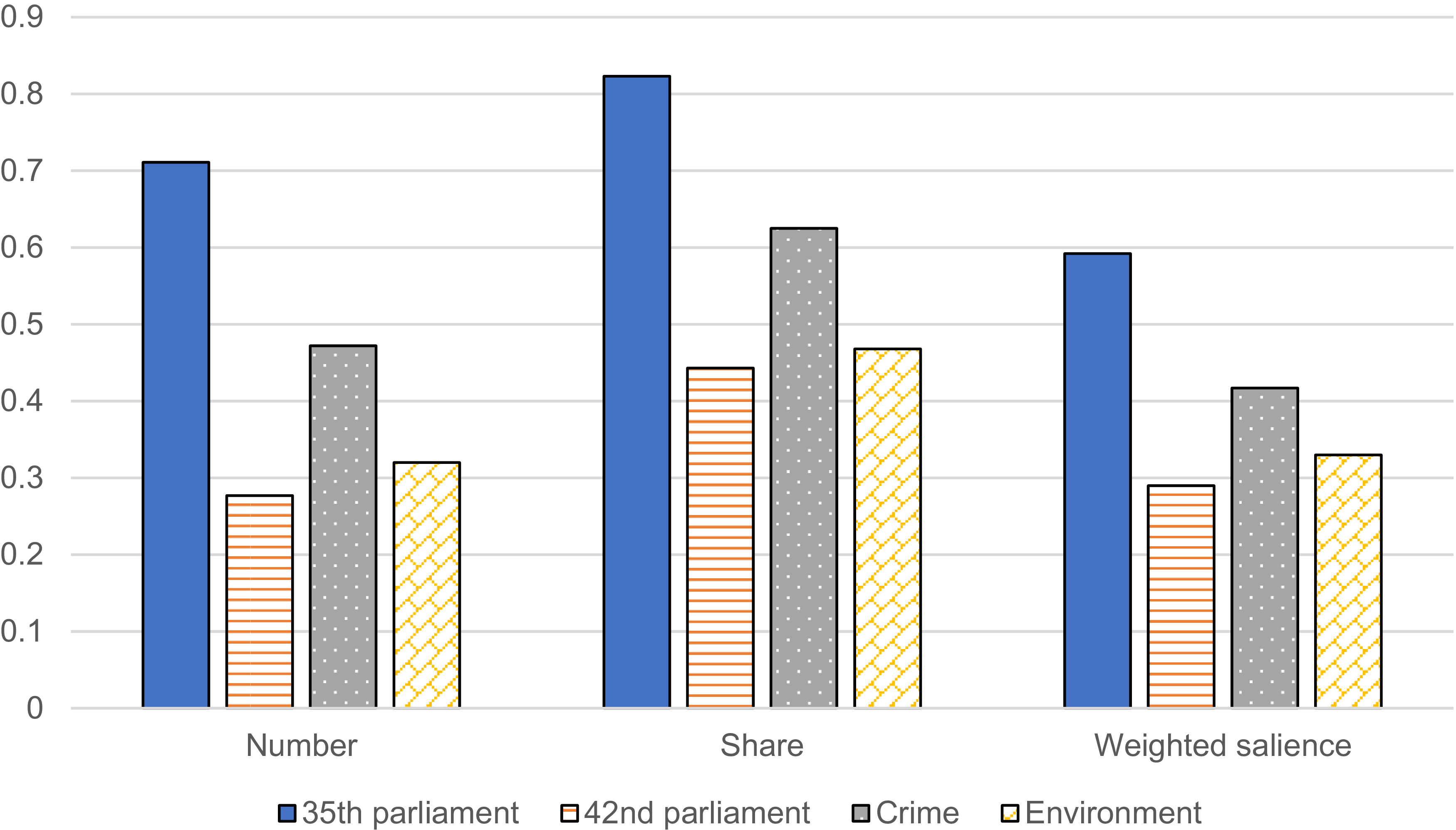
Overall, the findings support both those expectations, as illustrated in Figure 1. For one, a simple calculation of the number of different empirical disagreements we encounter for every ten statements (labeled “number” in Figure 1) results in much higher values for debates from the 35th parliament and debates on crime bills than for debates from the 42nd parliament and those on bills related to environmental protection. Of course, one might argue that the level of politicization does not depend as much on the number of disagreements but rather on the frequency with which MPs engage in them. To account for this, Table 1 also expresses the primary concept of interest as the sum of the proportion of all statements that engage in the identified empirical disagreements (labeled “share”).Footnote 7 Again, we find the same pattern. Some might still object to this operationalization, reasoning that genuine politicization requires an equally large commitment from two camps taking different positions in a disagreement. In other words, one might reasonably argue that a situation in which there are five statements presenting one empirical assertion and five statements presenting the opposite assertion constitutes more politicization of facts than one in which there is one MP presenting an empirical claim that is subsequently contested by nine others. To account for this argument, the final measure (labeled “weighted salience” in Figure 1) takes the sum of the proportion of all statements that engage in empirical disagreements and multiplies it by the sum of the proportion of all statements that take the minority position in empirical disagreements (for the sake of visualization, this value has subsequently been multiplied by 2). This measure again leads to the same conclusion: in the debates under investigation there appears to be more politicization of facts in the 35th parliament than in the 42nd, and more when debating bills on crime than bills on the environment.
Number of Empirical Disagreements, Share of Statements Participating in Disagreements, and Weighted Salience of Empirical Disagreement, by Parliament. (All differences between 35th and 42nd parliament, and between crime bills and environment bills significant at p < 0.001).

In interpreting these bivariate patterns, there are at least two possible confounding factors we should consider. First, it seems plausible that the politicization of facts might partially depend on the length of a debate. Fortunately, this possibility does not seem to bias our findings. For one thing, when we correlate the number of statements per legislative debate on a bill with our three measures of the politicization of facts, we only find a significant coefficient (r = −0.373, p = 0.013) on our first measure (the number of different empirical disagreements for every 10 statements).Footnote 8 Moreover, the difference between the length of debates on different subjects is relatively small (the average debate on environment bills counts 166.1 statements, whereas the average debate on crime includes 153.3 statements). We do see a much larger difference in that respect between the 42nd parliament (with an average debate length of 291.2 statements) than the 35th parliament (with an average length of 75.5 statements). When we run a regression analysis predicting the number of disagreements per 10 statements in a legislative debate on a specific bill by parliament (35th or 42nd) and the number of statements (for full results, see Appendix Table A4), we still reproduce the finding that there was more politicization in the 35th than in the 42nd parliament (by a value of 0.376), but that difference is no longer statistically significant (which is not surprising considering that in this analysis the unit of analysis is the bill and we therefore have a very small n of 44). All in all, differences in the length of different legislative debates could have influenced some of our findings to some degree, but do not affect the overall conclusions.
A second possible confounder is the degree of consensus on specific bills: it seems reasonable to expect more politicization of facts in debates on bills about which parties disagree than on bills that receive unanimous support. Again, closer inspection makes it seem unlikely that the patterns in Figure 1 are an artifact of this variable. For one, we only find a statistically significant difference between bills that pass unanimously on second reading and bills that do not (of 0.267, p = 0.044) on our second measure of politicization of facts (the sum of the proportion of all statements that engage in empirical disagreements).Footnote 9 Moreover, the share of bills that passed unanimously on second reading is actually larger in the 35th parliament (48%) than the 42nd parliament (35%). On the other hand, it is the case that bills on the environment under consideration more frequently passed unanimously (47% did) than those on crime (only 40%). When we run a regression analysis predicting the sum of the proportion of all statements that engage in empirical disagreements by subject (crime or environment) and whether the bill passed unanimously at second reading (for full results, see Appendix Table A5), we no longer reproduce the pattern in Figure 1: our coefficient is small (0.002) and statistically insignificant (0.986). Overall, this possible confounding factor might have influenced some findings (it particularly casts doubt on the difference between bills on the environment and crime for our second measure of politicization of facts) but does not seem to have affected the overall pattern in Figure 1.
All investigations so far have considered the overall politicization of facts in legislative debates without any consideration of the behavior of specific parties. To further investigate whether populist parties are really the driving force, the following pursues two additional investigations.
The first examines patterns in the extent to which empirical disagreements exclusively pit Members of Parliament from the right-wing opposition party (Reform Party or Conservatives) against Members from all other parties.Footnote 10 Upon first glance, the results of this investigation do not seem supportive of the overarching hypothesis in this article. The differences on this indicator we find between the Reform Party in the 35th parliament (where in 44.1% of all empirical disagreements we encountered Reform took a position that was not shared by Members from any other party) and the Conservative Party in the 42nd parliament (52.6%), and between bills on environment (53.5%) and on crime (45.3%) are relatively small and pointing in the opposite direction of what we might expect. Closer inspection, however, reveals a powerful interaction effect, summarized in Table 2.
Percentage of Disagreements Pitting Reform/CPC Exclusively Against All Other Parties, by Subject

Table 2. Long description
A table titled ‘Percentage of Disagreements Pitting Reform/CPC Exclusively Against All Other Parties, by Subject’ with three columns and four rows. The columns are labeled ‘Environment’, ‘Crime’, and ‘Total’. The rows are labeled ‘Reform’, ‘CPC’, and ‘Total’. Each cell contains a percentage value and a fraction representing the proportion of disagreements. Row 1: Reform, 32.6 percent (14/43), 49.0 percent (50/102), 44.1 percent (64/145). Row 2: CPC, 69.0 percent (40/58), 40.5 percent (32/79), 52.6 percent (72/137). Row 3: Total, 53.5 percent (54/101), 45.3 percent (82/181), 48.2 percent (136/282). The table shows the percentage of disagreements between the Reform Party and other parties, and between the Conservative Party and other parties, on environment and crime issues, as well as the overall total.
It appears that the Reform Party much more frequently stood on its own when taking part in empirical disagreements in bills on crime than on the environment (difference of 16.4 percentage points, significant at p = 0.031), but that this relationship is the reverse for the Conservative Party of Canada (difference of −28.5 percentage points, significant at p < 0.001). This provocative finding seems to suggest that the populist Reform Party was more engaged in the politicization of facts over crime, but that the Conservative Party of Canada (in the period from 2015 to 2019 at least) was more engaged in politicizing facts about the environment.
A second analysis considers the percentage of all statements that engage in empirical disagreements that were made by Reform and the Conservatives (see Table 3). Again, we find small differences on aggregate between the two parliaments (a difference of 3.5 percentage points in the unexpected direction, p = 0.014), and between the two subjects (difference of 4.4 percentage points, p = 0.003). More interestingly, we again find the same interaction effect we saw in Table 2. Reform was much more active in empirical disagreements on crime than on the environment (difference of 13.5 percentage points, p < 0.001), and we find the opposite albeit more modest difference for the Conservatives (difference of 3.4 percentage points, p = 0.059). Again, the conclusion these findings seem to suggest is that the populist right might indeed drive the politicization of facts, but that it does so especially when it comes to legislation on a topic that is important to its agenda. For as far as the more mainstream Conservative Party of Canada is involved, it primarily seems to concern empirical disagreement over the environment.
Percentage of Comments Taking Part in Empirical Disagreement by Reform/CPC, by Subject

Table 3. Long description
A table comparing percentages of comments in empirical disagreement by Reform and CPC on environment and crime. The table has 3 rows and 4 columns. Column headers are Environment, Crime, and Total. Row labels are Reform, CPC, and Total. Row 1: Reform, 30.2 percent (211/698), 43.7 percent (428/979), 38.1 percent (639/1,677). Row 2: CPC, 43.8 percent (341/778), 40.4 percent (572/1,416), 41.6 percent (913/2,194). Row 3: Total, 37.4 percent (552/1,476), 41.8 percent (1,000/2,395), 40.1 percent (1,552/3,871).
Conclusion and Discussion
The goal of this article is to contribute to the systematic investigation of the politicization of facts and its connection to populism. The preliminary investigation it pursues to this effect is a content analysis of almost 7,000 statements in the Canadian House of Parliament from different time periods and about different types of legislation. Overall, the findings suggest that the presence of right-wing populism does foster political contestation over empirically verifiable information. We find more frequent disagreement over empirical information in the debates we analyzed from the 35th parliament, when the populist right-wing Reform Party was represented, than in those from the 42nd parliament, when right-wing opposition was voiced by the more mainstream Conservative Party of Canada led by first Rona Ambrose and then Andrew Scheer. Moreover, we find more politicization of facts in legislative debates over crime, a subject which captures the central attention of right-wing populists, than in debates about environmental protection. These findings are especially worthwhile when we consider that the research design rests on a comparison between what we might call a mildly populist party and its more mainstream successor, controls for other relevant recent developments, and contrasts two policy areas that most clearly differ in the extent to which populist politicization could plausibly be attributed to a hidden corporatist agenda.
In addition, our findings reveal an interesting interaction effect. In the 35th parliament, members of the Reform Party were more likely to engage in empirical disagreements over crime than over the environment, and empirical disagreements on crime were more likely to be exclusively between members of the Reform Party on the one hand and members of other parties on the other than empirical disagreements on the environment. In the 42nd parliament, we find the exact opposite patterns, suggesting that the Conservative Party in Canada at that time was particularly involved in the politicization of facts about the environment. A speculative interpretation of this interaction effect (which would require further corroboration in subsequent research) is that Reform might have been driven to the politicization of facts for populist reasons (that is, to contest “expert assessment” and champion the “common sense of the common people”) whereas the involvement of the Conservative Party of Canada in disputes over empirical information about the environment was more driven by neoliberal interests.
This research has clear limitations. For one thing, it does not attempt to establish which position in the empirical disagreement is most consistent with evidence that was available at the time of the debate.Footnote 11 One should be careful, therefore, not to draw inferences from the findings above that it does not reveal directly. Second, the nature of the research design does not allow for the investigation of some of the areas in which the politicization of facts has in recent years become arguably most relevant. Factual disputes over the existence of COVID-19 and the efficacy of vaccines constitute one of the most dramatic instances in which political disagreement seemed to revolve around different understandings of empirical reality, but the carefully selected comparison between the 35th and 42nd parliaments does not allow for an investigation into this arguably critical case. Third, while the analysis includes the systematic investigation of thousands of contributions to parliamentary debates, it still constitutes a very small sample of countries, time periods and areas of legislation. Despite the careful research design, the conclusions of this study are therefore necessarily tentative and future research should establish to what extent they can be generalized beyond the relatively narrow context that has been investigated here. Especially worthwhile in this respect would be comparisons of different empirical contexts that vary in the nature of the legislation under consideration (in particular the degree to which it tackles issues of primary concern to populists), the extent to which populist politicians are represented in parliaments, and the degree to which the political system is open to the influence of lobbyists.
Despite these limitations, the findings of this article suggest important implications. The first is methodological and epistemological. Philosophers of science and social scientists have drawn attention to several important challenges to the positivist distinction between facts and values. And as the section on methodological considerations discusses, this article certainly runs into some of these challenges as well. Nevertheless, it is possible to identify statements that are at least in principle verifiable. In this article, we found 282 disagreements between at least 2 Members of Parliament that can be settled by empirical investigation, listed in Appendix Table A3. In sum, it is possible to distinguish empirical and normative disagreements, and there are good reasons to do so. The purpose of representative democracy is not to determine what is factually true but to represent different value-based interests, preferences and priorities. When parliamentarians express different perceptions of empirical reality in debating legislation, they risk obfuscating the issues at stake, contributing to misinformation and perverting the democratic process.
Second, the key findings of this article suggest pessimistic predictions for the immediate future. Populist right-wing parties and politicians are increasingly successful across representative democracies (Castillo, Reference Castillo2022; Imran and Javed, Reference Imran and Javed2024), and there is evidence of this trend in Canada as well. Even though not all commentators might agree on the exact way in which the current leaders of the Ontario Progressive Conservative Party (Doug Ford), the United Conservative Party in Alberta (Danielle Smith) and the federal Conservative Party of Canada (Pierre Poilièvre) differ from their respective predecessors, it seems clear that each of them exhibit to a larger extent what are typically described as crucial characteristics of populism—that is, the championing of the common sense of the common people and the chastising of “elites” (see for example Canovan, Reference Canovan1999; Fallend, Reference Fallend2004; Mudde and Kaltwasser, Reference Mudde and Kaltwasser2017). If the conclusion of this article that populism encourages the politicization of facts is correct, this suggests we might expect more of this phenomenon in the future.
Finally, the large involvement of the Conservative Party under Ambrose and Scheer in empirical disagreements about the environment suggest that careful scholarly attention to the subject is warranted even in the absence of overtly populist elements in a democracy. This article hopes to encourage such attention by outlining a feasible strategy of measurement and inquiry. As political scientists, we need to pay close attention to whether elected officials pursue the tasks that the system of representative democracy allocates to them or instead are engaged in behaviour that can challenge that very system to its core.
Supplementary material
The supplementary material for this article can be found at https://doi.org/10.1017/S0008423926101425
Acknowledgements
This research has been made possible by an Insight Development Grant from the Social Science and Humanities Research Council of Canada, which allowed me to hire a large number of research assistants. Many thanks to Olivia Bouchard, Ella Broadhead, Victoria Burman, Jana Jarjanazi, Claire Lillow, Braedon McDonald, Joshua Osborne, Piya Parmar, McKinley Pugh, Olivia Rizakos and Nathaneal Smith for their excellent assistance. I would also like to express my gratitude to friends and colleagues who provided valuable feedback on earlier drafts of this manuscript, in particular Dave Snow, Timothy van den Brink, Daniel Westlake and the three anonymous reviewers.
Competing interests
The author(s) declare none.





 Open access

