INTRODUCTION
Insects have been central to developing a framework for understanding tropical diversification (Grimaldi & Engel Reference GRIMALDI and ENGEL2005, Wilson Reference WILSON1992), and studies on butterflies have been particularly important to illuminating the population biology and evolutionary ecology of tropical insects (Boggs et al. Reference BOGGS, WATT and EHRLICH2003, Bonebrake et al. Reference BONEBRAKE, PONISIO, BOGGS and EHRLICH2010, Brown & Freitas Reference BROWN and FREITAS2000, DeVries Reference DEVRIES1987, DeVries et al. Reference DEVRIES, AUSTIN and MARTIN2008, Reference DEVRIES, PENZ and HILL2010; Fordyce Reference FORDYCE2010, Vane-Wright & Ackery Reference VANE-WRIGHT and ACKERY1984, Wahlberg et al. Reference WAHLBERG, LENEVEU, KODANDARAMAIAH, PENA, NYLIN, FREITAS and BROWER2009). Trap studies of tropical fruit-feeding nymphalid butterflies have demonstrated spatial and temporal variation in species diversity, and vertical stratification between the forest canopy and understorey (DeVries & Walla Reference DEVRIES and WALLA2001, DeVries et al. Reference DEVRIES, ALEXANDER, CHACON and FORDYCE2012, Dumbrell & Hill Reference DUMBRELL and HILL2005, Fermon et al. Reference FERMON, WALTERT, VANE-WRIGHT and MUHLENBERG2005, Grotan et al. Reference GROTAN, LANDE, ENGEN, SAETHER and DEVRIES2012, Hamer et al. Reference HAMER, HILL, BENEDICK, MUSTAFFA, SHERRATT, MARYATI and CHEY2003). While the importance of sampling both canopy and understorey partitions in tropical fruit-feeding nymphalid communities is now established, little is known about whether some understorey species are more abundant close to the forest floor, or if there are differential behavioural responses to traps among species.
Butterflies in the Neotropical tribe Haeterini (Nymphalidae, Satyrinae) occur in forest habitats in Central and South America with the greatest diversity in the Amazon. All Haeterini fly low to the ground, are easily sampled with fruit-baited traps, and may live over 1 mo in the wild as adults (DeVries Reference DEVRIES1987, and unpubl. data). Of the five species of Costa Rican Haeterini, three (Cithaerias pireta Cramer, Dulcedo polita Hewitson, Pierella helvina Hewitson) are abundant throughout the year in the Sarapiquí River Basin (DeVries et al. Reference DEVRIES, ALEXANDER, CHACON and FORDYCE2012). By taking advantage of their local abundance, this study experimentally tested three hypotheses relevant to the behaviour of these three species. Based on field observations, previous long-term studies, and their close phylogenetic relationships, we predicted that these species would: (1) be trapped more frequently near the forest floor than 1 m above it, (2) not differ in the duration individuals stayed in traps (trap persistence), and (3) would exhibit differences in sex-associated sampling bias.
STUDY SITE
This investigation was conducted from 25 January to 11 March 2009 at the Tirimbina Biological Reserve, Heredia Province, Costa Rica. The reserve encompasses an altitudinal range of 180–220 m within c. 345 ha of lowland rain forest in the Rio Sarapiquí river basin (10°29′50.3″S; 76°22′28.9″W). The study site is located within c. 150 ha with some natural and anthropogenic disturbance, but is effectively 85% primary forest. Rainfall records from the nearby La Selva Biological Station indicate this region receives an average of 3.7–4.2 m y−1 precipitation.
METHODS
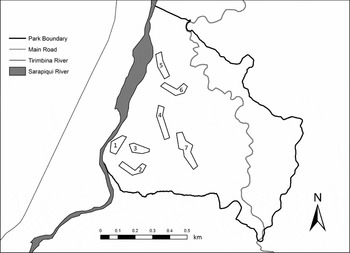
Individuals of C. pireta, D. polita and P. helvina were captured with traps (see DeVries Reference DEVRIES1987 and DeVries & Walla Reference DEVRIES and WALLA2001 for design) baited with mashed bananas that had been fermented in a large barrel 48 h prior to use, and the bait was refreshed or replaced in each trap as needed. Individual trap sites were established in the understorey of seven areas (Figure 1) that encompassed four levels of disturbance: 1 = old cocoa plantation, most disturbed; 2 = secondary forest with some disturbance; 3–6 = intact forest, least disturbed; and 7 = selectively logged over 40 y ago. All traps were checked at 24-h intervals, and butterflies were identified, sexed, uniquely marked using a non-toxic permanent marker, and released at the trap site.
Seven trapping areas in the Tirimbina Biological Reserve, Heredia Province, Costa Rica.

To test for potential differences in vertical distribution we compared individual abundances of species in areas 1–6 with 60 traps set at two heights: 15 cm and 1 m above the ground. Each area contained ten traps with five of each height interspersed. All traps were checked daily from 10 February to 1 March 2009. Only initial captures were included in the test for differential vertical distribution.
Trap persistence was defined as the continued presence of an individual in a trap 24 h after its presence was initially recorded. To evaluate potential differences among species to persist in traps we used the same 60 traps in areas 1–6, plus 20 traps in area 7. Here, trapped individuals were marked, returned to the trap, and the following day the presence or absence of marked individuals was noted. Any marked individuals still present in the traps were released. We continued sampling until trap persistence was determined for 30 individuals of each species, and because P. helvina was more abundant than the other species we assessed 30 individuals of each sex separately.
We used binomial tests to assess the null hypothesis that sample abundances were equal with respect to vertical trap height, trap persistence, species and sex. Relative differences among species were analysed using an odds ratio test with degrees of freedom = 1 (Sokal & Rohlf Reference SOKAL and ROHLF1995) and are reported in the text with a chi-square value. We used a Fisher's exact test to assess if trap persistence was affected by sex or vertical placement. Two-tailed P-values are reported for both binomial and Fisher's exact tests.
RESULTS
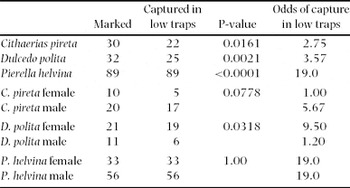
We captured, marked and released a total of 283 individual butterflies, of which 151 were included in the height trial, and 120 in the persistence trial. All three species had significantly greater abundances in the low traps (Table 1). Because the odds of capture in low traps did not differ significantly between C. pireta and D. polita (χ2 = 0.19, P > 0.05), we pooled them and found that they were more likely to be captured in the low traps. All P. helvina individuals were captured in the low traps. There was no significant difference between the sexes in capture in low traps for P. helvina and C. pireta, but there was a greater likelihood for female D. polita to be captured in low traps (Table 1).
Vertical distribution of three Costa Rican butterfly species in low and high understorey traps. Species abundances between trap heights were assessed with binomial tests. Adundances between sexes and trap heights were assessed using a Fisher's exact test, with odds ratios calculated for captures in low traps.

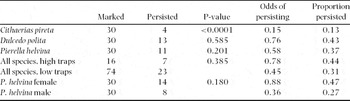
The number of individuals persisting in traps for 24 h was three times higher for D. polita and P. helvina than for C. pireta (Table 2). Because the odds of persisting did not differ between D. polita and P. helvina (χ2 = 0.27, P > 0.05), we pooled them and found that persistence did not differ significantly from 0.5 for those two species. Only C. pireta showed a probability of persistence in the traps significantly less than 0.5. Trap height had no effect on persistence and there was no difference in persistence between sexes of P. helvina (Table 2).
Number of individuals remaining in traps 24 h after marking was used to evaluate the effects of species, trap height and sex on trap persistence in three Costa Rican butterfly species. Species persistence was analysed with a binomial test. A Fisher's exact test was used to analyse persistence of species among trap heights, and between sexes for P. helvina.

Only D. polita showed differential attraction to traps with respect to sex (Table 3). The odds of capturing males did not differ for P. helvina and C. pireta, and when pooled there was no difference in attraction to traps between sexes. The odds of capturing males was significantly lower for D. polita compared with the other two (χ2 = 7.91, P < 0.01).
Abundance differences between sexes for three Costa Rican butterflies in low and high understorey traps. Abundance differences were assessed using a binomial test, with odds ratios calculated for capture probabilities of males.

DISCUSSION
Although previous studies of tropical fruit-feeding butterflies sampled at heights ranging from 0.5 to 40 m (Barlow et al. Reference BARLOW, OVERAL, ARAUJO, GARDNER and PERES2007, DeVries et al. Reference DEVRIES, ALEXANDER, CHACON and FORDYCE2012, Molleman et al. Reference MOLLEMAN, KOP, BRAKEFIELD, DEVRIES and ZWAAN2006, Tangah et al. Reference TANGAH, HILL, HAMER and DAWOOD2004), no study has sampled simultaneously at two levels within the lower forest understorey. By comparing the abundances of three closely related butterflies at two understorey levels, this investigation showed that all were trapped near the ground more often than 1 m above it. Members of Haeterini are well-known to fly close to the forest floor (DeVries Reference DEVRIES1987, DeVries & Walla Reference DEVRIES and WALLA2001, DeVries et al. Reference DEVRIES, ALEXANDER, CHACON and FORDYCE2012), but here we found that even within the tribe there were differences in capture height. This strongly suggests that seemingly small vertical differences in trap placement can affect species abundance estimates of these butterflies.
Since many other species of fruit-feeding nymphalid also visit rotting fruits on the forest floor (DeVries Reference DEVRIES1987, pers. obs.) feeding at ground level is not restricted to the Haeterini. For example, during this study we caught Morpho granadensis Felder (Satyrinae, Morphini) and Caligo atreus Kollar (Satyrinae, Brassolini) in the lowest traps, but unlike members of Haeterini, these and many other nymphalid species generally fly and perch several metres above the forest floor (DeVries Reference DEVRIES1987).
All available evidence indicates that members of Haeterini inhabit a unique vertical position within Neotropical forests (i.e. the forest floor). In concert with other work on insect stratification (Brühl et al. Reference BRÜHL, GUNSALAM and LINSENMAIR1998, Charles & Basset Reference CHARLES and BASSET2005, DeVries et al. Reference DEVRIES, ALEXANDER, CHACON and FORDYCE2012) the findings here imply the potential for other, undocumented vertical strata between the forest canopy and understorey. Given the ease of sampling them with traps, we suggest that fruit-feeding nymphalid communities may be useful for exploring species stratification at multiple vertical levels, and help gain a better understanding of species diversity in tropical forests.
We found that the three focal species differed in their probability of staying in traps over a 24-h period, with C. pireta most likely to leave. In the persistence trials every individual had been in the trap anywhere from 1 min to 24 h before being removed, marked and returned to the trap. Individual persistence could be affected by length of time in a trap, and future studies of Haeterini could test this by checking traps more frequently as in Hughes et al. (Reference HUGHES, DAILY and EHRLICH1998). Nevertheless, our study did show that trap persistence varied among these three species, and in concert with trap height this variation may lead to underestimating parameters such as relative abundance.
The present study found no sex differences in abundance for C. pireta and P. helvina, but we captured significantly more females of D. polita. This was unexpected because 5 y of trapping at Tirimbina (DeVries et al. Reference DEVRIES, ALEXANDER, CHACON and FORDYCE2012) showed that 39 of 51 abundant species were male-biased while the remainder had no detectable sex bias (unpubl. data). It seems unlikely that sex-associated sampling bias in D. polita reflects skewed natal sex ratios. Rather, the greater female abundance of D. polita in low traps suggests potential sex-specific differences in flight behaviours, temporal activity times, spatial distribution (DeVries et al. Reference DEVRIES, AUSTIN and MARTIN2008, Reference DEVRIES, PENZ and HILL2010), or other factors that may have influenced sampling. In any event, in the present study the males of D. polita were likely under-sampled relative to females.
This investigation revealed several behavioural characteristics in three closely related forest understorey butterflies. Compared with traps placed at 1 m or higher, all three species were more abundant in traps closest to the ground. Furthermore, one species, P. helvina, only entered the lowest traps, and female D. polita were more likely to enter low traps than males. In concert with previous work on fruit-feeding nymphalids (DeVries et al. Reference DEVRIES, ALEXANDER, CHACON and FORDYCE2012), this provides experimental evidence suggesting that members of Haeterini most frequently fly and feed in a third stratum found just above the forest floor. We also found sex differences among species with respect to attraction to traps, and differential persistence within traps. This shows that closely related species within the same forest can exhibit significant behavioural differences that may influence estimates of population characteristics derived from multi-species studies.
ACKNOWLEDGEMENTS
We gratefully acknowledge Isidro Chacón, Chevo Cascante, Cristian Miranda, Sergio Padilla and Emmanuel Rojas for field assistance, and the staff of the Tirimbina Biological Reserve for logistical assistance and research facilities. We thank Robinson Sudan for creating Figure 1, and Carla Penz for advice on trap construction. The comments of Charles Bell, Chris Nice, Carla Penz and Kookah Rozema improved previous drafts of this manuscript. This study was supported in part by the University of New Orleans Graduate Student Enhancement Fund and a USDA cacao initiative grant to the Milwaukee Public Museum.