Hybrid palliation, consisting of bilateral pulmonary artery banding and ductal stenting, has developed into a viable first-step palliation for hypoplastic left heart syndrome and its variants.Reference Gibbs, Wren, Watterson, Hunter and Hamilton 1 – Reference Schranz, Bauer and Reich 14 It establishes balanced systemic and pulmonary circulations without exposing the fragile newborn patient to cardiopulmonary bypass and deep hypothermic circulatory arrest required for the traditional first step of surgical treatment – the Norwood operation. There are variations between centres regarding the timing, technique, and the type of stent implanted. Balloon-expandable stents have been commonly used for ductal stenting from the initial reports of the hybrid approach.Reference Gibbs, Wren, Watterson, Hunter and Hamilton 1 – Reference Venugopal, Luna and Anderson 10 They offer high radial strength sufficient to overcome discreet ductal constrictions but conform poorly to the curvature of the duct.Reference Rolland, Charifi and Verrier 15 – Reference Grenacher, Rohde, Gänger, Deutsch, Kauffmann and Richter 17 In addition, during implantation of balloon-expandable stents, transient blockade of cardiac output occurs, which may destabilise an already vulnerable haemodynamic balance. Self-expanding stents have the advantage of flexibility and have more physiological alignment to the shape of the duct. As ductal blood flow is minimally disturbed during self-expanding stent implantation, haemodynamic instability is minimised. The flexibility of self-expanding stents comes at the price of lower radial strength; however, in our preliminary experience with this type of stent, it has not been an issue.Reference Goreczny, Qureshi and Rosenthal 18 The lack of specifically designed stents has often led to off-label use of coronary, biliary, or peripheral stents in the neonatal ductus arteriosus. Recently, the self-expanding, nitinol sinus-SuperFlex-DS stent has become available, specifically designed and Conformité Européenne marked for use in hypoplastic left heart syndrome.Reference Goreczny, Qureshi and Rosenthal 18 , Reference Schranz and Michel-Behnke 19 The aim of our study was to compare procedural and mid-term performance of self-expanding stents and balloon-expandable stents in patients undergoing hybrid palliation for hypoplastic left heart syndrome and its variants.
Material and methods
We performed a single-centre, retrospective cohort analysis at two time periods – use of balloon-expandable stents from December, 2005 to March, 2012 and use of self-expanding, sinus-SuperFlex-DS (OptiMed, Ettlingen, Germany) stents form October, 2012 to June, 2014 for ductal stenting. Data were extracted from the departmental database. Patient characteristics, technical procedural details, and mid-term follow-up of all neonates with hypoplastic left heart syndrome or its variants, who underwent hybrid arterial duct stenting with bilateral pulmonary artery banding at the Evelina London Children’s Hospital, were collected. The study was conducted as part of an audit/quality improvement project and was approved by the institutional audit board. The need for individual consent for data collection was waived.
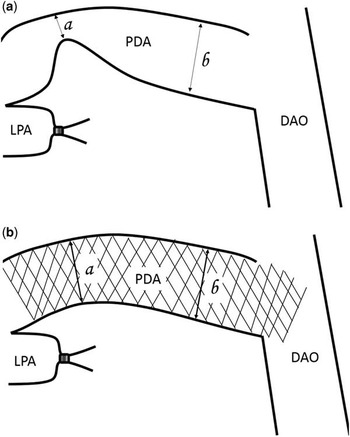
In order to compare the capability of self-expanding and balloon-expandable stents to expand discrete ductal narrowings, we produced a ductal narrowing index, measuring the ratio of the minimum to the maximum diameter of each duct before and after stent implantation (Fig 1).Reference Goreczny, Qureshi and Rosenthal 18
The diagram presents a concept of ductal narrowing index (DNI), which was produced to compare the capability of the balloon-expandable and sinus-SuperFlex-DS to expand discrete narrowings within the duct. The DNI was calculated as the ratio of the minimum to the maximum diameter of each duct before ( a ) and after ( b ) stent implantation. PDA=patent ductus arteriosus; LPA=left pulmonary artery; DAO=descending aorta.

Self-limiting haemodynamic or electrocardiographic disturbances were classified as minor, whereas all events requiring additional interventions were treated as major complications. All negative events temporally or causally connected to stent implantation were defined as stent related.
Patients
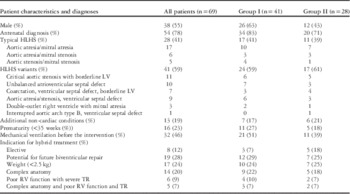
From December, 2005 to July, 2014, 69 neonates – 28 with typical hypoplastic left heart syndrome and 41 with various forms of obstruction of the left heart structures – underwent stenting of the arterial duct as part of hybrid palliation. The mean age was 8±5.9 days, and the mean weight was 2.8±0.7 kg. The population was divided according to the type of implanted stent. Among all, 49 patients who received balloon-expandable stents comprised group I, and 28 patients with self-expanding stents were defined as group II. Patient characteristics and indications for the hybrid pathway are shown in Table 1.
Patient characteristics and diagnoses.

HLHS=hypoplastic left heart syndrome; LV=left ventricle; RV=right ventricle; TR=tricuspid regurgitation.
Hybrid procedure
All interventions were performed in a biplane paediatric cardiac catheterisation laboratory under general anaesthesia with cardiopulmonary bypass available in the adjacent cardiac operating theatre. Our methodology for the hybrid procedure is outlined in detail elsewhere.Reference Venugopal, Luna and Anderson 10 , Reference Baba, Chaturvedi, Lee, Caldarone and Benson 12 , Reference Grenacher, Rohde, Gänger, Deutsch, Kauffmann and Richter 17 , Reference Goreczny, Qureshi and Rosenthal 18 Until mid-2012, balloon-expandable stents (Palmaz Genesis or Palmaz Blue; Cordis, Johnson and Johnson, Miami Flakes, Florida, United States of America) were used; since then, the self-expanding sinus-SuperFlex-DS stent has been used exclusively. Stents were chosen to be 1–2 mm larger than the maximal ductal diameter and long enough to cover the entire ductal length. If the duct was longer than the longest available stent, two overlapping stents were implanted, with the first being deployed distally. Final angiography was performed to confirm the position of the stent.
Statistical analysis
All data analyses were performed using GraphPad InStat software (GraphPad Inc., San Diego, CA, United States of America). Data are presented as frequencies, medians with ranges, or as mean±standard deviation, as appropriate. Kaplan–Meier curves for freedom from death and re-intervention were stratified by the type of stent implanted. The level of statistical significance was set at p⩽0.05.
Results
Ductal characteristics
In group I, the narrowest segment of the duct was at the pulmonary end in 20 (49%) patients, in 4 (10%) patients at the mid portion, and in 17 (41%) patients it was at the aortic end. The minimum and maximum ductal diameters ranged from 3.8 to 8.8 mm (mean 6.2±1.1 mm) and 4.8 to 11.8 mm (mean 7.8±1.4 mm), respectively. The ductal length varied from 4.8 to 27.9 mm (mean 16.6±5.4 mm), and the ductal narrowing index varied from 0.54 to 0.99 (mean 0.8±0.1).
In group II, the narrowest segment of the duct was at the pulmonary end in 16 (57%) patients, in the mid portion in 5 (19%) patients, and at the aortic end in 7 (25%) patients. The minimum and maximum ductal diameters ranged from 1.8 to 7.8 mm (mean 5.2±1.4 mm) and 4.3 to 9.2 mm (mean 7.0±1.2 mm), respectively. The ductal length varied from 10 to 25.5 mm (mean 17.8±3.8 mm), and the ductal narrowing index varied from 0.4 to 0.97 (mean 0.74±0.16).
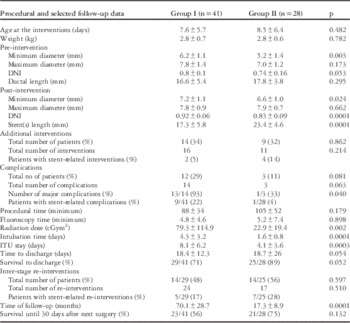
Patients in group II had a significantly smaller minimum ductal diameter (5.2±1.4 mm versus 6.2±1.1 mm, p<0.003) before intervention (Table 2). Comparison of other pre-intervention ductal characteristics showed no significant differences between the two groups.
Comparison of procedural and selected follow-up data between patients who received balloon-expandable (group I) and self-expanding stents (group II).

DNI=ductal narrowing index; ITU=intensive treatment unit.
Stent deployment
In total, 43 balloon-expandable stents were deployed in 41 patients. The minimum ductal diameter increased significantly from 6.2±1.1 mm before to 7.2±1.1 mm after implantation (p<0.0003), whereas the maximum ductal diameter before and after stent implantation did not change significantly (7.8±1.4 mm versus 7.8±0.9 mm, p<0.80). The ductal narrowing index increased significantly from 0.8±0.1 to 0.92±0.06 (p<0.02).
All but two patients in group I received a single stent at the index procedure. The most common stent diameter was 8 mm (n=20), followed by 7 mm (n=14), and the most commonly used stent length was 18 mm (n=24). In one patient weighting 1.5 kg, a 5-Fr sheath was used in the main pulmonary artery because of the patient’s size. This necessitated delivery of two, short Palmaz Blue stents to ensure coverage of the whole length of the duct. In one patient, a 7×18-mm Palmaz Genesis stent was successfully implanted, but subsequently migrated proximally, and a second stent was implanted to cover the distal part of the duct.
In group II, 47 self-expanding stents were deployed in 28 patients. These resulted in a significant increase in the minimum ductal diameter from 5.2±1.4 mm before to 6.6±1.0 mm after implantation (p<0.003) and the maximum ductal diameter from 7.0±1.2 mm to 7.9±0.7 mm (p<0.003). The ductal narrowing index increased significantly from 0.74±0.16 to 0.83±0.09 (p<0.02).
In nine patients, one self-expanding stent was implanted, and two overlapping stents were implanted in the remaining 19 patients. A ductal length measurement of >20 mm indicated that overlapping stents would be required in 10 patients. In the other nine patients, a second stent was deployed to ensure that the entire ductal length had been covered after assessing the position of the first stent. The most commonly used diameter of the stent was 8 mm (n=30), and the most common length of the stent was 20 mm (n=21).
Comparison between the two groups showed that patients who received a self-expanding stent had significantly lower post-procedure minimal ductal diameter (6.6±1.0 mm versus 7.2±1.1 mm, p=0.024) and ductal narrowing index (0.83±0.09 versus 0.92±0.06, p<0.001) after intervention (Table 2). The stented vessel length was also longer (23.4±4.6 mm versus 17.3±5.8 mm, p<0.001) when compared with those with balloon-expandable stents. Patients in group I received higher radiation dose (79.3±114.9 cGym2 versus 22.9±19.4 cGym2, p=0.002).
Additional interventions at initial procedure
In the balloon-expandable stents group, 2 patients (5%) required immediate post-dilation of the stent. Among all, 12 other patients underwent 14 additional interventions at the time of the hybrid procedure: aortic valve balloon dilation (n=7), balloon atrial septostomy (n=5), coil occlusion of the aortopulmonary collateral (n=1), and balloon dilatation of tight left pulmonary artery band (n=1).
In the self-expanding stent group, 1 patient (4%) required pre-dilation of the arterial duct before stent deployment, and four patients (14%) required immediate post-dilation of the stents. In addition, four other patients underwent six additional interventions during the same procedure, including balloon atrial septostomy (n=3), atrial septal stent implantation (n=1), and aortic valve balloon dilation (n=2) (Tables 2 and 3).
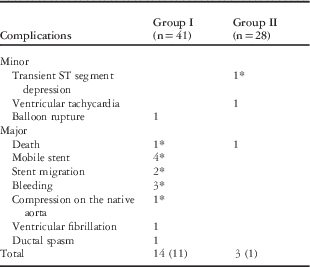
Complications related to the ductal stent with balloon-expandable (group I) and self-expanding stents (group II).

* Stent related
Complications
In group I, 12 patients (29%) had 14 complications including 13 major ones. In all, 11 stent-related complications occurred in nine patients (22%) (Table 3). In four patients after balloon removal, the stent was unstable and required suturing to the wall of the duct. In two patients, the stent migrated proximally, requiring additional stent implantation to cover the whole ductal length. In one patient, the sheath was displaced during removal of the balloon, resulting in significant bleeding, which was treated with additional purse-string sutures. In one patient, bradycardia and hypotension occurred during balloon inflation, related to compression of the native ascending aorta. The stent was successfully re-positioned surgically; one patient presented with ventricular fibrillation during sheath insertion to the main pulmonary artery, which was treated with cardioversion. In one patient, ductal spasm occurred during pulmonary artery band placement. The duct could be crossed with a guidewire and the patient was stabilised with a fluid bolus. Moreover, one patient had balloon dilation of the tight left pulmonary artery band, which resulted in balloon rupture. The balloon was easily removed without haemodynamic compromise; two patients presented 2 and 3 weeks, respectively, following their hybrid procedures with tamponade secondary to blood-stained pericardial effusions (haematocrit of pericardial fluid =36 and 42%). In both cases, the haemopericardium gathered over 72 hours and was considered likely to be due to late erosion of the ductal stent. The first patient presented with an acute increase in the ductal stent velocity thought to be secondary to distal migration of the balloon-expandable stents and constriction of the uncovered portion of the ductus. This finding coincided with a rapidly enlarging haemopericardium, which re-accumulated following initial drainage. The patient underwent an emergency Norwood procedure; however, no specific bleeding point was identified. The second patient presented from home in extremis and required 10 minutes of cardiopulmonary resuscitation at the time of pericardial drainage. This was followed by seizures, and a cranial MRI scan revealed a large haemorrhagic stroke; care was subsequently withdrawn.
In group II, complications occurred in three patients (11%) – one major and one stent-related minor complication (4%). A clinically unstable 1.3-kg patient underwent successful ductal stenting, but deteriorated during subsequent attempted atrial septal stent implantation and died. Another patient had ST segment depression during stent deployment. He recovered shortly with no sequel, and one patient had ventricular tachycardia during the procedure but not temporally related to ductal stenting.
Complications, any cause (29 versus 11%, p=0.81) and stent related (22 versus 4%, p=0.04), were more frequent among patients in group I. In group I, 13 of the 14 complications were classified as major, whereas only one complication in group II was considered major (93 versus 33%; p=0.063).
Outcomes
The median ventilation time after the intervention in group I was 3.5 days (range 1–16 days) compared with 1 day (range 1–4, p<0.001) in group II. The median intensive care stay after ductal stenting was 6 days (range 1–28 days) in the balloon-expandable stents group compared with 3 days (range 2–21, p<0.001) in the self-expanding group. The median length of hospital stay was similar in both groups (13 days, range 6–48 days versus 10 days, range 5–108 days; p=0.054).
In group I, 12 in-hospital deaths resulted with 71% (12/41) survival to discharge; five patients remained unstable after transfer to the Intensive Treatment Unit with worsening renal function and increasing lactate levels. Despite inotropic and renal support, they did not recover. After an initial uneventful course, three patients deteriorated suddenly and could not be resuscitated; two patients developed fatal necrotising enterocolitis. In one patient, brain imagining showed a significant cerebral haemorrhage and the parents decided to withdraw care. Finally, in one patient with coexisting severe pulmonary lymphangiectasis, no surgical option could be offered after the initial hybrid.
In group II, survival to discharge from the hospital was 89% (25/28). In addition to one death during atrial stent implantation, there was one in-hospital death 3 days after the procedure. Following an initially uneventful recovery, the patient deteriorated with apnoeic seizures and subsequent bradycardia. Despite immediate resuscitation, she died. The autopsy showed the stent and the bands to be in place, with unobstructed aortic arch and coronary arteries, and no clear cause for the sudden death; one patient underwent laparotomy for necrotising enterocolitis. Despite intensive treatment, he died of multi-organ failure 1 month after the surgery.
Re-interventions
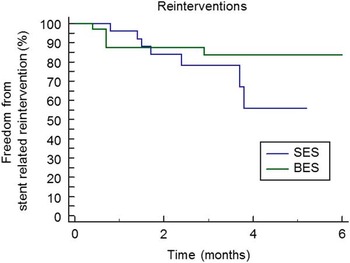
In group I, 14 patients (48% of those discharged) underwent 24 inter-stage interventions before their next scheduled operation – hemi-Fontan or biventricular repair. Among all, five patients (17%) required re-interventions involving the previously implanted ductal stents (Fig 2); two patients presented with narrowing within the stent and had successful second stent implantations. Moreover, two patients had late stent migration, leaving proximal ductal obstruction. This was treated with a second stent in one case and with emergency Norwood procedure in another patient because of clinical instability and concerns over stent erosion. Finally, one patient underwent successful stenting of retrograde aortic arch obstruction.
Kaplan–Meier curves presenting freedom from ductal-related re-intervention between the hybrid palliation and ductal stent removal at the next stage of surgical treatment (Norwood, combined Norwood and hemi-Fontan operation or biventricular repair). BES=balloon-expandable stent; SES=self-expanding stent.

In total, 14 patients (56% of all discharged) in group II required 17 inter-stage interventions, with seven patients (28%) requiring additional transcatheter treatment related to the previously implanted ductal stents (Fig 2). In addition, two patients presented with retrograde aortic arch obstruction and underwent successful implantation of coronary stents; five patients developed evidence of ductal stent obstruction, requiring balloon dilation of a distal narrowing in three cases and stent implantation within the distal portion of the original self-expanding stent in the other two.
Follow-up
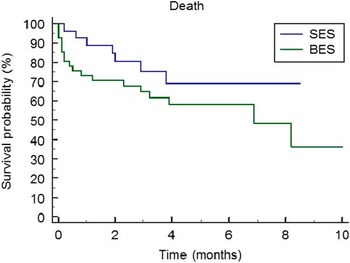
Figure 3 illustrates survival curves after hybrid bilateral pulmonary artery banding and ductal stenting, distinguished by the type of stent implanted. Data were censored at 30 days following a definitive operation involving removal of the ductal stent. These operations were either a combined Norwood and hemi-Fontan procedure (n=23), a Norwood procedure (n=16), or a biventricular repair (n=10). The overall survival at 30 days following their subsequent operation was 56% (23/41) in group I and 75% (21/28) in group II.
Kaplan–Meier actuarial survival curve until 30 days after the next scheduled surgery of all (n=69) patients who underwent hybrid palliation, differentiated by type of stent implanted to the arterial duct. BES=balloon-expandable stent; SES=self-expanding stent.

Discussion
Ductal stenting has been a viable option in the initial palliation of systemic or pulmonary duct-dependent circulation since the early 1990s.Reference Gibbs, Wren, Watterson, Hunter and Hamilton 1 – Reference Schranz, Bauer and Reich 14 , Reference Schneider, Zartner, Sidiropoulos, Konertz and Hausdorf 20 – Reference Santoro, Gaio and Giugno 22 Initial results were suboptimal, perhaps partly due to the stiff, high-profile, balloon-expandable stents used, due to limited availability of specifically designed equipment at that time.Reference Gibbs, Uzun, Blackburn, Wren, Hamilton and Watterson 2 Several years later, the Giessen group re-discovered hybrid transcatheter surgical palliation for hypoplastic left heart syndrome.Reference Akintuerk, Michel-Behnke and Valeske 3 , Reference Michel-Behnke, Akintuerk and Marquardt 4 In their first reported group of patients, balloon-expandable stents were used, and were subsequently replaced with self-expanding stents.Reference Akinturk, Michel-Behnke and Valeske 6 , Reference Schranz and Michel-Behnke 19 Over the next decade, several other groups introduced hybrid protocols involving ductal stenting via sternotomy or via a percutaneous approach using a variety of off-label biliary, coronary, or peripheral stents.Reference Galantowicz and Cheatham 5 , Reference Caldarone, Benson, Holtby, Li, Redington and Van Arsdell 7 – Reference Lloyd, Cutler and Tibby 13
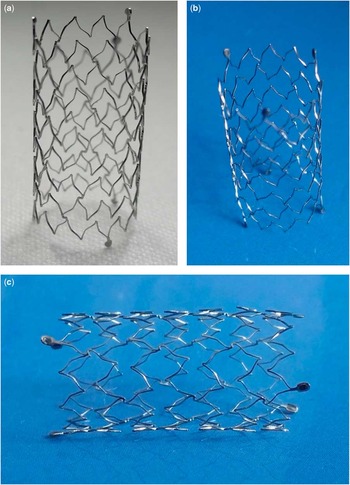
Our initial experience with the sinus-SuperFlex-DS stent showed that the stent performs well in the duct in hypoplastic left heart syndrome.Reference Goreczny, Qureshi and Rosenthal 18 All stents have been easy to remove during surgical arch reconstruction without need for additional, extensive dissection and repair (Fig 4).
( a ) An example of a self-expanding, open-cell, nitinol sinus-SuperFlex-DS stent. ( b and c ) 7 weeks after hybrid ductal stenting, the stent was easily slid out not requiring any dissection and leaving smooth tissue behind.

We have compared procedural data, complications, and follow-up between our historical group of patients who received balloon-expandable stents and the most recent cohort treated with self-expanding stents. Patients in both groups showed similar characteristics in terms of demographics, diagnoses, and co-morbidity. Hypoplastic left heart syndrome variants were common in both groups with more biventricular repairs in the self-expanding group (32 versus 5%).
Implantation of both types of stents resulted in significant increase in ductal diameters and ductal narrowing index. Patients in the self-expanding group had a tendency for lower ductal narrowing index before intervention, which became more evident after intervention. This probably reflects the lower radial force exerted by self-expanding. Although this had no haemodynamic consequence immediately after stent placement or during follow-up, it may have contributed to slightly higher proportion of need for re-dilation of the stents after initial implantation and during follow-up. On the other hand, a comparison between stent-related interventions showed no statistical difference.
Several patients in the self-expanding group required implantation of overlapping stents. More than half of them presented with initial ductal length of >20 mm, which, because of the maximum length of the sinus-SuperFlex-DS, precluded single-stent implantation. In some other patients, the first stent position after deployment was not felt to completely cover the duct. This may have been partially due to the operator learning curve with positioning and deployment of self-expanding stents. Implantation of overlapping stents led to longer stented vessel length in group II with no haemodynamic consequence.
Our total complication rate was 22% (15/69 patients), similar to observation reported by Baba et al (24%);Reference Baba, Chaturvedi, Lee, Caldarone and Benson 12 however, when compared between the two groups, all complications and stent-related complications were more frequent in the balloon-expandable stents group, 29 versus 11% (p=0.081) and 22 versus 4% (p=0.04), respectively. Moreover in group I, all but one of the stent-related complications were major, including one death, whereas in group II none of the stent-related complications were major. Minimal haemodynamic instability during self-expanding stent deployment, better alignment to the ductal curvature, and low radial force during expansion may have contributed to this advantage.
Group II had a significantly shorter ventilation and intensive care stay, with both groups having similar overall hospitalisation time. This may partially represent an era effect as we increase our experience in hybrid patient management, but also may relate to better stability of the self-expanding stents patients after intervention.
The Giessen group reported 12% in-hospital mortality for their early cohort of patients palliated with hybrid first stage, but have recently published data suggesting a drop in in-hospital mortality to 1.8% over a 15-year period.Reference Akinturk, Michel-Behnke and Valeske 6 , Reference Schranz and Michel-Behnke 19 We observed an in-hospital mortality difference between our two groups (29 versus 11%, p=0.052), reflecting much more than just a change in stent choice. Multiple aspects of our learning curve developed, including a change in qualification criteria, introduction of three-dimensional echocardiography, CT, and nuclear magnetic resonance in initial evaluation and in assessment for timing and nature of further procedures.Reference Ballard, Tibby and Miller 23 – Reference Nassar, Narayan and Nyman 27 We would consider, however, that the relative haemodynamic stability observed during and immediately after deploying self-expanding stents in the ductus has facilitated a less-morbid recovery period and contributed to higher overall survival at the point of censoring among self-expanding stent patients (75 versus 56%, p=0.132).
Limitations
This study is retrospective and limited to a single institution. Compared groups were treated during different time periods; hence, factors unrelated to the stent choice might have influenced the overall outcomes. The learning curve associated with deployment of these self-expanding stents has likely influenced the need for additional procedures in the early follow-up period.
Conclusions
Hybrid ductal stenting with self-expanding stents produced favourable results when compared with the results achieved with balloon-expandable stents. Immediate additional interventions and follow-up re-interventions were similar in both groups with complications more common in those with balloon-expandable stents.
Acknowledgements
None.
Financial Support
This research received no specific grant from any funding agency or from commercial or not-for-profit sectors.
Conflicts of Interest
None.