Introduction
Attention deficit hyperactivity disorder (ADHD) is a well-known childhood disorder that often continues into adulthood with a reported prevalence of 3–5% in the general population. Of those with ADHD in childhood, 30–50% continue to show symptoms of the disorder in adulthood (Mannuzza et al. Reference Mannuzza, Klein, Bonagura, Malloy, Giampino and Addalli1991). Principal symptoms of ADHD include inattention, hyperactivity and impulsivity. Based on the presentation of these symptoms in individual patients, the DSM-IV (APA, 1994) specifies three diagnostic subtypes of ADHD, including a predominantly inattentive subtype, a predominantly hyperactive–impulsive subtype, and a subtype that combines inattention with hyperactivity.
Recent studies addressing the expression of symptoms of ADHD in adults raise the possibility that symptoms of ADHD show systematic differences in clinical presentation in relation to age and gender. Specifically, although symptoms of inattention are likely to remain stable throughout life (highlighting the importance of attention problems in this disorder), evidence suggests that symptoms of hyperactivity and impulsivity may wane with increasing age (Biederman et al. Reference Biederman, Mick and Faraone2000). Furthermore, in addition to the age-related changes, an emerging body of literature indicates that symptoms of ADHD may differ in females and males. In the early ages, marked differences are observable in the prevalence of ADHD between the two genders even though symptoms of ADHD emerge early in childhood in both genders, with a mean age of onset between infancy and 7 years (Barkley, Reference Barkley1988). A prevalence of 5–7% has been reported in boys and 2–4% in girls (Barkley et al. Reference Barkley, Fischer, Edelbrock and Smallish1990). In addition, research has found that girls have fewer symptoms of ADHD than boys (McDermott, Reference McDermott1996), although several investigations have reported contrary results (e.g. Horn et al. Reference Horn, Wagner and Ialongo1989).
With regard to gender differences in ADHD, another emerging area of inquiry is the difference in the prevalence of co-morbid disorders between the two genders. Community-based studies with children suggest that girls with ADHD may display a different pattern of co-morbidity than boys. In particular, girls with ADHD may have greater prevalence of co-morbid internalizing and learning problems, whereas boys may display a greater prevalence of disruptive behavioral disorders (Berry et al. Reference Berry, Shaywitz and Shaywitz1985; Biederman et al. Reference Biederman, Mick, Faraone, Braaten, Doyle, Spencer, Wilens, Frazier and Johnson2002).
To date, only a few studies have explored the difference in distribution of ADHD subtypes between the two genders. In the pediatric literature, boys with ADHD were reported to have a higher rate of the combined (inattention with hyperactivity) subtype than girls (Biederman et al. Reference Biederman, Mick, Faraone, Braaten, Doyle, Spencer, Wilens, Frazier and Johnson2002). By contrast, one study that focused on adult subjects found that male and female ADHD patients did not differ in the frequency of ADHD subtypes (Grevet et al. Reference Grevet, Bau, Salgado, Fischer, Kalil, Victor, Garcia, Sousa, Rohde and Belmonte-de-Abreu2006). Clearly, more studies are needed to draw firmer conclusions about gender-related differences in subtype frequencies.
Attention is the core neuropsychological domain that has been most strongly implicated in ADHD, and for more than two decades essentially all conceptualizations of ADHD or functionally equivalent disorders included attentional symptoms. It should be noted that although previous research into the neuropsychology of ADHD focused on children, there is an emerging literature reporting on the investigation of cognitive functions, including attention, in adults with ADHD. Available findings from these studies do not unanimously implicate specific domains. Instead, they pin down a variety of neuropsychological functions; specifically, impairments in working memory, motoric inhibition and attention have been noted (Barkley, Reference Barkley1997).
Although deficits in neurocognitive functioning in general, and attention in particular, may represent a central feature of the disorder, to our knowledge no quantitative review has been conducted to assess age- and gender-related differences in these deficits and to delineate their profile compared to healthy control subjects in well-controlled studies. To date, most available reviews of clinical neuropsychological functioning of adult ADHD have focused on neuropsychological deficits at a global level. We found only a few reviews that disentangled these deficits into their principal constituents and investigated specific domains such as attention. Furthermore, as far as we know, no review has been published about neuropsychological deficits in ADHD in relation to age and gender.
The principal objective of this meta-analytic review was twofold: (1) characterize neuropsychological performance in subjects with adult ADHD by examining differences in ADHD versus normal control subjects; and (2) to examine whether these differences vary as a function of age and gender across ADHD and control groups. To accomplish this, we performed a comprehensive empirical review to synthesize published neuropsychological test results on adult ADHD with a special focus on attention deficits, and with an emphasis on gender and age. We expected that such a meta-analytic synthesis of the existing data from studies of adults with ADHD would provide an insight into the cognitive profile of ADHD with regard to attention functioning, which could serve as a framework for future clinical and research endeavors.
Method
Selection criteria for the meta-analysis
Articles were identified by search of Medline-referenced journals and from a manual review of references from pertinent publications, from January 1993 to February 2007. The key words were adult ADHD, neuropsychology, attention. To be included in the analysis, studies had to meet the following criteria:
• Each study had to contain at least one test measuring attention.
• Studies had to compare the performance of the adult ADHD patients with a normal control group.
• Participants had to be aged >18 years.
• Raw data for the effect size calculation had to be available directly from the paper.
• Diagnosis for ADHD had to include either DSM-III-R or DSM-IV criteria.
• Articles had to be published in English.
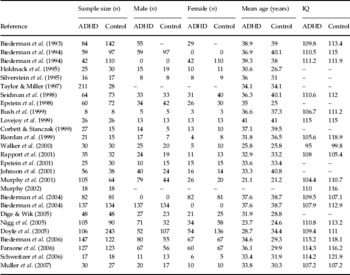
Twenty-five studies (Table 1) met our inclusion criteria for the meta-analysis.
Studies included in the current meta-analysis

ADHD, Attention deficit hyperactivity disorder.
Measures
Neuropsychologists argue about which neuropsychological tests measure which functions, as several neuropsychological tests have been shown to be associated with multiple cognitive functions simultaneously. In our meta-analysis we included tests that measure attention according to the criteria provided by Schoechlin & Engel (Reference Schoechlin and Engel2005). These comprised tasks that we include in the subsequent part of this section.
Stroop Color–Word Test (Stroop)
In brief, in this measure of attention (Golden, Reference Golden1975), a participant is shown three different cards. The first two cards require the subject to read color names and name colors (labeled as W and C conditions, respectively). The third card is used to measure the interference (CW condition), which indexes focused attention capacity. This card consists of color names, printed either in a denoted color (BLUE, printed with blue ink) or in a different color (BLUE, printed with red ink). Participants are required to name the ink color rather than read the word. Typically, four variables are determined on the basis of the test performance during the Stroop task: the W raw scores, the C raw scores, the CW raw scores and the Stroop interference score.
Trail Making Test (TMT)
In this test (Reitan, Reference Reitan1994), participants are required to connect series of circles. The test has two parts, in the first part (TMTa) the circles contain numbers from 1 to 25 and the participants have to connect them in counting order. This part has been considered as a measure of simple attention. The second part (TMTb) contains circles with both numbers and letters. The instruction is to connect the circles by alternating between numbers and letters (1–A–2–B). This part of the test serves as an index for focused attention.
Wechsler Adult Intelligence Scale-Revised (WAIS-R) Digit Span (Dspan) and Digit Symbol (Dsym) subtests
In the Dspan subtest of the WAIS-R (Wechsler, Reference Wechsler1981) participants are required to repeat a series of numbers read aloud by the experimenter. In Dspan forward, they have to repeat the sequence in the same (original) order, and in Dspan backwards, they have to repeat it backwards. The scores can be calculated separately or together. The Dsym subtest is a measure of focused attention that involves writing nonsense symbols that correspond to numbers as quickly as possible for a 120-s period.
Continuous Performance Test (CPT)
The CPT (Conners, Reference Conners1994; Conners et al. Reference Conners, Epstein, Angold and Klaric2003) measures sustained attention. The test requires the participants to press a button as quickly as possible when they see a letter presented on a computer screen. They have to do this in the case of every letter except the letter ‘X’, in which case they have to withhold their response. The variables reported most often are: (1) mean reaction time (Hit_RT), which can measure the latency of the response execution process; (2) the number of Commission errors, measuring behavior inhibition, with high error rates indicating poorer control of inhibition; and (3) the number of Omission errors, which indexes poor vigilance and is traditionally considered as a measure of inattention.
Statistical analyses
Pooled effect size (Cohen's d) was calculated across the studies to define the differences between the adult ADHD group (ADHD) and the normal control (Control) group. Cohen's d was defined as the difference between two means divided by the pooled standard deviation of both groups. The closer Cohen's d is to zero, the smaller the difference between the two groups. We consider absolute values of Cohen's d of 0.20–0.39 as small, 0.40–0.69 as medium, and ⩾0.70 as large effect sizes. A random effects meta-regression (a meta-analytic technique of multivariate linear regression across studies) was applied to estimate the pooled effect size of the difference between the ADHD versus Control group across various study samples and to study the association between the effect size in relation to age and gender. The meta-regression analysis was based on the general linear mixed-model technique using the approximate likelihood approach (van Houwelingen et al. Reference van Houwelingen, Arends and Stijnen2002). In particular, the effect size (d) from each study was regressed on an intercept and study-level demographic covariates, which included average age and gender composition (% of males) in each of the individual studies. A common weighted statistical effect-size estimate for the ADHD versus Control difference was calculated using the DeSimonian and Laird estimator based on the random effects component of the mixed model that incorporated both fixed and random effects (DeSimonian & Laird, Reference DeSimonian and Laird1986).
Results
Descriptive and demographic characteristics
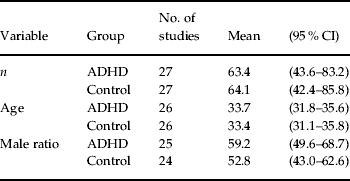
The 25 studies used for the meta-analysis included a total of 1711 patients with ADHD and 1731 controls. Basic descriptive characteristics of the patients are presented in Table 2. As the table indicates, the samples were not representative of the general population; subjects were young (mean age ~34 years), with a slight preponderance of males in the study population. However, there were no significant differences in age between the ADHD and the Control groups. In addition, there was no difference in either the male-to-female ratio or in the full-scale IQ between the groups.
Descriptive data on patient characteristics
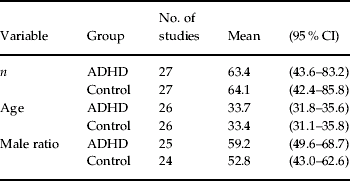
ADHD, Attention deficit hyperactivity disorder; n, number of participants; Age, mean age for study group; CI, confidence interval.
Attention functioning in patients with ADHD compared to controls
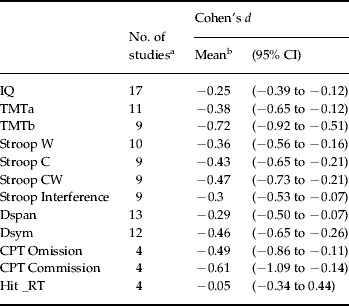
The results of the meta-analysis for IQ and for the indices of attention are summarized in Table 3. A negative sign in the effect size indicates worse performance in the ADHD group as compared to normal controls. Among all measures, the largest effect size was found for TMTb, with a value of −0.72, indicating that normal control participants performed substantially better at this focused attention task than the subjects with ADHD. For the rest of the tests a medium effect size could be detected.
Pooled effect size for intellectual and attention functioning

TMT, Trail Making Test; Dspan, Digit Span subtest; Dsym, Digit Symbol subtest; CPT, Continuous Performance Test; Hit_RT, mean reaction time; CI, confidence interval.
a Sample size varies according to the availability data in the original publications.
b With the exception of Hit_RT, all pooled estimates were significantly (p<0.05) different from 0.
For the Stroop test, we found a negative effect size for all indices selected for this meta-analysis. Of the four Stroop variables, the ADHD group performed worse on interference control as measured by the Stroop CW card (d =−0.47). For the Stroop W card a small effect size of d =−0.36 was found, and for the Stroop C measure a medium effect size was estimated (d =−0.43). These results indicate that the ADHD group had more difficulties compared to normal controls on color name reading and on color naming.
In the case of TMTa, only a small, but statistically significant difference, with an effect size of −0.38, was found between the ADHD and Control groups. A medium effect size was also found for the CPT Commission (d=−0.61) and Omission (d=−0.49) error variables. These results indicate that compared to the control group, the adult ADHD group showed worse performance on inhibition as measured by commission errors and worse on vigilance as measured by omission errors. A small effect size of d=−0.05 was found on CPT Hit reaction time, which indicates the difference between the ADHD and the Control groups in terms of speed of response was negligible.
Finally, we found a medium effect size of d=−0.46 for the WAIS Dsym subtest, indicating that the ADHD group had worse performance in terms of focused attention. In the WAIS Dspan subtest a small effect size of d=−0.29 was calculated.
As Table 3 indicates, the number of studies available for the analysis varied across individual measures. To investigate whether the variation in effect size across neuropsychological measures was attributable to the variation in the number of studies available for the analysis, we restricted the analysis sample to those studies that had obtained each of the measures of interest. The results of this analysis indicated that the TMTb and the Stroop test effect sizes remained essentially unchanged, whereas for the Dsym subtest the effect was stronger.
As the pooled effect size estimates can be distorted by publication bias (favoring the publication of small studies with large effect size), we investigated the funnel plots for measures, which were present in at least nine studies. Our results indicated no significant effect (publication bias) using the Begg & Mazumdar (Reference Begg and Mazumdar1994) approach for any of the variables (p>0.05 in all analyses).
Association between gender and age and attention functioning in patients with ADHD
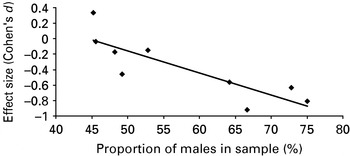
In addition to the overall difference between the ADHD versus Control groups on each measure, we also examined the effect of gender and age on the attention performance. The meta-regression analysis indicated a gender effect for Stroop interference, the results revealing a strong linear association between the group difference in terms of effect size and the overall proportion (%) of males in a particular study (Fig. 1). In particular, as Fig. 1 indicates, the more males there were in the study relative to females, the larger was the difference in the performance in terms of poorer functioning between the ADHD group and the normal control group. The estimated R 2 value was 0.7 in the regression analysis between the male proportion (%) and Cohen's d value for Stroop interference when the effect of age was controlled. The intercept was 1.13, with a value of 0.028 for the slope. For the male ratio of 75%, Cohen's d value estimated from the meta-regression analysis was −0.81; for the male ratio of 25% the estimated Cohen's d was 0.46. Age had no effect on the differences in attention performance between the two groups. No differences were found between the effect sizes with and without age correction.
Association between effect size for the Stroop test interference score and the proportion of males in the sample.

Discussion
We conducted the present meta-analysis to delineate the differences in attention functioning between adults with ADHD and normal controls based on data currently available in the literature. To our knowledge, this study is the first meta-analysis to review how attention deficits in adult ADHD patients vary as a function of gender and age.
As attention dysfunction may represent one of the core features of neurocognitive deficits in adults with ADHD, it seems essential to disentangle performance in subdomains of attention. Regarding the three subdomains of attention, we found the highest effect sizes for tests measuring focused and sustained attention (i.e. Cohen's d values with medium to large magnitude), whereas for tests of simple attention a small to medium effect size was observed.
Overall, our results are consistent with those of Schoechlin & Engel (Reference Schoechlin and Engel2005), who also found effect sizes in the medium range in the three attention subdomains in their meta-analysis. In terms of differences between the three subdomains of attention, we find that performance on tasks of simple attention is highly dependent on basic psychomotor reaction time, which is less impaired in adults with ADHD than performance on more complex attention tasks. Taken together, these results fit well with clinical reports of high distractibility in ADHD patients, which has been reported in more complex attention tasks (Weiss & Murray, Reference Weiss and Murray2003).
However, the problem of measuring and comparing performance in these subdomains inevitably arises if we attempt to study the mechanisms that underlie our findings. To be able to draw firmer conclusions with regard to the specific attention impairments in ADHD subjects, future studies should examine all attention subdomains separately with specific neuropsychological tests. In addition, for a more precise interpretation and comparability of the findings across studies, it is essential to develop a standard approach for quantification and interpretation of these tests, and for reporting the findings. For example, the original publications that we included in our meta-analysis did not provide the method that was used to compute the interference score of the Stroop test. Future researchers should supply this information to advance research synthesis and facilitate a unified and standard interpretation for the Stroop interference score.
One of the most reliable tests in measuring attentional performance has proven to be the CPT. Poorer performance on this test was noted earlier in adult ADHD patients (Hervey et al. Reference Hervey, Epstein and Curry2004) but only a few of the studies included in the current meta-analysis used this test. Our data provide evidence for the differences between the performance of the adult ADHD group and the normal control group on the test. As the CPT offers a great deal of specificity in differentiating between the ADHD and the normal population, we suggest the use of the CPT in further studies on attention with adult ADHD patients.
Nonetheless, it is important to note that the CPT versions that were used to investigate neuropsychological deficits in adult ADHD patients varied substantially across studies in terms of their methodology, including target-stimulus density (typically in the range of 20–80%). This, however, restricts the comparability of the respective findings across studies because the results yielded by the various CPT approaches do not correlate well with each other. For example, although high target density CPTs lead to more commission errors, low target density lead to more errors on omission (Borgaro et al. Reference Borgaro, Pogge, DeLuca, Bilginer, Stokes and Harvey2003). As most investigations of adult ADHD adopted a high target density paradigm, to ensure the comparability of findings the current meta-analysis included only those CPT data that were obtained from such a paradigm. However, we suggest that for a more systematic delineation of attention deficits in adult ADHD subjects, future research should evaluate various CPT paradigms.
Our results show a strong relationship between the overall sex ratio and performance on the Stroop interference test score as compared to normal control subjects. In particular, a higher proportion of males in the overall sample was associated with poorer functioning in the ADHD group as compared to the control group. Overall, these findings suggest that females with ADHD perform better than males on attention, as indexed by this test. In sum, a difference in attentional dysfunction appears across genders. However, additional research is needed to corroborate this finding.
A potential confounding factor in the delineation of the neuropsychological profile of ADHD is co-morbidity. Adults diagnosed with ADHD are at risk for co-morbid psychiatric and psychosocial problems. ADHD patients report a greater number of self-reported psychiatric symptoms than healthy controls, but fewer symptoms compared to mixed psychiatric samples (Walker et al. Reference Walker, Shores, Trollor, Lee and Sachdev2000).
To date, only a few neuropsychological studies have evaluated the impact of co-morbid conditions on cognitive functioning in individuals with ADHD, and they yielded variable findings. For example, Taylor & Miller (Reference Taylor and Miller1997) reported that the number of co-morbid diagnoses was positively related to the degree of attentional impairment in their ADHD sample. As they comprised a mixture of patients with various co-morbid conditions including mood disorders, anxiety and substance abuse, it is not possible to conclude whether any of the specific co-morbid conditions is specifically responsible for the findings (greater impairment of attention with increasing co-morbidity). In contrast to Taylor & Miller's results, some data available in the literature indicate that co-morbid disorders do not necessarily contribute to the pattern of cognitive deficits associated with ADHD (Katz et al. Reference Katz, Wood, Goldstein, Auchenbach and Geckle1998; Murphy et al. Reference Murphy, Barkley and Bush2001). Only a few of the studies included in our analysis examined the impact of co-morbid disorders in the adult ADHD group, which precluded a meaningful quantitative synthesis of the findings.
To conclude this discussion, we would like to point out certain limitations of our study. The first limitation is a problem arising during a meta-analytic synthesis of the data, namely the ‘file drawer problem’. This refers to the fact that studies without significant group differences tend to remain unpublished. This may of course limit the conclusions that can be drawn from our results. However, the analysis of the funnel plots in our study provided no support for publication bias. As the number of studies included in the analysis was small, additional studies may add further clarification to this issue.
An additional limitation was that only in a subset of the articles were all variables used in the meta-analysis available, and some of the important clinical variables were not reported. For example, as mentioned earlier, no data were provided on the occurrence of co-morbid disorders, and therefore we were not able to separate the differences in attention performance caused by ADHD or co-morbid disorders. Future researchers should include co-morbid disorders in the ADHD group as covariates in their analyses. This would help to clarify whether disorders that are commonly co-morbid with ADHD have any effect on cognitive functions, especially on attention.
A further limitation of note was that it was not possible to empirically evaluate the influence of ADHD subtypes on attention performance, as information given in the publications was insufficient with regard to the currently recognized three subtypes of ADHD (hyperactive, inattentive, and combined). Investigation of differences in cognitive functioning among ADHD subtypes, however, may significantly enhance our understanding of the heterogeneity of the disorder. Thus, in addition to conducting a pooled analysis for all ADHD subjects in a given study, in future investigations ADHD patients should be divided into groups based on the three principal clinical subtypes.
To summarize, in this meta-analysis we showed differences between ADHD patients and normal controls in three attention domains: sustained, focused and simple attention. These results reveal and highlight the attention difficulties that patients with ADHD have to deal with. As attention difficulties can severely impair daily functioning in ADHD patients, we suggest that more focus should be granted to the research of attention deficits for people with ADHD.
Although deficits in attention are readily observable at the level of clinical symptoms in ADHD patients, targeted neuropsychological research is needed to identify specific domains of attention and how they differ in the two genders. This would help to gain insight into the mechanisms that underlie the clinical manifestations of adult ADHD. Finally, the development of a neuropsychological test battery that is sensitive to ADHD deficits would be of great importance. Such a battery could also contribute to confirming and specifying neuropsychological deficits characteristic of ADHD.
Declaration of Interest
None.