1. Introduction
The concept of transparency is currently receiving a great deal of attention from both scientists and philosophers of science. The scientific community has been championing transparency under the auspices of the “open science” movement. According to the US National Academy of Sciences, “Open science aims to ensure the free availability and usability of scholarly publications, the data that result from scholarly research, and the methodologies, including code or algorithms, that were used to generate those data” (NAS 2018, 1). The open science movement has been celebrated as a means for promoting scientific reproducibility, hastening innovation, and benefiting the public (NAS 2018; Nosek et al. Reference Nosek, Alter, Banks, Borsboom, Bowman, Breckler, Buck, Chambers, Chin, Christensen and Contestabile2015; Royal Society Reference Society2012). At the same time, philosophers of science have been championing transparency as a strategy for responding in a responsible fashion to the value-ladenness of science. As the value-free ideal for science has come under fire, philosophers have been proposing alternative ideals for maintaining the trustworthiness, objectivity, and legitimacy of scientific results. Transparency is an important element of many of these proposals (see e.g., Douglas Reference Douglas2009; Elliott Reference Elliott2017; Havstad Reference Havstad2020; Stanev Reference Stanev, Elliott and Richards2017).
Nevertheless, the concept of transparency is highly complex (Biddle Reference Biddle2020). Scientists can be transparent about many different elements of their practice, including their data, methods, computer codes, analysis plans, conflicts of interest, and value judgments. Different kinds of information end up being more or less important to disclose depending on the reasons for pursuing transparency and the recipients of the information. While the scientific community has focused especially on developing initiatives for disclosing data and methods, philosophers of science have focused more of their attention on transparency about value judgments (Douglas Reference Douglas2009; Elliott Reference Elliott2018b). However, even when focusing on transparency about value judgments, one could focus on the judgments themselves, or the values underlying the judgments, or the consequences of making the judgments in one way rather than another. One might wonder whether the concept of transparency even makes sense when talking about value judgments in science. Speaking of “transparency” raises connotations of complete observability, whereas value judgments are often somewhat opaque and difficult to identify.
In an effort to bring greater clarity to the concept of transparency in science, this paper proposes a taxonomy that clarifies the major dimensions along which approaches to transparency can vary. Section 2 motivates the taxonomy by clarifying the importance of transparency in recent scientific and philosophical literature. Section 3 then presents the taxonomy itself, and Section 4 draws out insights from the taxonomy that can serve as starting points for further work by philosophers and other science studies scholars.
2. The importance of transparency
Before launching into a characterization of transparency, it is helpful to reflect on why the concept is important to investigate. As discussed in the introduction, the notion of transparency has recently received a good deal of attention not only from philosophers of science but also from scientists who are promoting open science. The open science movement encompasses a number of different initiatives aimed at somewhat different forms of transparency. One major element of the movement is open-access publishing, which provides free online access to journal articles without requiring paid subscriptions to journals (Else Reference Else2018). Other elements include providing greater access to study data, computer code, methods, and materials (NAS 2018; Nosek et al. Reference Nosek, Alter, Banks, Borsboom, Bowman, Breckler, Buck, Chambers, Chin, Christensen and Contestabile2015). Another aspect of open science involves incentivizing scientists to disclose more of their results—regardless of whether they are positive or negative (Chalmers et al. Reference Chalmers, Glasziou and Godlee2013); one approach to doing this is to require that scientists preregister studies before performing them (FDAAA 2007; Kupferschmidt Reference Kupferschmidt2018). Still other approaches to open science include making the peer review process more transparent (e.g., by publishing the content of reviews) and having scientists report the progress of studies in real time so that others can provide input (Foster and Deardorff Reference Foster and Deardorff2017; Lee and Moher Reference Lee and Moher2017; NAS 2018, 114).Footnote 1
The motivation for this openness or transparency comes from a variety of sources. One reason is to make science more reliable and reproducible. In fields like psychology and biomedicine, there have been concerns about a “reproducibility crisis” (Kourany Reference Kourany2020; Munafò et al. Reference Munafò, Nosek, Bishop, Button, Chambers, du Sert, Simonsohn, Wagenmakers, Ware and Ioannidis2017), and cutting-edge scientific results have the potential to be reported in ways that are misleading or overly “hyped” (Intemann Reference Intemann2020). Promoting transparency about data and methods is supposed to help alleviate these concerns (Nosek et al. Reference Nosek, Alter, Banks, Borsboom, Bowman, Breckler, Buck, Chambers, Chin, Christensen and Contestabile2015; Royal Society Reference Society2012). Another motivation is to help move scientific innovation forward more quickly; the thought is that having greater access to other scientists’ data and methods helps catalyze new discoveries and advances (Cheruvelil and Soranno Reference Cheruvelil and Soranno2018; Lowndes et al. Reference Lowndes, Best, Scarborough, Afflerbach, Frazier, O’Hara, Jiang and Halpern2017). Another common justification for open science is that it can benefit members of the public by giving them greater access to scientific information (Royal Society Reference Society2012). An additional (and less benign) reason for some special-interest groups to support open science is that they hope to obtain information they can use to harass scientists, slow down their work, and challenge their findings (Elliott Reference Elliott and Angulo2016; McGarity and Wagner Reference McGarity and Wagner2008; Oreskes and Conway Reference Oreskes and Conway2010).
Complementing this emphasis on transparency within the scientific community, philosophers of science have also been focusing their attention on transparency. Some of this interest is related to concerns about the reproducibility crisis, but much of it is focused on the ways that transparency can help policy makers and members of the public navigate the value-ladenness of science. The philosophical literature on science and values has emphasized that scientific research is value-laden in numerous ways; value judgments are incorporated in the questions that scientists ask, in the assumptions and study designs they employ, in the amounts of evidence they demand, and in the ways they frame and communicate their findings (Douglas Reference Douglas2009; Elliott Reference Elliott2017; Longino Reference Longino1990). This value-ladenness threatens the ability of decision makers to formulate choices that accord with their own values, insofar as the scientific information on which they rely could be infused with values with which they disagree (Betz Reference Betz2013; Elliott Reference Elliott2010; Schroeder Reference Schroeder2019).
Consider, for example, the case of a city manager tasked with helping her city adapt to flooding risks associated with climate change. Suppose she felt a responsibility to develop adaptation plans that would be effective in addressing worst-case flooding scenarios. She would be thwarted in this goal if the information she obtained from climate scientists was guided by different values. For example, suppose the climate scientists made modeling choices that resulted in highly plausible predictions but not worst-case scenarios. If the city manager did not recognize these value influences, she could end up formulating adaptation plans that did not actually provide the city with the protection she desired (see e.g., Parker and Lusk Reference Parker and Lusk2019). A concrete example of this kind of scenario occurred when the 2007 Fourth Assessment of the Intergovernmental Panel on Climate Change (IPCC) reported predictions for global sea-level rise that excluded important factors because they were difficult to predict. It is plausible that this has caused confusion and poor planning by some decision makers who did not understand the value-laden choices underlying the report (Keohane et al. Reference Keohane, Lane and Oppenheimer2014).
One of the common suggestions for responding to this difficulty is to promote transparency about the value judgments that influence scientific research (Douglas Reference Douglas2009; Elliott Reference Elliott2017). At least in theory, transparency could address the concerns of decision makers in at least two different ways. First, by making the value judgments in science transparent, decision makers could potentially influence those judgments so they accord with their values (Schroeder Reference Schroeder2017). As Heather Douglas puts it, “With the values used by scientists … made explicit, both policymakers and the public could assess those judgments, helping to ensure that values acceptable to the public are utilized in the judgments” (Reference Douglas2009, 153). A second way transparency could help is that it would give decision makers warning about whether the values associated with a particular piece of science accorded with their own values. In cases where it did not, they could either find someone to reanalyze the results in accordance with their values or at least avoid resting their decisions on it.
There are limitations to this solution, however. One problem is the phenomenon of what James Robert Brown has called “one-shot science” (Reference Brown and Radder2010). Some scientific studies, such as clinical trials of new medications, are so expensive that they are likely to be done very few times, and perhaps only once. Thus, if they are performed in a problematic way, it is impractical to do them over again. In such cases, the value of transparency is limited unless it occurs before the studies happen. Otherwise, it can warn decision makers not to rely on the science that has been done, but they are still left without science that informs their own values.
Philosophers who study the role of values in science have highlighted additional problems with appealing to transparency as a strategy for addressing the value-ladenness of science. For example, Drew Schroeder (Reference Schroeder2019) has argued that scientists are often unaware of all the ways in which their work is affected by value judgments, and even if they were aware of them, it would not be practical to discuss them all. In addition, Stephen John (Reference John2018) has pointed out that if those receiving information from scientists hold false beliefs about how science works, transparency about scientific practices could actually promote unwarranted skepticism on the part of those receiving the information (see e.g., Kovaka Reference Kovaka2019).
In response to concerns about transparency, a number of philosophers have argued that the best way to address the value-ladenness of science is to strive for scientific research to be informed by values that are ethically or politically legitimate (Brown Reference Brown2018; Intemann Reference Intemann2015; Kourany Reference Kourany2010; Kourany Reference Kourany2018; Schroeder Reference Schroeder2019). Nevertheless, if this is one’s goal, transparency still ends up being important. If scientists do not recognize that they are making important value judgments, then they are not able to reflect on the most responsible ways of handling them. Similarly, if other scientists do not recognize the value judgments made by their colleagues, they cannot critique them and scrutinize whether they are being made responsibly. Moreover, if policy makers and members of the public are not aware of the value judgments that inform scientific practice, then they cannot help to influence them. Thus, transparency is important not only for its own sake but also as a tool for helping to achieve other strategies for handling value judgments responsibly.
Given the importance of transparency for the scientific community and for philosophers of science, it is a concept that is well worth exploring more carefully. As the preceding discussion illustrates, it is also a very complex concept. There can be transparency about many different things, including data, methods, publications, peer reviews, and value judgments. Those promoting transparency can have many different motivations, including scientific reproducibility, efficiency, and public welfare. Transparency can also come in different degrees, depending on whether the information provided is highly usable and understandable or whether it is difficult to interpret. It can also pose a variety of dangers; not only can it be abused by special-interest groups, but it can also waste scarce resources and cause confusion by overwhelming people with too much information. Developing greater clarity about different forms of transparency should help advance more careful thinking about transparency in the future, as illustrated in section 4.
3. A taxonomy of transparency
In order to develop a more nuanced understanding of the concept of transparency, this section proposes a taxonomy that helps clarify the many different forms transparency can take. The taxonomy specifies major dimensions along which different forms of transparency can vary, and it organizes these dimensions based on four questions that one might ask about a transparency initiative: Why, Who, What, and How? The taxonomy focuses on transparency about scientific research in particular. While it might provide some insights for thinking about transparency in other domains, such as politics, different dimensions are likely to be important when analyzing transparency in other contexts (see e.g., Heald Reference Heald, Hood and Heald2006; Hood Reference Hood2007; O’Neill Reference O’Neill, Heald and Hood2006).
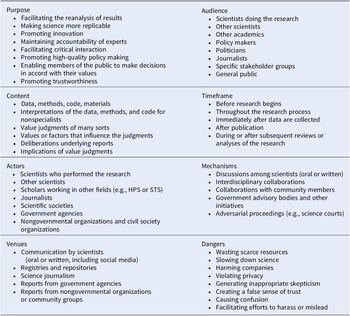
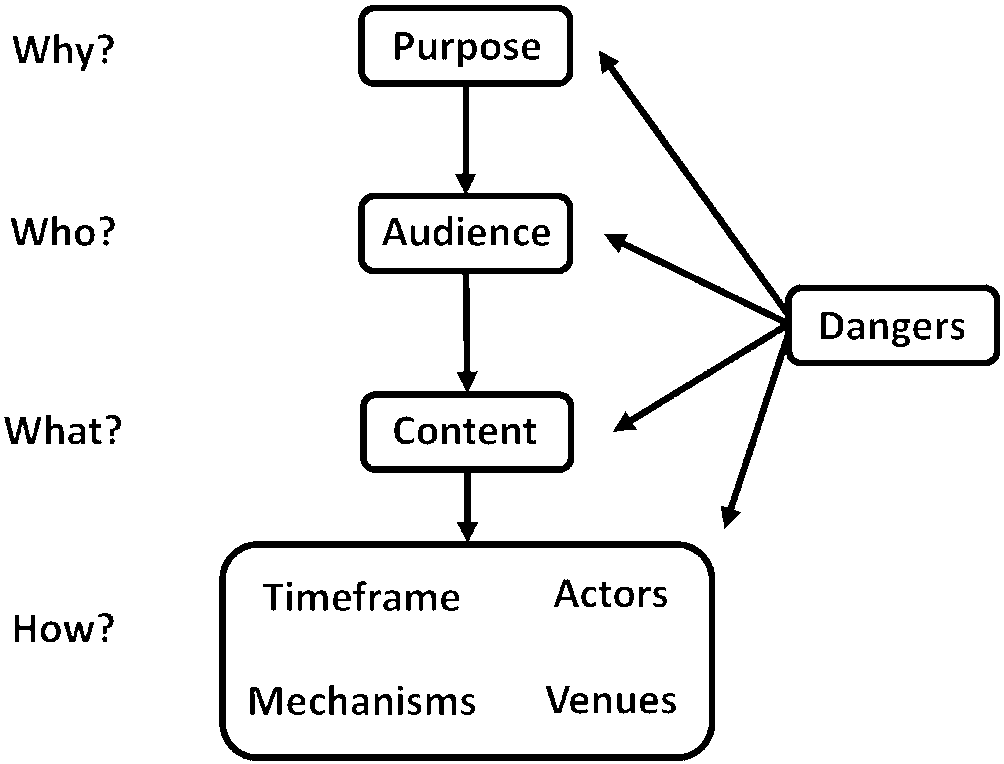
As shown in Figure 1, the taxonomy begins with the purpose dimension, which answers the question why transparency is being pursued in the first place. Table 1 provides a nonexhaustive list of different purposes for transparency. Most of them are related to one or more of the major goals described in the literature on the open science movement: improving scientific reproducibility, facilitating scientific progress, and equipping nonspecialists with the scientific information they need to make decisions (see e.g., NAS 2018; Nosek et al. Reference Nosek, Alter, Banks, Borsboom, Bowman, Breckler, Buck, Chambers, Chin, Christensen and Contestabile2015; Royal Society Reference Society2012). The purpose dimension is placed at the top of the figure to show that the purposes or goals for transparency provide a starting point that drives the other dimensions.
Eight dimensions of transparency and a list of variations within those dimensions.

A representation of multiple dimensions across which transparency initiatives can vary, organized according to four questions.

The second dimension represented in Figure 1 is the audience, which addresses the question of who is receiving information. Table 1 lists major audiences for transparency. One might wonder why the scientists doing the research are included in the list, but it is important to remember that they may not be aware of all the important judgments they are making, and thus it can indeed be valuable for other scientists or stakeholders to help make these judgments more “transparent” for the scientists doing the research. Figure 1 provides an arrow to show that the “purpose” dimension tends to drive the “audience” dimension. For example, if the primary purpose for transparency is to facilitate the reanalysis of results or to promote scientific innovation, then the primary audience for information would be other technical experts. In contrast, if the primary purpose is to enable decision makers to formulate decisions that accord with their values, then those decision makers need to receive the information that is being disclosed. In principle, influences can run in the opposite direction as well; if particular audiences are not receiving the scientific information they need or want, this may suggest that new transparency initiatives with new goals be pursued. Nevertheless, from a conceptual perspective, the goals for pursuing transparency determine the audiences that need to receive the information.
The next dimension represented in Figure 1 is the content, which answers the question what is to be disclosed. The content is guided by the purpose for pursuing transparency and the needs of the audience, so it is represented below those two dimensions in the figure. Some forms of content are relatively straightforward and widely recognized as part of the open science movement: data, methods, computer code, and materials. As emphasized earlier in this paper, another important form of content would be value judgments of various sorts; these could be related to choices about the questions asked, the categories or framing used (McKaughan and Elliott Reference Elliott2017), the background assumptions adopted, and the standards of evidence demanded. Depending on their goals, transparency initiatives could also be directed at revealing the values that caused (or could cause) those judgments to be made in particular ways. These could include funding sources or personal values of the researchers as well as institutional regulations or standards that influenced the research process. In the case of scientific reports such as those produced by the Intergovernmental Panel on Climate Change or by national academies of science, the underlying deliberations among the authors of the reports could sometimes constitute another important form of content to disclose. Finally, the implications of value judgments could also be important for some audiences. For example, most members of the public are unlikely to want detailed information about all the methodological choices made by researchers; instead, they would typically want the “take-home message” about how reliable the methods were and whether the results could have been different if alternative methods had been used.
Finally, Figure 1 lists four different dimensions that help answer the question how information should be provided. These four dimensions are placed at the bottom of the figure to demonstrate that they are guided by the dimensions above (purpose, audience, and content). For example, consider various options for the timeframe during which information is provided (see Table 1). Information could be provided before research commences, during the research process, after research is complete but before publication, when the results are published, or after publication. If the purpose of transparency is to assist decision makers, they may need the opportunity to influence research projects before the projects begin so that the right questions are asked and the best methodologies are employed. Discussing research projects in their early stages is especially important if they are expensive projects that are unlikely to be repeated; in such cases, it is important to get the study design “right” the first time (Brown Reference Brown and Radder2010). Disclosing research plans in advance is also an important strategy for making science more reproducible; it is easier to prevent scientists from making ad hoc changes to their research plans if they have disclosed them in advance (Kupferschmidt Reference Kupferschmidt2018). Alternatively, if one’s primary goal is to promote rapid scientific innovation, then one’s focus is more likely to be on releasing scientific results as soon as possible after they have been collected.
There are also a range of different actors who can communicate this content (see Table 1). The most obvious actors are the scientists performing the research under consideration. They are well placed to share their data, methods, and materials. However, when one considers other content, such as the value judgments involved in research, a number of other actors become relevant. For example, other scientists are often in the best position to identify value judgments that the scientists performing the research might not recognize. Scholars working in other fields, such as the history and philosophy of science or science and technology studies, are also well placed to recognize important judgments. For some audiences, such as members of the public, journalists are the most important actors for communicating scientific information (Angler Reference Angler2017; Elliott Reference Elliott2019). Finally, the actors who communicate scientific information are not always individuals. Scientific societies can help clarify important value judgments, as can government agencies, nongovernmental organizations, and other groups aimed at communicating to particular stakeholders. Given the wide range of audiences for scientific information, it is important to have a range of different actors who can communicate this information in ways that are meaningful to those different audiences.
It is also important to think about different mechanisms for identifying and clarifying the information that is to be made transparent. This is a dimension of transparency that is easy to overlook. There is a temptation to compare transparency in science to the activity of a shopkeeper picking items off a shelf and handing them to customers; in this analogy, the shopkeeper is the scientist doing research, the items on the shelf are pieces of information (e.g., data, methods, computer code, value judgments), and the customers are other scientists or decision makers who want to receive information about the research. However, this is a problematic analogy. In at least some cases, the scientists performing research are not aware that they are making value judgments (Schroeder Reference Schroeder2019), so they cannot just pick and choose which ones to disclose as if they were picking them off a shelf. Moreover, it would be ineffective for scientists to “hand over” information about value judgments in the same way to all recipients of the information, because various people have different levels of background knowledge. Thus, mechanisms are needed for identifying and clarifying value judgments in ways that are useful to those hearing about them. Although other elements of science are typically not as difficult to identify and communicate as value judgments, they sometimes also require mechanisms for rendering them understandable and communicable. For example, a great deal of work is typically needed in order to make data usable and intelligible by other scientists and, especially, nonspecialists (Leonelli Reference Leonelli2016; Royal Society Reference Society2012).
Mechanisms for identifying and clarifying information can take a wide variety of forms (see Table 1). Scientists can sometimes highlight important value judgments through discussions with each other (in person or through publications) or through interdisciplinary collaborations with other scholars. For example, initiatives have been launched to integrate humanists and social scientists in scientific labs to help scientists think more carefully about the social dimensions of their work (Schuurbiers and Fisher Reference Schuurbiers and Fisher2009; Shienke et al. Reference Shienke, Baum, Tuana, Davis and Keller2011). The growth of community-based participatory research (CBPR) and citizen science have provided many new opportunities for community members to interact closely with scientists, thus providing additional opportunities to work together with data and highlight value judgments that scientists might not otherwise recognize (Cavalier and Kennedy Reference Cavalier and Kennedy2016; Elliott and Rosenberg Reference Elliott and Rosenberg2019; Ottinger and Cohen Reference Ottinger and Cohen2011). In policy contexts, government agencies can create advisory bodies designed to uncover value judgments, and they can create initiatives that take government data and translate it into forms that are meaningful for specific groups of stakeholders (Holloway, Jacob, and Miller Reference Holloway, Jacob and Miller2018). Efforts to elicit diverse perspectives and uncover value judgments can even be formalized through mechanisms like science courts, which bring together experts with opposing perspectives to testify before scientific “judges” (Biddle Reference Biddle2013).
There are also a number of different venues through which scientific information can be transmitted (see Table 1); some of these venues overlap with the mechanisms for identifying and clarifying the information in the first place. For example, scientists can make information available through conversations, conference presentations, publications, and media interviews (see e.g., Havstad Reference Havstad2020). They can also provide information in the specially designed registries and repositories that have proliferated as part of the open science movement (Nosek et al. Reference Nosek, Alter, Banks, Borsboom, Bowman, Breckler, Buck, Chambers, Chin, Christensen and Contestabile2015). It has now become possible for them to share a great deal of information through blogs and social media as well. Science journalists have a particularly important role to play in communicating information in a way that is meaningful to members of the public (Angler Reference Angler2017). Reports from government agencies, national academies of science, and advisory bodies like the Intergovernmental Panel on Climate Change (IPCC) also provide excellent venues for communicating scientific information in ways that make it accessible and useful for nonspecialists. In addition, nongovernmental organizations and other community groups can play an important role as purveyors of scientific information that meets the needs of particular communities with specific kinds of interests.
A final dimension of transparency is the dangers. Technically, the dangers are not a component of the transparency process itself in the same manner as the other dimensions discussed here. Nevertheless, the dangers are a feature or consequence of transparency initiatives that inform the implementation of all the other dimensions. Thus, the dangers are represented along the side of Figure 1 with arrows to each of the other dimensions. Table 1 lists a number of important dangers that can affect transparency initiatives. In some cases, these dangers can be mitigated or addressed through creative solutions. For example, efforts can be taken to present information in ways that minimize confusion, and systems can be put in place to lessen the number of resources required to achieve transparency. In other cases, however, those implementing transparency initiatives might alter other dimensions of the taxonomy in order to alleviate the dangers. For example, when implementing a transparency initiative, one might find that disclosing particular content consistently creates confusion. To alleviate this difficulty, one might try altering the actors who provide the information or the audiences who receive it or the venues through which it is discussed. One might even abandon some of the purposes for transparency and the content that needed to be disclosed if one concluded that the dangers associated with confusion were too severe.
4. Using the taxonomy
This taxonomy can provide a variety of insights for philosophers and other science studies scholars. As a starting point for future work, this section focuses on three initial insights that one can glean by looking over the taxonomy.
Insight #1: Responding to objections
First, the taxonomy suggests strategies for responding to a number of objections that have been raised against the goal of making science (and specifically value judgments in science) more transparent. Looking at the taxonomy, one can see that most objections apply to some forms of transparency but not to other forms; thus, one can reframe most objections so that they are not an attack on transparency in general but rather an invitation to pursue different forms of transparency. Consider, for example, two of the most important objections against pursuing transparency, namely, that it is too difficult or too dangerous. The worry about difficulty is that it is simply not practical to try to identify and disclose information about all the value judgments associated with scientific research. For one thing, there are so many judgments that it would be impractical to try to disclose them all (Havstad and Brown Reference Havstad, Brown, Elliott and Richards2017). In addition, the scientists making the judgments are frequently unaware that they are making them (Schroeder Reference Schroeder2019). These problems are exacerbated by the fact that many scientific theories, models, and experiments are developed over an extended period of time by many different scientists (Biddle and Winsberg Reference Biddle, Winsberg, Magnus and Busch2010).
In addition to being difficult (or perhaps impossible) to achieve, transparency can also be dangerous. It has the potential to confuse people by burying them under a flood of information that they cannot easily digest. Transparency about value judgments in particular could also cause people to develop an unwarranted skepticism about scientific results once they realize that scientific research is not as straightforward as it might initially appear (Elliott et al. Reference Elliott, McCright, Allen and Dietz2017; John Reference John2018). Moreover, special-interest groups can exploit transparency initiatives and manipulate them to serve their purposes. For example, when academic scientists who study issues related to public or environmental health provide access to all their data, regulated industries can pay experts to reanalyze the data in misleading ways (Bauchner and Fontanarosa Reference Bauchner and Fontanarosa2019; McGarity and Wagner Reference McGarity and Wagner2008; Michaels Reference Michaels2008). In another recent effort to co-opt transparency initiatives, antiregulatory groups have pushed the US Environmental Protection Agency (EPA) not to incorporate scientific studies in their regulatory decision making unless all the data underlying the studies are publicly available (Malakoff Reference Malakoff2018). Although this might sound like a laudable policy, it actually appears to be designed to weaken the EPA’s ability to formulate regulations that protect public health, because some of the important studies that underpin its regulations incorporate data that cannot be made public due to concerns regarding study subjects’ privacy.
While these are important objections, the taxonomy of transparency considered here suggests that the best response to them is typically not to abandon the goal of transparency entirely but rather to consider what forms of transparency are best able to minimize them. Given the wide variety of content, mechanisms, and actors available, there are typically ways to achieve some of the benefits of transparency while minimizing concerns. For example, even if it were difficult or dangerous in some cases for scientists to disclose all the value judgments associated with their work, it might still make sense to demand that they provide detailed information about their data and methods so other scientists could scrutinize their work and identify important value judgments for themselves. In some situations, it might even be difficult or dangerous to provide complete information about data and methods, but scientists could still disclose some information, including major strengths and weaknesses of the methodologies they employed.
In addition, the taxonomy highlights that different actors can play different roles in an overall system for facilitating transparency. Even if scientists are not aware of all the value judgments they are making, they may be able to pursue some forms of transparency, such as publishing as many details of their work as possible and doing so in readily accessible venues. Then other actors, such as science studies scholars, citizens, government agencies, and NGOs, can facilitate other forms of transparency, such as clarifying the value judgments that the scientists did not recognize. Given the range of actors and mechanisms available to help identify and communicate about value judgments, and given the importance of subjecting these judgments to critical scrutiny for the sake of promoting scientific objectivity (Douglas Reference Douglas2004; Elliott Reference Elliott2018a; Lloyd and Schweizer Reference Lloyd and Schweizer2014; Longino Reference Longino2002), it seems best to keep striving for transparency but to use the taxonomy to find the most appropriate forms of transparency for different circumstances.
Insight #2: Major forms of transparency
A second benefit of the taxonomy is that it can help clarify major forms of transparency that merit further exploration. At first glance, the taxonomy can look overwhelming because there are so many different possibilities shown in Table 1. In practice, however, one finds that the range of possibilities tend to be restricted into “clusters” within the dimensions. In other words, particular purposes tend to call for particular audiences, which tend to require particular forms of content. Those purpose/audience/content clusters tend to face specific dangers, and they work best with particular timeframes, actors, mechanisms, and venues.
To illustrate, let us consider three clusters that capture much of the recent literature and discussion regarding transparency. One cluster is grounded in the purposes of facilitating the reanalysis of results and making science more replicable. When these goals are driving transparency, the primary audience tends to be other scientists, and the content that needs to be disclosed typically includes the data and methodological choices that allow other scientists to evaluate the quality of the work. Major dangers that then need to be addressed are the losses of time and money involved in putting all this data in a form that is useful to other scientists. Another danger that arises when human subjects are involved in the research is the loss of privacy if the data are not adequately anonymized. The appropriate timeframe for providing this information is partly before research commences (e.g., when methodological plans are provided in registries) and partly after the research is completed or published (when data can be released). The actors involved are typically the scientists doing the work; the venues for communicating the information typically include registries, repositories, and publications that usually do not require separate mechanisms for generating this information (other than the time and effort needed to make the data usable by other specialists). This transparency cluster has been receiving a great deal of attention under the auspices of the open science movement (e.g., NAS 2018; Nosek et al. Reference Nosek, Alter, Banks, Borsboom, Bowman, Breckler, Buck, Chambers, Chin, Christensen and Contestabile2015; Royal Society Reference Society2012).
A second cluster is associated with the purpose of promoting high-quality policy making. When this is the goal, the audience obviously tends to be policy makers and other stakeholders involved in the policy-making process. In order to formulate policy well, the content these policy makers need to receive is often a combination of the main take-home messages associated with current research and the major implications of the value judgments associated with it. They usually do not need to receive detailed information about all the value judgments associated with research, but it is important for them to know about the major strengths, weaknesses, and limitations of the available evidence. One of the most significant dangers associated with this kind of transparency is the potential for policy makers to become confused or overly skeptical. With respect to the timeframe, it is sometimes important for researchers to communicate with policy makers before research occurs so that the research can be made as relevant as possible for policy concerns, but transparency is also important after research has occurred. Deliberation among stakeholders and within science advisory boards can be important mechanisms for uncovering the value judgments that policy makers need to know about, and so this form of transparency includes not only scientists but also other stakeholders as actors. In recent years, science studies scholars like Heather Douglas (Reference Douglas2009) have been exploring how to promote this kind of transparency.
A third cluster is associated with the purpose of enabling members of the public to make decisions that accord with their values. As in the case of transparency for policy makers, members of the public typically do not need detailed information about data and methods; instead, they generally need to know about some of the major value judgments or the implications of the judgments that inform their decisions (Elliott and Resnik Reference Elliott and Resnik2019). The dangers and timeframe associated with transparency for members of the public are similar to those for policy makers. The major dangers include confusion and unjustified skepticism about the available scientific information. With respect to the timeframe, there are increasing calls to incorporate members of the public throughout the entire research process when scientists are engaged in studies that are of major importance to them (e.g., Corburn Reference Corburn2005; Elliott and Rosenberg Reference Elliott and Rosenberg2019; Ottinger and Cohen Reference Ottinger and Cohen2011). Public engagement in research, whether it be through citizen science projects or community-based participatory research or alternative approaches, can also be a powerful mechanism for uncovering important value judgments. A distinctive element of transparency initiatives directed toward the public is that some of the most important actors are science journalists (Elliott Reference Elliott2019). Important venues for communicating this information include not only traditional media articles but also social media.
Insight #3: Avenues for future scholarship
A final insight is that the taxonomy opens up avenues for future scholarship on the concept of transparency and the best ways to enhance it. For example, one major project would be to delve deeper into exploring the relationships between all the different dimensions discussed in section 3. One might investigate what audiences are important to reach and what content one would want to communicate when communicating to those audiences in the face of particular dangers and with particular purposes in mind. Starting from that audience and content, one could also consider what mechanisms and venues would make the most sense for uncovering and communicating that information.
Another avenue for future scholarship by philosophers and other science studies scholars would be to explore the complex systems of different individuals and institutions that might be needed in order to facilitate different forms of transparency. Consider, for example, transparency efforts geared toward facilitating decision making by the public (i.e., the third cluster that was just discussed). To better understand the challenges that arise when trying to achieve this form of transparency, consider the issue of genetically engineered (GE) crops. Most studies indicate that the GE crops currently on the market do not pose a risk to human health. Nevertheless, the scientific research on this topic is influenced by a wide range of value judgments (Biddle Reference Biddle2018). For example, the standardized guidelines for testing GE crops specify how to address a number of judgments, such as how long the studies should run, which animals to test, what parts of the crops to administer to the animals, and what biological endpoints to measure on the experimental animals. Some critics worry that studies performed according to the standardized guidelines have the potential to miss some risks associated with GE crops, and alternative studies that do not conform to the guidelines are not taken sufficiently seriously by the scientific community (Wickson and Wynne Reference Wickson and Wynne2012). Other critics point out that the entire risk assessment paradigm for studying GE crops is focused on human health risks and (to some extent) environmental risks, but it does not focus on the economic and social impacts of GE crops for farmers and agricultural communities (Lacey Reference Lacey2017).
These judgments about how to frame risk assessments for GE crops and how to perform GE safety studies have important ramifications for members of the public. Admittedly, most people are likely to be satisfied with receiving the mainstream view of the scientific community about the safety of GE crops, but those who are more risk averse are likely to want more information about the value judgments underlying GE safety studies. They would find it helpful to know that the safety studies incorporate methodological choices that could possibly miss some health effects and that some alternative studies have shown cause for concern (Wickson and Wynne Reference Wickson and Wynne2012). In addition, members of the public who are particularly concerned about being socially responsible consumers would find it helpful to know that current risk assessments of GE crops do not take economic and social considerations into account. This would alert them to the importance of investigating these social issues further if they were a matter of concern to them.
Considering the array of different value judgments that could matter to various members of the public when faced with an issue like GE crops, it becomes clear that achieving transparency about these judgments is not a simple matter. Scientists working on this topic cannot just post their data online or provide a simple statement about the outcomes of their experiments to journalists and expect this to meet the informational needs of all members of the public. If an important goal is to help people make decisions that accord with their values, then some members of the public need additional information about specific value judgments that matter to them. Moreover, different people have varying levels of scientific sophistication. Thus, an explanation of value judgments that is adequate for some people might leave others totally confused (Biddle Reference Biddle2020).
The taxonomy of transparency introduced in this paper can assist science studies scholars who are exploring systems to help address these challenges. As discussed earlier, it is misleading to conceptualize transparency as a matter of picking items (i.e., information) off a shelf to hand to customers. As in many other controversial areas of science, the value judgments associated with GE research are often not obvious to the scientists doing the work, and there can be many different ways of communicating about these judgments to different communities. Therefore, transparency in science requires identifying and clarifying the information that needs to be disclosed to particular audiences and then finding the right actors and venues for communicating that information in an understandable fashion (Royal Society Reference Society2012). The taxonomy highlights the wide range of actors, mechanisms, and venues available for communicating the content that matters to particular audiences.
For example, scientific societies and national academies of science can play an important role as sources of the mainstream views of the scientific community, as well as the most important uncertainties and limitations associated with the available evidence. However, most members of the public are unlikely to read the reports produced by these organizations; instead, journalists typically play the role of packaging this information in a manner that is accessible, interesting, and understandable for the public at large (Angler Reference Angler2017). Nevertheless, it is important to recognize that journalists can discuss some of the value judgments associated with a topic like GE crops in their pieces, but they are unlikely to delve into much detail. Thus, those who are particularly risk averse or socially conscious are more likely to obtain the additional transparency they seek from NGOs or citizen organizations that are especially concerned about these issues and that can produce communications specifically focused on these concerns. Scientific experts employed by these organizations, as well as science studies scholars working in academic settings, can help uncover value judgments that might otherwise go unnoticed by the scientific community. When these judgments appear to be particularly important, regulatory agencies can ask their science advisory boards to investigate them further and assess their significance.
By recognizing this complex system of individuals and institutions involved in achieving transparency on behalf of the public, those involved in promoting open science can take thoughtful steps to make the system more effective. For example, funding agencies can promote interdisciplinary research projects designed to help science studies scholars work with scientists to uncover important value judgments (Schuurbiers and Fisher Reference Schuurbiers and Fisher2009). Science journalists can explore their role as important sources of information about value judgments for members of the public (Elliott Reference Elliott2019). In addition, scientists can brainstorm ways to make their efforts at open science more relevant not only for their fellow scientists but for other communities as well (Elliott and Resnik Reference Elliott and Resnik2019). For example, the US National Aeronautics and Space Administration (NASA) has partnered with the US Agency for International Development to develop a project called SERVIR, which translates NASA data into information that can help local governments assess environmental threats and address natural disasters (e.g., Schumann et al. Reference Schumann, Kirschbaum, Anderson, Rashid and Hossain2016). Similarly, NASA has supported another project called HAQAST, which helps stakeholders use NASA data to answer environmental health questions that matter to them (Holloway, Jacob, and Miller Reference Holloway, Jacob and Miller2018). Science funders can also promote efforts involving CBPR and citizen science, which provide direct opportunities for citizens to learn about and influence the value judgments involved in research that matters to them.
Philosophers and science studies scholars can also help promote the success of these complex systems for promoting transparency by clarifying the iterative dynamics within these systems. For example, given the dangers of generating confusion or unwarranted skepticism, it is important to reflect on when it is worth discussing particular value judgments and when the costs outweigh the benefits (Elliott et al. Reference Elliott, McCright, Allen and Dietz2017; John Reference John2018). To do this, it is necessary to become aware of different value judgments and begin investigating their ramifications. This process might require preliminary discussions between scientists, science studies scholars, and interested community members to help clarify the issues that matter to particular groups of people. This information could help identify value judgments that might turn out to be significant and merit further investigation. Subsequent investigations could then clarify which value judgments actually make a difference to the research and which ones are worth sharing widely with decision makers and members of the public. Once interested communities were informed of these judgments, they could then potentially influence how these judgments were handled in future research projects. Exploring the best ways to achieve all these iterative activities involved in analyzing and communicating about value judgments merits further analysis, just like many other iterative aspects of scientific research that have come under scrutiny in recent years (see Chang Reference Chang2004; Elliott Reference Elliott2012; O’Malley, Elliott and Burian Reference O’Malley, Elliott and Burian2010).
5. Conclusion
The concept of transparency has become an important topic of discussion both for the scientific community and for philosophers of science. In order to help clarify the nature of transparency, this article has provided a taxonomy that elucidates the many different forms it can take. By clarifying the range of dimensions associated with transparency in science, the taxonomy provides several insights for philosophers and other science studies scholars. In particular, it helps address common objections to pursuing transparency in science, it clarifies major forms of transparency, and it suggests avenues for further research on this topic.
Acknowledgments
I am very grateful to Ingo Brigandt for inviting me to present an earlier version of this paper at a workshop he organized at the University of Alberta in the spring of 2019. I received very helpful feedback from Ingo and the other participants at the workshop as well as from audiences at the University of Helsinki, the Royal Institute of Technology in Stockholm, and the University of British Columbia. The paper is also much improved thanks to recommendations from two excellent reviewers for the Canadian Journal of Philosophy.
Kevin Elliott is a professor at Michigan State University with joint appointments in Lyman Briggs College, the Department of Fisheries and Wildlife, and the Department of Philosophy. He works at the intersection of the philosophy of science, research ethics, and environmental ethics.