Introduction
Laryngeal cancer is one of the commonest head and neck malignancies, with high incidence and mortality rates.Reference Karatzanis, Psychogios, Waldfahrer, Kapsreiter, Zenk and Velegrakis 1 Surgical treatment of advanced laryngeal cancer often requires total laryngectomy, which can result in permanent tracheostomy and potential treatment sequelae related to speech, communication and swallowing.Reference Gourin, Starmer, Herbert, Frick, Forastiere and Eisele 2 In addition, total laryngectomy patients often face psychosocial problems due to treatment-related impairments in physical, psychological and social functioning. Consequently, laryngeal cancer patients are at risk of mood disorders such as depression and anxiety, as well as a decreased quality of life (QoL).Reference Johansson, Rydén and Finizia 3
Quality of life can be defined as a subjective perception that a patient makes about the different aspects of life related to health, including successful surgery and the degree of physical, psychological, and social functioning.Reference Braz, Ribas, Dedivitis, Nishimoto and Barros 4 Studies into QoL can provide a better understanding of what patients consider their post-treatment problems and priorities.Reference Ramírez, Ferriol, Doménech, Llatas, Suárez-Varela and Martínez 5 Recently, there has been growing interest in the health-related QoL of patients after total laryngectomy, and functional status is recognised as an important outcome variable for evaluating laryngeal cancer treatment.Reference Johansson, Rydén and Finizia 3
Mental adjustment and coping strategies have been identified as important ways to increase the health-related QoL and psychological state of cancer patientsReference Grassi, Travado, Moncayo, Sabato and Rossi 6 ; they are significant factors in determining cancer recurrence and patient survival.Reference Cho, Choi, Kim, Shin, Cho and Kim 7 Several reliable and valid health-related QoL questionnaires are available, for example McHorney et al. developed the QoL in swallowing disorders (‘SWALQOL’) questionnaire, a specific tool for assessing the impact of swallowing alterations on QoL.Reference McHorney, Bricker, Kramer, Rosenbek, Robbins and Chignell 8 – Reference McHorney, Bricker, Robbins, Kramer, Rosenbek and Chignell 10 Clinicians have various rehabilitation procedures for eliminating or reducing post-treatment swallowing problems in laryngeal cancer patients.Reference Pauloski 11 As yet, few studies have been specifically performed to evaluate the impact of communication interventions on the mental adjustment of laryngeal cancer patients after total laryngectomy. Currently, most pre-operative and post-operative communication is mediated by physicians and local self-help groups.Reference Hilarius, Kloeg, Gundy and Aaronson 12 , Reference Relic, Mazemda, Arens, Koller and Glanz 13 It is unknown whether pre- and post-operative communication strategies utilising experienced patient populations would be successful.
A previous study by the current authors established that a patient-to-patient communication model could resolve swallowing problems after horizontal partial laryngectomy in Chinese patients with supraglottic laryngeal cancer.Reference Zheng, Liu, Li, Zhang, Ge and Sun 14 The present study used the same model to treat swallowing problems following total laryngectomy. It aimed to investigate the effects of psychological adjustment on the QoL of total laryngectomy patients and identify the best communication method for promoting swallowing rehabilitation after total laryngectomy.
Materials and methods
Patients
Between February 2009 and February 2013, 65 newly diagnosed laryngeal cancer patients (40 men, 25 women) completed the patient-reported outcome measures questionnaire at the Otorhinolaryngology Department, Second Affiliated Hospital of Harbin Medical University. All eligible patients underwent total laryngectomy as the primary treatment and post-operative adjuvant radiotherapy. Patients who received antineoplastic therapy such as chemotherapy and radiotherapy before admission were excluded. Patients with cognitive dysfunction (e.g. psychiatric disorder and dementia) and a poor understanding of the Chinese language were also excluded.
This study was approved by the ethics committee of the Second Affiliated Hospital of Harbin Medical University. All procedures used in this study complied with the ethical standards of the relevant national and institutional guidelines on human experimentation.
Study design
The 65 patients were randomly assigned into three groups: a routine communication group, a patient communication group and a physician communication group. Those in the routine communication group (n = 20) received no additional communication, those in the patient communication group (n = 20) received communication intervention with 10 volunteer communicators who had undergone total laryngectomy at least 12 months previously and those in the physician communication group (n = 25) received communication intervention with two surgeons who had performed the procedure. All patients received general communication including oral advice from nurses and doctors in the department.
In the patient-to-patient communication model, all volunteer communicators were patients with the same disease and the same therapeutic experience trained in methods of communicating. Early in the training period, two patients were enrolled to replace two communicators who had died of tumour recurrence and metastasis. Communication items were related to physiological (e.g. food, dinnertime, tongue usage) and psychological (e.g. overcoming fear of cancer and improving their confidence) topics.
Most patients were allowed to eat from 0.5 months post-surgery. For the first two weeks, patients received twice-weekly face-to-face communication interventions, underwent daily visual analogue scale (VAS) assessment and filled in the QoL in swallowing disorders questionnaire once a week. Starting at one month post-surgery, patients received monthly communication interventions and questionnaire assessment.
This strategy was named the patient-to-patient communication model and was aimed at adjusting the psychological status of patients to resolve swallowing problems resulting from total laryngectomy.
Visual analogue scale scoring
A VAS was used to score patients’ swallowing difficulties on a 10-point scale. Based on these scores, their ability to swallow solids was classified into 5 sublevels: 1 (0 score), unable to swallow; 2 (1–3 score), eating causes intolerable problems including pain; 3 (4–6 score), problems caused by swallowing can be endured; 4 (7–9 score), easy to eat solid food; and 5 (10 score), normal swallowing. In the first two weeks of eating, this questionnaire was used to evaluate the feeding ability of patients to adjust the timing of communication interventions.
Quality of life in swallowing disorders questionnaire
The quality of life in swallowing disorders questionnaire is a reliable, widely used standard for assessing swallowing-related QoL in dysphagic patients.Reference Ayres, Jotz, Rieder, Schuh and Olchik 15 It comprises 44 items for evaluating the impact on dysphagia-related outcomes of 11 domains: burden, communication, eating desire, eating duration, fatigue, fear, food selection, mental health, physical health, sleep and social functioning. The questionnaire scores ranged from 0 (worst) to 100 (best). To minimise the risk of missing data, all questionnaires were administered by a single research assistant over a one-year follow-up period.
Statistical analysis
Descriptive statistics were calculated to summarise patient characteristics including pre-operative status. Statistical associations between categorical variables were analysed using Pearson's χReference Gourin, Starmer, Herbert, Frick, Forastiere and Eisele 2 test. Descriptive data were calculated for all traditional variables using a two-tailed test. Statistical significance was set at a p value of 0.05.
Results
Patient characteristics
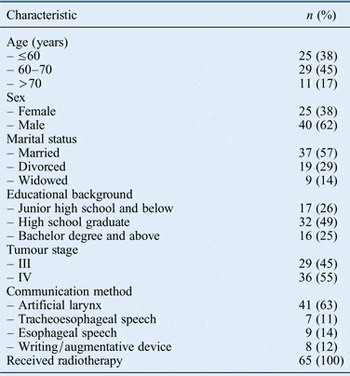
The sociodemographic and clinical characteristics of all 65 patients are shown in Table I. No significance differences in these characteristics were identified between patients. The average age was 64 years (range 51–78 years). Most patients (63 per cent) depended on an artificial larynx for oral communication. In all, 49 per cent of patients had been educated to high school level or above. Patients completed the questionnaires at different time points.
Sociodemographic and clinical characteristics of patients

Visual analogue scale assessment
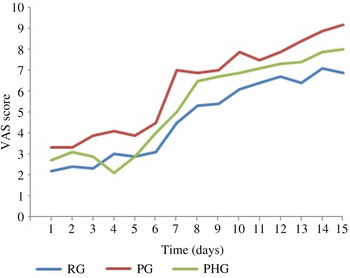
It took all patients approximately one minute to complete the VAS questionnaire. The average VAS score for the routine communication group improved significantly from 3.3 to 7.0 within a week after starting to eat (Figure 1). However, average VAS scores were lower in both the routine communication and physician communication groups than in the patient communication group; there was no significant difference in VAS scores between the routine communication and physician communication groups.
Graph showing visual analogue scale (VAS) scores at 0.5 months after starting to eat in the routine communication group (RG), patient communication group (PG) and physician communication group (PHG).

Quality of life in swallowing disorders questionnaire assessment
Most patients considered the QoL in swallowing disorders questionnaire to be understandable and acceptable. However, 15 patients (23 per cent) required help to fill out the questionnaire, mainly for reading the questions and writing the answers.
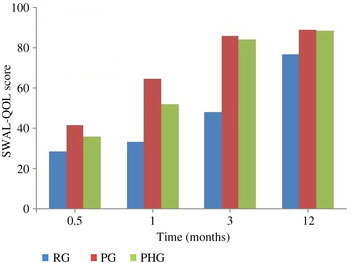
The 65 patients had various degrees of dysphagia, as reflected by their low scores in the QoL in swallowing disorders questionnaire (Figure 2). The average scores for all three groups were lowest at 0.5 months post-treatment: routine communication group, 28.6; patient communication group, 41.8; and physician communication group, 35.8. At 1 month post-treatment, the score was significantly higher for the patient communication group (64.7) than for the physician communication group (51.9), and scores were significantly higher for both the patient communication and physician communication groups than for the routine communication group (p < 0.05). At three months post-treatment, there was no significant difference between the scores of the patient communication and physician communication groups (p > 0.05). However, the score for the routine communication group was significantly lower compared with both the patient communication and physician communication groups (p < 0.05). At 12 months post-treatment, there was no obvious difference in QoL among the 3 groups (Figure 2).
Graph showing post-operative quality of life in swallowing disorders (SWALQOL) questionnaire scores for the routine communication group (RG), patient communication group (PG) and physician communication group (PHG).

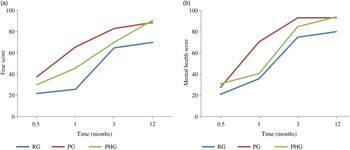
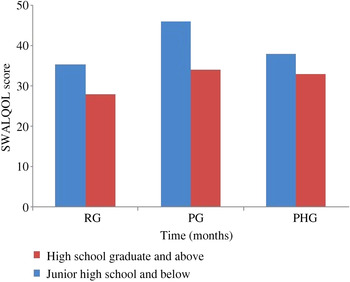
By evaluating several time points, it was apparent that two factors (fear and mental health) significantly improved in all three groups over time, suggesting that these factors have a major effect on swallowing-related QoL (Figure 3). Furthermore, swallowing problems were much more severe in patients educated to high school level and above than in others (Figure 4).
Graphs showing post-operative quality of life in swallowing disorders (SWALQOL) questionnaire (a) fear and (b) mental health subscores for the routine communication group (RG), patient communication group (PG) and physician communication group (PHG).

Graph showing quality of life in swallowing disorders (SWALQOL) questionnaire scores at 0.5 months post-surgery by patient education level.

Discussion
Voice and swallowing disorders are cited as the most important QoL issues by almost 80 per cent of patients undergoing total laryngectomy.Reference Robertson, Yeo, Dunnet, Young and Mackenzie 16 Assessing the effects of laryngeal cancer treatment on QoL requires specific tools because of the resultant voice and swallowing disorders and issues of physical appearance experienced by these patients.Reference Guibert, Lepage, Woisard, Rives, Serrano and Vergez 17 The present study applied VAS assessment and the QoL in swallowing disorders questionnaire to assess the effects of different types of communication intervention, and found that psychological adjustment to cope with dysphagia clearly improved the QoL of total laryngectomy patients.
Total laryngectomy is still restricted to advanced laryngeal or hypopharyngeal carcinoma patients when organ preservation programmes are not feasible or for salvage after failed non-surgical treatment.Reference Pereira da Silva, Feliciano, Vaz Freitas, Esteves, Almeida and Sousa 18 Complications after total laryngectomy such as swallowing and airway problems have a significant impact on patient morbidity, resulting in prolonged hospitalisation and, inevitably, increased healthcare costs.Reference Ganly, Patel, Matsuo, Singh, Kraus and Boyle 19 Furthermore, the psychological response (including feelings of helplessness and/or hopelessness, reduced fighting spirit, and depression) is suggested to decrease the 5- and 10-year survival rates in early-stage breast cancer patients.Reference Matsushita, Matsushima and Maruyama 20 Psychosocial considerations are now being integrated into the assessment of cancer patients. Increasing attention is focusing on resolving the psychological problems of total laryngectomy patients with the aim of improving their QoL.Reference Allison, Nicolau, Edgar, Archer, Black and Hier 21 , Reference Fawzy, Canada and Fawzy 22
Clinicians have developed mental adjustment methods to treat the psychological problems and so improve the QoL of patients. Different coping patterns, particularly emotion-oriented coping styles, can affect the QoL of digestive cancer patients through tackling psychological characteristics such as anxiety and depression.Reference Fawzy, Canada and Fawzy 22 Seeking and using social support such as joining a local self-help group was a coping pattern in cancer survivors and may be an improved coping strategy.Reference Hilton 23 There is also evidence that providing opportunities for sharing can improve family communication and thereby facilitate adjustment. Encouraging participation in support groups, especially those focusing on cancer concerns, provides another avenue for sharing. Moreover, the previous study found that the patient-to-patient communication model resolved swallowing problems and improved patient QoL after horizontal partial laryngectomy.Reference Zheng, Liu, Li, Zhang, Ge and Sun 14
-
• Dysphagia was greatly associated with fear and mental health scores in total laryngectomy patients
-
• The patient-to-patient communication model resolved swallowing problems caused by total laryngectomy in laryngeal cancer patients
-
• Patients receiving the patient-to-patient communication model had a significantly improved QoL
-
• Greatest effects were seen at early post-operative time points
Almost all total laryngectomy patients experienced swallowing problems such as dysphagia and poor QoL. Analysis of pre- and post-treatment data (until the one-year follow up) showed that complaints of dysphagia were greatly associated with fear and mental health issues. A patient-to-patient communication model was established for total laryngectomy patients to assess the effects of different communication interventions. Volunteer total laryngectomy patients shared their own experiences of the healing processes with those who had recently undergone the same procedure to help resolve swallowing problems caused by mental factors. The patient-to-patient communication model was more effective than physician communication at early time points post-treatment. However, both types of communications led to the same effects at a year post-treatment. Patients with a higher educational background had more psychological problems and should therefore be encouraged to accept more communication intervention. The patient-to-patient communication model should therefore be used as the preferred clinical communicational model to resolve swallowing problems in total laryngectomy patients. This study also showed that one week post-treatment was the best time to administer the communication intervention. During this period, the patient QoL improved twofold from 3.3 to 7.0. It is likely that previously treated patients gave current patients greater encouragement and confidence by sharing their experiences.
Conclusion
Strategies to aid mental adjustment could help total laryngectomy patients to cope with dysphagia and improve their QoL. Establishing an efficient combination of previously treated patients and physicians as communicators in which curative patients predominate in the early stages and physicians predominate in the later stages post-surgery may improve swallowing rehabilitation in total laryngectomy patients. Further research is necessary to investigate whether the patient-to-patient communication model can resolve other problems caused by total laryngectomy (such as speech problems), and to analyse whether it can influence the survival rate of total laryngectomy patients.
Acknowledgements
The research was supported by grants from the National Science Foundation of China (81372902, 81402234 and 81572647), the National Science Foundation of Heilongjiang Province (QC2013C117 and ZD201215/H1302), the Foundation of Heilongjiang Health Bureau (2012-624) and the Doctoral Foundation of the Second Affiliated Hospital of Harbin Medical University (BS2013–15).