





The making of a new regime in Syria since December 2024 has given rise to widespread interest in the constitutional history of the country, especially in its very first constitution, the basic law of the Syrian Kingdom in 1920. The historical context of that document and that polity is the long First World War. Between 1917 and 1920, the Allied Powers were in military occupation of most of the provinces of the Ottoman Empire. The army of a small associate power, the Kingdom of the Hijaz, occupied the Suriye province (and its capital Damascus) and the Aleppo province. This Hijazi (often called “sharifian”) army was led by Emir Faysal, a son of al-Hussein, King of the Hijaz (or, as he claimed, the King of the Arabs).
In this chaotic period foreign and local political actors considered contradictory plans for the making of new states. In occupied Damascus a large group of regional notables declared an independent polity, called the Syrian Kingdom with Faysal as king, in March 1920. Their assembly soon discussed a constitutional draft during the spring and summer of the same year. However, a French invasion in July 1920 disrupted this process. The French army claimed to restore order and to implement agreements reached at the Peace Conference according to which these regions were to come under a “class A” mandate of the League of Nations, administered by France. In an ultimatum, they argued that the Damascus government encouraged hostile action against the French army and rejected the new French-minted Syrian money. They also argued that the Hijazi army acted as a sovereign power although Damascus was legally still Ottoman territory, and that the assembly, “without authority,” declared Faysal a king, and therefore the assembly “rebelled” against the Peace Conference. The constitution of the Syrian Kingdom was never implemented.Footnote 1
Scholars have not yet found the original Arabic text of this important document. A French translation of a constitutional text containing 148 articles was published by Philippe David, an administrator in the French High Commission, as early as 1923. In 1955, an Arabic text also containing 148 articles was published by the Arab League’s Higher Arab Studies Institute (under the famous pan-Arabist educator Satiʿ al-Husri’s leadership). In 1972, Khayriyya Qasimiyya, a leading Syrian historian, published an Arabic text of 147 articles from the papers of the politician Hasan al-Hakim. Next al-Hakim himself published this text in his 1974 edition of political documents. Both al-Husri and al-Hakim were in Damascus during the spring and summer of 1920 and served in the nascent government (al-Husri was minister of education; al-Hakim was the director of the post and telegraphs); therefore their publications have largely been accepted as authentic, even though the two texts slightly differ from one another not only in the number of articles but also in Arabic wording and style. Neither of them shared the source of the texts they published. Some have suggested that al-Husri or his colleagues simply retranslated the French translation, published by David, back to Arabic in the 1950s.Footnote 2
I found the original Arabic text of a constitutional draft, printed in a little booklet, among the papers of Henry Ponsot (high commissioner in mandate Syria and Lebanon, 1926–1933) in the French Diplomatic Archives.Footnote 3 The booklet is in a dossier which is part of a large file containing many 1920s constitutions of new polities in the post-Ottoman space (including the Albanian, the Iraqi, and the Transjordanian constitutions), treaties (for instance the Treaty of Jidda between the Saudi Hijazi government and the British in 1927), and correspondence produced during the period from 1928 to 1930 about the “organic law” (statut organique) in the new State of Syria. The booklet and its French translation are in the very last dossier of the file (the arrangement of the material is largely chronologically backward). Ponsot or his office collected these texts during the 1928–30 troubled process of Syrian constitution-making (see more on the archival story at the end of the essay).Footnote 4
The text in this booklet is composed of 151 articles. The title page contains the following statement: “Lāʾiḥat al-Qānūn al-Asāsī allatī waḍaʿat-hā lajnat al-Muʾtamar al-Sūrī al-ʿĀmm al-munʿaqad fī Dimashq. Tuqaddamu hādhihi al-lāʾiḥa ilā hayʾat al-Muʾtamar al-ʿāmma li-yatadhākira bi-hā – sanat 1338 h wa-1919 m.” In English: “The draft of the Basic Law which was created by the [drafting] committee of the General Syrian Congress, convened in Damascus. This draft is submitted to the general assembly of the Congress for deliberation in the hijrī year 1338 and the Christian year 1919.” After reconstructing the editorial process, I will discuss below the problem of dating, the difference in the number of articles from those contained in the published versions, and the question of why this brief text had not previously been found. In the following I will refer to this booklet as AA (Figs. 1 and 2).
Title page of AA. Photo by author.

First page of AA. Photo by author.

FIGURE 2 Long description
The document is a printed page on aged, cream-colored paper with visible binding marks on the left edge. The text is in Arabic script, aligned to the right.
At the top center is a small page number or symbol. Below this is the first heading, Chapter One, followed by a sub-heading regarding general provisions. This section contains four numbered articles (1 through 4). Article 1 is marked with a bold numeral 1 on the right.
The middle of the page features the second heading, Chapter Two, followed by a sub-heading regarding the King and his rights. This section contains four additional numbered articles (5 through 8).
The text is neatly typeset with consistent spacing between lines. There are minor ink stains or aging marks on the left margin near the center and bottom. The left-hand page of the spread is blank.
In referring, as I do above, to “an original Arabic text,” I perhaps need to explain my use of the word “original.” AA is a printed booklet and thus evidently the product of editing and processing what were presumably hand-written draft materials. Its typography is similar to printed documents from Damascus in 1919 and 1920. The letter types resemble the types of the well-known government journal al-ʿAsima (The Capital) which was published by the “Press of the Arab Government” (Matbaʿat al-Hukuma al-ʿArabiyya). The Arabic text in this booklet, with some significant differences, is almost identical to the earliest known published French translation in 1923. There should be little doubt that this booklet was produced in Damascus in the 1919–20 period.
AA represents the earliest surviving Arabic draft of the constitutional text of the Syrian Kingdom and therefore offers the closest witness to its editorial formation. The various published versions reflect later stages of that process, which was interrupted by the French invasion. By comparing these texts, this article makes three contributions. First, it introduces the earliest known Arabic constitutional draft of the Syrian Kingdom. Second, by reconstructing the editorial history of the text through a historical-philological approach to constitution-making, it shows that the General Syrian Congress simultaneously reduced royal authority, strengthened the dynastic position of the descendants of the Prophet (pl. ashrāf) from King al-Hussein’s line, and replaced administrative independence with administrative decentralization in defining relations between the central government and the provinces. Third, by comparing the Arabic text with contemporary French translations, it reinterprets the constitution’s archival afterlife, dates the emergence of the mistranslation of its religion clause, and situates that mistranslation within the practices of French translation and archival bureaucracy rather than in a centrally directed policy. The article concludes by examining private papers in French diplomatic archives and by asking why Arabic copies have not yet surfaced in Syria itself.Footnote 5
Finding a Constitution
To reconstruct an editorial story, we must first examine the surviving documents themselves. The dossier in which I found AA contains two further typewritten French documents from the period. The first one, which I hereafter refer to as FA, is a translation of AA, including its title page and the 151 articles. The title in French is Projet de Constitution — établi par la commission du Congrès Syrien Général tenu à Damas — ce projet de Constitution sera soumis pour délibération au Congrès Syrien réuni en Assemblée Générale — L’an 1338 de l’Hégire — 1919 de l’Ère Chrétienne. In English: The Draft Constitution—created by the committee of the General Syrian Congress, gathered in Damascus—this draft Constitution will be presented for discussion at the Syrian Congress reunited as General Assembly—the year of 1338 according to the Hijra—1919 according to the Christian calendar. No translator is credited; simply the term “Drogmanat” (the “translation office” of a French consulate, likely the one in Beirut) is typed in the header. There are two copies of this document in the dossier.
The second French document, to which I hereafter refer to as FB, is different. Its title is Projet de Constitution qui a été lu au Congrès qui l’a approuvé après une seule lecture – ce projet de Constitution a été soumis à l’approbation du Congrès syrien. L’an 1338 de l’Hégire – l’an 1919 de l’Ere chrétienne. In English: The Draft Constitution which was read in the Congress which approved it after one single reading—this draft Constitution was submitted for acceptance by the Syrian Congress. The year 1338 according to the Hijra—the year of 1919 according to the Christian calendar. It starts with the French translation of an Arabic speech by ʿUthman Sultan (a well-known jurist from Tripoli), introducing the constitutional text to the General Syrian Congress.Footnote 6 Next comes a text of the constitution containing 148 articles. At the end of this text is appended a note to the effect that Louis Mercier, the chief of the political bureau (of the French High Commission), on 26 August 1920 in Beirut testified that it was identical to the original Arabic. There are also two copies of this document in the dossier.
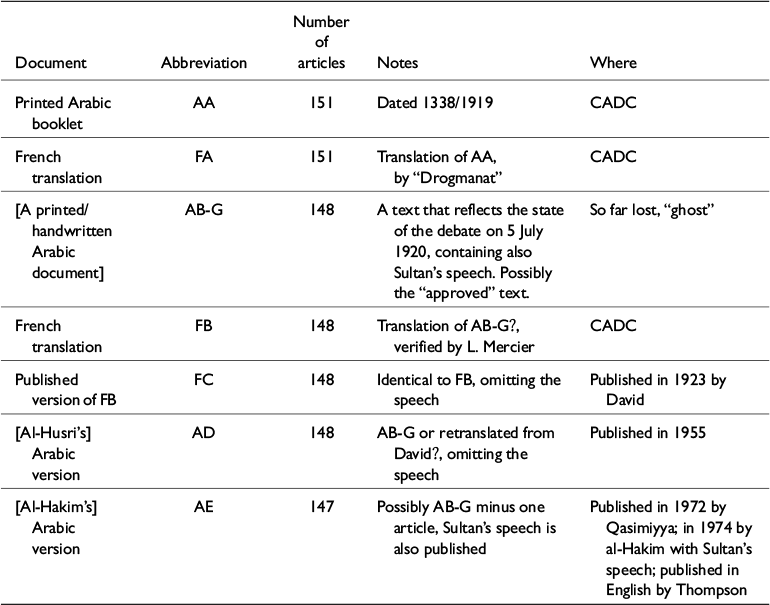
Table 1 summarizes the three documents in the archive (AA, FA, FB) and the three published versions (one French in 1923 and two Arabic; I call them FC, AD, AE, respectively). These documents permit a reconstruction of the constitution’s editorial evolution. My hypothesis is the following. The first constitutional draft (AA) contained 151 articles, which the congress debated in many sittings from late March 1920. When in early July the assembly hastily approved a text of 148 articles for further debate, a copy of this text existed either in hand-written or printed form, in which the speech of ʿUthman Sultan was also included. I name this supposed “ghost” Arabic text of 148 articles in Table 1 “AB-G.” I suggest that FB is a translation of this text and David published it in 1923; possibly both al-Husri and al-Hakim also relied on AB-G, although the latter one modified it by deleting one article, as will be described.
Comparison of Constitutional Texts of the Syrian Kingdom, 1919–20

Table 1. Long description
The table consists of five columns and seven data rows.
* Row 1: Printed Arabic booklet; Abbreviation A A; 151 articles; Notes: Dated 1338/1919; Where: C A D C.
* Row 2: French translation; Abbreviation F A; 151 articles; Notes: Translation of A A, by Drogmanat; Where: C A D C.
* Row 3: A printed or handwritten Arabic document; Abbreviation A B-G; 148 articles; Notes: Reflects debate on 5 July 1920, includes Sultan’s speech, possibly the approved text; Where: So far lost, ghost.
* Row 4: French translation; Abbreviation F B; 148 articles; Notes: Translation of A B-G?, verified by L. Mercier; Where: C A D C.
* Row 5: Published version of F B; Abbreviation F C; 148 articles; Notes: Identical to F B, omitting the speech; Where: Published in 1923 by David.
* Row 6: Al-Husri’s Arabic version; Abbreviation A D; 148 articles; Notes: A B-G or retranslated from David?, omitting the speech; Where: Published in 1955.
* Row 7: Al-Hakim’s Arabic version; Abbreviation A E; 147 articles; Notes: Possibly A B-G minus one article, Sultan’s speech is also published; Where: Published in 1972 by Qasimiyya, in 1974 by al-Hakim with Sultan’s speech, and in English by Thompson.
AA therefore represents the “original” text of the constitution only in the sense that it was the first full draft to be printed for the members of the assembly for debate and discussion. The documentary comparison can be supplemented by contemporary accounts of the drafting process itself. There had already been several stages of editing to reach this draft. First, even before a constitution-drafting committee properly speaking existed, in June/July 1919 there were some written documents of a constitutional nature. Our best source is ʿIzzat Darwaza, the Palestinian secretary of the General Syrian Congress. He writes in his memoirs that Emir Faysal requested in June 1919 that the congress create a committee to frame a constitution. First, the assembly discussed what the basic form of their new polity should be and agreed that it should be a monarchy with a representative government. Next, a “drafting committee” (lajnat al-ṣiyāgha) was “formed” (taʾlīf) for creating the text of this decision. It had three core members: Darwaza, Yusuf al-Hakim, and Saʿid Haydar, plus a number of others whom Darwaza does not identify. They drafted a text of the decision about the regime form (not yet a constitution). This text was discussed in the assembly before the arrival in late June 1919 of the American King-Crane Commission, sent from the Paris Peace Conference, which came to survey the wishes of the peoples in the occupied Syrian Ottoman provinces.Footnote 7 ʿUthman Sultan in his speech given a year later on 5 July 1920 also mentions that the monarchical and at the same time “representative” (niyābiyya; the French translated this term as parlementaire) government was the regime form they chose a year before (that is, in 1919) and they “submitted it to the American committee.” The King-Crane Commission was in or around Damascus between 26 June and 3 July 1919. In the archive of the commission, there is an undated, printed Arabic constitutional draft with 61 articles (a fragmentary document) from this period which framed a federative, post-Ottoman Syrian monarchy with Emir Faysal as king. It is unclear whether it was the work of the first committee of the congress or another body.Footnote 8
The second stage was the creation of a proper constitution-drafting committee. ʿUthman Sultan in his July 1920 speech mentions that a twenty-member committee was “elected” at some point to take charge of writing the constitution.Footnote 9 Darwaza provides ten names of committee members, noting however that “I am not sure; I may have forgotten some or I may have misnamed some.”Footnote 10 He does remember that each member received a salary of 30 British pounds (it is unclear whether this was a monthly amount or a lump sum). The committee elected the old notable Hashim al-Atasi as president and Darwaza as secretary; this small body started its work by comparing various Western constitutions with the Ottoman imperial one. Darwaza, as an effect of the post-Ottoman situation, used this occasion to learn from Turkish legal books, training himself and acquiring some expertise, imitating those members who were graduates of the Ottoman School of Law in Istanbul like al-Atasi, Saʿid Haydar, and ʿUthman Sultan. He underlines that these three were the core makers of the Syrian monarchical constitution. They worked almost every day until at some point (the date is unknown) they reached a full draft.Footnote 11
My assumption is that this full draft is AA. This text sets up a decentralized, federal Syrian monarchy with a “general assembly” (al-majlis al-ʿumūmī; the Ottoman term was meclis-i umumi, the French translated it as parlement, and American scholars today translate it as “congress”) comprising two parts: an elected House of Representatives and an elected Senate. Contained within the draft are twelve chapters which define the polity, the king’s rights, the branches of government, and the working of administratively independent provinces (these provinces are not named; the text does not define the geographical extent of this polity). The terms of the text provide extensive powers to the monarch. In discussing the exact scope of monarchical authority, committee members may have negotiated with Zayd, Faysal’s brother, who served as his plenipotentiary representative when Faysal was away in Europe. They may have been ready with this draft text of 151 articles before the General Syrian Congress suspended its work in early December 1919 and printed this text for distribution among the members of the assembly.
This course of events explains why AA is dated 1338/1919. It must have been printed sometime between September and December 1919 (the hijrī year of 1338 started in late September 1919). This assumption is also supported by the fact that by the time Emir Faysal called the notables again in early March 1920 to assemble and declare publicly his kingship and the independence of the Syrian Kingdom, the draft constitutional text was presented to them in complete form immediately after the second session. Importantly, the contemporary French translation (FA; the original Arabic text of AA is less clear regarding this point) suggests that the translator understood that the drafting committee made a distinction between the convention as a General Congress and the convention as a Constitutional Assembly; the translator possibly thought that they wanted this body to reassemble in the latter function to discuss the text. The congress switched into this constituent mode and started to discuss the articles in AA, one by one, from 23 March 1920.Footnote 12
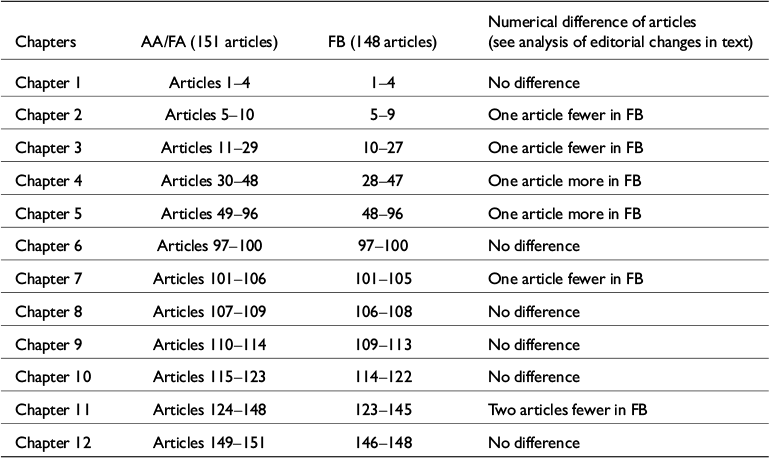
Based on reports in three Arabic newspapers (al-ʿAsima, al-Difaʿ, and al-Kinana), Mari Shahrastan has reconstructed in detail the discussions of the articles during the sessions of the assembly between March and July 1920. She has also highlighted the articles that were sent back to the drafting committee for further work.Footnote 13 Elizabeth Thompson, adding more details from Darwaza’s memoirs and from Rashid Rida’s works, has zoomed in on debates about three topics: the extent of monarchical authority, whether women should have voting rights, and whether and how minority groups should be represented.Footnote 14 Beyond these very helpful reconstructions (we would, for instance, never learn of the debate about women’s voting rights by reading only the constitutional drafts), the following textual comparison unearths more than debates about rights or the fact that an earlier version of the constitution (AA) contains three more articles than a later one does (FB). Table 2 provides an overview of the differing numbers of articles in AA and FB, and in the following I explore the textual changes in some detail.
Quantitative Comparison of Articles by the Chapters of AA/FA and FB

Table 2. Long description
The table consists of four columns: Chapters, A A / F A (151 articles), F B (148 articles), and Numerical difference of articles.
* Chapter 1: A A / F A Articles 1–4; F B 1–4; No difference.
* Chapter 2: A A / F A Articles 5–10; F B 5–9; One article fewer in F B.
* Chapter 3: A A / F A Articles 11–29; F B 10–27; One article fewer in F B.
* Chapter 4: A A / F A Articles 30–48; F B 28–47; One article more in F B.
* Chapter 5: A A / F A Articles 49–96; F B 48–96; One article more in F B.
* Chapter 6: A A / F A Articles 97–100; F B 97–100; No difference.
* Chapter 7: A A / F A Articles 101–106; F B 101–105; One article fewer in F B.
* Chapter 8: A A / F A Articles 107–109; F B 106–108; No difference.
* Chapter 9: A A / F A Articles 110–114; F B 109–113; No difference.
* Chapter 10: A A / F A Articles 115–123; F B 114–122; No difference.
* Chapter 11: A A / F A Articles 124–148; F B 123–145; Two articles fewer in F B.
* Chapter 12: A A / F A Articles 149–151; F B 146–148; No difference.
The textual comparison of AA and FB affirms that over the course of discussions about the constitution the assembly moved to strengthen the power of the government and the majlis ʿumūmī against the king’s authority. These changes also included the acknowledgment of all descendants of al-Hussein, Faysal’s father, King of the Hijaz, sharing common eligibility to be the one to accede to regnal authority over the new polity. Importantly, the changes included a specification that the king also could intervene in the composition of the assembly. Therefore, the trade-off was the reduction of the scope of monarchical power in return for perpetuating the rule of the Meccan ashrāf in Syria and accepting hand-picked royalist senators. The change is reflected textually in the following way: AA Article 6 about the succession order and Article 7 (“if the [male] line of succession of King Faysal dies out the new king will be elected by parliament and ministers with majority”) became included and modified in FB’s Article 6 (the new king was to be elected, by the members of parliament, only from among the descendants of al-Hussein; and FB Article 7 was an addition (“the newly elected king must take an oath before parliament” [prêter serment; in al-Hakim’s version yuqsim amām al-muʾtamar yamīnān]). Similarly, the right of the king to choose the prime minister as specified in AA Article 31 was deleted from FB Article 29; AA Article 34, stipulating that the king must agree to all laws, was slightly changed in FB Article 32 to the effect that the king, after the signature of ministers, only approves the laws; and finally a new article (Article 33) was added in FB that declares that all decrees of the king must be countersigned by the prime minister and the minister in charge of their execution. Importantly, the stipulation of Article 67 in AA according to which all senators are elected is changed in FB’s Article 66, which allows the king to designate some senators, half of the number of the elected ones (so one-third of the total senate would be royal appointees). Taken together, these changes simultaneously reduced the scope of monarchical action but preserved the basic constitutional role of the monarchical institution and allowed royal agency in the senate.
The textual comparison brings further fundamental changes to light. The first of these changes was the introduction of strengthened checks on the government and the general assembly itself. In FB a new article appears (Article 63) that declares that the constitution can only be changed by absolute majority in both houses; FB Article 99 furthermore stipulates that six judges in the Supreme Court, rather than five as originally stipulated in AA, must give their assent for any accusation process to go ahead. Second, as Shahrastan and Thompson have pointed out, in FB there were more generous provisions for minority representation (FB Article 89 allows a representative for every 30,000 minority citizens instead of 40,000 in the House, and FB Article 129 provides for one representative to be elected in the provincial assemblies for every 15,000 minority citizens, rather than for every 20,000 as originally stipulated in AA). Finally, several of the revisions attest to an attempt to tighten relations between the central government and the provinces (muqāṭaʿāt).
The status of provinces is perhaps the most important issue in the political structure of the new polity because it concerns relations in a very diverse post-Ottoman landscape. One can characterize the change in this aspect between AA and FB as one from a federal to a more unitary, centralized but still administratively decentralized logic of organization. AA Article 124 uses the term “independence” (istiqlāl) in describing the internal affairs of the provinces, whereas FB Article 123 modifies this to the principle of “decentralization” (lā-markaziyya in the 1955 Arabic version), a term which had been circulating since the 1900s in debates about reforming the Ottoman Empire.Footnote 15 Forty-three members of the assembly requested this change, and it was accepted during a May 1920 session.Footnote 16 Yet AA Article 3 declares also that the provinces enjoy “administrative independence” (al-muqāṭaʿāt mustaqilla istiqlālān idāriyyān), and this point seems to have remained in the “ghost” version (AB-G) because al-Husri’s 1955 Arabic version uses the same wording. FB Article 3 translated this Arabic phrase as “administrative autonomy” in French. Hasan al-Hakim deleted this article (AA and FB Article 3) entirely from his published version. Indeed, the assembly, it appears, voted to delete this article during its 12 July 1920 session because the members thought that it repeated what was already in the section on provinces (that is, the modified FB Article 123). This revised reference to decentralization instead of independence/autonomy (making the Syrian Kingdom a unitary instead of a federative polity) could have been as significant for the future of the country as was the reconceptualization of the king’s authority.Footnote 17 Taken together, these revisions suggest not the triumph of one constitutional vision over another but a negotiated settlement that redistributed authority among the crown, the representative institutions, and the provinces.
Losing a Constitution?
This very last point prompts us to inquire which text was the final one and exactly what “final” means in such a context. There should be no doubt that AA with its 151 articles was not the final text. Syrian scholars appear divided: al-Husri (or his team) and Shahrastan published the 148-article version, and Qasimiyya and al-Hakim published the 147-article version, from which the administrative autonomy clause was deleted. Al-Hakim’s 147-article version was published by Thompson in English, which may have led some readers to assume that this was the final version.Footnote 18
We may never learn exactly what happened in the very complex period between 5 July and 24 July 1920 in the assembly. Yet we do know that the publications of Qasimiyya and al-Hakim in the early 1970s provoked strong criticism from none other than ʿIzzat Darwaza, the secretary of the drafting committee and the assembly as well. In his memoirs, Darwaza warns explicitly about the texts published by Qasimiyya and al-Hakim. He writes:
A warning about the matter of the Constitution’s articles [published] in some books: In the book al-Hukuma al-ʿArabiyya fi Dimashq 1918–1920 by Dr. Khayriyya Qasimiyya and in the book al-Wathaʾiq al-Tarikhiyya by Hasan al-Hakim, there are texts containing the constitution’s articles. The authoritative opinion (al-marjaʿ) is that these are [only] texts of the draft (al-mashrūʿ, the “project”) which were read for one time only and published in the journals. The articles of the draft were not discussed, and no decision was made about them in their entirety, as we have mentioned before.Footnote 19
In Darwaza’s view, there was no “final” or even “latest” version of the constitution; only a draft about which there was no decision. The historian Shahrastan notes, without textual attestation, that the Lebanese notable Riyad al-Sulh suggested during the 15 July 1920 session that the assembly should decide to accept the constitution and should send it to the government so that the king could approve it as well. This suggestion was accepted, she writes. Yet we must note that it is unclear whether such a decision actually took place and, if it did, whether it was about the 148-article version or about the text that had been modified in the meantime.Footnote 20 Thompson suggests that there was no ratification, although the assembly “approved the text in principle.”Footnote 21 If we believe Darwaza—despite his old age when writing his memoirs, he may be the most reliable source for this matter—there was no decision or vote taken.Footnote 22
The uncertainty surrounding the constitution’s final text has shaped interpretations of its political significance. Thompson recently has suggested that the Syrian Kingdom’s constitution posed a major problem for the French government, especially for Alexandre Millerand (Prime Minister and Minister of Foreign Affairs, soon President) in the summer of 1920, because the French army justified, according to Thompson, its invasion of the inner Syrian lands by the argument that the Syrian Kingdom was “illegal” and that it was an Islamic “theocracy” (which was a threat to the Christian minorities).Footnote 23 She points out that David’s 1923 publication contains a major translation error, which was, in her eyes, deliberate. She writes: “David changed Article 1 so that the constitution appeared to establish a Muslim theocracy,” so that the 1923 published French translation suggested “that Islam was the state religion.” She quotes Millerand’s words: “All traces of Faisal’s illegal, improvised government must disappear.” Finally, she concludes: “The key piece of evidence was the 1920 Syrian constitution, which contradicted France’s image of Syria as a violent theocracy. French intelligence had obtained a copy that was presented on 5 July 1920 to Congress. On 26 August, their Beirut bureau issued an official French translation. The Arabic original then disappeared, presumably under Millerand’s orders.”Footnote 24
The High Commission in Beirut closely watched the activity of the General Syrian Congress during 1919 and 1920. Information on the Arab government in Damascus was vital for French intelligence because they regarded this government as both an enemy and a possibly co-opted partner in the future mandate. They acquired the printed booklet which contained the 151-article text (AA) and immediately translated it; this French translation is our document FA. This translation was accurate; the Drogmanat translated Article 1 properly: “the capital is Damascus and the religion of its king is Islam” (ayant pour capitale Damas et pour religion de son roi l’Islam). However, there is a later mark with a pencil: someone crossed out the term de son roi and substituted it with the term d’état which made it: “the religion of the state is Islam.” This phrase also can be translated to English simply as “the state religion is Islam” (Fig. 3).
Detail from FA. Photo by author.

FIGURE 3 Long description
The document is a typewritten page on aged paper. At the top left, the word DROGMANAT is underlined. Centered below is CHAPITRE I. underlined, followed by the title Dispositions générales.
Below this are two articles:
Art. 1.- Le Gouvernement des pays arabes syriens est un Gouvernement monarchique, civil et représentatif, ayant pour capitale Damas et pour religion de son roi l’Islam. There is a handwritten correction over the words ‘de son roi’ where ‘de son roi’ is crossed out and ‘d’État’ is written above it in cursive.
Art. 2.- Les pays syriens se composent de provinces ayant une unité politique indivisible.
This super-correction must have occurred during the summer of 1920. This is because FB (approved in August 1920 by Mercier) and the type-written French translation of ʿUthman Sultan’s 5 July speech (which precedes FB) already contain the mistranslated phrase. The French translation of Sultan’s speech when describing Article 1 is also that “the state religion is Islam” (sa religion d’Etat est l’Islamisme), although the original Arabic of this speech, which we know from al-Husri and al-Hakim’s editions, is dīn maliki-hā al-islām (“the religion of its king is Islam”).Footnote 25 There is therefore a consistent mistranslation of this phrase across all French texts in the dossier, after the crossing out of the correct first translation. Who was responsible for this change is unknown. David is unlikely to be the one, unless he was already serving at the High Commission by the summer of 1920.Footnote 26
However tempting it may be to read this as a deliberate conspiracy, there is no evidence to suggest that this mistranslation was part of a conspiratorial French project instigated by Millerand to efface “all traces of Faysal’s government.” The very fact of David publishing the translation as early as 1923 contradicts any such interpretation. Even if David’s intention was to argue, in a familiar racist framework, that the Syrians were unable to create a functioning government, the very fact of publishing the document so early would appear to have achieved the very opposite of rendering the Arab government invisible. Still, the deed was done: all subsequent interpretations relying on David’s published version made the mistaken assumption about the new polity’s religion being Islam until Syrian scholars published the Arabic texts.Footnote 27
The French Archival Question
Understanding how this mistranslation came to dominate later historiography requires a look at the archival history of the document. One is bound to ask: Why did it take about a hundred years to find an original Arabic text of the constitution, so fundamental to both Syrian statehood and the history of Arab nationalism in general? As previously noted, Thompson suggests that this was because Millerand gave orders for it to be hidden away from view—a move that, as I have explained above, seems unlikely. Rather, to explain the rarity of a printed text, we must explore first the circumstances of its printing. We do not know how many copies of AA existed. There was a shortage of paper in Damascus during 1919–20. There must have been only eighty-plus copies printed for the members of the assembly.Footnote 28 Second, the text was a draft that members of the assembly were actively changing, making its historical value possibly less in their eyes and so easily disposable. Third, we must turn to the archival story.
The Ponsot Papers are part of an archival subcollection called Papiers d’agents – Archives Privées (PA; Papers of Employees—Private Archives) within the large archival unit Entrées exceptionnelles et collections (Exceptional Acquisitions and Collections) in the Centre des Archives Diplomatiques, La Courneuve (CADC). These are private papers of ministers and employees who had an important mission or function in the Foreign Ministry; usually they donated these papers to the archive when they reached old age, or their family did so after their death. Despite the term “private,” these collections often contain official documents that the high bureaucrats took with them when transferring from one post to another. Although rarely studied, a number of documents in this archival unit bear importance for modern Middle Eastern history, including, for instance, the letters of François Georges-Picot (of Sykes-Picot fame) written to Jules Albert Defrance (French consul-general in Cairo during World War I) during 1915–16 among the Defrance Papers (56PAAP). The Ponsot Papers are another example of a private collection that contains important official documents for modern Middle Eastern history.Footnote 29
After his service as high commissioner in Lebanon and Syria ended in 1933, Ponsot took thousands of High Commission documents, among them the 1928 constitution dossiers, to France. This was his habit: he systematically preserved and took official documents from his previous and subsequent posts, too; the most important such positions also include his post as résident général au Maroc (resident general in Morocco; 1933–36), as French ambassador to Turkey (1936–38), and as the French representative of the High Commission for Refugees in 1945 and the chairman of the Preparatory Commission for the International Refugee Organization, the first UN agency specializing in refugees (1946–52). After Ponsot died in 1963, his widow transferred this private collection to the archive of the Foreign Ministry during the period of 1963–65. Here the papers remained uncatalogued for a long time; it appears that a first description of the documents was created only in 1989. In 2012 and 2018 new sets of documents arrived from the family. The final catalog of the three batches was ready in September 2019. Shortly after this date I conducted my research, and this is when I found AA. Yet this is not the end of the story of the Ponsot Papers. At the time of finalizing this article (July 2026), the online catalog of the Ponsot Papers displays one more donation from 2022.Footnote 30
Was Ponsot aware of the historical importance of AA? He or his office keenly studied and compared various constitutions during the 1928–30 constitutional process, extending their attention even to the constitutions in British Transjordan and Iraq; naturally, they examined all Syrian constitutional documents, including what they called the “Faysalian constitution” (AA) as part of a dossier which has the term “Hijaz” written on its title page. At some point the High Commission translation bureau must have sent the dossier (containing AA, FA, etc.) to Ponsot or to his office. Did Ponsot know that FA contained a possibly deliberate mistranslation introduced in 1920? Were there archival murmurs and memories in the High Commission in the late 1920s about what happened during the occupation period? Did he know at the time that the Arabic text of this draft constitution was nowhere to be found except in the High Commission?
Instead of attributing too much agency to Millerand’s undoubtedly wicked intentions, to explain the absence of documents we should understand the labyrinth of French bureaucracy and more importantly this peculiar French phenomenon, whereby high agents of the state might frequently take a considerable number of official papers with them when they moved and retired—in addition to the doubtless existing practice of the deliberate destruction of sensitive documents. Ponsot’s case illustrates this practice. His private collection was not confined to documents related to Syria and Lebanon but also included documents from nearly all his posts throughout his life. It is high time that Middle East historians explore and analyze the private archival practices of French bureaucrats related to the Middle East and North Africa.Footnote 31
My interpretation, however, does not account for why original Arabic copies of either the 151-article draft (AA) or the 148-article draft have not yet been located within Syria itself (or Lebanon or Palestine or Jordan). Given that there were more than eighty members of any given configuration of the General Syrian Congress, there must have been at least as many printed copies of AA, to say nothing of the manuscript drafts written by Sultan, Haydar, al-Atasi, and Darwaza. Possible explanations for the absence of attested copies include the limited printing run of AA and the panic that the French invasion prompted among many members of the congress, who then fled Damascus without paying attention to their documents. (Indeed, soon the French sentenced some to death or to imprisonment with property confiscation in absentia, although other former congress members continued to serve in various government capacities). Copies may yet survive in family collections, in the (formerly Asad) National Library of Syria, or even in some dossiers at the Center of Historical Documents in Damascus (Markaz al-Wathaʾiq al-Tarikhiyya, currently dysfunctional, although its collections are preserved).
Taken together, the textual and archival evidence allows us to reconsider both the making of the constitution and the reasons for the Arabic original’s later disappearance. The Arabic text of an early constitutional draft (AA) to set up the Syrian Kingdom has helped us to reconstruct the drafting committee’s original vision of giving extended powers to the monarch and independence to the provinces (that is, a loose post-Ottoman monarchical federation), and its evolution through the debates in the assembly. The textual comparison among the unpublished and published versions shows that the curtailing of monarchical power was balanced by giving other concessions. The discovery of the booklet in the French Diplomatic Archives reopens questions about translation (and mistranslation) and translators in interwar imperial bureaucracies, about archiving practices in French interwar and Cold War bureaucracy, about private archives in Syria and Lebanon, about the issue of al-Husri and al-Hakim’s sources, and about why the publication of the 147-article version in the early 1970s by Qasimiyya and al-Hakim provoked such a critical reaction from Darwaza. Of continuing relevance to Syria today is the assembly’s replacement of provincial administrative independence with administrative decentralization, indicating a tendency toward tighter political organization than the drafting committee had originally envisaged. The rediscovery of the Arabic draft restores one missing stage in the constitutional history of the post-Ottoman Middle East while simultaneously reminding us how archival silence and survival shape historical interpretation.
Acknowledgments
The author would like to express his gratitude to Clément Noual, Jean-Philippe Dumas, Raïssa Uwingabiye, Malika Zeghal, and Thomas Welsford for their assistance with various aspects of this article, and to the Gerda Henkel Foundation and the Weatherhead Center for International Affairs (Harvard University) for their financial support during this research.




 Open access

