INTRODUCTION
The yield of oilseed rape (Brassica napus) that is achieved on farms in the UK has not risen since the 1980s. There are similar observations from other countries (Berry & Spink Reference Berry and Spink2006). Several agronomic reasons have been put forward to explain the lack of yield improvement in the UK despite the introduction of higher yielding varieties (Spink & Berry Reference Spink and Berry2005). These include: short rotations, zero or sub-optimal cultivation methods, early drilling, the establishment of super-optimal plant populations, sub-optimal fungicide use, inadequate sulphur and incorrectly timed nitrogen applications (Spink & Berry Reference Spink and Berry2005). Many of these practices have been employed to reduce the costs of growing oilseed rape, but can also reduce yield.
Early sowing, the establishment of a dense plant population and early applications of nitrogen fertilizer result in large crop canopies, which can reduce yield via two mechanisms. Firstly, the crops are more prone to lodging (Lunn et al. Reference Lunn, Spink, Wade and Clare2003), which has been shown to reduce yield by up to 50% (Baylis & Wright Reference Baylis and Wright1990; Armstrong & Nicol Reference Armstrong and Nicol1991). Secondly, fewer seeds/m2 are set as a result of greater competition for resources because more light is reflected and absorbed by the flower layer (Mendham et al. Reference Mendham, Shipway and Scott1981; Leterme Reference Leterme1988; Bouttier & Morgan Reference Bouttier and Morgan1992). A trend towards warmer over-winter temperatures (Hulme et al. Reference Hulme, Jenkins, Lu, Turnpenny, Mitchell, Jones, Lowe, Murphy, Hassell, Boorman, McDonald and Hill2002) will increase the likelihood of developing an overlarge canopy. Cultivation methods that cause a consolidated layer of soil have been shown to restrict rooting (Blake et al. Reference Blake, Spink and Bingham2006), leading to less water being extracted from the soil, which is likely to reduce canopy survival and shorten the period of seed filling in dry years. Greater disease arising from shorter rotations and sub-optimal fungicide use will result in early canopy death and reduced radiation use efficiency.
It has been estimated that the yield potential of oilseed rape in the UK is 6·5 t/ha (Berry & Spink Reference Berry and Spink2006). This would be achieved if (1) the flower cover is restricted to 0·4 allowing 0·6 of incident light to be transmitted to the photosynthetic tissues, which will facilitate the production of 130 000 seeds/m2, (2) lodging is avoided, (3) the duration of seed filling is increased from 40 to 46 days with a solar radiation use efficiency of 0·75 g seed/MJ and (4) a tenth of the yield comes from stem reserves accumulated before flowering. It is clear that some of these targets are not easy to achieve using current agronomic practices because cost saving and time constraints mean that it is not always possible to employ the optimum practice.
Chemical growth regulation may be used to help achieve some of the growth targets required to achieve potential yield. Triazole-type compounds, including metconazole and tebuconazole, are currently used on oilseed rape grown in Europe for both their fungicidal and growth regulatory properties. Their growth regulatory activity results from the inhibition of the early steps of gibberellin biosynthesis (Rademacher Reference Rademacher2000). Gibberellins promote longitudinal shoot and leaf growth, primarily by promoting cell elongation. They are also involved with inducing bolting in long-day plants, seed development and fruit set. Many pre-cursors of gibberellic acid are used in the biosynthesis of other growth hormones, including cytokinins and abscisic acid. Inhibiting gibberellic acid, therefore, has the potential to manipulate many aspects of plant growth.
It may be hypothesized that anti-gibberellin compounds may improve three key aspects of growth, including lodging resistance by shortening the plants, seeds/m2 by restricting canopy growth in crops that would otherwise grow too large, and rooting by altering the partitioning of assimilate between the shoot and roots. The present paper tests the effect of metconazole on lodging resistance, seeds/m2 and rooting, and investigates to what extent the observed changes in growth affect seed yield.
METHODS
Experiments
Datasets from 13 experiments have been analysed. In each experiment, diseases were minimized by applying fungicides without growth regulatory activity (difenoconazole or a mixture of carbendazim and flusilazole) on two dates. The first application was made in late autumn when the plants had between four and eight true leaves; the second application was made in the spring, during early stem extension. There were five different experimental designs comparing the effects of metconazole at a range of rates and timings on crops established to represent the full range of those found in commercial practice. Trials were carried out at ADAS Rosemaund (2·6°W, 52·1°N) on a silty clay loam (Bromyard series), ADAS High Mowthorpe (54·1°N, 0·5°W) on a shallow silty clay loam overlying chalk (Wold series) and ADAS Boxworth (52·2°N, 0·0°W) on a clay (Hanslope series). Nitrogen fertilizer was applied as ammonium nitrate granules (345 g N/kg) in the spring and the rates were based on recommendations for the soil type and nitrogen index of each field (Anon 1994, 2000).
Design 1
Field trials were carried out at ADAS Rosemaund and ADAS High Mowthorpe in the harvest year of 1999. At each site, two trials were set up in one field with different cultivars (Apex, a short conventional inbred variety sown at 120 seeds/m2, or Pronto, a tall restored hybrid sown at 70 seeds/m2). Each trial was subjected to 19 plant growth regulator (PGR) treatments, of which seven included metconazole and one was untreated. The metconazole treatments were applied at several growth stages ranging from 9 true leaves (growth stage (GS) 1·09) to early pod set (GS 5·2) (Sylvester-Bradley & Makepeace Reference Sylvester-Bradley and Makepeace1984) at the rates of 0·6 and 1·2 litre/ha. At each site, the PGR treatments were applied to each of the two trials on the same dates. The treatments were arranged in a randomized block design with four replicates and an individual plot size of 24×3·5 m. See Lunn et al. (Reference Lunn, Spink, Wade and Clare2003) for further experimental details.
Design 2
Four field trials were set up at ADAS Rosemaund and ADAS High Mowthorpe in the harvest years of 2000 and 2001. Each trial included four treatment factors: (1) cultivar (Apex or Pronto), (2) sowing date (normal (mid-August to early September) or late (mid-September to early October)), (3) seed rate (60 or 120 seeds/m2) and (4) metconazole (1·2 litre/ha) applied at two timings: (i) between 15 and 30 March (GS 3·3–3·5) or (ii) between 10 and 25 April (GS 3·6–3·9). In 2001, metconazole at 0·6 litre/ha was also included at the March timing. The treatments were arranged in a 4-way factorial design with four replicates and an individual plot size of 24×3·5 m. See Lunn et al. (Reference Lunn, Spink, Wade and Clare2003) for further experimental details.
Design 3
Field trials were set up at ADAS Rosemaund and ADAS Boxworth in the harvest year of 2005. At each site cv. Winner (a tall inbred variety) was sown in early September at a seed rate of 6 kg/ha. Each trial included 11 cultivation, agronomic and PGR treatments, including minimum tillage with and without metconazole applied at 0·6 litre/ha in late March. The treatments were arranged as a randomized complete block design with four replicates and an individual plot size of 24×3·5 m. See Blake et al. (Reference Blake, Spink and Bingham2006) for further experimental details.
Design 4
Field trials were set up at ADAS Boxworth, ADAS Rosemaund and ADAS High Mowthorpe in the harvest year of 2006. In each trial, cv. Winner was sown in early September at a seed rate of 6 kg/ha. Two treatment factors were investigated including: (1) cultivation (plough, minimum tillage (MT), MT with deep soil loosening or MT without early nitrogen fertilizer) and (2) metconazole (nil, 0·6 litre/ha in autumn, 0·6 litre/ha in spring or 0·6 litre/ha in autumn followed by 0·6 litre/ha in spring). Autumn treatments were applied before stem extension on 9 November at High Mowthorpe, 14 November at Boxworth and 9 December at Rosemaund. Spring treatments were applied during stem extension (GS 3·3–3·6) on 24 April at High Mowthorpe, 21 April at Boxworth and 5 April at Rosemaund. The treatments were arranged as a two-way factorial design with three replicates and an individual plot size of 24×3·5 m at ADAS Boxworth and High Mowthorpe and with four replicates and an individual plot size of 12×3·5 m at ADAS Rosemaund. Additional treatments investigated included autumn metconazole (1·2 litre/ha) and spring metconazole (1·2 litre/ha), each with the minimum tillage cultivation treatment.
Design 5
Field trials were set up at ADAS Boxworth and ADAS Rosemaund in the harvest year of 2007. In each trial, cv. Castille (a short inbred variety) was sown in early September. Treatment factors included: (1) rain shelters during seed filling at ADAS Rosemaund only, (2) seed rate (40 or 80 seeds/m2) and (3) metconazole (nil, 0·6 litre/ha in autumn, 0·6 litre/ha in autumn and 0·6 litre/ha in spring, 0·6 litre/ha in spring or 1·2 litres/ha in spring). Autumn treatments were applied on 20 October at ADAS Rosemaund (GS 1·4) and on 18 October at ADAS Boxworth (GS 1·5). Spring treatments were applied on 26 March (GS 2·9–3·1) at both ADAS Rosemaund and ADAS Boxworth. At ADAS Rosemaund, the trial was arranged as a split-plot design with rain shelter as the main plot and seed rate and PGR treatment randomized within the main plots. Each treatment was replicated three times and each individual plot was 24×3·5 m. At ADAS Boxworth, the seed rate and PGR treatments were fully randomized and each treatment was replicated four times with an individual plot size of 24×3·5 m.
Measurements
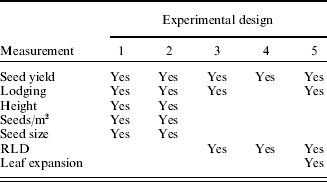
If any disease symptoms were observed during trial visits, the proportion of all green leaf area with disease symptoms was assessed on 25 plants per plot. A summary of the measurements recorded in each experimental design is given in Table 1. Seed yield was measured using a small plot combine. The harvested area was c. 48 m2 in all experiments apart from Design 4 at ADAS Rosemaund, in which the harvested area was c. 24 m2. Lodging was defined as the stems leaning at an angle of at least 10° from the vertical. Close to the time of harvest, the proportion of the plot area that was lodged was visually assessed to the nearest 0·05. Crop height was measured at the end of flowering by measuring the height to the top of the terminal raceme on 10 plants per plot. Seed weight at zero moisture was measured on a representative seed sample of 10 g. The seed was counted on a Numigral seed counter and corrected for moisture using the results from a Dickey John GAC 2000 grain analysis computer. Seeds/m2 were calculated from the seed weight and combine seed yield.
Summary of measurements recorded in each of the five experimental designs that were investigated over the course of this study

In November, leaf length was measured as the distance from the leaf tip to the stem on 10 plants per plot. Leaf 1 was defined as the latest fully emerged true leaf. The lengths of leaves 1, 2 and 3 were measured. In order to measure the green area index (GAI), all above-ground plant material from within a quadrat measuring 1·2×0·6 m was collected from each plot, 0·2 of the sample weight was taken and the area of the green lamina and stems was measured using a moving belt leaf area meter (Li-Cor Model 3100, Delta-T Devices, Burwell, Cambridge, UK).
Root sampling was conducted immediately after combine harvest. Six soil cores (26 mm diameter) were taken from each plot to a depth of 1 m and sub-divided into 0·2 m lengths. Soil cores were then frozen to minimize root degradation.
Roots were extracted from the soil using a root washer system (Delta-T devices Ltd, Burwell, Cambridge, UK) and collected on a 550 μm wire mesh filter. Any non-root material was removed from the root samples. Root length was then measured using a Win-RHIZO STD LC1600+ scanner (Regent instruments Inc., Sainte Foy, QC, Canada). The root length density (RLD) was then calculated for each 0·2 m soil horizon from the measured root length and the volume of the extracted soil core. In Design 3, all roots were washed and length measured. In Design 4, the roots from the 0·4 to 1·0 m soil horizons of all PGR treatments were washed and measured for the ADAS Rosemaund trial. At ADAS Boxworth, the untreated and metconazole applied in the spring at 1·2 litres/ha were washed and measured.
Statistical analysis
Analysis of variance (ANOVA) procedures for fully randomized block designs were used to test for differences in yield, height, lodging, seeds/m2 and seed size between the PGR treatments and calculated their standard errors of differences. A two-way ANOVA was used to analyse RLD, in which the PGR treatment formed one factor and the depth of the soil horizon formed the other factor. All data that were analysed using ANOVA were normally distributed. Simple linear regression analysis with groups was used to assess whether height and the proportion of the area lodged were significantly related and whether the relationship was different between the experimental trials. A two-tailed t-test for populations of equal variance was used to investigate whether metconazole increased yield more when applied to crops with a GAI greater than a predetermined threshold compared with crops below the threshold GAI. A two-tailed paired t-test for populations of equal variance was used to investigate whether metconazole affected yield, seeds/m2, seed weight and RLD across a number of experiments. The variance ratio was calculated for each set of data used in the t-tests, which confirmed equal population variances. Genstat 8.1 (www.genstat.com, verified 14 January 2009) was used for all statistical analyses.
RESULTS
In Design 5 at ADAS Rosemaund, the proportion of green leaf area infected with phoma leaf spot (Leptosphaeria maculans (Phoma lingam)) at GS 1·7 ranged from 0·0002 to 0·0035 between plots. This must be regarded as a low level of infection. In the other experiments, negligible amounts of disease were observed.
Height and lodging
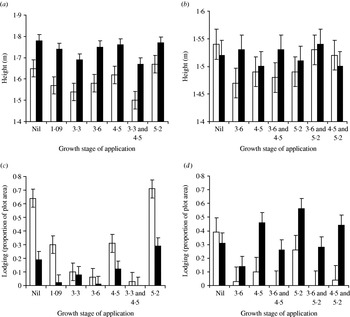
In Design 1, significant height reductions were observed at Rosemaund from metconazole (1·2 litre/ha) applied at green bud (GS 3·3) and at High Mowthorpe from applications made at late green bud (GS 3·6) (P<0·05). It should be noted that no treatments were made earlier than GS 3·6 at High Mowthorpe. The height reductions ranged from 70 to 110 mm (Fig. 1). Splitting the applications between early green bud and mid-flowering stages increased the reduction in height by 20–40 mm. Delaying applications until GS 4·5 or after generally resulted in smaller and non-significant reductions in height. Significant reductions in lodging were achieved from applications made from just before the onset of stem extension (GS 1·09) to mid-flowering (GS 4·5) (P<0·05; Fig. 1). The greatest reductions in lodging resulted from applications made at late green bud (GS 3·6). The response of Apex and Pronto to PGR could not be compared because they were grown in different trials; however, both varieties tended to have a similar pattern of responses to the PGR treatments (Fig. 1).
Effect of timing of metconazole on height for (a) ADAS Rosemaund 1999 and (b) ADAS High Mowthorpe 1999, and on lodging for (c) ADAS Rosemaund and (d) ADAS High Mowthorpe, all from Design 1. Open columns, cv. Apex; closed columns, cv. Pronto. Metconazole was applied at 1·2 litre/ha for single GS applications and at 0·6 litre/ha per application for split GS treatments. Error bars are ±1 s.e.d. (54 d.f.).

In Design 2 across both sites and varieties in 2001, metconazole (1·2 litre/ha) reduced height by, on average, 100 mm when applied in March (GS 3·3–3·5) or April (GS 3·6–3·9). Height reductions of 60 mm were achieved with rates of 0·6 litre/ha. At Rosemaund, metconazole applied at 1·2 litre/ha in March or April reduced the proportion area lodged from 0·34 to 0·16 and 0·06, respectively (P<0·05). Metconazole applied at 0·6 litre/ha in March reduced the proportion area lodged to 0·19. In 2001, there were no interactions between PGR and variety for height or lodging at either site. In 2000, height was not measured and there was very little lodging.
In Design 3, metconazole applied at 0·6 litre/ha in late March reduced the proportion of the area lodged from 0·76 to 0·08 (P<0·001) at Boxworth and from 0·36 to 0·14 at Rosemaund (P<0·05). In Design 5, metconazole applied in autumn or in late March at 0·6 and 1·2 litre/ha did not significantly reduce lodging.
Linear regression between height and lodging showed that parallel lines fitted to each experiment in Designs 1 and 2 accounted for 0·6 of the variation (P<0·001). On average, each 50 mm reduction in crop height reduced the absolute proportion of the plot area that was lodged by 0·1. Therefore, height is clearly a key determinant for lodging control. However, it is also apparent that significant reductions in lodging have been observed after relatively small and non-significant reductions in height. This indicates that metconazole may have reduced lodging risk by affecting other plant characters in addition to height.
Seed number and seed size
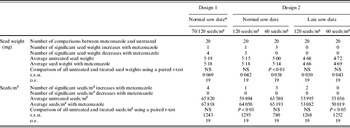
In Design 2, metconazole significantly increased the number of seeds/m2 in the treatments sown at 120 seeds/m2 at normal time from 59 894 to 64 050 seeds/m2 (P<0·01; Table 2). Metconazole did not affect seed number in the other treatments sown at normal time in Design 1 or 2 (Table 2). Metconazole significantly reduced the number of seeds/m2 in the treatments sown late at 60 seeds/m2 from 53 000 to 50 000 seeds/m2 (P<0·05; Table 2). Overall, metconazole had little effect on seed weight, apart from Design 2, where it significantly increased seed weight for the 60 seeds/m2 treatment sown at normal time from 5·00 to 5·14 mg (P<0·01; Table 2).
Summary of effects of metconazole on seed weight and seeds/m2

* 70 seeds/m2 for hybrid variety and 120 seeds/m2 for conventional variety.
Metconazole had different effects on seeds/m2 depending on the size of the crop canopy at the time of application. In Design 2, it was observed that metconazole increased seeds/m2 from 63 200 to 66 400 (P<0·05) when applied in March to crops with a GAI of greater than one, but did not affect the seed weight. For crops sprayed in April with a GAI greater than two, metconazole increased seed number by 2300 seeds/m2 and increased seed weight from 5·12 to 5·29 mg (P<0·05).
Rooting
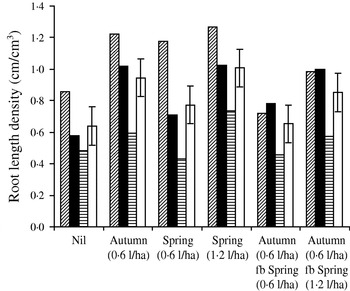
In Design 4 at ADAS Rosemaund, RLD was measured within the 0·4–0·6, 0·6–0·8 and 0·80–1·0 m horizons. RLD declined significantly with depth in the soil (P<0·001). The greatest RLD was 1·00 cm/cm3 at 0·4–0·6 m, followed by 0·85 cm/cm3 at 0·6–0·8 m, followed by 0·56 cm/cm3 at 0·8–1·0 m. Across the three depths, metconazole applied either in autumn at 0·6 litre/ha, or in spring at 1·2 litres/ha, or both treatments applied together, increased RLD from 0·64 cm/cm3 to between 0·85 and 1·01 cm/cm3 (P<0·05; Fig. 2). No interaction was observed between soil depth and metconazole treatment. Metconazole applied in spring at 0·6 litre/ha or in autumn at 0·6 litre/ha followed by a spring application at 0·6 litre/ha did not significantly affect RLD (Fig. 2). At Boxworth, plots treated with metconazole in the spring at 1·2 litre/ha did not affect RLD.
Effect of metconazole treatments on the RLD between soil depths of 0·4 and 1·0 m from Design 4. Error bars are ±1 s.e.d. (47 d.f.) for the average RLD between 0·4 and 1·0 m. Diagonal hatch, 0·4–0·6 m; black, 0·6–0·8 m; horizontal hatch, 0·8–1·0 m; white, 0·4–1·0 m.

In Design 5 at ADAS Boxworth, metconazole applied in spring at 0·6 litre/ha increased the RLD in the 0·4–1·0 m horizon from 0·07 to 0·11 cm/cm3 (P<0·05). The same treatment applied in autumn had no effect. At ADAS Rosemaund, no effects were observed from metconazole applied in autumn or spring at 0·6 litre/ha within the unsheltered treatments.
In Design 3 at ADAS Rosemaund, metconazole applied in spring at 0·6 litre/ha increased the RLD in the top 0·2 m from 2·60 to 3·43 cm/cm3 and from 0·61 to 1·28 cm/cm3 in the 0·4–0·6 m horizon (P<0·05; Blake et al. Reference Blake, Spink and Bingham2006). At Boxworth, metconazole applied in spring at 0·6 litre/ha did not significantly affect RLD at any soil depths.
The effect of spring-applied metconazole on rooting was tested eight times across seven trials. A two-tailed paired t-test carried out on the replicate values of these trials showed that, on average, metconazole applied in spring increased the RLD between 0·4 and 1·0 m from 0·48 to 0·60 cm/cm3 (P<0·05; t=2·07, 26 d.f.).
Yield
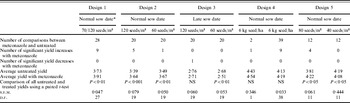
Across the five Designs, there were 173 comparisons between untreated and metconazole-treated crops. Metconazole significantly increased yield on 28 occasions and reduced yield once (P<0·05; Table 3). Disease was minimized to negligible levels in each experiment using fungicides without growth regulatory activity, so any yield effects were likely to be due to the growth regulatory activity of metconazole. On average, the metconazole treatments increased yield by 0·09 t/ha. However, there was a large amount of variation about this average, a large proportion of which was explained by the size of the crop at the time of spraying and, to a lesser extent, the timing of the treatment.
Summary of effects of metconazole on yield (t/ha)

* 70 seeds/m2 for hybrid variety and 120 seeds/m2 for conventional variety.
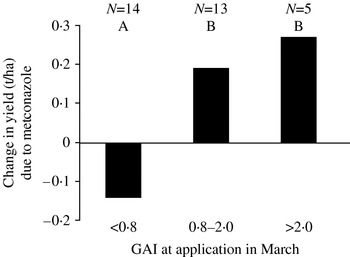
It is clear that metconazole caused large yield increases when applied to crops with higher seed rates. In Design 2, metconazole increased the yield of crops sown at a normal time at a rate of 120 seeds/m2 by 0·30 t/ha (P<0·01), but did not significantly affect the yield of crops sown at 60 seeds/m2 (Table 3). Similar effects were observed in Design 5, in which metconazole increased the yield of crops sown at 80 seeds/m2 by 0·41 t/ha (P<0·05), but decreased the yield of crops sown at 40 seeds/m2 by 0·11 t/ha (P<0·05). The size of the crop canopy at the time of treatment is therefore very important for determining the effect of metconazole on yield (Fig. 3). When metconazole was applied to crops in March (GS 3·3–3·5) with a GAI of between 0·8 and 2·8, it increased yield by 0·21 t/ha compared with a decrease of 0·14 t/ha when applied to crops with a GAI of less than 0·8. This difference in response was significant (P<0·05; t=2·07, 13 d.f.). A similar relationship was also observed for applications made in April (GS 3·6–3·9), when the threshold GAI above which yield was increased was 2·0. There were no interactions between variety and PGR treatment for yield, apart from the treatment sown early at high seed rate at High Mowthorpe in 2001, where the PGRs increased yield of the inbred variety Apex but had no effect on the hybrid variety Pronto (P<0·05).
Relationship between the metconazole effect on yield and the GAI in March when metconazole was applied at 1·2 litre/ha. Data from Design 2 carried out at ADAS Rosemaund and ADAS High Mowthorpe in 2000 and 2001 with cvs Apex and Pronto. A and B denote significant differences (P<0·05) estimated using a two-tailed t-test.

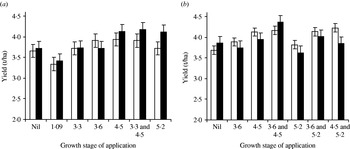
In Design 1, the greatest yield increases tended to be observed for applications made between late green bud (GS 3·6) and mid-flowering (GS 4·5) stages (Fig. 4). A similar trend was observed in Design 2, in which the average response of the early sown crops to applications made in April (late green bud to yellow bud (GS 3·9)) was 0·25 t/ha (P<0·05) and the average response to March applications (early green bud (GS 3·3–3·5)) was not statistically significant.
Effect of timing of metconazole on yield. (a) ADAS Rosemaund 1999 and (b) ADAS High Mowthorpe 1999, both from Design 1. cv. Apex (white), cv. Pronto (black). Metconazole was applied at 1·2 litre/ha for single GS applications and at 0·6 litre/ha per application for split GS treatments. Error bars are ±1 s.e.d. (54 d.f.).

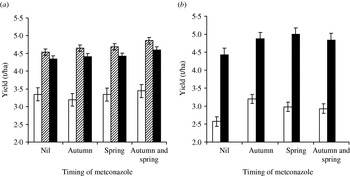
Autumn applied metconazole (0·6 litre/ha) was investigated in Designs 4 and 5. In Design 4 at High Mowthorpe and Rosemaund, autumn treatments followed by spring treatments increased yield by 0·32 and 0·25 t/ha, respectively (P<0·05; Fig. 3). Individual autumn and spring treatments did not significantly affect yield (Fig. 5). These effects were consistent across the cultivation treatments that were investigated. No effects were statistically significant at ADAS Boxworth. In Design 5 at Boxworth, the individual autumn and spring treatments increased the yield by 0·63 and 0·41 t/ha, respectively, for the crops sown at 80 seeds/m2 (P<0·05; Fig. 3). No significant effects were observed at Rosemaund from the autumn and spring treatments (Fig. 3).
Effect of timing of metconazole (0·6 litre/ha) on yield from (a) Design 4 and (b) Design 5 treatments sown at 80 seeds/m2 only. ADAS Boxworth (white), ADAS High Mowthorpe (hatched) and ADAS Rosemaund (black). Error bars are ±1 s.e.d. Design 4: 56 d.f. for each site. Design 5: 27 d.f. for ADAS Boxworth and 43 d.f. for ADAS Rosemaund.

DISCUSSION
A review of 13 experiments, which included 173 comparisons between metconazole-treated and untreated crops, showed that a large proportion of the variation in yield response to metconazole, in the presence of negligible amounts of disease, was explained by the size of the crop canopy at the time when it was treated. Crops with a GAI of 0·8 or more in March had an average response of +0·21 t/ha to metconazole applied at 1·2 litre/ha, whereas crops with a GAI of less than 0·8 had an average response of −0·14 t/ha. It should be recognized that some of the experimental treatments resulted in what would be considered very small and late-developing crops in commercial practice, e.g. 12 of the 32 test crops had a GAI of less than 0·5 in March. A survey of commercial oilseed rape crops in 2006 showed that the average GAI in February was 1·5 (unpublished data), which indicates that the majority of crops in that year would have yielded more in response to metconazole at 1·2 litre/ha. It should also be recognized that the maximum recommended rate of metconazole of 1·2 litre/ha was used in the present study. In practice, lower rates are frequently used, which would be less likely to reduce the yield of crops with small canopies. The timing of application also affected the size of the yield response with applications between late green bud and flowering generally giving greater yields than applications at around the early green bud stage. The response from autumn applications was inconsistent, ranging from no effects to increases of about 0·5 t/ha.
Lodging
Across the 116 treatment comparisons in which lodging was recorded, the cases in which metconazole reduced the proportional area lodged by 0·05 or more also had an average yield increase of 0·17 from 3·18 t/ha. The average reduction in the proportion of the plot area that was lodged in these 50 cases was 0·28. The mean response in the remaining treatment comparisons, the majority of which experienced zero lodging, was 0·04 t/ha. Lodging-induced yield losses have been estimated at 13% for modest amounts of lodging to 50% for severe lodging events (Baylis & Wright Reference Baylis and Wright1990). It therefore appears plausible that a mean reduction in the proportion of plot area lodged of 0·28 could result in a yield increase of 0·17 t/ha. Within the crops without significant lodging there were 14 cases in which metconazole increased yield by 0·30 t/ha or more. It is therefore clear that lodging control cannot explain all of the yield increases arising from metconazole and alternative mechanisms for the yield responses are discussed below.
Positive yield responses to metconazole were consistently associated with more seeds/m2 in both lodged and unlodged situations. Increases in individual seed weight in response to metconazole were negligible although there was a trend for greater increases in the treatments where the yield increase or lodging reduction was greatest. Previous studies found that yield improvements in response to triazole fungicides paclobutrazol and uniconazole were unrelated to changes in individual seed weight and were, by inference, associated with greater seeds/m2 (Armstrong & Nicol Reference Armstrong and Nicol1991; Baylis & Hutley-Bull Reference Baylis and Hutley-Bull1991; Zhou & Ye Reference Zhou and Ye1996). Seeds/m2 is determined during a critical phase for pod and seed abortion lasting about 300°Cd after mid-flowering (Mendham et al. Reference Mendham, Shipway and Scott1981; Leterme Reference Leterme1988). Pod and seed survival are determined by the amount of radiation intercepted by photosynthetic tissue per flower and per pod, respectively, during this critical period (Mendham et al. Reference Mendham, Shipway and Scott1981; Leterme Reference Leterme1988). Lodging during flowering or early pod development is expected to reduce the number of seeds that are set because the lower layers of the canopy receive little or no light, which reduces overall photosynthesis of the canopy. Lodging has also been shown to increase the number of seeds lost at harvest (Armstrong & Nicol Reference Armstrong and Nicol1991); however, it is uncertain to what extent this would have contributed to the yield effect. Lodging would also be expected to reduce the individual seed weight by reducing photosynthesis during seed filling. Baylis & Hutley-Bull (Reference Baylis and Hutley-Bull1991) also found that slight or moderate lodging did not affect individual seed weight. Severe lodging reduced individual seed weight by 13%, but this was not sufficient to explain the 50% reduction in overall seed yield in the experiment carried out by Baylis & Hutley-Bull (Reference Baylis and Hutley-Bull1991).
Lodging control has been shown to be strongly determined by the degree of height reduction achieved by metconazole. Greatest height reduction and lodging control was generally achieved from applications at the late green bud stage (GS 3·6). On average, the proportion of the plot area lodged was reduced by 0·1 for each 50 mm height reduction. It was apparent that surprisingly large reductions in the proportion of area lodged were often associated with relatively small and non-significant reductions in height. This observation was also made by Baylis & Hutley-Bull (Reference Baylis and Hutley-Bull1991). It must therefore be considered whether metconazole affects lodging by altering other plant characteristics in addition to height.
The plant characteristics that are associated with lodging in oilseed rape have undergone relatively little investigation. Lodging has been observed to result from failure of the anchorage system (root lodging) and from bending or buckling of the stem (stem lodging). An investigation into the mechanics of lodging in oilseed rape (Goodman et al. Reference Goodman, Crook and Ennos2001) has indicated that both forms of lodging are likely and that the strength of the anchorage system and the stem are important. Goodman et al. (Reference Goodman, Crook and Ennos2001) showed that the length, thickness and stiffness of the tap root, together with the strength of the surrounding soil, are the key determinants of anchorage strength.
The size of the canopy in March and April was strongly related to the severity of lodging. In Design 2, the proportional area lodged for crops in March with a GAI of less than 1 averaged 0·09 compared with 0·20 lodged for crops with a GAI of 1 or more. A large GAI during stem extension is likely to result in more rapid stem elongation, thinner stems and the partitioning of a greater proportion of assimilate to above-ground growth as a result of the plant's shade avoidance response (Pechackova Reference Pechackova1999). Measurements of leaf expansion in Design 4 showed that metconazole (0·6 litre/ha) applied in autumn at GS 1·4–1·5 reduced the length of the newest three leaves measured 4–6 weeks later from 33 to 28 mm at Boxworth and Rosemaund (P<0·05). These leaf-shortening effects resulted in a significant reduction in GAI measured in February from 3·51 to 2·97 (P<0·05). It therefore seems plausible that by reducing leaf expansion and GAI the plant's shade avoidance response will be diminished resulting in a stronger stem and taproot. These effects may explain some of the surprisingly large reductions in lodging from applications of metconazole during early stem extension, but are unlikely to explain how applications at flowering reduce lodging while making small reductions in height. It is possible that changes to the structure of the upper canopy may alter the way in which the plant interacts with wind and transmits the leverage force to the base of the plant. Further work is required to fully understand how plant characters interact to affect lodging in oilseed rape and how these may be affected by growth regulation.
Seed number and efficiency of light use
The radiation intercepted by green tissue at the time when seed number is determined is severely reduced by the layer of flowers, which absorb and reflect up to 0·6 of incident radiation (Mendham et al. Reference Mendham, Shipway and Scott1981). It has been shown that the pods of the terminal raceme cause significant shading of developing pods on lower branches, which causes their development to be reliant on imported assimilate at a time when it is in short supply due to reflection of light by flowers and leaf senescence (Chapman et al. Reference Chapman, Daniels and Scarisbrick1984). It is possible that inhibition of stem extension directly resulted in more assimilate available for setting seeds. Alternatively, the anti-gibberellin properties of metconazole reduced the length of the racemes, which reduced shading of the lower pods on each branch and increased the number of seeds set. Studies on paclobutrazol and uniconazole have shown that these triazole compounds reduced apical dominance and increased the number of primary and secondary branches (Baylis & Hutley-Bull Reference Baylis and Hutley-Bull1991; Zhou & Ye Reference Zhou and Ye1996). Paclobutrazol has also been shown to reduce petal size (Scarisbrick et al. Reference Scarisbrick, Addo-Quaye, Daniels and Mahamud1985), which may also increase the amount of light penetrating to the lower pods. However, it is not known whether metconazole has similar effects on branching and petal size.
When metconazole was applied in March to small crops with a GAI of less than 1, there was an average reduction in yield of 0·14 t/ha. This yield loss was associated most closely with a reduction in seeds/m2. It is possible that the growth regulator reduced the area of leaf to below the optimum size at the critical time when seeds/m2 was determined. A GAI of about 3·5 during flowering, of which about two-thirds was leaf, has been associated with the production of maximum seeds/m2 (Lunn et al. Reference Lunn, Spink, Stokes, Wade, Clare and Scott2001). It has been shown that leaves contribute 0·67 of assimilate during early flowering despite being in the lower part of the canopy (Chapman et al. Reference Chapman, Daniels and Scarisbrick1984). If the area of leaf is below that required to capture all of the light transmitted beyond the flower layer, then assimilate production will be reduced and this would be expected to result in fewer seeds/m2.
Rooting
Oilseed rape has fewer roots at depth than wheat (Barraclough & Leigh Reference Barraclough and Leigh1984; Barraclough Reference Barraclough1989) and low oilseed rape yields have been associated with years in which the rainfall during the seed filling period was below average (Blake & Spink Reference Blake and Spink2005). It therefore seems likely that treatments that increase rooting at depth will increase yield in dry seasons. Few previous studies have investigated the effect of growth regulators on oilseed rape rooting. Paclobutrazol was shown to increase root biomass when applied to Brassica carinata at GS 3·6 (Setia et al. Reference Setia, Bhathal and Setia1995). A test product triazole applied at GS 1·5 resulted in no effect on root biomass 26 days later (Bruns et al. Reference Bruns, Kuchenbuch and Jung1990).
The present study investigated the effect of metconazole treatments on RLD in seven field trials and found that, on average, metconazole increased the RLD between a soil depth of 0·40 and 1·0 m from 0·478 to 0·601 cm/cm3 (P<0·05). According to the rooting model for wheat of King et al. (Reference King, Gay, Sylvester-Bradley, Bingham, Foulkes, Gregory and Robinson2004), an increase in RLD of this size would increase the proportion of available water that the roots are able to extract from the soil from 0·62 to 0·70. This assumes that oilseed rape and wheat roots have a similar capacity to extract water per unit of RLD. Depending on soil type, this equates to an additional uptake of water of 6–9 mm. Taking account of the water use efficiency for producing carbohydrate-rich dry matter of 5 g/m2/litre (Green et al. Reference Green, Vaidyanathan and Hough1983) and the higher energy demand for the production of oil (Penning de Vries et al. Reference Penning de Vries, Jansen, ten Berge and Bakema1989), it may be assumed that the water use efficiency for producing oil-rich seed is 3·4 g/m2/litre. This indicates that increasing water uptake by 6–9 mm could increase oilseed rape yield (at 910 g dry matter/kg) by 0·22–0·34 t/ha in a water-limited environment.
Metconazole caused a wide range of rooting responses from neutral to over 50% increases. Part of this variation probably arose from the large error that is associated with measurements of RLD. Each of the test crops had a similar sized canopy in spring of about GAI 1. It is known that plants whose foliage is in close proximity partition a smaller proportion of assimilate to the roots as part of their shade avoidance response (Kasperbauer & Karlen Reference Kasperbauer and Karlen1986; Pechackova Reference Pechackova1999). It would be useful to investigate whether the effects of metconazole on rooting are greater on crops with a large GAI.
Design 2 experienced dry seed filling conditions with the proportion of June rainfall in 2000 and 2001 at 0·68 and 0·69, respectively, of the long-term average. In 2001, this also followed a dry May. It is therefore possible that some of the yield responses to metconazole in these years may have resulted from enhanced rooting. For example, half of the crops with yield responses of 0·3 t/ha or more in the absence of lodging occurred in 2001.
Agronomic implications
The production of overlarge canopies has been identified as a key factor responsible for the lack of yield improvement in the UK farms (Berry & Spink Reference Berry and Spink2006). There are several reasons why large canopies are often produced, including (1) sowing early to allow time for other farm activities, (2) the use of high seed rates in case plant establishment is reduced by slugs or a poor seedbed and (3) an increased frequency of warm autumns and winters. Additionally, large over-winter canopies are often aimed for to reduce damage from pigeons. The present study has shown that metconazole is a very effective method of controlling overlarge canopies in early spring in order to reduce lodging and achieve an optimal-sized canopy during the critical flowering phase when the seed number is determined. It was shown to be effective when applied at a relatively wide range of GSs between early stem extension and flowering, which increases the practicality of use. Positive yield effects were achieved when it was applied to crops with moderate or large canopies, which means it is important to target the crops to which it is applied based on canopy size.
Apart from cultivation, the present authors know of no other agronomic methods for reliably improving the RLD at depth. Since rooting has been shown to be inadequate in many oilseed rape crops (Blake et al. Reference Blake, Spink and Bingham2006), metconazole provides an important tool that farmers can use to increase rooting. This is likely to be of particular importance in situations where sub-optimal cultivations or compaction from previous field operations have resulted in soil conditions that restrict root growth. Improved rooting is also likely to be beneficial on soil types with a low available water capacity and in dry years. Predictions for reduced rainfall and increased evapotranspiration in the summer as a result of climate change (Hulme et al. Reference Hulme, Jenkins, Lu, Turnpenny, Mitchell, Jones, Lowe, Murphy, Hassell, Boorman, McDonald and Hill2002) suggest that the importance of an extensive and deep network of roots will become more important in the future.
CONCLUSIONS
In the presence of low or negligible disease, metconazole had the most positive effects on yield (+0·21 t/ha on average) when applied between the green bud and early flowering stages to crops with a moderate or large canopy size. The yield improvements were associated with either reduced lodging or more seeds/m2, or both together. Metconazole was also shown to significantly increase rooting at depth, which was estimated to increase yield by 0·2–0·3 t/ha in a dry season. The effects described above were observed across a wide range of environments and variety types, including restored hybrids and open-pollinated varieties. The results show that anti-gibberellin triazoles such as metconazole have the potential to improve several key aspects of growth that are believed to restrict current farm yields in the UK and other European countries. Further work must better understand the physiological mechanism by which anti-gibberellin triazoles increase seeds/m2, whether plant characters other than height are involved in lodging reduction and how effective autumn applications are for improving these key aspects of growth and yield.
Funding from the Home-Grown Cereals Authority and BASF is gratefully acknowledged.