Introduction
Professional prehospital mass-casualty incident (MCI) management requires training, and therefore, MCI exercises are common in several industrialized countries.Reference Delooz, Debacker, Moens and Johannik 1 In intrahospital settings, high-fidelity simulators (HFSs) contribute to a more valid estimation of the disaster preparedness than human actors (HAs).Reference Wallace, Gillett, Wright, Stetz and Arquilla 2 Gillet et al have shown that HFSs prompt critical actions equally to HAs.Reference Gillett, Peckler and Sinert 3 Performing critical actions (eg, providing a definitive airway or administering vasopressors), however, required more time in HFSs than in HAs, and therefore, simulators are thought to commit time resources more realistically.Reference Wallace, Gillett, Wright, Stetz and Arquilla 2 Although high-fidelity simulation has been shown to be useful in emergency medicine training,Reference Ten 4 - Reference Schulz, Zanner, Krautheim, Kochs and Schneider 9 it is difficult to carry out simulator training in prehospital settings due to technical limitations (eg, lack of video recording facilities and energy and gas supply for the simulator). Recent technical advances in simulation technology have resulted in commercially available wireless mannequins that can be used for easier simulation of intrahospital and prehospital transports. The dynamic responses of the simulators are based on physiologic models and allow the assessment of the trainee's performance by analyzing the simulator outcome using its data logs.Reference Mayer, Schulz, Kreuzer, Wagner, Schneider and Kochs 10 , Reference Schulz, Mayer, Kreuzer, Kochs and Schneider 11 This may compensate, in part, for the lack of scenario video recordings.
Simulated MCI exercises with HFSs are reasonable but cost intensive. Due to their ability to utilize human and material resources more realistically,Reference Wallace, Gillett, Wright, Stetz and Arquilla 2 , Reference Gillett, Peckler and Sinert 3 the use of simulators and actors may be helpful to reveal logistical and technical problems that cannot be detected with actors only. It remains unclear how trainees react and perform if they confront such a mixed sample in an unannounced drill. This report describes how four HFSs were integrated in a prehospital MCI drill with 75 HAs. Data about triage results, the number of diagnostic and therapeutic tasks, and transport times are presented, and the feasibility of this approach is discussed.
Report
Preparation of the Exercise
An MCI exercise was planned with the aim of providing training on: (1) triage skills; (2) transport according to triage results; and (3) Basic Life Support, including the application of a cervical collar, an intravenous line, and oxygen. For this purpose, the recruitment of 100 human amateur actors and as many HFSs as possible was intended. The organization committee decided not to herald the exercise in order to maximize realism. Only the directors of the Emergency Medical Services (EMS) involved in the exercise were informed in advance and provided informed consent. Apart from that, the Bavarian Ministry of the Interior and the police directors of the involved districts gave informed consent. The Institutional Review Board provided approval for publishing the results of the exercise (N° 5710/13).
In order to evaluate existing MCI concepts and disaster preparedness, the casualties were allocated to nine a priori defined injury patterns resulting in a typical distribution of severely, medium, and lightly-injured patients. This enabled the comparison of different groups with respect to the EMS’ ability to prioritize transports and to adequately match the therapeutic resources to the needs of each group.
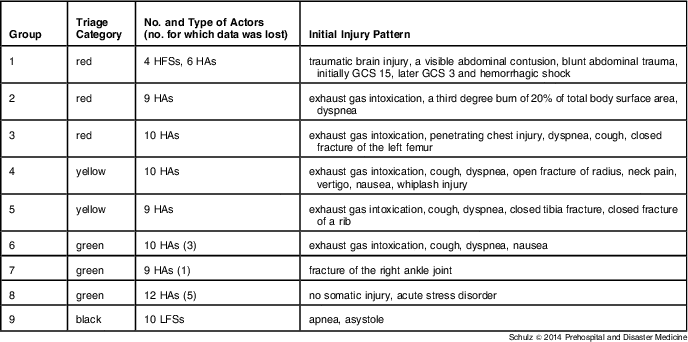
Accordingly, the casualties were subdivided into nine groups, each of them defined by a specific injury pattern. Seventy-five amateur HAs were recruited and the German section of METI provided four HFSs (Metiman, METI, Sarasota, Florida USA) (Table 1). These were allocated to Group 1, along with six HAs. This procedure allowed for intragroup comparison of triage results, the number of diagnostic and therapeutic tasks, and transport times between HFSs and HAs. Group 1 suffered from traumatic brain injury and blunt abdominal trauma, with an initial score of 15 on the Glasgow Coma Scale (GCS) and then developed hemorrhagic shock and coma (GCS = 3). Groups 2 through 8 consisted of HAs only, while 10 low-fidelity simulators (LFSs), (Resusci Anne, Leardal, Stavanger, Norway) were allocated to Group 9 and represented 10 dead patients. The script of the actors of Groups 1 through 3 included deteriorating vital signs, but they were not supposed to die. This report presents data about the feasibility of incorporating HFSs in an unannounced prehospital casualties incident exercise and does not offer explanations for the overall course of the exercise, nor does it provide conclusions with respect to training and organization of the EMS for the management of MCIs. Accordingly, only the necessary data are presented to understand the outcome of the HFSs.
Number and Type of Actor and Injury Patterns. Red indicates that immediate treatment is required, yellow requires delayed treatment, green stands for minimal or no treatment and black indicates the patient's death or an expectant treatment if the patient's death cannot be avoided.

Abbreviations: GCS, Glasgow Coma Scale; HA, human actor; HFS, high-fidelity simulator; LFS, low-fidelity simulator.
For illustration of the course of the exercise, triage results, and transport times for all HAs were calculated. The color red was defined to be the correct triage for the injury pattern of this group (Table 1). Every HA and every HFS technician recorded important time points and type and number of diagnostic and therapeutic tasks on a paper and pencil questionnaire. Moreover, the HFSs recorded physiological data and events that interfered with the physiological model (eg, the administration of fluids or oxygen). All HAs and all simulator technicians synchronized their clocks. For both actors and simulators, patient cards were used by the rescuers to record the result of triage, therapeutic actions, and important time marks. These cards are routinely used in real MCIs. Four fields of the colors red, yellow, green, and black represent different triage classifications according to the German Association of Emergency PhysiciansReference Sefrin, Weidringer and Weiss 12 and had to be hand marked (Table 1). Time marks and triage results were not recorded for the 10 LFSs.
Triage results are presented descriptively. All time measures are given as minutes and standard deviation after the alarm. Differences between arrival times and the number of diagnostic and therapeutic tasks were analyzed in an exploratory way. Odds ratios were calculated for the simulators’ risk of not receiving diagnostic or therapeutic tasks. Differences of means between HAs and HFSs were assessed by t test. One-way ANOVA was used to compare transport times between different triage results. All statistical tests were 2-sided and conducted with SPSS PASW Statistics 18 software (SPSS Inc., Chicago, Illinois USA) in an explorative manner (P = .05).
The Scenario
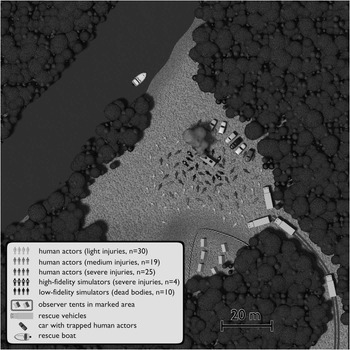
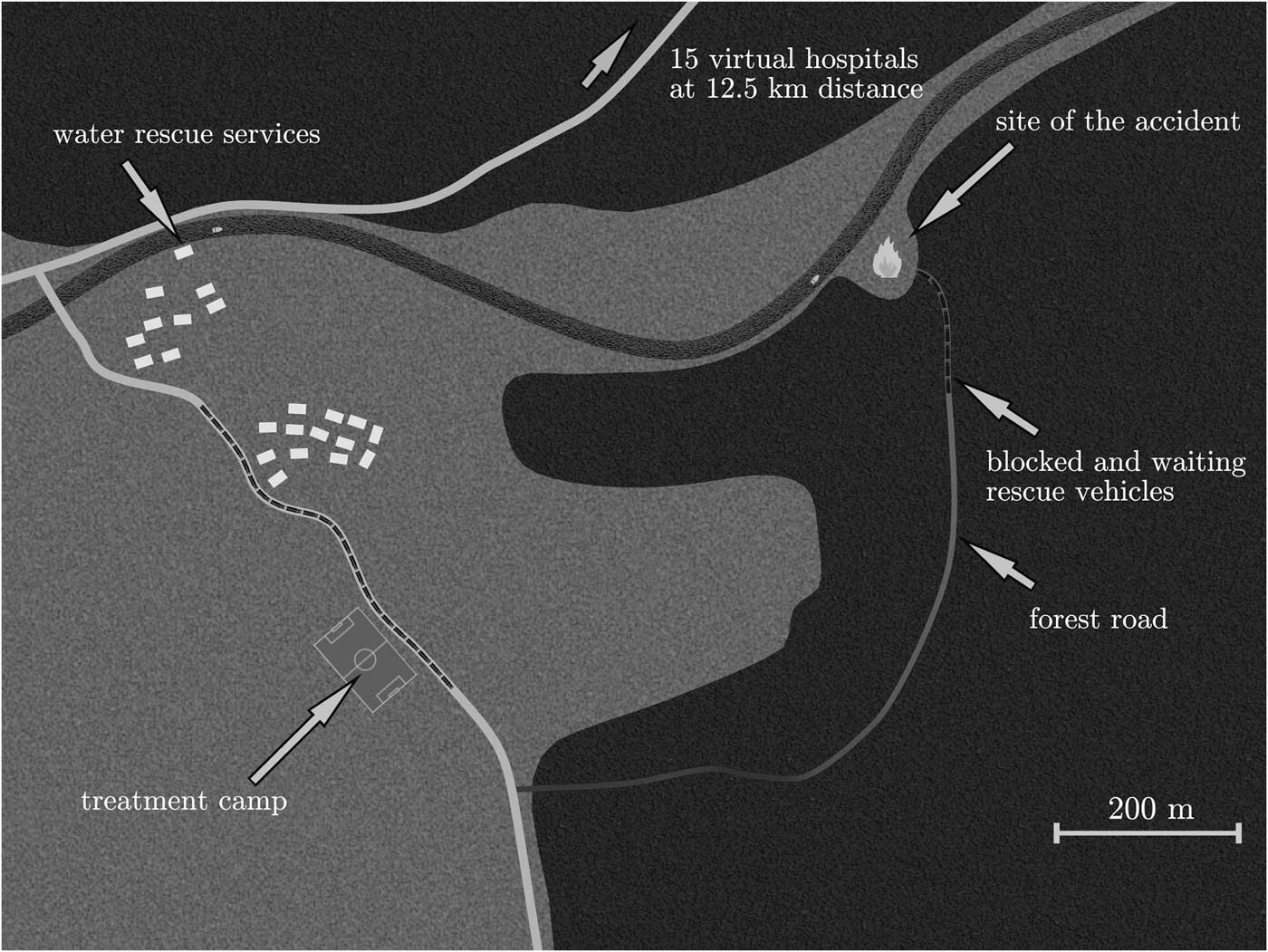
The scenario consisted of an explosion in a campsite resulting in an MCI. The EMS were supposed to conduct triage, treatment, and transport of the casualties. A more detailed description is provided in Figures 1 and 2. High-fidelity simulators represented patients with life-threatening injuries, but clearly provided signs of life (ie, spontaneous thorax excursions, palpable pulse, eye-blinking, and voice). Each simulator was operated by a technician located nearby using a laptop with a wireless local area network connection. All tasks performed by the rescuers were recorded. Standardized scripts were used within the simulator software, consisting of a continuous blood loss starting at the alarm time. Moreover, an intracranial injury started to become symptomatic by simulating unconsciousness and anisocoria 17 minutes after the first triage. An internal speaker was used to simulate a human voice.
On a hayfield, some gas cylinders exploded at a campsite where adolescents spent their holidays. The 75 actors were located around a burning automobile caravan; two of them were trapped in cars. Ten low-fidelity simulators were located near the exploded gas cylinders and illustrated dead bodies. The high-fidelity simulators (Metiman, METI, Sarasota, Florida USA) were placed among heavily-injured human actors in the center of the scene. The pattern of injury was illustrated by makeup and characteristic behavior of the actors.

A forest road of 1 km without room for one vehicle to pass another was the only land-based access to the field. Alternatively, the field could be reached by small boat (on the river) or by helicopter. In the course of the exercise, Emergency Medical Services were supposed to transport the patients to a virtual hospital. Therefore, the scenario included 15 virtual hospitals located nearby and staffed with teams of physicians and medical students representing the emergency departments (EDs). After handing over the patient to ED staff, ambulances were allowed to return to the scene only after a time delay that was calculated according to the time a transport to actual hospitals would have taken.

A phone call to the nationwide emergency number triggered the alarm on a workday at 7:30 pm in July 2011. Air temperature decreased on that summer day from 17°C at the beginning of the exercise to 12°C at the end. The caller briefly described an explosion in a campsite near a river. Twelve minutes later, the first rescuers arrived, consisting of the voluntary fire brigade of the next village. Immediately, they called back to the Public Safety Answering Point (PSAP) indicating that there were more than 50 injured patients, and started to extinguish the fire. Consequently, the PSAP team called out the highest alert level and activated additional EMS organizations, including professional fire brigades. Shortly after, the first EMS, consisting of an emergency physician and three paramedics, arrived and began triage immediately.
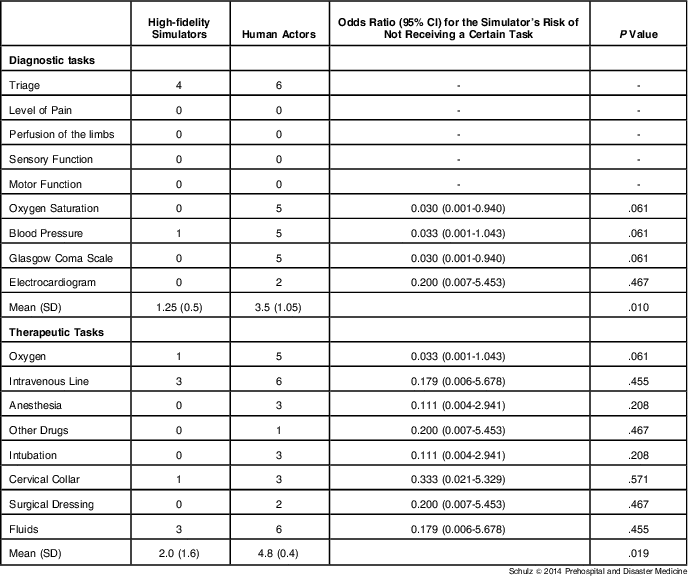
In Group 1, times until first triage after the alarm did not differ for HFSs (mean 40.0, SD = 13.4 minutes) and HAs (49.3, SD = 20.1 minutes; P = .404). All HFSs were thought to be dead, but after a verbal intervention by the technicians, the EMS recognized vital signs and all HFSs were triaged correctly. All actors of this group also were triaged correctly. The number of diagnostic and therapeutic tasks was compared between HFSs and HAs and the odds ratios for the simulator's risk of not receiving a certain task are given in Table 2. Significantly more diagnostic and therapeutic tasks were performed in actors (P = .010, P = .019, respectively). Significant odds ratios were not found. Three of the HFSs (after 110 minutes, SD = 63 minutes) and five HAs (after 81 minutes, SD = 38 minutes, P = .519) were brought to the casualties collection point that was set up in the hayfield near the end of the forest road (time data of one HA was lost).
Number of Diagnostic and Therapeutic Tasks Performed for High-fidelity Simulators and Human Actors. Simulators and actors comprised the mixed Group 1, defined by traumatic brain injury and blunt abdominal trauma. All members of this group were triaged. Pain, perfusion, and motor and sensory functions were not assessed in any member. Therefore, odds ratios and P values are not given for these tasks.

With respect to the hospital arrival times, some unexpected results are worth mentioning. According to the standardized scenario, each simulator lost consciousness 17 minutes after the first triage, the eyes closed, and it developed anisocoria. As sufficient amounts of fluids were not administered by the EMS, blood pressure deteriorated (< 80 mm Hg systolic blood pressure) within the first hour. In order to prevent premature death and to allow for the training and the transport of a heavily-injured casualty, the technicians intervened and 500 ml of crystalloids were administered to each simulator simultaneously. This procedure had to be repeated eight times. Approximately three hours after the beginning of the scenario, the leading emergency physician decided to transport the HAs due to imminent real hypothermia with priority. At this point, and in face of very low batteries of the wireless HFSs, the technicians let the simulators die in the time period from 195-209 minutes after the beginning of the scenario. Thus, none of the HFSs arrived at the hospital. The hospital arrival times for the entirety of actors were 219 (SD = 59) minutes for actors triaged red, 271 (SD = 63) minutes for actors triaged yellow, and 314 (SD = 41) minutes for actors triaged green; (P < .001).
Discussion
Triage results were correct for HFSs and HAs, but significantly fewer therapeutic and diagnostic tasks were performed in the HFS during this long-lasting MCI exercise. Only HAs were evacuated from the site of the accident and brought to hospitals.
One major reason was identified for this finding: Metiman HFSs are purely battery driven. This is a major advantage for out-of-hospital exercises because the alternative of using gas-driven mannequins with the necessity of providing a gas supply in out-of-hospital locations and related safety concerns can be avoided. Battery-driven mannequins can be transported in the same manner as HAs, and therefore, simulation is not limited to a single site of action. The batteries are localized within the mannequin and have more than three hours of capacity, which is sufficient for the duration of a normal exercise. In the exercise described here, low batteries led to the decision to let the simulators die at the site of the accident. In the face of severe difficulties in evacuating the casualties from the location of the accident (which continue to be evaluated and discussed among the participating organizations), many of the diagnostic and therapeutic tasks recorded for the HAs may have been performed later during the exercise (eg, in the treatment tents where more personnel and material resources were available, but where the HFSs never arrived). Additionally, some actors suffered from being cold, a few of them from real hypothermia, and therefore, the leading emergency physician decided to transport the actors with priority. The simulators’ death eliminated their last chance to be treated later on the way to the hospital. Unfortunately, the time marks of the diagnostic (with exception to triage) and therapeutic tasks were not recorded during this exercise. Future MCI training should record therapeutic tasks with the corresponding time marks to address this question with certainty.
Another important point is that, initially, the HFSs were not identified as treatable patients. Intervention by the technician was needed before they were triaged correctly. This can be explained by the fact that the EMS were not explicitly prepared to treat simulators. Additionally, the 10 LFSs illustrating dead patients, although completely different in size and aspect, may have contributed to the misunderstanding that the HFSs also were to simulate dead patients. Both facts possibly led to less acceptance of the simulators. In future settings, dealing with high-fidelity simulation in large prehospital MCI exercises, this may be avoided through announcing that simulators and actors are included in an upcoming exercise, and that both should be treated like real patients. Moreover, as is common for intrahospital simulation, a complete introduction of the diagnostic and therapeutic tasks that can be performed in the simulators should be provided. If trainees have no prior experience with HFSs, this is of particular importance, even if the surprise effect will probably be less to some degree. For a better understanding of differences in treatment between HFSs and HAs, the participants should rate the realism of HAs and HFSs and provide information about prior exposure to high-fidelity simulation.
In a previous study that compared resuscitation times for HAs and simulators in the surge setting of an influenza drill, 12 cases were randomized either to HAs or HFSs.Reference Wallace, Gillett, Wright, Stetz and Arquilla 2 Groups of three patients were introduced in the emergency department (ED) in four waves. The attending physicians and nursing staff were blinded to the study objectives, but they received a briefing with respect to how to treat the simulators and HAs. Times for specific tasks were significantly longer when performed on simulators and therefore, the authors concluded that in HAs, resource utilization is underestimated. Times needed for resuscitative procedures in simulators were similar to that for treatment of real patients. The authors concluded that HFSs may be superior to actors for the evaluation of disaster scenario preparedness. Another prospective study compared the number of critical actions in simulators and HAs during two intrahospital trauma drills in different EDs and investigated the perceived realism using a paper and pencil questionnaire.Reference Gillett, Peckler and Sinert 3 The number of critical actions was not found to differ between HAs and simulators. All participants agreed that the simulators mimicked the scenarios more closely than actors. They were not informed that simulators would be included in the drill, but 75% of them had prior simulator experience. In the exercise described here, these important properties of the HFSs had no measurable impact because the logistical difficulties for the evacuation and treatment of the HFSs and HAs were overwhelming. Comparability, however, was impaired by the fact that both studies were conducted in an intrahospital setting, whereas the setting in the present study was prehospital, and therefore much more difficult to control.
Correct triage of the HFSs emphasized that HFSs were able to mimic a real-life scenario as closely as HAs in prehospital MCI exercises. A log file-based assessment of simulator outcome may serve as an indicator of performance and could be used even without checklist scoring and reviewing videotapes when standardized scripts are used.Reference Mayer, Schulz, Kreuzer, Wagner, Schneider and Kochs 10 , Reference Schulz, Mayer, Kreuzer, Kochs and Schneider 11 In prehospital settings, this feature may be helpful for the evaluation of new technical devices or management strategies. For a meaningful analysis of the latter, however, a larger quantity of HFSs is necessary, and this may pose problems due to financial and organizational constraints.
Limitations
This case report has some important limitations. The a priori decision that the patients were not allowed to die was made with the aim of preventing an emotional overlay that might interfere with the focus of the exercise. This clearly has artificially improved the outcome of the patients of Groups 1 through 3 who normally would not have survived until their transport to the hospital. With respect to the simulators, low batteries resulting in the simulators’ death before they could be evacuated from the site of the accident and the low number of HFSs involved limited the informative values of the odds ratios for the simulator's risk of not receiving certain tasks.
Conclusions
In contradiction to findings of prior studies in intrahospital settings, simulators were not treated equally to human patient actors in this prehospital MCI exercise. Critical actions should be recorded with respective points in time if video recordings are not applicable. As widely accepted for intrahospital settings, a briefing about the diagnostic and therapeutic tasks that can be performed with high-fidelity systems is also recommended in prehospital settings.
Acknowledgements
The authors gratefully acknowledge the contribution of Ronny Schürer for technical assistance.