Introduction
Weight gain associated with pharmacological treatment of mental illness has serious implications for the health of patients. Antipsychotic, anticonvulsant and antidepressant drugs have all been associated with weight gain which often progresses to morbid obesity Reference Ackerman and Nolan(1,Reference Henderson and Doraiswamy2). Valproate is a widely used anticonvulsant which is also effective in the treatment of mania in bipolar disorder Reference Keck, McElroy and Bennett(3) and is frequently used longer term as a mood stabiliser. Weight gain is a commonly reported adverse effect of valproate treatment in up to 57% of all treated patients Reference El-Khatib, Rauchenzauner and Lechleitner(4,Reference Isojarvi, Laatikainen, Knip, Pakarinen, Juntunen and Myllyla5) and currently there are no useful predictors to determine which patient will be affected.
The determinants of weight gain in valproate-treated patients remain unclear Reference Elmslie, Mann, Silverstone, Williams and Romans(6,Reference Jallon and Picard7). However, lifestyle factors such as increased energy intake and reduced physical activity levels have been previously implicated in the high frequency of obesity observed in bipolar patients and in valproate-induced weight gain (Reference Elmslie, Mann, Silverstone, Williams and Romans6,Reference Breum, Astrup and Gram8,Reference Dinesen, Gram, Andersen and Dam9).
In addition, it has been suggested that a valproate-induced reduction of fatty acid β-oxidation rate contributes to weight gain Reference Breum, Astrup and Gram(8,Reference Dinesen, Gram, Andersen and Dam9). This may be due to carnitine deficiency, which occurs in up to 80% of individuals treated with valproate Reference Jallon and Picard(7,Reference Coulter10). Reduced availability of carnitine, a crucial component of intracellular long-chain fatty acid transport, directly impairs β-oxidation, limiting the body's capacity to metabolise fat as an energy source and possibly also contributing to increased appetite, a documented side effect of valproate treatment Reference Jallon and Picard(7). Under normal conditions carnitine requirements are met by a combination of endogenous synthesis and exogenously by diet, but when requirements are increased the diet may not provide sufficient carnitine Reference Santos, Cabranes, Vazquez, Fuentenebro, Almoguera and Ramos(11); in this situation supplementation may assist fatty acid metabolism.
To test the hypothesis that carnitine supplementation would aid weight loss in valproate-treated overweight patients, Elmslie et al. Reference Elmslie, Porter, Joyce, Hunt and Mann(12) randomised 60 bipolar patients to carnitine or placebo, which was taken in combination with a low fat, moderately energy restricted diet for 26 weeks. After the 26-week intervention, changes in body mass index (BMI), weight and waist circumference were not significantly different between groups.
The present study extends this work by using DNA samples to test whether genotypic status near INSIG2 (insulin-induced gene 2), a gene encoding a fat homeostasis protein, is associated with changes in weight in this controlled study. Like carnitine, INSIG proteins are key regulators of fatty acid and cholesterol synthesis mediating the action of sterol regulatory element binding proteins (SREBPs). SREBPs control cholesterol homeostasis by stimulating transcription of sterol-regulated genes. In the absence of circulating sterols, SREBPs are first released from a complex with INSIG in the endoplasmic reticulum and subsequently from SREBP-cleavage activating protein (SCAP) in the golgi apparatus. The mature, transcriptionally active basic helix loop helix SREBP peptide, is translocated to the nucleus, activating cholesterol and fatty acid biosynthesis pathway genes.
In animals, INSIG2 has been associated with controlling triglyceride levels in rats Reference Engelking, Liang and Hammer(13) and linked as a quantitative trait locus for obese mice Reference Cervino, Li and Edwards(14). In a double knockout study of INSIG1 and INSIG2, mice were more obese than wild-type littermates displaying an accumulation of cholesterol and triglycerides in their liver Reference Engelking, Liang and Hammer(13). Recently, using a cell culture system Ferno et al. Reference Ferno, Skrede, Vik-Mo, Havik and Steen(15) and Vik-Mo et al. Reference Vik-Mo, Birkenaes, Ferno, Jonsdottir, Andreassen and Steen(16) showed that atypical antipsychotic drugs which induce weight gain (clozapine and olanzapine, respectively) activate lipid biosynthesis gene expression through SREBP transcription factors. They subsequently screened 160 schizophrenic patients volunteering for treatment with clozapine for an association between increased BMI and single nucleotide polymorphism (SNP) markers around 5 genes known to affect SREBP transcription—SREBF1, SREBF2, SCAP, INSIG1 and INSIG2. Of these genes, SNPs in close proximity to INSIG2 were found to be significantly associated with increased BMI over the course of treatment Reference Le Hellard, Theisen and Haberhausen(17). Previously, Herbert et al. Reference Herbert, Gerry and McQueen(18) had shown the rs7566605 SNP (a G>C variant 10 kb upstream of INSIG2) was strongly associated with increased BMI in a genome-wide association study comprising nearly 10 000 individuals and 86 000 SNPs. This finding has been replicated in some but not all cohorts reported by Lyon et al. Reference Lyon, Emilsson and Hinney(19) and conflicting evidence for association has subsequently arisen (Reference Loos, Barroso, O'Rahilly and Wareham20–Reference Rosskopf, Bornhorst and Rimmbach22). Furthermore, a report failed to detect an association between the C allele and BMI in schizophrenic patients Reference Skelly, Pinheiro, Lange and Sullivan(23).
These studies all rely upon BMI (weight/height2). The relationship between BMI and body fat is influenced by age, ethnicity and exercise and may be an imprecise measure of body fatness in individual subjects Reference Prentice and Jebb(24). More accurate measures of body composition include underwater weighing, dual-energy X-ray absorptiometry (DEXA) scans and bioelectric impedance Reference Chumlea and Guo(25). This study examines the influence of the rs7566605 polymorphism on BMI and waist circumference as well as detailed phenotypic measures of DEXA scanning, bioelectric impedance and obesity-related biomarkers.
Our aims were (a) to analyse whether variation at SNP rs7566605 influenced weight loss in an intervention study of bipolar patients who had gained weight during treatment with sodium valproate; (b) to use detailed body composition measurements and obesity-related biomarkers to assess pathogenetic effects of the SNP before and after intervention; (c) to establish whether carnitine supplementation affected weight and fat loss and (d) to analyse the rs7566605 variant using a bioinformatics approach to genomic sequence around INSIG2.
Subjects and methods
This cohort has been described in detail previously as the bipolar weight reduction study Reference Elmslie, Porter, Joyce, Hunt and Mann(12). Briefly, all participants were overweight or obese (BMI > 25 kg/m2) and met Diagnostic & Statistical Manual (DSM-IV) diagnostic criteria for bipolar disorder. All were taking valproate for at least 6 months before commencing the trial and attributed a substantial proportion of their weight gain to this medication. Participants remained on valproate and their other usual medications throughout the study. Each participant received individualised dietary advice from a registered dietitian, designed to produce a caloric deficit of ≈500 kcal per day resulting in a gradual sustained weight loss over the intervention period. Participants were randomised to carnitine or placebo (15 mg/kg body weight/day). Body weight and body fat percent were measured fortnightly throughout the study and waist circumference measurements and DEXA were used to assess changes in body composition Reference Elmslie, Porter, Joyce, Hunt and Mann(12). Twenty-four hour urinary cortisol, fasting plasma cholesterol, triglycerides, glucose, free fatty acids, adiponectin, insulin and leptin were measured at baseline and 26 weeks.
Sixty patients were randomised to supplementation and 48 consented to provide blood samples for genetic analysis at baseline and were successfully genotyped at rs7566605 or rs17047764. Of these, 8 were male and 40 were female. Carnitine supplementation was carried out in 4 males and 20 females. We certify that all applicable institutional and governmental regulations concerning the ethical use of human volunteers were followed during this research. Ethics approval was obtained from the Canterbury Regional Ethics Committee and all volunteers gave written informed consent. Forty patients completed the present study.
Weight and body fat percentage were assessed using a body fat analyser (TBF-501, TANITA Corporation, Tokyo, Japan) at all dietetic visits. Body composition was measured using DEXA at baseline and 26 weeks by Canterbury Radiology, Christchurch. Participants were scanned on either a Lunar DPX or a Lunar Prodigy Scanner (GE Healthcare). To ensure that body composition measurements were not affected by scanner differences, both measurements in each individual were made on the same scanner.
Biochemical tests were undertaken by Canterbury Health Laboratories according to standard laboratory protocols. Samples were collected after an overnight fast, placed on ice, batched and stored at minus 80°C until analysis. Cortisol was measured by Enzyme-Linked ImmunoSorbent Assay (ELISA), cholesterol, trigycerides and glucose by Aeroset/c8000 analyser, adiponectin, insulin and leptin by immuno-assay and free fatty acids by an enzymatic method.
Variation at rs7566605 was determined using a specifically designed one tube allele specific polymerase chain reaction (PCR) protocol. The G allele was detected using the primers F1 5′-GTACTAACTGGCTCAAGGTCACCTAGCTA G-3′ and R3 5′-ACCACCCTGGTACAGACCTAAAGGACCAGC-3′ oligonucleotide primers, yielding a 182 bp product. The C allele was detected using F3 5′-TGCCAAGTACTTAACAATGGATATTTGAAC-3′ and R2 5′-TATGAGAGTCAGTGCGATGTCCTTGCCTTC-3′, generating a 115 bp product. A 239 bp control band is generated between the primers F1 and R2. All 4 primers were included in l0 μl reaction with 20–100 ng genomic DNA, Platinum Taq polymerase (Invitrogen), 0.2 mm each deoxyribonucleotide triphosphate (dNTP), 1.5 mm MgCl2 and the manufacturer's buffer. Thermal cycling conditions were 3 min at 94°C, followed by 35 cycles of 94, 62 and 72°C with 30 s for each temperature. A final extension step of 72°C was carried out for 7 min. Products were resolved in a 2% agarose gel. The genotyping assay was validated by sequencing a selection of products from each genotype (data not shown). Variation at rs17047764 was determined by sequence analysis.
The baseline characteristics of the study participants were compared using independent-samples t-tests. The effects of rs7566605 genotype and carnitine on body composition change over 26 weeks was assessed with univariate analyses of variance for each body composition variable, with treatment (carnitine or placebo) and genotype (GG vs GC or CC) as between subject factors and the baseline body composition variable as a co-variate. Only main effect and two-way interactions were entered into the analyses. The reported means are estimated marginal means generated by the ANOVA model. SPSS version 13 (SPSS Inc, Chicago, U.S.A.) was used for all comparisons.
Results
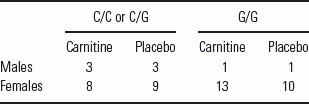
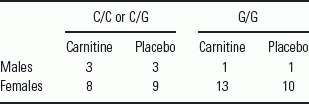
Genotyping of rs7566605 was carried out in 48 individuals comprising genotype consenting subjects of the 60 randomised in the bipolar weight reduction study. The minor C allele frequency was 0.26, consistent with previously published frequencies Reference Herbert, Gerry and McQueen(18,Reference Dina, Meyre and Samson21). Twenty-five individuals were homozygous for the G allele, 21 were heterozygous and 2 were homozygous for the C allele. Genotype frequencies are in Hardy–Weinberg equilibrium (p = 0.64 with chi-square = 0.88). Distribution of alleles by gender is presented in Table 1.
Allele distribution according to gender
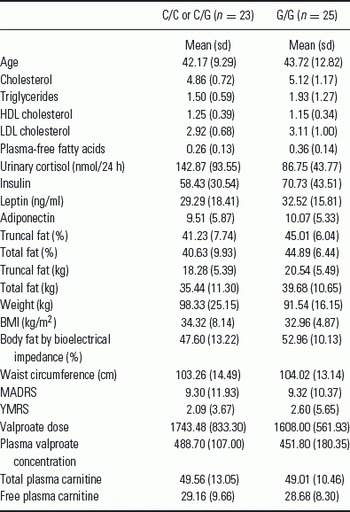
At baseline there were no significant differences in body composition variables associated with the presence of the C allele in either a recessive (not shown) or dominant model (Table 2) apart from urinary cortisol (t (30.899) = 2.616, p = 0.014) and plasma-free fatty acids (t (45) = −2.525, p = 0.015).
Baseline characteristics for 48 patients genotyped for the SNP rs7566605

HDL, high-density lipoprotein; LDL, low-density lipoprotein; MADRS, Montgomery-Åsberg Depression Rating Scale; YMRS, Young Mania Rating Scale.
Following 26 weeks of nutritional intervention and randomisation to carnitine, 40 completing individuals were successfully assessed for full body composition variables.
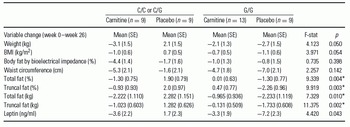
In this analysis we found no significant effect of genotype on any variables describing weight loss. We did however find a significant interaction between rs7566605 genetic status and treatment with carnitine or placebo (Table 3). Carriers of the C allele who were supplemented with carnitine on average lost weight (−3.1 kg) and decreased their BMI (−1.0 kg/m2). Carnitine supplemented non-C allele carriers (G homozygotes), similarly lost weight and lowered their BMI. However unlike G homozygotes, C allele carriers treated with placebo gained weight on average by 2.1 kg and increased their BMI (0.7 kg/m2). Using body composition data derived from the DEXA scans we were able to refine where fat mass was deposited and detected significant interaction between carnitine treatment and genotype on measures both of total and truncal fat. C allele carriers on average lost 2.22 kg of fat when supplemented with carnitine whereas those without gained 2.28 kg (F-stat = 7.329; p = 0.01, Table 3). Approximately half of this mass was lost from the vital truncal compartment, where C allele carriers lost 1.02 kg when carnitine was supplemented and gained 1.28 kg without it. Non-C allele carriers (G homozygotes) either receiving carnitine or placebo lost 0.97 kg and 2.23 kg, respectively (F-stat = 11.375; p = 0.002; Table 3). There was a further interaction between treatment and genotype on leptin levels which largely reflected weight change, BMI change and total fat change. Changes of body fat percentage measured by bioelectrical impedance and waist circumference were not significantly different (data not shown).
Body composition variables of 40 individuals completing the 26-week study. Using the Benjamini–Hochberg method to account for multiple testing the fat and truncal fat comparisons only, marked with an asterisk, are statistically significant with a false discovery rate of 5%. F-stat and p values are for the genotype and carnitine supplementation interaction

To account for multiple testing the Benjamini and Hochberg Reference Benjamini and Hochberg(26) method was applied to the p values in Table 3. Only the total fat and truncal fat comparisons, marked with an asterisk, are statistically significant with a false discovery rate of 5%.
Detection of a significant interaction between rs7566605 genotype and weight loss during a 26-week dietary intervention study, prompted us to test whether an INSIG2-associated BMI marker detected by Le Hellard et al. (2008) was associated with body composition markers in our bipolar patient cohort. We genotyped all our patients at rs17047764 and found that genetic status at this locus was not associated with any baseline body composition measures or any following 26 weeks of intervention, apart from blood cholesterol levels which differed between C homozygotes and G carriers at rs17047764 (F-stat = 5.782; p = 0.020; data not shown).
To assess the evolutionary conservation of genomic sequence around rs7566605, we used the vertebrate Multiz Alignment and PhastCons Conservation track (comprising 28 species) and other tracks available through the UCSC genome browser Reference Karolchik, Kuhn and Baertsch(27) using human genome build 18 (hg18). We detected a highly conserved 351 bp block of DNA encompassing rs7566605 with a transformed log-odds score (between 1 and 1000) of 631. A lower score (e.g. <100) reflects less conserved DNA sequence. The SNP rs7566605 lies 10 026 bp from the start codon of INSIG2. As a comparison we examined the highly conserved first exon of INSIG2. This sequence (182 bp) equated to a score of 596. This finding implies an evolutionarily conserved functional role for DNA sequence elements within the region containing rs7566605. It is noteworthy that hg18 sequence contains the minor or variant C allele at rs7566605, and one may expect the degree of conservation would increase with a wild-type G allele at chr2;118552495 (rs7566605) considering all other species encode a G at this alignment position.
Other bioinformatic tools available through the UCSC genome browser did not detect predicted sequence elements, apart from a slightly increased score for regulatory potential (ESPERR, regulatory potential based on seven species, a comparison developed by King et al. Reference King, Taylor, Elnitski, Chiaromonte, Miller and Hardison(28).
Discussion
The main finding of this study is that allelic status at rs7566605 interacted with carnitine treatment such that patients with one or two C alleles taking carnitine lost fat mass during the dietary manipulation but C allele carriers in the placebo group gained fat mass. Individuals without a C allele (G homozygotes) lost fat mass under both conditions but generally less in subjects taking carnitine. The results were consistent across most measures of weight and fat distribution. The lack of an effect detected by impedance measurement may simply reflect less sensitivity of this method.
These findings partly corroborate those of Herbert et al. Reference Herbert, Gerry and McQueen(18) who detected an association between C allele homozygotes at rs7566605 and obesity (measured using BMI) in a large population-based study ultimately comprising nearly 10 000 individuals. They found that C allele homozygotes at rs7566605 led to increased adiposity. In our study, detection of an interaction between patients with at least one C allele and an inability to lose weight, may implicate rs7566605/INSIG2 in reduced adipose metabolism, thus affecting energy expenditure. We speculate that the effect of the C allele lies in the greater tendency to both store and retain fat.
Our findings are also interesting when considered alongside the data of Le Hellard et al. Reference Le Hellard, Theisen and Haberhausen(17). They found that antipsychotic drug treatment with emergent BMI gain in patients with schizophrenia was associated with particular alleles of INSIG2. We tested whether one of these, the rs17047764 locus, was associated with any of the body composition variables measured in this study, including BMI. We did not detect an association between rs17047764 genotype and any weight related or other variable apart from blood cholesterol levels, between C homozygous individuals and G carriers. Failure to detect weight change measures associated with rs17047764 may be because of the smaller size of our cohort in comparison to the German sample size of 160, otherwise it indicates that this locus may not be associated with weight change, at least in this bipolar patient cohort.
Based on the findings of this study, we would suggest that carnitine supplementation would significantly reduce the weight gain associated with antipsychotic-treated patients who harboured a C allele. Interestingly, rs7566605 was not one of the three SNPs showing an association with increased BMI, which may reflect the sample size (160 patients) in their study when using BMI as a body composition measure. A large proportion of other studies have failed to associate BMI with obesity at the rs7566605 locus (Reference Lyon, Emilsson and Hinney19–Reference Rosskopf, Bornhorst and Rimmbach22). this study, we were able to detect a significant link between body composition and rs7566605 in a relatively small sample size of 40 by using sensitive body composition measurements better able to detect weight and fat loss or gain than BMI.
A recent weight reduction intervention study of obese German children detected a link between CC genotypic status at rs7566605 and reduced weight loss, measured as BMI Reference Reinehr, Hinney, Nguyen and Hebebrand(29). This effect appeared less marked than our results, as our cohort of C carriers actually gained weight in comparison to GG homozygotes. The Reinehr et al. (2008) trial did not include carnitine supplementation, and therefore could not address our findings of normalising adipose metabolism with carnitine.
At baseline we found that mean urinary cortisol levels were below the reference range (100–400 nmol/24 h) and that plasma-free fatty acids were higher in patients with a GG genotype (Table 2). Alterations in the hypothalamic-pituitary axis function of patients with bipolar disorder have been detected with the combined dexamethasone suppression/corticotrophin-releasing hormone test Reference Watson, Gallagher, Ritchie, Ferrier and Young(30). This is a potential contributing factor in the increased prevalence of obesity seen in bipolar patients Reference Elmslie, Mann, Silverstone, Williams and Romans(6,Reference Elmslie, Silverstone, Mann, Williams and Romans31). However, we did not detect other differences by genotype at baseline and these may be chance findings.
We recognise that our results form an interesting initial survey on the effects of carnitine and genotype on weight in this specific patient cohort. However, the possible weight loss effects of carnitine supplementation for a proportion of individuals is an important result to disseminate because other researchers may want to consider carnitine in future intervention studies.
The role of INSIG2 in fat metabolism has been established previously Reference Engelking, Liang and Hammer(13,Reference Gong, Lee, Brown, Goldstein and Ye32) where it has been identified as a hijacking protein in the endoplasmic reticulum. In response to changes in lipid levels, it affects sterol regulatory element binding proteins; proteins which act as nuclear transcription factors and regulators of lipid biosynthesis. Association of the SNP rs7566605 and weight gain was first seen in related individuals from the Framingham Heart Study Reference Herbert, Gerry and McQueen(18) where the authors went on to speculate that the SNP rs7566605 may affect regulation of the gene in closest proximity: insulin-induced gene 2 (INSIG2; Reference Herbert, Gerry and McQueen(18,Reference Lyon, Emilsson and Hinney19)). Their findings centred on an association between higher BMI and homozygosity for the C allele. The current study was not designed to examine an association between the genotype and body composition or the tendency to gain weight since we expressly recruited subjects who had already gained weight, but was designed to examine the ability of subjects to lose weight given adequate dietary advice and energy restriction. The pattern seen in our data suggests that the C allele may be associated with an impaired ability to lose adipose tissue under mildly energy restrictive conditions, which is reversed in individuals supplemented with carnitine. The fact that there was no independent effect of genotype on weight loss means that this conclusion cannot be established definitively at this stage. The lack of such an effect may be simply an issue of statistical power given that such an effect could only truly be examined in the placebo group of whom there were only 18.
We believe that the best explanation for these results is that subjects with the GG genotype are more able to lose weight and fat than those with a C allele, under conditions of energy restriction. Carnitine is crucial for the cellular transport of long-chain fatty acids and impairment of its function affects β-oxidation rates in adipose metabolism Reference Steiber, Kerner and Hoppel(33). Increasing the rate of β-oxidation by carnitine supplementation may therefore be circumventing the effects of INSIG2 expression differences between genotypes at rs7566605. This does not necessarily mean that the genotype directly affects β-oxidation. It may be that increasing β-oxidation only increases metabolism in subjects in whom it is particularly slow for other reasons. Our findings suggest that genotyping at the rs7566605 locus could potentially identify individuals about to commence dietary change who may benefit from carnitine supplementation.
It remains to be proved whether variation at rs7566605 affects INSIG2. We identified a highly conserved 336 bp DNA sequence, 10 026 bp upstream of INSIG2, encompassing the rs7566605 variant using bioinformatics available through the UCSC genome browser. We additionally found that this sequence was as conserved, if not more so, than the first exon of INSIG2. This finding points to an evolutionarily conserved functional role for elements within this sequence. It remains unclear as to whether the region directly influences INSIG2 but it is a strong positional candidate as a cis-acting enhancing element. In this context one may speculate an influence on gene expression through transcriptional regulation, possibly affecting the binding of repressor or enhancer proteins to the conserved sequence. Variation at crucial molecular interfaces between DNA and protein has been shown to affect interaction or binding in numerous studies (reviewed by Fraser and Bickmore, Reference Fraser and Bickmore(34) and Long and Miano, Reference Long and Miano(35)). It is difficult to examine the effect of this variant because of the great distance between it and the gene (10 kb). However, it should be noted that the variant's effects may rely on other, unidentified enhancers elsewhere within the genome, or could be due to long-range linkage disequilibrium with other SNPs.
While we acknowledge the small sample size of this study, we believe these findings are important and warrant further investigation in future studies.
DEXA scanning is a relatively easy and sensitive method of measuring changes in fat deposition Reference Houtkooper, Going, Sproul, Blew and Lohman(36). In this study it showed significant effects which were less obvious on simple measures of weight and not apparent on measures of impedance. It would also be interesting to know whether more detailed adipose distribution measures would affect the previous studies that either detect weak association or no association with obesity and variation at rs7566605. It may be that studies of overweight individuals using more detailed measures of fat accumulation may prove a better link between rs7566607/INSIG2 and obesity.
Conclusion
This study provides further preliminary evidence that genetic variation at rs7566605, within a highly conserved region close to INSIG2, affects fat mass. In this intervention study, bipolar patients with at least one C allele (CC or CG genotypes) lost significantly less weight in comparison to G homozygotes (GG genotype). This effect was reversed by carnitine supplementation. Carnitine may benefit patients with at least one C allele at rs7566605 who are commencing dietary change. The association we have detected suggests a possible role of the rs7566605 variant in adipose metabolism.
Acknowledgements
This work was supported by the Health Research Council of New Zealand and The Stanley Medical Research Institute. We would like to thank the bipolar patients who volunteered to participate in this study, Andrea Bartram for data management and Melanie Allington for help with the manuscript.