UNQUESTIONED ANSWERS, AND UNANSWERED QUESTIONS: MAYA AGRICULTURE AND POPULATION
Beginning with the Spanish in Yucatan in the early sixteenth century and continuing to the mid-twentieth century, Westerners observed the Maya living in dispersed settlements scattered thinly across the landscape. Furthermore, in Colonial period and later times Westerners consistently recorded Maya agriculture as a shifting swidden system focusing on maize, supplemented by beans and squash. However, the 90–95% population reduction following the Spanish conquest (Dobyns Reference Dobyns1966) indicates that agricultural practices observed in the colonial era may have been quite different from pre-Columbian times. As recently as the mid-twentieth century, Westerners generally extrapolated that same settlement pattern and agricultural system back into the ancient Maya past. The predominant understanding of Classic Maya settlements emphasized dispersed populations that occasionally coalesced for religious observances in the otherwise “empty” ceremonial centers. The mid-twentieth-century discoveries of high structure densities, interpreted as high population densities, challenged archaeologists to answer the question “how did the Maya feed the multitudes?” Archaeologists then focused on how to answer that question by considering other cultigens and agricultural strategies.
THE UNQUESTIONED ANSWER: EXTENSIVE MAIZE MILPA
Westerners' understandings of ancient Maya food production have undergone major transformations during the past five centuries. The predominant view of ancient Maya agriculture during the nineteenth and early-to-mid twentieth centuries was an extensive swidden cultivation of maize, with beans and squash as secondary crops, as noted by Harrison and Turner (Reference Harrison and Turner1978), Turner (Reference Turner, Harrison and Turner1978), and Sharer (Reference Sharer1994, Reference Sharer and Traxler2006). The origins of this view can be traced back to the mid-sixteenth century when Bishop de Landa described the Maya in the northern Yucatan peninsula relying on maize, slash-and-burn field preparation, and planting multiple maize seeds per digging stick hole (Gates Reference Gates1978:38–39). Bishop de Landa also mentioned beans, peppers, and unnamed root crops (Gates Reference Gates1978:103). De Landa did not specifically describe swidden agriculture, but his and other people's descriptions during colonial times contributed to the understanding that the Maya fed themselves from dispersed non-intensive agriculture. Early assumptions of ancient swidden agriculture in the Maya area were further supported by accounts of travelers, such as Thomas Gage (Thompson Reference Thompson1958), and Stevens and Catherwood (Reference Stevens and Catherwood1841), observing the Maya successfully feeding dispersed populations by non-intensive agriculture. As Turner (Reference Turner, Harrison and Turner1978) noted, Stevens argued for continuity by stating that the cultivation of maize by the nineteenth-century Maya probably differed little from that of the ancient Maya.
Archaeologists consolidated the argument for ancient Maya swidden system in the late nineteenth and early twentieth centuries by observing the traditional Maya cultivating extensive milpas and feeding dispersed populations. Morley (Reference Morley1946) more firmly implanted the swidden-maize-milpa model in our discipline by arguing that there had been no changes in agriculture over three millennia. His argument convinced most Mesoamericanists when he claimed it was the only form of agriculture possible in the Maya tropics because of the uniformly poor soils. Thus, extensive maize milpa farming became the unquestioned answer to how the Classic Maya fed themselves.
THE UNANSWERED QUESTION: HOW DID THE MAYA FEED THE MULTITUDES?
The recognition of dense Maya populations was slow in developing. As Webster (Reference Webster2002:173) noted, an employee of the American Chicle Company named Paul Schufeldt observed vast numbers of small house structures and conveyed that to Sylvanus Morley in 1921. Morley “violently disagreed” with that observation, and stated he would not dare express such an observation back in Cambridge (Webster Reference Webster2002:173). Decades later Morley changed his mind and suggested breathtakingly high population estimates for the Classic Maya (Webster Reference Webster2002). A few scholars in the early twentieth century, such as Thomas Gann and Oliver Ricketson, recognized small mounds as probable remains of commoner houses in the southern Maya lowlands (Harrison and Turner Reference Harrison and Turner1978). However, that recognition was qualitative, and quantitative aspects (i.e., density of structures per unit area, and inferred population densities) awaited settlement pattern studies of the mid-twentieth century.
The challenge to the unquestioned answer of dispersed milpa came not from direct archaeological discoveries of ancient agriculture, but through the “demographic back door.” Archaeological projects such as Barton Ramie (Willey et al. Reference Willey, Bullard, Glass and Gifford1965) and Tikal (Harrison Reference Harrison1999) during the 1950s and 1960s included intensive surveys that found vastly greater structure densities, interpreted as high population densities, than had been recorded or accepted previously (Willey Reference Willey and Flannery1982:4). Culbert and Rice (Reference Culbert and Rice1990) summarize numerous paleodemographic estimates of hundreds of people per square kilometer at many Classic period sites derived from those surveys. Sharer (Reference Sharer and Traxler2006:688) presents population densities from about 200 to 400 people per km2 for many sites. Webster (Reference Webster2002:174), among the most conservative of current Mayanists in estimating populations, states “if even the lower figure of 100 per km2… is accurate in order of magnitude terms, which seems likely, it much exceeds the capacity of long-fallow swidden cultivation.” By the 1960s it was clear that swidden was insufficient to feed such populations, and archaeologists accepted the challenge of seeking alternative agricultural strategies and cultigens practiced by the ancient Maya. The unquestioned answer was transformed into the unanswered question. Due largely to factors of differential preservation, archaeologists in the past five decades have made much better progress in documenting population densities than they have in answering the question: “How did they feed so many people?”
Bronson (Reference Bronson1966) responded to the demographic-subsistence conundrum by proposing root crops as possible dietary supplements for the ancient Maya. His well-researched and compellingly-written article was largely responsible for a burst in enthusiasm for root crops as subsistence alternatives to maize. He notes manioc cultivation was documented among seven out of ten ethnographically recorded Maya groups. One of them, the Chorti, who are the nearest Maya group to Ceren today, cultivate manioc in fields separate from other crops (Wisdom Reference Wisdom1940:56). Bronson (Reference Bronson1966) also mentions that the Maya word for manioc, “tz'iXn,” was found in all major branches of Maya languages, perhaps indicating widespread utilization in the past and significant time depth. Sanders agreed with Bronson that manioc produces more calories per unit area than maize, but argues that it was about double, and not the 10 times that Bronson asserted (Sanders and Price Reference Sanders and Price1968:92–93).
Sheets has conducted informal interviews with subsistence agriculturalists in central and western El Salvador since 1969. A general pattern has emerged, that the favored crop is maize, supplemented with beans, squash, and chilies. They are not only favored in localities of planting, as well as in the diet, but maize has a mystique and sacred quality not shared by any other cultigen. When asked about root crops, most cultivators say they do plant manioc and malanga (Xanthosoma) commonly, and rely on them in times of drought or when stored seed foods are running low. Neither manioc nor malanga are carefully cultivated for consumption today, in contrast to what we discovered at Ceren.
In their surge of enthusiasm for finding evidence of manioc cultivation, Mesoamerican archaeologists sought artifactual correlates, but in retrospect they could have done a bit better in that domain. For instance, Green and Lowe (Reference Green and Lowe1967:128–129) found small obsidian flakes at Altamira, and suggested they might have been used for grating manioc. Unfortunately, many Mesoamericanists, including Flannery (Reference Flannery and Flannery1982) and the authors of most Mesoamerican/Maya textbooks written since then, uncritically accepted that suggested function of those obsidian flakes—for scraping manioc. Many Mesoamerican archaeologists should have considered the cautionary insights of archaeologists familiar with manioc and its processing, such as DeBoer (Reference DeBoer1975), and recently of Perry (Reference Perry2005). If obsidian flakes actually were used to grate manioc, they would fracture badly, and the glassy fragments would induce considerable internal bleeding when ingested. If thin obsidian flakes were ever used to grate manioc, it probably was to prepare food for only the most undesirable visitor. The lithic “teeth” in actual manioc grater boards are not brittle thin vitreous minerals. Furthermore, while bitter manioc does need to be grated, as the first step in detoxification, sweet manioc contains so little HCN (hydrogen cyanide) that it does not need to be grated. All manioc currently grown in El Salvador is sweet, and it is likely the ancient Ceren manioc was sweet as well. Had bitter manioc been cultivated at Ceren, evidence in terms of manioc grater boards, the lithic “teeth” of the graters, cooking griddles, and/or the “tipitis” used for squeezing should have been found.
Flannery (Reference Flannery and Flannery1982:xix) noted the remarkable surge of interest in manioc among Mesoamericanists after Bronson's publication. However, he argued the enthusiasm outstripped the data, as he observed many Mesoamericanists who “believed [in Precolumbian manioc cultivation] on faith because there is no archaeological evidence to support it.” Flannery did mention two cases of ancient Manihot seeds discovered in sites in Tamaulipas and Chiapas, but stated that both may be wild. The evidence for Classic period Maya cultivation of manioc was so weak that Marcus (Reference Marcus and Flannery1982:252) suggested outsiders might have introduced it into the Maya area during the Postclassic period. She even suggested the Spanish might have brought it into the Maya area from the Caribbean during colonial times. Certainly manioc was the principal crop in the Caribbean area during the colonial era (Newsom and Wing Reference Newsom and Wing2004), and Taino natives worshiped a deity of manioc named Yucahu (Arrom 1989).
The Maya manioc controversy, at its height in the 1970s and 1980s, subsided in the 1990s, largely because of the frustration that grew from the paucity of direct and compelling evidence of manioc cultivation. Only recently have archaeologists and paleobotanists followed Perry's suggestions (2005) by looking for more direct evidence in the form of starch grains (microscopic amyloplasts) or phytoliths (Balter Reference Balter2007).
CLASSIC PERIOD MAYA AGRICULTURE: RECENT AND CURRENT UNDERSTANDINGS
In the most authoritative compendium of the ancient Maya, Sharer (Reference Sharer and Traxler2006:637–651) describes current understanding of subsistence as a mixture of extensive and intensive techniques focusing on maize, beans, and squash. He notes that population increase required more intensive food production techniques, including kitchen gardens, terracing, raised fields, and irrigation. He also favored the multi-species mosaic model of intercropping, mimicking the species diversity of the rainforest.
In the felicitously titled The Managed Mosaic, Fedick (Reference Fedick1996) and colleagues provide a detailed recent understanding of ancient Maya agriculture. The authors present many cases and interpretations consistent with Sharer's overview, and they emphasize environmental heterogeneity. Many chapters present large-scale agricultural intensification features such as terracing, raised fields, canals, and reservoirs, as they preserve better in tropical climates than do small-scale features. And, not surprisingly, the domesticated plant species that have the greatest chances of being preserved in the archaeological record are featured in the book, especially maize. The book's index provides 73 page references for maize, but only two for manioc. Of the 28 authors only Cathy Crane (Reference Crane and Fedick1996:271) mentions manioc, in the context of noting how little evidence of cultivation of it and any other root crop has been found in the Maya lowlands, and she concludes, “the role of root crops in the Maya diet is unknown.”
In recent decades scholars have found micro- and macroscopic evidence of manioc cultivation. Miksicek (Reference Miksicek and Hammond1991:180) identified some carbonized organic materials at Cuello as fragments of manioc stems, but he was unable to determine if they were wild or domesticated. Bruhns (Reference Bruhns1980:74) claimed to have found manioc pollen at Postclassic Cihuatan in northern El Salvador, but the shallow depth of burial and the porosity of sediments indicate a good possibility of modern infiltration. Bruhns (Reference Bruhns1980:1) did note “yucca” ([sic] yucca is a cactus in cold arid North America) grown by contemporary subsistence farmers near the site of Cihuatan, and she identified it as Manihot escuelenta. Manioc, locally called “yuca,” is a common crop throughout El Salvador today, and three varieties continue to be cultivated in the Chalchuapa area. Jones identified domesticated manioc pollen from a sediment core taken from Cobweb Swamp, but it is not well dated (Crane Reference Crane and Fedick1996). The best evidence of manioc in the Maya lowlands has come from microscopic examination of soils and sediments. Pohl et al. (Reference Pohl, Pope, Jones, Jacob, Piperno, DeFrance, Lentz, Gifford, Danforth and Josserand1996) found probable domesticated manioc pollen in swamp cores from northern Belize, dating to about 3400 b.c. Apparent domesticated manioc pollen more than a millennium older was discovered in nearby Tabasco (Pope et al. Reference Pope, Pohl, Jones, Lentz, von Nagy, Vega and Quitmyer2001). Manioc starch grains are even earlier in Panama, dated to ca. 5000–4000 b.c. (Dickau et al. Reference Dickau, Ranere and Cooke2007). Only scattered ancient manioc plants were found in previous Ceren research (Lentz and Ramirez-Sosa Reference Lentz, Ramírez-Sosa and Sheets2002:35–36), including one in the Household 1 kitchen garden (Sheets and Woodward Reference Sheets, Woodward and Sheets2002), leading us to think that manioc provided little to the diet. The occasional manioc plants in the kitchen gardens at Ceren are consistent with many Spanish colonial observations of manioc being a minor Maya plant limited to gardens (David Freidel, personal communication 2007). How wrong we were at Ceren.
What have eluded archaeologists are the cultivation details. Was manioc a minor cultigen planted occasionally in gardens? Was manioc a staple and given special attention in facilities dedicated to it alone? Or was it interplanted with other cultigens? Was it planted by seeds, or by stem cuttings? If stem cuttings (called “stakes”) were used for the next cycle of growth, were they planted vertically, slanting, or horizontally (and thus entirely below ground)? Were they planted with no particular ground preparation, or planted in specialized beds? Might leaves have been consumed, in addition to the tubers? Most of these questions we can begin to answer with the research conducted at Ceren in 2007.
SERENDIPITY AT CEREN
The theoretical framework for the 2007 research at Ceren (Figure 1) involves the interrelated domains of demography and agricultural intensification (Boserup Reference Boserup1965, Reference Boserup1981; Richards Reference Richards1985), which holds that increasing population pressure results in agricultural intensification. Certainly the Ceren area is a classic case of population increase, from zero people following the Ilopango volcanic eruption (Dull et al. Reference Dull, Southon and Sheets2001), to a densely populated area by the middle of the Classic period (Sheets 2002). Black (Reference Black and Sheets1983:82) estimated the overall population in the Zapotitan valley and mountains to be between 70 and 180 people per km2 in the Late Classic, with a few times more people in the most arable regions. More recent research on agricultural intensification has considered many factors beyond demography (Netting Reference Netting1993; Stone Reference Stone, Netting and Stone1990), while not discounting the importance of demographic changes. Kunen et al. (Reference Kunen, Culbert, Fialko, McKee and Grazioso2000) document demographic growth and agricultural intensification in the Peten wetlands, contemporary with Ceren. Most agricultural intensification literature and theory-building focuses on state-level societies, but the literature on smallholders (e.g., Netting Reference Netting1993) is pertinent to Ceren.
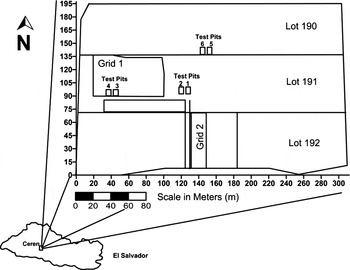
Map of research area immediately south of the Ceren archaeological site, and north of the present town of Joya de Ceren. The two grids were established for intensive ground-penetrating radar research. Test Pits 1 and 2 encountered the manioc planting beds. They are 195 m south-southwest of the plaza in the center of the Ceren site, and 170 m south-southwest of Structure 2, the domicile of the closest excavated household in the village. Map by Adam Blanford.

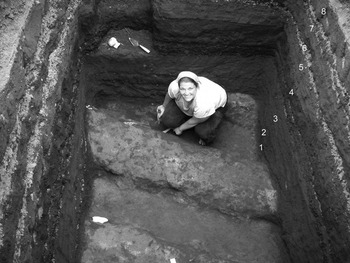
Intensification among traditional smallholders consistently is more pronounced near their households, such as the “high performance milpa” of Wilken (Reference Wilken1971), and usually diminishes with distance as one enters the outfields (Robert Netting, personal communication 1985). Our hypothesis in 2007 was that agricultural intensification and productivity would decline in fields a few hundred meters south of the village. The results did not support that hypothesis. The maize field encountered in Test Pits 5 and 6 was as intensive as those found within the site center. And the most important discovery, that certainly did not support the hypothesis, was the intensive manioc-planting field discovered in Test Pits 1 (Figure 2) and 2. These fields date to the Middle Classic period, about a.d. 600, as they were buried by the Loma Caldera volcanic ash at the same time as the Ceren village (Miller Reference Miller and Sheets2002; Sheets Reference Sheets and Sheets2002). Prior to describing the excavated manioc field at Ceren, consideration needs to be given to manioc itself, and its needs in terms of soils, moisture, and temperature.
Manioc planting ridges buried by the tephra from the Loma Caldera eruption, Test Pit 1. Christine Dixon is on a flat, hard-packed “calle” or walkway, with a large planting ridge in front of her. The white spot in the planting ridge in the foreground is dental plaster poured into a cavity left when a manioc tuber decomposed shortly after the eruption. The eruptive units are labeled on the right, with the odd numbers being fine-grained tephra layers resulting from steam explosions. The even numbers are darker and coarser layers representing air fall units.

MANIOC: BOTANICAL CHARACTERISTICS AND EDAPHIC REQUIREMENTS
Numerous varieties of wild manioc, genus Manihot, are common to the New World tropics from Mexico to the Amazon (Rehm and Espig Reference Rehm and Espig1991). Domesticated manioc is a small tree or bush that produces large carbohydrate-rich roots and edible leaves. Botanically classified as Manihot esculenta, manioc is locally known as “yuca” in Central America or “cassava” in South America (Hansen Reference Hansen and Janzen1983). The bush usually grows to 2–3 m tall, with long slender stems and long finger-like leaves. The leaves contain 15–18% protein (Hansen Reference Hansen and Janzen1983), and thus are a potential source of crude protein. Eight native South American groups consume manioc leaves (Dufour Reference Dufour1994:177). A hectare of manioc can produce up to five tons of protein in foliage per year (Moore Reference Moore1976; Toro and Atlee Reference Toro, Atlee, Cock and Reyes1985:208). Toro and Atlee (Reference Toro, Atlee, Cock and Reyes1985:208) and Cock (Reference Cock1982:755, 757) report manioc tuber harvest yields of 80 tons per hectare, but the average yield of cassava worldwide is 9–10 tons per hectare. These figures apparently are harvest weights, not dry weights, and as David Webster (personal communication 2008) states, the tubers contain 65% water, while maize contains 11% water. Most contemporary plots of manioc contain 5,000 to 20,000 plants per hectare, with the average at about 10,000 (Toro and Atlee Reference Toro, Atlee, Cock and Reyes1985:224–226). Most of the volume of the plant is underground, in the form of roots that thicken into large, carbohydrate-rich tubers, and some slender roots. Five to ten tubers develop from each plant (Hansen Reference Hansen and Janzen1983), and the dried tubers are 85% carbohydrates, less than 2% protein (Cock Reference Cock1982), and are good sources of vitamin B, iron, and phosphorous (Hansen Reference Hansen and Janzen1983). Tubers grow to a half-meter or more in length. Manioc is notable for requiring less effort in planting and tending, and is more drought-resistant, than the other Mesoamerican food crops (Leon Reference Leon1968).
Once harvested, manioc tubers must be consumed within a few days before they deteriorate. Thus storage of large amounts is a problem unless they are processed into dry flour, which does store well. However, smallholders observed by Sheets in El Salvador readily solve what would be an above-the-ground storage problem by only harvesting what is needed for immediate consumption, leaving the remainder in “storage” still growing underground. Being a perennial, manioc grows for a few years, and once mature the tubers can be harvested at any time during the rainy or dry season. During a long dry season or a drought the plant ceases to grow, but the tubers remain edible and available. Thus in times of stress it is an ideal carbohydrate source from the roots, and protein from the leaves, when other sources fail. It can be cultivated up to 2,000 m asl near the equator (Cock Reference Cock1982), but not quite so high in the Maya area because of lower temperatures. Manioc is much more tolerant of poor and acidic soils than maize, beans, or squash (Cock Reference Cock1982), but it does not grow well in waterlogged soils. The optimal precipitation range for manioc productivity is 1,000 to 2,000 mm, but precipitation can be as low as 500 mm in cooler subtropical climates, and up to 5,000 mm if good drainage is provided by digging drainage ditches or elevating planting beds (Rehm and Espig Reference Rehm and Espig1991). Manioc prefers direct sunlight and aerated soils, but where soils are dense and/or moist it can be planted in ridges (Rehm and Espig Reference Rehm and Espig1991).
People generally plant manioc vegetatively (Cock Reference Cock1982), by cutting the thicker, lower part of the stem of a plant, called the “stake,” and inserting that into the ground. Stake lengths are 20–30 cm (Hansen Reference Hansen and Janzen1983) or longer. There are three ways of planting the stake, horizontal (all of the stake below ground), vertical, or slanted. In some agricultural test cases slight differences in productivity resulted from variation in stake position in planting, but in other cases no differences were detected (Toro and Atlee Reference Toro, Atlee, Cock and Reyes1985). The stem contains growth nodes, from which sprout roots and stems for the next cycle of growth (Leon Reference Leon1968). After planting, some roots remain thin and fibrous while others accumulate great amounts of starch grains and thicken into edible manioc tubers. Manioc plants rarely produce seeds (Hansen Reference Hansen and Janzen1983:115), and though those seeds could be planted, it is rare both ethnohistorically and today.
There are two commonly identified variants of manioc, bitter and sweet. But as Hansen (Reference Hansen and Janzen1983) notes, these variants are ends of a continuum, and are not species differences. Bitter manioc contains more hydrogen cyanide and must be detoxified before consumption (Hansen Reference Hansen and Janzen1983). Bitter forms tend to occupy poor soils, live longer, are resistant to herbivory, but require a year or more before tubers are harvestable (Hansen Reference Hansen and Janzen1983). Bitter manioc is known primarily from South America, but is found occasionally in Central America. Sweet manioc can be eaten raw, or cooked or processed in a number of ways (Hansen Reference Hansen and Janzen1983). The sweet form provides edible roots in as little as six months (Hansen Reference Hansen and Janzen1983). Sweet manioc favors better soils, but does not require as fertile soils as do most seed crops.
The worldwide average for traditional manioc production is about 10 tons per hectare (Rehm and Espig Reference Rehm and Espig1991), or 9,072 kilos per hectare (presumably harvest weight), which can be greatly enhanced by careful cultivation. For comparison, Maya traditional maize agriculture today generally produces between 1,000 and 2,000 kilos per hectare (Sheets and Woodward Reference Sheets, Woodward and Sheets2002). Bronson (Reference Bronson1966:269) notes a comparative study where manioc produced six times more calories than maize per unit area under the same conditions. In a more scientifically controlled study in Brazil, manioc provided 15 times more (presumably harvest weight) per unit area than maize (Walker Reference Walker2004:49). If the fresh manioc tubers are 65% water, and fresh maize kernels 11% water, once moisture is removed the manioc still produced considerably more food value than maize per unit area. What may have been more important to ancient Maya agroecology is the fact that manioc is productive in much poorer soils and dryer conditions than maize (Cock Reference Cock1982). Thus the two crops may often have not been competitive, with maize planted in better soils, and manioc in poorer soils.
The differences between maize and manioc have implications for political economy. Our understanding of the Ceren households closely resembles the “smallholders” described by Netting (Reference Netting1993). Smallholders own their agricultural land, and make their own decisions regarding how, when, and what to plant, as well as how to maintain sustainability over long periods of time. They often are densely packed into the landscape, and thus usually increase production not by expansion of land but by increasing labor or changing technology. The advantages to the smallholder of growing both seed and root crops are many, as unforeseen climatic variations or plant pests affect different cultigens. However, if decision making and/or land ownership were supra-household, and harvesting were done en masse, storage of manioc tubers becomes problematic as they last only a few days above ground. To last longer the tubers need to be ground and dried. To date no evidence of manioc tuber drying and storage has been found in the Ceren site. The nature or degree of elite control of manioc farming is completely unknown, but future research will be exploring this important topic. If households controlled their manioc plots, extensive excavations should find discernable boundaries, and paths should be found leading toward individual households. Alternatively, if land ownership is at the community or elite level, the planting beds should extend over larger areas without subdivisions, and paths would be more communal. Harvesting presumably would be more simultaneous over a larger area than if harvesting were done by decisions made within different households. Webster (Reference Webster2002:175) argues that the greatest ignorance about ancient Maya agriculture is in this domain of political economy. Did the household or the community own the farmland, or was there elite ownership, influence, or control? At what level was decision-making done? Were commoner-elite relations coercive or were they voluntaristic and symbiotic?
2007 RESEARCH: AGRICULTURE SOUTH OF CEREN
The 2007 archaeological investigations at Ceren have significantly altered our understandings of agriculture at the site. The first step in the 2007 research was to accurately map the research area, consisting of Lots 190, 191, and 192 to the south of the Joya de Ceren archaeological site (Figure 1). Adam Blanford conducted the surveying by theodolite. Two geophysical grids within the research area were surveyed with particular care (Sheets et al. Reference Sheets, Dixon, Blanford and Guerra2007).
Monica Guerra supervised the geophysical survey, with the assistance of Christine Dixon. They used a state-of-the-art ground-penetrating radar (GPR) instrument in high-density close transects, with 400 MHz and, particularly, 270 MHz antennas. Two grids were surveyed, the larger in Lot 191 and the smaller in Lot 192. Survey lines were also conducted between the two to link them.
Dozens of geophysical anomalies were encountered within the two grids, and along the linking transects. Some apparently are natural, as some lava bombs up to a meter in diameter fell within the grids during the a.d. 600 Loma Caldera eruption, and became incorporated in the ca. 3 m of volcanic overburden. They are rather strong point source reflectors. Other anomalies apparently were created by the natural changes in landforms that existed prior to the eruption, and variation in subsurface drainage and sediment properties. We used eleven core drillings to calibrate radar rate of transmission to depth, and to verify our interpretation that we were correctly identifying the Classic period ground surface in the imagery.
After the GPR data were collected, three pairs of test pits were excavated in places of interest. Each test pit measured 2 x 3 m, with the long axis oriented north-south, and was excavated through 3 m of the Loma Caldera volcanic ash down to the Classic period ground surface contemporary with the Ceren village some 200 m to the north. The rationale for doing paired test pits, with 2 m separating them, was to examine patterning and variation in nearby localities, and to keep workers excavating rapidly through sterile volcanic ash, given the competition that developed between teams. The first pair of test pits encountered the manioc planting beds, the second pair encountered an area where manioc evidently had been cultivated years before the eruption but had been converted to an open activity area, and the third pair encountered a milpa with maize approaching maturity.
Manioc Planting Beds Discovered in Test Pits 1 & 2
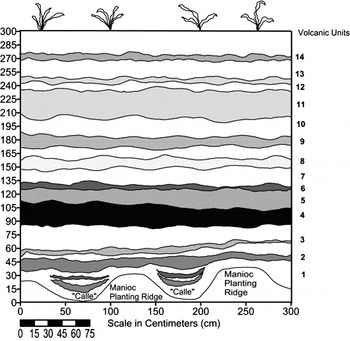
Test Pits 1 and 2 were placed toward the eastern end of GPR Tie Lines 3 and 8 (Figure 1). They were excavated at this location because they were on the GPR tie lines between the survey grids, and digging them at this locality would create minimal agricultural disturbance to modern sugarcane cultivation. Excavations slowed when approaching Unit 3 (Miller Reference Miller and Sheets2002), because experience within the Ceren site indicated the aboveground portions of cultigens were preserved as hollow spaces in that tephra deposit. The fine, moist tephra of Units 1 and 3 coated the stalks of plants; biological decomposition of the organic material occurred within months of the eruption, but fortunately the tephra retained the form of the plant for some 1,400 years. We were surprised to find no hollow spaces in any of the lowermost Units, 1 through 3, and then were even more surprised to find massive planting beds immediately below Unit 1 (Figure 2). These planting beds are seven to ten times the volume of the maize ridges that we found so commonly within the Ceren village (Lentz and Ramirez-Sosa 2002; Sheets and Woodward Reference Sheets, Woodward and Sheets2002), and in Test Pits 5 and 6 (see below). The size of the planting beds and the lack of aboveground vegetation created an interpretive conundrum.
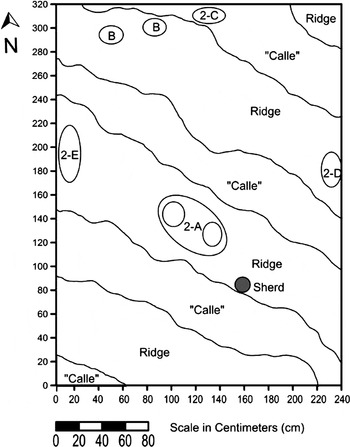
The planting beds (Figures 2 and 3) in both test pits had been reshaped a very short time before the Loma Caldera eruption began (Sheets et al. Reference Sheets, Dixon, Blanford and Guerra2007). The evidence was the freshness of the surface, with individual hand marks left by the packing and shaping of the ridges, and the occasional locations where the edge of the ridge was vertical, and even a few loci where the edge of the ridge was overhanging. The bed material is composed of only slightly weathered TBJ (Tierra Blanca Joven) tephra from the Ilopango eruption, with minimal clay content, therefore a vertical or overhanging surface is well beyond its angle of repose, and will hold only for a few hours to a few days. The Loma Caldera tephra arrived (Figure 5) and packed around these planting beds shortly after the people left, and preserved them.
Four manioc planting ridges and four “calles” in Test Pit 2. The letters denote loci where manioc tubers or manioc planting stalks were located, examined, filled with dental plaster, and excavated. Plan by Adam Blanford.

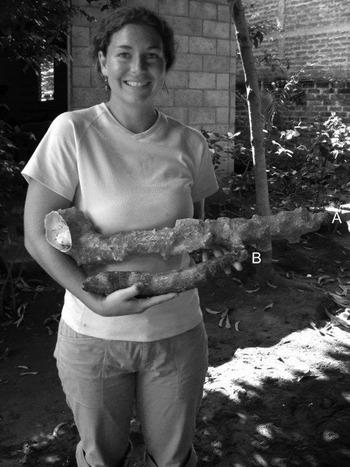
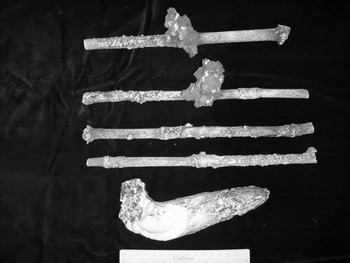
We made tiny exploratory excavations into hollow cavities inside the beds to investigate the enigma of bed massiveness with nothing growing above them. After discovery, our usual procedure is to explore each hollow with a fiber optic proctoscope and estimate its volume, and fill it with dental plaster. After the plaster set, we excavated it from its matrix and extricated a cast of the original plant. Some of the plaster casts were immediately identified as manioc tubers by us, by local farmers, and by agricultural engineers from the nearby CENTA (Centro Nacional de Technologia Agropecuaria y Forestal) agricultural experimental institution. Brazilian botanist Nagib Nassar (personal communication 2007) confirmed the identification of the tubers as manioc. Nassar also identified what was more numerous than the tubers, the stalks of the manioc bushes that had been cut into 1–1.5 m lengths and buried horizontally into the planting beds right before the eruption struck.
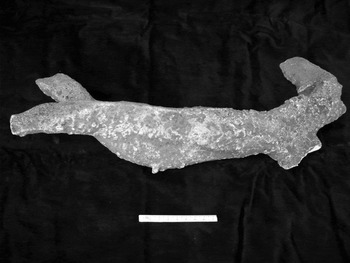
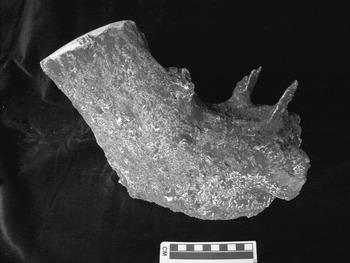
Test Pits 1 and 2 produced five manioc tubers (see Figure 4), which were fortuitously (for us) missed during the harvesting. They were buried fairly deep in the planting beds (Figure 5). We recovered a total of seven stalks (Figure 6) that had been cut and planted horizontally as “stakes” to begin the next cycle of growth.
Dental plaster cast of two overlapping manioc tubers that were missed in the harvesting that took place immediately before the Loma Caldera eruption, from Test Pit 2. Scale is 8 cm long.

Profile of west wall, Test Pit 1, showing tephrostratigraphy from the Loma Caldera eruption, and the manioc planting beds separated by the “calles.”

Monica Guerra holding a dental plaster cast of a manioc plant stalk (A) that had been cut and planted horizontally in the bed in Test Pit 1. Note robustness of the stalk. Below is a fresh manioc tuber (B) purchased in the local market, for comparison.

Local traditional agriculturalists remarked on how large the ancient manioc tubers were, and said they generally are not able to grow manioc that large today. CENTA agricultural engineers made the same observation. Nassar (personal communication 2007) noted that the stalks used as planting “stakes” were unusually robust, which would have resulted in abundant tuber production, had the eruption not occurred. Manioc thrives in well-drained, loose soils, and the slightly weathered TBJ soils certainly fit that description. Additionally, the fertility of the partially weathered TBJ soil exceeded manioc's modest needs.
The formality of the planting beds, with the straight and well-packed “calles” between them, their soft soils elevated so drainage was to the southeast toward the river, and the fact that they were exclusively devoted to manioc all indicate that this species was a staple, not just a minor kitchen garden crop.
One possible reason manioc was relegated to a distant field, while maize was cultivated all around households, may be ideological. Maize is central to Maya belief systems, including creation, and perhaps it is not surprising that it also was central in cultivation. The Ceren villagers enwrapped themselves in maize, both literally in milpa surrounding their households, and spiritually with their creation mythology and religious practices. Manioc is not and was not a “prestige” cultigen among the Maya, and its placement a couple hundred meters south of the Ceren village may be a direct statement to that effect. Manioc's culinary importance outstripped its miniscule cosmological significance in ancient Ceren. Bronson (Reference Bronson1966) cites many cultures around the world where one cultigen receives adulation and ceremony, and another, in spite of it being a staple, receives little or no special attention. That other at Ceren, manioc, was mundane, reliable, rather dull, and the tubers invisible while growing or in live underground storage.
Detailed estimation of caloric production of manioc per unit area must await excavating the beds that had yet to be harvested. Given the short time interval between harvesting/replanting at Test Pits 1 and 2, it is possible that unharvested portions of the manioc field are close by. In which direction they lay is unknown. When they are discovered and excavated, quite accurate estimations of caloric productivity per unit area will be made, and compared with present day manioc productivity. More importantly for archaeology, comparisons will be made with maize productivity in the same Classic period climatic and edaphic conditions. It is likely that manioc out-produced maize in harvest weight and dry weight per unit area at Ceren, but that must await pre-harvest volume measurements and comparisons.
A Cleared Area: Test Pits 3 & 4
Test Pits 3 and 4 were excavated on top of the gently sloping hill south of the Ceren site. Both encountered a Classic period surface that had been largely cleared of vegetation, and had been tramped down and smoothed by considerable foot traffic and probably by a variety of human activities. Both test pit surfaces exhibited gentle ridges that had been almost eliminated by post-agricultural activities. The fact that the tops of the faint ridges were about 115 cm apart indicates they were not the remains of a maize milpa. We believe it had been under manioc cultivation a few years before the eruption because that “wavelength” matches the manioc fields in Test Pits 1 and 2. A few weeds, two small bushes, and one small tree were encountered as hollow spaces and cast in dental plaster. The tree (Figure 7) had epiphytes growing on its lower trunk, only a few centimeters above the ground surface.
Stalk of tree encountered in Test Pit 4. The hollow space was encountered, and cast from there. The original (Classic period) ground surface at the lower right. Note two epiphytes growing on the tree, at upper right. Scale is 10 cm.

Maize Field Test Pits 5 & 6
Test Pits 5 and 6 were excavated on the northeastern edge of the hill to the south of the Ceren village (Figure 1). A total of 320 cm of Loma Caldera volcanic ash overburden had to be excavated to reach the Classic-period ground surface. Small-diameter cavities were encountered in clusters in Unit 3 (Miller Reference Miller and Sheets2002), similar to those found frequently within the Ceren village. A maize milpa was discovered in both test pits, with multiple sproutings of seeds planted together on ridgetops, resembling Wilken's (1971) “high-performance milpa.” The average distance between ridge tops was 80 cm, and ridges averaged 12 cm in height, much smaller and closer than the manioc ridges. The maize stalks (Figure 8) were thinner than those found previously within the site, averaging 1.6 cm in diameter, indicating that these maize plants were planted later in the growing season and had not matured at the time of the eruption. We estimate they would have needed another two or three weeks to reach maturity. As with the maize stalks, the maize ears were smaller than those we had found within the site, indicating they needed more time to mature. They averaged 4 cm in diameter and 14.5 cm in length.
Dental plaster casts of four maize plant stalks and one ear, from Test Pit 5. Scale is 15 cm. The stalks are notably thinner than those found within the Ceren village, and the ear of corn is considerably smaller. This probably is because this milpa was planted two or three weeks later than the others previously excavated. The maize in this milpa had not fully matured when the eruption occurred.

The planting and sprouting density of the milpa divulged by these two test pits apparently was as great as those within the Ceren village itself (Lentz and Ramirez-Sosa 2002; Sheets and Woodward Reference Sheets, Woodward and Sheets2002). In Test Pit 5 we found 11 clusters of maize plants, and in Test Pit 6 we found eight clusters. The difference between the two is not significant, as the shifting of a test pit boundary just a few centimeters can have a dramatic effect on the number of clusters within it. And more pertinently, we encountered a constructed feature, a raised and leveled surface with no plants growing in it, at the northwest corner of Test Pit 6. It occupied about a fifth of the 2 x 3 m test pit. Its function is unclear; it might have been a flat open area onto which maize ears could have been tossed during harvest, or for processing manioc from nearby plots, but other functions are quite possible. Had the eruption not occurred, these maize plants presumably would have matured and the ears of corn provided about the same high productivity as those within the village. Hence our expectation of declining intensity of agricultural efforts, and productivity per unit area as distance from the village increased, was not supported.
SUMMARY AND CONCLUSIONS
The 2007 research season at Ceren was educational for us, in that the results directly contradicted two expectations that we had. We expected that the agricultural productivity per unit area would diminish with distance from the village, and that turned out not to be true. And we expected to find no manioc outside the village, as it was such a minor kitchen garden crop within the village. It was a surprise to find manioc, and particularly in such a formal planting system that indicates it was a staple crop.
We expected to find a diminution in productivity with distance from the Ceren village, because the care in field preparation and density of cultigens could decrease outside the settlement. More specifically, if we found maize, we expected to find less care in maize ridging, which could have taken the form of smaller ridges, or simpler mounding around a cluster of seeds sprouted into maize plants, or greater distances between ridge tops, or distances along the ridge tops where plantings were done. The actual results supported none of these, as intensity was the same as in the village. It was notable that maize had matured earlier within the village, whereas the maize discovered in Test Pits 5 and 6 needed another two or three weeks to mature. We think the most likely reason is that maize was planted earlier in the village, but it is possible that greater organic returns (kitchen garbage and/or human waste) facilitated growth adjacent to households.
Our expectation regarding manioc was based on finding occasional isolated plants within the village, and over the years we became comfortable with the interpretation that it was only a minor garden plant, and thus it was not a staple. We found one area in 2007 where it apparently had been cultivated years before the eruption, but that had been converted to an open activity area kept largely clear of vegetation. The other area was intensively cultivated in large formal beds, and had been harvested of most of the tubers shortly before the eruption. And all aboveground vegetation had been cut, with some of the stalks of the bushes planted horizontally in the beds to begin the next cycle of growth.
Manioc grows well in a wider range of soils than maize does—from fertile to quite infertile. And it produces many times the harvest weight of maize, and greater calories per unit area than maize. But it preserves much more poorly in the archaeological record. And of course in Maya art, creation mythology, and cosmology maize is featured and manioc ignored. Thus it takes a site with unusual preservation, such as Ceren, to level the playing field and give all cultigens essentially equal chances of surviving into the twenty-first century. In our first tiny agricultural explorations outside the village we stand corrected, and recognize that although relegated to the outside of the village, manioc evidently was intensively grown as a staple crop (i.e., a crop regularly producing a high proportion of food for local households). We suggest that Ceren and other Maya sites could also have focused on maize as the “prestige” crop, while they were intensively cultivating manioc as a reliable staple at a distance, particularly useful in times of environmental stress.
Who owned the manioc field? It is possible that individual households owned their particular manioc plots, and thus made their own decisions on harvesting individual tubers, or harvesting the entire plant with all the tubers. In the latter case, they would also decide on how and when to do the replanting with the lower section of the stalk. If households owned their own portion, the field boundaries of their plots should be clear, and multiple paths should exist leading from fields to their houses.
Alternatively, if the community owned the field, one would expect to find more extensive manioc plots, without many individual subdivisions, and more substantial communal walkways back to the village. And supra-community land ownership is also possible, as elite from San Andres could have owned this land and regulated its cultivation. Each alternative has significant implications for our understanding of the economic, social, and political organization of Ceren within the wider Maya landscape. Future excavations can explore the agricultural political economy of the Classic Maya living in Ceren.
RESUMEN
La temporada de investigación de Ceren en 2007 era educativa para nosotros, en que los resultados contradijeron dos expectativas que teníamos. Nosotros esperamos que la productividad agrícola por el área de la unidad disminuyera con la distancia del pueblo y eso resultó no ser la verdad. No esperamos encontrar yuca (Manihot esculenta) fuera del pueblo, porque solo hemos descubierto yuca como planta aislada en jardines de cocinas dentro del pueblo. Era una sorpresa encontrar la yuca y particularmente en un sistema plantando formal que indica que era una cosecha principal.
La disminución en productividad que nosotros esperamos debido al cuidado disminuido en la preparación del campo y densidad de cultivos plantados. Más específicamente, si nosotros encontráramos el maíz, nosotros esperamos encontrar el maíz menos cuidado en dando forma de surco, eso podría ser monticulitos más pequeños, o amontonando más simple alrededor de un racimo de semillas crecido en las plantas de maíz o distancias mayores entre los surcos, o distancias a lo largo de los surcos dónde se encumbraron. Los resultados actuales no apoyaron ninguno de éstos, porque la intensidad era igual que en el pueblo. Era notable que el maíz había madurado antes dentro del pueblo (al momento del erupción de la Loma Caldera), considerando que el maíz descubrió en los pozos de prueba 5 y 6 necesitaron otro dos o tres semanas para madurar. Nosotros pensamos la razón más probable es que el maíz se plantó antes en el pueblo, pero es posible que los ingresos orgánicos mayores (la basura de la cocina y/o pérdida del humano) facilitó el crecimiento adyacente a las casas.
Nuestras expectativas con respecto a la yuca eran basadas en encontrar las plantas aisladas ocasionales dentro del pueblo, y durante los años de investigaciones nosotros nos pusimos cómodos con la interpretación que era sólo una planta menor del jardín, y así no era un cultivo principal. Nosotros encontramos un área (pozos de prueba 3 y 4) donde parece haber sido cultivado años antes de la erupción pero eso se había convertido en un área de actividad abierta mantenida libre de vegetación.
La otra área era intensivamente cultivado en yuca, Manihot esculenta, (pozos de prueba 1 y 2), y se había segado la mayoría de los tubérculos unas horas antes de la erupción. Toda la vegetación arriba del suelo había sido cortada, con algunos de los tallos de los arbustos sembrados horizontalmente en los surcos para empezar el próximo ciclo de crecimiento.
La yuca crece bien en un rango más ancho de tierras, de fecundo a bastante infecundo, que el maíz. Produce una cosecha muchas veces mayor que el maíz y calorías mayores por hectárea que el maíz. Pero la yuca se conserva peor que el maíz en el registro arqueológico. Claro que el maíz es favorecido en el arte maya, las mitologías de creación y la cosmología y la yuca pasada por alto. Requiere un sitio con la conservación muy buena, como en Joya de Cerén, para ver la cantidad de cada especie de cultivos y como estuvo cultivado. En nuestras primeras exploraciones agrícolas diminutas fuera del pueblo nos dimos cuenta que la yuca era una cosecha principal. Sugerimos ahora que Joya de Cerén y otros sitios mayas también podrían haber considerado el maíz como cosecha de "prestigio" mientras la yuca estaba cultivada intensivamente como un cultivo fiable a una distancia, particularmente útil en tiempos de tensión medioambiental.
¿Quién poseyó este campo de cultivo de yuca? Es posible que las familias individuales poseyeran su lugar de yuca particular y así tomó sus propias decisiones en cosechar los tubérculos individuales o cosechar la planta entera con todos los tubérculos. En el último caso, ellos decidirían también más adelante cómo y cuándo encumbrar con la sección más bajo del tallo. Así, si las casas poseyeran sus propias parcelas, los límites del campo de sus parcelas deben estar claros y el sendero del campo a su casa más individual.
Al contrario, si la comunidad poseyera el campo, uno esperaría encontrar el campo de yuca más extenso, sin tantas subdivisiones individuales y los senderos comunales más sustanciales hacia el pueblo. La propiedad de tierra de supra-comunidad también es posible, como la élite de San Andrés podría haber poseido. Las excavaciones futuras pueden explorar la economía política de los mayas que vivieron en Joya de Cerén.
ACKNOWLEDGMENTS
The 2007 research was supported by National Geographic Society Committee on Research and Exploration grants 5871-97 and 8156-07. Their support is heartily appreciated. Dr Lawrence Conyers, University of Denver, graciously loaned us his state-of-the-art ground-penetrating radar instrument, with multiple antennas. His assistance is enthusiastically acknowledged.
CONCULTURA, Ministerio de Educacion, graciously granted us permission to conduct the research, in October of 2006. They again granted us permission, at the beginning of June 2007, after suspending it for the month of May.
Our deep gratitude is also acknowledged for the exceptionally hard work done by our crew of 12 local Salvadoran workers. Their dedication to the project, and to their national patrimony, is impressive.
The assistance of agricultural engineers Abilio Orellana, Marcos Mejia, Raul Quintanilla, and Eduardo Funes, from the Centro Nacional de Tecnología Agropecuaria y Forestal (CENTA), in identifying the manioc tubers, and in detailed analyses of soil samples for fertility, is greatly appreciated. Nagib Nassar (Professor, Department of Genetics and Morphology, University of Brasilia) was instrumental in identifying the stalks of the manioc bushes that had been cut and placed horizontally in the planting beds to start the next cycle of growth.
David Webster contributed a detailed critique of the penultimate version of this manuscript, and his comments are greatly appreciated. We are indebted to Paul Healy for the Caribbean information and conceptualization of manioc, which stands in striking contrast with knowledge and research on Maya use of the plant. Emily McClung de Tapia and an anonymous reviewer provided suggestions that we found particularly helpful. Errors of omission or commission are ours alone.