


Introduction
There is a growing literature indicating that worry has a causal role in the occurrence of paranoia (see Garety and Freeman, Reference Garety and Freeman2013). Epidemiological studies have established that higher levels of worry are associated with non-clinical persecutory ideation (Freeman et al., Reference Freeman, McManus, Brugha, Meltzer, Jenkins and Bebbington2011) and approximately two-thirds of individuals with persecutory delusions have levels of worry comparable to those seen in generalized anxiety disorder (GAD) (Freeman and Garety, Reference Freeman and Garety1999; Morrison and Wells, Reference Morrison and Wells2007; Bassett, Sperlinger and Freeman, Reference Bassett, Sperlinger and Freeman2009). Worry predicts the new occurrence of paranoia (Freeman et al., Reference Freeman, Dunn, Startup and Kingdon2012), the persistence of persecutory delusions (Startup, Freeman and Garety, Reference Startup, Freeman and Garety2007) and the occurrence of paranoia in an experimental situation (Freeman et al., Reference Freeman, Pugh, Antley, Slater, Bebbington and Gittins2008). Consistent with a causal role for worry in paranoia, treating worry in people with persecutory delusions leads to a reduction in both worry and the delusion (Foster, Startup, Potts and Freeman, Reference Foster, Startup, Potts and Freeman2010; Hepworth, Startup and Freeman, Reference Hepworth, Startup and Freeman2011).
Much is now understood about factors that promote and intensify worry (Davey and Wells, Reference Davey and Wells2006) and worry is beginning to assume a transdiagnostic status. However, less is understood about what leads a person to stop a bout of worrying once they have begun. This knowledge has the potential to enhance clinical interventions. The question has never been addressed in a psychosis group before, but has been explored amongst non-clinical samples using concepts from the “mood-as-input” hypothesis (Martin, Ward, Achee and Wyer, Reference Martin, Ward, Achee and Wyer1993; Martin and Davies, Reference Martin and Davies1998; Startup and Davey, Reference Startup and Davey2001; Davey, Reference Davey, Davey and Wells2006).
The “mood-as-input” account proposes that individuals use their mood state to decide when to terminate their worry sequence in combination with “stop rules” (Davey, Reference Davey, Davey and Wells2006). Factor analysis suggests that individuals use two main types of stop rules: “as many as can” (e.g. “keep going until I have done enough”) or “feel like continuing” (e.g. “keep going as long as it feels right”) (Davey, Reference Davey, Davey and Wells2006). If a person has a stop rule of “keep going until I have done enough” then in the context of low mood they will worry for an extended period. If a person has a stop rule of “keep going as long as it feels right” then when in a negative mood they will terminate worry earlier. Chronic worriers are considered to have negative mood and stringent “as many as can” stop rules. There is experimental evidence in support of the idea that negative mood and “as many as can” stop rules drive worry (e.g. Startup and Davey, Reference Startup and Davey2001, Reference Startup and Davey2003), perseverative checking (MacDonald and Davey, Reference MacDonald and Davey2005), and depressive rumination (Watkins and Mason, Reference Watkins and Mason2002; Hawksley and Davey, Reference Hawksley and Davey2010).
The majority of research into stop rules has been conducted with non-clinical populations (Meeten and Davey, Reference Meeten and Davey2011) and it is unclear whether clinical samples adopt different or a greater range of stopping criteria. Worry is a significant problem for individuals with psychosis. If we can understand how worry eventually comes to a close we can better target worry intervention packages and ultimately reduce psychotic symptoms (Foster et al., Reference Foster, Startup, Potts and Freeman2010). Our aim is to explore what people with psychosis tell us about factors that bring a worry episode to an end. We use an open-ended semi-structured interview technique and Interpretative Phenomenological Analysis (IPA) to encourage a rich and broad elaboration of relevant constructs.
Method
Sample
Participants were recruited from the control arm of a randomized controlled trial (Freeman, Dunn, Startup and Kingdon, Reference Freeman, Stahl, McManus, Meltzer, Brugha and Wiles2012). This trial was evaluating the clinical efficacy of a brief cognitive behavioural intervention for worry for people with persecutory delusions. The first 14 participants to complete the trial were asked if they would like to take part in the current study during a routine follow-up visit at the end of the trial. Five people declined and one was too unwell to take part at the time of the interview, leaving eight people who consented to take part and completed the interview.
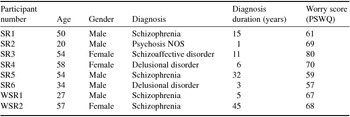
All participants had been recruited from mental health teams across Oxford Health NHS Foundation Trust and Southern Health NHS Foundation Trust. All participants were currently experiencing a persecutory delusion as defined by Freeman and Garety (Reference Freeman and Garety2000) within the context of non-affective psychosis (e.g. schizophrenia, delusional disorder or schizoaffective disorder). This delusion had to have persisted for at least 3 months for the patient to be considered for the study. They were also experiencing a clinically significant level of worry as indicated by a score of 45 or above on the Penn State Worry Questionnaire (PSWQ: Meyer, Miller, Metzger and Borkovec, Reference Meyer, Miller, Metzger and Borkovec1990; Startup and Erickson, Reference Startup, Erickson, Davey and Wells2006). Participants could not be currently receiving CBT, or be likely to receive CBT during the trial. Past experience of CBT was not recorded. The clinical details of the participants are displayed in Table 1.
Clinical details of the participants interviewed

Semi-structured interview
A semi-structured interview schedule was devised following a review of the relevant literature and it was used flexibly to guide the interview (see Appendix). In the opening question participants were asked about the kinds of things that worry them. A mixture of paranoid and non paranoid worries were disclosed by participants but it is the paranoid worries that were focused on in the analysis. The majority of participants disclosed their paranoid worries about others spontaneously when asked the opening question. However, one participant was prompted about whether she worried about others, as her main worry at the time of interview was her mother's illness. For those that described a number of different worries, it was their descriptions of how they stopped worrying about their persecutory beliefs that was focused on in the analysis and their quotes about this that support the themes.
Participants were then asked to bring to mind a recent time when they had been worried about what they had described and to talk through how their period of worry came to an end. The aim of the interview was to explore the internal and external processes (e.g. cognitive, behavioural and emotional components) that may lead to a period of worry stopping. In line with IPA recommendations (Smith and Osborn, Reference Smith, Osborn and Smith2008) questions began open-ended and the interviewers encouraged elaboration with both verbal (e.g. “can you tell me a bit more about that?”) and non-verbal (e.g. nodding) cues. The interviewers ensured that people were not primed into giving particular answers but follow-up prompts were used to tap any additional processes that the participant did not mention spontaneously (e.g. “do you say anything to yourself to bring worry to an end?”).
Procedure
Approval for this study was gained through the local research ethics committee (ref number: 11/SC/0001). Prior to being interviewed, all individuals gave written informed consent for their participation in the study and for the interview to be audio recorded. Data were anonymized by replacing names with codes during transcription and analysis. Participants were interviewed in a private room within their home or at their local mental health team base. The interviews were recorded on a digital dictaphone and transcribed verbatim into written text. Interviews ranged between 9 and 30 minutes in duration. The British Medical Journal’s guidelines for the conduct of qualitative research were followed in all aspects of the conduct of the study (Kuper, Reeves and Levinson, Reference Kuper, Reeves and Levinson2008). This guidance states that qualitative research should aim to generate in-depth accounts from individuals, taking into account the context in which they are based and the researchers’ perspective. Rather than being driven by hypothesis testing, meaning should emerge from the data. We followed this by ensuring we asked open ended exploratory questions of the participants. We have also made clear the context in which the interviews and analysis took place to allow the reader to reflect on the results and draw their own conclusions.
Data analysis
The transcripts were qualitatively analysed using IPA as described by Smith and Osborn (Reference Smith, Osborn and Smith2008). IPA was chosen as the method of analysis for its focus on understanding lived experiences and the subjective understanding of these experiences in the context of personal attitudes and perceptions (Smith, Reference Smith2004). In accordance with the IPA process each transcript was read and re-read to enable the researchers to become familiar with the accounts. The main researchers were clinical psychologists who also delivered the trial intervention and they were aware that participants had been drawn from the control arm of the larger trial. Two researchers (JC and KP) independently coded the transcripts to identify initial key ideas that arose from the data. Tentative labels were generated to capture the essence of the ideas within each interview, and subsequently clustered into themes. The two researchers regularly discussed their findings to validate the themes, as well as to cross-validate them across the eight interviews. Where there were any discrepancies in findings, these were discussed and, where necessary, the transcripts were looked at again. These were discussed further and refined with additional members of the research group (HS and DF). Through an iterative process a number of super-ordinate themes were agreed which described the cluster of initial themes (Smith and Osborn, Reference Smith, Osborn and Smith2008). Super-ordinate themes were chosen based on their prevalence within the text and ability to describe the richness within the data (Smith and Osborn, Reference Smith, Osborn and Smith2008).
Results
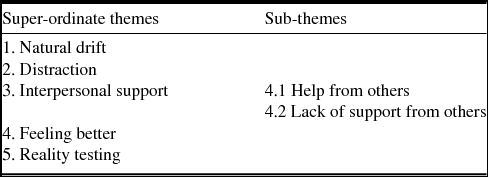
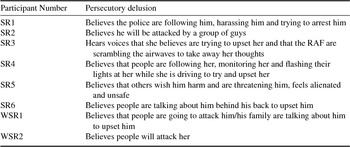
In response to the first interview question (“Can you tell me about the sorts of things that you worry about?”) the participants described a number of different persecutory beliefs. Full details of these are provided in a Table in the appendix. Within the transcripts, five super-ordinate themes were identified relating to the topic of bringing worry to an end. Table 2 details these super-ordinate themes and the sub-themes within them.
Overview of the super ordinate themes and sub themes within them
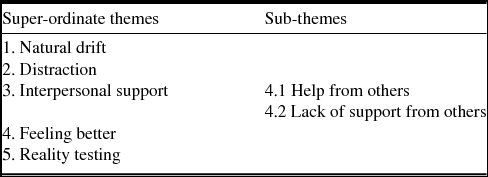
An additional super-ordinate theme was also identified relating to the experience of worry itself. Participants gave rich descriptions of what the process of worrying was like for them. Although this theme does not relate to the aim of the study, it was deemed important to highlight these descriptions of worry as they were a prominent aspect of the transcripts. This section will begin with the super-ordinate theme relating to the experience of worry and will then move on to the super-ordinate themes that relate to the process of stopping worry.
The nature and experience of worry
This super-ordinate concept was made up of three sub-themes and these are described below with supporting quotes from the transcripts.
Lack of control of worry
Participants described feeling overwhelmed by worry. There was a sense from participants that worry could start unexpectedly and that there was nothing they could do to stop it. Participants described worry taking over them so that they felt unable to control how they felt.
it's totally um. . .drowning. The fears. (SR03, p. 11)
but it's it's a general feeling that you state of mind is er. . .[pause] in control of you rather than you in control of it, y’know. (SR05, p. 1)
Persistence of worry
Participants described their worries as constant. They talked about never being totally free from worry and that it was always there affecting their day to day life.
it worries me all the time. . .all the time. . ..always worried about it. (SR01, p. 1)
it's always there lurking in the background. (SR04, p. 4)
I can't get away from it, here there or anywhere, it's always around. (WSR2, p. 7)
Impact of worry
Participants talked about the pervasive nature of worry. Participants gave rich descriptions of the physical feelings it could induce and the impact that this had on how they felt emotionally.
I feel really panicky, I feel jittery. I feel like I can't sit still. (SR03, p. 13)
Yeah, getting so as I can't breathe! And then. . .and . . .trying not to get physically upset y’know, and shaking. (SR04, p. 11)
Participants talked about worry escalating to the point where it would affect their behaviour and ability to cope.
Sometimes it stops me doing things I really wanna do. . .because I don't feel safe and I panic. (WSR2, p. 2)
. . .sit and think. Then get paranoider and paranoider and paranoider and paranoider. (WSR1, p. 3)
when other situations are presented to me because I’m worrying about that as well, I can't handle both and it goes into overdrive. (SR04, p. 1)
Themes relating to the experience of stopping worry
As shown in Table 2, five super-ordinate themes were identified in relation to stopping worry. These are described in detail below with supporting quotes from the transcripts.
Natural drift
Participants often described a passive relationship with worry, in which they felt unable to do anything about their worry, apart from waiting for it to end. Some participants struggled to notice when they had stopped worrying or how long they had been worrying.
I just have to wait for it to wear off. . .I know I shouldn't smoke but I do have cigarettes and a cup of tea, and. . .I just sit and wait for it to. . .wash over me. (SR03, p. 11)
Well you don't [know when you’ve stopped worrying] with schizophrenia, that's the thing I mean it's a sort of a. . ..I felt these things went on the whole day and all day. . .and then er. . .but actually when I was on my own, I thought, well, was it particularly acute as that at all? (SR05, p. 4)
Participants did not believe that they affected their worry in any way and that their worry ended independently from anything that they did.
It seems to be around 8 or 9 o’clock in the evening. I’d just had my temporary lull from them and things. . .I have a lull. And er. . .my mood . . .my moods er. . .sort of er. . .lifted about things. (SR05, p. 5)
it just sort of passed off. (SR01, p. 7)
It would just eventually go, I’d just stop thinking about it. (SR02, p. 3)
Distraction
Despite often describing their worry as uncontrollable, many participants talked about trying to manage worry with distraction techniques. These were predominantly behavioural in nature with participants trying to take their mind off worry by doing something else.
Well I had the music on and that helps, so that's my . . .y’know there's always got to be a distraction there. If there's no distraction it permeates my brain constantly. (SR04, p. 5)
Just to get out of the house. Try to take my mind off it. (WSR1, p. 8)
I watch the soaps if I can. (WSR2, p. 9)
Some participants were able to explicitly make the link that being engaged in something else could take their mind off their worries.
My body is still tense, and my brain is still burning up. Y’know, but. . .um. . .I’m physically doing other things and there's only so much my brain can um. . .think about doing, y’know. So I try and do those things. (SR04, p. 11–12)
When I’m at work, I’m not worrying too much, because I’m always busy. (SR06, p. 1)
However, some participants acknowledged that distracting themselves was not always an easy task and described struggling with this.
I just, try to preoccupy myself and. . .it's very difficult because it's going on in my head. (SR03, p. 7)
I put loud music on headphones and I turn the music up loud, but that doesn't work no more. (WSR1, p. 16)
There was also an awareness reported by some participants, that partial distraction did not always totally rid them of worry.
It contains it. It doesn't take it away, it contains it. (SR04, p. 6)
Some participants described being unable to use distraction techniques, even though they were aware that being busy could be helpful.
When that takes over me I can't do anything, I’m physically immobile. I can't go into the garden, I can't listen to my Nano, I can't be bothered to get it because it's so overwhelming. (SR03, p. 12)
Interpersonal support
This superordinate concept was defined by two sub-themes. The first of these encompasses the help that participants received from others. The other sub-theme describes the opposite to this, when participants felt unsupported by others.
Help from others
Participants reported talking to others as being something that they actively engaged in to reduce worry, or that others tried to talk to them to help them reduce their worrying. Some participants talked to others about their worries but other participants talked to people about something else, to distract them from their worries.
Well I’d talk with somebody about it. Helped quite a bit. . .helped to get it off my mind really. (SR02, p. 3)
He [husband] engages me in conversation. (SR03, p. 8)
Talk to the staff. . .about how I’m feeling and can they help me. . . they reassure me, they interact with me. (WSR2, pp. 4–5)
[did anything help you stop worrying?] I mentioned it to M. [did that help?] yeah, I thought it did, yeah (SR01, p. 8)
Participants also reported feeling safer and less likely to worry if they were with other people.
When she isn't here I have worries and paranoia. She's like my rock. (WSR1, p. 5)
I worry about [it] more when I am alone. (SR06, p. 4)
Lack of support from others
Lack of support from others also seemed to have an impact on worry. A couple of the participants reported that people did not believe the content of their worries. This left them feeling unsupported and could lead to further frustration and anxiety when worries come to mind.
[Does talking to your husband help?] No, my husband doesn't believe me. (SR03, p. 11)
I don't feel anyone cares, I don't feel anybody's gonna do anything about it, I feel that. . .the medical profession. . .or some of the medical profession feel that I’m imagining it, I certainly think the police think that. . . . (SR04, p. 5)
The fact that it keeps on happening and nobody gives a toss. That comes to the forefront every time. (SR04, p. 9)
One participant talked about his struggles to talk to others about his experiences and how this could leave him feeling isolated and without support.
I mean it's just the problem is that I don't share my emotional life with anybody and I haven't shared my emotional life, my sexual life, with anybody, for an extremely long time. And it's very hard to relate a sense of normality to people. (SR05, p. 13)
I don't know how you explain it but you just become a. . .a person completely adrift from other people, y’know? (SR05, p. 5)
Feeling better
Some participants talked about using their feelings as a guide that worry had ended. In contrast to the “feel like continuing” stop rule, participants seemed to be using their feelings as a communication that worry had ended or had “naturally drifted”, as described earlier.
[How would you notice that it had stopped?] I’d feel happy and I’d go down and do my work like normal. (SR02, p. 3)
I just totally relax. It feels like rubber. (SR04, p. 13)
I feel a sort of sense of. . . it's not relief, it's like um. . .sort of um. . . it's um. . . [pause] It's just a feeling of control of myself again, y’know.[indicates that worry has stopped] It's it's it's like a. . . some something's coming. . . coming to me of its own accord, y’know. (SR05, pp.7–8)
One participant described trying to change her feelings to bring worry to an end. This involved her either trying to appear happy to others or to think about a happy memory as a means to take her mind off her worries.
[What brought that worry to an end today?] I put on a brave front. . . being bright and breezy and happy. . . (SR04, p. 4)
I mean when I’ve had to pull over I’ve thought of my grandchildren. I’ve trained my mind to a mental picture of them you know. . .so. . .a happier moment. (SR04, p. 12)
Reality testing
Some participants seemed to be trying to reason with themselves when they were worrying to bring worrying to an end. This involved participants telling themselves that what they were worrying about could not happen.
I say don't be silly, they can't do that. But I know they are doing it. (SR03, p. 11)
I try to convince myself that because of that, surely nobody would go to the extreme of sitting outside and stuff like that, but. . .um. . .I know of people that would do that. (SR04, p. 8)
However, this often did not seem to convince them and would not lead to their worries reducing. Some described being unable to reality test their worries when they were in the midst of it. These participants were aware that all they could think about when they were worried was their worries and they would get caught up in thinking about the worst that could happen.
In my head, the thing I am worried about really happen. Not just worry. Because I think when I. . .when I am worried, I think that thing really happen. (SR06, p. 2).
I just. . .as I say I normally think the worse, and I just keep thinking bad things about myself, that I shouldn't go back out there and things. (SR02, p. 7)
Discussion
This is the first study to investigate what brings worry to a close for people with persecutory delusions. We used explorative qualitative methods to capture the patients’ experience of worry and specifically factors influencing worry closure. Analyses revealed one sub-ordinate theme that captured participants’ rich description of their experience of worry and five additional sub-ordinate themes covering a range of cognitive, behavioural, emotional and interpersonal factors that help bring worry episodes to a close (or at least lessen the impact).
The nature and experience of worry
Participants provided very rich accounts of the nature and experience of worry that were encapsulated by three sub-themes: 1) participants described a subjective sense of having little control over their worry; 2) they reported their worry as persistent and preoccupying; 3) they described worrying as having a range of negative emotional consequences. These accounts concur with what is perhaps the most widely cited definition of worry (cf. Borkovec, Robinson, Pruzinsky and DuPree, Reference Borkovec, Robinson, Pruzinsky and DuPree1983, p. 10). They also suggest that worry is something that individuals with persecutory delusions can talk about and reflect upon and that worry is considered a significant problem by this group. It has been striking during the course of the trial how few patients with persecutory delusions have not met the entry criterion for level of worry. This is consistent with findings of high levels of worry in patients with persecutory delusions (Freeman and Garety, Reference Freeman and Garety1999; Startup et al., Reference Startup, Freeman and Garety2007; Freeman, Pugh, Vorontsova, Antley and Slater, Reference Freeman, McManus, Brugha, Meltzer, Jenkins and Bebbington2010).
Stopping worry
In contrast to the two stop rules described in the literature (Davey, Reference Davey, Davey and Wells2006), individuals were able to tell us about five different factors that bring their worry to a close. First, there was the sense that worry termination came about via “natural drift” or by waiting for worry “to pass”. This implies a passive relationship to worry and for some there was a sense of being powerless in relation to their worry. Evidence suggests that negative meta-beliefs about worry, such as “worry is uncontrollable” and “overwhelming” are associated with more problematic worry (Wells, Reference Wells, Davey and Wells2006) and we know that powerlessness can be a feature of the appraisal style of this group (Bentall and Fernyhough, Reference Bentall and Fernyhough2008; Garety and Freeman, Reference Garety and Freeman1999). Whether this more passive stance was typical of certain individuals or in relation to certain types of worries was less clear.
The second theme covered “distraction”, which was the main “active” method reported by this group. The value of distraction techniques to calm worry is well documented (Meares and Freeston, Reference Meares and Freeston2008; Leahy, Reference Leahy2006) and individuals’ readiness to report this method suggests that this is a highly valued self-help tool for this group. The third theme represented “interpersonal support”. “Talking it through” with a trusted other was highly valued as a way of containing worry. Those without social support reported feeling alone and isolated with their concerns. Paranoid thoughts have been shown to be associated with a perceived lack of social support (Freeman et al., Reference Freeman, McManus, Brugha, Meltzer, Jenkins and Bebbington2011) suggesting that having trusted people to “talk through” worries and to offer support is invaluable for this group in managing anxiety.
Some of the participants talked about using their feelings as a guide that worry had ended, or even altering their feelings to end worry. This theme was called “feeling better”. In contrast to the “feel like continuing” stop rule (Davey, Reference Davey, Davey and Wells2006), participants seemed to be using their feelings as a communication that worry had come to a close or had “naturally drifted”. This is perhaps more along the lines of using “mood-as-information” in decision making (Schwarz and Clore, Reference Schwarz and Clore1983, Reference Schwarz and Clore2003). The final theme reported by this group was “reality testing” in which participants appeared to attempt to “talk down” their worries by reminding themselves of the reasons why their worries were unlikely or refutable. Looking for evidence against anxious thoughts is central to cognitive therapy for worry (e.g. Meares and Freeston, Reference Meares and Freeston2008) and suggests that this (untreated with CBT) group draw on these techniques by their own initiative.
That worry is a significant problem for this group of individuals is now well established (Freeman and Garety, Reference Freeman and Garety1999; Startup et al., Reference Startup, Freeman and Garety2007; Morrison and Wells, Reference Morrison and Wells2007; Bassett et al., Reference Bassett, Sperlinger and Freeman2009). The present study extends these findings by highlighting that individuals with paranoia are aware they worry, they can report on their experience of worry, and they have a number of resources that they draw on to bring worry to a close. We know that treating worry in people with persecutory delusions leads to a reduction in both worry and the delusion (Foster et al., Reference Foster, Startup, Potts and Freeman2010; Hepworth et al., Reference Hepworth, Startup and Freeman2011). The current study suggests that building on individuals’ distraction techniques, reality testing ability and their social support network could be of benefit. In addition, cultivating a “mindful” approach toward “letting go” of worries rather than adopting a stance of powerlessness and waiting for worries to “naturally drift” could also be beneficial for patients (Chadwick, Newman-Taylor and Abba, Reference Chadwick, Newman-Taylor and Abba2005). This qualitative study was designed to lead to further research on the clinically important question of how patients with persecutory delusions end bouts of worry. It would be valuable to develop a questionnaire to assess worry closure techniques and to test which are most likely to lead to reductions of worry over time.
The main strengths of this study are the novelty of the topic examined and the open-ended manner in which we explored how people with persecutory delusions stop worrying. The small sample is a limitation of the study, but this is the recommended size for qualitative studies due to the depth of analysis entered into for each transcript (Smith and Osborn, Reference Smith, Osborn and Smith2008). Although cross validation of themes between the main researchers and with other members of the team occurred throughout the data analysis processes, more formal reliability and validity checks were not performed. Furthermore these results cannot be generalized to other delusion types or delusions of greater or lesser severity or to those who are low worriers. It was also unfortunate that six participants approached were not willing or not able to participate. Clearly quantitative methods could now augment the generalizability of these emergent findings. Another avenue for further research is whether other clinical populations describe similar ways of stopping worry. We cannot decipher from this study design how implementable or successful these reported strategies actually are in bringing participants’ worry to a close but this warrants investigation. Overall, findings from this qualitative study suggest that people with psychosis are able to describe their experience of worry in rich and understandable terms and articulate five broad ways in which they believe they bring their worry to a close.
Acknowledgements
The study was supported by a grant (09/160/06) from the Efficacy and Mechanism Evaluation (EME) Programme, which is funded by the UK Medical Research Council and UK NHS National Institute for Health Research. DF is supported by a UK Medical Research Council Senior Clinical Fellowship.
Appendix
Questions used to guide the interview:
1. Can you tell me a little bit about the sorts of things you worry about?
2. We are interested in the sorts of things that lead to an episode of worry eventually stopping? To do this it might be useful to bring to mind a couple of recent worry episodes that you can recall.
a) (External) are there features of your day to day life that tend to intervene to bring your worry episode to a close.
b) (internal) are there thoughts in your mind or questions you ask yourself that bring your worry to a close
c) Are there feelings you experience that tend to bring your worry to a close?
d) Explore the above in relation to two or three specific worries (identified in 1)
Details of participants persecutory delusion




Comments
No Comments have been published for this article.