Emotion regulation is broadly defined as an ability to effectively modulate emotional experiences (Kring & Sloan, Reference Kring and Sloan2010) and is considered essential for psychological well-being. Pervasive difficulty with emotion regulation is a transdiagnostic problem believed to underlie a variety of psychological disorders, such as depression, anxiety, eating, substance use, and borderline personality disorders (Aldao et al., Reference Aldao, Nolen-Hoeksema and Schweizer2010; American Psychiatric Association, 2013; Sloan et al., Reference Sloan, Hall, Moulding, Bryce, Mildred and Staiger2017). Linehan’s biosocial model (Reference Linehan1993) provides one of the most thorough etiological explanations for pervasive emotion dysregulation, suggesting that the transactions between biological tendency towards emotion vulnerability and an invalidating environment give rise to emotion dysregulation over time. As research accumulated in the past decades, a developmental perspective of psychopathology was integrated to enhance the model (Crowell et al., Reference Crowell, Beauchaine and Linehan2009). This expanded biosocial model proposes a pathway through which early biological vulnerabilities potentiate across development by transacting with environmental risk factors, thereby leading to heightened emotional dysregulation.
The biosocial model
According to the biosocial model, biological vulnerabilities associated with genetics and brain systems (e.g., fronto-limbic dysfunction) may affect children’s temperament, such as by increasing impulsivity (Crowell et al., Reference Crowell, Beauchaine and Linehan2009). The biological vulnerabilities may shape ways the environment responds to children including caregivers’ behaviors. For example, children who are more impulsive and emotionally sensitive may express emotions more frequently that are poorly tolerated or rejected by caregivers. An invalidating environment is an environment where children are punished for reasonable expressions of emotions, through caregivers communicating that the (internal) experience of the child is not accurate, over-simplifying difficulties experienced, or discouraging display of emotions (Linehan, Reference Linehan1993). A tendency for caregiver to invalidate child emotions as well as inadequate coaching of emotional coping may further intensify extreme emotional expressions and subsequently reinforce emotion vulnerabilities, and children with greater vulnerabilities may be more susceptible for aversive environmental influences. Poorness of fit between child temperament and parenting style or insufficient parenting resources (e.g., time), such as when child’s demands for emotion modeling exceeds what caregiver is able to provide, may also perpetuate an invalidation environment and exacerbate vulnerabilities for emotion dysregulation. Over time, child’s dysfunctional reactions to emotional situations are developed and maintained leading to further disruptions to the development of emotion regulation capacity.
By emphasizing the influences of biological predisposition, environmental context, and their transactions on emotion regulation, the biosocial model informs testable research hypotheses regarding the development of pervasive emotion dysregulation (see Crowell et al., Reference Crowell, Kaufman and Beauchaine2014). Emerging evidence points to trait impulsivity, a heritable genetic predisposition found to increase the risk of developing emotion dysregulation and other externalizing behavioral problems, as a core biological vulnerability factor (Chapman, Reference Chapman2019; Crowell et al., Reference Crowell, Beauchaine and Linehan2009). Furthermore, prior studies confirm that caregiver-child conflict is a prominent source of dysfunctional environmental influences during early development (Musser et al., Reference Musser, Zalewski, Stepp and Lewis2018). Although parent-child conflict is a normative aspect of development (Holmbeck, Reference Holmbeck2018; Smetana et al., Reference Smetana, Yau, Restrepo and Braeges2017) and conflict resolution can buffer against exacerbation of psychopathology (Marceau et al., Reference Marceau, Zahn-Waxler, Shirtcliff, Schreiber, Hastings and Klimes-Dougan2015), invalidation that occurs within the context of parent-child conflict may increase risk for psychopathology. A meta-analysis (Lee et al., Reference Lee, Keng, Yeo and Hong2022) found a positive association between childhood parental invalidation and symptoms of borderline personality disorder (BPD), a disorder characterized by emotion dysregulation. Research also suggests that conflicts and inappropriate expressions of negative affect within family provide modeling for dysregulation among children (Morris et al., Reference Morris, Criss, Silk and Houltberg2017; Zeman et al., Reference Zeman, Cassano, Perry-Parrish and Stegall2006), while invalidating parent behaviors during parent-child conflict may shape ineffective emotional reactions in day-to-day experience (Vanwoerden et al., Reference Vanwoerden, Byrd, Vine, Beeney, Scott and Stepp2022).
Despite prior studies, we are still far from elucidating the developmental process of emotion dysregulation through a biosocial lens. This is, in part, because prior studies rarely examined the transaction between biological traits and environment. Transaction refers to a process of reciprocal interactions over time. Research solely focusing on biological or environmental factors does not provide insight to the developmental trajectory when both types of factors are continuously at play. Moreover, the majority of studies on biosocial model emphasize the environmental factors, while few have included measurements of biological vulnerabilities, though factors such as impulsivity are core tenets of the transaction (Musser et al., Reference Musser, Zalewski, Stepp and Lewis2018).
Additionally, it is worth exploring whether this potential transaction is universal or unique for children who experience emotion regulation problems, given that some findings (e.g., influences of invalidation) based on clinical samples were not replicated in non-clinical samples (e.g., Gill & Warburton, Reference Gill and Warburton2014; Reeves et al., Reference Reeves, James, Pizzarello and Taylor2010). In fact, it may be a normative process for child and caregiver characteristics and behavior to reciprocally influence each other. However, the transaction between child vulnerability and invalidating environment increases risk for emotion dysregulation, particularly when either factor is strong or the transaction is chronic (Crowell, Reference Crowell, Beauchaine and Linehan2009; Linehan, Reference Linehan1993). Therefore, it is possible that there are differences in the environmental and biological influences between children with or without high emotion dysregulation. Research is needed to answer the crucial question of whether a transactional process is indeed more likely to occur for children who develop heightened emotion dysregulation.
Transition from childhood to adolescence
Importantly, the transition from late childhood to early adolescence marks a critical window to examine potential transactions between environmental invalidation and pre-dispositional factors (Sharp & Fonagy, Reference Sharp and Fonagy2015). The broader literature suggests that adolescence is characterized by shifts in adolescents’ pre-dispositional factors and interpersonal environment (Blakemore, Reference Blakemore2018; Dahl et al., Reference Dahl, Allen, Wilbrecht and Suleiman2018). Neurobiological maturation of the limbic system and striatum precedes that of the prefrontal cortex during this period, making adolescence a critical time for impulsivity and risk-taking (Cohen & Casey, Reference Cohen, Casey and Egner2017; Somerville & Casey, Reference Somerville and Casey2010). Adolescents also begin to acquire greater cognitive-affective maturation and perspective-taking ability that expands the breadth and depth of their emotional experience (Blakemore, Reference Blakemore2018; Nook & Somerville, Reference Nook, Somerville, Neta and Haas2019). Concurrently, parent-youth conflict normatively increases during pubertal development and from childhood to early-adolescence (Laursen et al., Reference Laursen, Coy and Collins1998). This increase in conflict may result in greater instances of invalidation and escalation of conflict, which may increase the risk for developing emotion dysregulation in adolescents (Crowell et al., Reference Crowell, Baucom, McCauley, Potapova, Fitelson, Barth and Beauchaine2013, Reference Crowell, Butner, Wiltshire, Munion, Yaptangco and Beauchaine2017). Thus, the transition from late childhood to early adolescence is a high-risk period for the emergence of pervasive emotion regulation problems.
Nevertheless, little research has focused on the development of emotion dysregulation during late childhood and early adolescence using prospective longitudinal designs. One of the few longitudinal studies (Arens et al., Reference Arens, Grabe, Spitzer and Barnow2011) examined the combined effects of biological vulnerabilities and invalidating parenting styles and found that adolescent internalizing disorder (depression, anxiety, and somatic complaints) and an interaction between harm-avoidance temperament and maternal overprotection predicts a higher risk of being diagnosed with BPD five years later. Stepp et al.’s (Reference Stepp, Whalen, Scott, Zalewski, Loeber and Hipwell2014) longitudinal research involving girls aged 14 to 17 provided further support for the influences of youth’s BPD symptoms and other characteristics (e.g., impulsivity, negative affectivity) on subsequent parental punishment and low warmth, while acknowledging the need to continue such research in younger children. In most prior studies pertaining to the development of emotion dysregulation, recall bias of retrospective reports of childhood experiences and cross-sectional designs may have limited the extent to which the transactional developmental processes over time can be examined. Longitudinal studies of children during years that emotion dysregulation problems are likely to emerge are crucial for capturing the developmental process. Improving our understanding of the biosocial developmental process of emotion dysregulation is not only important for identifying key mechanisms of emotion dysregulation, but also necessary for informing timely prevention efforts.
The present study
The overall objective of the current study was to empirically test the biosocial model using data collected through the Adolescent Brain Cognitive Development (ABCD) study. The ABCD study is a longitudinal study of children starting when they are aged 9–10 years. A subset of child participants completed measures on impulsivity and family behaviors at baseline and a 2-year follow-up, and parents also reported family behaviors at baseline and the 2-year follow-up as well as emotion regulation problems of their children at a 3-year follow-up. The primary aim was to (1) examine whether child trait impulsivity and family conflict influence each other in a transactional fashion over the span of two years (from age 9–10 to 11–12). We hypothesized that greater child trait impulsivity would prospectively predict higher ratings of family conflict, and vice versa, while accounting for the changes in both impulsivity and family conflict over time. As a question remains in whether the transaction is universal or unique for children with heightened emotion dysregulation, in an exploratory manner, we also aimed to (2) explore whether the association is different between children with varying levels of emotion regulation difficulties at age 12–13.
Method
Procedures
The ABCD study (https://abcdstudy.org) is an on-going multi-site longitudinal study in the U.S. designed to inform understanding of the development of healthy behaviors and risk for mental health problems. Details of the recruitment process can be found elsewhere (Barch et al., 2018, 2021; Karcher & Barch, Reference Karcher and Barch2021). A cohort of 11,880 children aged 9 to 10 (and their parents/guardians) was recruited primarily from schools across 19 cities within 15 states throughout the United States at baseline (2016–2018) to be followed for 10 years until young adulthood. The ABCD study did not utilize randomized sampling methods, however, its sample is representative of the national demographic composition of youth. The study incorporates comprehensive assessments of mental health, physical health and biospecimens, neurocognition, gender identity and sexual health, cultural and environment, and brain imagining. The ABCD data release 4.0 (10/27/21) includes 4 waves of de-identified data from baseline, 1-year follow up, 2-year follow-up, and 3-year follow-up and was accessed via the National Institutes of Mental Health Data Archive.
Participants
Because our primary outcome of interest was emotion dysregulation, the analyzed sample consisted of 6112 children (and their parents/guardians) who completed the 3-year follow-up at the time of Wave 4 data release. The measure of emotion dysregulation was only incoporated at 3-year follow-up. The demographics of current sample were similar to those of the full sample involved in ABCD study (Barch et al., Reference Barch, Albaugh, Baskin-Sommers, Bryant, Clark, Dick and Xie2021). At baseline, the mean age was 9.52 (SD = .51) years old with 52.67% (n = 3219) boys, 47.15% (n = 2882) girls, and 0.11% (n = 7) who identified as transgender or with other gender identities. Of this sample of children, 45.17% (n = 2761) were in the 4th grade, 37.47% (n = 2290) were in the 5th grade, 14.32% (n = 875) were in the 2nd or 3rd grade, and 3.04% (n = 186) were in the 6th or 7th grade. The race breakdown was: 76.19% (n = 4657) White, 11.19 % (n = 684) Black, 4.47% (n = 278) mixed race, 2.36% (n = 144) Asian, 0.71% (n= 44) Pacific Islander, and 3.93% (n = 240) other race. Regarding family income, 6.68% (n = 408) reported $15, 999 or less, 16.51% (n = 1009) reported $16,000 through $49,999, 58.79% (n = 3575) reported $50,000 through $199,999, and 11.58% (n = 708) reported $200,000 and greater.
Measures
A detailed overview of measures can be found elsewhere (Barch et al., 2018, 2021). Variables of relevance for the current study are presented below.
Family conflict
The Family Conflict Scale (FCS) is a subscale from the Moos Family Environment Scale (Moos & Moos, Reference Moos and Moos1994). The FCS includes 9 self-report items about conflicts at home modified for the ABCD protocol (Barch et al., Reference Barch, Albaugh, Avenevoli, Chang, Clark, Glantz and Sher2018; Zucker et al., Reference Zucker, Gonzalez, Feldstein Ewing, Paulus, Arroyo, Fuligni, Morris, Sanchez and Wills2018), such as “family members rarely become openly angry”, “family members often criticize each other”, “if there’s a disagreement in our family, we try hard to smooth things over and keep the peace”, and “family members often try to one-up or outdo each other.” The items were rated with either 0 (“false”) or 1 (“true”), and higher total score of all items indicate greater conflict within the family environment. FCS was administered to both children and caregivers at baseline and 2-year follow-up. In this study, FCS scores showed reasonable internal consistency among children and caregivers, respectively (α = 0.66–0.67).
Trait impulsivity
Trait impulsivity was assessed by a modified version (Barch et al., Reference Barch, Albaugh, Avenevoli, Chang, Clark, Glantz and Sher2018) of the child-reported UPPS-P Impulsive Behavior Scale (Lynam, Reference Lynam2013; Zapolski et al., Reference Zapolski, Stairs, Settles, Combs and Smith2010). It includes 20 items measuring five dimensions of impulsivity: negative urgency, positive urgency, lack of perseverance, lack of planning, and sensation seeking. The items were rated using a 4-point Likert scale (1 indicates “agree strongly” and 4 indicates “disagree strongly”) with higher total score indicating greater trait impulsivity. UPPS-P was administered to children at baseline and 2-year follow-up. In this study, UPPS-P scores showed good internal consistency among participants (α = 0.78).
Emotion dysregulation
Emotion dysregulation was assessed by a modified version of the caregiver-reported Difficulties in Emotion Regulation Scale (DERS-P; Barch et al., Reference Barch, Albaugh, Baskin-Sommers, Bryant, Clark, Dick and Xie2021). The DERS-P examines difficulties related to nonacceptance, awareness, and clarity of emotions, engagement in goal-directed behavior, and emotion regulation strategies. The DERS-P included in the ABCD protocol retained 29 out of 36 items from the original scale (Bunford et al., Reference Bunford, Dawson, Evans, Ray, Langberg, Owens, DuPaul and Allan2020) eliminating items with poor factors loadings. The items were rated using a 5-point Likert scale (1 indicates “almost never” and 5 indicates “almost always”) with higher total score indicating greater emotion regulation difficulties. This measure was a new addition to ABCD study starting at 3-year follow-up, and DERS-P scores showed robust internal consistency (α = 0.93) in the current study.
Analytic plan
All analyses were conducted in R (https://www.R-project.org/). To examine the transaction between family conflict and child trait impulsivity, a cross lagged path model (CLPM) was used (R package “lavaan”). CLPM evaluates the autoregressive effects of each variable across time points, the covariance between both variables measured at the same time, and the cross lagged effect of variables on each other (e.g., the association between family conflict at time 1 and trait impulsivity at time 2) simultaneously. The model was first analyzed based on all participants (aim 1). Next, a multiple-group model was analyzed where all paths were tested separately among children with emotion dysregulation scores below the 1st quantile (25 percentile, score = 42, “low”), above the 3rd quantile (75 percentile; score = 65, “high”), and between the 1st and 3rd quantiles (25 to 75 percentiles, “moderate”) to explore whether the model results differ for those with different levels of emotion regulation difficulties at 3-year follow-up (exploratory aim 2). Analyses were based on z-standardized scores of variables given the difference in measurement scales. A χ 2 difference test was used to compare the multiple-group model that allowed effects to be estimated freely in each group and the model that constrained effects across groups in order to determine whether emotion dysregulation significantly moderated the model associations. Because family conflict was reported by both children and caregivers, we also ran analyses based on both child- and caregiver- reported family conflict scores, respectively. Approximately 0.8% of all data were missing and were addressed using maximum likelihood procedure.
Results
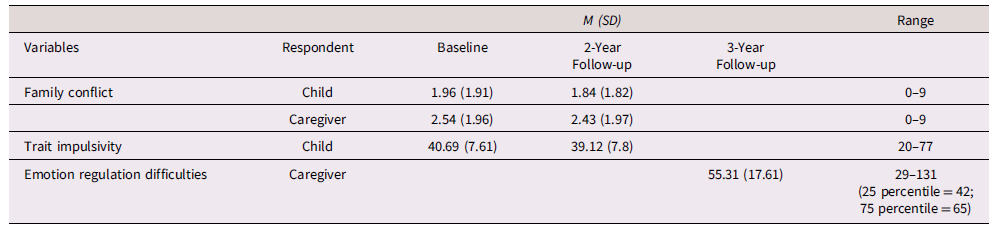
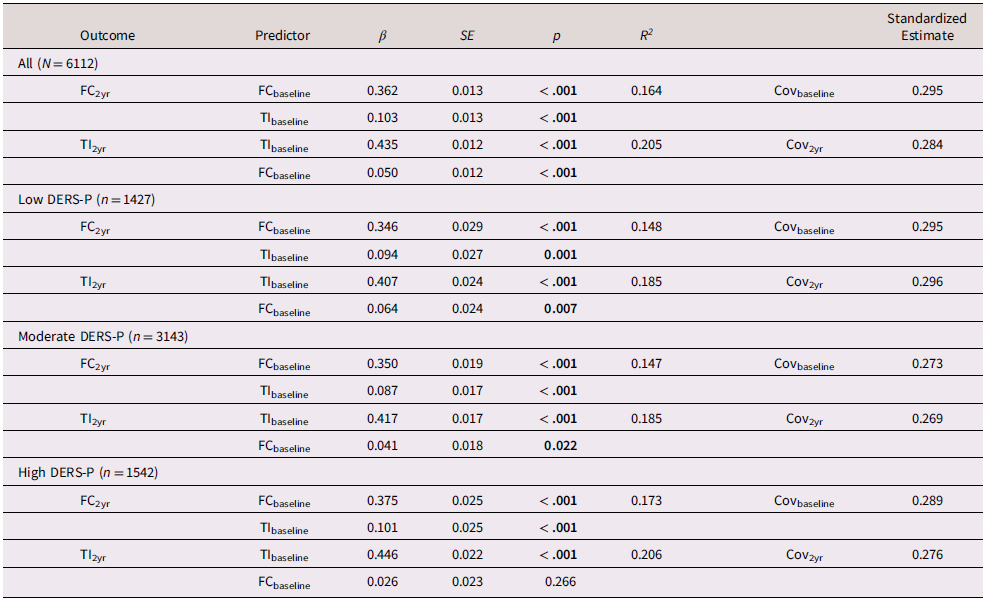
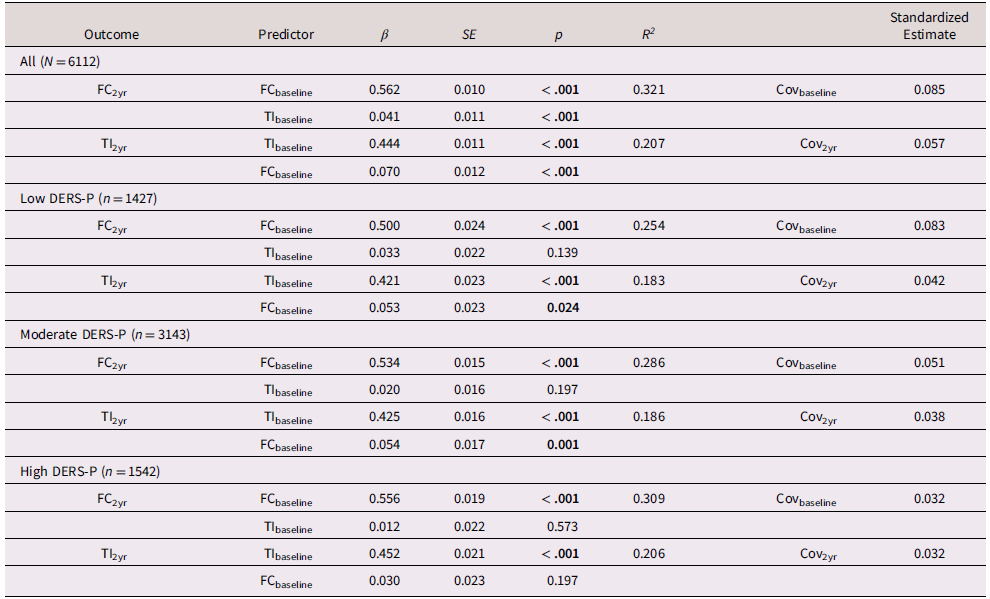
The descriptive statistics of study variables are displayed in Table 1. Details of CLPM results are presented in Tables 2 and 3, while key findings are summarized as follows.
Variable descriptives

Cross lagged model results based on child-reported family conflict

Note. FC = family conflict; TI = child trait impulsivity; DERS-P = (caregiver-reported) child emotion regulation difficulties; Cov = covariance between family conflict and trait impulsivity.
Cross lagged model results based on caregiver-reported family conflict

Note. FC = family conflict; TI = child trait impulsivity; DERS-P = (caregiver-reported) child emotion regulation difficulties; Cov = covariance between family conflict and trait impulsivity.
Models based on all participants
In both CLPM models based on child- and caregiver- reported family conflict scores (N = 6112), all paths were statistically significant. Higher child trait impulsivity scores at baseline predicted higher family conflict scores at 2-year follow-up, and higher family conflict scores at baseline predicted higher child trait impulsivity scores at 2-year follow-up. Comparing cross lagged paths, relative to the effect of family conflict on trait impulsivity, the effect of trait impulsivity on family conflict was stronger based on the child-reported model (χ2(1) = 8.26, p = .004), and marginally weaker based on the caregiver-reported model (χ2(1) = 3.72, p = .05). Current results were compared to those obtained from all participants with available baseline responses to evaluate whether results were biased through restricting the analyzed sample to participants who completed 3-year follow-up. Given no notable differences between these two sets of analyses, only the original results from the current sample were reported.
Multiple-group analyses
The multiple-group CLPM was used to explore whether the transaction between family conflict and child trait impulsivity, reported at baseline and 2-year follow-up, differed among children with high (n = 1542), moderate (n = 3143), and low (n = 1427) emotion dysregulation at 3-year follow-up. χ 2 difference tests suggested that emotion dysregulation moderated the associations between family conflict and trait impulsivity (based on child-reported family conflict: Δχ2(16) = 267.6, p <.001; caregiver reported family conflict: Δχ2 (16) = 676.7, p <.001).
According to models based on child-reported family conflict scores, the cross lagged associations between family conflict and trait impulsivity were statistically significant for children with low and moderate levels of emotion dysregulation. For children with high emotion dysregulation, trait impulsivity at baseline predicted family conflict at 2-year follow-up, but family conflict at baseline did not predict trait impulsivity at 2-year follow-up.
According to models based on caregiver-reported family conflict, family conflict at baseline predicted trait impulsivity at 2-year follow-up, but not in the opposite direction, for children with low and moderate levels of emotion dysregulation. Neither cross lagged path was significant among children with high emotion dysregulation.
Discussion
The current study aimed to test the potential transaction between trait impulsivity and family conflict over the span of two years in a sample of children aged 9–10 at baseline. We (1) examined the hypothesized transactional process among participants and (2) explored whether the transactional process differs for those with high, moderate, or low levels of emotion regulation difficulties at a 3-year follow up. The main strength of the current study lies in a longitudinal design of the Adolescent Brain Cognitive development (ABCD) study through which the current data were collected, filling the gap of longitudinal research in prior literature on the biosocial developmental process of emotion dysregulation among children. Research on the development of emotion dysregulation during the critical transition from late childhood to early adolescence is sparse, thus the current study is an important addition to the literature.
The first main finding was the association between (self- and caregiver- reported) family conflict and trait impulsivity in a cross-lagged fashion among children from age 9–10 to age 11–12, regardless of their levels of emotion dysregulation at age 12–13. By showing a bidirectional temporal association between a biological vulnerability and an environmental factor, this study expands the empirical literature of biosocial developmental model (e.g., Arens et al., Reference Arens, Grabe, Spitzer and Barnow2011; Lee et al., Reference Lee, Keng, Yeo and Hong2022; Stepp et al., Reference Stepp, Whalen, Scott, Zalewski, Loeber and Hipwell2014). It is noteworthy that the transaction between impulsivity and family conflict observed in the current study occurred during the phase prior to when emotion regulation problems are likely to emerge among a non-clinical sample of children recruited from around the U.S. (age 13–23; Sharp & Fonagy, Reference Sharp and Fonagy2015). This finding may thus be useful for elucidating the emergence of emotion dysregulation, through providing some support for the transaction between inherited impulse control problems and an environment that possibly facilitates ineffective child qualities and behaviors during early child development. Continuing research on biosocial developmental model may directly inform early detection of risky transactional mechanism thereby leading to more effective prevention for pervasive emotion regulation programs.
In contrast to the abundance of literature showing the unidirectional influence of environmental stress on individual traits and behaviors (Musser et al., Reference Musser, Zalewski, Stepp and Lewis2018), these findings appear to highlight how traits of children may also manifest and shape the developmental context in which more severe emotion regulation problems emerge. Furthermore, these findings corroborate prior writings, which argue that the management of impulsivity, a particular biological vulnerability emphasized in the updated biosocial model, may be a key dimension of effective treatment of emotion regulation problems (Sauer-Zavala et al., Reference Sauer-Zavala, Southward, Fruhbauerova, Semcho, Stumpp, Hood, Smith, Elhusseini and Cravens2023). Further research may benefit from replicating the model among groups of children defined by demographic (e.g., puberty) and sociocultural factors (e.g., education and community resources) that may influence the development of emotion dysregulation to rule out alternative explanations for these finding.
The second main finding was that the associations between family conflict and impulsivity appeared distinct among children with high emotion dysregulation, as compared to those among children with moderate or low emotion dysregulation. Specifically, different from the results based on all participants regardless of levels of emotion dysregulation, we found that among children who were later reported by their caregivers to have more severe emotion regulation difficulties at age 12–13, more self-reported family conflict at age 9–10 did not prospectively lead to greater impulsivity at age 11–12; whereas among those with low and moderate emotion regulation difficulties, more self-reported family conflict and greater trait impulsivity were associated in a cross-lagged fashion from age 9–10 to age 11–12. We also found no associations between caregiver-reported family conflict and child impulsivity among children with more severe emotion dysregulation, whereas greater impulsivity at age 9–10 did not prospectively lead to more caregiver-reported family conflict at age 11–12 for children with low and moderate emotion regulation difficulties at age 12–13.
The lack of mutually cross lagged associations between impulsivity and family conflict among children with more severe emotion regulation difficulties appears to contradict the biosocial model, which theorizes the transaction between biological vulnerability and environmental invalidation particularly among those with pervasive emotion regulation problems. It is also possible that the results reflect child and caregiver’s lower awareness or insight of bi-directional influences between trait impulsivity and family conflict, in which case the lack of insight poses a barrier to identifying a high-risk transaction and in turn heightens emotion regulation problems over time. Interestingly, in addition to the difference in the transactional process between children with high vs. moderate or low emotion dysregulation, an incidental finding was the inconsistent model results based on self- vs. caregiver-reported family conflict. Relative to the effect in the opposite direction, the strength of the effect of trait impulsivity on family conflict was relatively stronger based on child-reported family conflict, and weaker based on caregiver-reported family conflict. It is important to note that caregivers reported higher family conflict than children, which could have contributed to the differences in model results. The discrepancy in reports from child and caregiver informants also highlights the importance of research involving both informants.
When interpreting the current findings, there were several limitations of this research to consider. As mentioned, the data were from the ABCD study, a large ongoing study that was not specially designed to address our research question. This study relied on children’s self-reports on impulsivity but caregiver’s reports about these children on emotion dysregulation, raising questions regarding the accuracy of the data in describing children’s actual experience. For instance, children’s self-perception may have biased reports of impulsive behaviors. Caregiver reports of children’s emotional and behavioral problems, though may show greater consistency, may also overlook important information from children’s perspective (Van Roy et al., Reference Van Roy, Groholt, Heyerdahl and Clench-Aas2010). Future research may benefit from multiple informants from multiple settings, allowing for agreement and divergence of reports to provide more comprehensive understanding of measured constructs (Zapolski & Smith, Reference Zapolski and Smith2013). Moreover, the Family Conflict Scale showed relatively lower internal consistency; it does not assess the content of conflicts, and the dichotomously scored items may have obscured important information that could have been captured by a continuous scale. In addition, although family conflicts, such as frequent criticisms, could be perceived as a form of invalidation, it is important to note that the extent to which children felt invalidated during these conflicts was not measured. Regarding the modified version of DERS-P measure of emotion dysregulation, the scores used to categorize different groups with varying levels of emotion dysregulation were based on quantiles and not clinical cutoffs, as they are not yet established in literature.
Furthermore, one limitation of CLPM is that it only accounts for temporal stability of variables through autoregressive paths, without considering trait-like individual differences that may carry over (Hamaker et al., Reference Hamaker, Kuiper and Grasman2015). Longitudinal data of family conflict and impulsivity beyond the 2-year follow up was not yet available in Wave 4 release of the ABCD data at the time of the current study (data accessed on 10/12/22). The frequency of measurement limited the options for analysis that better accounts for stable-trait variance, such as random-intercept cross lag panel model that requires more than 2 longitudinal measurements of each variable. Also, because emotion dysregulation was only measured at 3-year follow up, we were not able to account for potential changes in children’s emotion dysregulation over time.
Finally, familial context is not the only context in which invalidation may occur during adolescence. As the salience of peer interactions increases during adolescence, invalidation from peers may be particularly harmful during this developmental period. Children with higher trait impulsivity and aggression have been demonstrated to be vulnerable to peer rejection, which in turn heightens risk for externalizing problems and emotion dysregulation in adolescence (Ettekal & Ladd, Reference Ettekal and Ladd2020; Gunnar et al., Reference Gunnar, Sebanc, Tout, Donzella and Van Dulmen2003). Thus, future research testing the biosocial model in adolescence should incorporate peer conflict into their models.
The study limitations are important lessons to learn for continuing this line of research. Despite limitations, the current research provides empirical evidence for how trait impulsivity and family conflict may influence each other prospectively among a sample of children, and how their associations appear to be different for children who were later found to have high vs. low or moderate levels of emotion regulation problems. Overall, our findings provided partial support for the biosocial model. Future research should expand on the current work to continue evaluating the emergence of emotion regulation problems and its timing in relation to biological vulnerabilities and invalidating family environment thereby enhancing our understanding of this critical transdiagnostic problem.
Data availability statement
This research was based on the publicly available data from ABCD study (data release 4.0: 10.15154/1523041). Analysis script can be accessed at: https://data.mendeley.com/datasets/nz5687898f/1.
Funding statement
Our research did not receive any funding.
Competing interests
Shireen L. Rizvi receives royalties from Guilford Press and revenue from YouTube.com. Qingqing Yin, Simone I. Boyd, and Jessica L. Hamilton do not have competing interests.