INTRODUCTION
Parasites are important factors affecting host population dynamics and host individual fitness (Poulin, Reference Poulin2007; Morand and Deter, Reference Morand, Deter, Thomas, Guégan and Renaud2008) and, in order to control or eliminate parasites, vertebrates have developed several defence mechanisms, including the immune system (Wakelin, Reference Wakelin1996). The vertebrate immune system discriminates between ‘self’ and ‘non-self’, and minimizes the consequences of being infected by parasites (Janeway et al. Reference Janeway, Travers, Walport and Capra1999). However, activation of an immune response and the maintenance of a competent immune system are energetically demanding processes that require trade-off decisions among competing energy demands needed for growth, reproduction, thermoregulation and other physiological maintenances (Sheldon and Verhulst, Reference Sheldon and Verhulst1996; Klasing, Reference Klasing1998; Martin et al. Reference Martin, Scheuerlein and Wikelski2003). In other words, trade-offs may occur between defence against parasites and other concurrent needs of the organism (Sheldon and Verhulst, Reference Sheldon and Verhulst1996; Agnew et al. Reference Agnew, Koella and Michalakis2000; Zuk and Stoehr, Reference Zuk and Stoehr2002; Lee, Reference Lee2006).
A component of parasitism that can affect the strength of the immune response is the variety of parasites a host may face. Some recent arguments suggest that parasites (i.e. parasite diversity per se) could be considered as selective forces acting on host life-history traits through investment in immunity (Marzal et al. Reference Marzal, Bensch, Reviriego, Balbontin and De Lope2008; Bordes and Morand, Reference Bordes and Morand2009). Indeed, maintaining several different means of defence is likely to be more costly than sustaining one specific type of defence (Taylor et al. Reference Taylor, Mackinnon and Read1998). Then, both the levels of the immune investment and response should be related not only to the number of parasite species but to the functional diversity of parasites a host may face, where the functional diversity of a community assemblage can be estimated by its taxonomic diversity (Poulin and Mouillot, Reference Poulin and Mouillot2004) or by its phylogenetic diversity (Clarke and Warwick, Reference Clarke and Warwick2001; Magurran, Reference Magurran2004).
In this study, we evaluated whether several indices representing the diversity of gastrointestinal helminths are related with two host traits that are likely influenced by the degree of parasitic infection. Furthermore, we investigated the performance of these indices at both individual (intraspecific) and species (interspecific) levels, which allowed us to investigate host individual responses in the ecological time and host species responses in the evolutionary time. At the individual host level, parasite diversity indices can be used to estimate individual host condition and allocation to immune response, while at the interspecific level, parasite diversity indices may estimate the parasite pressure acting on the level of immune investment (Bordes and Morand, Reference Bordes and Morand2009). Then, predictions may potentially differ considering intra- or interspecific levels (see Martin et al. Reference Martin, Møller, Merino and Clobert2001; Lee, Reference Lee2006). We used two families of indices based on (1) parasite species richness (i.e. the total number of parasite species) and on (2) parasite entropy (or parasite information; i.e. the proportion of each parasite species). In addition, these indices were calculated by taking (or not) into account the parasite taxonomy information. They were used both intra- or interspecifically. These indices by taking into account (or not) the proportion of parasite species (entropy versus parasite species richness), and incorporating or not the taxonomic information, may help define the ‘functional’ parasite diversity that may affect host-life traits.
In vertebrates, the spleen is involved in lymphocyte production (Kopp, Reference Kopp and Bowdler1990) and it has been shown in birds that larger spleens correspond to greater production of these immune cells (Møller et al. Reference Møller, Christe, Erritzoe and Mavarez1998; Smith and Hunt, Reference Smith and Hunt2004) and that bird species infected by high parasite species richness have evolved to a larger spleen mass compared to their body mass (Morand and Poulin, Reference Morand and Poulin2000). Several studies have shown positive relationships between parasite loads and spleen mass in rodents (Vincent and Ash, Reference Vincent and Ash1978; Garside et al. Reference Garside, Behnke and Rose1989; Watkins et al. Reference Watkins, Moshier, Odell and Pinter1991; Hõrak et al. 2006, Goüy de Bellocq et al. Reference Goüy de Bellocq, Ribas, Casanova and Morand2007). One hypothesis that may explain these results is that a larger spleen size reflects the physiological response to current infection, and then should be indicative of high parasite loads (such as splenomegaly, but see Brown and Brown, Reference Brown and Brown2002; Smith and Hunt, Reference Smith and Hunt2004). However, several studies on cervids (Vicente et al. Reference Vicente, Perez-Rodriguez and Gortazar2007; Corbin et al. Reference Corbin, Vicente, Martin-Hernando, Acevedo, Perez-Rodriguez and Gortazar2008; Malo et al. Reference Malo, Roldan, Garde, Soler, Vicente, Gortazar and Gomendio2009; Navarro-Gonzalez et al. Reference Navarro-Gonzalez, Verheyden, Hoste, Cargnelutti, Lourtet, Merlet, Daufresne, Lavín, Hewison, Morand and Serrano2011) have shown that spleen mass may reflect the condition of host and then that spleen mass should be negatively related to parasite infection. Most of these studies investigated the effects of gastrointestinal nematodes using intensities and not the entire gastrointestinal helminth diversity. This hypothesis is also supported in rodents by Luterman and Benett (Reference Lutermann and Bennett2008), who showed a positive correlation between fat and spleen mass in Natal mole rats. The empirical data from these published studies suggest the existence of an association between nematode intensities and spleen weight, or body condition and spleen weight, at the intraspecific level. However, very few studies have explored the relationships between parasite diversity and spleen weight at both interspecific level and interspecific levels.
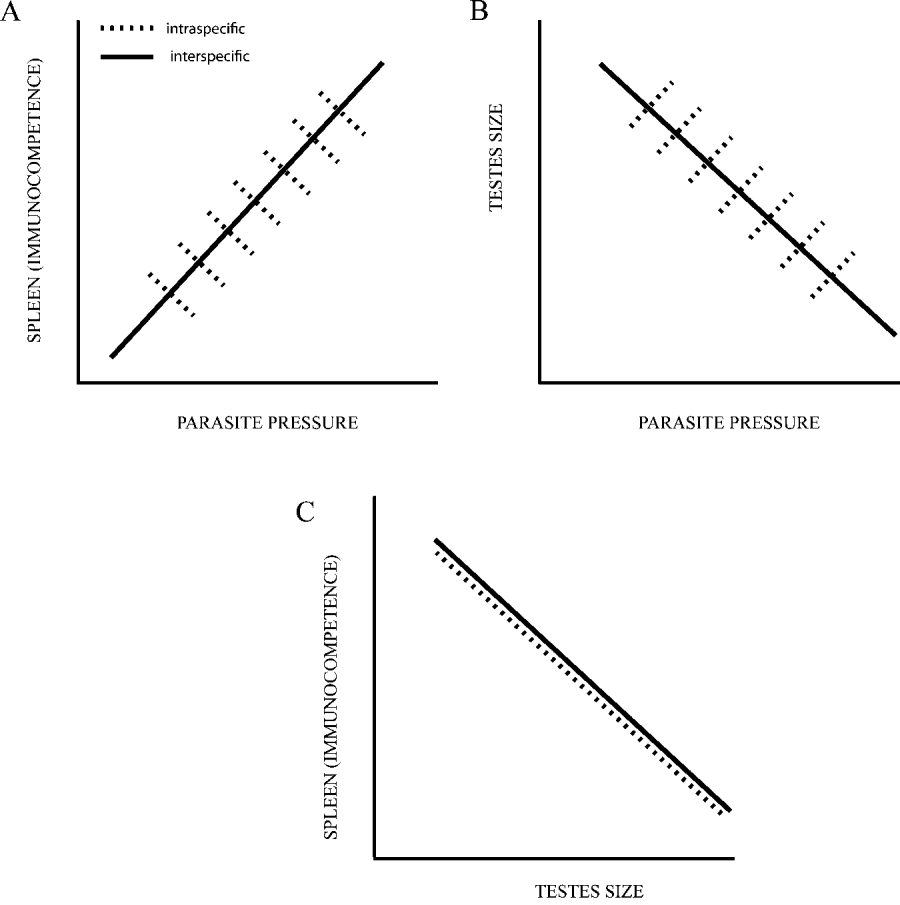
Here, we tested whether individual hosts (intraspecific level) infected by a high diversity of gastrointestinal helminths had larger spleens, as a response to a current parasite infection, or had smaller spleens, reflecting an efficient immune organ (i.e. immunocompetent) able to control parasites. We also tested whether host species (interspecific level) under high parasite pressure had evolved larger spleens as an adaptation to control a wide diversity of parasites (Fig. 1A). We analyzed host males and females separately.
We investigated the relationships between parasite diversity and relative testes size, which estimates the production of spermatozoids (i.e. larger testes produce more sperm than smaller ones; Parker, Reference Parker1970) at both individual and species level. We hypothesized at the intraspecific level that investment in sperm production estimated by the relative size of testes should have detrimental effects on immunity, as predicted by the Immunocompetence Handicap Hypothesis (ICHH; Folstad and Karter, Reference Folstad and Karter1992). We then predicted a positive relationship between relative size of testes and parasite diversity. At the interspecific level, we hypothesized that an increase in parasite pressure (measured by specific parasite indices) should drive species to a greater investment in immunity and consequently a smaller investment in sperm production (i.e. relative testes size) (Fig. 1B).
Hypothetical relationships (A) between spleen mass (immuncompetence) and parasite pressure, (B) between testes size and parasite pressure and (C) the resulting trade-offs between spleen mass and testes size at intraspecific level (dashed lines) and interspecific level (plain lines).

By comparing the two results, we should be able to discuss the existence of a trade-off between investment in sperm production and host immunocompetence using the relative size of spleen (Morand and Poulin, Reference Morand and Poulin2000). We looked at relationships between relative spleen weight and relative testes size (here, we used the testes size and not the testes weight because we only had this measurement; but, in performing the log transformation on our measurements, we believe that this should not be a problem for interpreting our results) to test a possible trade-off between spermatozoid and lymphocyte production (Morand and Poulin, Reference Morand and Poulin2000). We hypothesized, at the intraspecific level, that an investment in sperm production should be made at the detriment of an investment in immunity. We expected then a negative correlation between testes size and the relative spleen weight (in other words that one organ grows at the detriment of the other). At the interspecific level, larger spleens should be selected only in rodent species exposed to intense parasite pressure. According to the existence of costs associated with investment in spleen weight, we predicted that the relative spleen weight should be negatively correlated with the size of testes, at the interspecific level (Fig. 1C). We tested these hypotheses on rodents and their gastrointestinal helminths from Southeast Asia (Chaisiri et al. Reference Chaisiri, Herbreteau, Ribas and Morand2010a, Reference Chaisiri, Chaeychomsri, Siruntawineti, Ribas, Herbreteau and Morandb).
Materials and methods
Rodents
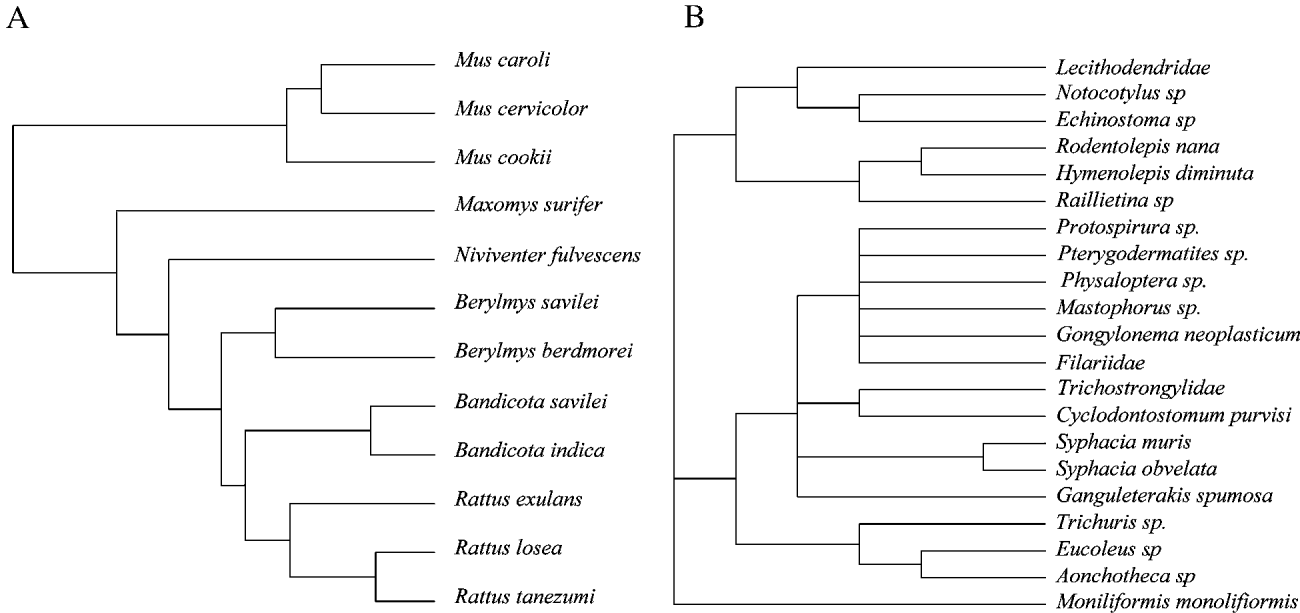
Four hundred individuals belonging to 12 species of rodents were collected using live-traps (the protocol of trapping is presented in Herbreteau et al. Reference Herbreteau, Rerkamnuaychoke, Jittapalapong and Morand2011) in Northern and North-eastern Thailand during field-trapping sessions in 2007 and 2008 (Table 1) in the CERoPath project (www.ceropath.org). Rodents were sexed and weighed to the nearest 0·01 g. Spleens were removed and weighed to the nearest 0·001 g using a precision electronic balance (AR1530 Adventurer™). Body length (distance between the tip of the nose and the middle of the anus) and testes length for males were measured using a vernier calliper. Furthermore, phylogeny of these rodents has recently been published by Pagès et al. (Reference Pagès, Chaval, Herbreteau, Waengsothorn, Cosson, Hugot, Morand and Michaux2010) (Fig. 2A).
(A) Phylogeny of the rodents investigated (adapted from Pagès et al. Reference Pagès, Chaval, Herbreteau, Waengsothorn, Cosson, Hugot, Morand and Michaux2010), (B) Taxonomic tree of the gastrointestinal helminths found in the rodents investigated.

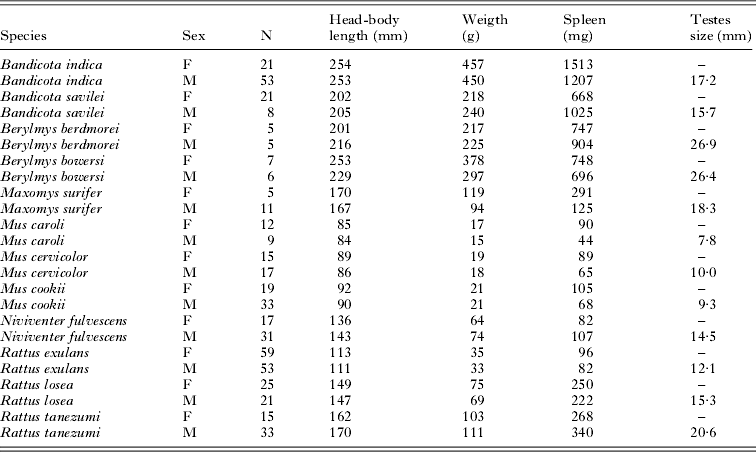
List of rodent species with sex, number of individuals (N), average head-body length (mm), average weigth (g), spleen (mg)

Parasites
Gastrointestinal helminths were collected, following the procedure of Herbreteau et al. (Reference Herbreteau, Rerkamnuaychoke, Jittapalapong and Morand2011). Twenty-one species of gastrointestinal helminths, belonging to 3 phyla (Nematoda, Trematoda plus Cestoda and Acanthocephala) were identified (Fig. 2B; Chaisiri, Reference Chaisiri, Herbreteau, Ribas and Morand2010a, Reference Chaisiri, Chaeychomsri, Siruntawineti, Ribas, Herbreteau and Morandb, and unpublished data).
Parasite diversity indices
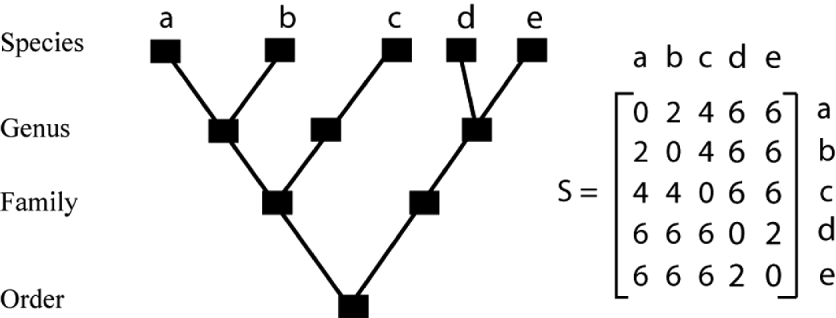
Parasite diversity indices are presented below and in Table 2. Two types of indices, richness and entropy, were calculated in a standard way by considering each parasite species independently. These types of indices were also computed taking into account the taxonomic information. We used the taxonomic weight, k (Ricotta, Reference Ricotta2002) as a means to incorporate the parasite taxonomy in diversity indices. The taxomomic tree of parasites was used to compute a distance matrix among the taxa. Each level in a taxonomic tree corresponds to a taxonomic hierarchy (i.e. species, genus, family, order, etc.). The distance matrix between all species was computed by counting the number of steps that separate each pair of species in the taxonomy hierarchy (Fig. 3). The ki taxonomic weight corresponds to the sum of elements of the i line of the matrix divided by the total sum of the matrix. The taxonomic weight is not a distance between two taxa but an attribute of each parasite species, which confers the statistical advantage to be used in univariate analyses.
Virtual taxonomic tree and distance matrix among the taxa corresponding to this tree. Each level of filled points corresponds to a level in a taxonomic hierarchy (i.e. species, genus, family, order, etc.). A distance matrix between all species is computed by counting the number of steps that separate each pair of species in the taxonomy hierarchy. The ki taxonomic weight corresponds to the sum of elements of the i line of the matrix divided by the total sum of the matrix (adapted from Ricotta, Reference Ricotta2002).

Parasite diversity indices used in the analyses, n=number of parasites species hosted by an individual or a rodent species; pi=proportion of the parasite i in an individual or a rodent species; ki=standardized taxonomic weight of the parasite i, such as ∑i ki=1

Parasite species richness PSR is the number of gastrointestinal helminth species found in one indvidual host (for intraspecific analyses) or the number of gastrointestinal helminth species found in one given host species (for interspecific analyses). In order to correct for the potential sampling effect on PSR, we evaluated the existence of a significant influence of sample size on parasite diversity, depending on the significance of the regression, we later considered the residual variation of the regression of the number of parasites on the host sample size. Taxonomic species richness (TSR) takes into account both parasite species richness and parasite taxonomy by computing the mean taxonomic weight (ki) of gastrointestinal helminth species found in an individual host or in a given host species. Shannon index SH (Shannon, Reference Shannon1948 in Magurran, Reference Magurran2004) was used to evaluate the entropy of gastrointestinal helminths harboured by individual host or by host species. Finally, the taxonomic equivalent to this previous index is the taxonomic entropy TE (Ricotta and Avena, Reference Ricotta and Avena2003), where the log-transformed term is not the parasite proportion but the parasite taxonomic weight. It is evident that when each parasite species is present in the same proportion in a host, TE = TSR. All indices were log-transformed for linearizing possible allometric relationship with morphological measurements.
Statistical analyses
An estimator of the sperm competition is the relative size of testes to the body weight. The relative spleen weight was estimated using the log shape ratio of spleen weight to the body weight (MacLeod, Reference MacLeod2010).
Here we focused on the quantitative relationships between gastrointestinal helminth diversity (classic and taxonomic) indices and spleen mass and testes size. Consequently, we performed analyses involving parasite diversity indices on parasitized individuals only. We considered non-parasitized individuals at both intra- and interspecific level to evaluate if there are differences in spleen mass and testes size between parasitized and non-parasitized host individuals at the intraspecific level, and if variations in spleen mass and testes size are related to the probability of being infected at the interspecific level.
Intraspecific analyses
In order to estimate whether individual investment in testes size may affect gastrointestinal helminth load, we first performed a likelihood ratio test on a Generalized Linear Model (GLM) (McCullagh and Nelder, Reference McCullagh and Nelder1989) with the logit link family function for binary data (i.e. parasitized versus non-parasitized) with species, sex and relative testes size as independent variables. Then we performed multiple regressions of each parasite diversity index on parasitized individuals with species, sex and relative testes size as independent variables using type II sums of squares.
To test if the spleen is a good estimator of immunocompetence, we performed similar analyses with the relative spleen weight as response variable instead of testes size.
Finally, we tested for a potential trade-off between spleen weight and testes size using an ANCOVA of spleen weight on relative testes size with species as factor. Here we also considered only type II sums of squares using the car package implemented in the R software (R Development Core Team, 2010). If a trade-off occurs, we expected a negative slope for the testes size covariate.
Interspecific analyses
We used the method of the phylogenetically independent contrasts (Felsenstein, Reference Felsenstein1985) to test relationships between parasite diversity indices, spleen weight and testes size at the interspecific scale. The maximum likelihood phylogram was used as input for the phylogeny, branch lengths were rescaled for obtaining a clock-like tree using the method of Sanderson (Reference Sanderson2002). These analyses were performed using the ape package in R (Paradis, Reference Paradis2006).
Results
Variation in spleen weight
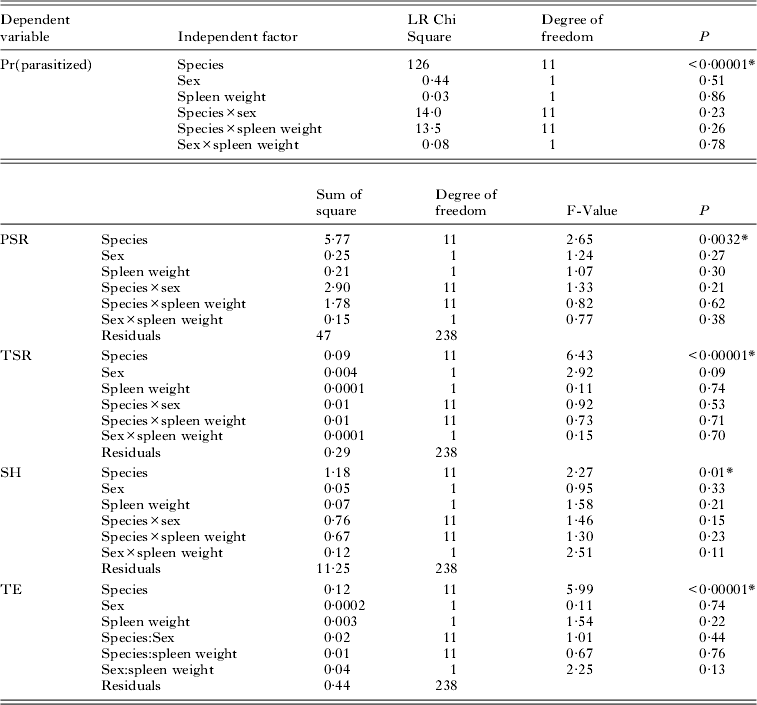
At the intraspecific level, host infection was significantly different between species. However, there were no effects of host sex, spleen weight and interaction terms. Diversity indices were not significantly related to host sex, spleen weight and interaction terms (Table 3).
Probability of being parasitized and parasite diversity indices (PSR=parasite species richness, TSR=taxonomic species richness, SH=Shannon index, TE=taxonomic entropy) as a function of rodent species, host sex, spleen weight and interactions (*significant differences)

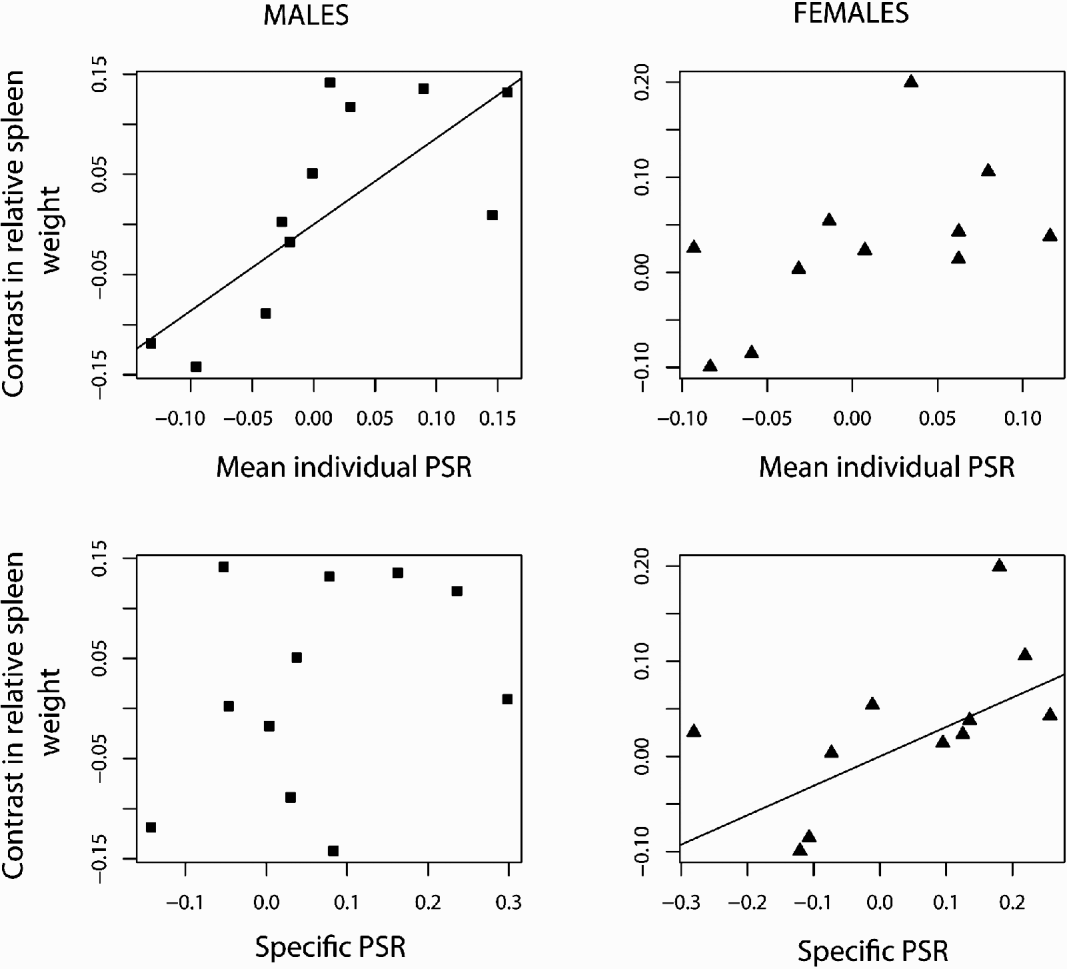
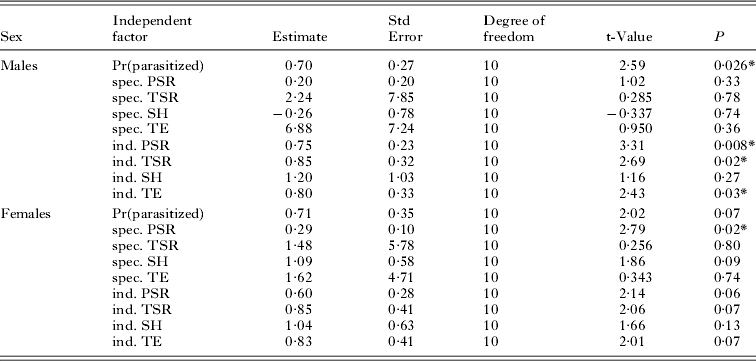
At the interspecific level and using independent contrasts, the relative spleen weight was positively influenced by the probability of being infected by gastrointestinal helminths and by the individual parasite diversity indices in males (except for the Shannon entropy) (Table 4). In females, the relative spleen weight was only significantly and positively related to the specific parasite species richness (Table 4) and close to significance for the specific Shannon Entropy index. Several other indices were also close to be significantly correlated with spleen weight in females (except for the individual Shannon Entropy) (Fig. 4).
Relationships between the relative value of spleen weight and gastrointestinal helminths diversity at the level of individuals (up row) or species (down row) in males (left column) and in females (right column).

Interspecific variation of spleen size in male and female rodents, according to the probability of being parasitized or to parasite diversity indices, specific (spec) or individual (ind.) (PSR=parasite species richness, TSR=taxonomic species richness, SH=Shannon index, TE=taxonomic entropy) (*significant differences)

Variation in testes size
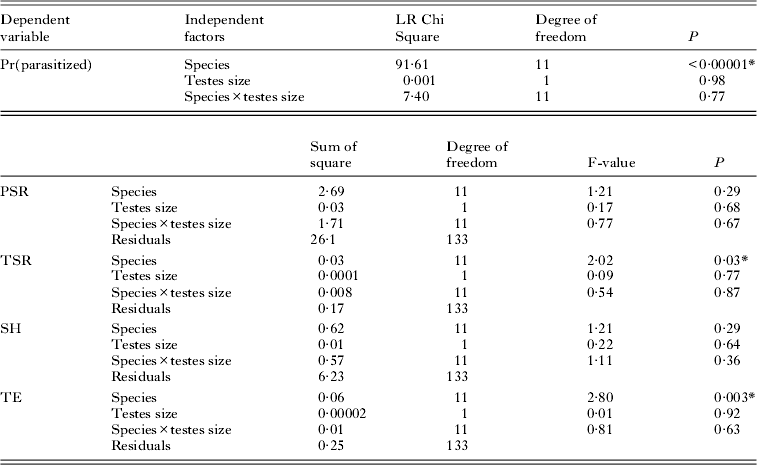
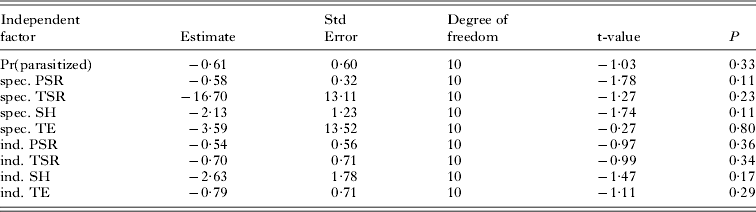
At the intraspecific level, the relative testes length differed significantly among species (F(11, 127)= 152, P<0·001). However, being parasitized was not significantly associated to testes size (Table 5). None of the diversity indices was found to be linked with testes size (Table 5).
Probability of being parasitized and parasite diversity indices (PSR=parasite species richness, TSR=taxonomic species richness, SH=Shannon index, TE=taxonomic entropy) as a function of rodent species, host sex, testes size and interaction (*significant differences)

At the interspecific level, there were no relationships between relative testes size and parasite diversity indices (Table 6).
Interspecific variation of spleen size in male and female rodents, according to the probability of being parasitized or to parasite diversity indices, specific (spec) or individual (ind.) (PSR=parasite species richness, TSR=taxonomic species richness, SH=Shannon index, TE=taxonomic entropy)

Relationship between spleen weight and testes size
Relative spleen weight was not correlated to relative testes size (F(1, 127)=2·26, P=0·14) at the intraspecific level. However, there was a significant interaction between species and relative spleen weight on the relative testes size (F(11, 127)=2·33, P=0·01).
We found no relationship between relative testes size and relative spleen weight at the interspecific level using the independent contrasts (t(10)=0·10, P=0·92).
Finally, we found no significant correlation between testes size and spleen mass, but a significant interaction effect between rodent species and testes size was observed. When considering relationships within each species, this significant interaction was observed only in Bandicota salivei with only 8 individuals sampled. Therefore, this significant interaction could be spurious and likely to be due to sampling effect.
DISCUSSION
Bordes and Morand (Reference Bordes and Morand2009) emphasized the effects of polyparasitism on several aspects of the ecology and evolution of hosts. They advocated the need to consider the whole parasite community and infection intensities in order to improve our knowledge on the ecology and evolution of host-parasite interactions. They also advocated for the development of indices that take into account the taxonomic diversity of the parasite community an individual host or a host species may face. Here, we used two indices, the Taxonomic Species Richness (TSR) and the Taxonomic Entropy (TE), where the taxonomic information was easily incorporated in usual indices, the parasite species richness (PSR) or the Shannon index (SH) with the taxonomic weight (ki, Ricotta, Reference Ricotta2002). Furthermore, we considered both intra- and interspecific levels which allowed us to hypothesize on the genotypic competition for individual strategies on the one hand, and on functional constraints between traits on the other hand.
Variation in spleen weight
We found differences between species for all parasite diversity indices, but these differences are not explained by spleen mass variation, considering sex influence, at the intraspecific level. Neither the physiological response hypothesis of the spleen (Brown and Brown, Reference Brown and Brown2002; Smith and Hunt, Reference Smith and Hunt2004), nor the spleen as an estimator of the immunocompetence hypothesis (Vicente et al. Reference Vicente, Perez-Rodriguez and Gortazar2007; Corbin et al. Reference Corbin, Vicente, Martin-Hernando, Acevedo, Perez-Rodriguez and Gortazar2008; Malo et al. Reference Malo, Roldan, Garde, Soler, Vicente, Gortazar and Gomendio2009; Navarro-Gonzalez et al. Reference Navarro-Gonzalez, Verheyden, Hoste, Cargnelutti, Lourtet, Merlet, Daufresne, Lavín, Hewison, Morand and Serrano2011) were supported by our analyses. These results could be explained by the lack of control variables, as heterogeneities in the host population (e.g. age, level of androgen hormones), in the gastrointestinal helminth population and in extrinsic factors (e.g. seasonality) (Wilson et al. Reference Wilson, Bjornstad, Dobson, Merler, Poglayen, Randolph, Read, Skorping, Hudson, Rizzoli, Grenfell, Heesterbeek and Dobson2002). Moreover, parasite distribution may be spatially and/or temporarily heterogeneous or aggregated. Consequently, some immunological parameters can change seasonally or at different stages of an animal's annual life-cycle (Paz Nava et al. Reference Paz Nava, Veiga and Puerta2001). There is a lack of such information concerning gastrointestinal helminth ecology (Calvete et al. Reference Calvete, Blanco-Aguiar, Virgos, Cabezas-Diaz and Villafuerte2004; Brooker and Clements, Reference Brooker and Clements2009).
The relationship between spleen mass and immune function can be confounded by the blood storage function of this organ in mammals (Crivellato et al. Reference Crivellato, Vacca and Ribatti2004). At the interspecific level, male spleen weight increases with the probability of being parasitized and by mean individual parasite diversity, but not by specific parasite diversity indices (i.e. a measure of gastrointestinal helminth pressure occurring on a host species). On the contrary, female spleen weight increases with the specific PSR, i.e. the number of gastrointestinal helminth species that infect rodent species. This suggests that females, at the interspecific level, have evolved to a greater spleen mass in response to higher gastrointestinal helminths pressure, which may potentially limit the individual variation of the spleen mass. Individual parasite diversity indices were close to significance, suggesting that some intraspecific variations may still occur. The significant relationship observed in females concerns the ‘classic’ parasite species richness (PSR), and not the taxonomic species richness (TSR). One hypothesis is that species could not harbour a large taxonomic diversity of gastrointestinal helminths, representing an important functional diversity, because of important costs associated with mounting and maintaining the required immunological defences. Since the relation was found only in females, this indicates that males and females differ in their immunocompetence (estimated by spleen weight). The theoretical model of sexual dimorphism in immunocompetence proposed by Stoehr and Kokko (Reference Stoehr and Kokko2006) predicts that if condition has little effect on male mating success and if sexual selection is strong, we might expect males to sacrifice immune defences (and thus survival) to a greater degree, leading to a dimorphism in immunocompetence if condition is still important for female fecundity. These authors also suggested that the strength of sexual selection is not solely responsible for this sexual dimorphism in immunocompetence: sex differences in the relationship between immune defence and condition or condition and reproduction can play a large role.
Females seem to show an evolutionary response to gastrointestinal helminth diversity by investing in spleen mass, whereas males seem to show a plastically varied response with spleen mass depending not only on gastrointestinal helminths but subject to other constraints. Male spleen mass did not correlate with the gastrointestinal helminth pressure that a host species may face, but significantly varied with individual gastrointestinal helminth loads. As spleen is involved in production of red cells and that the probability of being parasitized may increase with several activities such as foraging or the research of sexual partners (Combes, Reference Combes2001), it might be possible that the male spleen may be constrained by energy-dependent traits other than immunity. Males are often more mobile than females (Tew and Macdonald, Reference Tew and Macdonald1994) and they often show increased circulating stress hormones in relation to social or environmental stressing influences which are known to affect spleen mass in mammals (Fernández-Llario et al. Reference Fernández-Llario, Parra, Cerrato and Hermoso de Mendoza2004).
Variation in testes length
We found no relation between testes size and gastrointestinal helminth diversity, neither at the intraspecific level nor at the interspecific level. Investment in spermatozoid production (i.e. in sperm competition estimated by the relative testes size) does not seem to be directly influenced by gastrointestinal helminth diversity. These results are not in agreement with the Immunocompetence Handicap Hypothesis (Folstad and Karter, Reference Folstad and Karter1992) suggesting that the testosterone release in blood has a role in the development of sexual traits and sex-related behaviour (Wingfield et al. Reference Wingfield, Hegner, Dufty and Ball1990; Owens and Short, Reference Owens and Short1995; Salvador et al. Reference Salvador, Veiga, Martin, Lopez, Abelenda and Puerta1996; Enstrom et al. Reference Enstrom, Ketterson and Nolan1997; Hunt et al. Reference Hunt, Hahn and Wingfield1997; Hagelin and Ligon, Reference Hagelin and Ligon2001; Schlinger et al. Reference Schlinger, Soma and Saldanha2001), with an immunosuppressive side-effect. Getty (Reference Getty2002) suggested that fit males can have good health condition and more parasites than unhealthy males, which indicates that parasite loads may not the best index for testing the ICHH. Furthermore, Malo et al. (Reference Malo, Roldan, Garde, Soler, Vicente, Gortazar and Gomendio2009) showed that the relationship between testes mass and the level of testosterone in Iberian red deer (Cervus elaphus hispanicus) is only positively correlated during the breeding season and linked with an increase in endoparasite loads. This increase in endoparasite infections in red deer could be a side-effect of breeding season-linked activities, as the control of sexual partners or territoriality. French et al. (Reference French, DeNardo and Moore2007) showed that the trade-off between reproduction and immune function in female tree lizard (Urosaurus ornatus) can be observed only when resources are limited.
We cannot put forward more hypotheses due to the lack of information on the biology and ecology of rodent species from Thailand, and specifically on their mating systems. Thailand is a tropical country and resources may be less limited than in temperate countries and, as a consequence, the existence of a trade-off between sperm competition and immunity may be even more difficult to detect.
RELATIONSHIP BETWEEN SPLEEN WEIGHT AND TESTES SIZE
We found no relationship between spleen weight and testes size at either interspecific and interspecific levels. Spleen mass and testes size have been used in this study as proxies for immunological activity and sperm competition, respectively. A causal relation between these traits may not be direct, and several factors may obscure the potential existence of a trade-off between immunity and sperm competition. As mentioned above, the role of spleen for red cell storage may bias the immunological interpretation of the spleen mass. This advocates for the use of other estimates of immunocompetence. Dosing the testosterone and stress hormones in blood, or in faeces, could be informative by allowing the estimation of sexual selection-linked activities (Garamszegi et al. Reference Garamszegi, Eens, Hurtrez-Bousses and Møller2005).
ACKNOWLEDGEMENTS
We thank Dr. Tim Littlewood for inviting us in this special issue of Parasitology. We thank two anonymous referees for their helpful and valuable comments. This study was supported by the French ANR Biodiversity Grant ANR 07 BDIV 012; the CERoPath project “Community Ecology of Rodents and their Pathogens in a changing environment” (www.ceropath.org).