In 2000, Arizona and Maine implemented full public funding for state legislative elections, and Connecticut will do so in 2008. Candidates who opt to accept public funding receive grants that pay for the entire cost of their campaigns. Advocates of these so-called clean elections argue that the programs reduce quid pro quo corruption, increase electoral competitiveness, and open up the process to candidates who lack access to traditional fundraising networks (Phelps 2004). Critics respond that the Maine and Arizona public funding programs have achieved nothing, save for imposing unjust burdens on candidates who refuse to participate (Basham and Zelder 2005).
Here we address the impact of public funding on competition and campaign decision-making. The conventional wisdom holds that public funding programs should be especially advantageous for candidates who are not part of existing recruitment efforts or lack access to key political elites. According to this line of thought, women and challengers—two categories of candidates traditionally shut out from established political networks—will benefit most from this alternate source of campaign funds. This expectation is reasonable enough. But other elements of the conventional wisdom about women and campaign finance are incorrect—women actually raise as much as similarly situated male candidates, sometimes more (Thompson et al. 1998). Thus, we need to determine whether public election funding actually increases the diversity of the candidate pool and whether women are indeed more likely to participate in such programs than men.
The decision to accept or reject public funding is unambiguous and directly observable. Candidates either take the money, or they do not, in a formal, public, and irrevocable decision. We thus have an opportunity to directly observe differences between male and female candidates and to see how a combination of gender-specific effects and the broader campaign environment shape these differences.
Our results show that first, public funding has increased levels of electoral competitiveness, albeit the effects are modest. Second, we find that women are much more likely than men to accept public funding; however, these effects are limited to elections for the house and have no bearing on the overall composition of the candidate pool. Third, we find that the decision to accept public funding depends on the estimated competitiveness of the race. Challengers, in particular, become more likely to accept public funds as races become less competitive and less likely to take it when they appear to have better odds of actually winning. It is apparent that public funding can prompt challengers to emerge when they otherwise would not.
Gender and Campaign Finance
Women occupy only 23.5% of the state legislative seats in the country, even though they comprise over half of the electorate (CAWP 2007). Women's legislative representation varies considerably from state to state, a difference attributed to state political culture, institutional structures, and electoral systems (Pritchard 1992; Squire 1992; King 2002). There have been fewer studies of how gender affects campaign decision-making, and little evidence that women and men behave differently as candidates (Sapiro and Walsh 2002). The effects of gender on campaigning, if they exist at all, are contextual: they are difficult to detect, far from constant, and reflect a myriad of institutional, strategic, political, demographic, and campaign-specific factors (Dolan 2004; Sapiro and Conover 1997).
There may be, however, a gender-specific aspect to the initial decision to run for office. Fox and Lawless (2004) found that women were less likely to take seriously the idea of running for office and were less likely to be encouraged to run by party officials. But, once this initial decision to go forward is made, and at least with respect to campaign finance, women do not appear to face gender-specific barriers and are generally able to raise money at the same pace as men (Thompson et al. 1998; see also Burrell 1998). But nevertheless, quite obviously something gender-related is going on somewhere in the electoral process, as otherwise women's share of elected offices would be closer to parity.1
Duerst-Lahti (1998) favors a “bottleneck” explanation: the predominance of men in the legislature means that women must beat incumbents—a difficult task—in order to increase their share of seats.
In theory, public funding provides a way out of the competitive catch-22 that challengers, including women, face: they are not seen as competitive unless they can raise at least a threshold amount of money, but they cannot raise money unless they are seen as competitive. If the arguments of pro-reform advocates are correct—that women are not as connected as men to existing political and fundraising networks—then women should be more likely than men to accept public funding. Alternatively, if women have already reached campaign finance parity as academic studies suggest, we should see less of or no effect, as women and men would face the same environment and make the same strategic calculations.
Competitiveness
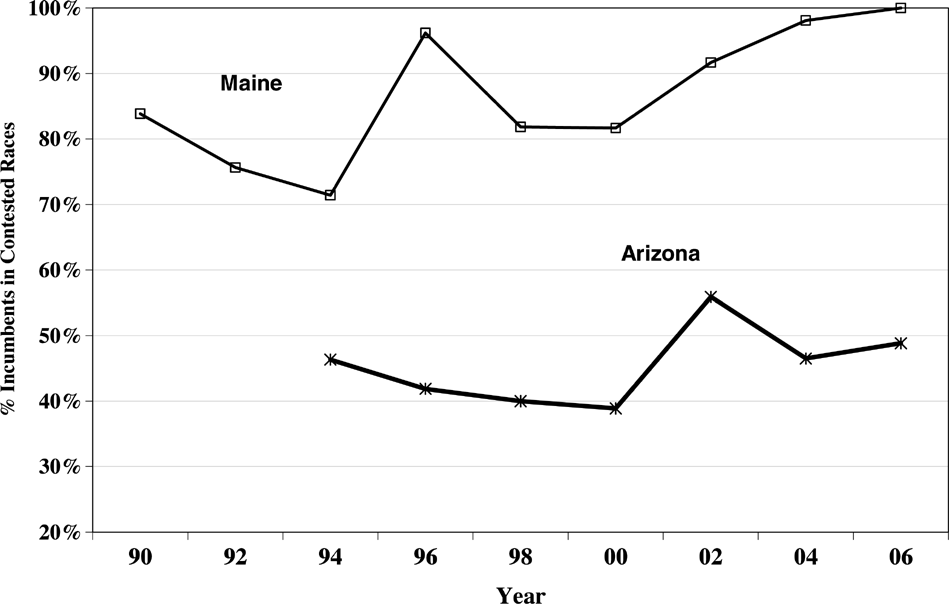
In earlier research, we described the effect of public funding on competitiveness through the 2004 elections (Mayer, Werner, and Williams 2006). We found that Maine and Arizona had marginally higher electoral competitiveness after clean elections went into effect in 2000, as measured by the percentage of incumbents facing major-party opposition, the percentage of incumbents who ran in competitive races (defined as winning with less than 60% of the vote), and the incumbent reelection rate. The 2006 results continue to show a modest increase in competitiveness, although the reelection rate for Arizona incumbents has returned to pre-reform levels. In Figure 1, we show the percentage of house incumbents with a major-party opponent. In 2006, every incumbent in Maine faced a challenger, and Arizona continued to show more contested races than it did in the pre-reform period.

Incumbents Facing Major Party Challenger, General Election—State House—Excluding Incumbent Pairings
Aggregate Analysis
Initial accounts of public funding programs—produced by pro-reform advocates—claimed to find a surge in both the number of female winners and candidates, but the evidence does not support such a claim. “Clean elections” has had no obvious effect on gender composition of the candidate pool or legislatures. In the 2006 general elections, 31% of Arizona House and 32% of Maine House candidates were women (roughly the same as in the primaries). In Arizona, women currently hold 18 out of 60 house seats (30%) and 13 of 30 senate seats (43%). In Maine, women hold 45 of 151 house seats (30%) and 12 of 35 senate seats (34%). These percentages are not markedly different than the pre-reform numbers, and in the case of the Arizona House and Maine Senate, women hold fewer seats than they did in the late 1990s.
But a very different picture emerges from examining public funding acceptance rates, as women are far more likely to accept full public funding than men in house elections. Since the beginning of public funding in 2000, 63% of women Arizona House candidates have accepted grants, against 48% of men. In Maine, the overall acceptance rate since 2000 is 70% for women and 61% for men. In the senate, the acceptance rates are much closer, with 80% of women and 72% of men accepting in Maine since 2000, along with 36% of women and 32% of men in Arizona. Obviously, these aggregate figures are not the complete story, as the differences could easily be a function of incumbency, partisanship, or something other than gender. But the rates present two puzzles. First, it is not obvious why gender affects acceptance rates but not the overall composition of the candidate pool or the legislature. Second, it is unclear why the difference in acceptance by gender is smaller in senate elections. To untangle these puzzles, we turn to an analysis of the individual-level decision to take public election funding.
Individual-level Analysis
We use logistic regression to estimate the odds that an individual candidate accepts or declines public funding.2
Since many candidates ran more than once between 2000–2006 (either incumbents or repeat candidates), we computed robust standard errors using Huber's (1967) method for calculating standard errors.
We assume that the main benefit of public funding comes on the “cost” side of the decision to run for office, since public funding lowers the major barrier to campaigning—an inability to raise funds—for less experienced candidates. Thus, we expect the probability of taking public funding to be inversely related to the chances of winning. Whatever gives a candidate a better shot at office—experience, running in a competitive district, or an open seat—should lower the odds of taking public grants. Consequently, we expect that challengers will be more likely than incumbents to take public funds and that more experienced candidates should be less likely to accept.
From the aggregate analysis, we know that women are more likely to accept public funding than men. What we would like to know is whether gender has an independent effect once we take into account other factors.
Our dependent variable is the public funding decision, set to (1) if a candidate accepts it for the general election and (0) if not.
Our independent variables control for the exogenous factors that will shape the decision to accept or refuse public funds. We include a gender variable, coded (1) for female candidates and (0) for males. We expect a positive value, indicating that female candidates are more likely than male candidates to accept public funding.
We control for candidate experience in two ways. First, we include dummy variables for incumbents and challengers, using open seats as our omitted baseline category. Incumbents should be less likely than open-seat candidates or challengers to take public funding, since they have experienced campaign organizations, have more access to private donors, and are less likely to face serious opposition. Second, we also include a dummy variable measuring whether a challenger has run for the legislature previously. We expect this coefficient to be negative, as most challengers running for the second time will be more established politically and may perceive that they have a better chance of winning (Carsey, Berry, and Forrest 2003).
In our senate model, we include a dummy variable for challengers or open-seat candidates who served in the house. These candidates, since they are running from an established base, will behave much like incumbents and should be more likely to shun public funding in favor of private financing. This is especially true in Arizona, where house and senate district boundaries are identical.
We control for strategic context by capturing the effects of partisanship, behavior of the opposing candidate, legislative control, and the specific effects of a particular election cycle. We theorize that candidates will be more likely to take public funding if their opponent has also accepted it, for two reasons. First, since accepting public funding typically ties a candidate's hands by capping their spending, candidates may be more likely to accept it if their opponents do so (or if they anticipate that their opponent will do so). This expectation rests on the premise that a candidate who accepts public funding unilaterally could be financially handicapping herself.3
This expectation may be countered by “bonus” provisions which provide additional grants (or relieve candidates of spending limits) when candidates run against high-spending privately funded opponents. Still, there is a maximum grant size in both states.
We include a party variable coded (1) for Democrats and (0) for Republicans and expect that Democrats will be more likely to accept public grants. This expectation stems from the broader differences between the two major parties on campaign finance issues.
To control for state-level strategic conditions, we include two sets of dummy variables. Our first set estimates the effects of running as a member of the chamber's majority party. We expect that candidates from the majority party will be less likely to accept public funding than members of the minority party, given the political benefits of being in the majority and their party's statewide strength.4
The 2000 election in Arizona resulted in a senate split 15-15. For the 2002 election cycle, we coded neither party as having a majority.
Finally, we include a measure of district competitiveness, calculated as:

This variable ranges from 0 (when the previous result was a perfectly competitive 50-50 split) to 50 (when the previous election was uncontested, with the candidate's party receiving either 0 or 100% of the two-party vote). We calculated competitiveness using results from the previous cycle, to insure that the variable is exogenous with respect to the current campaign. Our expectation is that as districts become more competitive, candidates will become less likely to accept public funding. In competitive districts candidates may be less willing to accept the spending limits that accompany public grants. In addition, candidates are likely to have more access to private funding in competitive races. We also include separate interaction effects for challengers and incumbents, as we expect challengers in particular to be more responsive to changes in competitiveness.
Although adding this variable to the model makes sense theoretically, it comes at a cost. We cannot calculate the previous vote in elections that occur after redistricting (2002 in Arizona, 2004 in Maine), since the new districts do not overlap perfectly with the old, and we lack the precinct-level data that would permit an approximation.5
Arizona presents yet another problem since two house members are elected from each of the state's 30 legislative districts; we calculated our competitiveness indicator for each house candidate by dividing the total number of votes for that candidate's party in the district by the total number of votes cast for major-party candidates in his or her district (each voter casts two votes).
Logistic Regression Results
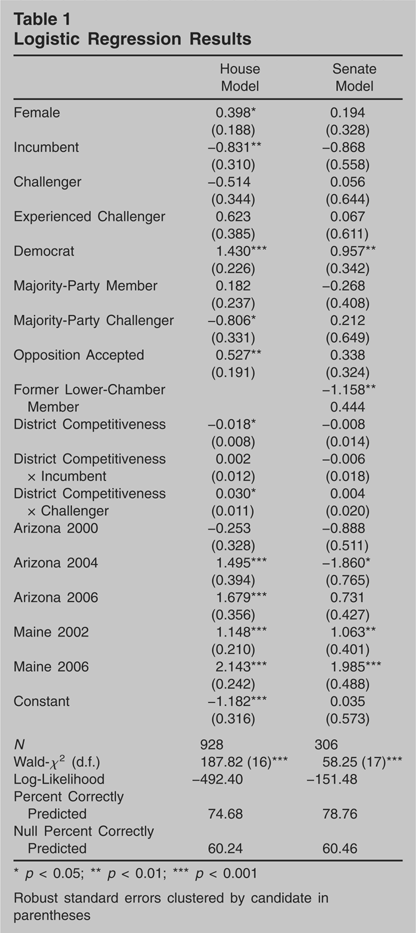
The results appear in Table 1. Our specification for the house shows that gender has a significant independent effect on the decision to take public funding. Even after controlling for candidate experience, incumbency, partisanship, and strategic context, women are more likely than men to participate in public funding programs. Transforming the logit coefficients into probabilities, we find that for most house candidates, being a woman increases the probability of accepting public funding by eight to 11 percentage points. The existence of a gender-specific campaign effect—that is, a difference between men and women that is not simply the result of differences in incumbency, political experience, qualifications, or party—strongly suggests that men and women respond differently to at least this aspect of the campaign environment.
Logistic Regression Results

We are confident that these gender-specific effects are real, because the other coefficient estimates are, with only a few exceptions, what we expected to see. Incumbents are far less likely to take public funding than either challengers or open-seat candidates, with incumbency itself reducing the probability of accepting by up to 25 percentage points. House candidates are significantly more likely to take public funding if their opponents also lock themselves into a spending limit by participating. Democrats are more likely to accept, with a difference between Democrats and Republicans of up to 40 percentage points. And challengers from the chamber's majority party are less likely to accept public funding, with an effect approximately equivalent to the impact of incumbency.
Although the coefficient for challengers is the correct sign (positive), it does not meet the conventional threshold for statistical significance. What this means is that challengers and open-seat candidates are about equally likely to accept public funds.
Being an experienced challenger—having run for the legislature at least once previously—does not have any effect, a result suggesting that repeat candidates do not always gain useful experience. It may be that challengers have so little chance to unseat incumbents in any event, that previous (and, by definition, unsuccessful) campaign experience for legislative office does not offer much advantage. Alternatively, candidates may see a need to be consistent in their campaign finance choices in successive campaigns: 83% of the challengers who ran more than once made the same decision in regard to accepting public funding across elections
The state/cycle variable estimates for Arizona and Maine show a distinct pattern of increased participation over time, as more and more candidates opted in during each successive election cycle: in both states, the coefficients change from large negative values in 2000—signifying that the probability of accepting is lower than for candidates in the baseline—to significant and positive values in 2004 and 2006. We note that our model is not estimating overall participation rates, which can be easily calculated directly for each cycle using the raw data. Rather, we are estimating the conditional effect of each independent variable. Controlling for candidate characteristics, incumbency, experience, majority control, etc., we still see an increase in the likelihood of an individual candidate participating in these states in each successive election cycle.
This model also confirms that district competitiveness exerts a significant effect on the decision to take public funding, with markedly different effects for incumbents, challengers, and open-seat candidates. The incumbent and competitiveness interaction is statistically insignificant, but the challenger and competitiveness coefficient is significant and positive. Recall that these competitiveness variables take values from 0 to 50, with increasing values denoting a less competitive district. The impact for open-seat candidates is measured with the baseline district competitiveness coefficient (−0.018, p < 0.05); to estimate the effects for challengers, we add together the challenger, district competitiveness, and challenger and competitiveness interaction coefficients.6
For incumbents, we add together incumbency, competitiveness, and incumbent and competitiveness interaction coefficients; in all states and cycles in our sample, competitiveness had no effect on incumbents' decisions to accept or refuse public funding.
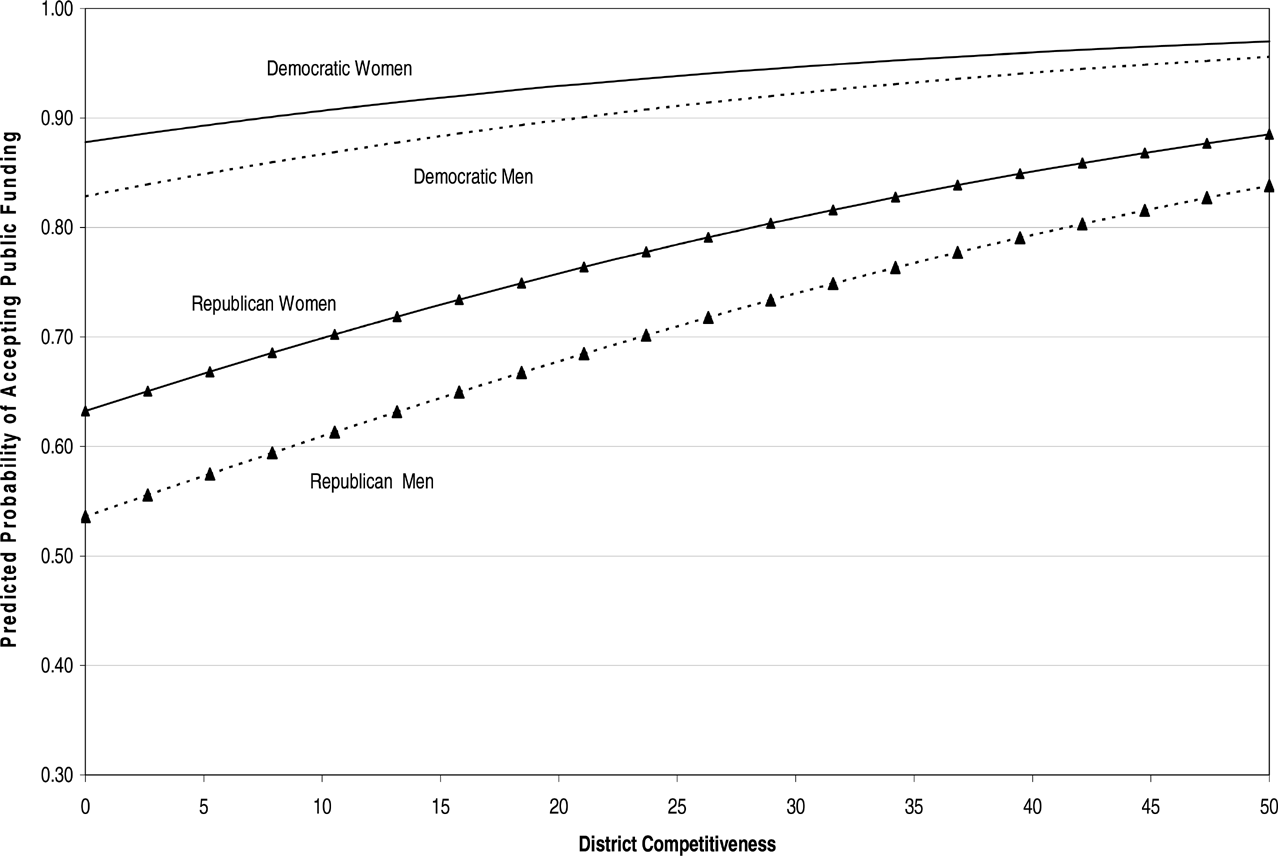
We show this effect in Figures 2 and 3, plotting the predicted probabilities that a challenger will accept public funding in the 2006 Maine and Arizona House elections. These graphs show separate lines for Democrats, Republicans, and men and women. The differences are stark. In Maine (Figure 2), women are 5–10 percentage points more likely to accept funding than men, and Democrats are about 15 percentage points more likely to take it than Republicans. The gap between Republican men and women is greater than for Democratic men and women. And, overall, challengers in perfectly competitive districts are about 30 percentage points less likely to accept public funds than those running in previously uncontested districts.
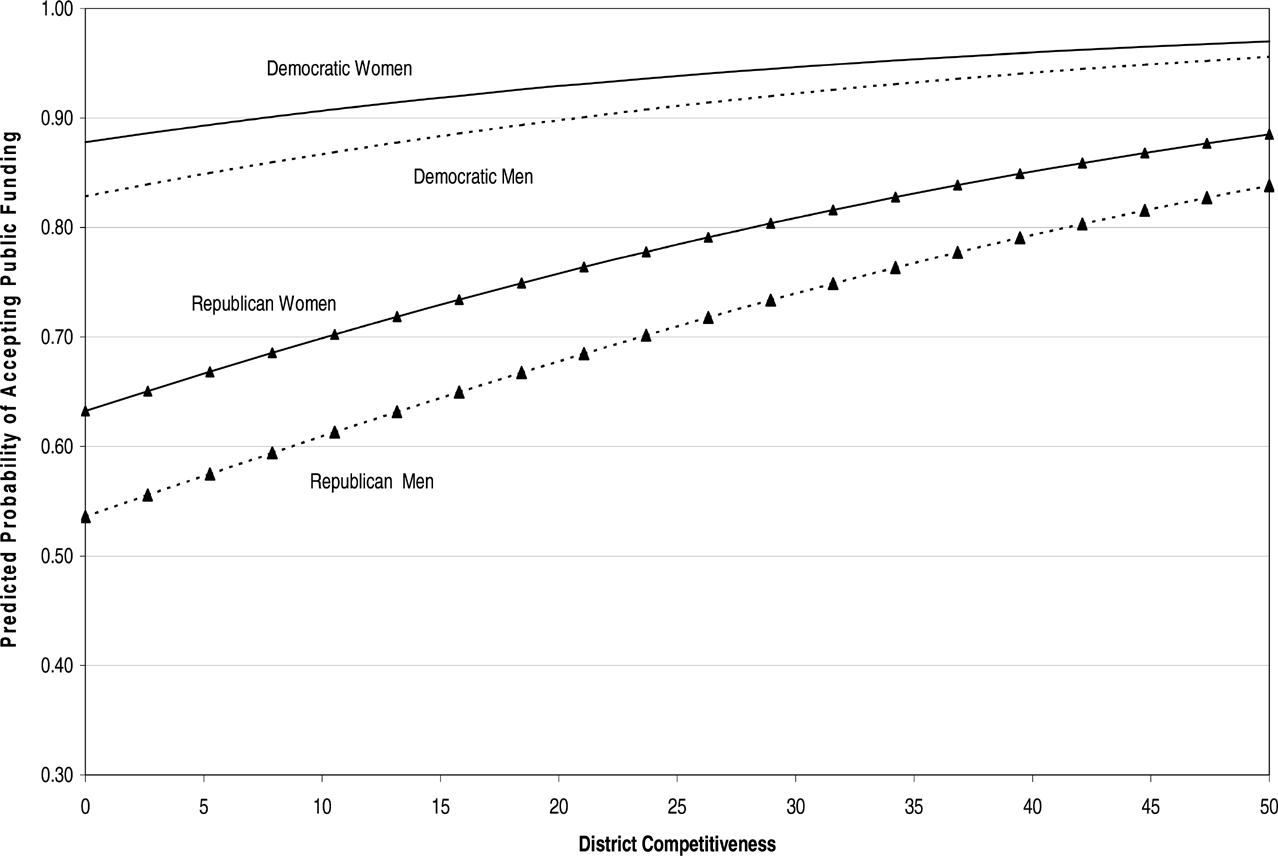
Maine House Challengers 2006
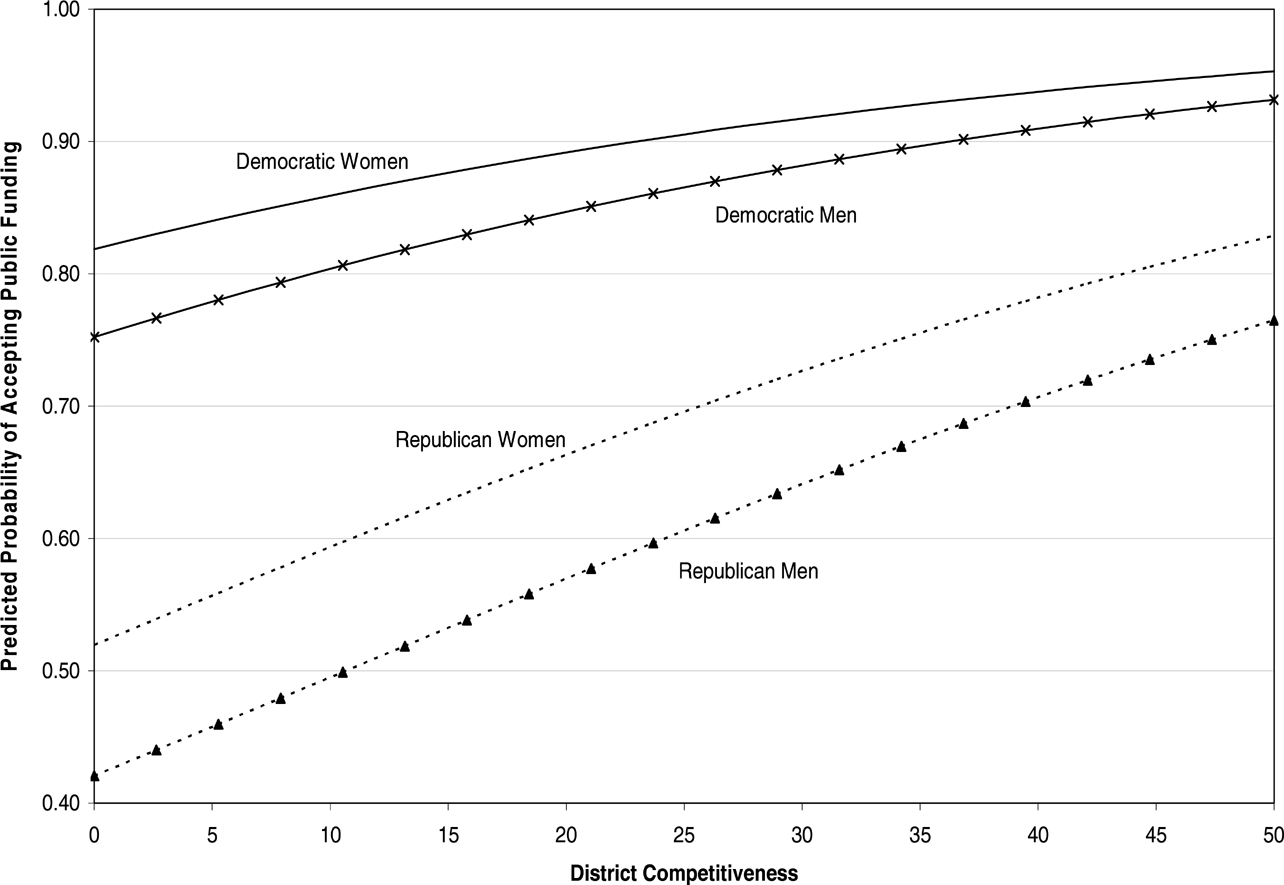
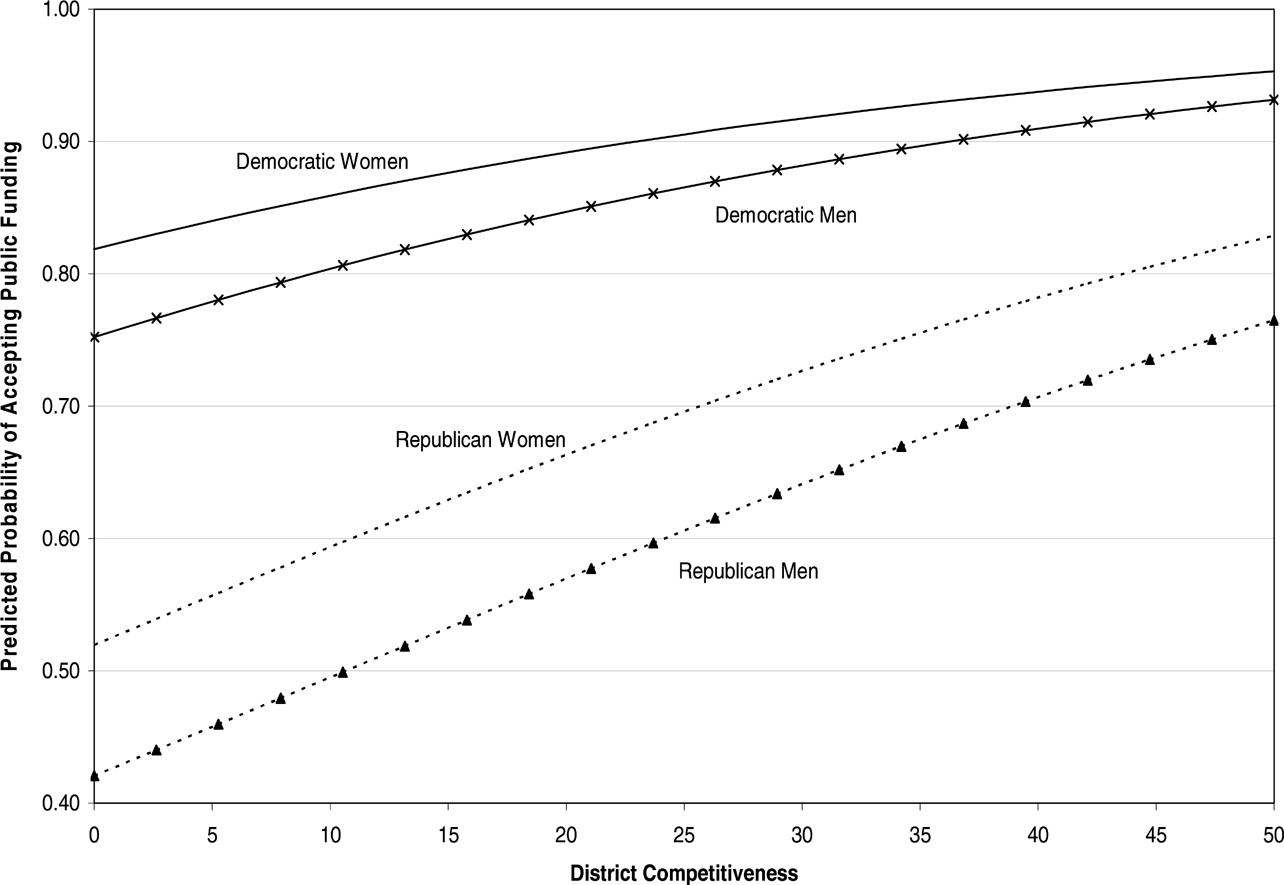
Arizona House Challengers 2006
Figure 3, illustrating the relationships for the 2006 Arizona elections, shows a similar pattern. The effects of gender remain apparent, but party plays an even larger role. In a previously close district (a competitiveness value of 10), the probability that a Republican male accepts public funds is about 0.5. For a Democratic male, the probability is over 0.8, a 30-point difference. The impact on women is slightly less (a little over 25 points), but only because the probability of accepting begins to approach the upper limit of 1 for Democratic women. Candidates in the most competitive districts are far less likely to accept public funds than are candidates in previously uncontested races.
These are reasonable results, consistent with what our theoretical approach would predict. Challengers, who normally start with a huge disadvantage, are utterly hopeless if they are also running in a district dominated by the opposition party. In these cases, private contributors will stay away, and public grants may well be the only option available. When a district becomes more competitive, private contributors should be more willing to participate, and challengers will at least have the potential to raise funds. Truly competitive challengers, such as those running against an incumbent weakened by scandal, are often able to raise significantly more in private funds than they could under the spending limits that come with public funding.
Table 1 also shows the estimates for senate candidates. The models are the same as for the house, with one additional variable: a measure of whether a challenger or open-seat candidate is a member of the house. The results show that Democrats running for the senate, like their house counterparts, remain much more likely than Republicans to accept public grants and that the state/cycle dummy variables have, for the most part, effects similar to those in the house model. The effects of incumbency and gender disappear. Neither, it appears, has any effect on public funding decisions in senate races. The aggregate effect of gender—in which women are marginally more likely to accept public grants—washes out completely once we control for other factors.
In our senate model, running from a lower-chamber seat decreases the probability of taking public funding by as much as 30 percentage points. Obviously, candidates already serving in the legislature have much greater ability to raise money when they need it. We also expect that there is a good deal of strategic behavior going on here, with house incumbents running for the senate when they see an opportunity because of a weak incumbent or an open seat (Francis 1993).
We are left then with the question of why, when it comes to taking public campaign funds, gender matters for house races but not for senate races.
We think that the best explanation stems from the strategic framework that has anchored our analysis throughout. Running for the state senate is not usually an entry-level experience, particularly when compared to running for the house. The most important distinction between house and senate campaigns is the experience level of candidates. There is no doubt that state senators have more political experience—usually including service in the lower chamber—than their house counterparts. Senate seats are universally considered preferable to house seats, with smaller chambers, larger constituencies, longer terms, more opportunities to have a substantive legislative impact, and better prospects for higher office (Kousser 2004; Francis 1993; Francis and Kenny 2000). In their study of 47 state legislatures, Francis and Kenny (2000) found that between 1968 and 1986, sitting lower-chamber members ran for a senate seat 1,112 times against 18 cases of sitting senators running for a lower-chamber seat. This disparity occurs even though lower-chamber members always have to give up their seat to move up, while senators often do not. “[I]t seems safe to say,” they conclude, “that most state house members would prefer a state senate seat over a house seat” (7). Senate campaigns cost much more, suggesting a greater degree of difficulty and a higher “market” value. As the desirability of political office increases, so too does the quality of the candidates who seek it. Even political amateurs will have to have more resources or visibility if they are to be taken seriously as candidates. This is consistent with what others have surmised (Pritchard 1992, 68).
Our findings suggest that gender effects are most likely to show up in true entry-level campaigns or when candidates lack experience in public office. As candidates seek offices higher up the career ladder, it is simply that much harder for them to mount credible campaigns without some kind of experience. Consider the case of current members of lower chambers who consider senate candidacies: they have better odds of winning than most challengers, but they face higher costs as well, since they must give up their seat in order to run (Francis 1993). For these candidates, public funding and gender appear to have played a comparably smaller role in their decisions to run than the broader strategic dynamic of the race. Although gender differences in ambition appear to play a role in explaining why more men than women seek to move up the career ladder (Fox and Lawless 2005), we believe that our findings suggest that the effect that candidate gender has on strategic decision-making during the campaign diminishes as candidates gain more experience and seek higher office.
Thus, the role of gender in electoral decisions appears to be highly contingent on other strategic factors and has its greatest impact in “entry-level” political races, such as those for the state house. Once candidates gain experience and establish a political base, gender appears to play a smaller role in their decision-making.
Conclusion
Our analysis has shown that female candidates are substantially more likely than male candidates to accept public funding in races for the state house. This finding holds, even after controlling for a variety of partisan and candidate-experience variables. At the same time, this effect disappears in state senate races. Since our conclusions are the result of direct observation of a discrete and unequivocal decision made by every candidate, they represent an advance in our understanding of what role gender plays in the campaign process.
At the entry level, gender matters, suggesting that there are some specific barriers that apply more to women than to men. This could be the result of differences in the eligibility pool, the unique issues that women face when running for office, or it could reflect a baseline difference in how women, irrespective of party or ideology, view public funding. But the conclusion that gender effects disappear as candidates move up the career ladder confirms that gender is not a universal or constant factor in campaigns.
Our findings have several clear implications for future research. One is that we are more likely to find gender-specific differences in candidate decision-making in lower-level campaigns. Comparatively, gender effects should be stronger in U.S. House races than in U.S. Senate races, mayoral campaigns than in gubernatorial campaigns. Second, we need to investigate how, and why, gender effects diminish as candidates become more experienced. The existing literature on gender and politics argues that the differences between men and women—and how voters perceive and respond to those differences—depend crucially on the overall context of a race. Gender, as we have confirmed in the context of campaign finance, is a highly contingent factor. As a discipline, we have a less sophisticated understanding of precisely why the effects are so conditional. It is possible that voters care less about a candidate's gender when there are more substantive issues and factors to consider. Normatively, this would be a positive result. But it is also possible that women candidates face more pressure to deemphasize their personal character as they move up the career ladder; that is, running “as a woman” may work against them. Is it possible that as women run for higher office, they must increasingly “act like men”?