I. INTRODUCTION
Spinel-structured aluminum oxynitride (γ-AlON) is an important single phase and stable solid solution ceramic within the Al2O3–AlN system. Reference MaCauley, Patel, Chen, Gilde, Strassburger, Paliwal, Ramesh and Dandekar1 Transparent AlON ceramics have attracted a growing interest as infrared/visible window material, transparent armor, and other extremely durable optics due to its high strength and high hardness, high resistance to rain and sand damage, and excellent optical transparency properties. Reference Su, Zhou, Wang, Yang, Cao and Hong2–Reference Zhang, Chen, Chen, Zhang, Li, Liu and Wang8 Transparent AlON can be fabricated by conventional pressureless sintering, hot pressing, or hot isostatic pressing. Reference Su, Zhou, Wang, Yang, Cao and Hong2,Reference Wang, Wang and Li9–Reference Kumar and Johnson12 However, conventional fabrication of AlON ceramics usually requires sintering of a green body at high temperature (≥1850 °C) for a long holding period (≥6 h). Reference Liu, Jiang, Li, Sun, Pan and Guo13 Unfortunately, high sintering temperature and long holding time can easily lead to excessive grain growth and coarse microstructure, which, in turn, tend to decrease the hardness of the processed materials. Reference Krell and Bales14
Recently, our work has confirmed that AlON powder having a bimodal particle size distribution (PSD) can be more efficiently pressureless sintered under fast heating of 40 °C/min and a lower sintering temperature of 1820–1880 °C. More importantly, the holding time of pressureless sintering used to obtain transparent AlON utilizing this bimodal powder can be remarkably shortened down to 1.5–2.5 h. Reference Shan, Xu, Wang, Sun, Liu, Xu and Li15 It was revealed that the bimodal powder can keep its bimodal PSD throughout the whole sintering process and therefore it can be rapidly densified. At the early or middle stage of the pressureless sintering (before the formation of AlON, <1700 °C), the bimodal samples have an excellent gap filling and rearrangement ability. At the final stage of sintering, AlON grains in the bimodal samples can diffuse much faster due to the transient bimodal AlON grain size distribution inherited from the bimodal starting powder. Further investigation into the phase transformation and microstructure evolution of these pressureless sintered samples indicates that high heating rates enable the sintering mixtures to keep a near spherical shape bimodal PSD until phase transformation from Al2O3 to AlON is fully completed. Then mass transport between large to large, large to small, and small to small AlON grains can simultaneously happen at the final fast densification stage, which benefits the less active formation of pores and fast growth of AlON grains. Therefore, high heating rates play a key role for fast and better consolidation of the utilized bimodal AlON powder.
On the other hand, spark plasma sintering (SPS) has been recognized as one of the most attractive rapid powder consolidation technologies. It provides heating rates up to hundreds of °C/min through the Joule heating effect which largely shortens the processing time. At the same time, the applied pressure during SPS also offsets the required processing temperature level. As a result, SPS allows the rapid compaction of highly dense ceramics at relatively lower temperatures and with shorter holding time compared to conventional powder processing techniques. Reference Khaleghi, Lin, Meyers and Olevsky16–Reference Orru, Licheri, Locci, Cincotti and Cao18 In addition, high heating rates of SPS are also helpful for obtaining high density and fine-grained products. Reference Cui, Wei, Olevsky, German and Chen19,Reference Hu, Li, Qu and Li20 Therefore, SPS-processed specimens usually possess smaller grains compared to their conventionally sintered counterparts as the grain growth is both temperature and time dependent.
Temperature overshoot is a universal phenomenon for SPS, which is similar to a two-step sintering. Generally, two-step sintering is an efficient approach for obtaining fully dense small grain ceramics because it suppresses grain growth at the final stage of sintering. Reference Chen and Wang21 Because of these unique features, SPS was selected in the present study to consolidate a bimodal AlON powder to obtain highly dense transparent ceramic components with small grains and excellent properties. Therefore, using bimodal AlON powder synthesized by the carbothermal reduction and nitridation (CRN) method as the starting material, the SPS process similar to the mentioned two-step method was developed to obtain small grain specimens with higher hardness. High density transparent AlON ceramics based on the three-phase system (AlON, α-Al2O3, and h-AlN) were prepared after holding during 10 min at 1350 °C by the SPS. At the same time, the obtained ceramics also demonstrated a high hardness.
II. EXPERIMENTAL
High purity nanosized γ-Al2O3 (DK410-2, Beijing DK Nanotechnology Co. LTD, China) and activated charcoal powder (Beilian Chemical Reagent Co., China) were used as the starting materials for the synthesis of AlON powder. In high purity nitrogen, single phase AlON powder was firstly synthesized by the CRN method inside a graphite furnace (a detailed fabrication process has been described in Ref. Reference Shan, Xu, Wang, Sun, Liu, Xu and Li15). After removing the possible carbon residues in the synthesized AlON powder at 640 °C for 4 h in air, 0.5 wt% Y2O3 (Grade C, Starck, Germany) was added into the obtained powder. Using Si3N4 grinding balls (having 5, 8, and 10 mm diameter and weight ratio at 1.7:1:1.3) as milling media, keeping the ball-to-powder weight ratio at 7:1, the mixture of powders of AlON and Y2O3 was processed in absolute ethyl alcohol at 170 rpm for 24 h into a bimodal powder. The detailed fabrication process of the bimodal AlON powder has been described in Refs. Reference Shan, Xu, Wang, Sun, Liu, Xu and Li15 and Reference Shan, Zhang, Sun, Xu, Qin and Li22.
The phase composition of the synthesized AlON powder was characterized by X-ray diffractometry (XRD; D/Max-ULtima+, Rigaku, Tokyo, Japan) using Cu Kα1 radiation as shown in Fig. 1. The PSD of the milled AlON powder was measured using laser particle size analyzer (Mastersizer 2000, Malvern Instruments, Malvern, United Kingdom), and its PSD is shown in Fig. 2. The morphology of the obtained mixture powders was observed by field-emission scanning electron microscopy (FESEM; supra 55, Zeiss, Jena, Germany) as shown in Fig. 3.
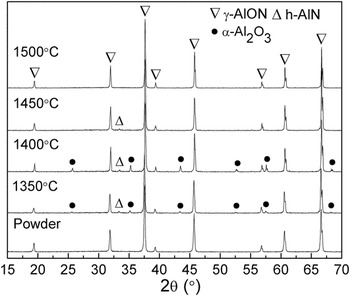
XRD patterns of the AlON powder and the SPS-processed samples.

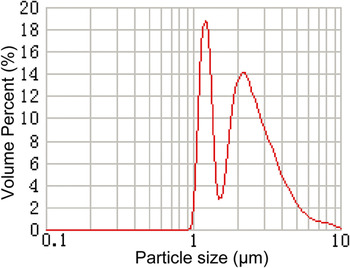
Particle size distribution of the milled AlON powder.

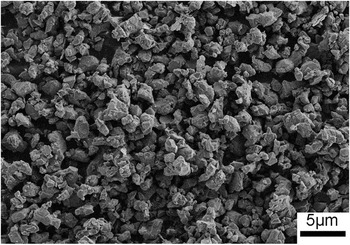
SEM image of the milled AlON powder.

2.7 g of the obtained bimodal AlON powder were placed into a graphite die with a diameter of 15 mm and then sintered in a SPS apparatus (SPSS-515, Fuji Electronic Industrial Co., Ltd., Kawasaki, Japan) in vacuum. The sample was first heated to 1350 °C, 1400 °C, 1450 °C, and 1500 °C at a heating rate of 100 °C/min, respectively. Then, after holding for 10 min, the heating system was shut down and the furnace was cooled down to room temperature. The axial pressure was maintained at the level of 40 MPa during the entire sintering process. The sintered samples were subsequently ground and polished on both sides to a thickness of 1.2 mm for the following optical transmittance measurements.
The phase compositions of the sintered samples were characterized by XRD. The microstructure of sintered samples was observed using scanning electron microscope. The bulk density of the sintered samples was measured by the Archimedes method. Optical transmittance of all the fabricated samples in the wave range of 1330–6000 nm was recorded by a Fourier transform infrared spectroscopy (FTIR; Frontier, PE, USA). Vickers hardness at room temperature was measured by a hardness tester (M-400-H1, Leco Corp., St. Joseph, MI, USA) under a preset load of 1.0 kgf.
III. RESULTS AND DISCUSSION
A. Characteristics of AlON powder
The XRD pattern of the synthesized powder is shown in Fig. 1, which illustrates that single phase γ-AlON powder was synthesized by the CRN method and, as a result, only the γ-AlON crystalline phase was detected in the obtained powder. Figs. 2 and 3 present the PSD and the scanning electron microscopy (SEM) image of the milled powders, respectively. It can be observed that the synthesized single phase γ-AlON powder was successfully milled into the bimodal powder (at ∼1.1 and ∼2.2 μm). For the bimodal AlON powder, the gap filling ability of the small particles between large particles was found to be favorable for the fast densification process. Reference Wonisch, Kraft, Moseler and Riedel23,Reference Petersson and Ågren24
B. Characteristics of processed AlON ceramics
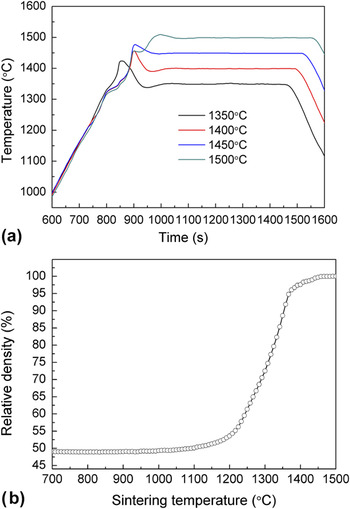
After being processed by the SPS at 1350 °C, 1400 °C, 1450 °C, and 1500 °C for 10 min, respectively, high density γ-AlON ceramics were obtained. As shown in Table I, the density of the sintered sample is 3.69–3.74 g/cm3. The measured temperatures shown in Fig. 4(a) reveal that the sintering temperature overshot the set temperature during heating. The corresponding overshoot temperature is 1425, 1458, 1477, and 1509 °C for the samples held at 1350, 1400, 1450, and 1500 °C. Assuming that the phase composition of the sintered sample is based on the γ-AlON single phase during heating, the densification kinetics curves have been calculated and are shown in Fig. 4(b). Figure 4(b) reveals that the main shrinkage of all the samples has occurred during the first ramping up period, and the relative density has already reached 98.72% when the respective specimen was heated up to 1425 °C. Therefore, the bimodal AlON powder can be fast densified during the fast heating (100 °C/min) of the SPS process, and the high density of the obtained samples should be mainly benefited from the higher first step sintering temperature.
Density of the samples after holding 10 min at different temperatures.

Sintering temperature (a) and densification kinetics curves (b) of the bimodal AlON powder.

The phase composition analysis of all the sintered samples is shown in Fig. 1. It reveals that besides the major γ-AlON phase, some minor amounts of α-Al2O3 and h-AlN phases could be also detected in the samples fabricated at 1350 and 1400 °C. It has been demonstrated that AlON particles are firstly transformed into Al2O3 and AlN at low temperatures which then form the AlON phase again at high temperatures. Reference Shan, Zhang, Sun, Xu, Qin and Li22,Reference Willems, Hendrix, de With and Metselaar25 Moreover, the phase structure of Al2O3 depends on the particle size of AlON powder, namely, the fine AlON particles were transformed into hexagonal α-Al2O3 and h-AlN, while coarse AlON particles were transformed into cubic η-Al2O3 and h-AlN. Reference Shan, Xu, Wang, Sun, Liu, Xu and Li15,Reference Shan, Zhang, Sun, Xu, Qin and Li22 In the SPS-processed samples (held 10 min at 1350 and 1400 °C) prepared from the bimodal AlON powder, γ-AlON, α-Al2O3, and h-AlN were detected instead of the η-Al2O3, α-Al2O3, and h-AlN phases, which indicates that either the coarse particles keep their AlON phase due to the fast heating rate (100 °C/min) combined with the structural similarity between cubic γ-AlON and η-Al2O3 or the holding period (10 min) contributes to the retransformation from η-Al2O3 and AlN to γ-AlON. Therefore, in the SPS processing of the bimodal AlON powder, the AlON phase should be favored by the coarse γ-AlON particles, and the α-Al2O3 and h-AlN phases are formed from the fine γ-AlON particles in the powder. In addition, the XRD patterns shown in Fig. 1 also reveal that in the SPS process, α-Al2O3 and h-AlN retransform into γ-AlON after sintering temperature is increased, α-Al2O3 cannot be detected in the sample held at 1450 °C, and single phase γ-AlON ceramics were obtained when sintering temperature increased to 1500 °C. It is noted that the phase transformation temperature from Al2O3 and AlN to AlON is lower than that of the traditional pressureless sintering, 1450 °C versus 1700 °C. Reference Shan, Zhang, Sun, Xu, Qin and Li22 It is noticeable that although a small amount of the h-AlN phase can be detected in samples sintered at 1450 °C, and the density of h-AlN is lower than cubic γ-AlON and α-Al2O3 (Table II), the SPS-processed sample shows the same density as that of the γ-AlON phase. It suggests that for the sample sintered at 1350–1450 °C, the effect of h-AlN on the density may be ignored, for only a small amount of the h-AlN phase can be detected in the three samples sintered at 1350 °C, 1400 °C, and 1450 °C (Fig. 1). As shown in Table II, the density of α-Al2O3 (3.99 g/cm3) is higher than that of γ-AlON (3.69 g/cm3), so not taking into account AlN, 8.2 wt% and 15.1 wt% Al2O3 are present in samples sintered at 1350 °C and 1400 °C, respectively, according to the XRD patterns shown in Fig. 1, which leads to the samples fabricated at 1350 °C and 1400 °C having a density of 3.71 g/cm3 and 3.73 g/cm3 based on the rule of mixture. It is noticed that the calculated density of 3.71 g/cm3 and 3.73 g/cm3 is close to the tested density values of 3.70 g/cm3 and 3.74 g/cm3 shown in Table I, respectively. Therefore, the higher density of 3.70 and 3.74 g/cm3 (Table I) of samples sintered at 1350 and 1400 °C should be attributed to the formation of α-Al2O3. Moreover, due to the greater amount of α-Al2O3 (15.1 wt%) detected in samples sintered at 1400 °C than in those sintered at 1350 °C (8.2 wt%), the higher density was measured for the samples sintered at 1400 °C than for those sintered at 1350 °C. Therefore, the higher density of 3.70 and 3.74 g/cm3 (Table I) of the samples sintered at 1350 and 1400 °C should be attributed to the formation of α-Al2O3. Moreover, due to the higher amount of the α-Al2O3 phase (15.1 wt%) detected in samples sintered at 1400 °C than that in the samples sintered at 1350 °C (8.2 wt%), the higher density of 3.74 g/cm3 was measured for the sample sintered at 1400 °C than for the one sintered at 1350 °C.
Density of γ-AlON, ɑ-Al2O3, and h-AlN.

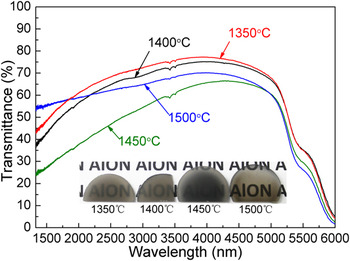
Figure 5 shows all the transparent samples and their measured transmittance (1.2 mm in thickness) fabricated at 1350–1500 °C. Despite being three-phase materials, the obtained samples sintered at 1350 °C and 1400 °C exhibited high infrared transparency. The maximum infrared transmittance of SPS-processed samples at 1350 °C for 10 min is 77.3% at ∼3900 nm, which is similar to that of the samples pressureless sintered at 1880 °C for 90 min. Reference Shan, Xu, Wang, Sun, Liu, Xu and Li15 These results indicate that the SPS sintering temperature can be decreased by about 500 °C and holding time can be shortened by 80 min when using SPS technique for the consolidation of the bimodal AlON powder. It is worth noticing that this is the first known work which succeeded in fabricating transparent AlON ceramics at such low temperatures by SPS technology. Moreover, for the present AlON sample with a thickness of 1.2 mm, its maximum infrared transmittance is slightly higher (2.1%) than that of the specimen with thickness of 0.5 mm, SPS-processed at 1700 °C by using Al2O3, and AlN as starting materials. Reference Wei, Fu, Wang and Wang27 However, compared with the best obtained transmittance of the AlON specimens sintered by the conventional pressureless sintering method (1850 °C held for 6 h, 1 mm in thickness), Reference Liu, Jiang, Li, Sun, Pan and Guo13 the transmittance of the SPS-processed AlON ceramics is slightly lower, 83.3% versus 77.3%. Optimization of the processing, based on the heating rate, holding time, pressure etc., should be able to further improve the transmittance of the SPS-processed AlON ceramics.
Transparent samples and their transmittance curves.

Additionally, as illustrated in Fig. 5, the transmittance of fabricated samples decreases when the sintering temperature increased from 1350 °C to 1450 °C at whole wavelength range of 1330–6000 nm. However, under further increased sintering temperature to 1500 °C, the transmittance of the obtained single phase AlON ceramics was obviously improved at near visible wavelength, i.e., from being at 25.0% for the sample held at 1450 °C the transmittance increased up to 54.7% for the sample obtained at 1500 °C.
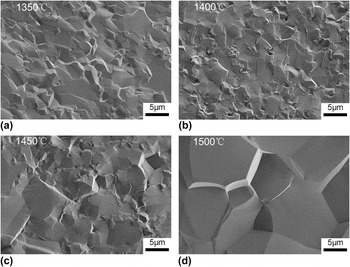
As shown in Fig. 6, no visible pores can be observed at the fracture surfaces of all the sintered samples. Therefore, the high infrared transmittance of the obtained three-phase AlON ceramics should be mainly attributed to their high density [Figs. 6(a) and 6(b) and Table I]. Figs. 6(a) and 6(b) also reveal that the sample structure is predominantly represented by small size grains. Most grains are about 5–10 μm, but some very small grains of less than 2–3 μm can be observed too. Since α-Al2O3 and h-AlN phases are formed from fine AlON particles, the phase compositions of the smaller grains in the sintered samples should mainly be based on the α-Al2O3 and h-AlN phases. Therefore, the reason of why the produced three-phase material does not compromise infrared properties at longer wavelength of >3000 nm can be attributed to the grain size effect of small α-Al2O3 and h-AlN grains, which results in lower scattering at long wavelength band. Reference Jones, Hyuga and Hirao26 On the contrary, the small α-Al2O3 and h-AlN grains result in higher scattering in short wave length range, and the respective sample shows lower transmittance at the wavelength of <3000 nm (Fig. 5). In addition, the small refraction index difference of ∼0.13 Reference Kischkat, Peters, Gruska, Semtsiv, Chashnikova, Klinkmüller, Fedosenko, Machulik, Aleksandrova, Monastyrskyi, Flores and Masselink28,Reference Hartnett, Bernstein, Maguire and Tustison29 between major phase AlON and minor phase α-Al2O3 (the effect of h-AlN is negligible due to its lower content, as shown in Fig. 1) can be another reason to explain the high infrared transparency of the obtained samples. Therefore, after increasing the sintering temperature up to 1500 °C and thus enabling the α-Al2O3 and h-AlN phases’ retransformation into the γ-AlON phase (Fig. 1), the obtained single phase AlON with >4–5 μm grains [Fig. 6(d)] shows an improved transmittance at near visible band, but its infrared transmittance is lower about 7% than that of the sample held at 1350 °C. Hence, the grain size should be the other importance reason to influence the transparency of AlON ceramics. Adjusting the initial particle size combined with SPS processing parameters controlled to improve the grain size distribution of AlON ceramics should be a promising approach to improve the transparency of the processed AlON ceramics. Additionally, the hardness measurements indicate that the fabricated AlON ceramics at 1350 °C has high hardness of 17.81 GPa, which is slightly higher (1.69 GPa) than that of the specimen fabricated by the conventional method (1860–1880 °C for 10 h). Reference Wang, Xie, Qi, Wang, Wei and Lu11 The high hardness of the SPS sintered AlON should be attributed to its small grain size of <10 μm caused by the high heating rate, low sintering temperature, and short holding time. More processing approaches should be explored to control the single phase AlON grain sizes within a desired range.
SEM images of the fracture surfaces of the sintered AlON ceramics.

IV. CONCLUSION
The bimodal γ-AlON powder synthesized by the CRN method can be rapidly densified during fast heating (100 °C/min) of the SPS process, and high density γ-AlON ceramics were fabricated at 1350–1500 °C after holding 10 min. Moreover, highly infrared transparent AlON ceramics have been produced by the SPS of the bimodal γ-AlON powder at the low temperature of 1350 °C. Despite being three-phase (γ-AlON, α-Al2O3, and h-AlN) materials, the obtained samples showed high infrared transparency: the maximum transmittance in the medium infrared region could reach 77.3% at ∼3900 nm for 1.2 mm thick specimens. At the same time, the sintered samples have high hardness of 17.81 GPa. The high infrared transparency of the obtained samples should be mainly attributed to their high density. Also, the smaller size of α-Al2O3 and h-AlN grains, as well as the small refraction index difference between AlON and α-Al2O3 phases, should further benefit the high infrared transmittance of the obtained ceramics. In addition, the high density and small grain size contribute also to the high hardness of the processed transparent ceramics.
ACKNOWLEDGMENT
The support of the US researchers by the US Department of Energy, Materials Sciences Division, under Award No. DE-SC0008581 is gratefully acknowledged. This work has been supported also by the Fundamental Research Funds for the Central Universities (3132015097, 3132016329), China Scholarship Council (201506575020).