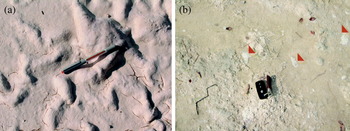
Introduction
Data from the rover Opportunity had indicated that the Mars regolith contains some carbonate-evaporite minerals, such as magnesite (Bandfield et al. Reference Bandfield, Glotch and Christensen2003) and jarosite, with possible relics of gypsum (Madden et al. Reference Elwood Madden, Bodnar and Rimstidt2004; Mancinelli et al. Reference Mancinelli, Fahlen, Landheim and Klovstad2004; Clark et al. Reference Clark2005; Tosca & McLennan Reference Tosca and McLennan2006; Tosca et al. Reference Tosca2006). Furthermore, reworked evaporitic sandstones formed of roughly equal amounts of siliciclastic basaltic debris and chemical constituents are dominated by evaporitic minerals; hematite and possibly secondary silica were also reported from Meridiani Planum by McLennan et al. (Reference McLennan2005). They suggested that these sediments were reworked by aeolian and subaqueous transport mechanisms. These sediments are believed to be formed by evaporation of acidic waters derived from interaction with olivine-bearing basalts and their subsequent diagenetic alteration. They described several features from these sediments, including moulds resulting from the dissolution of evaporites, concretions and vugs. The first outcrop-scale investigation of the sedimentary rocks on Mars by the Mars exploration rover (MER) Opportunity showed that the exposed rocks are composed of sandstone formed through the erosion and re-deposition of fine-grained siliciclastics and evaporites derived from the weathering of olivine basalts by acidic water (Squyres & Knoll Reference Squyres and Knoll2005). Klingelhöfer et al. (Reference Klingelhöfer2004) reported that Mossbauer spectra measured by the Opportunity rover detected the presence of four mineralogical assemblages at Eagle Crater in the Meridiani Planum. These are a jarosite- and hematite-rich outcrop, hematite-rich soil, olivine-bearing basaltic soil and a pyroxene-bearing basaltic rock.
Several attempts were made to find a terrestrial analogue that would provide a similar environmental setting for the formation of such mineralogical and lithological suites. Among the proposed sites suggested were sabkhas, which can occur in different parts of the world, because of their carbonate-evaporite mineral composition and the microbial content needed in the formation of these sediments. Krumbein et al. (Reference Krumbein, Gorbushina and Holtkamp-Tacken2004) discussed the adaption mechanism of cyanobacterial and other microbes to the extreme conditions of the sabkha systems of the Red Sea. They suggested that microbial life is better suited to survive under extreme conditions compared with larger organisms and they normally show poikilophilic adaption patterns to such conditions. Barbieri et al. (Reference Barbieri, Stivaletta, Marinangeli and Ori2006) studied the microbial signatures of the sabkha evaporites from Tunis, such as mucilage, rods, microfibers and dumbbell morphologies inside dolomite crystals, which are associated with evaporites. They suggested that these fingerprints can be detected by the analytical equipment planned for future Mars missions.
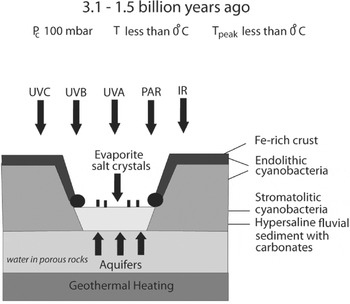
It is believed that the surface regolith of Mars during the Late Noachian-Hesperian period, according to hydrological models proposed by McKay (Reference McKay1997), consisted of a surficial layer containing endolithic and stromatolitic cyanobacteria with a mixture of fluvial and hypersaline carbonate and evaporite sediments with evaporitic crystals in ‘basins’ or depressions (Edwards et al. Reference Edwards, Mohsin, Sadooni, Nik Hassan and Munshi2006) (Fig. 1). There are also indications of aeolian fallout and some fluvial influences on what seems to be a restricted carbonate-evaporitic condition.
A model showing the possible evolution of Mars during the Late Noachian and Hesperian period (after McKay Reference McKay1997 and Edwards et al. Reference Edwards, Mohsin, Sadooni, Nik Hassan and Munshi2006).

In addition to the similarity of their mineral suites, there are other features common between some arid parts of Earth and Mars. Many of the surface rocks of Mars that have been imaged by the Viking and Mars Pathfinder Landers show dark, shiny surface coatings resembling desert varnish (DiGregorio Reference DiGregorio, Hoover, Levin, Paepe and Rozanov2003; Flood et al. Reference Flood, Allen and Longazo2003). Many workers reported the existence of sand dunes (Bourke et al. Reference Bourke, Balme, Beyer, Beyer, Williams and Zimbelman2006; Claudin & Andreotti Reference Claudin and Andreotti2006; Grotzinger et al. Reference Grotzinger2006a). Elwood Madden et al. (2004) noted that although jarosite formation requires the presence of a wet, oxidizing and acidic environment, it rapidly decomposes and can persist under arid climatic conditions only. Madden et al. (Reference Elwood Madden, Bodnar and Rimstidt2004) suggested that jarosite is the result of water-limited chemical weathering on Mars. Long et al. (Reference Long, Fegan, McKee, Lyons, Hines and Macumber1992) reported the presence of jarosite from a hypersaline system in Australia, where acidic groundwater enriched with K, Al, Fe+3 and SO4 enters a playa due to evaporation from the top 20 cm of the sediments. Benison (Reference Benison2006) compared the evaporites on Mars with a saline lake deposits in Kansas, USA.
The aim of this paper is to describe a terrestrial geologic setting that may explain part of the mineralogical–lithological association in the surface sediments of Mars. The approach will be based on detailed petrographic and chemical characterization and the microbial fingerprints of the coastal sabkha sediments of Abu Dhabi and their relation to the Arabian Empty Quarter Desert and the Northern Oman Mountains.
Study area
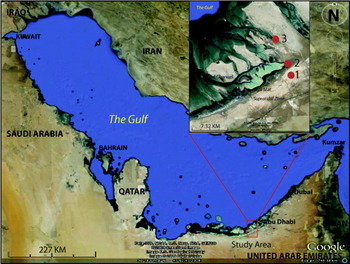
The classic coastal sabkha of Abu Dhabi in the United Arab Emirates is probably the best-studied sabkha in the world (Fig. 2). The sabkha area is composed of wide, salt-encrusted pans with complex sedimentary environments, including aeolian, fluvial, groundwater and marine regimes. These environments are reflected in a complex suite of sediment formed of clastic materials, such as quartz, feldspar and serpentine mainly of fluvial-aeolian origin; carbonates, such as calcite, aragonite, dolomite; and evaporates, such as halite, gypsum and anhydrite. Landward, these flat areas change gradually into the sand dune fields of the Empty Quarter Desert, which eventually ends up in a complex terrain of igneous rocks comprising the Northern Oman Mountains and even further to the south into what is called the Arabian Shield bordering the Red Sea, which is a complex of igneous and metamorphic rocks.
Satellite image of the study area showing cored sample locations (base image courtesy of Google).

The coastal sabkhas of Al-Dhabia area are located around 35 km south of Abu Dhabi city. The term sabkha is used here to include a larger area than the sabkha senso stricto as defined originally (for a historical perspective see Shearman Reference Shearman1963; Alsharhan & Kendall Reference Alsharhan and Kendall2003). The term sabkha area includes the deflation surface covered with sediments rich in halite, gypsum and other evaporitic minerals, plus the cyanobacterial mat covering the intertidal zone and the shallow subtidal zone of the coastal area.
The present study is based on an analysis of three deep cores from a depth of six metres and a large number of surface samples from the area of Al-Dhabia, one of the few areas that have thus far escaped urbanization. This is the first time that such deep cores have been cut in the area due to attendant technical problems associated with coring with heavy equipments on such soft sediments.
Methodology
Standard thin sections were prepared from both surface and subsurface samples. All the samples were X-rayed, by scanning at min−1 in the range of 2θ from 3° to 65°, in order to determine their composition. The percentage of each component was calculated and a lithologic column for each of the deep cores was constructed. Samples from the cyanobacterial mats were collected and analysed for the amount and type of organic matter present. The collected samples were examined by Scanning Electron Microscope (SEM) to determine their crystal morphology and nano-scale features. Energy Dispersive X-ray (EDX) analyses were also performed on the samples inspected under the SEM. A sample (5 g) was initially introduced to an inorganic carbon removal stage, where 10% HCL acid was added to the sample. A total organic carbon (TOC) analyser instrument, LECO CS 200, used to oxidize and detect the organic carbon by combustion in an oxygen-rich environment, resulting in the complete conversion of carbon to carbon dioxide. The carbon dioxide generated from the oxidation process is directly related to the TOC in the sample. This instrument is used to simultaneously determine carbon and sulfur, employing an induction heating furnace and solid-state infrared detection system.
Main lithologic components
The major minerals found in the sediments investigated according to their abundance are: calcite, quartz, dolomite, aragonite, plagioclase, gypsum, anhydrite, clay minerals and serpentine.
Calcite
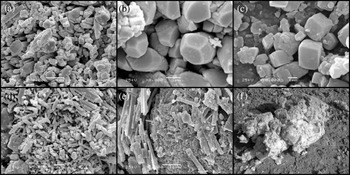
Calcite (Fig. 3(a)) is the major mineralogical component in the sediments studied. It ranges between 6% and 54% and generally increases with the depth of sampling. Calcite is believed to be formed either by direct precipitation from sea water in the shallow parts of the coastal area due to evaporation or by disintegration of the skeletons of some organisms, such as mollusks and large foraminifera.
The main mineral assemblages identified in the studied sabkha sediments under the SEM: (a) calcite; (b) quartz; (c) dolomite (d) aragonite; (e) plagioclase; (f) gypsum.

Quartz
Most of the quartz (Fig. 3(b)) present is in the form of fine grains ranging in size between 100 and 200 μm. The composition ranges between 4% and 51% with no definite horizontal or vertical trend noted. Most of these quartz grains are believed to be aeolian in origin, derived from the nearby deserts. Aqrawi & Sadooni (Reference Aqrawi and Sadooni1988) studied the contribution of the aeolian processes to the sediment budget in the northern parts of the Arabian Gulf and suggested that these may form up to 34% of the sample in some cases. Larger quartz grains may result from the fluvial outwash during the infrequent but strong thunderstorms.
Dolomite
Dolomite (Fig. 3(c)) is an important component of the sediments studied and was found to comprise between 6% and 51% of the total. Dolomite, in most cases, is found as aphanitic perfect rhombs with little variation in size, but nevertheless exhibiting wide textural variations. Some of the dolomite was fluffy or clustered into small granules. In some cases it is associated with cyanobacterial mats, clay minerals, the boring of the fauna and evaporites.
Dolomite development is an important phase in the growth of the microbial activity in the sabkha sediments. In a study on the same sediments by Edwards et al. (Reference Edwards, Mohsin, Sadooni, Nik Hassan and Munshi2006) using Raman spectroscopy, it was concluded that the extremophile colonies found in the subsurface sediments required the presence of dolomite or magnesite as a substrate. In addition to this Mg-rich base necessary for the microbial activity to develop, the presence of dolomite increases the porosity of the sediments by around 13% and hence creates the necessary space for the development of the colonization.
Aragonite
Aragonite (Fig. 3(d)) was found in all the recovered cores, comprising up to 20% of the total sample weight with no definite vertical variation. There are, however, three distinctive textures as revealed under the SEM. The most common is the typical nodular texture, which was probably formed either by direct precipitation from saturated sea water or from the disintegration of the skeletons of organisms. The second textural type is in the form of nibbles and protruding surfaces with dissolution and deformation marks. These are most probably associated with microbial activity. The third texture is in the form of slimes or bands surrounding mineral grains, including quartz, and these probably resulted from the action of binding organisms, such as algae and bacteria. Similar textures have been described by Barbieri et al. (Reference Barbieri, Stivaletta, Marinangeli and Ori2006) from the sabkha sediments of Tunisia and also from marine carbonates in Puerto Rico by Chacón et al. (Reference Chacón, Berrendero and Garcia Pichel2006), and in both cases these were attributed to microbial activity. Andres et al. (Reference Andres, Summer, Reid and Swart2006) noticed that aragonite associated with cyanobacteria usually has isotopic signatures of heterotrophic organisms.
Plagioclase and serpentine
Surprisingly, Plagioclase (Fig. 3(e)) was detected in a relatively high percentage ranging between 6% and 21% in all the recovered cores and at the entire cored intervals. This is contrary to the common perception that the Abu Dhabi sabkhas are typically a carbonate-evaporite system. If this plagioclase is derived mainly by aeolian processes as the only perceived mechanism, then wind plays a more active role than previously recognized. Most of the plagioclase in the aeolian sand dunes circumscribing the coastal sabkhas of Abu Dhabi is derived from the erosion of the igneous and metamorphic rocks forming the Northern Oman Mountains and the Arabian Shield.
Serpentine is found only in the surface sediments of one of the cores, and then only as low as 1%, and probably originates the same way as the plagioclase; its presence further supports the important role of wind as a transporting agent in the sabkhas.
Gypsum (Fig. 3(f)) and anhydrites are reported by the early workers of this area (Shearman Reference Shearman1963; Butler Reference Butler1969) at the upper layer of the supratidal zone of the area by evaporation of the upward moving groundwater. The finding of these evaporites represented at the time a great leap in our understanding of the carbonate-evaporite depositional system.
Fingerprints of the studied sediments
In spite of the harsh climatic conditions and the high salinity, sabkha sediments are strongly influenced by the impact of microbial activity. Such activity is reflected in widespread and varied morphological features. Some of these features are large enough to be recognized in the field, while others can be seen only under the magnification of the SEM. In some cases, they cannot be observed visually and can be detected only indirectly through analytical equipment.
Geochemical fingerprints
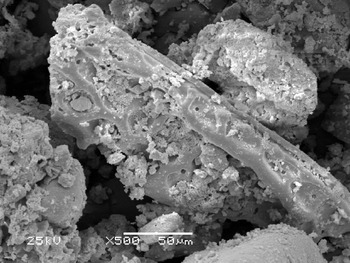
The total amount of carbon present in the sabkha sediment is considered to be an indirect measure of the extent of the microbial activity in these sediments. The TOC content of the sediment studied shows a wide range of organic enrichment (0.95%–12.07%), indicating an excellent productivity of organic matter (Fig. 4). Sulfur content is another indirect method of evaluating organics and its percentage in the samples varies from 0.09% to 4.39%, reflecting a higher marine input to the organic matter. Both carbon and sulfur in the studied sediments are closely related to the cyanobacterial mat, which is also rich in framboidal pyrite (FeS2). These spherical to sub-spherical aggregates of equidimensional pyrite crystals are a characteristic feature of the intertidal zone of the sabkha (Fig. 5). The association of pyrite with carbon and sulfur could provide a possible microbial link.
Large cellular wood fragment mixed with the carbonate sediments.

Cyanobacterial mat of the intertidal zone showing an underlying layer of black mud due to the presence of framboidal pyrite.

Algal pigments analysis has indicated that the identified carotenoids belong mostly to cyanobacteria, with the exception of lutein, which is generated from green algae or higher organisms. Lutein is present, however, in a low concentration, so the microbial population is composed mainly of cyanobacteria.
At the upper 0.0–2.5 cm of the core fraction, both unicellular and filamentous cyanobacteria were found to form a dense layer along with partially decomposed biomaterials. From the top 2.5–4.5 cm of the core, the remains of orange plasmodial slime moulds are found in association with highly decomposed organic matter belonging to cyanobacterial colonies. It is known that the plasmodial slime mould is a diaploid multinucleated, cytoplasmic mass enveloped by a slime sheath that creeps along phagocytizing decaying plant materials. At times that are unfavourable to growth, such as during dryness or desiccation, the plasmodium develops sporangia, which is a reproductive form that produces many spores resistant to dry condition. In contrast, under more favourable moist conditions, the spores germinate and fuse to produce a zygote that feeds on dead plant tissue to form a new plasmodium again. Below the top 5 cm of core to a depth of 50 cm, little remnants of the detritus material could be identified. No further signs of biological contents were detected below 75 cm of the examined cores.
The presence of the lutein pigment could be related to the presence of the mangrove trees (Avicenna marina), which is a characteristic feature of the upper intertidal zone of the sabkha area. The pneumatophores (the aerial roots) of the plant remain buried in sediments even after its death and its remains may be responsible for the presence of this biopigment.
Spectroscopic fingerprints
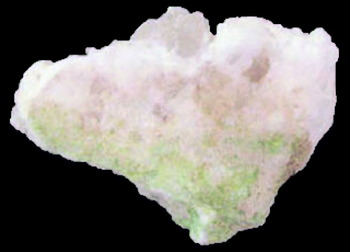
The same sediments have been studied hitherto using Raman spectroscopy (Edwards et al. Reference Edwards, Mohsin, Sadooni, Nik Hassan and Munshi2006; Howari Reference Howari2006). Three types of halotrophic extremophiles were identified in the sabkha samples, two of which are subsurface and the third is a surface benthic mat. One of the studied specimens showed the presence of carotenoids and chlorophyll in a biological zone at the interface between halite, gypsum and carbonate sediments. A surface cover of evaporitic minerals may be able to cover and protect some of the biosignatures in these sediments due to their low porosity (Fig. 6). Vreeland et al. (Reference Vreeland, Rosenzweig and Powers2000) reported the isolation of 250 million-year-old halotolerant bacterium from a primary salt crystal.
Large gypsum crystal in halite matrix with cream-colored sedimentary subsurface deposits containing a layer of a green cyanobacterial colony (after Edwards et al. Reference Edwards, Mohsin, Sadooni, Nik Hassan and Munshi2006).

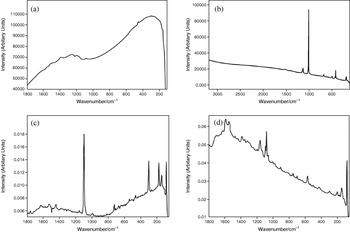
All three types of halotrophic extremophile identified in this study are closely associated with the sedimentary deposits containing magnesium and carbonate ions; the availability of the former for chlorophyll synthesis could be a factor in this, as would be the porosity of the carbonates for access of water and nutrients. Examples of the spectrographs of the identified extremophiles are shown in Fig. 7.
Raman spectroscopes of some of the extremophiles identified in the studied sediments. (a) Raman spectrum, in the 100–1800 cm−1 range, of the underside of a halite crust specimen, showing broad features between 1200 and 1500 cm−1 characteristic of chlorophyll and cyanolichen biochemical. (b) Underside of the subsurface gypsum crystal shown in Fig. 6 at the interface with sedimentary deposits, showing the presence of beta-carotene and hydromagnesite. (c) Green colony in the subsurface, showing the presence of dolomite, lutein and cyanolichen protective biochemical. (d) Raman spectrum, range 100–1800 cm−1, of the surface of the intertidal cyanobacterial mat, showing the presence of scytonemin, the ultraviolet-protective cyanobacterial pigment (compiled from Edwards et al. Reference Edwards, Mohsin, Sadooni, Nik Hassan and Munshi2006).

Macro microbial fingerprints
Cyanobacterial mats
Cyanobacterial mats are the most common visual feature of the sabkhas after the surface salt flats (Kendall & Skipwith Reference Kendall and Skipwith1968; Park Reference Park1977; Cardoso et al. Reference Cardoso, Watts, Maxwell, Goodfellow, Eglinton and Golubics1978) (Fig. 8). They are formed of a millimetre-thick alternation of dark organic materials with white cream carbonate sediments (hence they are called algal biscuit sometimes) and cover wide areas that extend to several square kilometres of the upper intertidal zone of the sabkha. Cyanobacteria are photoautorophic microorganisms that flourish on the interface between sediment and water (Noffke et al. Reference Noffke, Gerdes and Klenk2003). Cyanobacteria usually develop an adhesive mucilage biofilm that covers mineral grains in sediments, carbonates in this case, that provide protection to the microbes and represent a conduit for nutrient movement to the colony (Charaklis & Marshall Reference Charaklis and Marshall1990). These ‘mats’ are formed not only of cyanobacteria, but also of other microorganisms, such as heterotrophic bacteria, fungi and diatoms (Noffke et al. Reference Noffke, Gerdes and Klenk2003).
Regional view of the intertidal zone at low tide showing the cyanobacterial mats and mangrove trees on the horizon (inset: close up of the cyanobacterial mat).

Gas bubbles
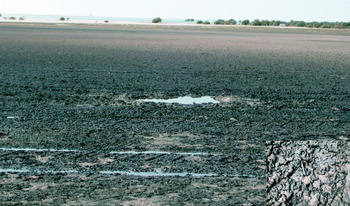
A common feature of the intertidal zone of the sabkha is the presence of gas bubbles and pockets. These are believed to result from the decay of organic materials at the upper part of the sediment. These gases would become entrapped and then push the soft sediment surface upward, forming these pockets (Fig. 9(a)). Most of these gases are probably methane and carbon dioxide. Furthermore, much of the sediment has high organic content and normally goes down as air cushion under the feet.
(a) Gas bubbles in the carbonate sediments of the intertidal zone generated from the decay of organic materials within the sediments. (b) foam of gas floating on the wet intertidal carbonate sediments.

The presence of clay and the high percentage of organic materials make these sediments elastic enough to accommodate the rising gases, while the presence of evaporates would bound the sediment grains quickly. When wet, the generated gas bubbles may coalesce together forming floating foam (Fig. 9(b)).
It is practically impossible to ascertain the origin of gases if recorded in Martian samples. In this case, the whole geologic and mineralogical association should be examined.
Microscopic microbial fingerprint
Many of the mineral assemblages of the sabkha, in particular the carbonates, bear the marks of active microbial activity during their formation. In order to investigate such footprints, several samples were examined under a SEM and also by X-Ray Diffraction in order to determine their exact mineralogy. The following is a short summary of the major microbial footprints that we managed to identify in these assemblages.
Boring
Many of the biological components in the sabkha sediments were bored and perforated. Boring surface expressions are normally rounded, but then they enlarge by further action by the microbes or by dissolution or combination of the two processes. The resultant tubes may be shallow and restricted to the upper surface layer, but in other cases they are deep and would collapse forming larger depressions, which sometimes are filled with a mesh of soft sediments or dolomite rhombs.
Chacón et al. (Reference Chacón, Berrendero and Garcia Pichel2006) studied the microbial signatures from marine carbonates in Puerto Rico, including cyanobacterial borings using a SEM, cultivation and molecular genetic techniques and this resulted in the documentation of an articulated borings with micritic envelopes. Barbieri et al. (Reference Barbieri, Stivaletta, Marinangeli and Ori2006) argued that these micritic envelopes may be preserved even if the boring features were degraded or eliminated and hence could be used as an indicator of microbial activity.
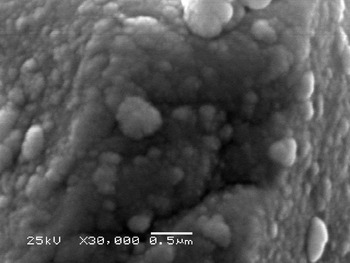
Pustular texture
Some of the dolomite and aragonite crystals examined under the SEM exhibited well-developed, rounded pumps on the surfaces of the dolomite rhombs and aragonite crystals (Fig. 10). In some cases, a macro version of this texture can be seen in the surface of the carbonate sediments of the sabkha. A similar texture has been described in the microbial Holocene carbonate sediments of Hainan Island, China, by Teng & Shen (Reference Teng and Shen2008).
A close-up of the pustular texture on the surface of a dolomite rhomb.

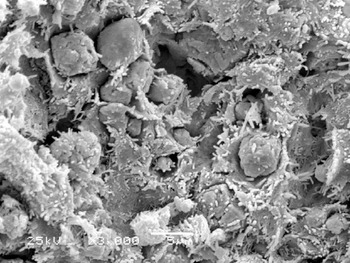
In some cases rod-like crystals of aragonite were precipitated around the sand grains. Some of these grains are resting in ‘nests’ formed of slime and probably clay minerals. Most of these textures are probably new and may need new names to describe them properly (Fig. 11).
Rod-like carbonate crystals covering the surface of clastic grains resting in nests made up of a mixture of slime and clay minerals.

Although different in appearance, both the nipple-texture and the rod-shaped crystals are probably formed by a similar microbial action, in which the sticky mucilage cover of the microbes attracts minute crystals of aragonite and calcite to form these features. As stated earlier, aragonite associated with cyanobacteria usually has isotopic signatures of heterotropic organisms.
Extraterrestrial implications
Recent data on the Meridiani Planum of Mars, reviewed earlier in this paper, revealed the existence of evaporite-rich clastics (McLennan et al. Reference McLennan2005; Squyres & Knoll Reference Squyres and Knoll2005). These clastics are believed to be the product of erosion and redeposition of fine siliciclastic materials. In the Endurance crater, a section of aeolian dunes and sand sheets more than seven metres thick was reported. The upper half metre of these deposits shows the presence of festoon cross lamination that may formed under subaqueous deposition, similar to a playa-like interdune setting (Grotzinger et al. Reference Grotzinger2006b). Silicates and sulfates are the dominating minerals in the outcrops, but with higher iron contents.
The area covering the coastal sabkhas of Abu Dhabi, United Arab Emirates, the sand dune fields of the Empty Quarter Desert in Saudi Arabia and the basaltic rocks of the Northern Oman Mountains represent a terrestrial geologic analogue capable of generating mineralogical and lithological products similar to a certain extent to those described from Mars (Fig. 12).
A regional satellite image of the region between UAE, Saudi Arabia and Oman, showing the main prevalent geologic processes and their products (base image courtesy of Google).

The coastal sabkhas of Abu Dhabi are formed of a supratidal zone in which halite, gypsum and anhydrite minerals are formed. The intertidal zone is characterized by a well-developed cyanobacterial mat with carbonate minerals, such as aragonite, calcite and dolomite. The sabkha is bordered by the sand fields of the Empty Quarter that receive sand generated from the action of wind and water on the basaltic mountains of Oman and that of the Arabian Shield along the Red Sea. In the middle of Fig. 12, it can be clearly seen that the brown aeolian sand is interfingering with the iron-rich dark sediments derived from the erosion of the Oman Mountains. These sediments are rich in quartz, iron, feldspar and other ferromagnesian minerals. Some of these minerals are transported by wind and mixed with the sabkha sediments of Abu Dhabi. The major clastic minerals present in the sabkha are quartz, plagioclase and, to a lesser extent, serpentine.
The present data indicate that the geologic setting of the coastal sabkha of Abu Dhabi with its bordering sand dunes and the basaltic Northern Oman Mountains to the east provide a reasonable geologic province in which the prevailing geologic processes may generate mineralogical assemblages similar to those reported from Mars.
In discussing the astrobiological implication of the sabkha as related to Mars, the whole sabkha regime should be considered. This regime can be characterized by three components:
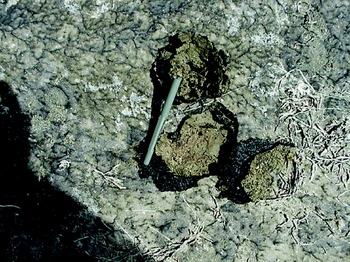
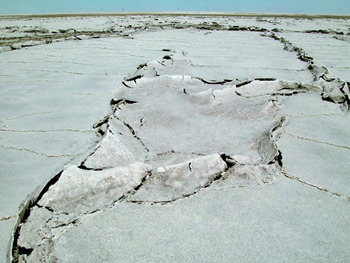
1. lithologic morphologies and structures, such as enterolithic and nodular anhydrite, large evaporite nodules, evaporite-cemented dunes, salt-encrusted mud-cracks (Fig. 13) and duricrusts features;
2. microbial morphologies, such as cyanobacterial mats, stromatolitic limestone (algal biscuit structure), algal filaments and boring;
3. mineralogical association, such as the co-existence of carbonate, evaporite and clastic minerals and framboidal pyrite.
Large, salt-encrusted mud cracks in the supratidal zone of the sabkha, which are a distinctive mega feature of the sabkha system.

Many of these features can be identified by the detection equipment being sent to Mars, including the Raman spectroscope. So even if the biosignatures of these sediments are degraded and no longer recognizable by our present-day equipment, the mega features can be recognized, and once some or all of them are found, then the microbial part of the regime may be inferred.
Conclusions
A multi-proxy study, including detailed petrographic, geochemical and spectroscopic analyses, was conducted on deep cores and surface sediments collected from the coastal sabkha of Abu Dhabi. The sediments studied are the result of a combined action of marine, fluvial, groundwater and aeolian processes. They are formed of admixture of carbonate minerals (calcite, dolomite and aragonite), evaporitic minerals (gypsum and anhydrite) with quartz, plagioclase and serpentine. The sediments also contain a considerable amount of microbial fingerprints, both macro and microscopic, such as cyanobacterial mats, gas bubbles, boring and nibble texture. In a regional context, the coastal sabkha of Abu Dhabi borders the sand fields of the Empty Quarter Desert of Saudi Arabia and extends to the basaltic Northern Oman Mountains. The resultant mineral assemblages, their microbial content and morphologic structures provide a suitable terrestrial analogue to those assemblages reported from Mars. These features are recognizable by the detection equipment used on Mars, including the Raman spectroscope.
Acknowledgements
This project is sponsored by the UAEU Research Council grant 201/203. The authors are grateful to Wajeh Kittana and Omer Al-Basheer, Geology Department, UAE University for their help with the field logistics and administrative work.