Introduction
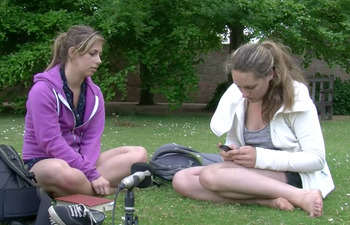
This article describes participants’ use of the English first person singular imperative let me/lemme X in everyday conversational interaction. The example below serves as a typical instance. In this casual interaction between friends, Beth is in the middle of composing a text message on her phone (Figure 1) when Amanda asks her a question. Transcript conventions follow Jefferson (Reference Jefferson2004) for hearable conduct. Pound/hash sign indicates the precise moment when a corresponding screenshot was taken, following Mondada's (Reference Mondada2016) conventions.

Beth composes text message.

Beth now has two relevant courses of action that she could pursue: composing her text message and/or engaging in talk-in-interaction. As a practical matter, these circumstances require some method of coordinating one course of action with the other (see Haddington, Keisanen, Mondada, & Nevile Reference Haddington, Keisanen, Mondada and Nevile2014). Beth could conceivably do both at the same time, texting and responding in parallel (Mondada Reference Mondada2014). She could also adjust the degree of her involvement in one such that the other may progress (Raymond & Lerner Reference Raymond and Lerner2014). Or, as it happens, she could prioritize engagement in one and displace taking up the other. Beth's reply—lemme finish texting this then we can talk about w(h)at I'm wearing—orients to the relevance of answering Amanda's question, but postpones that until after her current activity is finished. She treats the two activities as practically incompatible and places them into consecutive ordering (see Keisanen, Rauniomaa, & Haddington Reference Keisanen, Rauniomaa and Haddington2014). In this way she departs from what Amanda expected her to do in that sequential environment (i.e. answer her question), and instead self-authorizes (continued) engagement in another activity.
Studying cases of lemme X as it appears in episodes of naturally occurring social interactions, this article describes the construction in terms of the contextual particulars to which it orients and the uses to which it is ordinarily put. The analysis proceeds according to methods and principles from conversation analysis (e.g. Hoey & Kendrick Reference Hoey, Kendrick, de Groot and Hagoort2018) and interactional linguistics (Couper-Kuhlen & Selting Reference Couper-Kuhlen and Selting2018). Accordingly, I take lemme X as a social action format (Fox Reference Fox2007) that implements particular actions in particular sequential environments. The general aim is to describe lemme X by reference to the recurrent practical problems for which it has emerged as a solution (Schegloff Reference Schegloff, Enfield and Levinson2006). I argue that through lemme X speakers self-authorize some activity while displacing another relevant one, which regularly serves to advance the speaker's interests and initiatives.
The data used for this article are recordings of naturally occurring social interactions in English in ordinary and institutional settings. These were collected with the participants’ informed consent and all identifying information has been anonymized in the transcripts. The principal data were recordings of construction site activities collected by the author, select data archived in Talkbank (MacWhinney Reference MacWhinney, Beal, Corrigan and Moisl2007), and semicommunal ‘classic’ conversation analytic data (see Hoey & Raymond Reference Hoey, Raymond, Berez-Kroeker, McDonnell, Koller and Collister2021). Cases of lemme X were identified by text search of transcripts for ‘let me’ and ‘lemme’.Footnote 1 An initial thirty cases were collected from the construction site data. Close examination of these cases led to a preliminary analysis. This was then iteratively refined as additional cases were sought in other data sources to capture a maximum amount of variation in its use. This proceeded until apparent saturation was reached at around eighty cases, where no new uses were encountered. The resulting collection of over 100 cases forms the empirical basis of the analysis.
Background
Let me/lemme X is an imperatively formatted construction (Collins Reference Collins2004), but what kind of imperative is it? Prior work has characterized the construction as a permission directive (Ervin-Tripp Reference Ervin-Tripp1976), request for permission (West Reference West1990), and a request with the illocutionary force of a suggestion (Aijmer Reference Aijmer1996). In the only extended examination of let me to date, Kohnen (Reference Kohnen2004) specified politeness as the operative feature, arguing that it invokes a strategy of approval, which preserves the addressee's volition and orients to their negative face (Brown & Levinson Reference Brown and Levinson1987). The limited research done on the construction largely takes lemme X as a conventional indirect request (Culpeper & Archer Reference Culpeper, Archer, Jucker and Taavitsainen2008). And there certainly is evidence for seeing it this way. For example, in extract (2) lemme see that bar uttered by a construction worker to his colleague is clearly an object-transfer request.

The speaker recruits the recipientFootnote 2 to do something (pass him a tool) that advances his immediate interests (bending bars), which also advances the workers’ collective aims more globally (see Rossi Reference Rossi2012; Zinken & Deppermann Reference Zinken and Deppermann2017). This is done indirectly: not with a straightforward give me that bar, but with a construction that appeals to the recipient's power and willingness to bring about the speaker's seeing/possessing the bar.
In this instance let is used in the sense of ‘cause to happen’ and is thus hearably a request. But not all cases of lemme X are so clearly requests. For example, in the emergency call below, the caller uses let me see while verifying an address. This is not a request in the sense of getting someone to do something. The recipient takes no overt action, but merely waits as the speaker unilaterally engages in an autonomous activity.

Similarly, no request is observed in the ordinary phone call below. The caller's question is your mom around receives the response yes. lemme get her.

Lemme get her is not a request for action or even an ‘indirect’ request. It might be better characterized as an announcement of the speaker's departure, an account for his impending absence from the telephone, or perhaps a show of compliance with the request implicit in is yer mom around (see Fox Reference Fox2015). We could even think of it as an offer, insofar as he formally seeks permission to do something for the recipient.
For this article, I set aside instances such as lemme see that bar, where the construction unambiguously obliges the recipient to do some overt action. This restriction is taken partially because such request types are evidently rare (there were only three out of 100+ cases in my collection), but also because these request cases do not exhibit what is taken to be the notable sociolinguistic feature of lemme X. That is, with lemme X the speaker appears to solicit their recipient's consent while at the same time providing little latitude for them to resist. Permission is not quite sought but presumed. As Kohnen (Reference Kohnen2004:166) observed, this produces ‘an artificial situation of approval’. The question this article seeks to address, then, is what this presumption of permission is used to accomplish and how it works.
Research on the semantics of let is instructive here. As compared to similar verbs permit and allow, let differs in its force dynamics (Duffley Reference Duffley1992; Egan Reference Egan2008), or how it construes entities with respect to force (Talmy Reference Talmy1988). Let prototypically encodes non-imposition of some action and, when the reference is to past time, implies that it actually occurred (she let the motorcade pass by). By contrast, permit/allow tend to encode barrier-removal and, when referring to past time, remain agnostic about the actual occurrence of an action (we adjourned the meeting to allow people to use the bathroom). These findings are consistent with the extracts above, where lemme X refers to activities that are either already underway (lemme finish texting this) or incipiently emerging (let me see, lemme get her). That is, the speaker is already committed to, if not currently undertaking, their lemme X activity. Such a construal of events precludes the possibility of asking for permission to proceed, and instead through let the speaker directs the recipient to support or not impede the nominated activity.
While this semantic account of let specifies its prototypical force dynamics, it remains silent regarding the contextual particulars that condition the appropriate use of the construction, and says virtually nothing about the actual uses to which the construction is put. A more action-centered account of this kind was provided by Schegloff (Reference Schegloff1980), who analyzed phrases like let me ask you this and I wanna ask you something as forms of ‘action projection’, as given below.

Speaker B's use of I wanna ask you something projects a question, but what comes next is not a question. Rather, they produce an informing (I wrote a letter t'the governer…), and only thereafter does their question arrive (Will I get an answer d'you think). Action projection routinely serves to first establish the grounds for producing the projected action, which is contingent on how the recipient responds to the action projection turn. Through action projection, speakers mark what they are doing (here, the informing) as preliminary to a projected action.
Schegloff's (Reference Schegloff1980) analysis of lemme X as a form of action projection has much to recommend it. However, as the extracts above show, lemme X is not always preliminary to a speaker's action-to-come, and the occurrence of that projected action is not always contingent on the recipient's response. Lemme finish texting this refers to an ongoing rather than projected activity, for example, and the departure that accompanies lemme get her is unilaterally done rather than done with permission. The discrepancies between this short array of examples and the range of specimens analyzed in Schegloff (Reference Schegloff1980) likely emerges from the kinds of verbs appearing in the lemme X construction. Namely, Schegloff's analysis was restricted to verbs of communication like ask, tell, and suggest. By contrast, extracts (1)–(4) involve verbs of practical embodied action—finish texting (manipulate), see (inspect), and get (retrieve). The analysis in this article therefore builds on Schegloff's influential account by expanding beyond instances of lemme X with verbs of communication.
This article also contributes to studies of requests, imperatives, and related directive actions in social interaction (e.g. Couper-Kuhlen Reference Couper-Kuhlen2014; Drew & Couper-Kuhlen Reference Drew and Couper-Kuhlen2014; Sorjonen, Raevaara, & Couper-Kuhlen Reference Sorjonen, Raevaara and Couper-Kuhlen2017). Prior work on naturally occurring interactions has produced a picture of imperatives as ‘the language of immediate action’ (Auer Reference Auer2017). Imperatives characteristically display relatively strong deontic authority (Stevanovic Reference Stevanovic2018); they embody a claim of entitlement to issue a directive in a particular situation (Heinemann Reference Heinemann2006), orient to few contingencies that would affect the success or grantability of a request (Curl & Drew Reference Curl and Drew2008), and do not project noncompliance (Craven & Potter Reference Craven and Potter2010). Lemme X shares these characteristics, but differs from other imperative formats in the greater agency apportioned to the speaker in its use.
Agency refers to the degree to which an actor displays flexibility and accountability in their action (Kockelman Reference Kockelman2007; Enfield Reference Enfield2013). Flexibility is understood as the capacity to decide to undertake some action, design it, and anticipate its likely interpretations and subsequent effects. Its counterpart is accountability: the actor's entitlement, duty, or ownership regarding the action undertaken—in other words, the degree to which their rights and obligations to do the action may be invoked. To put it in Goffmanian (Reference Goffman1981) terms, the actor's agency corresponds to the extent to which they are the action's animator (physically producing the action), author (choosing how it is done), and principal (committed to, responsible for its doing). For instance, impersonal deontic declaratives of the type ‘it is necessary to X’ systematically leave the identity of the animator unspecified, thereby providing for the interactional negotiation of this aspect of agency (Rossi & Zinken Reference Rossi and Zinken2016). The use of lemme X, as I hope to show, distributes more agency to the speaker in that they are seen to be the self-same animator, author, and principal of their action.
The remainder of the article proceeds as follows. I first build on Schegloff's (Reference Schegloff1980) analysis of action projection by showing how speakers recurrently use lemme X as a way to displace some action in favor of the nominated, self-authorized one. I then detail how such self-authorized actions routinely serve to advance the speaker's interests and initiatives. In the final analytic section, I give an account for the presumption of permission that lemme X embodies. The article concludes with a discussion of the findings in relation to matters of agency and autonomous action.
Analysis
In this section, I examine three aspects of the lemme X construction, starting with the operation that it conducts on talk, specifically how it displaces what a recipient may expect of or project for a speaker.
Lemme X displaces recipient's projections of speaker's actions
Participants as a matter of course make projections of others’ actions and reciprocally expect others to do the same. They actively form expectations about likely trajectories of action for a given sequential environment. Projection operates at various levels of structural organization and with varying degrees of specificity as to what is projected. There are local projections at the level of words, phrases, turns, and sequences, to more global projections at the level of trajectories of action and overall organization of activities (Sacks, Schegloff, & Jefferson Reference Sacks, Schegloff and Jefferson1974; Schegloff Reference Schegloff, Ochs, Schegloff and Thompson1996; Robinson Reference Robinson, Sidnell and Stivers2013). With lemme X, the recipient's projections of the speaker's actions are displaced in favor of the nominated, or self-authorized, action. At the level of turn-construction (Schegloff Reference Schegloff, Ochs, Schegloff and Thompson1996), we saw in extract (3) how let me see was used to displace progressive movement toward turn-completion. And at the level of sequence (Schegloff Reference Fox2007), we saw in extract (1) (reproduced as extract (6)) how lemme X was used to displace the production of an answer to a question.

Beth is in the middle of composing a text message—specifically, a response to a mutual friend on behalf of both of them—when Amanda asks whatta you gonna wear tonight. Her question makes conditionally relevant an answer in next position; it projects that action to appear in that place (Schegloff & Sacks Reference Schegloff and Sacks1973; Schegloff Reference Fox2007). This known-in-common expectation provides a basis for seeing how that answer gets displaced. Instead of a response, what appears is lemme finish texting this. Beth displaces answering, the action that was expectably relevant in that environment, in favor of continuing and completing her in-progress action.
Rather than self-authorizing the continuation of an in-progress action, lemme X can prepare a place for a new action. In the casual telephone conversation below, Marsha produces an invitation, which projects in next position an acceptance or declination from Ron.

What Ron does next is neither an acceptance nor declination, however. After some delay,Footnote 3 he responds with lemme look at my thing. I know I have an engagem'n Tue:sdee er Wednesday, after which he is heard paging through his agenda. Ron thus displaces what is normatively expected of him in that sequential environment and instead attends to the practical preconditions for responding.
These extracts show how lemme X operates in the context of adjacency pairs, where a sequence-initiating action obliges the recipient to produce a responsive action selected from a limited range of relevant next actions (Schegloff & Sacks Reference Schegloff and Sacks1973). The projective potential of a sequence-initiating action lies in its control over what actions may relevantly appear next. We can depart from the firm grounds of the adjacency pair organization and its tight coupling between initiating and responding actions to see how lemme X operates in other sequential contexts.
In contrast to the prior cases, where a turn-at-talk projected a specific responsive action, in the case below it is the recipient's bodily action that implicates a next action from the speaker. Two construction workers (Ryan and Chuy) have been patching holes in a tarp on the ground. As Ryan is working in one spot (lines 1–3), Chuy finishes patching his section and approaches the area where Ryan is (line 3).

Chuy's movement embodies his progression to the next-spot-to-patch. What this projects or implicates is that Ryan should move out of the way so that Chuy can access that spot. So for Ryan there are now two relevant activities: finishing his current task and moving out of Chuy's way. As with extract (6), Ryan prioritizes his activity-in-progress and displaces engagement in the competing activity. So while Chuy did not explicitly request that Ryan move, his physical approach was treated as implicating that all the same.
Participants may use lemme X to self-authorize some activity that is situated at the level of overall structural organization of the whole episode of interaction (see Robinson Reference Robinson, Sidnell and Stivers2013). The extract below shows the beginning phases of the call. It begins with a compact summons-answer, greetings, and recognition phase (lines 1–3) followed by the how-are-you phase (lines 4–15).

After the how-are-you phase, the caller ordinarily has the opportunity to produce a reason-for-the-call or a first topic (Schegloff Reference Schegloff1986). In this extract Hunt is the caller, but as we see, it is the called party, Colson, who speaks in this environment. After coming to possible turn completion with yuh (line 15; Schegloff Reference Schegloff, Ochs, Schegloff and Thompson1996), turn-transition becomes relevant (Sacks et al. Reference Sacks, Schegloff and Jefferson1974). But Colson does not cede the turn-space. He instead projects turn-continuation with a swift audible inbreath in the transition space of his turn. This orients to the misplacement of his turn-to-come; it treats that slot as ‘belonging’ to Hunt, the called party. This is also seen in the design of his turn-continuation. His new turn-constructional unit (TCU) begins with lemme uh:m ih-: lumme, through which he creates a space to ‘get in’ some activity. He then backs up to insert (Schegloff Reference Schegloff, Hayashi, Raymond and Sidnell2013) before you say anything as a new turn beginning. This explicitly acknowledges Hunt's right to begin speaking in that position. It also sets up a contrast with the activity that he self-authorizes: lemme say a couple a'things (line 19).
Compared to the prior cases, where the lemme X turn was responsive to some perceptible action by the recipient (a turn-at-talk, a bodily movement), in this case the speaker is not orienting to anything the recipient did. Rather, lemme say a couple a'things orients to mutually shared expectations around how call openings are normatively organized. It trades on shared understandings of who speaks when, or a projectable ordering of speakership. This shows that lemme X may displace not only specific actions that are projected to occur (like a response to a question) but also those that are projectably relevant or expectable in the overall organization of an activity.Footnote 4
The cases analyzed in this section demonstrate how lemme X orients to what the recipient had projected for or expected of the speaker. The construction was shown operating at various levels of structural organization (turn, sequence, and overall structure), for both verbal actions and bodily ones, and for both the continuation of an in-progress activity and the initiation of a new one. These extracts also illuminate how lemme self-authorizes actions. By acknowledging the relevance of taking up the projected action, but forgoing it in favor of another one, speakers may be seen as acting against wishes or expectations of the recipient.
This subsection showed how lemme X was used to displace one action in favor of another. The next subsection addresses what regularly gets done with such a displacement operation.
Lemme X regularly prioritizes the speaker's interests and initiatives
A fair range of the most common uses of lemme X have already been seen. It is regularly used to momentarily suspend a turn-at-talk (extract (3)), delay an upcoming response (extract (7)), announce a departure from interaction (extract (4)), and forestall recipient action (extract (9)). What these appear to have in common is that they allow the speaker to insert some autonomous action. As a structural outcome of this, lemme X is biased towards prioritizing the speaker's interests and initiatives. And commonly (though not invariably), this prioritization is done at the expense of the recipient's projected course of action. We see this in the doctor-patient interaction below, which starts as the doctor asks what brings you in here today.

In response, the patient first offers a gloss on the nature of his problem (my back) and then begins to elaborate on this with I uh (line 2). But before the patient has finished his elaboration, the doctor asks back pain? (line 3). This is heard by the patient as prematurely moving onto another phase of the interaction, which would displace the relevance of his not-yet-finished elaboration. The patient responds to the doctor's question affirmatively, then reasserts his agenda with lemme tell you what ha:ppened (line 4). With this he projects a multi-unit turn, securing for himself adequate space to proceed with his elaboration. In this way the patient advances his own interests over the doctor's.Footnote 5
The next case also features lemme tell you. But rather than serving to reassert the speaker's agenda, it advances their perspective during a heated argument. The background for this exchange is that Mom and her teenage daughter Kendra had been arguing in the car on their way back home. Mom accused Kendra of lying about staying the night with a friend and has decided to ground her as punishment. Kendra fiercely resists both the accusation and the punishment. We join the interaction during a break in their argument as they arrive home and transition from car to house. The transcript begins as Mom informs Dad, who was not in the car, that she and Kendra got in another F:ight, which she says as she walks away to go t'the ba:throom (lines 1–3). (The parallel activity here—the Sister informing others that she's starting the dishwasher—is not analyzed.)

Though there had been a break in their argument, it is reinvoked when Mom informs Dad of another F:ight. As Mom walks to the bathroom, Kendra declares with conviction Lemme tell you r:ight now,<I did nOT spend the night (lines 6–7). With this Kendra advances the validity of her own perspective against that of her Mom. She formulates her action as an informing (lemme tell you), but of course this would not be new information for Mom, who couldn't help but know her daughter's position in their argument. It is also likely that she is presenting this as news for Dad as well, as a kind of preemptive defense or even as an invitation to align with her against Mom. By formulating it in this way, Kendra treats the matter as still up for debate. It reflexively locates her and Mom as ‘still arguing’, the upshot of which is that it allows Kendra to resist and potentially relitigate the punishment that her Mom has decided on.
As these extracts show, the prioritization of the speaker's self-authorized action may also complementarily dismiss or demote the recipient's interests or initiatives. However, this is not always the case. As seen earlier, the self-authorized action may be done in service of something projected or made relevant by the recipient, or in service of some shared project that participants are committed to on a more global level (e.g. Rossi Reference Rossi2012; Zinken & Ogiermann Reference Zinken, Deppermann and Ogiermann2013; Clayman & Heritage Reference Clayman, Heritage, Drew and Couper-Kuhlen2014; Couper-Kuhlen Reference Couper-Kuhlen2014; Zinken & Deppermann Reference Zinken and Deppermann2017). In extract (7), lemme look at my thing self-authorizes an action that is recognizably on the way to responding to the recipient's invitation, thus arguably serving their interests. And in extract (8), the construction workers’ shared task of patching up the tarp is advanced by lemme cover up this hole in this fucker when viewed from a global perspective.
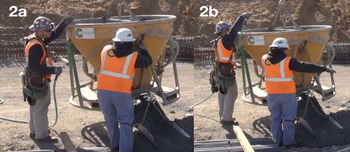
How can we reconcile the fact that lemme X may serve the interests and aims of either the speaker or recipient? Note that while lemme X does displace some action, it does not necessarily reduce the importance or relevance of that action. It produces a serial relationship between the two actions, which may but need not be taken as disfavoring the displaced action. The self-authorized action is in principle independent from the displaced action. This is seen in the following extract. Ryan and Chuy, the same workers as above, are about to start rinsing the cement out of a large ‘bucket’ (Figure 2). We join the interaction as Chuy manipulates a chain on the side of the bucket as Ryan looks on (Figure 2a). It iss apparently unclear what Chuy is doing this for, as Ryan asks y'tryna undo the chain altogether? (line 2).

Chuy manipulates chain on side of bucket (2a). Ryan sprays inside of bucket as Chuy points to where bucket should be moved (2b).

After a repair sequence (lines 3–6; Schegloff Reference Schegloff2007), Chuy explicates his actions by pointing to a concrete pile off to the side (Figure 2b). With this he suggests that they move the bucket over there (line 11). His suggestion is not heard, however—Ryan had already started spraying the bucket (line 10, Figure 2b)—and so Ryan initiates repair with WHAT? (line 15). His repair initiation indicates that he doesn't know what Chuy is summoning him for. All that he knows is that he's being summoned, which would take him away from his current activity. Chuy begins to produce a repair solution, but is interrupted by Ryan, who enters with Idunno<lemme wash this shit off the sides and then uh (line 17–19). By not waiting for Chuy's repair solution to be completed, Ryan shows his absolute priortization of his current activity over the alternative proposed by Chuy. He self-authorizes his continuation of spraying the bucket and displaces some unknown activity that Chuy is proposing.
The prioritization of the speaker's interests and initiatives, then, emerges structurally. Though lemme X sometimes serves the recipient's interests or furthers some shared aim, because it provides a place for the speaker to do some action rather than one made relevant by the recipient, it is structurally biased towards prioritizing the speaker's prerogatives and perspectives. This kind of prioritization has been described, in the context of political debates, as ‘asserting dominance and power’ (Schubert Reference Schubert2019). However, we might respecify dominance and power in terms of agency (Enfield Reference Enfield2013). With lemme X, speakers proceed unilaterally with their action, which they presume the recipient will also go along with. In terms of agentive flexibility, they control the occurrence and design of their self-authorized action, and are able to anticipate how it will be understood and treated. In terms of agentive accountability, the speaker will be seen as displacing some action in favor of the self-authorized one, and in this respect they may be held responsible for not doing what was projectably relevant in that sequential environment.
The unilateral agency exhibited through the use of lemme X has been the focus of this subsection. The final aspect of lemme X to be examined concerns the presumption of permission that such a stance embodies. I turn to this aspect next.
Self-authorized actions are treated as urgent and minimally imposing
An interesting feature of lemme X, as already noted, is that the speaker formally seeks the recipient's approval or permission, while at the same time presumes that approval to be given. This presumptuousness requires an account. Why should a recipient advance the speaker's prerogatives or entertain their perspectives, and how can a speaker presume that the recipient would do so? Part of this, for some situations (e.g. extracts (6), (7), (8), (12)), is certainly participants’ preexisting commitment to a joint project (Rossi Reference Rossi2012). Examples abound, however, of cases where lemme X does not contribute to any larger shared aim—indeed, the antagonistic exchanges in extracts (10)–(11) show participants with conflicting aims. Apart from cases featuring commitment to a joint engagement, I suggest that speakers’ presumption of permission is underpinned by treating their self-authorized action as urgent and minimally imposing on the recipient.
Urgency
Speakers can justify the self-authorization of their activity by treating it as urgent (see Mondada Reference Mondada2017). One practice for doing ‘urgency’ is the very inappositeness that lemme X indexes through its placement. By doing some action despite it being ill-fitted for the location where it appears, speakers can reflexively exhibit that action as needing to be done then and there. This was seen in extract (9) (reproduced as extract (13)), where the called-party projects turn-continuation with a sharp inbreath (line 16) despite the next turn ‘belonging’ to the caller in that environment.

We also saw this in extract (11), partially reproduced as extract (14).

The local sequential context does not provide for Kendra's lemme turn in that there is no place for it in the current participatory configuration. There are two exchanges: one between Mom and Dad (lines 1–3) and another between Mom and the Sister (line 5). Kendra is not a ratified participant in either of these participant frameworks (Goodwin & Goodwin Reference Goodwin, Goodwin and Duranti2004) and so she must work to get in her turn. This configuration is all the more unsuitable for Kendra to address Mom seeing as Mom just announced her departure for the bathroom and began walking away, thereby projecting unavailability as a recipient (see Broth & Mondada Reference Broth and Mondada2013). Moreover, when Kendra does begin speaking, she arrives in interruptive overlap with her Sister's turn (lines 5–6), thus disregarding her Sister's right to one full TCU (Sacks et al. Reference Sacks, Schegloff and Jefferson1974). In such a context, the placement of Kendra's self-authorized action can be seen as urgent precisely because of the factors disfavoring its occurrence.
Aside from their placement, the design of a lemme X turn can also indicate urgency. This can be done with explicit reference to an action's timing or sequential placement. The inclusion of temporal adverbial phrases such as before you say anything (extract (13)) or r:ight now (extract (14)) emphasize the importance of getting in the lemme action at that very moment. Another way that turns are designed to show urgency is through the omission or underspecification of grammatical arguments. Grammatically, let me projects a verb phrase complement, but components of that may be left out, leaving instead silences or disfluencies. In extracts (15)–(16), lemme turn this fuh- and lemme pull out my are both grammatically incomplete clauses (though pragmatically adequate; see Ford & Thompson Reference Ford, Thompson, Ochs, Schegloff and Thompson1996).

In these cases, Edna was projectably on the way to saying something like lemme turn this fan off, and Mark something like lemme pull out my notes. By projecting these components but not articulating them, the speakers treat those words as not needing to be said, and treat the recipient as not needing to hear them. What is treated as more immediately relevant is the work done by lemme itself. This is perhaps most evident in cases where speakers use lemme without any verb phrase at all. Below, Lottie retreats slightly from the telephone receiver to retrieve an object, accounting for her departure only with lemme (.) uh: (.) lemme.

In these instances of underspecification and omission, speakers orient to the relative importance of doing their self-authorized action at that very moment over fully articulating or accounting for that undertaking. They do not merely say lemme but enact the suspension of ongoing action.
Minimal imposition
Self-authorized actions are also regularly portrayed as minimally imposing on recipients. Imposition can be seen as part of the range of ‘contingencies’ that impede the fulfillment of a request (Curl & Drew Reference Curl and Drew2008). This can account for the presumption of permission embodied by lemme X insofar as recipients remain unhindered when they go along with the speaker's self-authorized activity. The preservation of the addressee's freedom or volition (i.e. their negative face) was a key component of Kohnen's (Reference Kohnen2004) analysis, where lemme X was grounded in politeness (Brown & Levinson Reference Brown and Levinson1987). The extracts below support this account by showing how lemme X turns are designed and treated as minimally imposing.
Speakers can design their lemme X turns in ways that portray the action as negligibly invasive. For example, they may include minimizing tokens like real quick, a sec(ond), and just quickly, as in the examples below (cf. Zinken & Deppermann Reference Zinken and Deppermann2017).

We also see minimization in the very acoustic production of the turn itself. Speakers’ vocal practices for downgrading the occurrence of their speech include producing it quickly (extract (21)) or quietly (extract (22)). These departures from the pacing and modal phonation of talk so far let speakers iconically minimize the departure that their talk embodies.

Additional evidence for this association comes from recipient's responses. With lemme X, the recipient is directed to permit the occurrence of the nominated activity. What it usually implicates for the recipient is waiting or suspending an activity until the speaker's self-authorized action is complete. We can see this in the regular co-occurrence of lemme X with suspension directives like wait and hang on (see Keisanen et al. Reference Keisanen, Rauniomaa and Haddington2014; Licoppe & Tuncer Reference Licoppe and Tuncer2014).

In terms of the division of labor (e.g. Couper-Kuhlen & Etelämäki Reference Couper-Kuhlen, Etelämäki, Drew and Couper-Kuhlen2014), the speaker usually undertakes some action while the recipient simply waits. So what is being asked of recipients is generally some undemanding or ‘low cost’ (Bolden Reference Bolden2017) contribution. And indeed, this is often what happens, as in extract (1), reproduced and expanded as extract (26).

After Beth self-authorizes texting this (line 4), Amanda's response is to sit idly. The silence that follows (line 6) embodies the absence of resistance, and she is seen doing ‘being idle’ in her nonsense self-talk (line 7) and her stretching and looking around (line 8).
However, there are circumstances in which instructing the recipient to wait is not justified or not ‘low cost’. For example, there may be time sensitive situations where waiting may result in negative consequences, as seen in extract 12, reproduced as extract (27). Here, Ryan has started spraying the inside of the concrete bucket (line 9), despite the fact that his coworker Chuy had summoned him to do something else. Ryan self-authorizes his activity and delays taking up whatever Chuy was asking of him (lines 18–19). What is relevant for Chuy to do is wait for Ryan to finish spraying.

Even though waiting is often low cost, here Chuy resists being asked to do so. During the silence in line 20, Chuy looks down to the ground, where he sees that Ryan's spraying of the bucket is producing an accumulation of concrete runoff. He then looks to a pile of rebar nearby, evidently making a visual calculation of the risk of the runoff coming into contact with the rebar. Seeing this risk, he points out that there's a little bit a con- u::h rebar (line 21). He is proposing that they move the bucket in the direction that he indicated in line 8. Chuy's invocation of the rebar is apparently sufficient to communicate this proposal. Ryan responds with a candidate formulation oh y'wanna- y'wanna go over there a little bit?, which Chuy confirms (lines 23–24).
Under the normative operation of lemme X, the speaker justifiably presumes the recipient's permission in undertaking their self-authorized action. This case deviates from this pattern in that the recipient treats that presumption as unjustified. Chuy resists being asked to wait because there was in fact a time sensitive contingency, the concrete runoff potentially getting on and damaging other construction materials.
The presumption of permission embodied by the use of lemme X can be accounted for in part by participants’ orientations to urgency and minimal imposition (among other factors, like joint commitment). For if the action nominated by lemme must be done ‘now’, and if it does not unduly infringe on the recipient's agency, then speakers have some basis for assuming consent would be given, and recipients similarly have some basis for going along with the speaker's interests and initiatives.
Discussion
To summarize, this article has offered an account of the English first person singular imperative construction, lemme X, based on evidence from participants’ orientations to its use in a range of naturally occurring social interactions. It systematically described across several sequential contexts how lemme X provides a place for some nominated action by displacing what the recipient had projected or expected to occur there. Through this displacement operation, a speaker self-authorizes the undertaking of their action or the pursuit of their interests, often over those of the recipient. It was argued that the presumption of permission that lemme X embodies is largely explained by orientations to the urgency of the self-authorized action and, complementarily, the minimal imposition that that action has on the recipient.
The picture that emerges from the analysis of lemme X is one in which a speaker is apportioned relatively more agency (Kockelman Reference Kockelman2007) in proceeding with their nominated activity as compared to other imperative constructions. The distribution of agency through lemme X may be seen in the very formatting of the construction. With lemme X, the speaker is given special distinction and formal expression (first person singular me), while the recipient is cast in a supporting role. The speaker inhabits an agentively prominent role as compared to the diminished presence of the recipient. Similarly, the use of the verb let plays a part. As noted in the introduction, the force dynamics of let ordinarily assign passive nonimposition to the recipient rather than active barrier removal (Egan Reference Egan2008). Thus it apportions to the speaker greater agency in terms of which party undertakes the action and thereby controls it.
The speaker's agency is also expressed in the actual selection of some verb X. Lemme X is among the class of devices through which speakers formulate a description of their own conduct. It is a way for speakers to characterize what they are doing and thus how they would like their conduct to be understood and treated (see Robinson Reference Robinson2016; Sidnell Reference Sidnell2017). Because the construction provides speakers with a first opportunity to establish for the record what is transpiring, the use of lemme X amounts to an exercise in accountability. For example, in extract (8) the speaker's turn let me cover up this hole in this fucker serves both as description of his current conduct and an explanation for not moving out of the recipient's way. Absent such a characterization, the recipient could justifiably account for the speaker's conduct as, for instance, ‘he doesn't see me’ or, more uncharitably, ‘he's being uncooperative’. Speakers display not only their right, ability, and/or obligation to advance their self-authorized activity, but also their accountability for its occurrence and for whatever consequences emerge.
Use of lemme X can reveal a speaker's understandings of the distribution of agency for their particular nominated activity (see Enfield Reference Enfield2013). As a method for getting someone to do something, lemme X usually works to inhibit rather than induce recipient action while the speaker unilaterally pursues their activity. In this respect, the construction seems suited for the pursuit of relatively autonomous actions rather than those requiring close coordination. Activities like composing a text message (extract (1)) or checking one's schedule (extract (7)), for example, typically involve action by the speaker alone. While these sorts of activities can under some circumstances permit recipient activity, with lemme X speakers treat them as affording autonomous action.
These observations suggest that lemme X is an alternative to directives that provide for greater recipient involvement. We can compare it, for example, to a second person imperative, for which the recipient is granted greater agency. Commanding someone to do something cedes to them the ability to decide whether to do it and, if so, how it will be done. This is not so in self-authorizing an action, where the speaker controls the occurrence and composition of their action. We might also compare lemme X to the ‘proposals’ and ‘suggestions’ implemented through the first person plural imperative let's X (see Xiang & Liu Reference Xiang and Liu2018). These have been described as more egalitarian because the participants reach an agreement about doing something together, and both parties carry out and benefit from the nominated action (Couper-Kuhlen Reference Couper-Kuhlen2014). In contrast, lemme X appears less egalitarian. For while it treats the recipient as able to resist (see extract (27)), it does not provide an express location for them to do so. Finally, lemme X may also be seen as an alternative to presequences, which are customarily used to establish the preconditions for a forthcoming action (Schegloff Reference Schegloff2007). With lemme X, by contrast, speakers bypass establishing those preconditions (cf. Fox Reference Fox2015; Rossi Reference Rossi2015) and thereby disregard the possibility of encountering an impediment. This is consistent with semantic analyses of let, according to which letting something happen implicates its actual occurrence (Duffley Reference Duffley1992).
As part of the ‘language of immediate action’ (Auer Reference Auer2017), the first person singular imperative stands out in how it apportions agency, ceding relatively little to others as the speaker unilaterally undertakes their self-authorized action. This contributes to studies of imperatives and related constructions (e.g. Drew & Couper-Kuhlen Reference Drew and Couper-Kuhlen2014; Sorjonen et al. Reference Sorjonen, Raevaara and Couper-Kuhlen2017) an interactionally based, action-centric account of a particular construction, and a demonstration of participants’ orientation to the partitioning of action—that is, whether the action favors autonomous effort or close collaboration.