1. Introduction
Many major members of the World Trade Organization (WTO) use antidumping, safeguards, and anti-subsidy (countervailing) instruments to maintain trade openness and compliance with their other commitments. These trade remedies are at the heart of what came to ail the WTO.
In 2019, the Trump administration ended the WTO dispute settlement system because of American discontent with how 20 years of WTO litigation curtailed US access to trade remedies. As a result, no WTO commitments of any kind – not just trade remedies – by any member were subject to binding dispute settlement any longer.
Repairing trade remedies faces many challenges. This paper identifies them and describes tradeoffs associated with potential negotiated solutions.
Section 2 examines data on the use of trade remedies under the WTO. It shows first that the United States is not the only country with a vested interest in maintaining access to trade remedies. Between 1995 and 2019, more than 45 WTO members initiated roughly 7,000 investigations and imposed over 4,300 trade restrictions through a complex array of often substitutable policy instruments. Second, it is tempting to highlight ‘China’ as the organizing principle around reform efforts. In 2019, trade remedies covered more than 7% of China's exports to the Group of 20 (G-20), and the figure is rising. To the United States, more use of trade remedies is the equilibrium result of an increased supply of problematic behavior – e.g., industrial policy, pervasive state-owned enterprises, subsidies leading to overcapacity in key sectors – that threatens its national security. Yet the data also reveal that exporters other than China have increasingly found themselves adversely affected by trade remedies the European Union, India, and many others – in addition to the United States – use to address imports from China.
Section 3 provides a second set of stylized facts confirming that the WTO dispute settlement process disproportionately challenged the use of trade remedies by the United States. Changing trade remedy rules would thus seemingly need to balance importing countries’ access to policy flexibility against exporters’ market access rights, all the while allowing for a mutually acceptable means of resolving the future trade frictions that will inevitably arise.
Section 4 examines potential solutions. It begins with a framework through which to view what problems trade agreements – and trade remedies – are designed to solve. It then considers different proposals to change trade remedy rules as well as tradeoffs associated with each. It also highlights the lack of consensus on what it is about China that its trading partners find problematic and that should thus guide reform. Section 5 concludes with additional concerns.
2. Use of Trade Remedies Under the WTO
The WTO's agreements on antidumping, subsidies and countervailing measures, and safeguards describe its current rules on trade remedies.Footnote 1 These agreements expand on Articles VI and XIX of the original 1947 General Agreement on Tariffs and Trade (GATT).
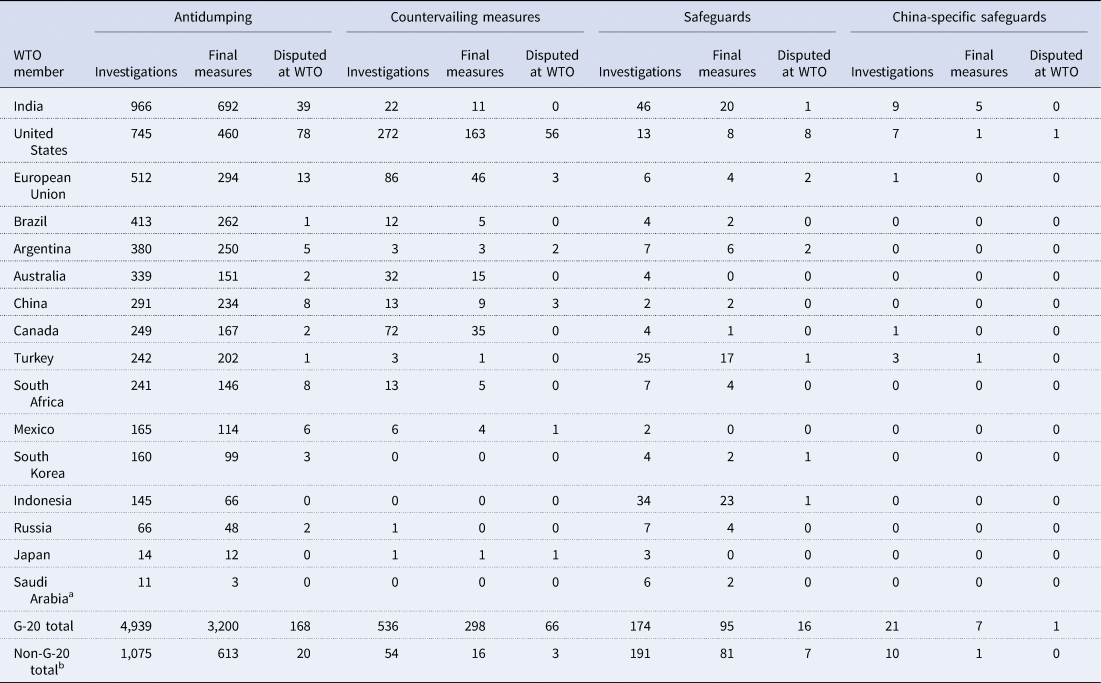
In the final years of the GATT, the United States, the European Union, Canada, and Australia were the main users of trade remedies. Since establishment of the WTO, in 1995, more than 45 other members have also used them, including other members of the G-20 (Table 1).
Total number of investigations, final measures, and WTO disputes over antidumping, countervailing measures, and safeguards in 1995–2019, by G-20 economy

Note: Figures do not include the application of trade remedies by current EU member states before they joined the European Union
Source: Author, based on Bown et al. (Reference Bown, Cieszkowsky, Erbahar and Signoret2020).
a The Gulf Cooperation Council (Bahrain, Kuwait, Oman, Qatar, Saudi Arabia, and the United Arab Emirates) adopt trade remedy decisions jointly.
b See Appendix Table A1.
2.1 Trade Remedy-Using Economies and Affected Exporters
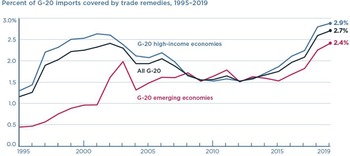
One way to understand the potential economic importance of trade remedies is to consider their trade coverage. By the end of 2019, G-20 use of trade remedies was the highest it had been since the WTO was created, in 1995 (Figure 1).Footnote 2 These levels are expected to grow in response to the subsidies and new protection associated with the COVID-19 pandemic and the economic recession that began in 2020.
Import coverage of trade remedies was higher in 2019 than ever before
Note: Trade remedies include antidumping, countervailing duties, and safeguards. Saudi Arabia is omitted because its data were not available. Data do not capture the US–China trade war tariffs, the US steel and aluminum (national security) tariffs, or the counter-tariffs imposed in retaliation in 2018–2019.
Source: Author. Based on data from Bown et al. (Reference Bown, Cieszkowsky, Erbahar and Signoret2020) and UN Comtrade.

What this trend means is not clear. There is no consensus as to whether even 3% of imports covered by trade remedies was too much, too little, or just right. Trade remedies may have been becoming an increasingly worrisome form of protection (after all, they can reduce the market access implied by a country's tariff commitments). Yet it is also possible that the use of trade remedies was actually helpful rather than harmful. Given that most other tariffs remained low and trade was kept open, such flexibility may have prevented more trade-restrictive outcomes. A third alternative is that coverage was below the optimal level. A further argument is that excessively low levels were caused by the WTO's overly aggressive constraints, which pushed demands for import protection into policy instruments that were even more problematic, such as the Trump administration's ‘national security’ and ‘trade war’ (with China) tariffs beginning in 2018.
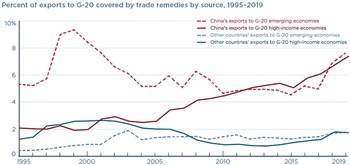
The view from the exporter perspective raised different puzzles. China certainly has been the major target of trade remedies since its WTO accession, in 2001 (Figure 2). By 2019, for example, more than 7% of China's exports to the G-20 were subject to foreign-imposed trade remedies – and the figure was rising.
Trade remedies increasingly targeted China's exports between 1995 and 2019
Note: Trade remedies include antidumping, countervailing duties, and safeguards. Saudi Arabia is omitted because its data were not available. Data do not capture the US–China trade war tariffs, the US steel and aluminum (national security) tariffs, or the counter-tariffs imposed in retaliation in 2018–2019.
Source: Author. Based on data from Bown et al. (Reference Bown, Cieszkowsky, Erbahar and Signoret2020) and UN Comtrade.

Why the coverage continued to increase was unclear. Was it reflective of more Chinese dumping, more subsidies, and larger export surges? Or was it that China, with its low-cost, low-priced sales, had become a larger exporter, putting competitive pressure on an ever-larger share of import-competing industries in other countries? What trading partners found worrisome about China remained ill-defined, increasingly unmoored from legal elements of the WTO agreements on trade remedies as well as empirical evidence.
Figure 2 also reveals a second and less-appreciated change in trade remedy use: the rising share of other countries’ exports subject to trade remedies. Although still low relative to the share of Chinese exporters, the share of exports from other countries sent to high-income countries that were subject to trade remedies was more than twice as high in 2019 as it had been only five years earlier.
2.2 China Workarounds for Existing WTO Members
China's accession to the WTO was a special case. WTO members granted themselves multiple additional forms of trade remedy flexibility to address both the expected increase in imports from China and its unique economic system.
WTO members could use a transitional safeguard to address imports from China alone. The safeguard also contained a ‘trade deflection’ clause designed to ease use by a second country as soon as a first had imposed protection (Bown and Crowley, Reference Bown and Crowley2010). Perhaps surprisingly, the transitional safeguard was rarely invoked during its 12 years of authorization (see Table 1). One high-profile example was the US safeguard on Chinese tires in 2009, which was swiftly met with Chinese retaliation against US exports (more below).
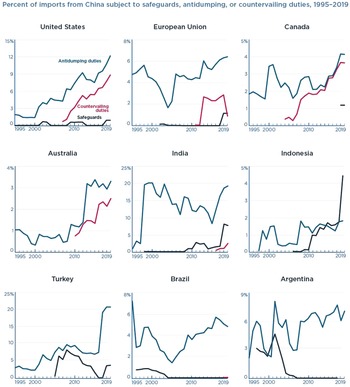
Beyond retaliation fears, WTO members did not use the transitional safeguard because they had access to other policies (Figure 3). China's status as a non–market economy made antidumping duties easy to apply, because it allowed investigating authorities to rely on data from third countries for evidence of dumping. Some countries also turned to countervailing duties. The United States, for example, reversed a 1980s decision not to investigate petitions over imports from communist countries under its anti-subsidy law and began to consider cases against China in late 2006 (Department of Commerce, 2006a, 2006b, 2007). The Department of Commerce decided that Chinese state-owned enterprises (SOEs) would henceforth be treated as ‘public bodies’ and be able to provide subsidies to other private companies, meaning that a state-owned bank, energy company, or other input provider could grant subsidies by charging below-market prices to downstream Chinese firms. WTO members could also use the regular safeguards provisions to restrict imports from China, with the caveat that the restrictions would have to be applied on a Most Favored Nation (MFN) basis to third-country exporters as well.
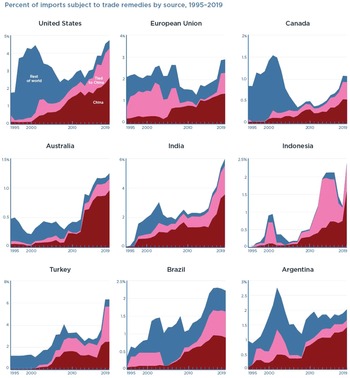
Many G-20 economies use a combination of trade remedies to target imports from China
Source: Author. Based on data from Bown et al. (Reference Bown, Cieszkowsky, Erbahar and Signoret2020) and UN Comtrade.

Any reform to trade remedies must thus also acknowledge the substitutability of policy instruments, as WTO members are already applying a combination of safeguards, antidumping and countervailing duties on imports from China. In the United States, for example, more than 10% of imports from China were covered by antidumping, more than 8% were covered by CVDs, and roughly 1% by safeguards in 2019.Footnote 3 The European Union, Australia, and Canada similarly relied mainly on antidumping and CVDs. India and Turkey focused on antidumping, which covered roughly 20% of each country's imports from China by the end of 2019, and, to a lesser extent, safeguards. In contrast, by 2019 Indonesia's safeguards covered more imports from China than its antidumping measures did. Brazil and Argentina were relying almost exclusively on antidumping.
2.3 Exporters other than China and Trade Remedies Targeting China
Another implication for reform is that trade remedies imposed on China are increasingly extended to also cover trade in the same products from third-country exporters (Figure 4). In the United States, for example, nearly 80% of the imports from third countries covered by its trade remedies in 2019 were in products tied to trade remedy cases targeting China. The figure was more than 80% for trade remedies imposed by India, Turkey, and Indonesia, and more than 60% for trade remedies imposed by the European Union, Canada, and Australia.
Third-country exporters are increasingly caught up in trade remedies targeting China
Note: Trade remedies include antidumping, countervailing duties, and safeguards. Tied to China refers to products from other countries subject to trade remedies that simultaneously or earlier targeted China's exports.
Source: Author. Based on data from Bown et al. (Reference Bown, Cieszkowsky, Erbahar and Signoret2020) and UN Comtrade.

Trump administration policy actions provide examples. Despite having largely stopped direct Chinese imports through the trade remedies it applied earlier to solar panels, washing machines, steel, and aluminum, the United States extended protection on each of these products to third countries beginning in 2018. Figure 4 includes the third-country exports affected by US safeguards on solar panels and washing machines, for example. However, because the additional US protections of steel and aluminum were imposed under the ‘national security threat’ law of Section 232 of the Trade Expansion Act of 1962, Figure 4 provides only an underestimate of this phenomenon. (Figure 4 also omits the separate US trade war tariff actions on imports from China imposed under Section 301 of the Trade Act of 1974.)
Trade remedies also target imports from third countries with links back to China in ways not included in Figure 4. One is applying tariffs to imports that are made from subsidized inputs imported from China.Footnote 4 For example, the United States has used the ‘particular market situation’ to claim that China's subsidization of hot rolled steel implicitly subsidized downstream South Korean processed steel manufactures.Footnote 5 The European Commission imposed trade remedies on imports of glass fiber from Egypt manufactured by subsidiaries of Chinese firms allegedly benefiting from subsidies from Beijing.Footnote 6 The United States has similar legislation under consideration.Footnote 7
2.4 China's Own Use of Trade Remedies
Beginning in the late 1990s, China relied on antidumping, mostly to protect its chemicals industry. Over their second decade of use, China's trade remedies proved increasingly controversial, with Beijing using them as retaliation or as a tool of economic coercion.
In 2008, China opened an antidumping investigation of EU steel fasteners, attempting to influence the European Union's final determination in a case over the same product less than a month later (Bown and Mavroidis, Reference Bown and Mavroidis2013). When the United States imposed a transitional safeguard on imports of Chinese tires in 2009, Beijing immediately responded with antidumping on US chicken feet and car exports.Footnote 8 In response to the United States initiating a WTO dispute over Chinese policies toward green technologies in 2010, China used antidumping against US exports of dried distiller grains. Though subsequently overshadowed by the US–China trade war, US safeguard tariffs on solar panels and washing machines in February 2018 were quickly met with the imposition of antidumping on US sorghum exports.Footnote 9
China's trade remedies – targeting US exports, for example – became economically important for a time; by 2011, antidumping covered roughly 8% of US exports to China (Bown, Reference Bown2021). China's use of remedies became so serious that it prompted the United States to challenge them with formal WTO disputes – some of the few instances in which the United States brought cases against any country's trade remedy use (more on this below). China's use of trade remedies then fell off considerably, covering less than 4% of imports from the United States by 2020. With the US–China trade conflict beginning in 2018, China turned to other policy instruments to retaliate against the United States. On sorghum, for example, China removed its antidumping duties in 2018 and imposed its retaliatory tariffs as part of the trade war.
There is an additional concern that China sees trade remedies as one more tool to use to signal displeasure with other, noneconomic policies. For example, it brought antidumping cases against Australian barley and wine after Canberra called for an independent investigation into the origins of COVID-19.Footnote 10 Trade remedies would build on a variety of other policy tools of economic coercion China has used historically.Footnote 11 In 2010, China restricted exports of rare earths after a territorial dispute with Japan.Footnote 12 Norway's salmon exports to China suddenly suffered after the Nobel Peace Prize was awarded to Liu Xiaobo, an imprisoned Chinese dissident, in 2010.Footnote 13 Banana exporters from the Philippines were subject to Chinese trade restrictions after a 2012 skirmish between the two countries in contested waters around the Scarborough Shoal.Footnote 14 In 2017, Beijing cut access to tourist packages and encouraged a boycott of South Korean products in response to Seoul's agreement to deploy a US missile system.Footnote 15 China banned canola imports from Canada in early 2019 after Canada arrested a Huawei executive, at the behest of the United States, for alleged sanctions violations.Footnote 16 It encouraged boycotts of European and other Western brands in 2021 when clothing companies refused to source cotton from Xinjiang over concerns about forced labor.Footnote 17 In the recent flareup with Australia, China deployed other policies targeting Australian exports of coal and beef.
3. Trade Remedies, Uruguay Round Negotiators, and the WTO's Appellate Body
The modern system of trade remedies is partially the result of reforms taking place after the GATT's Uruguay Round of negotiations (Bown, Reference Bown2002). Paired with the new system of binding dispute settlement, the changes that resulted contributed to the WTO paralysis that began in 2019.
Negotiators sought to make the use of safeguards more appealing, given the growing problem of voluntary export restraints (VERs). In the 1970s and 1980s, exports from Japan and other new entrants put adjustment pressure on established suppliers in the United States, Europe, and other markets; managed trade was often the negotiated result. The WTO's new Agreement on Safeguards prohibited VERs and also changed the rules so that it no longer required compensation to adversely affected trading partners for the first three years after trade barriers were imposed. This change was designed to encourage WTO members to use safeguards instead of VERs.
In the antidumping negotiations, countries like Japan and South Korea were increasingly concerned about US antidumping hitting their exporters and sought to tighten disciplines. Their approach included attempts to limit US use of ‘zeroing’, a technique used in assessing price data that replaced instances in which imports are not dumped with zeroes and that thus biases otherwise mechanical calculations to find more evidence of dumping. Trading partners wanted this practice stopped, the United States wanted it retained; the negotiating fudge was to neither ban it nor condone it, letting both sides believe they had won (Kim and Ahn, Reference Kim and Ahn2018).
Trade negotiations often feature such compromise. The problem with leaving the text vague this time arose from a third major Uruguay Round reform – the fact that the WTO would include a binding dispute settlement system that the GATT did not. US negotiators attempted to protect their use of antidumping from WTO litigation by including Article 17.6 in the Antidumping Agreement. This provision stated that WTO dispute settlement should show deference to domestic authorities in trade remedy investigations.
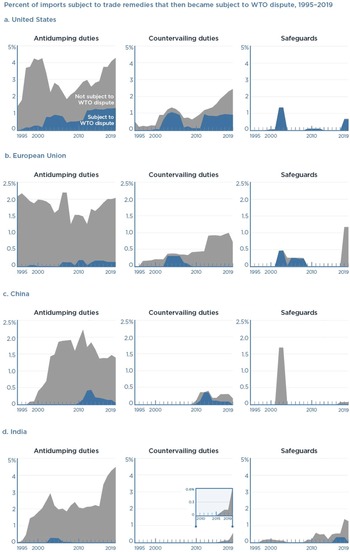
Almost immediately after the WTO went into effect, US use of safeguards, antidumping, and countervailing duties were legally challenged (Figure 5). The WTO's new Appellate Body showed little deference to the United States, ruling against almost every US trade remedy it adjudicated. Every safeguard was challenged. By 2006, more than a third of US imports covered by antidumping duties were caught up in WTO disputes. For countervailing duties, the figure was over 80%.
US trade remedies faced more scrutiny than those imposed by other WTO members
Source: Author. Based on data from Bown et al. (Reference Bown, Cieszkowsky, Erbahar and Signoret2020) and UN Comtrade.

US discontent worsened as rulings accumulated during the Bush and Obama administrations. When the Trump administration arrived, it refused to allow new appointments to the WTO's Appellate Body. Without new Appellate Body members to replace those whose terms expired, the WTO's system of binding dispute settlement ended in 2019. WTO rulings against US trade remedies were a major reason for this (Bown and Keynes, Reference Bown and Keynes2020).Footnote 18
Early WTO litigation did not involve China; more recent cases against US trade remedies did. One of the more controversial disputes resulted in the WTO ruling against the US designation of a Chinese SOE as a possible ‘public body’, with potential for broad impact on US use of countervailing duties (Ahn, Reference Ahn2021). In 2016, China also challenged its continued treatment as a non–market economy in antidumping investigations by the United States and the European Union. China ultimately dropped both disputes – the one filed against the European Union reportedly after seeing a privileged view of the panel report.Footnote 19 The dispute against the United States – as well as other ongoing litigation against US trade remedies imposed on Chinese exports – was overtaken by the scale of tariffs and counter-tariffs of the US–China trade war.
Overall, WTO dispute settlement disproportionately targeted US trade remedies (see Figure 5).Footnote 20 The US arguments to date, though, have not been that other countries’ trade remedy use should have been disciplined more. Indeed, with the exception of disputes challenging China's trade remedies (which were used as a retaliatory tool), the United States has rarely brought such cases. And there is certainly no independent evidence to suggest that it refrained from bringing cases because other countries’ trade remedies were any more in line with the WTO agreements than those of the United States.
4. Toward Trade Remedy Reform
As the experience after implementing the Uruguay Round reforms made clear, any change to rules governing one trade remedy will likely affect the use of others as well as the enforceability of other WTO agreements. Trade remedy reform thus has to be considered in a broader context.
Scholars understand the WTO as helping to solve the prisoner's dilemma problem, which results when large countries impose beggar-thy-neighbor policies – such as tariffs – on one another (Bagwell and Staiger, Reference Bagwell and Staiger1999, Reference Bagwell and Staiger2002).Footnote 21 Multilateral rounds of reciprocal negotiations have resulted in countries lowering those tariffs; members have then bound them and committed to other WTO disciplines to protect the market access implied by those bindings. From that perspective, the limited and temporary use of trade remedies can maintain cooperation more broadly – providing, for example, more of the market access implied by those commitments – when shocks create incentives to impose new import protection.Footnote 22
Yet scholars have had less success understanding the specific (and important) legal details of the WTO agreements over trade remedies than of why some sort of policy flexibility exists. The exact evidentiary criterion defining dumping as international price discrimination or pricing below average total costs has confounded economists for decades, for example.Footnote 23 The Agreement on Subsidies and Countervailing Measures has some provisions that seem to go too far – constraining subsidies that may address market failures or externalities, for example – and others that may not go far enough.Footnote 24 Even defining the appropriate use of safeguards – a trade remedy that permits temporary and nondiscriminatory protection from imports without needing to provide (inevitably dubious) evidence of anything unfair – has proven difficult.Footnote 25
Ideally, trade remedy reform would define and tackle the underlying problem that existing rules are unable to address without eroding the value of other WTO agreements. The revelation that trade remedies are now used primarily to address imports from China is, of course, suggestive of where the underlying problem rests. However, policymakers have yet to clarify the specific concerns with China and thus what trade remedy reform should attempt to fix.
From an economic perspective, one potential concern is if China's non-market economic system creates an excessively concentrated environment over the long run. Once activity has concentrated sufficiently within China, for example, Beijing could use policy to exert market power and harm consumers or using industries in other countries. In general, concentration is riskier when it arises in a state-driven economy relative to market economies, where policymakers have a harder time coordinating the actions of private firms. Furthermore, there is evidence that China has restricted exports when it has market power and used its policies as tools of economic coercion.
Another potential concern with China (and other economies with large SOE sectors) could arise if these economies add to the already considerable adjustment costs facing workers, companies, and local communities in market economies.Footnote 26 Suppose, for example, a global demand shock is expected to negatively affect firms and workers everywhere proportionately. If workers and SOEs are less responsive to such shocks in state-centric economies such as China – that is, workers do not need to be laid off and production does not need to be scaled back – then a larger share of the adjustment burden will fall on workers in market economies.
In light of the data and these concerns, the following subsections describe potential approaches to reform. Some involve adding new rules to the existing legal structure of trade remedies. Others are more radical, taking the view that if the existing WTO agreements are already problematic, then it may make sense to start over. One important question for each proposal is whether it adequately tackles the underlying problem with the Chinese economic model that motivated the need for reform in the first place.
4.1 More Legal Precision on Subsidies
One approach involves writing ever-more detailed rules on permissible and impermissible subsidies, an attempt to try to ‘complete’ the (incomplete) WTO contract. In January 2020, the ‘trilateral’ combination of the United States, the European Union, and Japan proposed expanding the list of prohibited subsidies, adding subsidies that ‘distort capacity’ to the list that cause ‘serious prejudice’, shifting the burden of proof onto subsidizing countries to show that their subsidies are doing no harm, and more (see Bown and Hillman, Reference Bown and Hillman2019).Footnote 27
There are many difficulties with attempts to write harmful subsidies out of existence. One challenge is getting very different economic systems to first agree on the definition of a subsidy and then to agree to an exhaustive list. The Organisation for Economic Co-operation and Development (OECD) reports on the aluminum (OECD, 2019a) and semiconductor (OECD, 2019b) value chains highlight some of the problems of such an approach. Substantial Chinese subsidies arise in ways that WTO rules would find difficult to capture, ranging from below-market provision of debt or equity to subsidized energy to export restrictions and manipulation of value-added tax rebates on upstream inputs subsidizing downstream manufacturers.
Such an approach also risks perpetuating recognized problems. China is already accused of failing to notify its subsidies to the WTO. Without additional ways of enforcing transparency, banning even more subsidies is likely only to exacerbate the notifications challenge.
This approach could also introduce new problems. For example, as there is no objective definition of ‘excess capacity’, it is not clear exactly what it means to ‘distort’ capacity. Surely the US subsidies to manufacturers of personal protective equipment and COVID-19 vaccines in 2020 distorted capacity in those industries, but such subsidies arguably represent economic policies that WTO rules should encourage countries to undertake. Similar to mis-equating predatory dumping with international price discrimination or pricing below short-run average costs, creating dubious legal constructs could result in both not adequately capturing the ‘harm’ WTO members should be worried about and discouraging otherwise desirable policies.
Furthermore, attempting to identify all of the subsidies arising from the ‘China, Inc.’ model may be futile (Wu, Reference Wu2016, Reference Wu2020). In response to any newly detailed rules on behavior, the Chinese system may endogenously respond to implement the effects of the banned subsidies through creative policies that do not technically violate those behavioral rules.
A final issue involves enforcement. Trade remedies would address only subsidies resulting in excessive imports, without affecting subsidies to China's exports to third markets or those impacting China's own imports. The result could be more of the same: China's exports to third markets reduce global prices, the US, EU, and other countries increase imports from third countries, and third country exporters get targeted with trade remedies even if they did not subsidize (see Figure 4).
Beyond trade remedies, an alternative enforcement model is that of the European Union. The European Commission has supranational authority to investigate and discipline industrial subsidies (‘state aid’) granted by member states. It would be a significant shift in the model for WTO members to grant such powers to a supranational body such as the WTO Secretariat.
Alternative forms of state-to-state enforcement – such as those that already exist under the WTO – would likely run into the same problems as arose under WTO dispute settlement. For a variety of reasons, including the threat of extra–WTO retaliation and acts of economic coercion, WTO members other than the United States (and even some industries within the United States) were extremely wary of filing disputes against China (Bown and Keynes, Reference Bown and Keynes2020).
4.2 Competitive Neutrality
An approach to the challenge of a subset of China's subsidies – those resulting from SOEs – is to adopt and enforce principles on competitive neutrality (OECD, 2015; Lardy, Reference Lardy, Kai and Schipke2019a; García-Herrero and Ng, Reference García-Herrero and Ng2021). The basic idea is to create a metric to hold SOEs accountable by defining and then netting-out their noncommercial objectives and then subjecting their performance (e.g., returns on investment) to the standards facing similar private firms in the economy.
Relying on competitive neutrality would pose numerous challenges. One is that a within-China comparison of SOEs and non–SOEs may have limited utility. Within the Chinese economy, other subsidies and industrial policy pressures distort outcomes for both SOEs and private firms in the same sector, necessitating reliance on external benchmarks. Yet China would then likely be concerned that policymakers would have discretion over which surrogate countries or input providers to use, just as they do in antidumping calculations for countries with non-market economy status. Furthermore, there is not always a ‘real-world’ alternative to China – proxies with similar access to transport infrastructure and agglomeration externalities – to provide an appropriate external benchmark.
Relying on competitive neutrality may also suffer from the enforcement problem. In Europe, for example, the European Commission enforces SOE disciplines on member states through its rules on state aid. In other (smaller) market economies with SOEs, like Australia, enforcement may be done by other private actors within the economy. Yet trading partners are unlikely to accept Chinese self-enforcement of competitive neutrality principles given the possibility of its actions imposing international externalities, given its size.
4.3 Focusing on Market Access Rather than Subsidies
At the other extreme, rather than worry about the subsidy – and all of the troubles defining it ex ante, making sure countries notify it, identifying it when they do not, and then measuring it – reform efforts could focus explicitly on market access outcome. Sykes (Reference Sykes, Appleton, Macrory and Plummer2005) has broadly suggested such an approach for subsidies disciplines. Reference StaigerStaiger (forthcoming) has applied it more broadly to the challenges posed by China's economic system.Footnote 28
Consider how focusing on market access outcomes would work. Market economy members of the WTO have agreed to tariff bindings and disciplines on each other's policies that together imply a level of market access (exports and imports). With non–market economy members of the WTO, market economies could instead contract directly over market access. Trade remedies would then be part of the toolkit to use when non–market economies take actions that create major deviations from those market access promises. Reference StaigerStaiger (forthcoming) makes the additional argument that China could find such an approach attractive if it also meant that trading partners stopped meddling in its internal (domestic) policies, its SOEs, its industrial policy plans, etc.
Such an approach is intellectually appealing, but it, too, faces numerous practical challenges. One is that it would require converting the WTO's traditional focus on monitoring policies – e.g., tariffs and subsidies, which have always implicitly defined market access – to explicit commitments over exact amounts of trade,Footnote 29 effectively resulting in ‘managing trade’ with non–market economies. Furthermore, the approach would not solve the real-world problem that shocks external to China can also affect trade volumes. Any analysis into whether China was living up to its market access commitments – not exporting too much or importing too little – would also need to control for other shocks to demand and supply. In a multi-country world, managed trade would need to be established and monitored for every Chinese trading partner. Such a system would not be free of power asymmetries. China would be tempted to meet purchase commitments from (and limit exports to) the more powerful partners, such as the United States or the European Union, at the expense of smaller partners with lesser capacity to retaliate.
5. Conclusion
Trade remedies have become a big enough problem for the WTO that something needs to be done. Reform needs to address concerns about China in a rules-based way in order to restore some form of dispute settlement to the WTO agreements. Yet all of the proposed approaches have imperfections.
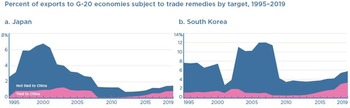
Is it possible that Chinese exports might become less targeted by foreign trade remedies without reform? The need for trade remedies could decline, for example, if China became more market-oriented – something that seems less and less likely (Lardy, Reference Lardy2019b) – or if China's export mix evolved to compete less with industries in trade remedy-using economies. Japan and South Korea, for example, are no longer the primary targets of trade remedies that they were in the 1980s and 1990s (Figure 6). Although not well-studied, the cause is certainly more than the ‘benefit’ of China coming along as a bigger target. Indeed, these countries’ exports of similar products have recently been caught up again in cases involving China.
Japanese and South Korean exports have become less targeted by trade remedies over time
Note: Trade remedies include antidumping, countervailing duties, and safeguards. Tied to China refers to products from other countries subject to trade remedies that simultaneously or earlier targeted China's exports.
Source: Author. Based on data from Bown et al. (Reference Bown, Cieszkowsky, Erbahar and Signoret2020) and UN Comtrade.

To conclude, two points affecting reform efforts are worth reiterating. By design, these data end in 2019, the point at which the WTO's Appellate Body stopped functioning. The devastating disruptions of the COVID-19 pandemic, as well as the fiscal and industrial policies to emerge in the period since, have changed the landscape. More countries beyond China are now subsidizing and using industrial policy. It is too early to tell whether this trend will create additional demand for disciplines or change negotiating positions in the other direction.
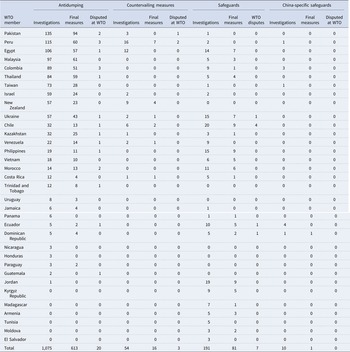
Finally, many WTO members have become users of trade remedies, complicating the reform process (see Appendix Table 1). Interestingly, some nonmembers of the G-20 – including many emerging economies and developing countries – have become greater users of safeguards than most G-20 members. Any tweaks to the WTO rules on trade remedies are likely to affect their use by dozens and dozens of countries.
Appendix A
Total number of investigations, final measures, and WTO disputes over antidumping, countervailing measures, and safeguards in 1995–2019, by non-G-20 economy