INTRODUCTION
Maize (Zea mays L.) is the major staple crop in Timor-Leste but average yields are low at 1·0–1·7 t/ha (FAO 2013) and losses in storage are high, leading to food insecurity. Key problems are the low yield potential of local maize populations and post-harvest damage from the maize weevil (Sitophilus zeamais Motschulsky). Estimates of maize grain damage from weevils in storage in Timor-Leste vary from an average loss of 0·13 reported in a recent baseline survey (SoL 2012a ) up to 0·45 (Guterres & Williams Reference Guterres and Williams2006).
The maize weevil is present in all warm tropical areas of the world and is considered the most damaging storage pest of maize in the tropics (Kim & Kossou Reference Kim and Kossou2003). Storage losses of 0·20 to 0·90 from weevil attack have been reported for untreated maize in Southern and Eastern Africa (De Lima Reference De Lima1987; Giga et al. Reference Giga, Mutemererwa, Moyo and Neeley1991; Mutiro et al. Reference Mutiro, Giga and Chetsanga1992; Mboya Reference Mboya2013). In several African countries (Benin, Cameroon, Ghana, Kenya, Malawi and Nigeria) it has been reported that under traditional methods of storage many of the new high-yielding maize varieties, which lack weevil resistance characteristics, result in major storage losses – summarized in Kossou et al. (Reference Kossou, Mareck and Bosque-Pérez1993). Genetic variation in resistance to the maize weevil has been reported among Mexican landraces, Tanzanian open-pollinated and both tropical and temperate inbred varieties (Kim et al. Reference Kim, Brewbaker and Hallauer1988; Tipping et al. Reference Tipping, Legg, Rodriguez and Poneleit1988; Arnason et al. Reference Arnason, Baum, Gale, Lambert, Bergvinson, Philogene, Serratos, Mihm and Jewell1994; Derera et al. Reference Derera, Pixley and Giga1999). The most commonly reported resistance factor is kernel hardness (Eden Reference Eden1952a ; Dobie Reference Dobie1974); while variation and inheritance of several other grain characteristics and biochemical markers for resistance have been studied (Tipping et al. Reference Tipping, Legg, Rodriguez and Poneleit1988; García-Lara et al. Reference García-Lara, Bergvinson, Burt, Ramputh, Díaz-Pontones and Arnason2004, Reference García-Lara, Khairallah, Vargas and Bergvinson2009, Reference García-Lara, Burt, Arnason and Bergvinson2010). Screening was facilitated with the use of Dobie's (Reference Dobie1974) index of susceptibility based on shelled kernels. Given the differing mechanisms of resistance, it is no surprise that the inheritance of resistance to maize weevil is complex, involving both additive and non-additive gene actions (Derera et al. Reference Derera, Pixley and Giga1999; Dhliwayo & Pixley Reference Dhliwayo and Pixley2003). But the screening of shelled grain for resistance is of limited relevance to regions where farmers store the crop in husks, which are known to be protective against weevil attack in both the field and the store (Kossou et al. Reference Kossou, Mareck and Bosque-Pérez1993) and where pesticides are unavailable. The value of a good husk cover in reducing weevil damage in maize has long been recognized (Eden Reference Eden1952b ). Long husks extending beyond the cob tip and husk tightness at the tip are both required for resistance (Brewbaker & Kim Reference Brewbaker and Kim1979).
In Timor-Leste a considerable variety of post-harvest storage systems can be found (Guterres & Williams Reference Guterres and Williams2006) with the majority of maize cobs stored un-threshed in the husk. The husk can contain 10–20 leaves surrounding the cob. A recent survey found that when maize is stored in the husk, it is normally stored in an elevated dry area, such as above a fireplace (0·58 of households), hanging in a tree (0·26 of households) or in an elevated house to minimize weevil damage and reduce rodent attack (SoL 2012a ). Less than 0·15 of households used improved airtight storage methods such as silos or fuel drums in 2011 (SoL 2012a ). In locations where farmers regularly store shelled maize in sealed drums, they combine airtight storage in second-hand 200-litre fuel drums with the use of recently introduced high yielding maize varieties (Guterres & Williams Reference Guterres and Williams2006). Such varieties come from the introduction and initial evaluation on-station of a range of maize germplasm (Gonzalez Ceniceros et al. Reference Gonzalez Ceniceros, Palmer, Piggin, San Valentin, Tilman De Sa Benevides, De Oliveira, da Costa, Piggin, Fox and da Cruz2003) and its subsequent participatory assessment in over 1000 on-farm trials across all six agro-ecological zones of Timor-Leste from 2005/06 to 2008/09 (Williams et al. Reference Williams, Borges, Lacoste, Andersen, Nesbitt and Johansen2012). The varieties Suwan 5 and Sele showed increases in mean annual yield ranging from 36 to 54% over local varieties. Clearly the current low national maize yields can be increased by the use of improved maize varieties.
With the overarching aim of guiding agronomic research and storage management for improved food security in Timor-Leste, the present study was designed specifically to estimate weevil damage to maize stored on-farm, and to gauge the relative importance of and interactions among the effects of variety, location and storage method. Component 1 was a comparison of household storage method on local and introduced maize using participatory methodology. In Component 2 the weevil damage in stored grain among maize populations (local and introduced) of two separate multi-location varietal trials was assessed.
MATERIALS AND METHODS
Component 1: weevil damage in local and improved maize using different on-farm storage methods
This participatory research involved 18 farmer groups in three regions (Loes, Maubara and Remexio) of Timor-Leste testing a range of storage methods with local and introduced maize varieties for 33 weeks after harvest. The regions were selected to cover a range of agro-ecological environments and maize production systems on the north coast, which was specifically targeted because of the long dry season during which maize must be stored. On the north coast, maize grows for 4–5 months and is stored and consumed for the remainder of the year. The regions were Loes in Liquiça district with most sites at 10–20 m a.s.l., the area around and inland from Maubara in Liquiça district with sites from c. 200–700 m a.s.l., and the area around Remexio in Aileu district with sites at c. 800 m a.s.l.
The fieldwork was conducted with a farming family at the locations of 18 previously established farmer groups and started around harvest time at the end of the wet season in April 2004 and ended around the time of planting the next crop at the start of the next wet season. Project staff visited each field site once every 3 weeks (a total of 11 visits per location) during the period. At each site a maize storage experiment was conducted, which ran for 33 weeks, from 1 April to 16 November 2004. In the experiment, the staff worked with farmers to track and record the storage qualities of local and modern maize varieties. One storage experiment was established at each site and included local maize varieties and local storage methods. Prior to conducting the experiment, farmers were asked about the varieties that they grew the previous year and their method of storage. An experiment was then designed that included recently grown maize varieties and the normal method of storage. The typical experiment consisted of six treatments: Two varieties stored by three different methods. Each variety/treatment combination was replicated twice. Thus, there were 12 experimental units at each site. Maize used for the experiment was purchased from farmers at the start of the experiment, and the farmers kept the stored maize away from rodent attack. Each lot of maize consisted of 50 cobs, equivalent to c. 2 kg of grain. Identifying marks were made on the different maize varieties, so that they could be recognized throughout the trial. The maize was dried with the traditional method of sun-drying for c. 3 days and shelled by hand.
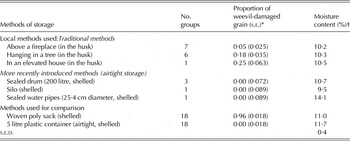
Across all sites, three traditional methods were tested: hanging in a tree, storage above a fireplace and storage in an elevated house. Maize stored using these traditional methods was stored in the husk. Several groups used more recently introduced methods, all of which were examples of airtight storage, and these were also tested: storage in a second-hand fuel drum (with a capacity of 200 l), storage in a silo and storage in sealed 25·4 cm-diameter water pipes. For storage in the sealed containers, the grain was first shelled. At each site, for comparison purposes, maize was also stored in a woven poly-sack and in a sealed 5-litre plastic container. Poly-sacks were used as a treatment as it is still a method of maize storage, both in the market and in the house. The sack containing the grain was hung in the kitchen to prevent rat damage. The maize was shelled in both poly-sacks and sealed containers. Table 1 shows the number of groups using each storage method for the experiments.
Weevil (Sitophilus zeamais Motschulsky) damage of maize under various storage methods

* Mean and standard error (s.e.) of proportion of weevil-damaged grain (back-transformed) stored by the various methods averaged over replicates, varieties and groups in the final two samples (Weeks 30 and 33).
† Average moisture content (%) of grain averaged across all 11 samples for each storage method.
The maize varieties tested included two of the most commonly grown modern varieties in 2004 – Arjuna and Kalinga. There was also a selection of local maize varieties, which farmers identified as either full-season maize (large cob, batar boot) or short season maize (quick maize, batar lais). It was expected that in each group, an experiment could be established that compared local maize varieties with a modern variety such as Kalinga or Arjuna, which had been distributed to farmers at planting time the year before. However, in practice this was not possible since not all groups had more than one variety. Some had only local varieties and some had only modern varieties. In total seven groups had cvar Kalinga, six Arjuna, nine full-season local and five short-season local.
On every visit to field sites and together with the farmers, the stored grains were assessed for storage problems and farmers were requested to judge the suitability of the cobs for human or animal consumption. Farmers could evaluate the immediate results of any weevil damage to the different treatments. Observations were made with farmers regarding moisture, mould and weevils, while research staff collected a sample of maize from each experimental unit for laboratory testing at the National University of Timor-Leste (UNTL), Hera. Each sample was c. 100 g (or two cobs). In the laboratory the samples were analysed for moisture content (%) and the proportion of seeds with weevil damage. Weevil damage was measured by staff inspecting each grain in the sample and dividing the sample into clean and weevil-damaged seed. The numbers and weight of the clean and eaten maize were measured. Moisture content was assessed by weighing each sample and then drying it in an oven at 80°C for 3 days before reweighing.
Data were entered into MS Excel and proportion information angularly transformed prior to analysis. GenStat 16.2 (VSN International) was used for analysis. An unbalanced analysis of variance (ANOVA) was used to compare weevil damage of the two types of variety (traditional/modern), locations in the three types of storage (traditional/airtight/comparative methods) by sampling date. Finally using data from the final two sampling dates of storage (Weeks 30 and 33) only, the weevil damage of the eight methods of storage were compared by a one-way ANOVA. Means are presented back-transformed.
Component 2: assessment in 2007 and 2010 of maize populations stored from multi-location yield trials
Two experiments comparing maize populations were conducted at different locations in Timor-Leste, and then 9 months following their harvest in April/May weevil damage and husk tightness were assessed. In the first experiment yield trials were grown in the 2005/06 season and evaluated for storage in 2007, and in the second experiment the yield trials were grown in the 2008/09 season and the grain assessed for weevil damage in 2010. The set assessed for weevil damage in 2007 comprised a total of 19 populations with four local populations, two populations introduced from Indonesia, six from the International Maize and Wheat Improvement Center (CIMMYT) – India and seven from CIMMYT – Zimbabwe. In the 2010 cohort the 19 populations comprised three local populations, ten populations from the Philippines, two approved varieties from Thailand and India, two populations from CIMMYT – Zimbabwe, one from Indonesia and one Indonesian×Thai cross. There were seven entries common to both yield trial cohorts, comprising two local populations, two from Zimbabwe, one from Indonesia and two approved varieties from Thailand and India. More detailed information on the populations is available in programme reports (SoL 2006, 2009).
Trial locations were selected to represent different agro-ecological zones (AEZs; ARPAPET 1996) namely in 2005/06 Kintal Portal, Aileu (08°41′S, 125°33′E, elevation 972 m a.s.l.) in AEZ 3 and Maliana, Bobonaro (8°55′S, 125°10′E, 298 m a.s.l.) in AEZ 2; and in 2008/09 at Loes, Liquiça (8°44′S, 125°8′E, 20 m a.s.l.) in AEZ 1; Fatumaka, Baucau (8°33′S, 1126°23′E, 500 m a.s.l.) in AEZ 2; and Betano, Manufahi (9°9′S, 125°43′E, 3 m a.s.l.) in AEZ 6.
At each trial location, the test populations were arranged in a randomized complete block design with three replications and 5×5 m plots. Trial agronomic management and the data of yield, yield components and morpho-agronomic traits are given in SoL (2006, 2009). At harvest, grain yield was estimated from the centre four rows of the plot. Twenty cobs were taken from the outer two rows of each plot, and stored for 9 months as whole cobs, in the husk, in open poly-bags in a rat-proof environment.
After 9 months, cobs were separated into loose and tight husks at the end of the cobs. Cobs were then opened and scored for the proportion of grains with evident weevil damage. This was inserted into an MS Excel spreadsheet to calculate the overall proportion of damage for each plot. Prior to analysis, all proportion data were angularly transformed with the means presented as back-transformations. Data were analysed as two multi-location trial sets with GenStat Discovery Edition 3 (VSN International). The expectations of mean squares were derived for the combined ANOVA (Snedecor & Cochran Reference Snedecor and Cochran1967) and used to estimate the variance components of all significant effects (P<0·05). Broad-sense heritability (H 2) based on an entry mean basis was estimated as in Falconer & Mackay (Reference Falconer and Mackay1996).
RESULTS
Component 1: participatory storage experiment
There were significant differences between locations (P<0·001) for weevil damage, with the coastal locations having the highest and lowest weevil damage. There were also large significant differences among storage methods (P<0·001). All methods with sealed containers – plastic containers, silos, second-hand fuel drums and sealed water pipes – showed no weevil damage after 33 weeks at any of the experimental sites. This was true for all varieties and for all the different methods of storing the maize in an airtight container, despite the containers being opened every 3 weeks to sample seed.
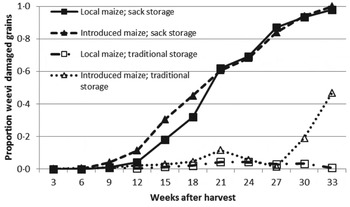
In contrast to storage in an airtight container, there was significant weevil damage to the grain stored by all the other methods (P<0·001). Storing shelled maize in a woven polysack was the worst method with an average of 0·96 of the grain in sacks attacked by weevils by Week 33 after the start of the experiment (Fig. 1 and Table 1). This was significantly (P<0·001) higher damage than with the three traditional means of storage tested. The best traditional method tested was storage in the husk above a fireplace, followed by hanging in a tree and storage in an elevated house (Table 1).
Proportion of grains eaten by weevils over time for shelled grain stored in a poly-sack and averaged over traditional storage methods in husks for local and introduced varieties.

Comparing maize varieties, locals were less susceptible to weevil damage overall than introduced types. But there was a highly significant (P<0·001) variety×storage method interaction and both types were damaged by weevils at a similar rate when stored as shelled grain in a poly-sack (Fig. 1). Importantly, however, modern varieties using storage in the husk were damaged more extensively by weevils than local maize types using traditional storage methods (above a fireplace, in a tree and in an elevated house). The vast majority of samples of local varieties tested near the end of the trials (Week 33) showed very little weevil damage (mean of 0·01) when stored by traditional means (Fig. 1). In marked contrast, weevil damage to modern varieties averaged 0·47 by the end of the trials over traditional storage methods in the husk (Fig. 1).
Grain moisture content did not vary over the period of sampling. Only a single maize sample was stored at a moisture content above 12% and this was in a sealed airtight container (water pipe). When sampling the maize at this specific site, staff noted fungal growth on the grain and a musty smell, indicating relatively high moisture content. This was the only case of fungal growth observed. All other samples were stored at low enough moisture content for long-term storage of maize seed. Grain moisture, averaged across the 11 samples collected for each treatment, is presented in Table 1.
Component 2: weevil damage in population comparisons over locations
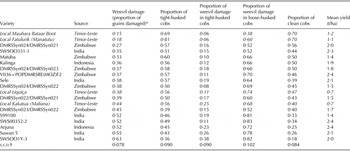
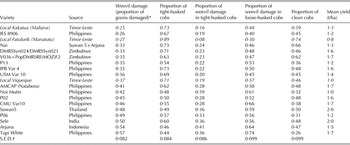
In both 2007 and 2010 there were significant differences between varieties and between locations for the characters weevil damage (proportion of grains damaged) and proportion of cobs with tight husks. For other related traits there was less consistency over years, as varietal differences reached significance in 2007 for proportion of weevil damage in loose-husked cobs and proportion of clean/undamaged cobs, whereas in 2010 there were significant differences among populations for proportion of weevil damage in tight-husked cobs. The variety×location interaction was not significant for most traits when tested using a linear mixed models analysis in the data sets of both yield trials, with the exception of proportion of cobs with tight husks in 2007 and proportion of clean cobs in 2010. In view of the generally low level of location×variety effects, population means are given in Table 2 for 2007 and in Table 3 for 2010.
Mean weevil damage and related traits of 19 maize varieties (ranked on damage) grown in the 2005/06 season and stored (2006/07) at Aileu and Maliana

* Proportion data presented as back-transformed means; local varieties are italicized; yield data are from SoL (2007).
† S.E.D., standard error of difference.
Mean weevil damage and related traits of 19 maize varieties (ranked on weevil damage) grown in the 2008/09 season and stored (2009/10) at Aileu, Loes, Fatumaka and Betano

* Proportion data presented as back-transformed means; local varieties are italicized; yield data are from SoL (2007).
† S.E.D. Standard error of difference.
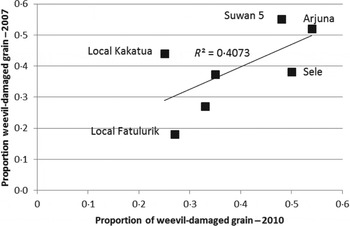
The overall level of weevil damaged grain was similar in both years at 0·39 when stored for 9 months in the husk. In 2007 the weevil damage to local maize populations (range 0·15–0·44) was less than the weevil damage in the introduced maize populations (range 0·27–0·63) (Table 2). In 2010 local maize populations again had an overall lower level of weevil damage ranging from 0·25 to 0·37 compared with the 0·26 to 0·57 recorded for introduced populations (Table 3). Focusing on the seven populations common to both yield trial sets, the coefficient of determination between proportion of weevil-damaged grain across the seasons was R 2=0·41 (Fig. 2), showing an intermediate level of repeatability. Over all populations the broadsense heritability estimates on an entry mean basis for proportion of weevil-damaged grain were H 2=0·81 in the 2007 trial and H 2=0·59 in 2010.
Proportion of weevil-damaged grain of seven common entries to the yield trials assessed in 2007 and 2010.

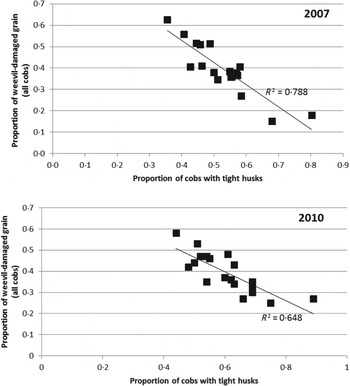
Phenotypic correlations among plant traits are shown for both yield trials in Table 4. There was an inverse correlation between the weevil damage within the cobs and the proportion of tight husks, and Fig. 3 shows that populations with a high proportion of cobs with tight husks are much less susceptible to weevil damage than those with more exposed cobs. A total of 0·79 in 2007 and 0·65 in 2010 of the population differences in proportion of weevil damage were accounted for by how tightly closed the cob husks were. The broadsense heritability among populations for proportion of cobs with tight husks was H 2=0·32 in the 2007 trial and H 2=0·76 in 2010.
Relationship between the proportion of weevil-damaged grain (all cobs) and proportion of cobs with tight husks in 2007 and 2010.

Phenotypic correlations among traits for the yield trial (2005/06) assessed for weevils in 2007 (top triangle) and the yield trial (2008/09) assessed for weevils in 2010 (lower triangle)

P⩽0·05, r=0·456; P⩽0·01, r=0·575 with 17 d.f.
DISCUSSION
At the household level the study showed that the level of weevil damage to maize – the key staple of Timor-Leste – varied markedly depending on storage method and maize variety. Whereas there was no weevil damage in any sealed (airtight) containers, there were losses for all other methods of storage. Storage of shelled maize in a sack provided no protection, with virtually total loss by Week 33 irrespective of variety. Storage in the husk above a fireplace, in a tree, or in an elevated house were in many cases quite effective methods of storage for local maize varieties, with some samples showing little weevil damage even at Week 33. However, these methods of storage were ineffective for modern varieties, with very significant weevil damage in some samples by 15 weeks, and in all samples by 33 weeks. This is a very significant finding in relation to the promotion of high yielding varieties of maize. Their use needs to be coupled with airtight methods of storage, lest the benefit of the higher yields be lost through post-harvest damage. From farmer interviews, all farmers had clear reasons for choosing to grow the maize varieties that they did (Guterres & Williams Reference Guterres and Williams2006). Those who grew modern varieties, such as Arjuna and Kalinga, did so because they had access to airtight storage methods. Others knew of these modern high yield varieties, but chose not to use them because they were aware of the storage problems (Guterres & Williams Reference Guterres and Williams2006).
Maize storage in Timor-Leste is still predominantly by traditional methods in the husk (SoL 2012b ). Maize populations from several countries have been tested for yield and weevil tolerance in trials at different locations in Timor-Leste. Although many of the introduced populations have a markedly higher yield than the local populations (Williams et al. Reference Williams, Borges, Lacoste, Andersen, Nesbitt and Johansen2012), only a few have the same level of weevil tolerance of the local populations. The high-yielding released variety Suwan 5 was highly susceptible to weevils in both seasons, whereas the variety Sele was lower in susceptibility in 2007 than in 2010. The newly released white maize Noi Mutin (introduced from the Philippines) was of intermediate susceptibility to weevils and also high in yield. Much of the variation in weevil tolerance among populations is clearly due to tight husks, as described by Eden in the 1950s (Eden Reference Eden1952b ). The storage trials emphasize that farmers using traditional storage methods need to store varieties with tight husks. The broadsense heritability estimates based on entry means are intermediate/high for proportion of weevil-damaged grain (H 2=0·81 and 0·59) and for proportion of cobs with tight husks (0·32 and 0·76) for 2007 and 2010, respectively, so a response to selection – either direct selection for proportion of weevil-damaged grain or indirect selection via proportion of cobs with tight husks – may be anticipated. Given the diversity of mechanisms of resistance to maize weevil found elsewhere, direct selection for proportion of weevil-damaged grain is probably preferable to indirect selection via tight husks, as it opens the possibility of harnessing resistance mechanisms additional to husk characteristics. Notwithstanding the selection method to be employed, there is clearly considerable potential for discovering populations that combine both a substantial yield increase with no increase in weevil susceptibility above the local material.
Taking a broad approach to food security embracing both increased production and improved methods of storage, it is important to exploit the interaction of varietal yield with storage method. Exploiting the interaction would allow farmers to benefit from the 40% higher grain yield from improved varieties (Williams et al. Reference Williams, Borges, Lacoste, Andersen, Nesbitt and Johansen2012), as well as guarantee that grain is kept safe from rats and weevils. The Timor-Leste Maize Storage Project (TLMSP), funded by the International Fund for Agricultural Development (IFAD), has started recently to disseminate subsidized 200-litre steel, airtight fuel drums to maize-growing households in Timor-Leste. Similar airtight maize silos were recently reported to improve food security in Kenya (Gitonga et al. Reference Gitonga, De Groote, Kassie and Tefera2013). In response to the TLMSP project, a study was made of the complementarity of drum distribution with SoL distribution of the seed of new high-yielding maize cultivars (Young Reference Young2013). This complementarity was confirmed on the basis of net farm income from maize cultivation, of returns per labour-day, and also of incremental benefits from growing maize. The research emphasized the considerable added value between maize seed dissemination and drum distribution, if the programmes were ‘twinned’ and implemented in the same maize growing districts at the same time. Subsidized storage drums are now being distributed together with maize seed in a campaign to increase food security in Timor-Leste.
We wish to gratefully acknowledge the financial support of the Australian Department of Foreign Affairs and Trade (DFAT) and the Australian Centre for International Agricultural Research (ACIAR), and the technical assistance of other members of the Timor-Leste Ministry of Agriculture and Fisheries.