1. Introduction
1.1. cognitive grammar and usage events
The theory of cognitive grammar (as presented in Langacker, Reference Langacker1987, Reference Langacker1991, Reference Langacker2008, and elsewhere) provides a framework for analyzing linguistic structure in terms of basic and general cognitive abilities, such as perception, attention, and categorization. “Its central claim is that grammar is per se a symbolic phenomenon, consisting of patterns for imposing and symbolizing particular schemes of conceptual structuring” (Langacker, Reference Langacker and Tomasello1998, p. 2, italics in original). Within this model, not only lexical items, but also grammar itself are seen as meaningful. The semantics of language is equated with conceptualization, and as such, meaning is understood as being encyclopedic in nature, rather consisting of dictionary-like entries (of a ‘mental lexicon’). Indeed, drawing on the basic nature of our perceptual experience for our understanding of other domains, the theory treats grammar as reflecting processes of construal, that is: ways of conceiving and portraying a situation.
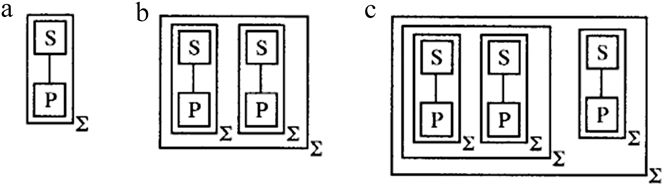
As in De Saussurian (1959 [1916]) semiotics, the symbolic structures (∑) that constitute linguistic units in cognitive grammar consist of linked semantic and phonological structures, represented in Figure 1 with S and P, respectively. An example of this often cited by Langacker is the formation of increasingly compounded forms in English via the affixes of derivational morphology, as with sharp, sharpen, sharpener. Since this same type of patterning is argued to be found on the level of larger, grammatical constructions, there is a continuum in cognitive grammar between lexical items and grammar itself, with each consisting in assemblies of symbolic structures.
Assemblies of symbolic structures in cognitive grammar in order of increasing levels of complexity (from Langacker, Reference Langacker2008, p. 15).

The position of cognitive grammarians is that the form–meaning (phonological–semantic) associations within any language are abstracted by users of that language. The theory is thus usage-based in how it works from the ground up to see how any language (and language in general) is structured the way that it is. “Units emerge via the progressive entrenchment of configurations [of semantic and phonological structures] that recur in a sufficient number of events to be established as cognitive routines” (Langacker, Reference Langacker2008, p. 220). The establishment of units in this way is a gradual process, and entrenchment can take place to varying degrees. The sites from which these units are abstracted are called ‘usage events’ (Langacker, Reference Langacker and Rudzka-Ostyn1988). A usage event itself involves a conceptualization, encompassing “the expression’s full contextual understanding” – including “everything evoked as the basis for its apprehension” (Langacker, Reference Langacker2008, p. 458), as well as a means of expression: “On the expressive side, it includes the full phonetic detail of an utterance, as well as any other signals, such as gestures and body language” (p. 457). This characterization automatically reveals the assumption that the basic usage events of language are spoken language usage events. One conclusion we can draw from this description of them is that (i) usage events can be multimodal in nature (involving not only audible words but also potentially including visible aspects of behavior), and (ii) they are dynamic in contour, given the time-locked nature of speech and of gesture as well.
Yet if we consider most analyses published using the framework of cognitive grammar, we find a different picture. Take, for example, the following data analyzed in Langacker (Reference Langacker2008):
The SWAT team surrounded the house (p. 148)
The students had collected a lot of money for the trip (p. 121)
Jason stated that Victoria would make a good candidate (p. 59)
Much of it consists of constructed examples, albeit ones which would sound plausible to native speakers of English. This appears to follow the tradition established in Chomskian linguistics of using native speaker intuitions to test grammaticality judgments about invented examples. In addition, many of the examples, like those above, consist of sentences, with the arguments often filled with full noun phrases.
However, it is conversation which is taken as ‘canonical’ in cognitive grammar, and as providing the basic model from which other uses of language are adapted (Langacker, Reference Langacker2008, p. 459). When we consider most conversations, we find that spontaneous spoken language use is organized in a different way than it is in sentences. On the macro-level, research in Conversation Analysis (CA) has made it clear that the turn-at-talk is a fundamental unit. On the micro-level, however, within turns, we find talk expressed in the form of intonation units (Chafe, Reference Chafe1994; Du Bois, Schuetze-Coburn, Cumming, & Paolino, Reference Du Bois, Schuetze-Coburn, Cumming, Paolino, Edwards and Lampert1993; Stelma & Cameron, Reference Stelma and Cameron2007). These units are not just matters of prosody; they also differ grammatically from written sentences. They rarely have the structure of full noun phrase + verb + full NP (Croft, Reference Croft1995). Rather, they show a tendency towards argument structures in which only one full NP occurs per intonation unit, with that possibly being the object of a transitive verb or the subject of an intransitive verb. New information may be presented in an intransitive context (e.g., “your friend Sue called”), such that it can then be referred to after that with a pronoun (e.g., “she got a new job”), allowing for other new information to appear as, for example, the object of a transitive verb. Du Bois (Reference Du Bois, Du Bois, Kumpf and Ashby2003a, Reference Du Bois and Tomasello2003b) calls this the ‘Preferred Argument Structure’ of conversation. The interactive nature of conversation also involves a different use of syntax than that found in written texts. The former is what Du Bois (Reference Du Bois2014) calls ‘Dialogic Syntax’. Finally, we also know from CA research that spontaneous talk involves restarts and repairs as integral parts of its structure, and that these can play fundamental roles in the structure of the talk, particularly in terms of negotiating interaction; they are not ‘mere dysfluencies’. Talk and usage events of spoken language in general thus involve complex systems that change dynamically moment by moment (Ellis & Larsen-Freeman, Reference Ellis and Larsen-Freeman2009; Gibbs & Cameron, Reference Gibbs and Cameron2008).
1.2. what would it mean to take the claims of cognitive grammar seriously?
Since usage events of spoken language are quite different from those of written language, more than just different varieties of grammar are involved here. During face-to-face talk – what Clark (Reference Clark and Moore1973) has called the ‘canonical encounter’ between people – the embodied expression of utterances is perceivable for sighted-people not only auditorily but also visually (note the title of Kendon's Reference Kendon2004 book, Gesture: visible action as utterance).
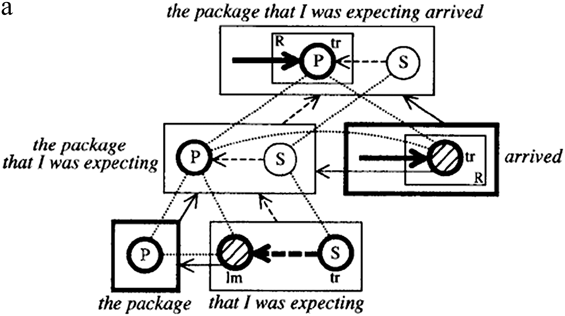
Yet, consider most analyses in cognitive grammar, e.g., as shown in Figure 2. They are valuable as tools for bringing out the way basic cognitive processes, such as foregrounding versus backgrounding (shown with bold lines versus plain ones), play a role in how grammar functions. However, the analysis is limited to the words, and the means of analysis is static.
Example analysis in cognitive grammar (Langacker, Reference Langacker2008, p. 213).
What would it mean to take the claims of cognitive grammar seriously? Given the position that “units emerge via the progressive entrenchment of configurations [of semantic and phonological units] that recur in a sufficient number of events to be established as cognitive routines” (Langacker, Reference Langacker2008, p. 220), what kinds of recurrent structures are there in the dynamic multimodality of spoken language usage events which should be taken into account as linguistic units? Limiting the scope here to some European languages, and focusing more on English, we see that existing research already points to several possibilities. We will focus here on:
– non-lexical sounds
– intonation, and
– manual gesture
Others, however, could also be imagined, such as the use of eye-gaze, body posture, or object manipulation. But even with the three categories noted above, we will see that consideration of the potential symbolic role that these behaviors may play in usage events of spoken language has additional implications for cognitive grammar because of their inherently variable nature.
2. Some aspects of spoken language usage events
2.1. non-lexical sounds
Studies such as Clark and Fox Tree (Reference Clark and Fox Tree2002) and Ward (Reference Ward2006) have considered the role of a set of sounds in American English, some of which will be familiar to speakers of other varieties of English and other languages, e.g.:
– uh-hm, uh-hn
– uh, uhhh, um, hmm, mm
– yeah, nyeah, oh-yeah, eah
They have been represented here with approximate orthographic forms and in terms of groups which share some relations in terms of their auditory forms and the functions they may serve. Though the items are word-like in written form, many people may not consider them to be words of the English language, thus their status as non-lexical sounds.
Each group shares a set of meanings, but the forms within each group vary as to the usual scope of their range of meanings. To think of non-lexical sounds in even broader terms, consider:
– throat-clearing; exhaling; alveolar tongue clicks
Whereas forms such as yeah and uh-hm have more fixed form–meaning correspondences, for expressions such as uh and behaviors like throat-clearing, this is less true. There is thus variability within the category of non-lexical sounds with regard to their potential for symbolic status.
Additionally, there is variation according to the context of use. In some contexts, one of these expressions could more likely constitute a turn at talk: e.g., in an emotional fight between lovers, where any form of reaction could be attended to closely. In other settings, though, this would be less likely. For example, in American courts of law it is verbalized words that count for the record as valid responses to questions, not behaviors like throat-clearing or even head nods (though see LeVan, Reference LeVan1984).
Certain non-lexical sounds can therefore have a symbolic relation to certain meanings, but this is the case to varying degrees, with some form–meaning correspondences being more fixed, and others less so. In addition, the degree to which these behaviors may ‘count’ for participants in an interaction also varies according to the broader context in which they are used.
2.2. intonation
Within the sonic modality itself, intonation can have a role which could plausibly be accounted for within cognitive grammar as part of the phonological pole of a complex linguistic symbolic structure. For example, some fixed phrases occur frequently with certain intonation contours. In American English these include “I don’t know” with a pattern [Low* High Medium] and “ʔuh-ʔuh!” with a [High* Low] to mean “no”. (The intonation is indicated with a variation on the ToBI systemFootnote 1 (based on Pierrehumbert, Reference Pierrehumbert1980) for analyzing patterns of intonation that serve meaningful differences within a given language, in which the asterisk [*] marks the pitch accent in an intonation unit.) In these cases, the intonation contours alone, hummed as a tune with one's mouth closed, can sometimes substitute for these words.
Other intonation contours do not necessarily correspond to meanings which are also lexicalized in the language, but are nevertheless used in a limited set of contexts, such as [Low* High] for disbelief by speakers of American English and many other languages. Meanwhile, other intonation patterns are used with a much wider range of contents in English, such as High* for new information, and Low* for already given information (Pierrehumbert & Hirschberg, Reference Pierrehumbert, Hirschberg, Cohen, Morgan and Pollack1990; Wennerstrom, Reference Wennerstrom2001).
What this suggests is that certain intonation contours can have a symbolic relation to certain meanings, but to varying degrees, with some form–meaning correspondences being more fixed, and others less so.
2.3. gesture
Research on the motoric/visual modality, particularly from recent decades, makes claims about the lexical and grammatical function of gestures in certain contexts. However, there are different degrees to which manual gestures are conventionally communicative. This range has been characterized as Kendon’s continuum (McNeill, Reference McNeill1992, Reference McNeill2005), based upon Kendon (Reference Kendon and Poyatos1988):
sign language–pantomime–emblems–speech-linked gestures–spontaneous gesticulation
Since the expressive modes on the left side of the continuum, sign language and pantomime, are normally not accompanied by speech, they will not be considered further here.
2.4. gestural emblems
To begin with emblems (Efron, Reference Efron1941), they have a relatively standardized relationship between their gestural form and the meaning for which they are used. A standard example in American culture is the “OK” sign formed with the thumb and index finger forming a ring, with the other fingers extended more or less upward, used to indicate agreement or that something is alright. Such a gesture has a fixed symbolic status within the culture (differing in other cultures, for example in some places in the Mediterranean where it has a very different, sexual denotation). The use of emblems is also an intentional act. The existence of a form–meaning pairing with emblems is clear from the existence of popular dictionaries of emblems for various cultures, such as Monahan (Reference Monahan1983) for Russian, Saitz and Cervanka (Reference Saitz and Cervanka1972) for US American and Colombian, and Wylie (Reference Wylie1977) for French. In cognitive grammar terms, there is a fixed symbolic relation of phonological structure (emblem gesture) and semantic structure (its meaning). Emblems can and do sometimes substitute for words, and, like words, their meaning in a given culture is largely the same across different contexts of their use (see Kendon, Reference Kendon2004, Ch. 16, for details).
2.5. speech-linked gestures
Another category of gestures used to substitute for words is that of speech-linked gestures (McNeill, Reference McNeill1992, Reference McNeill2005). These differ from emblems in terms of being specifically tied to a given context. Speech-linked gestures may replace word(s) in contexts so indicated, especially in performed quotations (e.g., “He went [gesture]” or “And I was like [gesture]”). Their other main use is linked to certain words, such as spatial deictic terms (e.g., there, this, that) and words indicating that manner of action or type of form is relevant (e.g., like this, such a; German son, as in so ein [Fricke, Reference Fricke2008; Streeck, Reference Streeck2010]). The information about the referent is then pointed to or its form or motion is represented when, or just after, this word is uttered.
As for the fixedness of the symbolic status of such gestures, it is clearly weaker than that of emblems, since their form is so dependent on the context and on the referent. However, there is the schematic form–meaning structure in place whereby such words call for some kind of depiction or illustration in order for the speaker's point to be adequately expressed (as if the word had a slot that needed to be filled by a gesture). In addition, Ladewig (Reference Ladewig, Müller, Cienki, Fricke, Ladewig, McNeill and Bressem2014a) argues that word-replacing gestures typically have a preferred syntactic position, namely phrase-final. This fixedness of grammatical context for their use provides relative fixedness for their symbolic status. This is certainly greater than that found with the following category, namely spontaneous gestures, or as Kendon refers to them, ‘gesticulation’.
2.6. gesticulation
This category consists of “idiosyncratic spontaneous movements of the hands and arms accompanying speech” (McNeill, Reference McNeill1992, p. 37). The claim is that they are idiosyncratic in terms of their form, not structured by conventions but rather highly dependent on the speech for their ‘meaning’ and also their form. Many involve relatively relaxed handshapes, produced with little observable tension or effort, and so any imagistic content they bear may not necessarily be clearly articulated. We can say that the gestures on this end of the continuum do not have a fixed symbolic status.
2.7. recurrent gestures
Although we have reached the end of the continuum, there is another category of gestures which has been gaining attention in recent research (see the work of the project ‘Towards a Grammar of Gesture’ [www.togog.org] under the direction of Müller, Fricke, Lausberg, and Liebal), called ‘recurrent gestures’ (Bressem & Müller, Reference Bressem, Müller, Müller, Cienki, Fricke, Ladewig, McNeill and Bressem2014; Ladewig, Reference Ladewig, Müller, Cienki, Fricke, Ladewig, McNeill and Bressem2014b). This category appears to fit between speech-linked gestures and spontaneous gesticulation.
With any one of these gestures we find a recurring group of forms, with limited variations. Take the example of the cyclic gesture, analyzed in Ladewig (Reference Ladewig2006, Reference Ladewig2011, Reference Ladewig, Müller, Cienki, Fricke, Ladewig, McNeill and Bressem2014b). It involves a basic pattern of outward rotation repeated in one location in gesture space, usually rotating at the wrist, but possibly also involving mainly the fingers or index finger. Like other gesture families (Kendon, Reference Kendon2004; Müller, Reference Müller, Müller and Posner2004), recurrent gestures constitute what can be called a family resemblance category of phonological structure, recalling Wittgenstein's (Reference Wittgenstein1953) observations about how many kinds of categories consist of sets of overlapping features, rather than of necessary and sufficient conditions. Any recurrent gesture is also used with a limited set of meanings or functions. In the case of the cyclic gesture, it goes with reference to some ongoing activity and its continuity (Ladewig, Reference Ladewig2006, Reference Ladewig2011, Reference Ladewig, Müller, Cienki, Fricke, Ladewig, McNeill and Bressem2014b). With English speakers this often involves the use of verbal forms expressing the progressive aspect (to be ___ing) (Harrison, Reference Harrison, Zlatev, Andrén, Falck and Lundmark2009b).
Another example is the set of gestures produced with the flat hand(s) making a horizontal stroke or oscillating movement. Such gestures occur in a number of European languages when speakers are expressing negation (Calbris, Reference Calbris2003; Kendon, Reference Kendon2004). As Harrison (Reference Harrison2009a) outlines (in Figure 3 here), these gestures take a variety of forms, even extending to head-shakes. Compared with the cyclic gestures, here we find a broader set of gestures whose forms constitute a family resemblance category. In parallel fashion, such gestures also cover a set of related meanings; compare the array of lexicalized forms of negation in English, such as not, -n't, not any, none, never, etc.
Recurrent gestures of negation in English (Harrison, Reference Harrison2009a, pp. 268–269).
Other examples of recurrent gestures function even further on the pragmatic end of the semantic spectrum. Consider the types of palm-up open-hand gestures used for offering small objects for inspection, as well as suggesting ideas or posing questions (Kendon, Reference Kendon2004; Müller, Reference Müller, Müller and Posner2004), or the gesture used to brush away some crumbs or lint off of one’s shirt front, which is also used by speakers of Spanish (and of some other languages) in the air, to dismiss an idea being talked about (Teßendorf, Reference Teßendorf2005, Reference Teßendorf, Müller, Cienki, Fricke, Ladewig, McNeill and Bressem2014).
Given these sets of related forms used with sets of related meanings, we can say that recurrent gestures can be considered semi-symbolic units in cognitive grammar. Taking recurrent gestures into account, then, the revised ‘right side’ of Kendon's continuum would look like this:
emblems – speech-linked gestures – recurrent gestures – spontaneous gesticulation
2.8. conclusions about gesture
We see from this discussion that some gesture forms and meanings (in a given culture) are associated with each other in a more systematic fashion, and so can constitute symbolic units abstracted from usage events of spoken interaction. But with other gestures, this is less true. There is thus a range of different potential sign status for different types of gestures; i.e., there are variable degrees to which gestures can have linguistic status. There are also variable ways in which gestures can have a linguistic status. Some can play a lexical role, in terms of replacing certain words, and others can have a grammatical function, as we saw above with the gestures expressing negation and progressive aspect (see also Harrison, Reference Harrison, Zlatev, Andrén, Falck and Lundmark2009b).
The degree to which gesture is a part of language is therefore variable. The variation plays out along different timescales: along a micro-scale, moment by moment within a conversation, but also along a macro-scale, developmentally, as gesture plays different communicative roles across the lifespan (as toddlers learn their first language [Namy, Campbell, & Tomasello, Reference Namy, Campbell and Tomasello2004], in fully developed language use in adulthood, and with language impairment, for example from aphasia [Goodwin, Reference Goodwin and McNeill2000]). There is also a difference depending on the specific genre event of communication, as gesture can acceptably play a greater or lesser role in different contexts. However, these topics require separate exploration beyond the scope of this paper. In any case, this exploration of the variability with which gesture can form the phonological pole of signs abstracted from spoken language usage events stands in contrast to an all-inclusive view of, for example, “gestures as part of language” (McNeill, Reference McNeill2005, p. 4).
3. The role of these behaviors in the expression of construal
If we take seriously the tenet that linguistic signs arise from repeated pairings of certain expressive behaviors with certain concepts in ostensibly communicative contexts, we can conclude that this extends the boundary of what constitutes linguistic signs into some uses of intonation, less clearly lexicalized sounds, and some types of gestures. The category of linguistic signs, while maintaining a prototypical center in spoken languages of spoken morphemes and their combinations in certain constructional patterns, thus appears to have a fuzzy boundary.
An additional aspect of taking these co-verbal forms of behavior into account, to varying degrees, in a theory of language is that it also makes even more salient a key point in cognitive grammar, namely that linguistic meaning involves both conceptual content and the construal imposed on that content. As Langacker (Reference Langacker2008) summarizes in Chapter 3, ‘Construal’, “our manifest ability to conceive and portray the same situation in alternate ways” (p. 43) involves at least four phenomena: different levels of specificity (or degree of granularity or resolution), the degree of focusing (foreground, background), prominence relations (profile/base, trajector/landmark), and perspective (viewing arrangement, subjectivity/objectivity).
Whereas the level of specificity relates most clearly to lexical choice (e.g., finger vs. hand vs. forearm), gesture can provide additional (visual) information in this regard about how referents are to be conceptualized, for example by virtue of the degree of schematicity in the form of the gestures used, be it on the more simple schematic level (such as that of image schemas à la Johnson, Reference Johnson1987, like path or cycle) or closer to basic-level human actions (like those discussed in Zlatev, Reference Zlatev and Hampe2005, as mimetic schemas, like put in or run) (Cienki, Reference Cienki2013). In addition, the mode of representation (Müller, Reference Müller, Santi, Guaïtella, Cavé and Konopczynski1998a, Reference Müller1998b, Reference Müller, Müller, Cienki, Fricke, Ladewig, McNeill and Bressem2014) a speaker employs provides a particular specification of the referential function of the gesture. It can highlight either the specific means of doing an action or the form of an entity, relation, or motion (the latter by virtue of the hand either standing for an entity in some particular form, or ‘as if’ outlining the form of an entity being touched, or tracing some form in the air in two or three dimensions).
As the description of the modes of representation above makes clear, gesture can also bring out the speaker’s construal of the degree of focusing and of prominence. Müller (Reference Müller, Cienki and Müller2008), for example, considers the foregrounding of metaphor in particular stretches of talk through the use of accompanying gestures, for example, by talking about a love relationship having its ups and downs and then tracing a sine curve up and down moving from left to right. Such a gesture not only illustrates selected aspects of the source domains of metaphors mentioned verbally, but also heightens their salience through the use of gestures that, for example, take up large areas of gesture space or are produced in the line of sight between speaker and addressee. While the examples in Müller (Reference Müller, Cienki and Müller2008) concern the use of metaphor, one can think of those foregrounding devices as more general principles of expressing prominence via co-verbal behaviors, perhaps characteristic of a kind of meta-expressive awareness. Intonation also clearly plays a role in the expression of focus and prominence, particularly in marking information that is to be taken as new in the given context (see Wennerstrom, Reference Wennerstrom2001, p. 34, for an overview of this literature). Non-lexical sounds can also play an important role in indicating what the listener takes as prominent in the speaker’s contributions, in the form of back-channel responses.
The construal phenomenon of perspective is physically manifested in speakers’ gestures. McNeill (Reference McNeill1992) discusses how gestures in narratives can reflect a character viewpoint or an observer viewpoint. Character viewpoint is a first-person enactment of an action as one would actually do it (e.g., putting ones curved hands consecutively one over the other as if climbing a rope); compare the first of the modes of representation, described above. Observer viewpoint, however, provides a representation of an action or entity as seen, so a third-person perspective (e.g., pointing one’s finger outward and moving it vertically upward to indicate someone climbing up a rope). Parrill (Reference Parrill, Dancygier and Sweetser2012) adds that some other gestures reflect the meta-perspective of the narrator, outside the story-world itself (e.g., describing someone climbing a rope but simply putting one’s hand out flat, palm up, as one does when simply presenting a new bit of information, as described in Müller, Reference Müller, Müller and Posner2004). (See Stec, Reference Stec2012, for an overview of how changes in conceptual viewpoint are expressed in various forms of bodily movement.)
The various behaviors discussed here, that are on the edge of what many would canonically consider ‘linguistic’, all play roles in expressing aspects of the speaker’s construal of some conceptual content being communicated. It is worth noting that the imagistic formalisms of cognitive grammar can handle all of these categories of co-verbal behaviors. As symbolic units, non-lexical sounds can be represented with the same formalism as spoken words insofar as their phonological pole, when they are part of more sign-like units, is also constituted by sonic phonetic material. However, the gradable nature of their signlike character would need to be captured; perhaps this could be handled with lighter or darker shades of gray in their graphic representation. Prominence relations already appear in the cognitive grammar formalism through the use of heavy dark lines versus lighter thin lines. To represent the role of intonation with this function, this aspect of the phonological pole could be illustrated with analog curves like those produced by software such as Praat (http://www.praat.org; Boersma, Reference Boersma2001) – this could appear parallel to the horizontal timeline sometimes used in cognitive grammar to demonstrate construal over time; or it could be marked in a digital fashion such as with the phonemic marking of intonation with the ToBI system, indicating relevant high (H) and low (L) points in a row below the accompanying words and vocal sounds. Finally, Langacker (1987, p. 39) explicitly states that, “[g]rammar (like lexicon) embodies conventional imagery”. Since the heuristics for analyses in cognitive grammar are by their very nature diagrammatic, there is great potential for incorporating schematic images of relevant gesture forms as part of the phonological pole (Cienki, Reference Cienkiin press) – images which, through their form and orientation, would also inherently show the perspective of the speaker’s construal. A trick that remains to be solved is how to display these analyses dynamically (with moving graphics), so as to better reflect the actual dynamic processes of expression and online thinking (or understanding) for speaking (in the sense of Slobin, Reference Slobin1987).
4. General conclusions
In this view of spoken language (in general and in terms of any specific language), it is not denied that ‘traditional’ words and grammar form the expressive core. However, other behaviors can gain symbolic status as well, e.g., non-lexical sounds, intonation contours, and (manual) gestures. In the model of the usage event as elaborated here for spoken language, the behaviors discussed above (although not exclusively those) are argued to play a role as linguistic symbols to varying degrees in various types of contexts. Note that this stands in marked contrast to a view in linguistics that is reflected in a quote from Ladd, cited in Liddell (Reference Liddell2003, pp. 70–71):
The central difference between paralinguistic and linguistic messages resides in the quantal or categorical structure of linguistic signaling and the scalar or gradient nature of paralanguage. In linguistic signaling, physical continua are partitioned into categories … In paralinguistic signaling, by contrast, semantic continua are matched by phonetic ones. (Ladd, Reference Ladd1996, p. 36)
That is, in the model of grammar as abstracted from spoken language usage events, the borderline between the linguistic and the paralinguistic is considered permeable. The degree of permeability, and the permeability to which kinds of behaviors, varies according to various temporal contexts and to various timescales – e.g., within usage events (moment by moment), across usage events (on the order of minutes, hours, or days), across the lifespan (developmentally), over the time period of generations (historically), and in the evolution of language (phylogenetically). We may conclude, therefore, that a more nuanced approach is needed toward characterizing the symbolic units in cognitive grammar in order to take into account their flexible nature, for example by saying that behaviors that repeatedly occur in usage events paired with certain meanings/functions become more entrenched linguistic signs.
Another conclusion of this research is that we need to acknowledge that usage events of spoken language are quite different in nature from those of written language. This suggests not only that different varieties of grammar are involved in spoken and written language, but also that different kinds of semantic content are expressed in the two forms of language (Cienki, Reference Cienki2008). This is a claim also supported by research on languages in cultures without a written tradition versus in those with one (e.g., Güldemann & von Roncador, Reference Güldemann and von Roncador2002). Although sign languages have not been treated in this paper, it appears that in many respects spoken and signed languages share certain important aspects which written forms of language do not, and as Liddell (Reference Liddell2003, p. 362) concludes: “It is much more likely that spoken and signed languages both make use of multiple types of semiotic elements in the language signal, but that our understanding of what constitutes language has been much too narrow.”