On 28 April 1900, the Phono-Cinéma-Théâtre opened its doors at 43 rue de Paris, where for the next five and a half months an exhibit would offer visitors to the Paris Exposition Universelle the opportunity to view visions animées des artistes célèbres.Footnote 1 In the weeks leading up to the opening, cinematographer Clément Maurice Gratiolet (who also went by the name of Clément Maurice) had used a 35 mm camera designed by Ambroise-François Parnaland to film some of the most celebrated performers of the day, including singers, actors, dancers, clowns and mimes, in a studio constructed on the roof of the Phono-Cinéma-Théâtre.Footnote 2 Once the exhibit opened, many of these silent films – such as ballerina Carlotta Zambelli's en pointe performance of a scene from Léo Delibes's Sylvia and music-hall comedian Little Tich's slapstick routine, for which he wore boots measuring 28 inches from heel to toe – were screened with real-time sound effects and musical accompaniment in the Phono-Cinéma-Théâtre's daily shows. But the exhibit was best known for its synchronised sound films. In each show, Clément Maurice's sons, Georges and Léopold Maurice, manually synchronised a selection of silent films – including those made by such luminaries as Sarah Bernhardt, Coquelin aîné and Victor Maurel – with cylinder recordings made by the same performers in the Phono-Cinéma-Théâtre's studio.Footnote 3
Despite the exhibit's star-studded line-up and newfangled technology, the Phono-Cinéma-Théâtre found itself in financial decline within a matter of weeks. Throughout the summer of 1900, the president of the Société du Phono-Cinéma-Théâtre, Paul Decauville, sought out new means of turning a profit, including raising the price of admission, petitioning the Exposition for permission to add a bar to the establishment, and sub-letting one of the two screening rooms to an exhibitor of baby incubators.Footnote 4 The Phono-Cinéma-Théâtre's artistic director, Comédie-Française sociétaire Marguerite Vrignault, took a different approach: recognising that fairgoers had become weary of the Phono-Cinéma-Théâtre's repetitive programmes, she invited actors and singers to record new synchronised sound films, and she also began hosting a series of Friday-night soirées, to which she occasionally invited the performers featured on the programme.Footnote 5 One such late addition to the Phono-Cinéma-Théâtre's programme was Jeanne Hatto's performance of an excerpt from Christoph Willibald Gluck's Iphigénie en Tauride, most likely filmed and recorded near the end of the summer of 1900. Around this same time, Vrignault also invited Hatto to perform selections from this opera (as well as from Mozart's Le nozze di Figaro) at one of her Friday-night galas at the Phono-Cinéma-Théâtre.Footnote 6 On 12 August 1900, the young soprano had starred in a much publicised performance of Iphigénie en Tauride at the open-air Théâtre-Antique in Orange, and thus Vrignault likely expected that Hatto's performance would not only attract novelty-seeking fairgoers, but also draw audiences who had read reports of the revival that had recently taken place in the Roman ruins of southern France. By thus capitalising on current events – and, more broadly, on the fin-de-siècle fascination with classical antiquity – Vrignault may well have hoped that Hatto's performance would help to revive the Phono-Cinéma-Théâtre's fortunes in the final months of the fair.
Recently restored and digitised by the Cinémathèque Française and the Gaumont Pathé Archives, the film Hatto made for the Phono-Cinéma-Théâtre affords us a glimpse into another revitalising force ascribed to female performers around the turn of the century: the ability to bring ancient statues – and antiquity itself – to life through physical movement.Footnote 7 While studying at the Conservatoire National de Musique et de Déclamation in 1896–1897, Hatto took lessons in opéra from the acclaimed operatic bass Alfred Giraudet, who was committed to preserving and popularising the principles of dramatic expression developed by his teacher, François Delsarte. Delsarte's theories in turn owed much to late eighteenth-century understandings of human animation, which gave rise to enduring aesthetics and metaphors of performance: around the turn of the nineteenth century, critics lauded highly sensitive performers – whose bodies seemed to move in response to spontaneous physiological sensations – as animate statues, while lambasting those whose attitudes appeared mannered as insentient statues, automata and puppets. Such metaphors took on gendered meanings alongside the rise of romanticism: in the early part of the nineteenth century, critics continued to praise performing women as living statues, attributing to them the ability to animate the past through their acting, but as the century progressed, authors often criticised actual and fictional female performers as soulless statuettes, mechanical dolls and lifeless puppets.Footnote 8 When describing the physical gestures of the prima donnas who helped to revive Gluck's reform operas over the latter half of the nineteenth century, however, critics returned to the earlier rhetoric of animation and, with it, the metaphor of the living statue. Hatto's critical reception locates her among these animate statues, as does her performance for the Phono-Cinéma-Théâtre, which reveals traces of Delsarte's method, as passed on by Giraudet. Ultimately, I suggest that, through their revival of classical antiquity, prima donnas recovered a form of corporeal authority that had all but disappeared from the French stage over the past century.
Acting natural, or the aesthetics of the animate statue
Alfred Giraudet, who had taught at the Conservatoire since 1889, had trained François Delsarte in the early 1860s, but never achieved the recognition that accompanied an appointment at the Conservatoire. Instead, he taught privately from the late 1830s until his death in 1871, and died before completing a treatise describing his method of dramatic expression.Footnote 9 Giraudet thus made it his mission to revive his teacher's theories for a new generation of performers, and, in 1895, he published one of the most systematic and practical explanations of Delsarte's method to date, entitled Mimique, physionomie et gestes: Méthode pratique d'après le système de F. Del Sarte pour servir à l'expression des sentiments.Footnote 10
As Giraudet's manual makes clear, Delsarte's method was deeply indebted to pictorialism, an acting style in which performers manifested the internal states of their characters with physical gestures and poses, shifting between attitudes to represent responses to the text, scenario or music. In recent years, scholars have focused on Delsarte's influence on modern modes of movement, suggesting that his approach bridged the gap between pictorialism and what are often considered subtler or ‘psychological’ methods of acting emergent near the end of the nineteenth century, including naturalism.Footnote 11 Yet the fragments of writing Delsarte left behind suggest a keen awareness of the ‘natural’ gestural aesthetics of the late eighteenth century, during which time pictorialist practices absorbed contemporary philosophical and physiological perspectives on human animation.Footnote 12 As the body's sensitivity came to be understood as a marker of its liveliness (due in no small part to the influence of Étienne Bonnot de Condillac's 1754 Traité des sensations), critics advised actors, dancers and singers to model their gestures after physiological reactions to internal or external stimuli, thus giving the illusion of spontaneity despite their meticulous planning.Footnote 13 Indeed, the sensitive body was believed to be highly unpredictable, and thus – as Denis Diderot warned in his famous Paradoxe sur le comédien – actors could not afford to leave any part of their performances to chance.Footnote 14 Delsarte's method not only extended the aesthetics of sensitivité underlying late eighteenth-century pictorialism into the mid-nineteenth century, but also valorised practices such as rote rehearsal and self-conscious performance at a time when many actors and singers were beginning to claim that their physical movements emerged from in-the-moment inspiration.Footnote 15
Delsarte's attentiveness to physiological sensitivity emerged in the opening chapter of his book draft, in which he emphasised the importance of spontaneous, reflexive physical gestures by recounting a personal anecdote from his days as a student at the Conservatoire, where he had trained as a tenor in the 1820s. For some weeks, Delsarte had found himself confounded by the performance of a simple phrase in which a young soldier expresses his surprise at meeting an old acquaintance; as Delsarte recalled, ‘at the first words I was stopped short by an almost insurmountable difficulty. This difficulty was all in my gesture.’Footnote 16 His professors provided little help, each instructing him to perform the phrase accompanied by different and contradictory poses. Indeed, Delsarte's retelling of this tale seems intended, at least in part, to point out just how many competing claims could be made to naturalness, especially as rendered in physical movements. Only when Delsarte's cousin made a surprise visit to the Conservatoire did Delsarte identify the appropriate gestures to accompany this scene. ‘Judge of my astonishment’, he wrote:
not only my gesture, until now so persistently awkward, seemed suddenly metamorphosed and became harmonious and natural; but, stranger yet, it did not correspond in the least to what had been prescribed. However, it was nature herself that had revealed this to me … Without a doubt, I now possessed the truth. An emotion, spontaneously produced and so deeply felt, could not result in an error.Footnote 17
In an effort to identify other such movements, Delsarte scrutinised the bodies surrounding him in Paris, from the nannies minding their charges in the Tuileries to the corpses decomposing in dissecting rooms.Footnote 18 Through minute observation of the involuntary gestures of the living and the dead – the curl of the thumb or the tilt of the head, for instance – Delsarte developed what he described as his ‘system of semeiotics’.Footnote 19
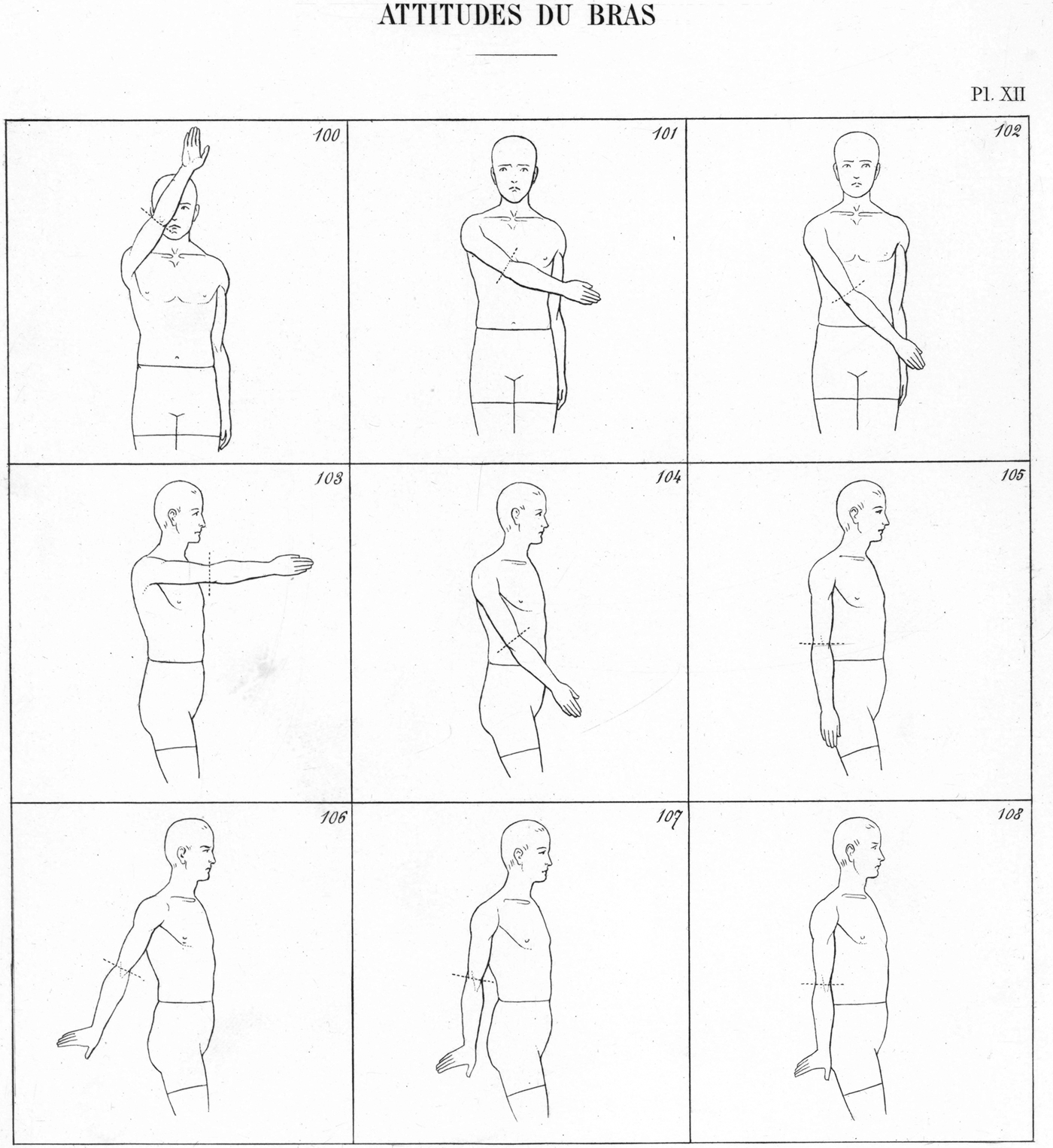
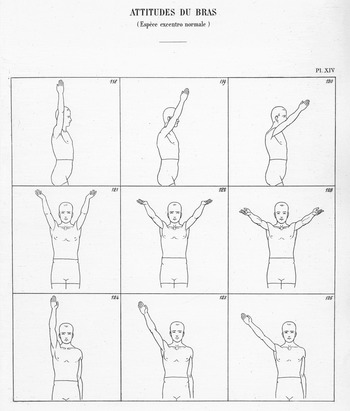
Delsarte's system codified the body's natural, instinctual responses to physical, intellectual and spiritual stimuli. According to Giraudet, Delsarte theorised that the human being comprised imbricated trinities: the Self (le Moi) existed in three states of being – the life (la Vie), the mind (l'Esprit), and the soul (l’Âme) – to each of which belonged a distinctive physical purpose, sensation (l'action des forces sensitives), reflection (l'action des puissances réflectives) and emotion (l'action des vertus affectives).Footnote 20 Crucially, Delsarte delineated the Self into three parts to demonstrate the entirely intermingled nature of the human being: far from remaining distinct entities, the life, the mind and the soul contained components of the others. Delsarte maintained that each of the body's physical gestures mirrored the tripartite nature of the Self, and thus he analysed movement according to three central attitudes (excentric, concentric or normal, which reflected the life, the mind or the soul, respectively); when combined with directional movements (again defined as excentric, concentric or normal), the three attitudes became nine. The arms, for example, have nine primary poses associated with nine distinct emotional states, which Giraudet grouped together according to their directional orientations: the protection of one's face, moral desire and constraint, and self-reflection he defines as concentric gestures directed towards the body's core; exaltation, expansion and calm are normal, because of their direction straight ahead or down towards the side; and vehemence, restriction, and anxiety and humility are excentric movements directed away from and behind the body.Footnote 21 (See Gaston Ledoux's accompanying illustrations of these poses in Fig. 1.) Even barely perceptible physical movements could transform an attitude and the intensity of its accompanying sentiment, as Giraudet demonstrated with the pose for exaltation (see Fig. 2). Here, he noted, ‘The exaltation will be extreme with the arms raised all the way [as in the left column], contained when raised a little above the shoulders [as in the right column], and average when raised to a level in between the two [as in the middle column].’Footnote 22
Gaston Ledoux's illustrations of the primary poses of the arms, including the protection of one's face (No. 100), moral desire and constraint (No. 101), self-reflection (No. 102), exaltation (No. 103), expansion (No. 104), calm (No. 105), vehemence (No. 106), restriction (No. 107) and anxiety and humility (No. 108), Plate 12 in Giraudet, Mimique, physionomie et gestes (Sibley Music Library, Eastman School of Music, University of Rochester, Rochester).

Gaston Ledoux's illustrations of variations on the pose of ‘exaltation’, Plate 14 in Giraudet, Mimique, physionomie et gestes (Sibley Music Library, Eastman School of Music, University of Rochester, Rochester).

At first glance, the poses depicted in the pages of Giraudet's manual might appear static, even statuesque, but they were meant to give rise to fluid, finely tuned gestures. Indeed, Delsarte urged his students to introduce subtle inflections into their attitudes, maintaining that ‘dynamic wealth depends upon the number of articulations brought into play; the fewer articulations an actor uses, the more closely he approaches the puppet’.Footnote 23 The puppet was just one of several metaphors late eighteenth- and early nineteenth-century writers used to critique actors, dancers and singers with insensitive, stilted gestures; other inanimate figures to which critics commonly compared performers included the automaton and the statue.Footnote 24 At the same time, however, the metaphor of the living statue became an important means of describing performers who seemed to have access to a heightened physiological sensitivity, as suggested by gestures that appeared instinctive and spontaneous rather than learned or mannered, and whose acting stirred the senses of their spectators.Footnote 25 Envisioned as animate statues, performers’ bodies – especially female performers’ bodies – took on new significance, capable not only of moving their audiences but also of connecting the present to the past, as Ellen Lockhart has recently observed with regards to the critical reception of Giuditta Pasta, as well as that of the fictional improvvisatrice Corinne.Footnote 26 Delsarte's system aimed to heighten performers’ awareness of the body's physiological sensitivity, thus laying bare the physical mechanics that gave rise to the metaphor of the living statue.
Soulless statues, mechanical dolls, lifeless puppets
One of the most striking accounts of a statuesque diva and a singing automaton occurs in Auguste de Villiers de l'Isle-Adam's 1886 science-fiction novel L’Ève future (The Eve of the Future), in which a fictionalised Thomas Edison constructs what he describes as an Android to take the place of his friend Lord Ewald's fiancée, an opera singer. Written around the same time the actual Edison invented and marketed his talking doll (which sang nursery rhymes, thanks to the miniature phonograph installed in its torso), Villiers's plot hinges on the supposed interchangeability of the mechanical reproduction and the female singer. Villiers makes this relationship apparent not only through Edison's creation of an Android to replace the prima donna, but also through Edison's and Ewald's repeated comparisons of the singer to an inanimate statue. Throughout the novel, mechanical and sculptural metaphors take on darker resonances, for even as Villiers seeks to distance the subjectively human from the merely mechanical, he locates the statuesque prima donna on the side of the machine.
Early in the novel, Ewald explains his dilemma to Edison: he is simultaneously repelled by and attracted to the prima donna, Alicia Clary, a woman who resembles ‘a marble divinity’, even ‘the stunning form of Venus Victorious ’ in her physical appearance.Footnote 27 Her exterior beauty belies a lack of interior substance, a personal failing that Ewald connects to her career as a professional singer. ‘Isn't a virtuoso the direct and mortal enemy of Genius, and so, by direct consequence, of Art itself?’ he asks Edison, before continuing:
Art, as you know, has no more connection with virtuosity than Genius has with Talent; the differences are in fact beyond all measurement. The only living souls who deserve the name of Artists are the creators, those who awaken impressions that are immense, unknown, and sublime. The others? … who cares? The followers and imitators may pass; but these virtuosos who come to pretty up, but really to enfeeble, the divine work of Genius? … Such puppets make one feel ashamed; they seem to have souls only metaphorically, as we speak of the soul of the violin. – Well, that's the sort of soul Miss Alicia has!Footnote 28
As Ewald makes clear, Alicia treats her puppet-like profession dispassionately, seeing her voice as ‘nothing but an empty instrument … a way of making a living less WORTHY than any other’.Footnote 29 The pinnacle of Ewald's diatribe comes in the form of a remembered visit to the Louvre. ‘I got the idea’, he recalled, ‘of confronting this living despondency with the great marble who is, as I told you, her image – the Venus Victorious herself. I simply wanted to see what this insufferable woman would say in such a presence.’Footnote 30 Ewald found Alicia's response deeply disturbing, for she failed to recognise the greatness of the statue and instead commented that she had arms where the Venus had none, that she was more ‘distinguished looking’ than the statue, and (most troubling of all to Ewald) that if the Louvre had spent so much money to see such a figure, then surely she (Alicia) would do well on the stage.Footnote 31 As Ewald tells Edison, though he finds Alicia's inner self entirely unworthy of his love, he continues to desire her because of her physical beauty. Thus racked by internal conflict, he no longer wishes to live.
In an effort to console his friend, Edison proposes to craft an Android. When Ewald worries aloud that the Android could be nothing but a doll, Edison assures him that ‘you will have to be careful, when you compare the two and listen to them both, that it isn't the living woman who seems to you the doll’.Footnote 32 Intrigued (though not a little apprehensive), Ewald agrees to Edison's proposal. Over the course of chapters with such titles as ‘Flesh’, ‘Aromatic’, ‘Hair’ and ‘Epidermis’, Edison reveals the mechanical workings of the Android prototype to Ewald. All that remains, the inventor explains, is to fashion the Android in Alicia's image, physically, gesturally and vocally. Edison and Ewald invite the singer to visit Menlo Park for an extended period of time, during which the inventor uses the camera and phonograph to surreptitiously reproduce Alicia's voice, mannerisms and physical appearance as she poses and performs. Using a nineteenth-century method of three-dimensional reproduction known as ‘photo-sculpture’, Edison perfectly replicates the singer's physical appearance to create the Android's body. He then implants two golden phonographs – which reproduce Alicia's finest performances – in the Android in the place of lungs, and beneath these lungs he installs a cylinder, which plays ‘all the gestures, the bearing, the facial expressions, and the poses of the woman that one incarnates in the Android’.Footnote 33 When Ewald meets the completed Android for the first time, he mistakes her for Alicia; only when she expresses a range of emotion beyond that available to the superficial Alicia does Ewald realise that he had mistaken the doll for the living woman. Enraptured with the Android, Ewald breaks off his relationship with Alicia, and the rejected singer prepares to return to England.
If Villiers's narrative to this point seems optimistic about the subjectivity of the mechanical reproduction, it does not remain so for long. In the final paragraphs of the novel, disaster strikes. En route to Ewald's home in England, the Android – identified in the ship's log as Alicia Clary – drowns in the Atlantic Ocean. Villiers withholds further information, purposefully eliding Alicia and the Android in death as in life. In the end, both the mechanical doll and the statuesque diva are too lacking in authenticity and interiority to survive in Villiers's romantic world.
In the second act of Jacques Offenbach's 1881 opera Les Contes d'Hoffmann, which was based on E.T.A. Hoffmann's 1817 short story ‘Der Sandmann’, the automaton Olympia famously serves as a similar locus for contemporary concerns surrounding feminine performance. Created by the inventor Spalanzani and his partner Coppélius, Olympia charms her guests – including her admirer Nathanael – with her conversation and singing. In Hoffmann's tale, several of the guests find Olympia disconcertingly lacking in that coherence between interior subjectivity and exterior expression so critical to nineteenth-century notions of liveliness. One of the guests, Siegmund, draws on distinctly romantic interpretations of sculptural and mechanical metaphors to caution his friend Nathanael:
We think she is – you won't take it ill, brother? – that she is singularly statuesque and soulless. Her figure is regular, and so are her features, that can't be gainsaid; and if her eyes were not so utterly devoid of life, I may say, of the power of vision, she might pass for a beauty. She is strangely measured in her movements, they all seem as if they were dependent upon some wound-up clockwork. Her playing and singing have the disagreeably perfect but insensitive timing of a singing machine, and her dancing is the same. We felt quite afraid of this Olympia, and did not like to have anything to do with her; she seemed to us to be only acting like a living creature, and as if there was some secret at the bottom of it all.Footnote 34
At the end of Hoffmann's short story, as at the end of the operatic act, Olympia's mechanical nature is revealed, in a destructive scene not unlike that of Villiers's L’Ève future. Just moments before she is torn apart, limb by limb, however, Offenbach's Olympia performs what has become one of the most famous arias in French operatic history, ‘Les oiseaux dans la charmille’, a virtuosic number that requires machine-like precision from the prima donna. As Heather Hadlock has argued, the sheer difficulty of ‘Les oiseaux dans la charmille’ – with its staccato coloratura and challengingly lofty high notes intended to evoke the sounds of a mechanical doll – deprives the singer's voice of ‘grain’ and ‘texture’.Footnote 35 In this number, Hadlock claims, ‘the prima donna inside Olympia hides behind a mask of stiff gestures and deliberately hollow, inexpressive vocal quality’.Footnote 36 Only in the final moments of the act, in which Olympia's vocal mechanism breaks down amid passages of erratic vocalise, does ‘a genuine prima donna [replace] the doll-instrument’.Footnote 37 Here, Hadlock suggests, the ‘disorderly diva’ prevails over the mechanised order of the automaton's aria: ‘her roulades get out of control; she gets stuck in the cadential trills; she rewrites the piece to the surprise and alarm of everyone around her’.Footnote 38 This finale, Hadlock concludes,
acknowledges the way that the performer always ‘breaks character’ in a coloratura showpiece, because her singing is so breathtaking and strenuous that we cannot escape our knowledge of the particular live woman doing it. In such moments, the prima donna plays only herself.Footnote 39
Hadlock's assertion of the prima donna's power may well ring true today, but for Adèle Isaac – the prima donna who created the character of Olympia in 1881 – the role of the soulless statue or the singing machine likely felt all too familiar.
Such fictional narratives both shaped and were shaped by much broader nineteenth-century discourses surrounding femininity. As scholars including Gail Marshall and Jeffrey Richards maintain, classical statues informed Victorian parameters of feminine beauty and propriety, defining how women should look, move and speak both on and off the stage.Footnote 40 At the same time, nineteenth-century anxieties over mechanical reproduction prompted the widespread assignment of mass-produced goods (and the mechanical more broadly) to the realm of the feminine, as Andreas Huyssen, Felicia Miller Frank and Patrick Vincent have demonstrated; the valorisation of such creative ideals as originality, authenticity and interiority depended in part on the stigmatisation and feminisation of mass culture.Footnote 41 Throughout the nineteenth century, then, prima donnas could not escape enmeshment with the statuesque and the mechanical by simply breaking character, as Hadlock implies. Rather, performers and critics actively negotiated alternative meanings for such metaphors, especially that of the statue, marshalling the older rhetoric of animation to make sense of encounters with classical antiquity – and new media technologies.
Animating antiquity
The impulse to recover and restore aspects of ancient Greek culture inflected the creation of Gluck's reform operas in the 1760s and 1770s – and the revival of these works a century later.Footnote 42 Amid broader efforts on the part of anthropologists and archaeologists to establish France's ties to classical antiquity, interest in Gluck's operatic retellings of Greek mythology resurfaced over the nineteenth and early twentieth centuries. Hector Berlioz has long held a central role in the resurrection of Gluck's operas, especially the revivals of Orphée in 1859 and Alceste in 1861 (and again in 1866).Footnote 43 But spectators most often remarked on the revivifying force wielded by the female performers who embodied the title roles of Gluck's operas. When she performed the part of Orpheus in the 1859 revival of Orphée, for example, Pauline Viardot was renowned for her attitudes, which alluded to antique figures while subtly animating them; she was, according to Paul de Saint-Victor, a ‘statue that has been moved with emotion … a sculpture that has started to come to life’.Footnote 44 The writer Marie d'Agoult similarly trained her attention on Viardot's acting:
I have seen nothing, not even Rachel, that came close to this plastic beauty, and to this freedom, in feeling for the antique. You feel there is nothing planned, nothing contrived, nothing that recalls the classroom. She made me think constantly of the most beautiful bas-reliefs and Greek vases.Footnote 45
As Flora Willson has recently observed, critics praised Viardot as a powerful agent of animation, capable of calling ‘history – whether ancient or operatic – into full-bodied presence, while simultaneously envoicing a continuation of the past’.Footnote 46 Throughout the late nineteenth and early twentieth centuries, critics returned often to the metaphor of the animate statue in their descriptions of the prima donnas who played the parts of Alcestis, Armida, Iphigenia and Orpheus, using it to articulate the performer's ability to enliven the ancient past by way of her body.
Viardot's ‘sculptural attitudes’ (as Hector Berlioz described her gestures) set the standard for how the characters from Gluck's reform operas would be performed in France for more than half a century, so much so that many critics drew direct comparisons between fin-de-siècle prima donnas and Viardot.Footnote 47 When the English mezzo-soprano Marie Brema revived the role of Orpheus at the Opéra-Comique in 1898, for example, the music historian and critic Henri de Curzon hailed her as ‘the best Orpheus we have seen in Paris since Mme Viardot’, further noting that Brema had taken great care to fashion herself after Viardot (and had even gone so far as to collect photographs of the older singer in character).Footnote 48 De Curzon further coupled Brema with Viardot by recalling, perhaps unwittingly, phrases d'Agoult had used to describe Viardot:
Very tall, her white tunic raised to just above the knees, legs well-bound with their bandelettes, arms exposed, this is exactly the character who appears in the old photographs and engravings of Mme Viardot. Mme Bréma [sic] finds, moreover, without having an air of planning, very simple but very noble poses, which make one think with rapture of certain ancient bas-reliefs.Footnote 49
The French mezzo-soprano Claire Croiza, who performed the role of Orpheus at the Théâtre Royal de la Monnaie in 1908 and again at the Opéra-Comique in 1914, was similarly said to move through the entire work ‘exactly like a living statue of the Elegy’.Footnote 50
The same rhetoric of animation informed the reception of the prima donnas who revived other Gluck operas. When Jeanne Raunay performed as Iphigenia in the 1899 revival of this work at the Théâtre-Lyrique, she was ‘not content to be beautiful and to have sculptural attitudes … she truly had the sacred fire’.Footnote 51 Comparing Raunay with the corseted ballerinas who performed the funeral dance in the second act, the critic for Le Radical wrote: ‘How much closer to the ancient statues the beautiful artist Mme Jeanne Raunay seemed to us. In harmoniously sad attitudes, she successively incarnates sadness, terror, horror, which her voice and her gestures express so well.’Footnote 52 The bass-baritone Jean-François Delmas praised the acting of Rose Caron, who performed the part of Iphigenia at the Opéra-Comique in 1900, 1901 and 1903, drawing attention to the harmonious rhythm – or ‘eurhythmy’, a word derived from the Greek – of her movements:
None deserves the title of tragédienne more than this singer. Tragédienne, she is this in her physiognomy, in the pensive sadness of her smile, the eurhythmy of her gestures, which are ever moving and never forceful; she is this in her innate ability to arrange herself in the fashion of the eternal heroines sculpted on a Greek bas-relief.Footnote 53
When Jeanne Hatto participated in the 1900 revival of Iphigénie en Tauride at the Théâtre-Antique in Orange a few months after Caron's performance of this work in Paris, the conductor Eugène d'Harcourt observed:
Mlle Hatto emerged as a statue, beautifully draped in an immense white peplum, which the wind tossed about with sublime, marvellous, epic rage; and her voice, rising in the arias, made itself heard all the way to the listeners perched at the top of the amphitheatre. It truly seemed that she was the daughter of Agamemnon.Footnote 54
Another critic went so far as to compare Hatto's Iphigenia to a statue only relatively recently excavated and installed in the Louvre: the Winged Victory of Samothrace.Footnote 55 He wrote:
Dressed entirely in white, priestly and majestic in garb, gestures, accents, during the first three acts, she appeared, wearing all red, at the tragic sacrificial hour. In her ultimate appearance, while the somewhat shrill breeze lifted her veils and lent her flowing gown the supple architecture of the incomparable Victory of Samothrace, she gave free rein to the youthful zeal of her effortless and courageous talent.Footnote 56
The Provençal writer Paul Mariéton lauded Hatto's performance as Iphigenia:
The incomparable style and sentiment of this young girl, the easy charm and purity of her mysterious voice, no less than the unspeakable beauty of poses, multiplied and varied by the wind in the most modestly classical eurhythmy, gave that night to the eight thousand spectators assembled at the Théâtre d'Orange the illusion of the very apparition of the divine Greece, eternally reborn from the ruins.Footnote 57
Taken together, such remarks – especially Mariéton's rhapsodic claim that Hatto produced ‘the illusion of the very apparition of the divine Greece’ – suggest that prima donnas’ bodies continued to be understood as conduits connecting the ancient past and the present moment well into the first decade of the twentieth century.
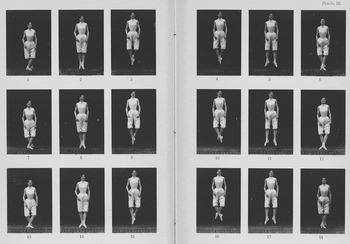
Late nineteenth- and early twentieth-century opera critics were not alone in framing women's bodies as thresholds into the ancient world. In the mid-1890s, the musicologist Maurice Emmanuel explored the relationship between ancient and contemporary gestures, in collaboration with Georges Demenÿ, a French gymnastics expert who had served as Étienne-Jules Marey's assistant at the Collège de France. Demenÿ created chronophotographic images of the Paris Opéra's ballerinas performing classical balletic gestures, which Emmanuel then compared to the figures preserved on ancient vases and bas-reliefs. In his 1896 La Danse grecque antique (based on his dissertation of the previous year), Emmanuel posited that the poses practised by contemporary ballerinas constituted ‘restorations’ of ancient attitudes. For example, the entrechat-quatre – in which the ballerina leaps from fifth position and criss-crosses her straightened legs four times at the calves – Emmanuel maintained ‘could be considered … the restoration of a Greek leap, of which the vase-painter had fixed a characteristic moment’ (see Fig. 3).Footnote 58 Based on Demenÿ’s chronophotographic evidence, Emmanuel further argued that ancient Greek dances had not simply comprised long-held poses or ‘characteristic moments’ (as the vases and artefacts seemed to suggest), but instead had consisted of athletic attitudes constantly in the process of appearing and evaporating, uncannily similar to those practised by contemporary dancers. Emmanuel's claim to have discovered a close connection between the physical gestures of fin-de-siècle dancers and those of the ancient Greeks further figured the female performer's body as a means of accessing antiquity: fixed in celluloid, the ballerina's body seemed a kind of artefact.Footnote 59
Georges Demenÿ’s chronophotographic images of a ballerina performing the entrechat-quatre, Plate III in Emmanuel, La Danse grecque antique d'après les monuments figurés (UBH Ap III 36, Hauptbibliothek, Universität Basel).

The metaphor of the animate statue that had informed the reception of female performers since the beginning of the nineteenth century thus took on a more material form alongside widespread efforts to excavate classical culture, among which we can locate both the revivals of Gluck's reform operas and Emmanuel's study of ancient Greek dance. Around the turn of the century, this rhetoric of animation not only elucidated the corporeal force of the women who brought antiquity to life, but also invested the chronophotographic gun and the moving-picture camera with similar abilities, positioning performing women and emerging technologies of reproduction alike at the interstices of past and present, stasis and kinesis.
Visions animées
A living statue and a statuette share the stage in the film Hatto made for the Phono-Cinéma-Théâtre. The scenario demands the presence of Diana, played by another soprano in operatic productions of Gluck's Iphigénie en Tauride: in this initial scene, the priestess Iphigenia, believing her beloved family to be dead, beseeches the goddess – who had once interceded to save her life – to now let her die. Within the context of the film, however, Hatto directs her pleas to a small plaster replica of the Diana of Gabii, an ancient statue that had been displayed at the Louvre since the 1820s.Footnote 60 The statuette's stasis contrasts strikingly with Hatto's fluid gestures, throwing into relief the soprano's animation.
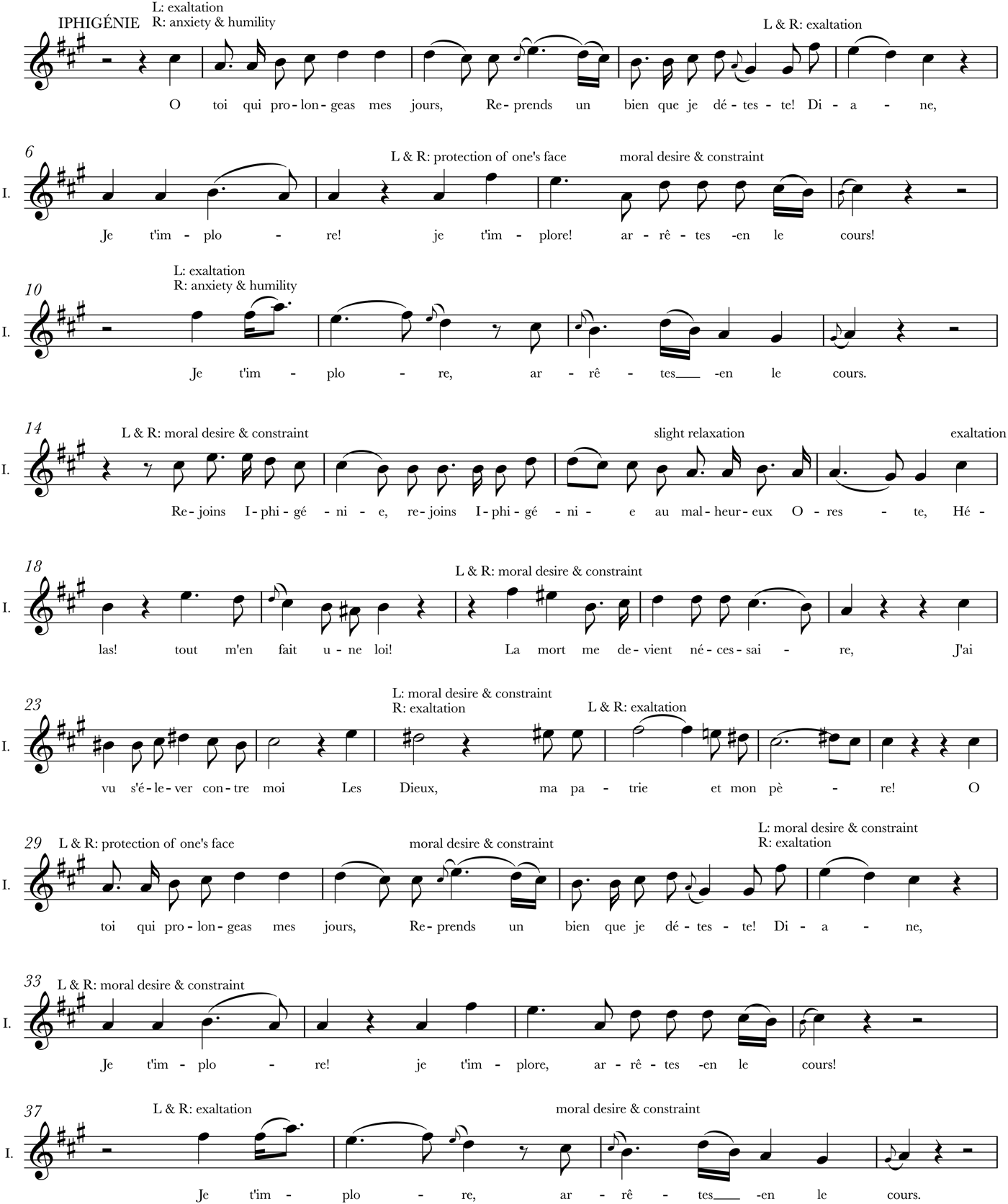
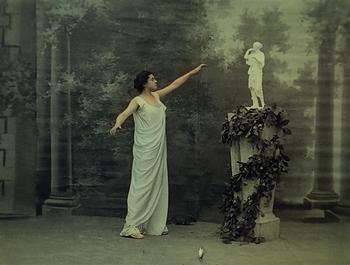
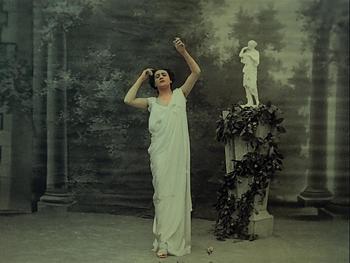
Throughout the first section of the rounded-binary aria, Hatto introduces the attitudes of the arms that Giraudet defined as ‘exaltation’ (a pose that seems to have represented a state of emotional or physical agitation), ‘anxiety and humility’, ‘moral desire and constraint’ and ‘protection of one's face’, all of which may be found in Figure 1. Even before she begins to sing, Hatto lifts her left arm in ‘exaltation’, the extension of her arm away from her core indicating the intensity of Iphigenia's emotional state; her right arm stretches down the side of her body and slightly behind her hip in a faint gesture of ‘anxiety and humility’ (see Figs. 4 and 5). Throughout the opening four bars – during which she sings ‘O you, who [once] prolonged my days, take back a gift that I detest!’ – Hatto maintains these gestures. Only when Iphigenia addresses the goddess by name does Hatto's right arm gradually shift to match the pose of ‘exaltation’ held by the left. In the subsequent bars (bb. 6–9), her gestures rapidly lose energy, and, as she implores Diana to end her life, she draws her hands in close to her face and then her chest in concentric attitudes representing the ‘protection of one's face’ and ‘moral desire and constraint’, respectively. Here, the angles created by the elbows are important, communicating through their acuteness the extent to which Iphigenia feels herself to be confined by her circumstances. Over bars 10–13, Hatto gradually extends her arms out once again in attitudes of ‘exaltation’ and ‘anxiety and humility’, resuming her opening gestures as she returns to the tonic key area.
Jeanne Hatto's abbreviated version of Gluck, Iphigénie en Tauride, Act I, scene 1, ‘Invocation à Diane’, with annotations indicating the gestures she used in her film for the Phono-Cinéma-Théâtre.

Film frame featuring Hatto with her left arm in the attitude of ‘exaltation’ and her right arm in ‘anxiety and humility’ (‘Invocation à Diane: Air d’Iphigénie en Tauride’, performed by Jeanne Hatto, Société anonyme du Phono-Cinéma-Théâtre, Paris, 1900, film restored by Gaumont Pathé Archives and Cinémathèque Française, Paris).

In the transitional moment between the first and second sections, Hatto turns away from the statuette of Diana and begins to address the camera directly. In the passages she performs while facing the cinematic apparatus (and the audience), Hatto invests the poses she had used in the opening section with new shades of meaning. In bars 14–17, for example, she pulls her hands close to her body to express ‘moral desire and constraint’, but slowly relaxes the angle of her elbows as, for a moment, Iphigenia thinks of her brother, Orestes. Throughout the remainder of this section, Hatto reflects Iphigenia's increasingly distraught emotional state by moving through poses more rapidly. In bars 17–19, she briefly extends her arms into ‘exaltation’ as she sings ‘Alas! Everything has become a law to me’ before gradually lowering her arms into ‘moral desire and constraint’ in bars 20–4, only to suddenly raise her right arm into ‘exaltation’ in bar 25 (followed by her left in bar 26) when she again invokes the gods.
The emotional weight of the second section affects Hatto's performance of the final portion of the aria, which constitutes a complete reprise of the opening section (compare bb. 28–40 with bb. 1–13). Strikingly, Hatto begins the reprise not with the poses of ‘exaltation’ and ‘anxiety and humility’, but rather with the attitude representing the ‘protection of one's face’ (see Fig. 6), closely followed by ‘moral desire and constraint’. Although she returns to many of the same poses she had used in the initial section in her reprise, throughout nearly every moment she maintains some level of flexion in her elbows, and she closes her performance not in the attitudes of ‘exaltation’ and ‘anxiety and humility’, as we might expect, but rather by drawing her hands in towards her body in one final gesture of ‘moral desire and constraint’.
Film frame featuring Hatto with arms in the attitude of ‘protection of one's face’; her left arm, with its elevation, expresses a more extreme version of this pose than that held by the right arm (‘Invocation à Diane: Air d’Iphigénie en Tauride’, performed by Jeanne Hatto, Société anonyme du Phono-Cinéma-Théâtre, Paris, 1900, film restored by Gaumont Pathé Archives and Cinémathèque Française, Paris).

Even when analysed alongside Giraudet's manual, Hatto's physical movements are not easily interpreted. Indeed, the alterations Hatto introduces in the reprise hint that her gestures correspond not – or at least not only – to the words or music, but rather to emotions and sensations, thus suggesting a keen intuition into her character's shifting states of being. Furthermore, she may have treated Giraudet's method book with a certain amount of flexibility (as many performers did with such manuals), instead taking inspiration from the prima donnas who had played the role of Iphigenia in the months before Hatto recorded her performance for the Phono-Cinéma-Théâtre. Such readings of Hatto's gestures further assume a certain transparency on the part of the Phono-Cinéma-Théâtre's technologies, but of course Hatto may also have modified her onstage performance practices for any number of reasons when performing for the Parnaland camera. Hatto's film – another kind of artefact – thus resists even as it reveals, offering partial glimpses into the methods and means by which the prima donna animated antiquity while still occluding much from our view.
***
On 12 November 1900, the Phono-Cinéma-Théâtre closed its doors on the rue de Paris – a financial fiasco, its president Decauville becoming embroiled in a legal battle with the official organisers of the Exposition Universelle that would stretch on until late January 1901.Footnote 61 The reasons for this failure were many, including the repetitive nature of the shows (only partially mitigated by Vrignault's introduction of new scenes) and especially the loose synchronisation of sound and screen, by all accounts performed inexpertly.Footnote 62 Indeed, the Phono-Cinéma-Théâtre's uncoupling of performers’ bodies and voices may well have touched a nerve already exposed by the many recent portrayals of soulless statues and mechanical dolls on stage and in literature. With her physical gestures out of sync with her voice, Hatto's recorded performance must have seemed lacking in liveliness, especially if screened alongside her real-time rendition of Gluck's aria at one of the Phono-Cinéma-Théâtre's Friday-night galas.
But despite the financial losses suffered at the Exposition Universelle, the Phono-Cinéma-Théâtre survived under the direction of Marguerite Vrignault, who replaced Decauville as president in 1901. Throughout 1901 and 1902, Vrignault took the Phono-Cinéma-Théâtre on tour around Europe, giving lectures before screening selected films originally created for the Exposition Universelle.Footnote 63 Occasionally, Vrignault advertised Hatto's filmed performance of the ‘Invocation à Diane’, suggesting that the spectacle of physical, temporal and technological animation remained a viable means of attracting an audience during the early years of the new century.Footnote 64 Indeed, on the operatic stage, prima donnas continued to be lauded as living statues well into the second decade of the twentieth century, whether in revivals of Gluck's operas or in performances of new works based on ancient subjects, to which their sculptural gestures added an air of the antique.Footnote 65 Ultimately, through their embodiment of ancient Greek figures, prima donnas laid claim to the bodily authority ascribed to performing women near the beginning of the nineteenth century, which they then exercised in works old and new, on stage and in visions animées.