INTRODUCTION
Even though some of the earliest records of Indo-Pacific caridean shrimps are from the Persian Gulf (Nobili, Reference Nobili1905a, Reference Nobilib, Reference Nobili1906a, Reference Nobilib), very few additional records have come to light. Only sporadic records have appeared since the early contributions by Nobili (Reference Nobili1905a, Reference Nobilib, Reference Nobili1906a, Reference Nobilib) and Coutière (Reference Coutière1908), with most of these records reviewed in De Grave (Reference De Grave2007). Three further species have been recently described from the area by Anker & De Grave (Reference Anker and De Grave2009), Anker et al. (Reference Anker, Naderloo, Marin, De Grave and Fransen2010) and Marin (Reference Marin, De Grave and Fransen2010). In contrast, some of the surrounding regions, such as Pakistan (Kazmi, Reference Kazmi2006) and the East African coastline have received much more attention.
As part of an impact assessment related to oil extraction several surveys of the Al'Idd Ash Sharqi oilfield, Qatar were conducted, the first in May 1995 concentrated on the northern part of the oil field and the second in April 1998 concentrating on the southern part of the oilfield; a repeat survey in August 2003 covered both areas. Samples were taken with a 0.1 m2 Day grab with an additional three qualitative scrape samples being taken from the legs of three platforms in the 2003 survey. The qualitative samples yielded no decapods but a number of interesting species were obtained from the grab samples. A report on some thalassinidean lobsters collected during this study has already been produced (Dworschak, Reference Dworschak2009). The present contribution reports several species of caridean shrimp collected from these surveys, some of which are reported for the first time for both Qatar and the entire Persian Gulf. The genus Philocheras Stebbing, 1900 (Crangonidae) is recorded for the first time from the area with two species and the family Pandalidae is represented by a further species, new for the Gulf.
The material is deposited in the Zoological Collections of Oxford University Museum of Natural History (OUMNH-ZC-2006-18). Post-orbital carapace length (pocl, in mm) is used as the standard measurement. The abbreviation ULR is used to denote Unicomarine Laboratory Reference Number.
MATERIAL EXAMINED
1 female (pocl 1.75), Station 1 [ULR 12308]; 25°19′22.296″N 52°22′24.312″E, 29.85 m, 22 April 1998; 1 female (pocl 1.10), Station 19 [ULR 8003], 25°19′37.637″N 52°21′58.284″E, 32.9 m, 25 May 1995; 1 female (pocl 1.00), Station 16 [ULR 7958], 25°29′28.212″N 52°23′01.716″E, 32.60 m, 25 May 1995; 1 male (pocl 1.10), Station 10 [ULR 7953], 25°22′58.44″N 52°21′48.960″E, 12.07 m, 25 May 1995.
REMARKS
The specimens agree well with the description of Kemp (Reference Kemp1916), although the mid-dorsal carina on the carapace appears more developed, divided into two elevated convex ridges, on the gastric region and further posteriorly. As in the material of Bruce (Reference Bruce1994), in one specimen the gastric ridge is developed in a subacute tubercle. A distinct sternal tooth between the first pereiopods is present in all specimens, with the three recurved distal teeth on the merus of the first pereiopod and the short telson being further diagnostic. Philocheras lowisi was previously only known from the Andaman Islands (Kemp, Reference Kemp1916), Hong Kong (Bruce, Reference Bruce and Morton1990), the Timor Sea (Bruce, Reference Bruce1994) and Amakusa, Japan (Kikuchi & Miyake, Reference Kikuchi and Miyake1978), and is here recorded for the first time in the Persian Gulf.
MATERIAL EXAMINED
1 female (pocl 2.50), Station 54 [ULR 31373], 25°27′17.710″N 52°22′28.416″E, 35.80 m, 27 August 2003.
REMARKS
The single specimen agrees closely with the description of Kemp (Reference Kemp1916) and harbours three mid-dorsal carapace spines. The true distribution of this species is unclear, as the majority of specimens recorded under this name by Barnard (Reference Barnard1955) from Delagoa Bay in Mozambique, one of which is presumably illustrated by Kensley (Reference Kensley1972), harbour four mid-dorsal spines, as does the material from Madagascar (Ledoyer, Reference Ledoyer1969). The taxonomic status of these southern Indian Ocean specimens must await a re-examination of the entire material of P. pilosus. Presently, the species appears to be only known with certainty from the Gulf of Manaar (Kemp, Reference Kemp1916), New Caledonia (Ledoyer, Reference Ledoyer1984) and Qatar (present record).
MATERIAL EXAMINED
1 female (pocl 4.75), 1 male (pocl 4.80), Station 17 [ULR 7961], 25°29′26.880″N 52°22′58.800″E, 33.80 m, 25 May 1995; 1 female (pocl 5.00), Station 13 [ULR 7988], 25°21′22.320″N 52°21′38.160″E, 13.81 m, 25 May 1995; 1 juvenile (pocl 1.25), Station 28 [ULR 31308], 25°29′14.604″N 52°23′05.028″E, 32.60 m, 27 August 2003.
REMARKS
Specimens agree closely with the description of Chace (Reference Chace1985), although the carpal articulations of the second pereiopods are relatively indistinct. Procletes levicarina has a wide Indo-West Pacific distribution, including the Gulf of Oman (Calman, Reference Calman1939), and is particularly abundant in the northern part of the Indian Ocean (Gopala Menon, Reference Gopala Menon1972). It is here newly recorded for the Persian Gulf.
MATERIAL EXAMINED
1 female (pocl 1.75), Station 13 [ULR 31275], 25°21′22.320″N 52°21′38.160″E, 13.8 m, 25 May 1995; 1 male (pocl 3.25), 2 females (pocl 2.15, 1.50), Station 2 [ULR 12309], 25°19′57.612″N 52°22′23.520″E, 32.07 m, 22 April 1998; 2 females (pocl 1.75, 1.50), 2 post-larvae, Station 14 [ULR 7993], 25°29′25.400″N 52°22′54.444″E, 33.00 m, 25 May 1995; 1 male (pocl 2.15), 1 female (pocl 1.20), Station 23 [ULR 31342], 25°29′28.212″N 52°23′01.716″E, 32.60 m, 27 August 2003; 4 females (pocl 2.00–2.35), Station 19 [ULR 8003], 25°19′37.637″N 52°21′58.284″E, 32.9 m, 25 May 1995; 3 females (pocl 1.00–2.35), 1 juvenile (pocl 0.45), Station 18 [ULR 7963], 25°29′18.560″N 52°22′52.212″E, 32.80 m, 25 May 1995; 2 females (pocl 2.00–2.30), 1 male (pocl 2.30), 1 megalopa, Station 1 [ULR 12308], 25°19′22.296″N 52°22′24.312″E, 29.85 m, 22 April 1998.
REMARKS
The present specimens agree closely with the description of Chace (Reference Chace1976), with the elevated dorsolateral ridges on the carapace present in both sexes, and the concealment of the basicerite by the carapace being diagnostic. Nevertheless, in a few specimens, the basicerite was only partially covered, which may be linked to the preservation status of the specimens, as the carapace appeared deformed in those specimens. Hayashi (Reference Hayashi and Richer de Forges1995) drew attention to the presence of additional ventrolateral spiniform setae on the sixth abdominal somite, as a potentially useful character for species identification. In the present material, these spiniform setae range in number from zero to two, with frequently different counts on either side of the same somite and appear to be of limited value in differentiating species in the L. (L.) aculeocaudata group. Leptochela (L.) aculeocaudata was only known with certainty from the Red Sea and Queensland (Chace, Reference Chace1976), an unspecified location in north-western Australia (Hanamura, Reference Hanamura1987) and from a location in the United Arab Emirates (De Grave, Reference De Grave2007). Hayashi (Reference Hayashi and Richer de Forges1995) remarked that the specimens recorded as Leptochela aculeocaudata hainanensis by Armstrong (Reference Armstrong1941) from Samoa and re-examined by Chace (Reference Chace1976) probably belong to the closely related species L. chacei, on account of the basicerite not being covered by the carapace. However, the true taxonomic significance of this character requires clarification, as preservation state may play a role in this (based on the present specimens) or indeed may be due to natural variability (Hanamura, Reference Hanamura1987).
MATERIAL EXAMINED
1 female (pocl 3.50), Station 16 [ULR 7957]; 25°29′28.212″N 52°23′01.716″E; 32.60 m, 25 May 1995.
REMARKS
The present specimen agrees very well with the description in Hayashi (Reference Hayashi1975). The species has a widespread distribution in the Indo-West Pacific and has been previously recorded from the Persian Gulf by Noël (Reference Noël1986).
MATERIAL EXAMINED
1 ovigerous female (pocl 4.00), Station 25 [ULR 7972], 25°28′22.224″N 52°24′07.596″E, 34.20 m, 25 May 1995; 1 male (pocl 1.75), Station 18 [ULR 7962], 25°29′18.560″N 52°22′52.212″E, 32.80 m, 25 May 1995; 2 females (pocl 1.35–2.10), Station 30 [ULR 31310], 25°29′34.404″N 52°22′44.400″E, 27.50 m, 27 August 2003.
REMARKS
These specimens agree with the type description (Hayashi, Reference Hayashi1975) and present no noteworthy features. The species is known from scattered locations in the Indo-Pacific, from South Africa through to Japan, including two records from the southern part of the Arabian Pensinsula (Gurney, Reference Gurney1937 as P. australiensis; Hogarth, 1987) and one previous record from the Persian Gulf (Zirku Island; De Grave, Reference De Grave2007).
DISCUSSION
The present collection contained several more species, notably some Hippolytidae (Hippolyte) and Alpheidae (Alpheus, Athanas and Salmoneus), but due to extensive damage, possibly as a result of the sampling method, these are not further considered here. Although the herein reported species are few in number (six), the fact that three species (i.e. 50%) are new records for the Persian Gulf highlights once again the lack of knowledge about caridean shrimps in this region, previously commented upon by De Grave (Reference De Grave2007) and Anker & De Grave (Reference Anker and De Grave2009).
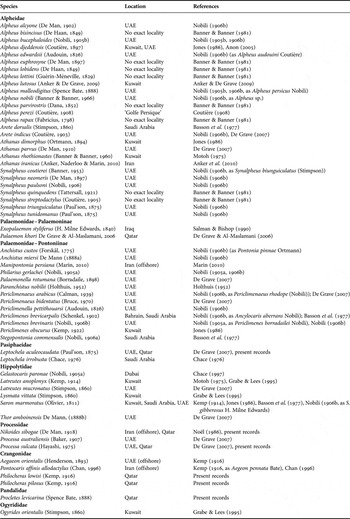
To provide an overview of the currently known caridean shrimp fauna, an exhaustive literature search was conducted, supplementing the records listed by De Grave (Reference De Grave2007) who listed 46 species. Subsequently, Anker & De Grave (Reference Anker and De Grave2009) described a new species of alpheid, Alpheus lutosus, from intertidal mudflats in Kuwait, raising the number of species reported from the Persian Gulf to 47. Most recently, Anker et al. (Reference Anker, Naderloo, Marin, De Grave and Fransen2010) described the intertidal Athanas iranicus from Qeshm Island (Iran), whilst Marin (Reference Marin, De Grave and Fransen2010) described Manipontonia persiana from a depth of 51 m in the northern Persian Gulf. Here, we report on a total of 59 species positively recorded from the area (Table 1). Chace (Reference Chace1997) did not provide any locality details on the specimens of the sponge-associated hippolytid Gelastocaris paronae. However, K. Reed (personal communication) confirmed that this record was based on three specimens (1 male and 2 ovigerous females) from Dubai (leg. T. Bright, 8 February 1981), but these specimens were returned to the sender, and are not incorporated into the USNM collection, as indicated in Chace (Reference Chace1997).
Decapoda Caridea currently recorded from the Persian Gulf per country (Banner & Banner (Reference Banner and Banner1981) do not provide precise locality details for their records).

UAE, United Arab Emirates.
Apart from the records listed in Table 1, five further species have been recorded from the Persian Gulf, which can be considered as doubtfully occurring there. Motoh (Reference Motoh1975) recorded Alpheus distinguendus De Man based on a single female of unknown origin deposited at the Kuwait Institute of Scientific Research. Even if this species was obtained in local waters (which appears uncertain), Hayashi & Nagata (Reference Hayashi and Nagata2002) treated A. distinguendus as a junior synonym of the Japanese Alpheus digitalis De Haan and thus the record of this species is likely in error. Basson et al. (Reference Basson, Burchard, Hardy and Price1977) listed Leptochela robusta Stimpson, Alpheus dentipes Guérin-Méneville and Processa canaliculata Leach from material obtained in Saudi Arabia. As Chace (Reference Chace1976) considered records of L. robusta west of the Philippines doubtful, and given the abundance of L. aculeocaudata in the region (De Grave, Reference De Grave2007; present records), we tentatively attribute the record of Basson et al. to that species, although it is noted that a second species also occurs in the Persian Gulf (Table 1), albeit rarely recorded. Both A. dentipes and P. canaliculata are restricted to the Atlantic Ocean, and those records are considered misidentifications at the species level. Jones (Reference Jones1986) recorded Hippolyte ventricosa H. Milne Edwards from Kuwait. However, according to d'Udekem d'Acoz (Reference Udekem d'Acoz d'1999), a number of species may have been confused under the name H. ventricosa and the true H. ventricosa may be restricted in distribution to India. A closely related species, H. orientalis Heller has been recorded extensively from the Red Sea and the Gulf of Aden, and it seems likely that the record in Jones (Reference Jones1986) refers to H. orientalis. Although the present collection does contain specimens of Hippolyte, they are too damaged to derive a positive identification to species level, as did the material reported in De Grave (Reference De Grave2007).
Al-Aidaroos (Reference Al-Aidaroos1993) and Grabe & Lees (Reference Grabe and Lees1995) provide further records of larval Caridea for the area, but not identified to species. In addition to genera already listed in Table 1, the following taxa are recorded: Harpilius sp. (Al-Aidaroos, Reference Al-Aidaroos1993 from the western Persian Gulf), and Crangon sp., Periclimenes sp., Tozeuma sp., ?Acanthephyra and ?Systellaspis from Kuwait Bay (Grabe & Lees, Reference Grabe and Lees1995).
ACKNOWLEDGEMENTS
Occidental Petroleum of Qatar Limited is kindly acknowledged for permission to use the data presented in this paper. In particular Dr Joe Jarrah (formerly of ERM) and Ali Jassim Al-Saigel (OPQL) negotiated the release of the material for further study. We thank staff from Thomson Unicomarine for the initial sample processing. Karen Reed (USNM, Washington, DC) is acknowledged for providing information on USNM holdings, whilst R. Naderloo (Senckenberg Research Institute, Frankfurt) checked the fauna list for omissions.