1. Introduction
Self-respect is a complex and difficult concept. Despite having received a lot of attention in the literature in the past 40 years or so, it is still far from clear both what it is, and what role it should play within theories of social justice. On the one hand, developing, and maintaining, self-respect, is a deeply personal affair: no one can take over this work for you. Self-respect cannot be directly given to people; it cannot be literally distributed. On the other, it seems equally implausible to deny that social and political circumstances and processes can have a deep and lasting impact on people’s capacity to develop and maintain self-respect.
This double-faced nature of the concept makes it a battleground for different convictions in political philosophy, and politics. Currently dominant views in political philosophy stress the dependence of self-respect on being treated in ways that express the respect and esteem of others (Bird Reference Bird2010, 17), and often incorporate specific requirements intended to cater to self-respect into their theories. Examples are Rawls (Reference Rawls1999a), and many Rawlsians, who argue for an egalitarian distribution of liberties, and an equal, or not too unequal, distribution of income and wealth, on grounds of self-respect, as these goods, and their specific distribution, are supposed to function as its ‘social bases’.Footnote 1 Other views in this broad camp ground the value of social equality, as a value distinct from distributive fairness, on the need for self-respect (Miller, Reference Miller and Mason1998; Wolff Reference Wolff1998) or build a theory of recognition on it (Honneth Reference Honneth1995; Taylor Reference Taylor and Gutmann1994). These views have been criticised, in a Stoic vein, for supposedly overlooking that disrespectful treatment by others never constitutes a good reason to lose self-respect, and that individuals can, and should, retain their sense of self-worth even under such circumstances (Bird Reference Bird2010, 19). On this kind of view, highlighting the dependence of self-respect on others’ actions, and grounding special requirements of justice or recognition in it, amounts to relying on a conception of the person that, in effect, treats people as ‘in every way … “other-directed”’ (Bloom Reference Bloom1975, 654).
This paper argues, in some sympathy with such criticisms, that standard liberal egalitarian accounts of self-respect are indeed, in an important respect, mistaken about what self-respect is, at least on one fairly common understanding of self-respect, which is an understanding we have much reason to care about. On the understanding that is dominant in liberal theories of justice and equality, self-respect may require more substantive equality than would otherwise be required; and disrespect, injustice, and inequality constitute reasons for losing it. On the alternative understanding, self-respect is less of a mere reflection of the kind of recognition that individuals receive in society. It is an appropriately robust capacity for individual self-orientation, including a capacity to retain such orientation under adversity, and to face the latter without losing integrity. It therefore turns out to be problematic, for both conceptual and substantive reasons, to seek to base additional requirements of equality on self-respect. Part of the point of self-respect is precisely to be able to put up with adverse circumstances, including some injustice, and inequality. It is constitutive of self-respect that individuals are securely aware that such circumstances, should they occur, are not reasons to lose self-respect, and that they are committed to fighting for it when it is under threat. This, however, does not mean – contra the criticisms mentioned– that there are no specific social bases of self-respect that such liberal theories of justice should incorporate. What it means is that these social bases are different from those proposed in dominant accounts. They consist of the appropriate motivational and epistemic resources to arrive at, and retain, correct convictions of one’s worth, especially under adversity. This will require a special focus on cultivating resilience in upbringing and education, publicity and transparency of social and political arrangements, and superentrenched protection of effective freedom of speech, information, and association, including measures aiming at a pluralistic and active civil society.
The paper is structured as follows: Section 2 analyses the attitudes and convictions constitutive of self-respect, and distinguishes between two kinds of it, standing self-respect and standards self-respect. It explains the centrality of the question of robustness for both, and identifies the variants of both standing and standards self-respect that are of most importance for liberal egalitarian theories of justice: normative (or morally correct) standing self-respect, and empirical (or psychological) standards self-respect. Section 3 then inquires into the requirements that normative standing self-respect, can, and cannot, give rise to within liberal egalitarian theories of justice. Section 4 does the same with empirical standards self-respect. Section 5 concludes by discussing objections to the argument.
2. A preliminary anatomy of self-respect
2.1. The role of self-respect
It is important to approach the concept of self-respect, and its workings, in a way that is broad, and draws on common understandings, in the wider philosophical literature as well as in everyday moral psychology, and not in a way that is, from the outset, internal to specific theories, such as Rawls’s. This is so because, presumably, such theories aim at gaining external support by demonstrating how they can accommodate what we commonly recognise as self-respect, and account for its special significance – as Rawls wants to do when he claims that self-respect is ‘perhaps the most important primary good’ (Reference Rawls1999a, 386).
Self-respect is a ‘secure conviction of [one’s] own worth’ (125); the issue of contention is the exact content of that conviction. What is uncontested about self-respect is that its lack is a terrible thing. If it is missing, then, in Rawls’s words, ‘[n]othing may seem worth doing, or if some things have value for us, we lack the will to strive for them. All desire and activity becomes empty and vain, and we sink into apathy and cynicism’ (386). Literature abounds with (anti-)heroes whose loss of self-respect, and inability to regain it, leads to ‘social, spiritual, and physical suicide’ (Dillon Reference Dillon and Dillon1995, 2).Footnote 2 While not all shortcomings of self-respect have such disastrous consequences, focusing on extreme cases of complete lack helps to unearth the crucial psychological role of self-respect.
Self-respect is not merely a mental state which contributes to well-being, as feelings of happiness do. While it does so contribute, it is a disposition, or attitude, which plays a particularly active and organising role. Its task is to orient agents in their actions by assuring them of their own worth, and of their capacity to be the authors of their own actions. In order to play this role, self-respect needs to be generally able to motivate agents to act in conformity with it. This is an integral part of its orientation role; it is its ‘practical side’.Footnote 3 Agents who have self-respect display the virtue of integrity: their commitment to certain beliefs about themselves, and to consequent standards of actions, remains relatively stable over time. Instances in which agents fall foul of these standards give rise to emotions such as guilt and shame, as cases of ‘letting oneself down’. Total loss of these beliefs and commitments amounts to fundamental insecurity about oneself, to personal disorientation, with the possible consequences described above. As mentioned, this account of the role of self-respect expresses no pre-commitment to any of the particular conceptions of self-respect discussed in what follows; that self-respect plays such a role is uncontested. What is more difficult to establish is what the relevant beliefs and commitments range over.
2.2. Standing and standards
A fundamental distinction that has emerged in the literature on self-respect over the last decades is between standing and standards self-respect. Standing self-respect is a matter of moral convictions about one’s status in relationships with others, concerning the kind of treatment one can expect from them, and is due to give to them oneself. Standards self-respect, on the other hand, can, but need not, be moral in content: it refers to standards one should hold one’s conduct to beyond the moral duties directly dictated by one’s standing, and these typically depend on particular personal abilities, character traits, and projects. Convictions of self-worth stem from fulfilling these standards. This distinction between two kinds of self-respect has been captured as one between recognition self-respect and appraisal self-respect (Darwall Reference Darwall1977), or between entitlement and standards self-respect (Bird Reference Bird2010, 20), and there is some overlap between it and the distinction between ‘self-respect’ and ‘self-esteem’ sometimes used in everyday language (when it does not treat them as synonymous).Footnote 4 Different authors advance different construals of these two kinds of self-respect, of the relationship between them, and of their respective importance for the psychology of the self. These do not matter yet, at this stage, as the task of this section is to develop a classification of kinds of self-respect that is as broad as possible. Nevertheless, both kinds of self-respect need to be delineated somewhat further, to prepare the discussion of how they can be accommodated within liberal egalitarian theories of justice (Sections 3 and 4).Footnote 5
As noted, the defining feature of standing self-respect is that it is a matter of convictions about one’s moral status, and the rights and duties flowing from it. Individuals with secure and practically effective standing self-respect feel indignation at perceived injustices against them, and will protest these, unless there are overriding moral or prudential reasons not to do so – for example, because such protest would endanger one’s loved ones (Hill Reference Hill1991, 11). That much is common to all conceptions of standing self-respect. The term ‘standing’ is preferable to ‘recognition’, or ‘entitlement’, because it highlights how this kind of self-respect functions, psychologically, without yet narrowing it down. As recognition is arguably a success concept, ‘recognition self-respect’ seems to imply that one correctly recognises one’s own worth (see 2.4.), and has no mistaken moral beliefs about one’s own status. So, for our purposes in this section, even Mafia bosses fully identifying with their role can have standing self-respect, if they regard their status – in particular the expectation of unquestioning obedience of their inferiors, and the obligation to ‘protect’ those who accept their power – as dictated by a Mafia value system (incorporating the values of hierarchy, deference, and silence), and not simply as due to their capacity to stay on top by using violence.Footnote 6 ‘Entitlement’ implies that the most basic moral conviction at work is one of having fundamental rights (equal to those of all others). While this is a defining feature of the broadly Kantian view that is prominent in contemporary moral philosophy (Hill Reference Hill1991, ch. 1), and also at work in liberal egalitarian theories of justice (Section 3), this is not the only way in which one can have such self-respect. Footnote 7
How standards self-respect functions has been well described by Massey: a person with standards self-respect ‘identifies with a project, activity, or status which he regards as having value, ’ which ‘provides both a standard of worthy or appropriate conduct and a desire to act in accordance with it’. Furthermore, he ‘believes that he has acted in accordance with his conception of what is worthy’, and ‘is confident that he will continue’ to do so (Reference Massey1983, 249).Footnote 8 As already noted, standards self-respect might refer to specifically moral standards – for example, when someone regards it as her most important aim in life to help others, to fight injustice even beyond the call of duty, or to save the environment – but it need not be exclusively, or even dominantly, moral, and in fact often is not. It can rest on a commitment to certain professional standards and the conviction that one meets them, such as being a good teacher or businesswoman, artistic standards, or standards governing certain types of personal relationships for which morality might play only a minor role, such as, perhaps, standards defining what it is to be a passionate lover. Most such standards will incorporate some moral standards – good teachers do not bully their students, and good businesswomen do not cheat in negotiations – but these can be of varying centrality to the project in question.
Individuals with standards self-respect react with shame when they realise that they have failed to live up to them. Insofar as failure is not simply a matter of lacking abilities, but involves having compromised essential commitments, shame is accompanied by guilt. Take, for example, a philosopher who feels both ashamed and guilty after having to admit to himself that he has, in response to a challenging question, deliberately used sophistry – such as throwing confusing counter-questions at the questioner – in order to dodge it (while sensing that it posed a serious difficulty for his view). It is not necessary for standards self-respect that standards are in any significant sense self-set, or chosen from a set of alternatives; what is needed is merely that agents identify with them. A focus on choice, or autonomous development, is, again, a feature of a specifically liberal conception of standards self-respect (Section 4).
2.3. Security and robustness
Given how important such a capacity for self-orientation is, in both the moral and the non-moral domain, we will want to make sure that it is externally secure: that its development is appropriately enabled, and its maintenance shielded from avoidable threats. However, precisely because both kinds of self-respect have the orientation role described above, they also need to display a certain internal robustness in order to function properly.Footnote 9 That means being able to deal with at least some adversity.
Take, for standing self-respect, the following example: I think I am convinced of my worth as right-holder equal to all others. However, after having been subject to an injustice – an arbitrary arrest by the police – I find that nagging doubts about my worth creep in. I sometimes wonder whether I might not be the kind of person to whom it is fine to do such a thing, and try to find reasons as to why the police may have been right, after all. In this case, I have to conclude that I actually do not have standing self-respect, or at least only of a deficient kind. It was not robust; it did not function when it was needed.
Similarly, for standards self-respect, consider again the philosopher mentioned above. Let us say the question he received was a knock-down objection, and it came five minutes into his talk. As a result, he finds himself musing about changing his job to something which does not require the same kind of intellectual abilities, about whose possession he is becoming increasingly unsure. In this case, he must come to the conclusion that, no matter the pride he felt about previous achievements, he actually did not have standards self-respect, as it was not secure, but crumbled at the first serious threat.
Having self-respect thus means being able to deal with at least some potential threats to it. This includes being prepared to change some of the convictions and standards that are its content in response to such threats, if necessary. Such change need not always be a bad thing. Perhaps the philosopher in question would be right to undergo a painful process of personal reorientation, if he could, in the end, be happier in a different job. In the case of standing self-respect, such changes might sometimes even be mandatory: think about a sexist whose self-worth rests largely on his conviction that, as a man, he is intrinsically worth more than women.
This sharpens our phenomenology of self-respect, by illustrating its double-faced nature mentioned above, and sets us up for the search for the right kind of social bases for self-respect to incorporate into theories of justice. Since being able to deal with adversity is a constitutive part of having self-respect, trying to protect people against all conceivable threats to their self-respect would mean, in effect, to try to relieve them of the need to have any. The right kind of social bases will be those factors that, among other things, enable individuals to achieve, and maintain, appropriate robustness.
A very important, and probably unsubstitutable, such social base is the right kind of upbringing and education. This much is uncontested. Later on (Sections 3 and 4), we will identify some specific features of such an education, on the view of self-respect put forward here. The main bone of contention is, however, which kinds of social bases are required for adults’ self-respect: under which conditions it is appropriate to expect adults to maintain it.Footnote 10 Dominant views hold that these bases consist of more substantive equality – of an economic, and/or political, kind – than might otherwise be demanded by justice. This is what will be disputed. Before entering into the argument, however, it is necessary to complete the classification of kinds of self-respect, in order to identify those that matter most for liberal egalitarian theories of justice.
2.4. Normative and empirical self-respect
The distinction between normative and empirical self-respect is, as mentioned in 2.2., different from the one between standing and standards self-respect: it refers to the moral correctness of individuals’ convictions of their own worth, not to their status in their own eyes. As standing self-respect necessarily refers to one’s moral convictions, while standards self-respect need not be (mainly) moral, the difference may be easy to miss.
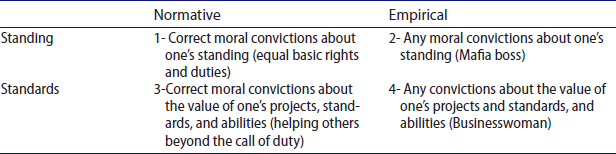
Introducing this distinction yields four kinds of self-respect, as illustrated in Table 1 (with examples used previously entered where they seem most fitting).

Of these, 1 and 4, will be of specific interest for liberal egalitarian theories of justice. As the foundational requirement of such theories is that of paying equal respect to individuals’ autonomy, understood as the capacity to understand, and act on, demands of justice, and the capacity, to adopt, develop, and revise their own conception of the good life, they aim at granting individuals the greatest possible leeway for developing and pursuing such a conception of the good. So they will not issue any particularly stringent moral demands, if any, on the content of standards self-respect (category 3).Footnote 11 And while morally misguided standing self-respect (possible in category 2) is an interesting subject for psychological research, it is clear that theories of justice will, in the first instance, demand, and seek to promote, the right kind of standing self-respect. What that is, for liberal egalitarian theories, and what its social bases are, are the questions to which we now turn.
3. Normative standing self-respect
3.1. Normative standing self-respect under ideal conditions
Morally correct and practically effective convictions about one’s standing are evidently a very valuable good for those who have them, and also for the society of which they are members. Within a Rawlsian framework, such convictions refers to one’s moral standing as a free and equal member of society: as a bearer of rights to equal basic liberties, including political liberties, and to a fair share – equal, or at least not too unequal – of resources. Such convictions are valuable because they give individuals justified confidence that they are worthy of being treated as equals capable of co-determining common affairs in accordance with their sense of justice, that they are capable of developing and carrying out their own conception of the good, and that they may insist on the social and political conditions necessary for both.Footnote 12
At the same time, widespread possession of normative standing self-respect is an important instrumental good for society as a whole. It contributes to the stabilisation of just arrangements, as individuals with such self-respect will reliably protest injustice against them. Standing self-respect is intricately linked to an effective sense of justice: it constitutes its self-regarding part. By protesting injustices against them, individuals will contribute to the cause of those who suffer the same injustices. This is an important connection between the theory of self-respect and theories of just resistance. However, standing self-respect should not be demanded on grounds of its facilitating resistance. This would not properly account for its value, and would be potentially self-defeating. Individuals should be convinced of their own intrinsic worth, not merely of the importance of protesting violations of this worth for others. That it facilitates just resistance is, then, just an additional instrumental reason – albeit an important one – for valuing correct and robust standing self-respect.
However, while the value of normative standing self-respect, and the distinctive reasons it yields for realising a just society, are clear, it is much less clear what, if anything, just arrangements should do for its realisation, on top of what they are already doing. The reason for this is that proper standing self-respect consists of the correct and practically effective awareness of one’s moral standing. Being treated justly means being treated in conformity with it. So, with regard to this kind of self-respect, the question for those advocating special requirements is: why would individuals not keep their proper standing self-respect under such conditions, without any need for additional efforts? All they need to do is internalise that everything is alright, from the point of view of justice. To list self-respect and its bases among the goods over which social justice ranges, alongside goods such as rights, opportunities, and income and wealth, as Rawls does, amounts to double-counting, as far as normative standing self-respect is concerned. It is just these other goods, and their proper distribution, which constitute its social bases. This thought can be expressed with the help of the Alignment Thesis: if social and political arrangements are arranged in a just manner, then proper standing self-respect should follow.Footnote 13
The Alignment Thesis needs to be hedged. It does not deny that there will be special requirements based on self-respect in upbringing, aimed at the formation of persons who are capable of properly acknowledging their own worth. In particular, a successful upbringing nurtures ‘basal self-respect’ (Dillon Reference Dillon1997) - an unshakeable conviction that one is worthy of concern and love - as the basis of the propositionally more complex standing and standards self-respect. Such a sense of self-love will also decisively contribute to people’s capacity to deal with threats to self-respect – though other educational strategies will also be called for (see 3.2.). But why would ‘well-adjusted adults’ (Bird Reference Bird2010, 18), who have, ex hypothesi, received the right kind of upbringing, need extra requirements of justice to preserve their standing self-respect? It seems if such people advocated such requirements, they would be simply making a mistake. Absent special conditions, if social and political arrangements honour people’s moral worth appropriately, it should be up to the latter to properly recognise this.Footnote 14
So, if all other requirements of liberal justice, aiming at the (roughly) equal advancement of persons’ moral powers, are fulfilled, including special requirements of justice in upbringing, considerations of normative standing self-respect do not give rise to additional substantive requirements. The need for proper internalisation merely supports a requirement of publicity, according to which justice must not only be done, but also seen to be done. Social and political institutions must make it reasonably easy for individuals to understand which laws and policies are in place, so that individuals can see that they are being treated justly. Publicity is, then, properly regarded as a specific social basis of standing self-respect.Footnote 15 However, this does not give rise to any new requirements, but merely reinforces a commitment to publicity which, under liberal egalitarianism, will already exist for other reasons, such as reasons of democracy – for the effective exercise of rights to political participation, the arrangements that people live under must be reasonably transparent to them, which requires unhampered public access to relevant information – and, more generally, of assurance that effective rules are in place which enable stable coordination and mutual cooperation.Footnote 16
Importantly, the Alignment Thesis does not say anything about standing self-respect and its maintenance under conditions of injustice. For example, under gendered arrangements of care, many women may find that they are actively discouraged from having the same kind of standing self-respect that many men tend to have: dominant social norms urge them to regard themselves as less important than men (and perhaps children), and to assign their own claims to attention and personal space a backseat, in order to serve and comfort the former. In this example, there is independent substantive injustice: the norms in question prop up an exploitative division of emotional labour. A telling example against the Alignment Thesis would have to be one where harm to standing self-respect is not connected to any such independent injustice. Possible examples for standards self-respect will be discussed in Section 4. For standing self-respect, the obstacle to finding such cases is that, if they are not otherwise unjust (imagine there were good arguments of justice for this unequal division of emotional labour), then individuals ought to adapt their standing self-respect accordingly.
3.2. Normative standing self-respect under adversity
What should we say, then, about cases such as the gender case? This is the question of normative standards self-respect under conditions of adversity; specifically, under injustice. Analysis of such cases shows that just circumstances are not, in their entirety, a social basis for standing self-respect – if the latter is understood as the robust good outlined above. However, certain specific requirements are, which therefore deserve heightened protection.
Let us return to the case of the person who loses standing self-respect, or at least suffers a significant dent to it, as a reaction to being treated unjustly, such as being arbitrarily arrested (2.3.). Views critical of the supposed dependence of people’s self-respect on continued just recognition by others stress that it is not an appropriate reaction to such a scenario to lose self-respect – unjust treatment by others never constitutes a good reason for such a loss (Bird Reference Bird2010, 19). It might, of course, happen, and we have good reasons not to criticise the sufferer. After all, maintaining her self-respect is her own business. But a person whose sense of self-worth is entirely dependent on continued recognition by others does not actually have self-respect, on the analysis developed above, because such dependence does not render a person capable of orienting herself about her own worth in a robust way. The capacity for orientation is robust when it is modally effective over a range of different possible circumstances, and adverse circumstances are naturally the most important case. It is needed precisely in circumstances when not everything goes smoothly, from the point of view of justice. It is most important to remain convinced of your equal moral standing, and to affirm it, when others disregard it: a person with standing self-respect will react to injustice with indignation, and, other things being equal, protest against it – she is committed to affirming her own worth even under adversity. Such a commitment can be expressed by engaging in protest, even where it might have no chance of success (Boxill Reference Boxill1978), or by engaging in other strategies of self-ascertainment, such as conversation with sympathetic others.
However, even if this analysis of standing self-respect and its concurring commitments is right, it does not follow that there are no specific bases of self-respect that theories of justice ought to incorporate. It is true that unjust treatment by others, no matter how unjust, is never, objectively speaking, a good reason to lose self-respect. In that sense, it is never an appropriate reaction. It is appropriate to lose self-respect only in reaction to severe moral failings of one’s own – such as that of being so selfish that one cannot even fulfil the most basic obligations to others. But in a different sense, which is more relevant for theories of justice, losing self-respect is an appropriate reaction when one cannot be reasonably expected to maintain it, because conditions are just too unfavourable.Footnote 17 Having the capacity to orient oneself robustly is not automatic, and also rests on appropriately favourable circumstances. These are its social bases. But there are many injustices, including significant ones, which do not deprive individuals of these.
Take the example of political equality. Rawlsians regard a demanding conception of equal political liberties, including their ‘fair value’, as a particularly important social base of self-respect (Rawls Reference Rawls1996; 318, n. 29). This is because political inequality expresses to the underenfranchised that their political institutions do not regard their interests as worthy of equal advancement, and their sense of justice as not deserving an equal hearing (Krishnamurthy Reference Krishnamurthy2013, 183ff.).Footnote 18
Let us assume that the case for such equal political liberties is indeed unassailable, from the point of view of justice (3.1.). Let us also grant that, as a matter of fact, some people will react to such underenfranchisement with a loss of standing self-respect. Even then, however, we should question whether it is appropriate to react in that way, and investigate further the reasons for which this may be so. Think, for example, about a society in which the political system is successfully rigged by the rich, who secure disproportionate political influence through a variety of means, such as private campaign financing, which is insufficiently regulated, and extensive networks of informal contacts in the political system, which they can activate at will. Now add, however, that the facts of such influence are publicly accessible, and in fact well known to a very large section of the population – perhaps the majority – who react to it with indignation. A lively protest movement exists, organising regular events and demonstrations, protected by effective freedom of speech, information, and assembly. It does not meet with any sanctions, or attempts at repression. Under these circumstances, it does not seem appropriate to react to underenfranchisement by losing the conviction of one’s equal worth – one can join the protest movement, and shore up said convictions in solidaristic action with fellow sufferers of the same injustice. That is, while it is appropriate for the underenfranchised to feel disrespected by political institutions, and, if disparities of political power are sufficiently large and entrenched, even insulted by them, losing standing self-respect is yet another step, and means to avoid it are available.
Contrast this case with a different one, where disparities in political rights are officially mandated, and publicly justified on grounds of the disadvantaged’s supposed moral depravity, and stupidity – the official message is that, were they given equal rights, they would only use them badly, bringing about disastrous outcomes. This message is constantly drummed into people by the government, and the dominant media, which are all on board. Attempts to challenge public discourse, and change political arrangements, meet with a mixed strategy of official counterargument and repression; freedom of speech and assembly are curtailed. As a result, there is no protest movement. At the same time, the state is reasonably successful in guaranteeing a minimum quality of life to all under its power, so that the proposition that changing the political system may engender some undesirable outcomes enjoys at least a minimal credibility. In this scenario, it seems appropriate for the underenfranchised to lose convictions of their equal worth – if they ever managed to develop them, in the first place.
What the example is supposed to show is that the social bases of robust and correct standing self-respect are specific, and not co-extensive with social justice overall, or even with all those requirements of justice that are particularly apt to express people’s equal worth as agents - as equal political rights are (Cohen Reference Cohen and Freeman2002, 110; Gonzalez Ricoy and Queralt Lange Reference Gonzalez Ricoy and Queralt Lange2018, 19ff; Schemmel Reference Schemmel2012, 141). These social bases consist of the motivational and epistemic resources to arrive at, and retain, correct convictions of their own worth, even under injustice. It is difficult to deliver an exhaustive list of these resources, as threats to robust self-respect can vary. But we can make progress by identifying ideal-typical threats, and asking which specific resources are needed to withstand these. The crucial feature of such threats is that powerful others enjoy dominance in the space of reasons on which victims can draw in their self-conception, Footnote 19 and use that dominance to engender misguided beliefs. Dominance can be achieved and maintained in a variety of manners. An important factor in the example above is that the pronouncements of governments, especially effective ones, often serve a special orientation role in society, so that the reasons it gives for its measures will feature prominently in people’s deliberations.Footnote 20 The power to advance effective justifications for inequality – including bad ones– is distinct from, and not reducible to, repressive power (Forst Reference Forst2015, 112f.).
Accordingly, the aim of providing resources for robust standing self-respect is to counteract such power, and to give individuals the means to resist it. Equal freedom of speech, information, and association are crucial such resources. They must include real, effective opportunities to make use of them, both in terms of economic means, and in terms of ensuring the existence of a lively sphere of initiatives and associations. Within these, people can come together in the pursuit of social and political activities which develop and corroborate convictions of self-worth. Of particular importance are effective opportunities to form protest and self-help associations that serve as counter-resources against disorienting and repressive power of other groups, and/or the state.Footnote 21
On liberal egalitarian views, such freedoms and effective opportunities will, again, already be independently required by justice, at least in roughly similar shape, insofar as its main imperative is that of equal respect for individual autonomy. However, if we regard robust and correct standing self-respect as a very important and valuable personal good (3.1.), we have specific reasons to care even more about them; and thus to assign their protection higher priority. They should be superentrenched.Footnote 22
This account of the motivational and epistemic resources needed to develop, and maintain, robust self-respect even under adversity is, as mentioned, not intended to be fully exhaustive. It would, however, be unacceptably incomplete without noting its implications for upbringing and education: the point of such an upbringing for robust self-respect is not to shield adolescents from all possible external threats to their conception of self-worth, but to try to equip them for dealing with these. Unconditional love generating ‘basal self-respect’ will be a – probably indispensable – foundation, but once it is present, it will be important not to hover over adolescents and try to solve all problems for them, but to encourage resilience and capacity for resistance. The right strategy here may not consist of incessant repetition of everybody’s equal worth, and rights (nor of compulsory participation in moral philosophy seminars). A focus on exemplars, such as Rosa Parks, who kept their standing self-respect even under very adverse circumstances, and did not hesitate to affirm their equal worth, may be an important plank. Such a focus might also discourage an unquestioning expectation that one will always receive just treatment by others, and shift attention to the question of how one is to react. But such questions of strategy are ultimately for educational research.
To conclude this analysis of standing self-respect and its social bases under adverse circumstances, it is important to deal with a challenge from the opposite direction. Views inspired by Stoicism argue that, extreme cases such as prolonged torture apart, even very severe injustice still leaves individuals with opportunities for self-ascertainment.Footnote 23 What we should do, to be successful at it, is to base our standing self-respect simply, and austerely, on the awareness that ‘we all exemplify a distinctive, iterated, configuration of genetic material not essentially different from that making up all of nature, capable of agency, self-consciousness, pain and pleasure, joy and sorrow, but with sharply limited control over the events that affect their [sic] lives’ (Bird Reference Bird2010, 34). Our common awareness of these facts could then serve as a basis for compassion and some form of solidarity, thus supplying the link between self-worth and moral orientation.
The response to this challenge is to concede that such a conception of standing self-respect may indeed be more robustly accessible even under conditions of severe injustice; and that adaptation towards it may therefore indeed be a way to limit the damage for individuals who are faced with such injustice, are deprived of the social bases outlined above, and have little opportunity to end the former, or attain the latter.Footnote 24 However, such adaptation involves orienting oneself away from the right kind of standing self-respect for liberal views of justice; rights make no appearance anymore, and equality, if at all, only a very attenuated one. We have discussed the reasons for which liberals ought to regard a richer and more demanding conception, revolving around equal moral standing and rights, as a great good (3.1.). Unless this is wrong, it is worthwhile to inquire into this good and its social bases.
4. Empirical standards self-respect
Let us now turn to the second kind of self-respect of special interest to liberal egalitarians: empirical standards self-respect, that is, the practically effective conviction that one’s projects and plans – whatever these may be – have value, and that one has the requisite talents and abilities for them. For the sake of brevity, this will from now on be referred to as ‘self-esteem’.
Incorporating special concern for self-esteem within theories of justice does not introduce conceptual difficulties similar to those encountered by standing self-respect. While normative standing self-respect has to incorporate considerations of justice, this is not the case for self-esteem. There is nothing incoherent in objecting to an otherwise just social and political arrangement on grounds of it. For example, somebody who is disadvantaged in terms of income and wealth can, in this sense, perfectly well say ‘I know there are no (other) grounds of justice for condemning this inequality, but I can’t help myself: I feel a lack of worth because of it’. On the substantive level, however, basing demanding egalitarian requirements on self-esteem generates two problems. The first is the intimate connection of such requirements with envy; the second is that a requirement of equal bases of self-esteem could lead to imposing limits on freedom of association in favour of some form of conformism. Because of these problems, liberal egalitarian views of justice encounter severe internal tensions when trying to incorporate such requirements. This section elucidates these tensions, and proposes a construal of self-esteem and its social bases that avoids them.
Rawls’s view of self-respect incorporates both dimensions of standing self-respect and self-esteem.Footnote 25 He uses ‘self-respect’ and ‘self-esteem’ interchangeably, and defines it ‘as having two aspects. First of all, […] it includes a person’s sense of his own value, his secure conviction that […] his plan of life […] is worth carrying out. And second, self-respect implies a confidence in one’s ability […] to fulfill one’s intentions (Reference Rawls1999a, 386). Empirical standards self-respect (self-esteem) is in play insofar as the sense of worth in question is spelled out also by reference to one’s particular conception of the good, and abilities.
As noted, it is easy to see how egalitarian concern for this good could give rise to special requirements of justice on social and political institutions: making sure everybody has equal social bases of it, or at least that they are distributed in a maximin fashion, could lead to more stringent limits on economic inequality than might otherwise be required. This is because possession of resources is itself an important ground for confidence that one is able to fulfil one’s projects, for which these are instrumental (Eyal Reference Eyal2005, 208); and, more indirectly, as social comparisons, in particular with the more advantaged and their projects, might put a dent into the sense of worth of their own projects that individuals are able to secure.
Rawls entertains the possibility that even otherwise justifiable inequalities might endanger the self-esteem of the worse off, and give rise to “excusable general envy’ (Reference Rawls1999a, 468). He concedes that, in this case, inequality needs to be narrowed further (465f). However, he is aware of how dangerous this strategy is. Envy is ‘collectively disadvantageous’ (466). It can be satisfied by simply making the envied worse off, and is, unlike indignation, ‘not a moral feeling’ (467): it does not commit its bearer to giving a justification for why it is morally appropriate to feel it. Therefore, he does not characterise envy as directly relevant for justice, but merely argues that, if sufficiently widespread, it might endanger the stability of (otherwise) just institution: ‘[W]e check to see whether just institutions […] are likely to arouse and encourage these propensities to such an extent that the social system becomes unworkable […]’ (465, my emphasis). This suggests that what is at work is not egalitarian concern for the self-esteem of disadvantaged individuals (no matter how many they are), but a straightforwardly instrumental consideration about securing as much justice, in the long term, as people’s imperfect psychologies might allow.
We have seen above (2.3.) that self-esteem, too, is a capacity for orientation, and that it needs to be robust. To some extent, people must be able not to compare themselves to the wrong groups and individuals. Just as a person whose convictions of her moral worth crumble at every injustice has no standing self-respect, a person whose positive image of herself requires favourable comparisons with everybody else does not have self-esteem. From that, however, it does not follow that envy must never be elevated to a concern of justice. It is still possible that inequality, or some degree of it, just creates too unfavourable circumstances for the maintenance of self-esteem.
Holding this, however, generates two difficulties. The first is that it saddles such an account with having to devise a non-arbitrary criterion for how much inequality exactly is too much for everybody’s healthy self-esteem, even if there are no (other) injustices. This problem is very difficult, perhaps impossible, to come to terms with: it encourages speculation about how people would conceive of their social status, and what they would base their self-esteem on, under (otherwise) just arrangements. Such claims are very difficult to back up.
The second, and deeper, problem with permitting such an additional constraint on inequality on psychological grounds is that it introduces a fundamental tension with a standard requirement on the justification of equality, or inequality, that is at the core of autonomy-based liberal egalitarianism: that the case for certain social and political arrangements over others is not based on how people might be disposed to feel towards each other, but on independent reasons concerning which allocation of opportunities among individuals for adopting and carrying out different conceptions of the good is fair. Even though self-esteem is, on a liberal view, unlike standing self-respect, (largely – see 2.2.) not a moral concept, liberals have to entertain principled limits on what, in terms of social bases, can be demanded in its name.
Analysis of the relationship between self-esteem and freedom of association reveals similar internal tensions. Here we encounter the problem of conformism. Liberals such as Rawls, and Scanlon, argue that freedom of association is especially conducive to everybody’s self-esteem, as it allows all individuals to join associations with others committed to similar standards, where mutual confirmation of their value takes place. Cross-group comparisons consequently recede into the background (Scanlon Reference Scanlon, Clayton and Williams2002, 55f; Rawls Reference Rawls1999a, 470). In this way, self-esteem generates an additional argument for this core liberal freedom, supplementing the standard argument based on offering the widest possible range of opportunities to exercise one’s autonomy together with others. For Rawls, the generation of self-esteem follows the ‘Aristotelian Principle’ - ‘[H]uman beings enjoy the exercise of their realized capacities […], and this enjoyment increases the more the capacity is realized, or the greater its complexity’ (Reference Rawls1999a, 364)– and this principle is generally person- and group-relative: self-esteem comes from enjoying one’s particular abilities and the esteem of like-minded others within particular associations (385), apparently without the need to look to society at large.
However, if this is empirically false, egalitarian concern for self-esteem can work against freedom of association. If cross-group comparison is prominent, and many people engage in evaluations according to which some activities generally command more esteem than others – such as activities that are more complex and challenging, or make contributions to overall societal culture that are widely regarded as particularly valuable (Thomas Reference Thomas1978, 261ff.) – then individuals lacking the abilities needed to participate in groups based on these activities face higher risks of ending up with low self-esteem, even if such groups are diverse. Egalitarian concern for their social bases of self-esteem then generates a case for socialising people into one cohesive overarching group, and ensuring that conformity to its standards is the main social base of self-esteem (as well as for making sure that they are easy to fulfil). This would be in fundamental tension with the standard liberal case for freedom of association. Again, we are led to demand principled limits on what, for liberals, can be appropriate bases for self-esteem.
To be sure, this does not magically do away with these difficulties. With regard to income and wealth, it might just be the case that a significant proportion of people will react very negatively towards inequality exceeding a certain range even where it is (otherwise) perfectly justified, and will not be capable of adjusting their self-esteem. This could be a kind of anthropological constant about life in society.Footnote 26 With regard to freedom of association, it might be the case that, even in a just society, the combination of reigning tendencies to cross-group comparisons and available group options always leaves some individuals with less favourable opportunities to find their particular projects valued by peers and society at large. The point is simply that these are problems, which, within liberal theories of justice, cannot be easily solved by making a few adjustments, because these adjustments would be in fundamental tension with liberal conceptions of the person as free and autonomous.
Perhaps these problems ground a good case against these theories, then. Within them, they generate pressure to construe self-esteem so as to demand, in a way that is parallel to the capacity of robust standing self-respect to withstand injustice, a capacity to withstand its own particular adversities: the injunction to learn to avoid pernicious comparisons by adjusting the range of people and projects one measures oneself against must specifically include others of whom one knows that they receive more esteem for what they do, or that they enjoy more means to develop their particular abilities and projects (insofar as this is otherwise consistent with justice).Footnote 27
Again, however, demanding such robustness of self-esteem does not imply that there are no specific social bases for it which theories of justice should incorporate. In upbringing, this will require not to shower children and adolescents with constant praise and esteem for whatever they do, thus creating corresponding expectations for adult life, but unconditional love coupled with encouragement to concentrate on oneself, on sober assessments of one’s own strengths, and on cultivating the willingness to build on these.
Such self-esteem then still needs to be protected against a set of particularly dangerous external threats. One such threat consists of dominant status norms which actively narrow the range of available esteem-bases. Take a society in which reigning social norms not only dictate that the possession of income and wealth confers esteem, but also that only their possession confers it.Footnote 28 This is a case of dominance in a Walzerian sense (Walzer Reference Walzer1983, 10ff.): the norms in question crowd out other social esteem mechanisms, whatever these may be. So, special efforts are required to counter such norms.Footnote 29 Another particularly pernicious threat consists of depriving some of the opportunity, not to engage in particularly complex, and meaningful, activities, but in activities that are generally regarded as useful to others.Footnote 30
The social bases of self-esteem are thus, in important respects, similar to those of normative standing self-respect. They include freedom of association, including real opportunities for group formation and membership and the means to make use of them, a lively civil society with, plural spheres of achievement, and guaranteed opportunity for some achievement (such as useful work). Again, fulfilling these requirements will overlap significantly with fulfilling liberal core requirement of paying equal respect to everybody’s autonomy. But they need not perfectly coincide, and even where they do, concern for robust self-esteem grounds a claim to their elevated protection.
5. Conclusion: objections
By way of conclusion, let us consider several possible objections to the argument made so far, in order to sharpen it, and clarify some of its implications.
One objection that can be quickly set aside runs as follows: the argument has mainly pointed out that the social bases for the two kinds of self-respect identified aim at providing opportunities for individuals to develop and maintain them, not a guarantee that they will do so. But everybody, including the standard Rawlsian views discussed, accepts this. Doppelt, for example, is clear that ‘[w]hatever the social conditions, persons may fail to exercise, recognize, or properly value their moral powers’ (Reference Doppelt2009, 134). That much is simply up to them. The response to this objection is that the argument has done more than that: it has identified specific ways in which functioning self-respect has to be robust, and specific threats it has to be able to deal with. These threats include, for standing self-respect, some significant kinds of injustice, and, for self-esteem, some disparities not only in talents, but also in esteem, and means for their exercise. That is what is missing in such views, and what constitutes robust self-respect.
This clears the way for a second, more interesting objection. According to it, such standard views and the view developed here simply aim at different goods. Standard views aim at secure confidence in one’s equal possession of the moral powers and of opportunities to exercise them, where ‘secure’ means ‘externally unchallenged’ (2.3.). To this extent, the argument may have talked past them; such security is desirable, and, if it is present, it is not necessary to focus on robustness. Or, perhaps, we could simply aim at both.
There are two problems with this objection. The first is that, comparing these two goods, it is robust self-respect that is more valuable for individuals, and thus has a better claim to being ‘perhaps the most important primary good’: it is better for individuals to be able to orient themselves even in the face of significant external threats. It constitutes a superior capacity for self-direction, and thus for effective agency in a greater variety of different circumstances. As seen, standard views tend to tie the question of whether others’ actions are insulting, or constitute disrespect in other ways, too closely to the question of self-respect.Footnote 31 But individuals with real self-respect are capable of feeling insulted, and perhaps even humiliated, while retaining it, and thus their orientation.
The second problem is the following: the confidence that Rawlsians want is certainly a welcome by-product of just arrangements (3.1.), but, once we agree that we should promote robust self-respect, explicit efforts to promote the former would not only be unnecessary, but also somewhat self-contradictory. Attempts to promote robust standing self-respect are successful when individuals understand, and internalise, that it is not appropriate to lose it in reaction to injustice. But that just means that, if Rawlsian confidence in one’s standing is under threat, the attitudes constitutive of robust self-respect need to be activated. If, against that, we made special efforts to shield people from such injustice specifically on grounds of such confidence, in addition to whatever else grounds the injustice in question, this would seem to imply a lack of trust in their robust self-respect - or even that it would be appropriate to lose it, after all. For self-esteem, there are substantive reasons for liberals to aim at enabling a capacity to withstand a specific set of threats whose elimination in the name of secure confidence about the value of one’s talents and projects cannot be demanded. The esteem conditions for unchallenged Rawlsian confidence might perhaps sometimes be equally present for all, if we are fortunate – but we cannot go further than that.
A third objection is that the argument seems to overlook those who cannot attain robust self-respect even under the favourable circumstances demanded. There are at least two relevant cases: the first is that of individuals who face difficulties due to special conditions, such as a propensity to depression, or paranoid schizophrenia. The second concerns cases of victims of previous severe injustice, which included deprivation of the social bases of self-respect. These may be disabled from attaining proper self-respect even if its bases are now present. In both cases, nothing in the argument rules out special accommodation. In the second case, temporary measures of special assurance are certainly appropriate even after the end of the primary injustice, to allow victims to rebuild their sense of worth and gain trust and confidence in their societal arrangements – such as public apologies for past oppression, and remembrance events.Footnote 32 In the first case, it is important to keep in mind that the argument concerned the social bases of self-respect for otherwise well-adjusted, healthy adults; it can, and should, be coupled with an argument about justice in health and health care to account for such cases. But this is a task for another day.
A final objection is that, even in ‘ideal’ cases, real self-respect is an illusion: the fortitude of character that constitutes it is attainable only for the fortunate few. For the rest, self-respect just is dependent on others’ respect and esteem in the way sustained by dominant views. This is an empirical question; the jury is out. We have likely not yet seen a society in which the social bases of real self-respect are guaranteed for all (let alone a fully just society). If the argument of this paper is sound, we have good, and distinct, reasons to try to bring it about.
Funding
Part of this work was supported by a Senior Research Fellowship at the Centre for Advanced Studies ‘Justitia Amplificata – Rethinking Justice’ at Goethe Universität Frankfurt and Freie Universität Berlin.
Acknowledgments
I would like to thank audiences at Nuffield College, Oxford, King’s College, London, Jerusalem, Warwick, Manchester, Bologna, Braga, Zürich, and Frankfurt for their questions and comments. Special thanks go to Emanuela Ceva, Francesco Chiesa, Rob Jubb, Miriam Ronzoni, Andrea Sangiovanni, and Laura Valentini for extensive written comments on earlier versions, and to two anonymous reviewers for comments on the near-final one. Thanks also to Tom Christiano and Robert Goodin for some advice on framing and structure of the paper.