


Unhealthy eating is the main worldwide risk factor for mortality and years of life lost due to disability(1), also being associated with malnutrition, micronutrient deficiencies and obesity(Reference Shrimpton2,3) . Additionally, food can influence human health through the environmental impacts caused by diets derived from unsustainable food systems(Reference Swinburn, Kraak and Allender4,Reference Shrimpton5) . Considering that all these problems occur simultaneously and have effects that enhance each other, they are understood as a Global Syndemic(Reference Swinburn, Kraak and Allender4), one that affects children and adolescents in a particularly intense way considering the vulnerabilities of this group and possible long-term effects that would affect them(3,6) .
Given the global awareness and relevance of this theme, the fight against all forms of malnutrition has been included in the Sustainable Development Goals for 2030, which outlines strategies such as the promotion of healthier eating behaviours and the adoption of sustainable food systems(6,7) . To achieve these goals, encouragement of consumption of fresh or minimally processed foods from sustainable agriculture and the disincentive to the consumption of ultra-processed foods are highlighted(Reference Swinburn, Kraak and Allender4,7) .
The structuring of well-designed school feeding programmes is essential in this agenda. These programmes act directly on all axes of the syndemic, while also encouraging students to stay in school and improve their learning skills(6–Reference Swinburn, Sacks and Hall8). The Brazilian National School Feeding Program (PNAE, in the Portuguese acronym) is the second-largest of such programmes in the world(9) and was referenced internationally in 2016 as a promising public policy model to achieve these objectives(10).
The meals offered by PNAE are free of charge and intended for students in the basic public school system. One to three meals can be offered with an amount of energy, macronutrients and micronutrients depending on the student’s age range, school vulnerability, shift (morning, intermediate, afternoon, evening or full time) and the grade the student attends(11,12) . Its guidelines also state the provision of meals based on staple food, the prohibition of sugary drinks and the restriction on the supply of Na- or saturated fat-rich ultra-processed foods, as well as the promotion of healthier food systems through links with family farming producers, should be highlighted and praised(11,13) . The relationship between the consumption of PNAE meals and the diet quality of students from the ninth grade of elementary school was recently investigated using data from the 2012 National School Health Survey (PeNSE, in the Portuguese acronym)(Reference Locatelli, Canella and Bandoni14). These results and other Brazilian(Reference Horta, Do and Junior15–Reference Azeredo, de Rezende and Canella17) studies suggested that school meals can promote healthier eating habits.
The 2015 PeNSE survey(18) included, for the first time, students from the sixth grade of elementary school to the third grade of high school, in addition to the usual sample of students (ninth grade of elementary school). Therefore, an unprecedented opportunity was presented to expand the investigation of the PNAE role as a public policy promoting healthy eating and a strategy to contribute to the mitigation of Global Syndemic in a sample that covers the entire adolescence period. Furthermore, considering the importance of adolescence as a critical phase of development and progressively greater autonomy that can influence their outcomes and long-term health choices(Reference Lobstein, Jackson-Leach and Moodie19), this study aims to assess the association between consumption of the PNAE meals and the diet quality of adolescents aged 11 to 19 years enrolled in the Brazilian public education.
Methodology
Database and sample
This was a cross-sectional study based on the 2015 PeNSE data(18). PeNSE is a 3-year survey with adolescent students that started in 2009. It was initially representative of the state capitals in Brazil and was later expanded to the whole country. It is a partnership between the Ministry of Health and the Brazilian Institute of Geography and Statistics (IBGE, in the Portuguese acronym) and is supported by the Ministry of Education(18). In 2015, PeNSE included an expanded sample (called ‘sample 2’) of students from the sixth grade of elementary school to the third grade of high school, from public and private schools that attended classes during that year, both from urban and rural areas throughout the Brazilian territory.
The sample estimates are representative of Brazil and the five major regions (North, Northeast, Southeast, South and Midwest). Schools in these regions were selected using a cluster sampling scheme based on data from the 2013 School Census. Data collections were carried out in 371 schools, which were represented by 653 classes. All students were asked to take the survey, totaling 16 608 completed questionnaires. Of this total, fifty-two questionnaires were not validated because students refused to participate or did not report age or sex(18).
Classes with less than fifteen students and students attending the following High School stages/modalities were excluded from the data collection: adult education (EJA, in the Portuguese acronym), concomitant professional education, subsequent professional education, mixed professional education (concomitant + subsequent), 4th year/4th grade of regular, integrated or normal/teaching high school(18).
Only questionnaires from public school students were analysed (n 12 381 students; 282 schools) in the present study. After excluding non-respondents to the questions regarding exposure and/or the outcome of this study, the final sample corresponded to 12 260 adolescents.
Data collection and study variables
IBGE agents carried out data collection between April and September 2015. The students completed a self-administered electronic questionnaire, which included several variables, without the need for interference from the interviewer(18).
Exposure variable
The exposure variable in this study, which was the consumption of school meals, was assessed by the question ‘do you usually eat the food (school meal/lunch) offered by the school?’. The possible answers were: ‘Yes, every day; Yes, 3 to 4 d a week; Yes, 1 to 2 d a week; Rarely; No; It does not apply (students who did not know how to answer or answered that the school did not offer meals)’. High consumption of PNAE school meals was considered when the adolescents consumed school meals 5 d/week. The remaining students were considered as without or infrequent consumption of school meals.
Sensitivity analyses were performed by considering the high consumption of school meals as the consumption of three or more meals per week and excluding schools in which most of the students answered that they did not receive school meals (nine schools in total).
Outcome variables
The diet quality was assessed based on questions regarding food consumption in the previous 7 d of the week, a method considered satisfactory and a valid indicator of dietary habits(Reference Horta, Do and Junior15). The adolescents could answer that they did not consume or indicate a frequency that varied from 1 to 7 d. The assessed food groups were beans, vegetables, fruits, fried salty snacks, treats (e.g. candies, sweets, chewing gum and chocolates), soft drinks and ultra-processed salted foods (e.g. hamburgers, sausages, packaged salty snacks and instant noodles). The first three food groups were classified as healthy eating markers and the other four as unhealthy eating markers, a classification adopted by IBGE(18). Finally, three scores were created to evaluate the outcome: (1) consumption of healthy foods; (2) consumption of unhealthy foods and (3) overall diet quality (healthy + unhealthy foods).
The consumption frequencies were grouped into weekly consumption of 0 to 2 d, 3 to 4 d, and 5 to 7 d, and zero, one or two points were assigned to the score for each of these frequencies, respectively. The scores were calculated by summing the scores corresponding to the number of times in the week that each food was consumed. Therefore, zero in the first score (consumption of healthy foods) means the lowest diet quality and six corresponds to the best quality possible, while zero in the second score (consumption of unhealthy foods) indicates a better-quality diet and eight the lowest diet quality. In the calculation of the overall score, the unhealthy foods score was inverted and thus, the best score was 14 points (6 points from the first score plus 8 points from the inverted second one).Thus, the scores ranged from 0 to 6; 0 to 8 and 0 to 14, respectively. The scores showed satisfactory internal consistency (Cronbach’s α = 0·78; 0·77 and 0·68, in that order).
Covariates
Variables related to socio-demographic characteristics, physical activity, presence of cafeteria in the school and eating habits outside of school were used to describe the sample and as potential confounders in the models of the association between exposure and outcomes.
The following variables were used to describe socio-demographic characteristics: sex (female or male); race/skin colour (white, black, yellow, brown or indigenous); age (groups: 11 to 15 years; 16 to 19 years); regions (North, Northeast, Southeast, South and Midwest); living with parents (neither, both or just one); maternal education (groups: incomplete elementary school; completed elementary school; completed high school; higher education – either complete or incomplete), home situation (rural or urban), school shift (morning, afternoon, intermediate, full time and evening) and a score for goods and services (categorised in thirds of the distribution observed in the sample studied), adapted from Levy et al. 2010(Reference Levy, Castro and Cardoso20). The following items were included to create the goods score: ownership of television, landline phone, cell phone, car and presence of paid domestic worker. Each item received a weight equivalent to the inverse of the frequency of ownership or presence in the total sample studied. Then, the weights of the respective items were added for each adolescent.
The level of physical activity was calculated from the questionnaire validated by Tavares et al. (2014)(Reference Tavares, Castro and Levy21), considering the sum of the weekly commute time to school, physical education at school and sports activities for leisure/extracurricular. Those who performed at least 300 min of physical activity per week were considered active, following the recommended level of physical activity by the WHO(22). The presence of a cafeteria at the school was answered by the school principal in a separate questionnaire.
To determine the eating profile outside of school, the following habits, on 5 or more d/week, were assessed: (1) having breakfast; (2) having lunch or dinner with parents or guardians; and (3) eating while watching television or studying. The first two were considered positive habits, while the third was considered negative.
Since 27·8 % of the questionnaires did not include answers about the maternal education variable, a multiple imputation analysis was carried out, assuming that the losses were random and these values were conditioned to other variables. The main analysis model included all the covariables described above as predictors of maternal education for the imputation process. The results of twenty-five imputations showed satisfactory statistical reproducibility according to the Monte Carlo error analysis (Reference Royston and White23).
Statistical analysis
A descriptive analysis of the socio-demographic variables, level of physical activity, eating habits outside of school, food consumption and the presence of a cafeteria at school was performed for the general sample. High consumption of school meals (daily) was described for the sample as a whole and according to covariates. The association between high consumption of school feeding and each covariate was assessed by Poisson regression.
Linear regression models were used to test the association between high consumption of school meals (exposure) and results (diet quality scores). To control the potential confounders, for each score we performed two adjusted models. The first one, including sociodemographic characteristics, and other adding the level of physical activity, presence of cafeteria at school and consumption outside the school environment. The data were presented at 95 % confidence intervals (95 % CI) and the significance value adopted was P ≤ 0·05. PeNSE is designed with a complex sample, including strata, primary sample units (schools) and sample weights. To account for all the characteristics of the sample design we have used the SVY command (survey command) in all analyses. The Stata/se software version 14.2 was used for all analyses, and the complex design of the sample was considered.
Results
Data from 12 260 students were analysed. The characteristics of this Brazilian adolescent population, aged 11 to 19 years and students in public schools, are described in Table 1. It is noteworthy that most of the adolescents declared to be either black or brown (59·1 %) and aged between 11 and 15 years (59·3 %). Most of the students resided in urban areas (92·9 %), in the Southeastern (38·7 %) and Northeast (30·2 %) regions of the country, and their mothers did not complete elementary school (40·1 %). The adolescents attended mostly to morning and (44·6 %) and afternoon (34·4 %) school shifts. The most regularly consumed (≥ 5 times/week) healthy food was beans (60·0 %), while only a third of the students consumed fruits (31·9 %) and vegetables (36·8 %) with the same frequency. Treats were the most frequent (38·6 %) unhealthy foods regularly consumed, followed by salted ultra-processed foods (29·2 %) and soft drinks (26·6 %).
Socio-demographic, food consumption and health habits of adolescents aged 11 to 19 years attending public schools. Brazil, 2015
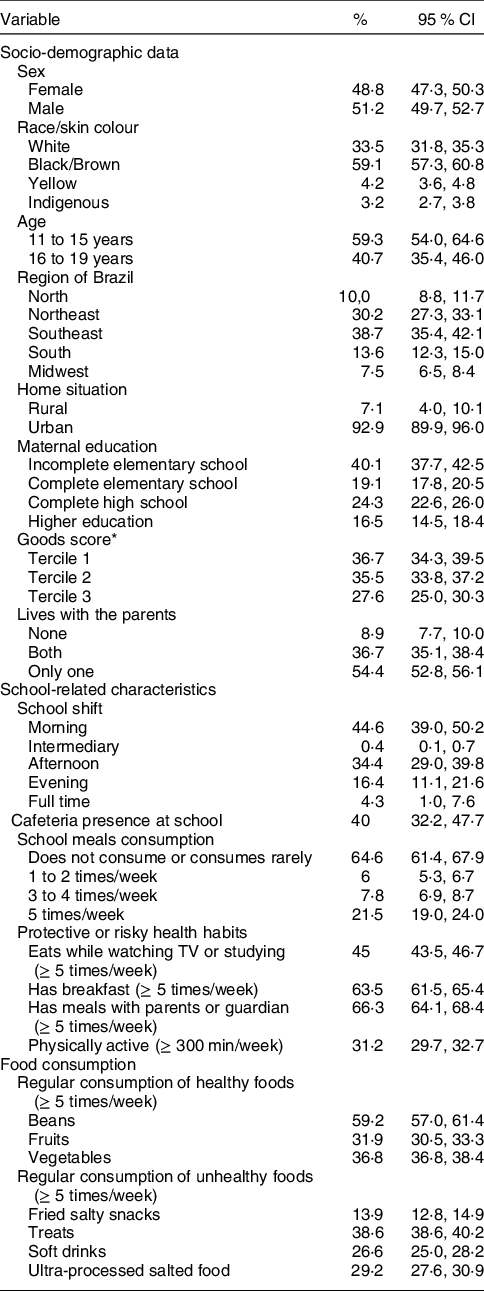
* Calculated from the variables: landline phone, cell phone, computer, car and paid domestic worker.
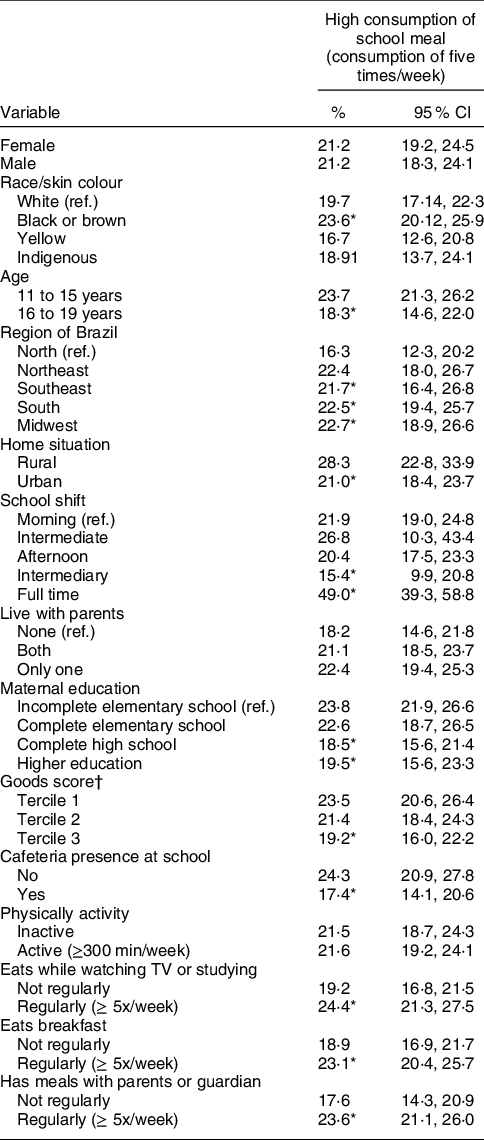
Regarding the frequency, 21·5 % consumed school meals every day and were considered as having high consumption of the school meals, while 64·7 % reported not consuming the meals on any day of the week and 13·8 % from one to four times a week. Table 2 presents the high consumption of school meals according to the characteristics of the sampled adolescents.
High consumption of school meals of adolescents aged 11 to 19 years attending public school according to socio-demographic data, eating outside of school profile and physical activity. Brazil, 2015
Ref. = Reference.
* P < 0·05.
† Calculated from the variables: landline phone, cell phone, computer, car and paid domestic worker.
High consumption of school meals was significantly higher in adolescents that were black or brown, younger, residents of the rural area, full-time students, who had breakfast, who had meals with parents/guardians and that frequently had meals while studying or watching television. There was a significantly lower consumption of school meals among adolescents with higher goods score, who had mothers that completed high school or attended higher education, that were students from a school that had a cafeteria in its interior and/or studied in the evening shift.
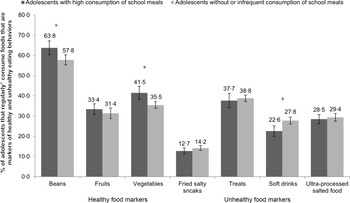
Figure 1 shows the regular consumption of healthy and unhealthy food markers according to consumption of school meals. Adolescents with high consumption of school meals had significantly higher regular consumption of beans (P = 0·002) and vegetables P < 0·001) and lower regular consumption of soft drinks (P < 0·001) when compared with others. No statistically significant difference was found in the consumption of fruits, treats, fried salty snacks and ultra-processed salted snacks between the adolescents with high consumption and those who does not eat school meals or eat less frequently.
Regular consumption of foods that are markers of healthy and unhealthy eating behaviors of adolescents aged 11 to 19 years old and students of public schools, according to the consumption of school meals Brazil, 2015. *Significantly different P < 0·05; †consumption ≥ 5 times/week
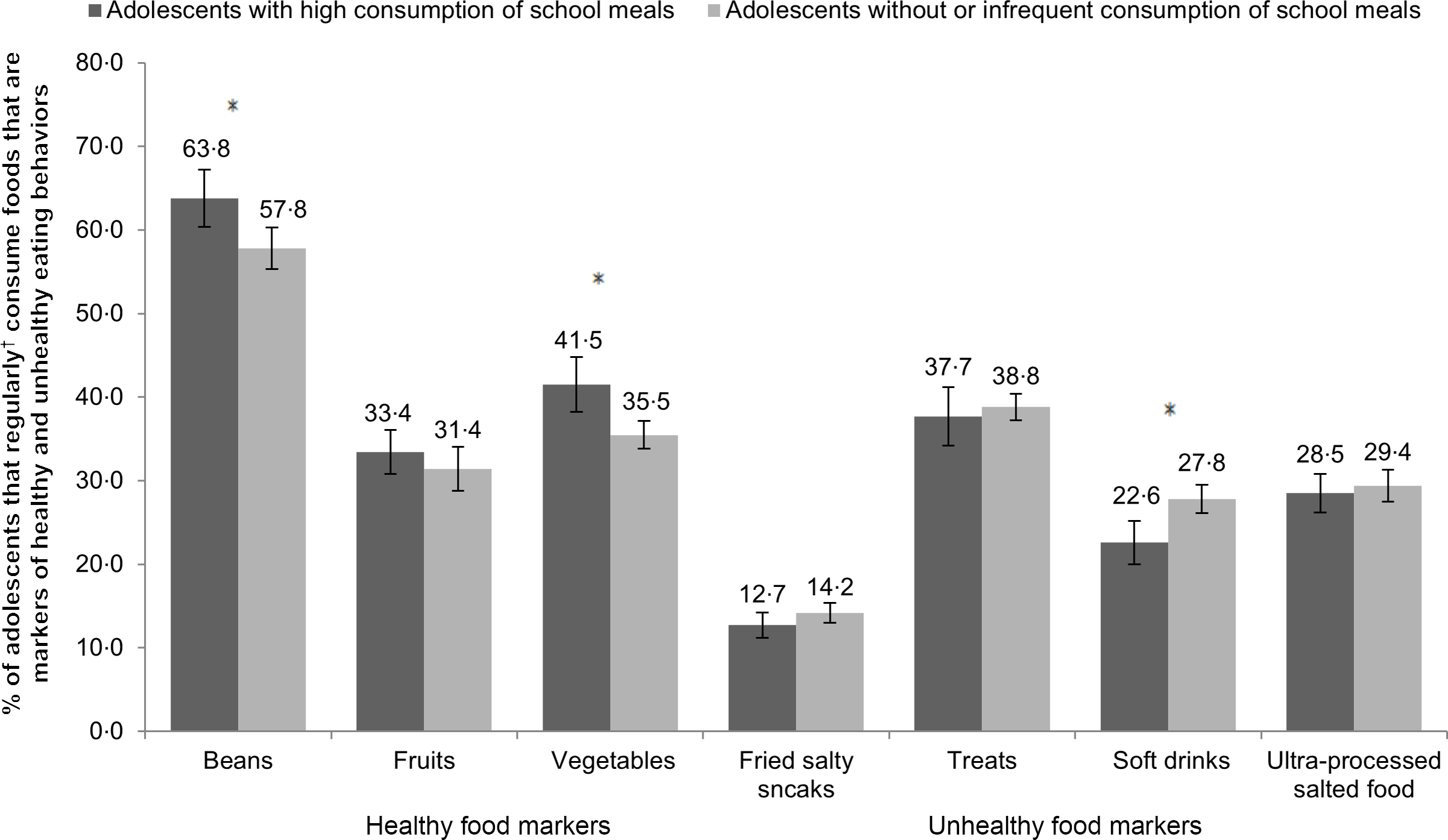
Table 3 shows that the high consumption of school meals was associated with a better quality diet. Students with a high consumption of school meals had an average healthy food score 0·20 (95 % CI 0·08, 0·32) points higher than those who does not eat school meals or eat less frequently. Furthermore, they had a lower average in the unhealthy food score when compared with those who did not consume school meals every day (< 5 times/week) (coefficient −0·24 points; 95 % CI −0·39, −0·1). Finally, students displayed an average in the overall healthy eating score 0·46 points (95 % CI 0·28, 0·63) higher than the others. There was no substantial change in any of the associations found after adjusting for covariates. Sensitivity analyses considering high consumption of school meals, defined by the consumption of the school meals 3 or more times/week and excluding schools in which most of the students reported to not receive school meals, showed maintenance of the association between variables and significance in all tests.
Association between consumption of school meals and the quality of the diet scores of adolescents aged 11 to 19 years attending public schools. Brazil, 2015

* P < 0·05.
† Calculated from the categories of weekly frequency (0 to 2 times, 3 to 4 times and 5 o 7 times) of consumption of beans, fruits and vegetables where 0 = consumed two times or less healthy foods and 6 = consumed all healthy foods at least five times a week.
‡ Calculated from the categories of weekly frequency (0 to 2 times, 3 to 4 times, 5 to 7 times) of consumption of treats, soft drinks, ultra-processed salted foods and fried salty snacks, where 0 = consumed two times or less unhealthy foods and 8 = consumed all unhealthy foods at least five times a week.
§ Calculated from the categories of weekly frequency (0 to 2 times, 3 to 4 times and 5 to 7 times) of consumption of healthy (beans, fruits or vegetables) and unhealthy foods (treats, soft drinks, ultra-processed salted foods and fried salty snacks), where 0 = consumed two times or less healthy foods and five times or more unhealthy foods and 14 = consumed five times or more all healthy foods and two times or less unhealthy foods.
‖ Adjusted for socio-demographic variables (gender, race/skin colour, age, home situation, goods score, maternal education, living with parents and school shift).
¶ Adjusted by model 1 + eating outside of school profile (eating while watching television, eating with parents and guardians and having breakfast), school cafeteria and physical activity.
Discussion
The results of this study suggest that consumption of school meals positively influenced the diet quality of adolescents aged 11 to 19 years that attended Brazilian public schools. It was also associated with both lower consumption of unhealthy foods and higher consumption of healthy foods. Thus, these results support the evidence that the school feeding offered by the PNAE can play an important role in health promotion in Brazil and contributes to mitigate the global syndemic.
These findings became even more important considering the recent growing trend of a worldwide increase in the consumption of ultra-processed foods in replacement of fresh and minimally processed foods, which was also noted for the Brazilian population(24). Data from the previous PeNSE editions already showed a reduction in the consumption of beans(Reference Reis, Malta and Furtado25), high consumption of ultra-processed foods and low intake of fruits and vegetables among Brazilian adolescents(Reference Levy, Castro and Cardoso20,Reference Azeredo, De Rezende and Canella26) . The eating patterns acquired during adolescence are usually worse than in childhood and tend to remain similar in adulthood(Reference Cruz, Ramos and Lopes27), thus interventions to improve eating habits and prevent detrimental outcomes are essential. Considering that adolescents spend a large part of the day at school and that the consumption of food outside the home contributes to an important fraction of their diet(Reference Lachat, Nago and Verstraeten28), successful actions in the school environment aiming to improve the diet quality are worth mentioning.
The results showing the association between higher consumption of school meals and a higher-quality diet among adolescents are consistent with the PNAE legislation. The PNAE rules, since 2009(13), follow the current Brazilian guidelines, which value a diet based on fresh or minimally processed foods and limited consumption of ultra-processed foods(29). The provision of a menu with at least three servings of fruits and vegetables, upper limits for simple sugar, fats and salt, a ban on the offer of sugary drinks and a restriction on the purchase of semi-prepared foods with federal government resources exemplify these rules(11). These parameters were improved and became more strict in 2020, after the definition that the PNAE resources should be spent following criteria based on food processing, particularly restricting purchases of ultra-processed foods(30). Another established practice to encourage high-quality menus enriched with fresh and minimally processed foods is the allocation of 30 % of the programme’s specific budget to the purchase of foodstuffs from family farming(Reference Ventura, Gonçalves and Diogo31,Reference Sidaner, Balaban and Burlandy32) . Finally, two key differential values of the programme are the requirement of a professional nutritionist as the technical manager responsible for the elaboration of menus and the existence of a supervisory board. Since the PNAE aims at offering 20 to 70 % of students’ daily needs(12), it was expected that the quality of the offered meal would have a direct impact on students that join the programme.
The present findings regarding the positive association of school meals and the consumption of healthy foods strengthen the previous results obtained from PeNSE 2012 data(Reference Locatelli, Canella and Bandoni14), which surveyed students from the ninth grade of elementary school (14 and 15 years old). Data from PeNSE 2012 survey demonstrated that students that consumed school meals three to four times a week or more displayed higher consumption of healthy food groups. Here, a similar result was found when the sample age range was expanded (11 to 19 years), the consumption was assessed through scores, the criterion for considering high consumption was more rigid (five times a week) and the model was adjusted by factors such as the level of physical activity, school characteristics (shift and presence of a cafeteria) and profile of eating outside of school. Besides, the protection for the consumption of unhealthy foods was also consistent with the results of other studies with Brazilian adolescents(Reference Locatelli, Canella and Bandoni14,Reference Horta, Do and Junior15,Reference Azeredo, de Rezende and Canella17) .
A recent survey with students aged 8 to 12 years living in one of the Brazilian state capitals demonstrated that a high frequency of consumption (3 times a week or more) the food provided by PNAE was associated with higher diet quality(Reference Horta, Do and Junior15). The associations had higher magnitude among students living in areas associated with a higher social vulnerability risk. The survey concluded that consuming the school meals frequently meant less consumption of ultra-processed foods – mainly lesser soft drink consumption – and a higher consumption of fresh and minimally processed foods, with higher average consumption of fruits and vegetables when compared with their peers. Another study worth mentioning showed that better scores on an overall quality of the diet score had already been found among students from public schools when compared with students from private schools, where the PNAE is absent(Reference Azeredo, De Rezende and Canella26).
It is important to highlight that, despite our positive findings, the percentage of high consumption of school meals was only 21·5 %. However, this result was no different from other Brazilian studies that also pointed to a low consumption of school meals (23·2 to 46 %)(Reference Cesar, Valentim and Almeida33), especially when referring to adolescents (17 to 22 8 %)(Reference Locatelli, Canella and Bandoni34,Reference Honário, Rocha and Fortes35) . The main factors commonly identified to justify low consumption of school meals are related to student preferences related to the time when meals are served, a structure of the place, the taste and temperature of the food, socio-economic issues, food preferences and competition with snacks sold in school cafeterias(Reference Valentim, Choma and Taconeli36,Reference Cesar, Taconeli and Osório37) . Other issues involving adolescence may play a role in low consumption of school meals, such as restrictions or reductions in consumption due to body image disorders, acceptance by the group and strengthening of autonomy(Reference Pegolo and Silva38,Reference Miyawaki, Lee and Kobayashi39) . Thus, increasing consumption of meals offered by PNAE seems to be a priority to expand the benefits related to the health of students and also to achieve goals related to sustainable development.
Finally, the socio-demographic profile of adolescents with high consumption of the meals offered by PNAE was also similar to other studies(Reference Locatelli, Canella and Bandoni14,Reference Honário, Rocha and Fortes35–Reference Cesar, Taconeli and Osório37,Reference Sturion, Silva and Ometto40) . High consumption was most common among black or brown students, with mothers with less education and family income (score of goods). These findings are noteworthy, as it affects a group whose socio-demographic markers were associated with poorer quality of diet in Brazilian studies involving adolescents(Reference Assumpção, Barros and Fisberg41,Reference De, Sarti and Pereira42) . Thus, a supply of healthy food by school programmes can play an interesting role in reducing possible disparities in access and consumption of this type of food, such as fruits and vegetables(Reference Horta, Do and Junior15). In addition, age also seems to influence the school meals consumption; previous studies(Reference Pegolo and Silva38,Reference Sturion, Silva and Ometto40) showed a decline in consumption with increasing age. Another point associated with the consumption of school meals was the study shift. The adolescents who most consumed the PNAE meals were those on the full-time shift, where the nutritional contribution coming from the programme is more than double in relation to the partial shifts(11) Although our results remain significant after adjusting for shift, another Brazilian study showed that the longer time spent at school was associated with less consumption of ultra-processed foods and greater contribution of fresh or minimally processed foods to the students’ diet(Reference Bento, Moreira and Carmo16). In addition to the socio-demographic characteristics, our study corroborates with other study, showing that certain behaviours at home, such as having breakfast and having meals with parents or guardians, are positively associated with the regular consumption of school meals(Reference Locatelli, Canella and Bandoni14). The presence of a school cafeteria, and consequently the sale of competitive foods with school meals, has also been associated with lower consumption of school meals(Reference Honário, Rocha and Fortes35–Reference Cesar, Taconeli and Osório37) and higher consumption of unhealthy foods(Reference Azeredo, de Rezende and Canella17).
The study has some limitations. First, the FFQ does not assess quantities. Besides that, it was already considered a satisfactory tool to estimate the eating practices of adolescents(Reference Tavares, Castro and Levy21). Second, the questions related to food consumption were not restricted to school days, thus it cannot be ascertained that healthy or unhealthy foods were consumed at school. However, we believe that this is not an important limitation since consumption and exposure to food at school have the potential to influence consumption outside this environment(Reference Micha, Karageorgou and Bakogianni43). It is worth mentioning that although we have adjusted for several variables, it is still possible to have residual confusion in the analyses. Finally, school menus and compliance with the programme’s rules have not been evaluated here, but we stress that this study aimed to evaluate the results of the PNAE regardless of how it was carried out by each school. After mentioning the limitations, we highlight as strengths of this study its sample size. The present study is representative of both Brazil as a whole and each of the Major Regions of the country, while also covering an ample age range.
In conclusion, the results of this study showed that high consumption of the PNAE meals was associated with a better diet quality among adolescents, reinforcing its potential to mitigate the global syndemic. Strategies to increase the consumption of school meals among adolescents seem relevant to broaden the reach of these benefits to a greater number of people. This is especially relevant in a scenario where the consumption of few healthy foods and many unhealthy foods contributes to one in each five deaths worldwide(1). The update of the Program’s legislation raises the expectations that the results from joining the PNAE may be even greater. Lastly, our findings suggest that PNAE may be an important strategy for health promotion.
Acknowledgements
Acknowledgements: The authors thank the Coordenação de Aperfeiçoamento de Pessoal de Nível Superior (CAPES) and Conselho Nacional de Desenvolvimento Científico e Tecnológico (CNPQ) for financial support. Financial support: This work was supported by CAPES and CNPQ (grant number 442999/2019-4). CAPES and CNPQ had no role in the design, analysis or writing of this article. Conflict of interest: The authors declare that they have no competing interests. Authorship: M.B. participated in the design and planning of the study, analysis and interpretation of data and the manuscript writing. F.R. participated in the data interpretation and approval of the final version of the manuscript. C.M.A. participated in the planning of the study, in the data interpretation and approval of the final version of the manuscript. R.B.L. participated in the planning of the study, data interpretation and approval of the final version of the manuscript. M.L.L. participated in the planning of the study, data interpretation, the critical review of the content and approval of the final version of the manuscript. Ethics of human subject participation: This study was conducted according to the guidelines laid down in the Declaration of Helsinki, and all procedures involving research study participants were approved by The Brazilian National Research Ethics Council (registration no. 1,006,467) and The Research Ethics Committee of the School of Physical Education and Sport of the University of São Paulo (registration no. 3,558,870/2019). Written informed consent was obtained from all subjects.