1. Introduction
Early metazoans required sufficient oxygen to enable their complex morphologies and lifestyles, and their appearance in the fossil record coincides with rising but fluctuating oxidation conditions of the early Palaeozoic oceans (Wood & Erwin, Reference Wood and Erwin2018). Gills – organs specialized in transferring oxygen from the external medium to the interiors of animals – appeared by the early Cambrian and played an important role in the biodiversification of early metazoans (Raff & Raff, Reference Raff and Raff1970). Structures exposed to the external environment are liable to pollution and damage, and actions that maintain their efficient functioning likely offered advantage. Among living aquatic animals grooming is considered to be a ‘secondary behaviour’ undertaken when ‘primary behaviours’, such as feeding, mating and fighting, are not being conducted (Vanmaurik & Wortham, Reference Vanmaurik and Wortham2014). One of the principal functions of grooming in arthropods is to clear the gills so as to maximize the surface area available for oxygen uptake (Wortham & Pascual, Reference Wortham and Pascual2017), and it is regarded as a task essential for survival (Pohle, Reference Pohle1989). However, grooming has rarely been discussed with respect to the early arthropod fossil record (Fortey & Owens, Reference Fortey and Owens1999; Waloszek, Reference Waloszek, Legakis, Sfenthourakis, Polymeni and Thessalou-Legaki2003; Stein et al. Reference Stein, Waloszek, Maas, Koenemann and Jenner2005), and gill grooming has only been proposed in a single Silurian ostracod, Spiricopia aurita (Siveter et al. Reference Siveter, Briggs, Siveter and Sutton2018). Here we investigate the appendicular details of two trilobites, the middle Cambrian Olenoides serratus and the Late Ordovician Triarthrus eatoni, and suggest how their gills were cleaned.
2. Materials and methods
Materials described in this paper are housed in the Geological Survey of Canada (GSC), Ontario, Canada; The Hunterian Museum, University of Glasgow (GLAHM), UK; the National Museum of Natural History (NMNH) of the Smithsonian Institution, Washington, DC, USA; and the Yale Peabody Museum of Natural History (YPM), Yale University, USA.
The pyritized specimens of Triarthrus eatoni are from the Beecher’s Trilobite Beds of the Katian (Late Ordovician) Frankfort Shale of upper New York State, USA, and the Katian Whetstone Gulf Formation (‘Martin Quarry’) (Briggs et al. Reference Briggs, Bottrell and Raiswell1991; Farrell et al. Reference Farrell, Martin, Hagadorn, Whiteley and Briggs2009). Specimens of Olenoides serratus are from the Burgess Shale Biota of the middle Cambrian (Wuliuan Stage) Burgess Shale Formation (previously known as the Stephen Formation) of British Columbia, Canada (Briggs et al. Reference Briggs, Erwin and Collier1994). The limbs of both these trilobite species show a consistent morphology along the anterior–posterior body axis, except for specialized limbs recently interpreted to represent sexual dimorphic features (Losso & Ortega-Hernández, Reference Losso and Ortega-Hernández2022), and differ slightly in size (Whittington, Reference Whittington1975; Whittington & Almond, Reference Whittington and Almond1987). Of c. 250 specimens examined by us either directly or as images, few show the necessary combination of well-exposed setae on both walking legs or gill shafts, and gill filaments, which are necessary for assessing the relationship between setae and their associated gill branch and for providing relative size data. The clearest insights come from limbs preserved in incomplete specimens (GSC 34692, 34695, 34697; USNM 65514). For this reason, we cannot identify the particular trunk segment to which the limbs described belong, except in USNM 65513 (and its counterpart USNM 58590) in which the limb is the third cephalic biramous appendage (Whittington, Reference Whittington1975). The terms walking leg and gill branch used in this paper follow Whittington (Reference Whittington1975) and we use them because they simplify our discussion of functionality.
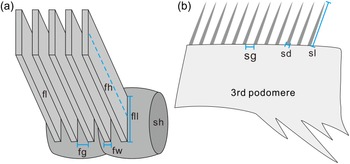
Here, filament length (fll; Fig. 1a) is measured along the dorsoventral axis where the filament contacts the gill shaft or lobe, as this direction closely mirrors the long axis of the dorsoventrally pointed setae of the walking legs. The long axis of the filament we refer to as filament height (fh; Fig. 1a). Filamental gap (fg; Fig. 1a) is measured along the proximal end of the filaments, which is near the shaft or lobe of the gill branch. The extent of the filamental gap is measured between the margins of adjacent filaments (Fig. 1a), where its length is least affected by taphonomic compression. The interfilament interval is the combination of the thickness of one filament measured across the inflated, dumbbell-shaped end (corresponding to the end of the inflated marginal bulb of the filament, as described in Hou et al. (Reference Hou, Hughes and Hopkins2021)) and one filamental gap. Setal gap (sg; Fig. 1b) is measured along the podomere of the walking leg. Setal diameter (sd; Fig. 1b) is measured along a line that is perpendicular to the seta itself or to setal length (sl; Fig. 1b). Setae have clearly exposed boundaries (light-coloured matrix in figures) that are parallel to each other and thus serve well for measurement of setal diameter.
Illustration of the measurement terms used in this paper: (a) reconstruction of the partial gill branch of Triarthrus eatoni showing the filament length and filament gap; (b) reconstruction of the partial walking leg of Olenoides serratus showing the setal diameter, setal gap and setal length. Abbreviations: fg, filamental gap; fh, filament height; fl, filament; fll, filament length; fw, filament width; sd, setal diameter; sg, setal gap; sh, gill shaft; sl, setal length.

The specimens were photographed using a Canon EOS 50D with Canon EF-S60 mm lens, Leica MZ16 with DFC420 lens, Leica M205C with DFC 700T lens, Opto-Digital Microscopy and PHILIPS XL-30 Environmental Scanning Electron Microscope (ESEM). The Opto-Digital Microscopy and Leica M205C is installed with a stack or non-stack function. The ESEM was used with both backscattered-electron (BSE) and gaseous secondary electron (GSE) techniques, which are described in the figures. Figures were prepared using CorelDRAW 2018. For more information see Hou et al. (Reference Hou, Hughes and Hopkins2021).
3. Results
3.a. Olenoides serratus
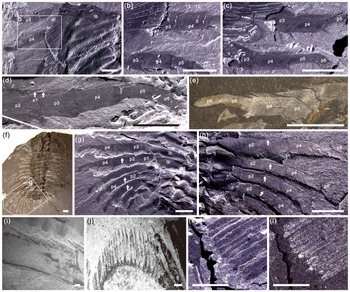
The endopod (walking leg) bears setae on the dorsal surface of its third to fifth podomeres (Whittington, Reference Whittington1975). Podomeres 3 and 4 are preserved close to the distal margin of the gill branch. Podomeres 3, 4 and 5 bear as many as 14 (calculated based on the number of visible setae and the length of podomere 3 in Fig. 2d), 15 (Fig. 2b, d) and 3 (Fig. 2c, d) setae, respectively, inserted on their dorsal surfaces. Podomere 2 may also have borne dorsal setae, as one possible example is recognized (Fig. 2d) although confirmation of this is difficult in these two-dimensionally preserved specimens. The length of the setae is c. 2.5 times (observed in five specimens) the length of the opposed filaments on the other branch of the same biramous limb. Measuring the well-preserved appendages (Fig. 2a) shows that the filaments are arranged c. 0.28 mm apart, and the dorsal setae on the walking leg are arranged c. 0.25 mm apart and are each c. 0.15 mm in diameter. Each gill filament also bears a group of setae distally, about five in total, which are slightly shorter than the filament length (Fig. 2j–l). The distal lobe of the gill branch bears setae that are approximately four times longer than the filament setae (Fig. 2j).
Setae on appendages of Olenoides serratus: (a–c) dorsal setae of walking legs, GSC 34695a – (b) has been rotated 180° with respect to (a); (d) dorsal setae of walking legs, GSC 34697; (e) dorsal setae of walking legs, GSC 34694; (f–h) dorsal setae of walking legs, USNM 58589; (i–j) setae on both walking leg and gill branch, USNM 65514; (k–l) distal setae of gill filaments, GSC 34697. Arabic numbers mark the number of setae. White arrows point to dorsal setae. Abbreviations: dl, distal lobe of the gill branch; ds, distal seta of the gill filament; lb, limb base of the walking leg; pl, proximal lobe of the gill branch; p1–6, podomeres 1 to 6, respectively. Scale bars: 0.2 mm (i, j); 2mm (k, l); 5 mm (a–h).

3.b. Triarthrus eatoni
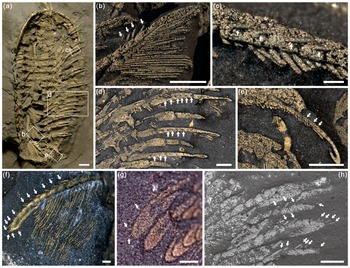
In contrast to the walking leg setae of O. serratus, T. eatoni had setae on the shaft of its gill branches (Fig. 3a–h). Most proximal shaft articles apparently bore one seta (Fig. 3a–e), but there were possibly two or more in each article on the distal shaft articles (Fig. 3f–h). The terminal spoon-shaped article of the shaft, actually consisting of many separate narrow articles (Fig. 3d–f), bore many spines surrounding its margin (anterior, distal and posterior), forming a terminal brush-like structure (Fig. 3f–h). The length of setae on the gill shaft is about four times the length of associated filaments. The diameter of the setae is about half of the interfilament interval.
Grooming setae of Triarthrus eatoni and reconstructions of grooming behaviour: (a–e) T. eatoni, GLAHM 163103, close-up of shaft setae in (b–e) being marked in (a); (f) T. eatoni, setae on the margin of gill shaft and the distal portion of the gill filaments, YPM 220; (g) setae on the gill shaft of T. eatoni, USNM 65527; (h) setae on the gill shaft of T. eatoni, USNM 400932. White arrows point to shaft setae. ds, distal seta of the gill filament. Scale bars: 0.2 mm (c, f–h); 1 mm (b, d, e); 5 mm (a).

4. Discussion
4.a. Grooming gill filaments
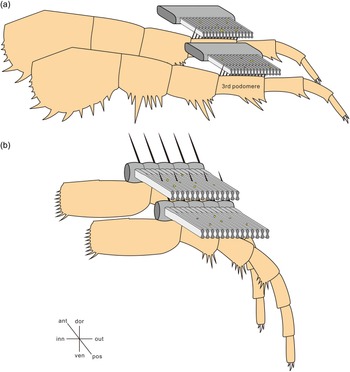
In Olenoides serratus, the distal lobe of the gill branch partly overlapped the third podomere of the walking leg (Fig. 2a), thus the majority of the gill branch was not located directly above the dorsal setae, which are on podomeres 3 to 5. The mismatch between gill filaments and dorsal setae means that these two structures were not in direct contact when the appendages were prone. However, with rotation of walking legs during the walking motion, these dorsal setae moved in relative position. Anterior or posterior rotation of the walking leg positioned both podomeres 3 and 4 beneath the gill filaments, and thus the dorsal setae could penetrate between the gill filaments (Fig. 4a). This interaction between the dorsal setae and the gill filaments achieved the grooming function. This is consistent with evidence that a slightly narrower interval between dorsal setae than between gill filaments allowed each slim seta to penetrate into the gaps between filaments, which had a relatively wide interval, possibly permitting every interfilament channel to be cleaned. The distal setae of the filaments themselves (Fig. 2j–l) may have provided additional aid in grooming the gill filaments of the adjacent appendage by working together with the dorsal setae of the walking legs.
Reconstructions of trilobite grooming behaviour: (a) partial grooming reconstruction of Olenoides serratus; (b) partial grooming reconstruction of Triarthrus eatoni. The fouling materials are reconstructed as randomly distributed irregular yellow shapes.

The possible seta (Fig. 2d) and linear impressions (Fig. 2g–h) on podomere 2 hint that there may have been additional setae on the dorsal surface of that podomere and possibly also on podomere 1. As the appendages decrease in size posteriorly along the trunk (Whittington, Reference Whittington1975; Whittington & Almond, Reference Whittington and Almond1987), it is possible that the number of dorsal setae varied among walking legs, but during rotation all dorsal setae of the walking legs were located closely beneath the gill filaments in the necessary posture for grooming. In contrast, the ventrally located endite spines of the walking legs are considered to have been used for processing food and their location prevents them having been used in grooming the gill filaments.
In Triarthrus eatoni, setae are developed not on the walking leg, but along the gill shaft itself, where a single seta is located near the distal end of each article. We envisage a situation in which these setae groomed the gill filaments of the appendage preceding them (Fig. 4b). The diameter of the grooming setae is about half of the interfilament interval, meaning that the seta is wider than the gap near the inflated dumbbell-shaped ends, with the thickness of these ends about twice the filament gap (Hou et al. Reference Hou, Hughes and Hopkins2021). However, the ratio of the setae to filaments is about 1:3. A small number of setae compared to filaments would allow setae to easily penetrate into the filament gaps, and we envisage some flexibility amongst filaments, that may have temporally compressed together during grooming. Thus, each seta may have serviced several adjacent filaments via a series of grooming sweeps. This grooming form and function is clearly distinguished from that of O. serratus.
In both species, the grooming setae, being distinctly longer than the length (dorsal–ventral direction) of the filaments, allowed them to pass between and extend beyond the filaments, effectively extruding particles trapped between adjacent filaments (Fig. 2a–l, 3a–h, 4a–b). Coordination between the grooming setae and the gill filaments apparently worked to remove fouling material from the surface of the gill filaments (Fig. 4a–b). The two different positions of setae studied herein may suggest that multiple solutions to gill fouling evolved among trilobites. Among modern arthropods, particularly crustaceans, grooming is an activity pursued on a necessarily daily basis. Crustacean gill filaments are relatively fragile and are located in concealed positions, and these animals use a diversity of structures to perform grooming, e.g. the epipod (Bauer, Reference Bauer1981), pereiopod (Batang & Suzuki, Reference Batang and Suzuki2003) or chela (Bauer, Reference Bauer1979) for gill grooming (Bauer, Reference Bauer, Watling and Thiel2013). Coordination between the appendages and gills in modern crustaceans (Bauer, Reference Bauer, Watling and Thiel2013) is comparable to that described above for the two trilobite species. In modern examples the grooming setae display a high diversity of morphologies (Bauer, Reference Bauer, Watling and Thiel2013; Wortham & Pascual, Reference Wortham and Pascual2019), suggesting varied ways of dealing with gill fouling. Perhaps likewise, here we suggest two different modes of gill cleaning among some of the only trilobite species sufficiently well preserved to permit its evaluation. Modern crustaceans can also use appendages on the right side of the body to clean gills on the left side of their bodies (Batang & Suzuki, Reference Batang and Suzuki2003). This appears not to have been possible in these trilobites because the ventrally projected endite spines of the walking legs would have obstructed such movement. Considering that the morphology of grooming structures has played an important role in the classification of arthropods (Spruijt et al. Reference Spruijt, Van Hooff and Gispen1992), further analysis of setal morphology and possible grooming behaviour among trilobites may prove to be phylogenetically informative.
4.b. Contamination source
Palaeozoic Cruziana or Rusophycus trace fossils are known to have been produced by trilobites or trilobite-like arthropods (Alpert, Reference Alpert1976; Seilacher, Reference Seilacher1985; Crimes & Droser, Reference Crimes and Droser1992; Seilacher, Reference Seilacher2007). Their construction via walking leg digging involved disturbing seafloor sediment, and resuspending it. Unlike decapod crustaceans that have the branchiostegite (gill chamber) to protect from gill fouling (Bauer, Reference Bauer, Flelgenhauer, Watling and Thistle1989), the openly exposed gill filaments of trilobites would bring them into direct contact with suspended sediments or particles. Thus the water flowing through gill filaments would have been rich in suspended particles that could have become trapped between gill filaments. While digging and associated food collection may have been a primary cause for gill fouling, periodic storms in the shelf settings where these trilobites lived were likely another. Biological contamination was likely another important source. There are already several cases of epibiont or symbiosis recorded in diverse Cambrian animals (Zhang et al. Reference Zhang, Han, Wang, Emig and Shu2010; Cong et al. Reference Cong, Ma, Williams, Siveter, Siveter, Gabbott, Zhai, Goral, Edgecombe and Hou2017; Li et al. Reference Li, Williams, Harvey, Wei, Zhao, Guo, Gabbott, Fletcher, Hou and Cong2020; Nanglu & Caron, Reference Nanglu and Caron2021; Yang et al. Reference Yang, Vannier, Yang, Wang and Zhang2021), and trilobite exoskeletons were targets for biological attachment (Brandt, Reference Brandt1996; Hughes, Reference Hughes, Zhuravlev and Riding2001; Key et al. Reference Key, Schumacher, Babcock, Frey, Heimbrock, Felton, Cooper, Gibson, Scheid and Schumacher2010; Baets et al. Reference Baets, Budil, Fatka, Geyer, Baets and Huntley2021). In modern crustaceans, tightly arranged filaments provide other organisms the opportunity to trap particles from the respiratory stream, favouring the growth of microbial organisms and epizoites on the gill surfaces (Bauer, Reference Bauer, Flelgenhauer, Watling and Thistle1989). Without grooming, such fouling can be severely deleterious (Bauer, Reference Bauer, Watling and Thiel2013). Given structural similarities, such conditions can both be expected to have also occurred in trilobite gill filaments.
4.c. Other aspects of grooming
Folding or complex patterns of overlap among gill filaments have been recorded among early arthropods (Stein, Reference Stein2013), and, if this also happened in live trilobites, grooming may also have helped in preening the gill filaments into optimal disposition, reducing the possibility of entanglement among the filaments of adjacent gill branches. If, as in modern arthropods such as horseshoe crabs (Sekiguchi et al. Reference Sekiguchi, Seshimo and Sugita1988), moulting frequency declined with age, grooming maintenance may have had an especially high premium at later ontogenetic stages, such as those preserved in the two cases discussed herein.
Acknowledgements
This research was funded by the US National Science Foundation EAR-1849963 (N.C.H.), the Smithsonian Institution Fellowship Program, and the International Postdoctoral Exchange Fellowship Program – Talent-Introduction Program of the China Postdoctoral Science Foundation (J.-b.H.). It is a contribution to IGCP668. We thank Doug H. Erwin, Mark Florence, Kathy Hollis, Finnegan Marsh, Conrad C. Labandeira, Jennifer Strotman and Scott Whittaker of NMNH for accessing the specimens and providing research techniques; Michelle Coyne for assessing specimens of the Geological Survey of Canada; Derek EG Briggs, Susan Butts, Elissa Martin, Jessica Utrup and Zhenting Jiang of YPM for accessing the specimens and technical help; Neil DL Clark of GLAHM for access to specimens; Mary L Droser and Liza and Chris Casey for their logistic support; and Derek Siveter and James Holmes for carefully reviewing the manuscript, which resulted in significant improvements.
Declaration of interest
The authors declare none.