

Slavery and the Natural World, a series of events and online publications at the Natural History Museum, London, directed by Tracy-Ann Smith, written and edited by Katherine Hann, document research by Katherine Prior and Mabintu Mustapha. Viewable online at http://www.nhm.ac.uk/nature-online/collections-at-the-museum/slavery/ (accessed 5 January 2010).
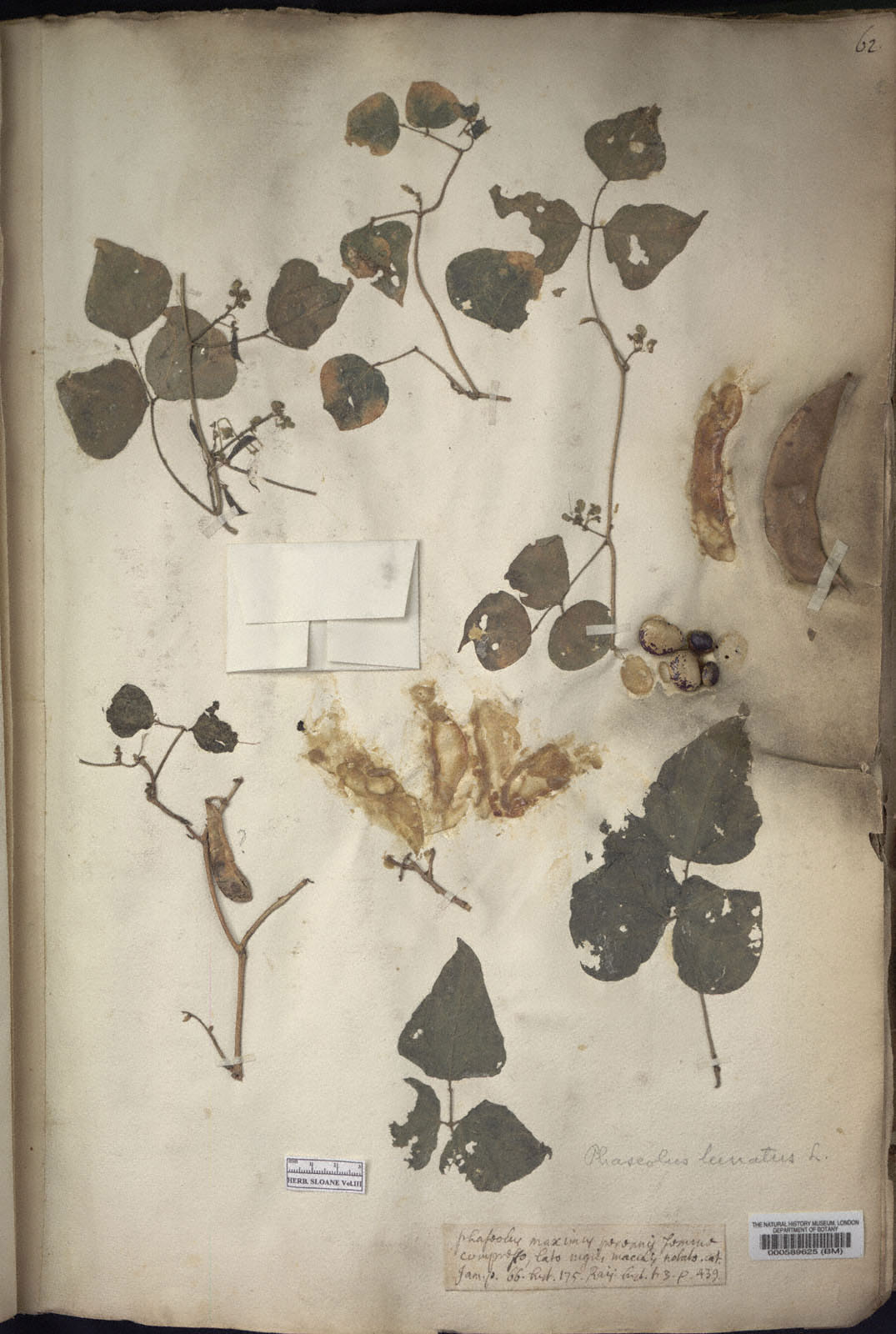
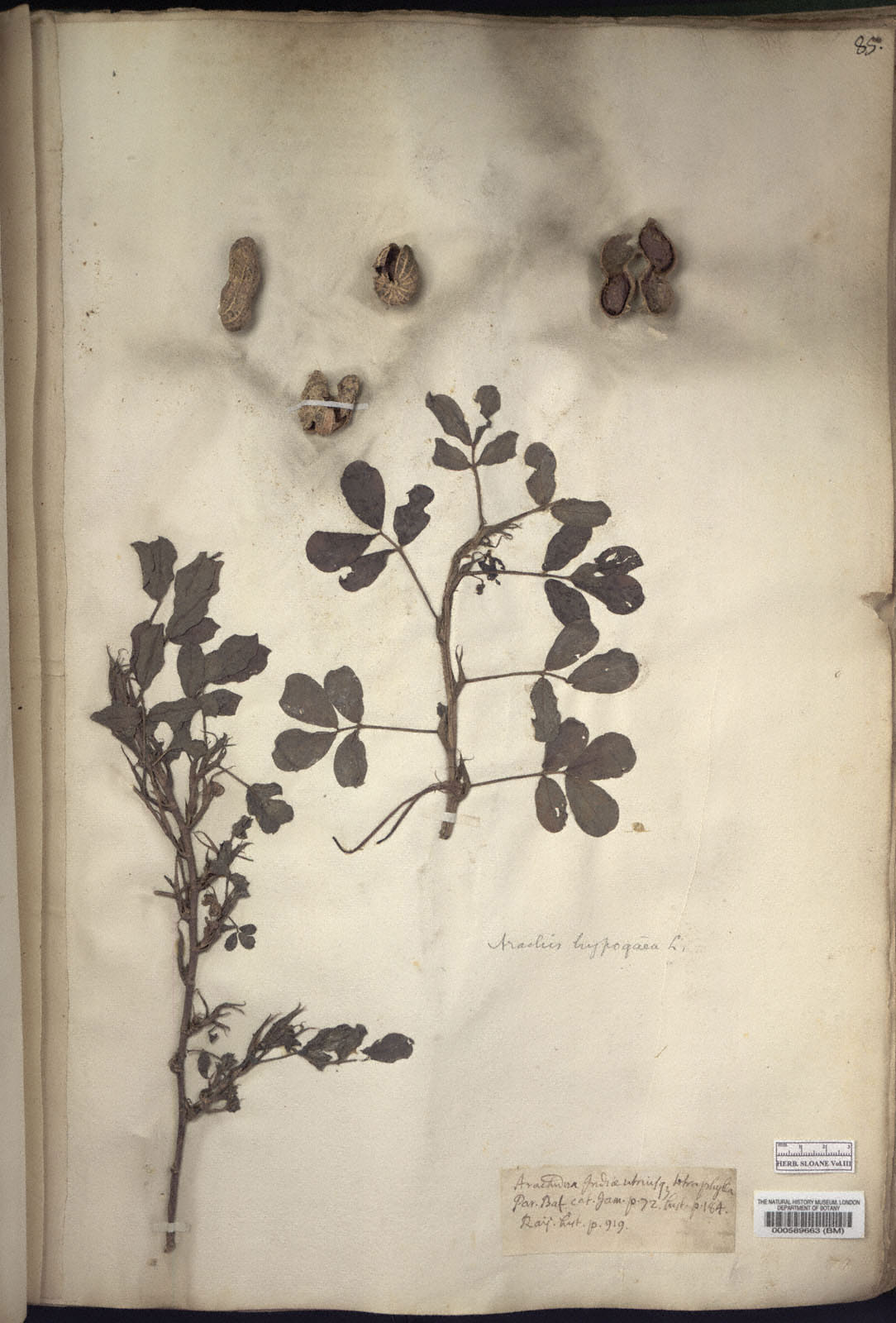
The herbarium of Hans Sloane in the Natural History Museum's Department of Botany is a cunning object: a book of colonial nature that contains ethnographic artefacts in the guise of natural specimens. The eight volumes of Sloane's specimens from his Jamaican voyage of 1687–1689 hold both dried plants and sample foodstuffs, many together with the original drawings prepared for the engravings of them published in the Natural History of Jamaica (1707–1725). These remarkable volumes have been re-bound over the years, but the plants, seeds and fruits remain essentially where they were when glued to the page over three hundred years ago. Visitors may examine heroic samples like Sloane's Cacao: the most famous specimen in the herbarium, and both a lucrative commodity and a type specimen. But the majority, wrapped in their pre-Linnaean polynomials, are far more anonymous. Consider, for example, the Phaseolus maximus perennis, semine compresso, lato, nigris maculis notato and the Arachidna Indiae utriusque tetraphylla: varieties of kidney-bean and peanut. These bean and nut samples are highly significant, however. They are tangible evidence of how the Atlantic slave trade shaped the making of natural history. Dutifully sourcing his specimens, Sloane noted that Phaseolus beans ‘are planted in most gardens, and provision plantations, where they last for many years’ – ‘provision plantations’ being a synonym for plots of land cultivated by enslaved Africans.Footnote 1 The Arachidnae, meanwhile, were ‘brought from Guinea in the Negroes ships, to feed the Negroes withal in their voyage from Guinea to Jamaica’. On a plantation tour of Jamaica, he had seen them ‘planted, from Guinea seed, by Mr. Harrison, in his Garden, in Liguanee’.Footnote 2 Africans themselves, on the middle passage and in their provision grounds, were agents of environmental transformation as much as Europeans and, far from being discounted, African expertise was deemed vital to European projects of natural history. The beans and nuts Sloane fixed in his herbarium were essential to African provisioning and to the support of plantation slavery. Thus one of the founding collections of British botany contains at its centre powerful specimens of African experience, displaced and exploited via the slave trade.
Strikingly, only in the last few years have scholars begun to examine the agency of the slave trade in circulating natural knowledge, suggesting the possibility of overcoming the long-standing notion that slavery and science had nothing to do with each other, and that the ‘social death’ of enslavement denuded African migrants of all epistemic capacity. Thirty years ago, William Grimé's Ethno-botany of the Black Americans (1979) catalogued numerous examples of plants and herbs used by Africans across the Atlantic world, as documented in European natural histories, although few historians of science seemed to pay much attention. Historians of race have, of course, long been interested in the objectification of Africans by naturalists. But treating Africans as subjects and actors in early modern histories of natural knowledge is a recent development. Scholars have now begun to raise pressing questions about Africans as active carriers and producers of botanical and medical knowledges, as collectors, expert cultivators, keepers of provision grounds, and skilled poisoners. The link between institutional science and the slave trade, meanwhile, has always been hidden in plain view in the British case, as demonstrated by the overlooked career of Sloane – the future Royal Society president and British Museum founder who gathered specimens in Jamaica, then emerging as the most lucrative slave colony in the first British empire.Footnote 3
Though not primarily concerned with natural knowledge, Vincent Brown's The Reaper's Garden provides an insightful history of colonial Jamaica that suggests how scholars can advance the study of colonial knowledges through more multi-sided and intercultural histories of contests over natural landscapes and their meanings. Brown's is a cultural history of death in Jamaica, and his central claim, inspired in part by the work of the pioneering anthropologist Melville Herskovits, is for the role of death in shaping Jamaican life, both for colonizers and for the enslaved. ‘The dead are active participants in the world of the living’, Brown writes, outlining what he describes as a ‘materialist history of the supernatural imagination’ (pp. 4, 5). Jamaica was a catastrophic machine for consuming human lives to make profits through the trade in Africans and the production of sugar, and it became central to Britain's economy in the eighteenth century. As Daniel Defoe caustically noted in 1713, the year British merchants won the asiento to supply slaves to Spain's American colonies and the Peace of Utrecht opened a period of unprecedented commercial growth, ‘no African trade, no negroes; no negroes no sugars, gingers, indicoes, etc; no sugars etc no islands, no islands no continent; no continent no trade’ (quoted p. 24). In the century when British merchants surpassed their competitors in slaving, Jamaica witnessed the most sales of Africans in any British colony and the highest prices paid for them, accounting for one-third of the empire's 2.2 million slaves between 1740 and 1807. If the physical hardship of sugar cultivation did not kill Africans, then diseases like the yaws, tetanus or lockjaw might. Colonizers were by no means immune themselves, as Abraham James's iconic caricatures of the damned ‘Johnny New-come’ witheringly documented.
Brown's chapters, which admirably seek to deal in complementary manner with African and British experience, discuss funerary practices, property inheritance, ‘Obeah,’ death in abolitionist discourse and syncretic African-evangelical Christianity. Three main themes emerge that relate to natural knowledge: conceptions of matter and spirit, magical systems and practices, and slave gardens. African animism confounded Europeans' desire to see matter as brute substance subject to higher powers. Olaudah Equiano, for example, wrote of white slavers as dark sorcerers and evil magi, resistance against whom required deploying sacred talismans and ritual cleansings. In Jamaica, Africans inhabited vivid spirit worlds, wary of malevolent souls they called ‘duppies’ who haunted the living, and soliciting the services of Obeah-men and -women for healing and attack. To their disquiet, colonizers witnessed Africans listening to coffins and corpses in funeral processions, as if dead matter could speak. Brown begins by describing a contest between white materialism and black spiritualism, as if power for the colonizers were purely a thing of this world, while for Africans power were other-worldly. But his subsequent account of struggles between the two populations over understandings of the supernatural compellingly supplants this initial dichotomy. Instead of rejecting their traditional philosophies of matter and spirit, Africans retained strains of animistic thinking even as they converted to Christianity. For African converts, the Christian cross might thus function as matter possessed of spiritual agency – yet another fetish object, rather than the antidote to fetishism the evangelicals sought. Some Africans reckoned that what they called the Christian Obea (p. 210) was, however, less effective than the charms they bought precisely because baptism cost nothing.
Obeah figures prominently in Brown's most dynamic chapter, which analyses the struggle for control of supernatural understanding through a range of material and corporeal means, and provides an object lesson in the comparative anthropology of antagonistic knowledge systems. Obeah (also ‘Obia’, ‘Obi’ and the cognate label ‘Myal’) is a term probably derived from the Ibo-speaking peoples of the Bight of Biafra, dbia connoting ‘adept’ or ‘master’, and relating to the use of plants, minerals, animals and artefacts to heal or destroy, according to the skill and spiritual acumen of the man or woman who practises the art. Just as European collectors scoured the New World for useful vegetables, animal life and curious objects, practitioners of Obeah were herbalists, apothecaries and sages who sought out specific substances – earth, blood, crystals, claws, seeds, feathers, spices, eggshells – to concoct remedies and weapons, in whose efficacy Africans and also many Europeans trusted. Just as reform of African funerary rites and the banning of musical instruments aimed to reduce the cultural resources for slave rebellion, displaying the severed heads of rebels was an attempt by the British to demonstrate mastery of their slaves' spiritual destinies. They aimed to show that martyrdom in the name of resistance did not return the enslaved to Africa but resulted in physical annihilation. Colonizers produced the bodies of their victims to project military victory also over the belief systems of rebellion. In the aftermath of Tacky's Revolt in Jamaica in 1760, this involved staging a contest between experimental philosophy and the Obeah of the rebels' West African leaders, some of whom appear to have been tortured at their site of execution using electrostatic machines. Such glorification of experimental apparatus as imperial Christian fetish objects was the logical culmination of a twofold British perception: that Obeah was a form of enthusiasm, whose technologies were laughable yet also deeply threatening, and that the enthusiastic basis of challenges to colonial authority could be undermined by their own technological interventions in ‘the black theatre of superstition’.Footnote 4 Again, the British sought to control the spiritual through the material, but their own theology of civility, Christianity and Enlightenment was no less at stake.
Brown's emphasis on the cultural productivity of death provides a telling corrective to Orlando Patterson's famous thesis that slavery entailed social death.Footnote 5 Despite the book's title, moreover, his discussions of African provision grounds point to the centrality of life to the story about death he wants to tell – the life of plants. As Beth Tobin and Jill Casid have explored, enslaved Africans were encouraged to provision themselves by cultivating their own land, since planters' obsession with cash crops made them reluctant to use land to grow food.Footnote 6 Plantains, yams, sweet potatoes, maize, okra, beans and oranges were all grown by Africans, who also raised livestock. Rice was grown both on provision grounds and by Jamaica's autonomous Maroon communities, who successfully resisted enslavement. In the internal economy of slave societies, Africans sold their produce for profit at weekly markets, and even acquired personal property. Although deprived of legal rights as enslaved persons, Africans nevertheless willed their grounds to heirs, a transmission planters blocked at serious risk of retaliation. The geologist Henry de la Beche, better known to historians of science for his role in the Devonian controversy, was also a plantation owner who conceded in his Notes on the Present Condition of the Negroes in Jamaica (1825) that ‘custom gives the negro the power of disposing of his property as he may think fit’ (p. 115). African provision grounds were zones of botanical experiment, agricultural and economic profit and, as inheritable land where the enslaved were also buried, sacred sites of identity and community. Cyrnic Williams, best known for the Gothic tale entitled ‘The Obeah man’ (1827), told of one African who claimed compensation from a master who had cut off the branch of a calabash tree that he claimed was rightfully his: ‘the negro maintained that his own grandfather had planted the tree, and had had a house and garden beside it’ (p. 125). While the Grim Reaper found a rich harvest in Jamaica, the scythe also denoted agricultural community, fertility and life. The two cycles were inevitably entwined for both white and black communities.
Long-repressed African claims to American landscapes also feature in a recent programme of events and publications at the Natural History Museum (NHM), entitled Slavery and the Natural World. This courageous project, occasioned by the commemoration in 2007 of the abolition of the British slave trade two hundred years before, begins the overdue work of making slavery visible in public museums of science, and very much deserves the attention of scholars.Footnote 7 Staff at the NHM initially wondered what their collections could possibly hold of relevance to the 2007 commemorations. The overwhelming answer, in the tradition of Grimé's eye-opening catalogue, is documented in a series of freely downloadable chapters on the museum's website (see above). Prepared by public-education specialists supported by historians, and designed as suggestive samplings of the documentary record for a general audience, the chapters nevertheless raise provocative questions for scholars as well, through a wealth of primary sources (including a useful bibliography), which may serve as a prompt to further research and/or a dynamic set of introductory teaching materials. These use the museum's specimen collections, library and archives to shed light on the provenance, identity and use of specimens, revealing their connections to the labour, knowledge and experience of Africans in slavery. Evidence drawn from numerous travellers and naturalists from the seventeenth century to the nineteenth addresses the slave trade itself, the commercial use of plants, the Atlantic crossings and everyday lives of the enslaved, diet and nutrition, resistance and poisons, illness and medicines, processes of knowledge transfer and the attitudes of naturalists to enslaved and indigenous sources of knowledge.
The documents also include material from public events at the NHM which benefited from the presence of members of London's African and Caribbean communities, who were invited to handle specimens and objects and discuss both their historical meanings and the larger issue of public silence about the relation between science and slavery. From the session I attended, what stood out was the capacity of the specimens and artefacts to provoke reaction, conversation and alternative accounts. With sensitive encouragement from the organizers, participants spoke of their own knowledge of plants (in particular, foodstuffs) passed down over generations through family and community life. In this respect, the programme's events recalled the collaborative and conversational quality of early modern natural history itself. In contrast to the image of Linnaean botany as silencing and decontextualizing, this was an exercise in natural history as collective, oral and informational – a process of telling and listening, and gathering expertise across cultures, demonstrating how the vernacular knowledges exploited but rarely credited in natural histories persist into the present. One of the most intriguing elements of the chapters is the sampling of audience reactions, in sections entitled ‘alternative interpretations’. Readers can thus glimpse members of the public grappling with the explosive issues presented during the sessions, and asking very pertinent questions. ‘Were enslaved Africans and indigenous peoples in the Americas scientists?’ one person asked (2:26); and, responding to the extraordinary biography of an African healer who secured his freedom by helping colonizers track down runaway slaves in Surinam, ‘was Kwasi an entrepreneur who worked the system or a traitor?’ (2:27). It is a testament to the participants, as well as the organizers, that they have posed questions about knowledge transfer in the context of the slave trade that scholars themselves are just now exploring.
With the decision in 2008 to make Atlantic slavery a permanent feature of the curriculum in British schools, projects like the NHM's hopefully mark only the beginning of public understanding of Africans' role in making scientific knowledge. Through programmes like this, and cultural histories like The Reaper's Garden, it finally becomes possible to see founding collections like the Sloane herbarium simultaneously as specimens of the history of European natural sciences and artefacts of the conflict over nature's resources and meanings produced by early modern colonialism.