


The Ordovician was an epoch of the highest diversity of conodonts in their long geological history. This aspect of the period stimulated development of the most advanced methodologies of biostratigraphy and palaeobiology (Bergström Reference Bergström1971; Lindström Reference Lindström1971; Bergström & Ferretti Reference Bergström and Ferretti2017). In particular, the Baltic region provided opportunity to perfect the population and apparatus approach to Ordovician conodonts with reliable stratigraphic control. Faunas inhabiting the ancient continent of Baltica were mainly under control of its drift from the subpolar location in the Cambrian to the equatorial in the Silurian (Bergström Reference Bergström1990; Torsvik & Cocks Reference Torsvik and Cocks2017). Episodic global temperature fluctuations, as well as short-term eustasy, which to some degree influenced the climate (Edward et al. Reference Edward, Korte, Ullmann, Colmenar, Thibault, Bagnoli, Stouge and Rasmussen2022), were superimposed on the gradual regional warming resulting from changing palaeogeography (Rasmussen & Stouge Reference Rasmussen and Stouge2018; Stouge et al. Reference Stouge, Bagnoli and Rasmussen2020). Even the latest Ordovician conodont community in Baltica (Bergström & Bergström Reference Bergström and Bergström1996) was dominated by species typical of the temperate climatic conditions.
The general pattern of Ordovician conodont succession and evolution can be deciphered using a classic faunistic approach to the fossil record. The spatial distribution of Ordovician conodont communities has been addressed in several papers, starting from Barnes & Fåhraeus (Reference Barnes and Fåhraeus1975) and Bergström & Carnes (Reference Bergström and Carnes1976). While presenting the results of previous research I refer to the fates of individual species rather than their role as parts of living communities, the structures of which are inferred from fossil assemblages. Such an approach prevents controversies connected with the generally low integration within communities (inter alia, Hoffman Reference Hoffman1979; Hubbel Reference Hubbel2005).
The fossil record of conodont species succession in the Ordovician of the Baltic region is probably one of the most complete for any taxonomic group. Thousands of samples have yielded millions of specimens and it is now no longer easy to discover any new species not already reported in the literature. Based on this unusually rich material, the pattern of immigrations of conodonts to the Baltic region has been repeatedly addressed in several papers in attempt to understand their faunal history (e.g., Dzik Reference Dzik1983; Bagnoli & Stouge Reference Bagnoli and Stouge1996; Stouge et al. Reference Stouge, Bagnoli and Rasmussen2020). The methodology applied in this work, based more on palaeobiology than biostratigraphy, will hopefully help to decipher the faunal history of conodonts.
1. Material
Quantitative data on the distribution of 838,822 conodont elements were available for the purpose of the present work. They range in age from the late Tremadocian (Hunneberg age in Baltic regional geochronology) to the late Katian (Pirgu age). Conodont zones referred to in the text are informally understood as chronological units diagnosed on evolutionary origins of eponymous species. They are not necessarily identical, with the widely used biostratigraphic zones based on First or Last Appearance Datums, which were ecologically controlled and unavoidably diachronous in geographic space. No distinction is made between zones and subzones.
1.1. Boreholes and exposures
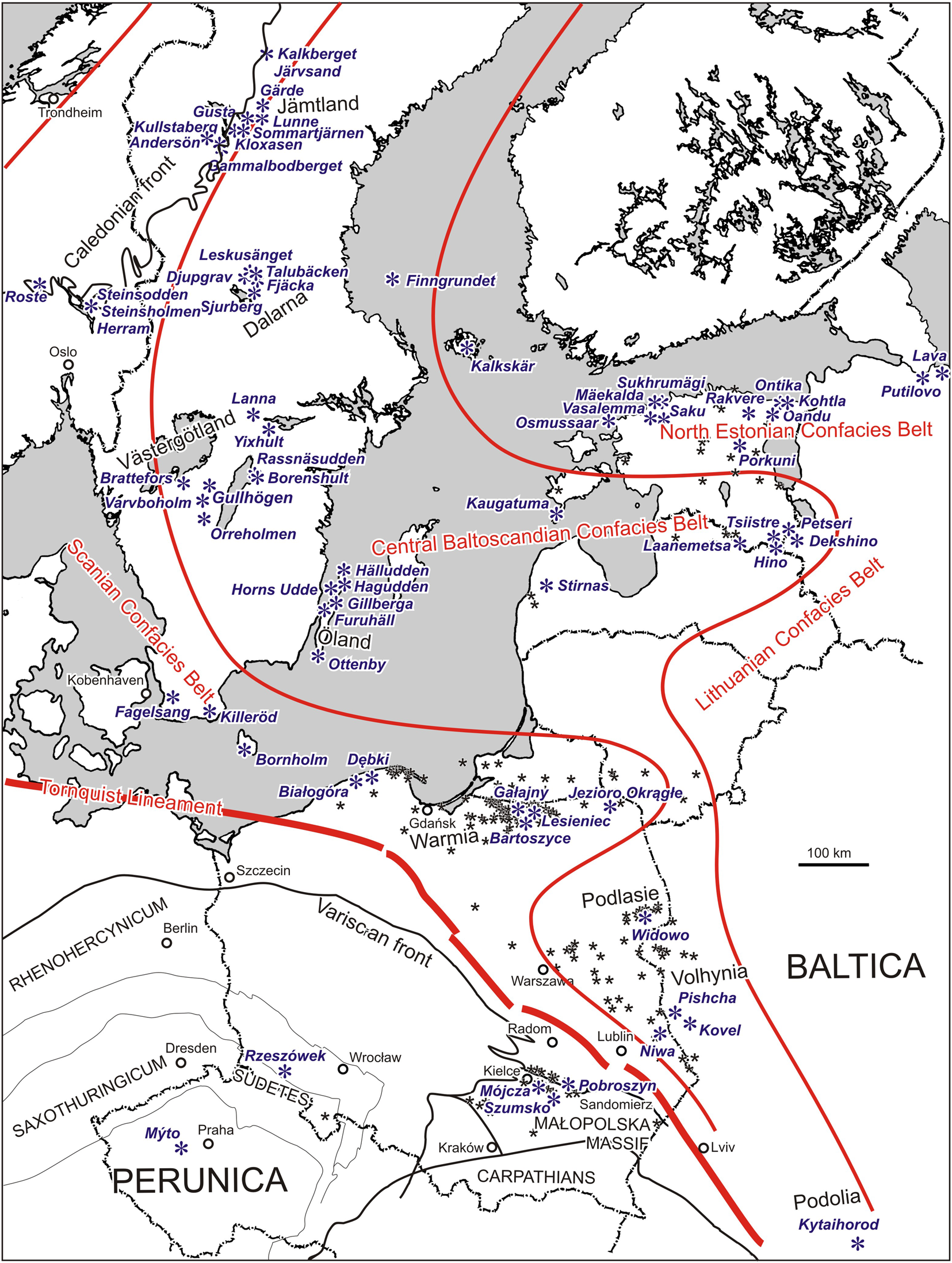
The research was focused on the evidence obtained from boreholes drilled in the Polish part of the East European Platform (55,875 specimens). The most complete core of the borehole Lesieniec IG 1 (21°30′03.17″E 54°11′25.16″N; drilled in 1970 by Oil Exploration Company in Wołomin) provided 64 samples. They have been supplemented by six samples from the borehole Gałajny IG 2, 11 samples from the Jezioro Okrągłe IG 1 (Podhalańska et al. Reference Podhalańska, Modliński, Waleczek, Cymerman and Wiszniewska2019), and four samples from the Bartoszyce IG 1, all representing the same tectonic unit that approximately covers the Warmia (Ermland) and Masuria regions (Fig. 1). Some literature data are also available in Bednarczyk (Reference Bednarczyk1979), who illustrated Floian conodonts from boreholes drilled nearby at the northernmost tip of Poland.
The exposures and boreholes mentioned in the text (marked with larger blue asterisks) and other boreholes that reached the Ordovician rocks (marked with small black asterisks) shown on a non-palinspastic map of north-central Europe.

The Mazury elevation, where Triassic rocks cover directly the Precambrian crystalline basement (Modliński Reference Modliński1973; Barmuta et al. Reference Barmuta, Barmuta, Papiernik, Golonka, Golonka and Bębenek2017; Golonka et al. Reference Golonka, Porębski, Barmuta, Papiernik, Bębenek, Barmuta, Botor, Pietsch and Słomka2019), separates the Peribaltic syneclysis from another area of the preserved subsurface Ordovician in NE Poland, located southward in the Podlasie region. It is represented by three samples from the Widowo and two samples from the Niwa boreholes. Some conodonts of Floian to Katian age were already described from there by Nehring-Lefeld (Reference Nehring-Lefeld1987). The boreholes Kovel-1 (Saadre et al. Reference Saadre, Einasto, Nõlvak and Stouge2004) and Pishcha-16 (Drygant Reference Drygant1974) in Volhynia provide qualitative data from the same geotectonic unit in Ukraine. Further south there are exposures in Podolia, which I sampled at the locality of Kytaihorod (Dzik Reference Dzik2020).
The newly obtained, unavoidably limited evidence from boreholes and a few Swedish, Estonian and Russian exposures can be merged with numerical literature data on the Baltic Ordovician conodonts (591,296 specimens). Their taxonomy is here revised according to present understanding of the apparatus species (supplementary Tables 1–68 available at https://doi.org/10.1017/S1755691024000070). I also had the opportunity to sample Ordovician exposures at Sukhrumägi in Estonia, as well as at Ottenby, Hälludden, Varvboholm, and the Gullhögen Quarry in Sweden. This supplemented data from literature sources with 18,823 specimens. Quantitative data on conodonts from the Volkhov age strata at Putilovo Quarry in Ingria come from Tolmacheva et al. (Reference Tolmacheva, Egerquist, Meidla and Holmer2001a). A few samples were taken by me in the same region at the Lynna River, the section described in detail by Lindskog et al. (Reference Lindskog, Eriksson, Rasmussen, Dronov and Rasmussen2020), who gave also a qualitative description of the conodont succession. Probably the most complete qualitative data on the Mid and Late Ordovician conodont succession is available from Estonia (i.e., Hints et al. Reference Hints, Viira and Nõlvak2012; Mellgren et al. Reference Mellgren, Schmitz, Ainsaar, Kirsimäe and Eriksson2012; Männik Reference Männik2017). The meaning of all these materials can be understood owing to the meticulous work published in classical papers by students of the Scandinavian and East Baltic Ordovician (Löfgren Reference Löfgren1978, Reference Löfgren1985, Reference Löfgren1993, Reference Löfgren1994, Reference Löfgren1995, Reference Löfgren1997a, Reference Löfgren2003; Bagnoli et al. Reference Bagnoli, Stouge and Tongiorgi1988; Stouge & Bagnoli Reference Stouge and Bagnoli1990; Bagnoli & Stouge Reference Bagnoli and Stouge1997; Zhang & Sturkell Reference Zhang and Sturkell1998; Rasmussen Reference Rasmussen2001; Tolmacheva & Fedorov Reference Tolmacheva and Fedorov2001; Tolmacheva et al. Reference Tolmacheva, Egerquist, Meidla and Holmer2001a, Reference Tolmacheva, Koren, Holmer, Popov and Raevskaya2001b, Reference Tolmacheva, Fedorov and Egerquist2003; Tolmacheva & Purnell Reference Tolmacheva and Purnell2002; Stouge & Nielsen Reference Stouge and Nielsen2003; Viira et al. Reference Viira, Mens and Nemliher2006b).
1.2. Glacial erratic boulders
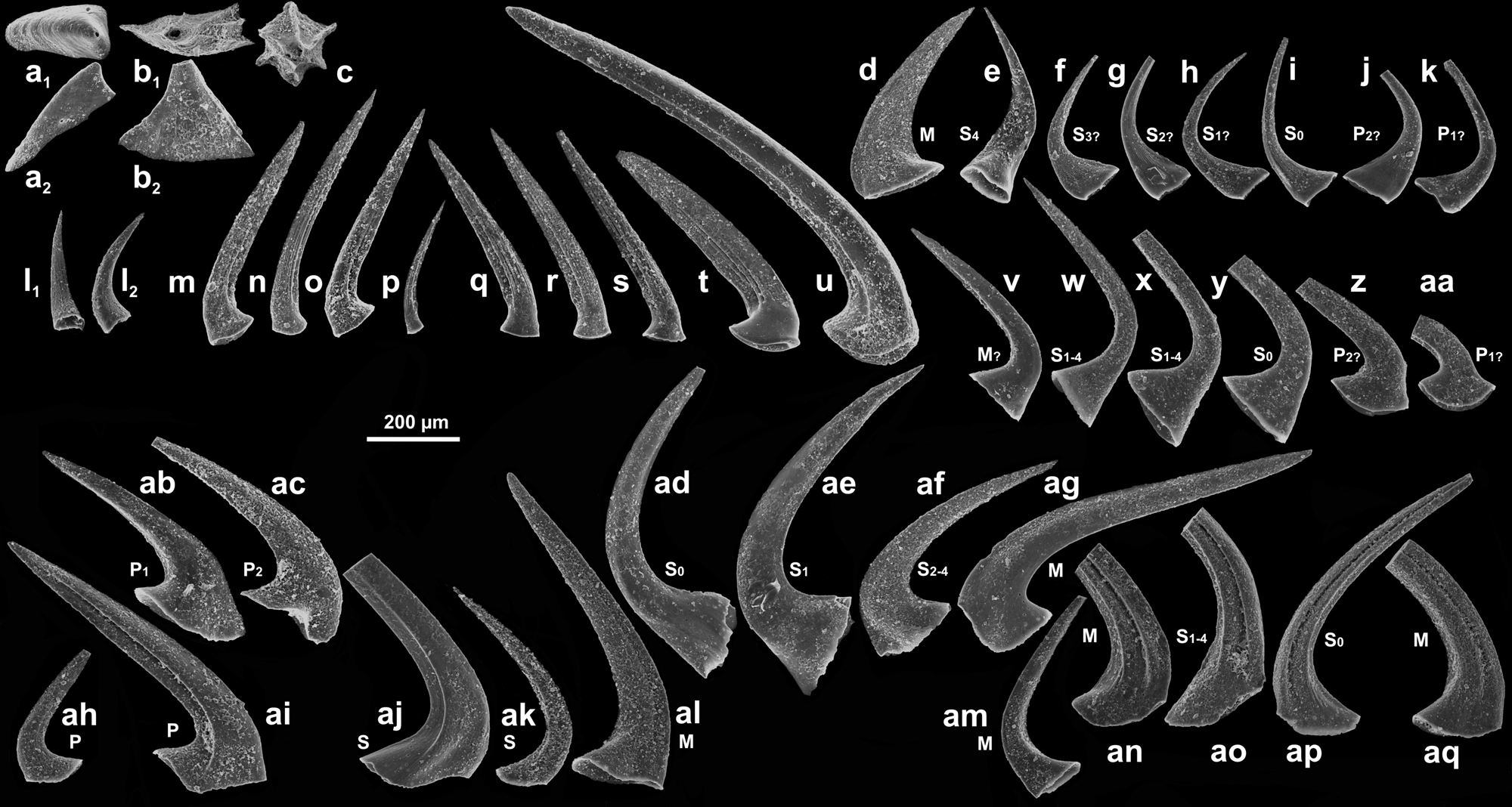
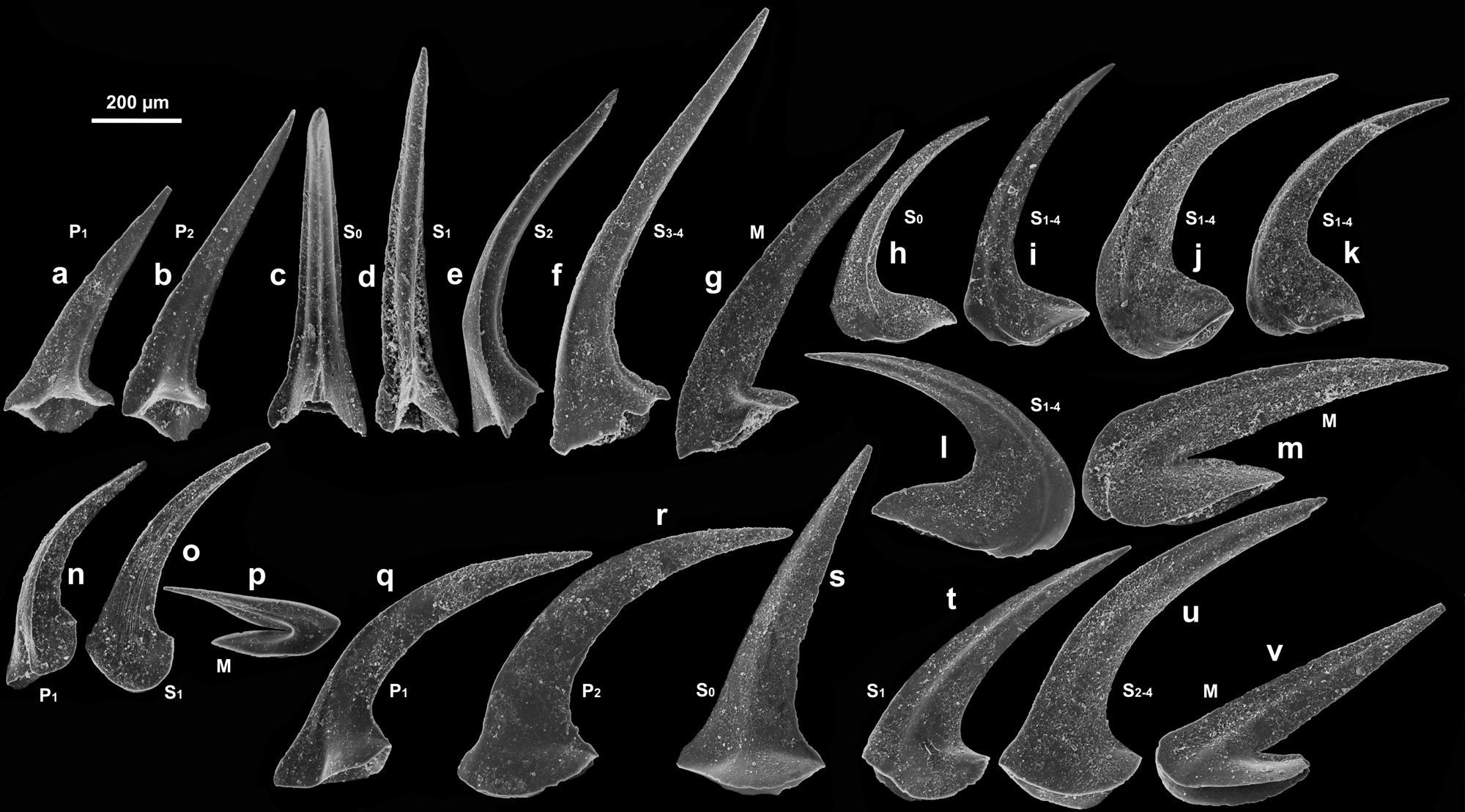
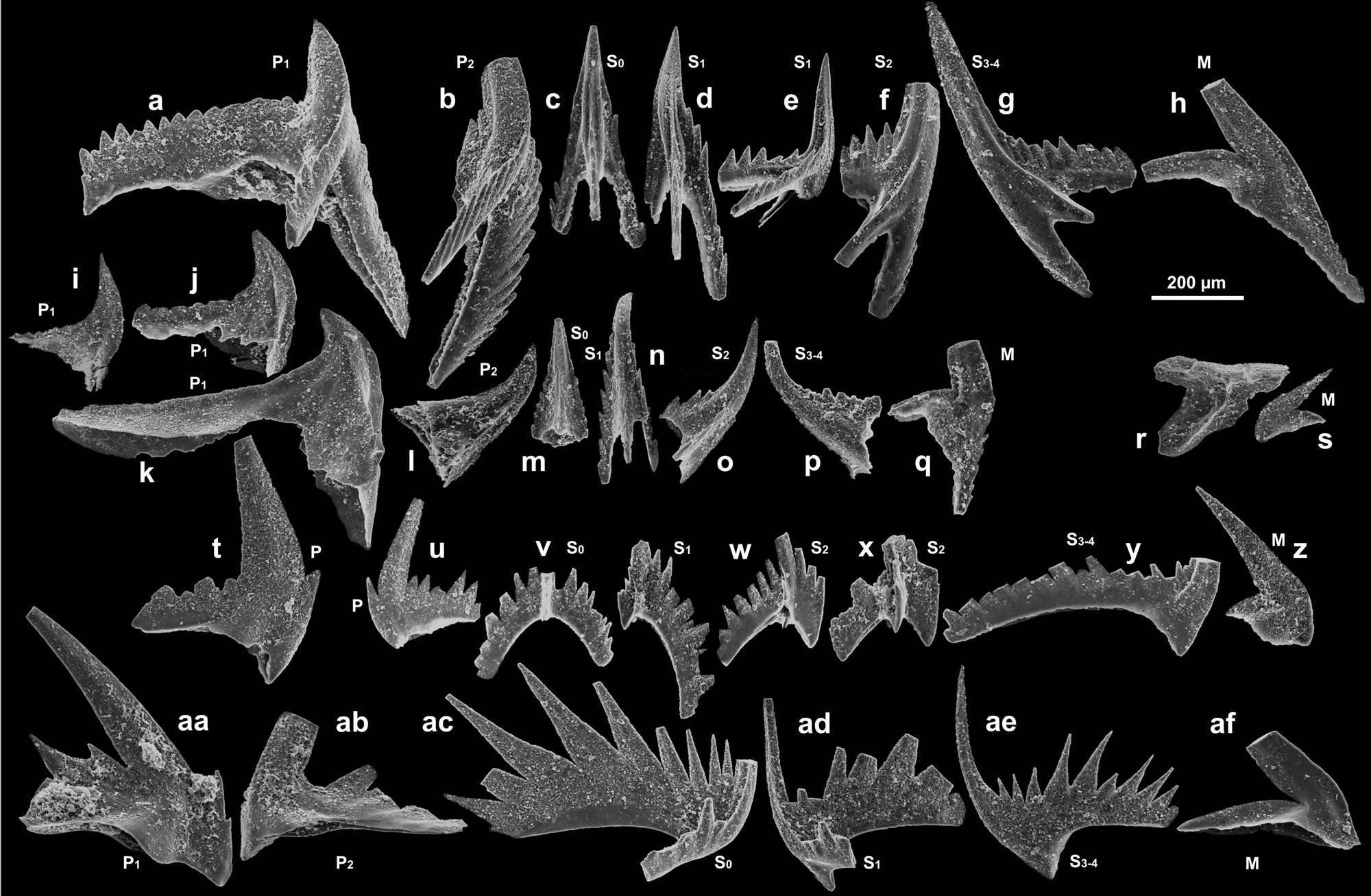
It is necessary to keep in mind that, during the Pleistocene, the continental ice motion removed most of the sedimentary rock cover from Scandinavia and East Baltic, and deposited it over the central European plain, locally accumulating more than 200 metres of glacial deposits. The sedimentary rocks survived glacial erosion only locally, where early Palaeozoic strata were protected under Permian volcanic caps or preserved within meteoritic craters (Fig. 1). Some rock formations are no longer represented in exposures. This makes glacial erratic boulders an important source of evidence for the conodont succession in the Baltic region (Wolska Reference Wolska1961; Dzik Reference Dzik1976). The Ordovician boulders collected in the Pleistocene drift in Poland yielded 55,875 specimens. The large number of specimens in particular samples enabled tests of the apparatus reconstructions based on less numerous samples from boreholes. This is exemplified by the large sample E-360 (of 46,499 specimens; Figs 2–4; supplementary Table 41) assembled in an attempt (not quite successful) to identify discrete classes of coniforms and identify their position in the apparatus.
Composition of conodont apparatuses with coniform elements identified in sample E-360 from Międzyzdroje, Baltic coast of Poland. (a) Pseudooneotodus mitratus (Moskalenko 1973) specimen ZPAL cVI/1104 in occlusal and lateral views. (b, c) Nericodus capillamentum Lindström Reference Lindström1955a? specimens ZPAL cVI/1183 and 1181 in occlusal (b1, c) and lateral (b2) views. (d–k) Scalpellodus latus (van Wamel Reference van Wamel1974) early form, specimens ZPAL cVI/1114–1116, 1118, 1119, 1121, 1117 and 1120, respectively (d; element M). (l) ‘Oneotodus’ sp.; specimen ZPAL cVI/1110 in medial and lateral views. (m–t) Decoriconus peselephantis (Lindström 1955a); specimens ZPAL cVI/1112, 1109, 1106, 1113, 1107, 1108, 1110 and 1111, respectively. (u) Protopanderodus? sp.; specimen 1105. (v–aa) Cornuodus longibasis (Lindström Reference Lindström1955a); specimens ZPAL cVI/1122–1127, respectively. (ab–ag) Drepanodus arcuatus Pander Reference Pander1856; specimens ZPAL cVI/1128–1133, respectively. (ah–am) Protopanderodus rectus (Lindström Reference Lindström1955a); specimens ZPAL cVI/1135, 1134, 1136, 1137–1139, respectively. (an–aq) Protopanderodus sulcatus (Lindström Reference Lindström1955a); specimens ZPAL cVI/1141–1144, respectively.

Composition of conodont apparatuses with coniform P and S elements but geniculate M element identified in sample E-360. (a–g) Triangulodus brevibasis (Sergeeva, 1963) specimens ZPAL cVI/1145–1150, respectively. (h) Paroistodus parallelus (Pander Reference Pander1856) specimen ZPAL cVI/1153. (i–m) Paroistodus originalis (Sergeeva Reference Sergeeva1963a) specimens cVI/1154–1158, respectively. (n–p) Drepanoistodus forceps (Lindström 1955a) specimens ZPAL cVI/1151, 1152 and 1200, respectively. (q–v) Drepanoistodus basiovalis (Sergeeva, 1963) specimens ZPAL cVI/1159–1164, respectively.

Composition of conodont apparatuses with denticulated ramiform elements identified in sample E-360. (a–h) Baltoniodus navis (Lindström 1955a) specimens ZPAL cVI/1165–1168, 1203, 1169–1171 respectively. (i–q) Trapezognathus diprion (Lindström 1955a) specimens ZPAL cVI/1174, 1173, 1172, 1175–1180, respectively. (r) Unidentified platform element ZPAL cVI/1182. (s) Unidentified juvenile M element (possibly Periodon) ZPAL cVI/1184. (t–z) Microzarkodina flabellum (Lindström Reference Lindström1955a) specimens ZPAL cVI/1185–1187, 1189, 1188, 1198, 1190 and 1191 respectively. (aa–af) Periodon flabellum (Lindström Reference Lindström1955a) specimens ZPAL cVI/1192–1197, respectively.

The routes of glacier tongues have been inferred mostly by identification of source areas of crystalline rocks represented by erratic boulders (e.g., Viiding et al. Reference Viiding, Gaigalas, Gudelis, Raukas and Tarvydas1971; Overweel Reference Overweel1977; Hall & van Boeckel Reference Hall and an Boeckel2020). However, limestone boulders significantly contribute to the till, too. Glacial erratics of Ordovician limestone are known as far northward as central Sweden (Löfgren & Laufeld Reference Löfgren and Laufeld2007). They were transported southward mostly along the middle of the present-day Baltic Sea (Hall & van Boeckel Reference Hall and an Boeckel2020), but it is difficult to connect precisely the distribution of particular rock types with the source outcrops. Unlike specific kinds of igneous rocks identified in the Scandinavian crystalline basement, formations of sedimentary rocks were once widely distributed in the Baltic area. The material at my disposal is too scarce to determine precisely occurrences of particular kinds of limestone boulders in moraines representing specific glacial episodes. Nevertheless, it is apparent that some characteristic lithologies differ in frequency between western and eastern Poland. For instance, the red cephalopod limestone is common on the Baltic seashore in the west, whereas glauconitic limestone of the same age is common in the east. This refers to occurrences of glacial drift deposited in the last glaciation about 20 ka, and in the preceding one about 140 ka, but also during the most extensive glacier expansion up to the Sudetes about 340 ka (Mokrzeszów). Therefore, I subdivided the conodont assemblages from glacial erratics in two groups, covering the eastern and western halves of Poland.
1.2.1. Erratics from eastern Poland
Mochty: E-079, E-080, E-081, E-085, E-103, E-190, E-211, E-213, E-214, E-215, E-216, E-291, E-294, E-303, E-305, E-307, O-461; Wieżyca: E-087, E-231, E-237, E-239, E-240; Rozewie: E-111, E-116, E-130, E-252, E-320, E-323, E-335, E-348, E-349; Zgierz: E-089, E-090, E-096, E-112, E-113, E-173, E-182, E-189, E-201, E-204, E-207, E-295, E-204; Jóźwin: E-314, E-315, E-317, E-330, E-334, E-336; Orłowo: E-117, E-134, E-135, E-137, E-194, E-195, E-196, E-224, E-225, E-226, E-227, E-254, E-255, E-319, E-322; Chłapowo: E-119, E-124, E-197; Wieżyca?: E-232, E-236; Kartuzy: E-326.
1.2.2. Erratics from western Poland
Międzyzdroje: E-104, E-138, E-140, E-141, E-142, E-143, E-144, E-145, E-148, E-149, E-154, E-157, E-181, E-186, E-222, E-228, E-229, E-230, E-251, E-259, E-260, E-261, E-262, E-263, E-266, E-267, E-268, E-270, E-271, E-273, E-274, E-276, E-279, E-282, E-283, E-285, E-350, E-351, E-352, E-353, E-354, E-355, E-356, E-357, E-358, E-359, E-360, E-361, E-362, E-364, E-367, E-368, E-369, E-370, E-371, E-383; Szczecin: E-275; Rewal: E-328, E-338, E-339; Złocieniec: E-342, E-344; Mokrzeszów: E-374, E-375.
2. Methods
A troublesome aspect of the apparatus approach to conodonts is that in the case of closely related sympatric species some elements of their apparatuses do not exhibit taxonomically diagnostic characters. They cannot be determined at the species level. In such cases I attribute them to both species, splitting the counted specimens roughly in the proportion shown by those elements that are taxonomically determinable.
Regrettably, almost all conodont researchers apply the vertical (typologic) concept of species. Conodonts are not different in this respect from other organisms that have a fossil record complete enough to substantiate recognition of chronospecies. From the biostratigraphic point of view, the methodological differences between vertical and horizontal approaches are seemingly just subtleties. However, this is a truly relevant issue. It has to be remembered that because of the Gaussian nature of population variability, specimens representing any vertically defined chronospecies are very rare at the beginning and at the end. This makes the stratigraphic range of such species strongly dependent on the sample size. Admittedly, boundaries of biostratigraphic units based on horizontally defined species are foggy as well. The biological evolution is slow, its path is crooked and unpredictable. The evidence is never quite convincing, despite numerous biometrically studied examples of the Ordovician conodonts (e.g., Baltoniodus in Dzik Reference Dzik1994, Reference Dzik2020; Microzarkodina in Löfgren & Tolmacheva Reference Löfgren and Tolmacheva2008).
The major concern with diagnosing chronospecies refers especially to the biological implications of such a procedure. Obviously, ranges of vertically understood (typologic) species overlap by definition, even when they are parts of a continuous phyletic lineage (e.g., Albanesi & Barnes Reference Albanesi and Barnes2000; Pyle & Barnes Reference Pyle and Barnes2002, figs 12–14; Stouge et al. Reference Stouge, Bagnoli and Rasmussen2020, fig. 3). Application of such methodology gives a false support to biased views on evolution: as the evidence of sudden origin of species, evolution proceeding exclusively by ‘speciation’ or even as a result of ‘species selection’. There is no doubt that ‘vertical taxonomy’ results in a misrepresentation of data. Potentially, it is possible to ‘translate’ the hard palaeontological evidence into something of use to evolutionary biology, but it is not an easy task.
This is why in this work the ‘horizontal’ (population) approach to taxonomy is followed. This requires that a species discrimination is done on each sample separately, irrespective of whether it belongs to a continuous stratigraphic succession or not. This enables biologically meaningful quantitative description of lineages, making it possible to estimate the numerical contribution of particular species to fossil assemblages.
2.1. Standing crop versus biological productivity
Frequency of a particular species in a time-averaged fossil assemblage reflects its contribution to the biological productivity of an ecosystem, not to the standing crop (Dzik Reference Dzik1979), which is a truth usually overlooked by palaeontologists (e.g., Kranz Reference Kranz1977; Kidwell & Flessa Reference Kidwell and Flessa1996; Dietl et al. Reference Dietl, Kidwell, Brenner, Burney, Flessa, Jackson and Koch2015). This is why juvenile individuals are seemingly underrepresented and adults overrepresented in most fossil assemblages. Exceptions are assemblages that originated by catastrophic events, but this hardly refers to minute conodont elements deposited continuously together with mineral grains to the sediment. It is thus tempting to interpret the conodont fossil assemblages in terms of palaeoecology and to estimate quantitatively their contribution to the flow of living matter in the Palaeozoic sea. Several factors may prevent this. The most obvious of them is taphonomy (Von Bitter & Purnell Reference Von Bitter and Purnell2005) that results not only in distorting the contribution of particular apparatus elements but also in deformation of the actual proportions of species. Remarkably, the imbalance is much more significant in the late Palaeozoic conodont fossil assemblages than in the Ordovician ones, presumably as a result of increased predation on conodonts (inter alia, Zatoń et al. Reference Zatoń, Broda, Qvarnstrom, Niedźwiedzki and Ahlberg2017). Delicate S and M elements are more prone to fragmentation in the predator's intestine than massive P elements. Still, the percentage contribution of apparatus elements of particular species is a meaningful approximation to reality and also enables a presentation of changes in structure of fossil communities in geological time.
The numerical proportion of fossilised individuals does not necessarily reflect the real contribution of a species to biological productivity in an ancient community. This depends on their growth rates and mature size. The generation turnover may be much more intense in species of small size individuals and their contribution to the biological productivity much lower in terms of the standing crop. Counting and measuring rhythmic increments presumably representing Ordovician or Devonian days (Dzik Reference Dzik2000, Reference Dzik2008, Reference Dzik2015) may allow us to estimate these aspects of the biology of conodonts. Specimens of high quality of preservation and with unmineralised basal body tissue are then required. In any case, the conodont element size alone is a source of easily accessible important information. Potentially, also the weight (or volume) of fossils may reflect biomass of ancient organisms (e.g., Dzik Reference Dzik1979) but fragmentation of conodont elements due to their taphonomy, diagenesis and laboratory preparation prevents reliable measurements.
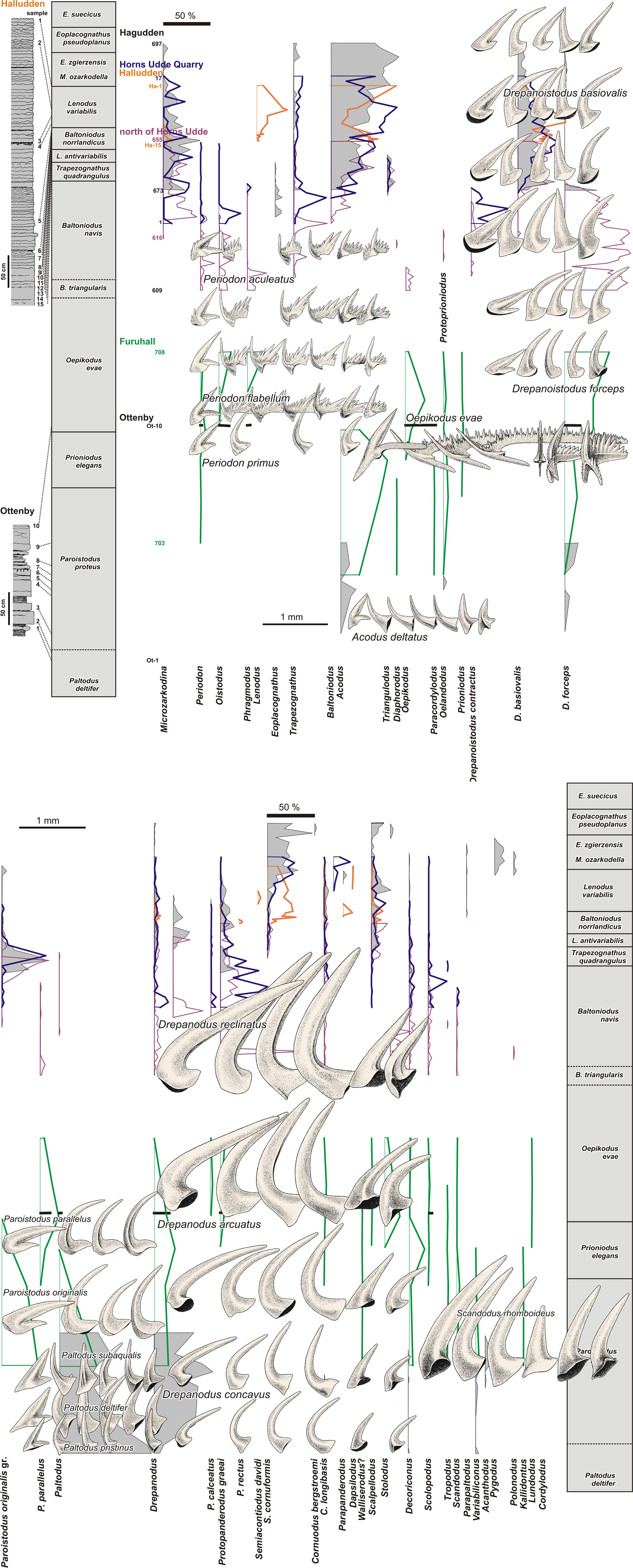
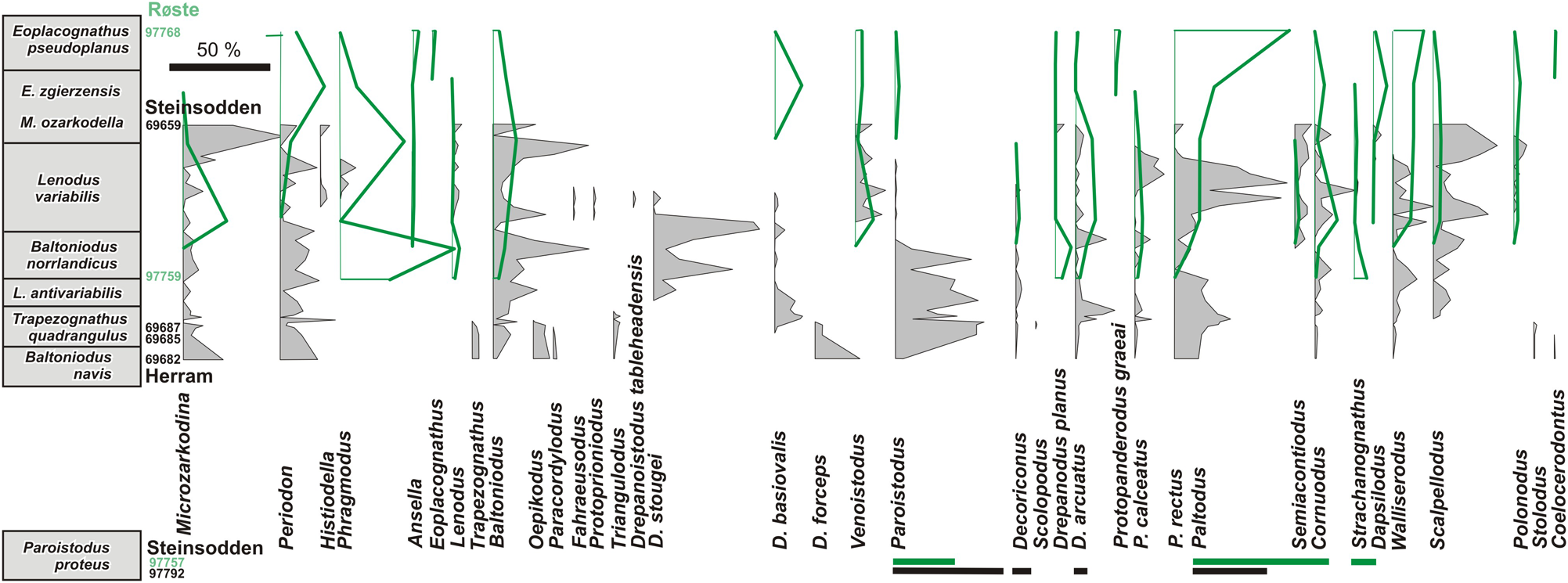
To offer at least a crude overview of particular species’ contribution to the conodont community, drawings of restored apparatuses are illustrated with the same magnification (Figs 5–8 and 9). These show the approximate mean size of elements in samples that depend on the population dynamics; that is, on the distribution of mortality at particular stages of ontogeny.
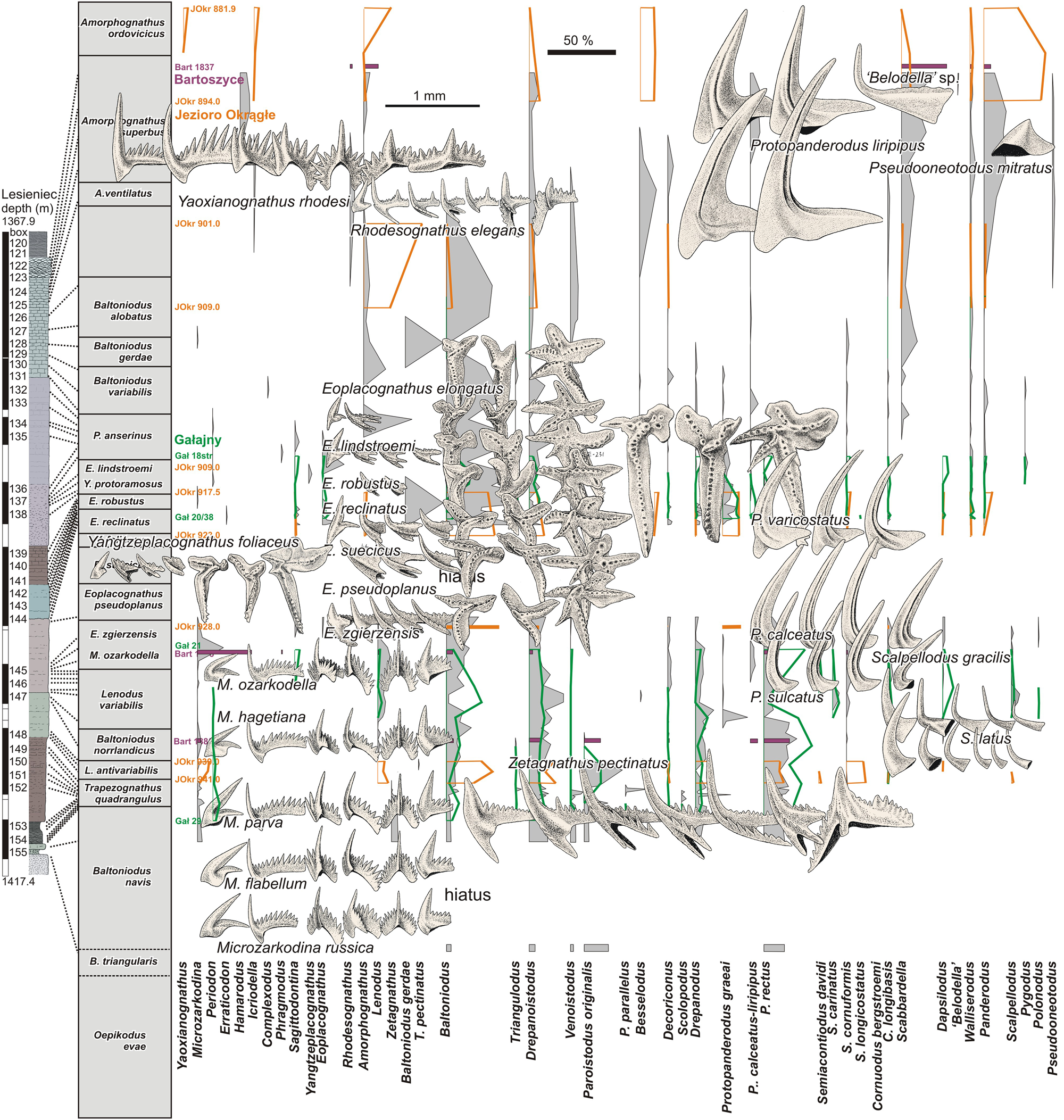
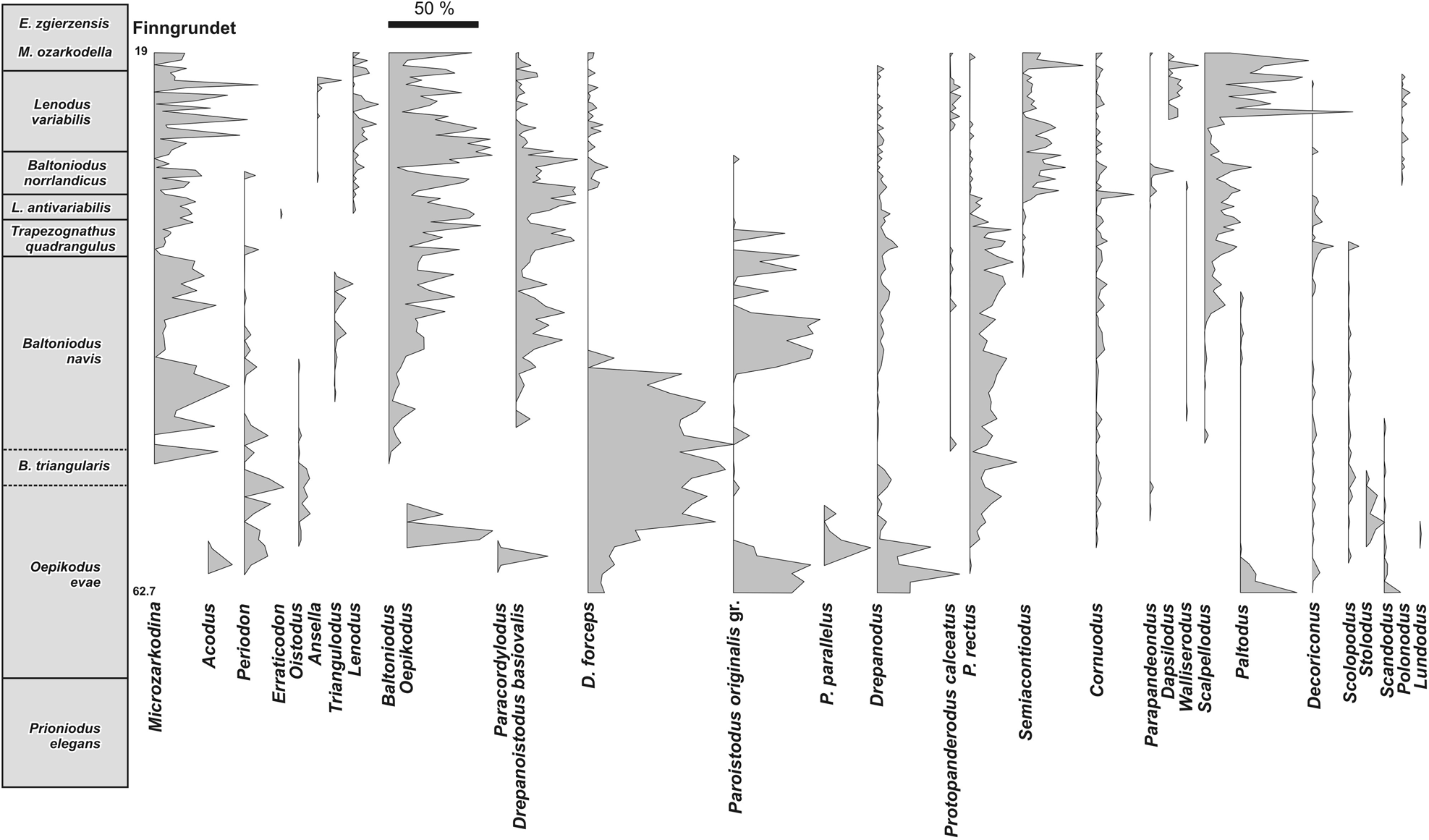
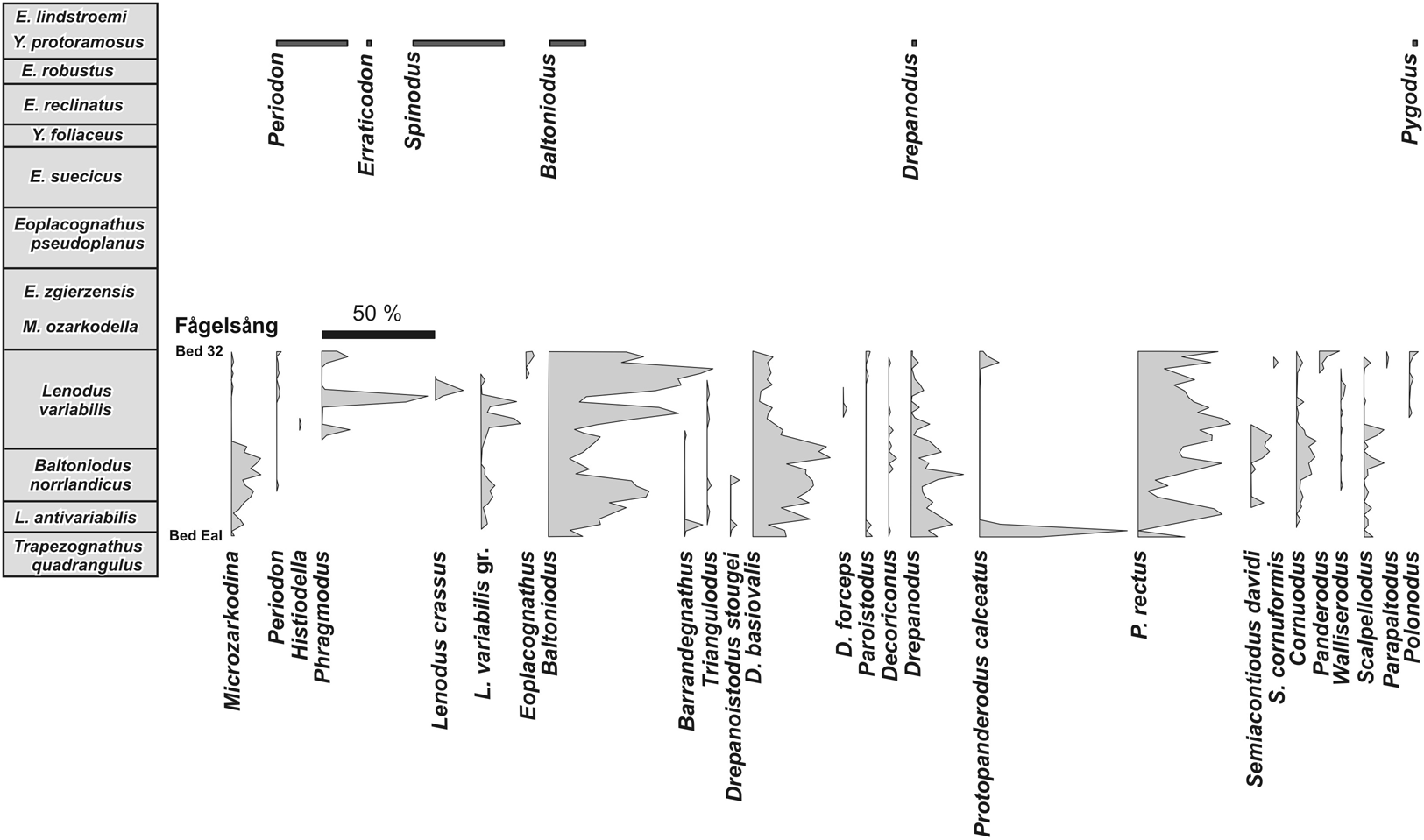
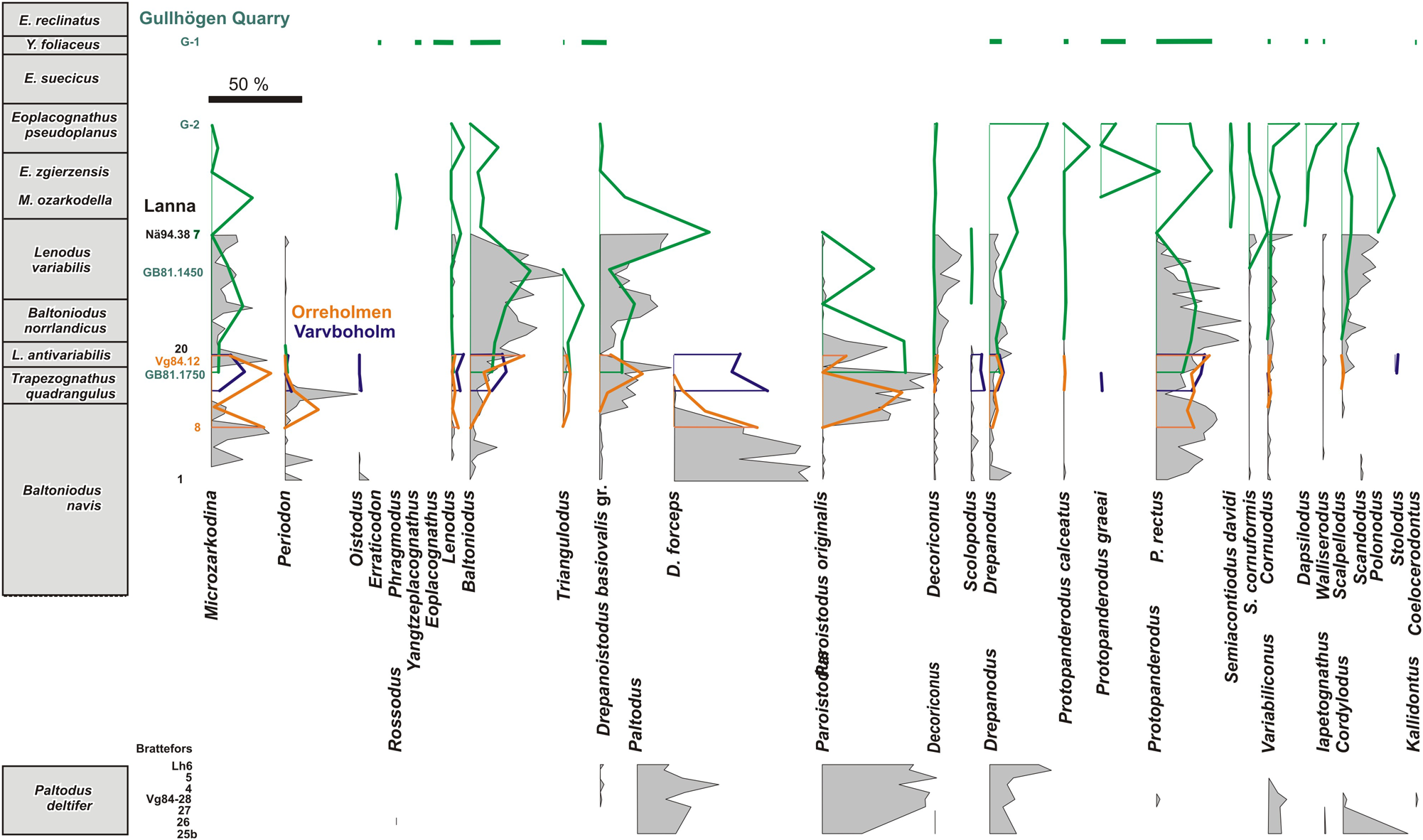
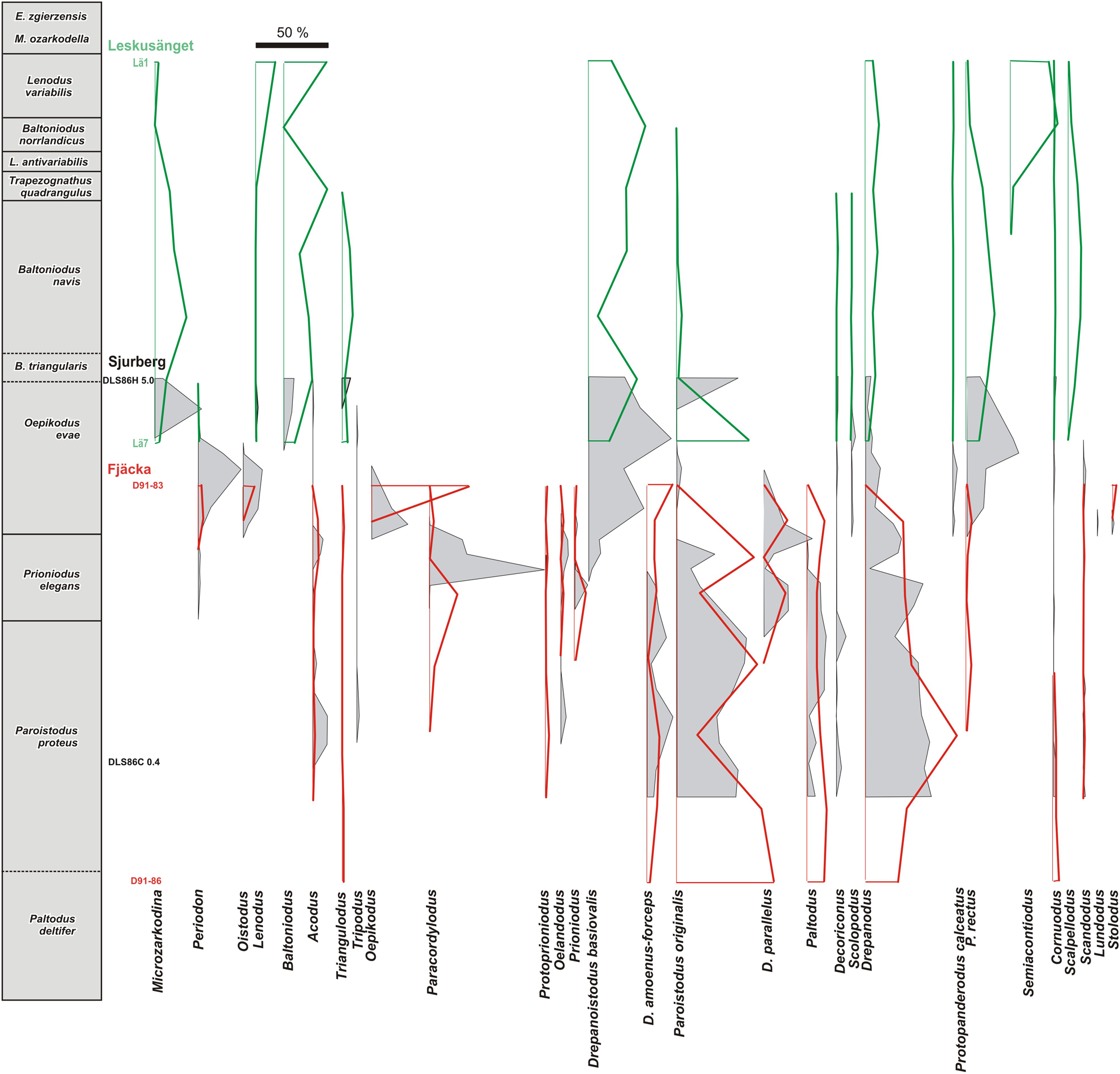
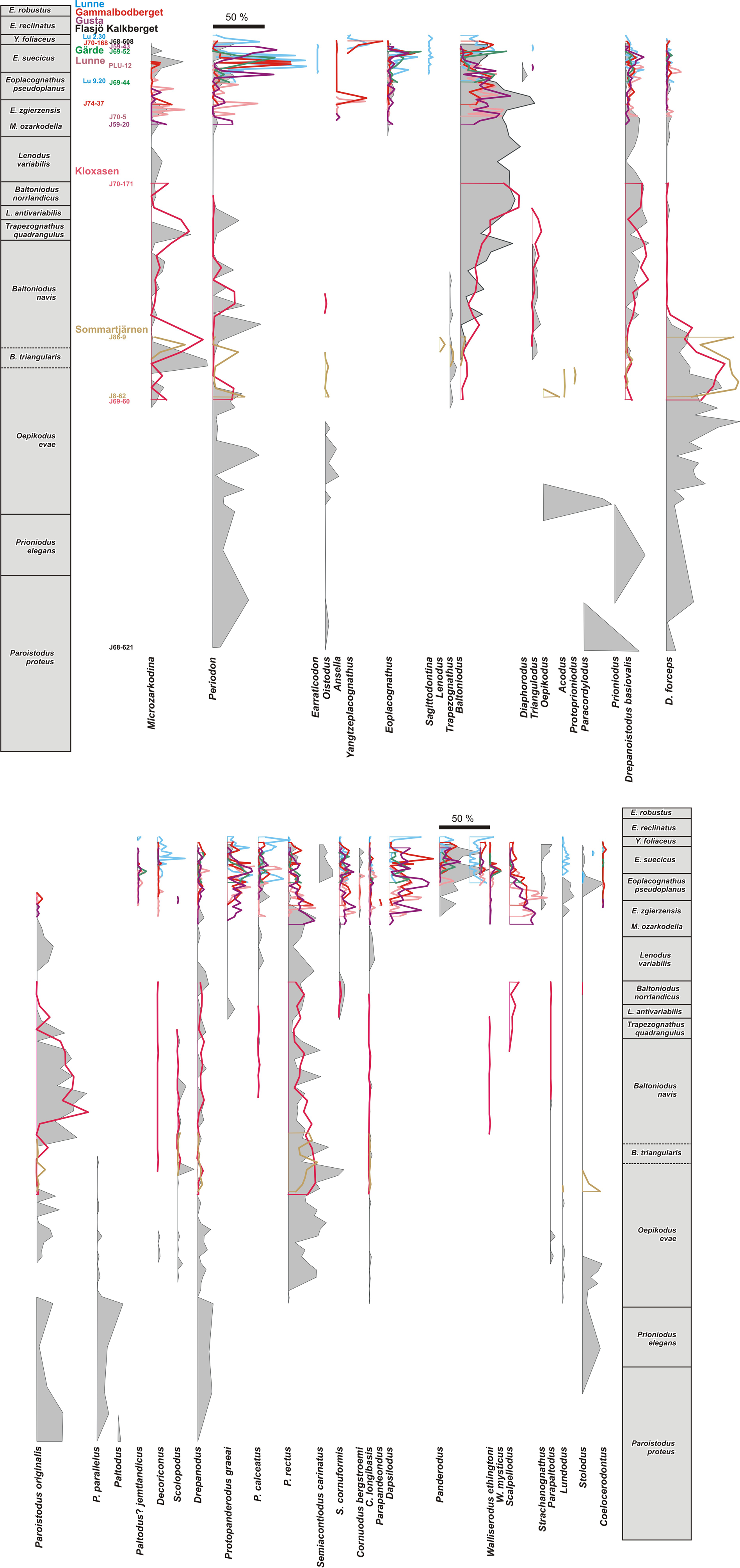
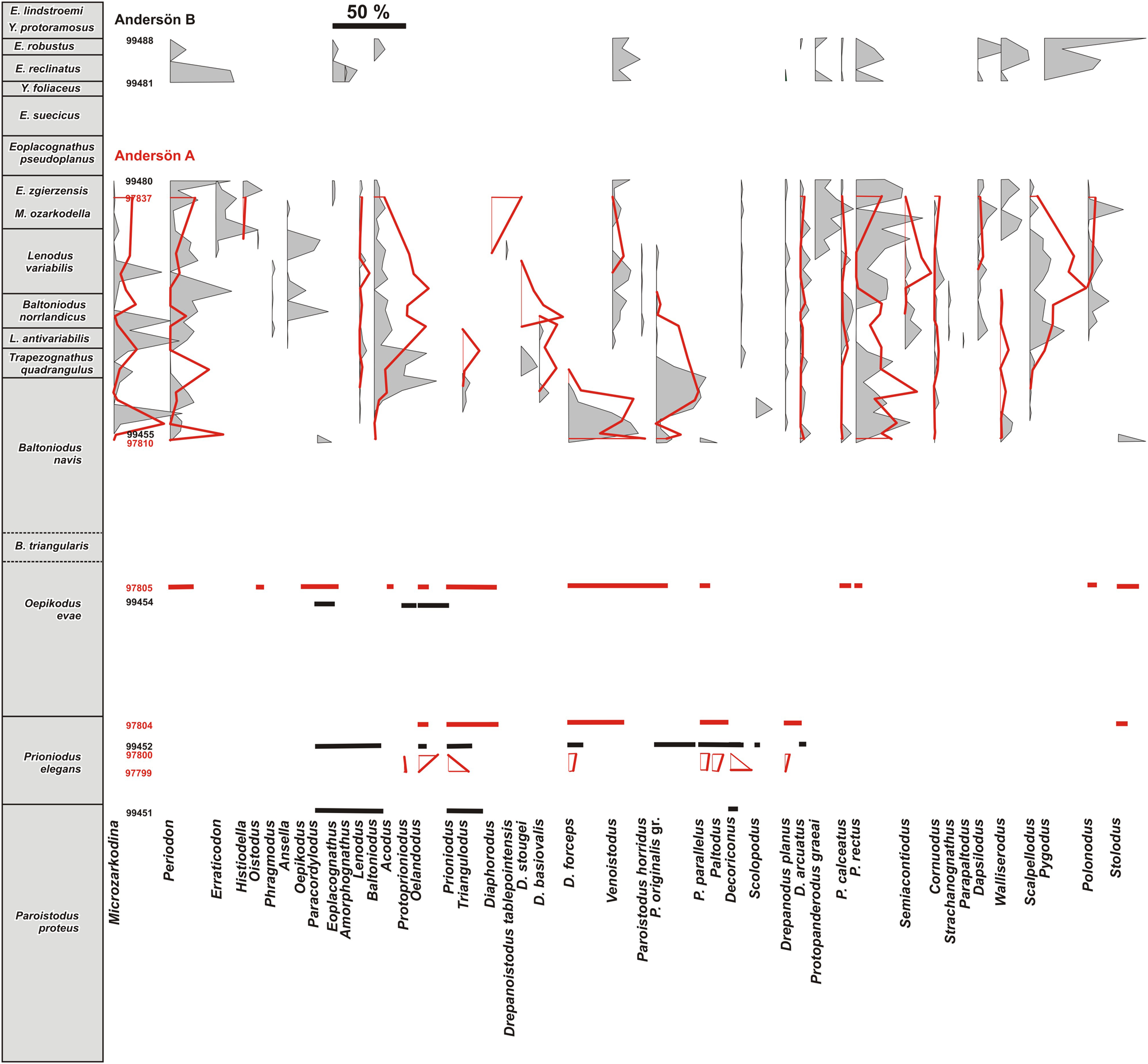
The Ordovician conodonts succession in the Warmia–Masuria region recorded in the boreholes Lesieniec IG 1, Gałajny IG 2, Bartoszyce IG 1 and Jezioro Okrągłe IG 1. Geological ages of biostratigraphic units in this and subsequent figures are standardised according to absolute geological ages proposed by Dronov (Reference Dronov, Dronov, Tolmacheva, Raevskaya and Nestell2005) and Nōlvak et al. (Reference Nōlvak, Hints and Männik2006) that are comparable with ages based on data from other regions (Goldman et al. Reference Goldman, Sadler, Leslie, Melchin, Agterberg and Gradstein2020). Ranges of informal conodont zones and biozones (without making a distinction between zone and subzone ranks) are shown here; their correspondence to international higher-rank geochronological units is shown on Fig. 8b. Drawings of conodont elements are in the same magnification to visualise the contribution of particular species to biological productivity of their communities.

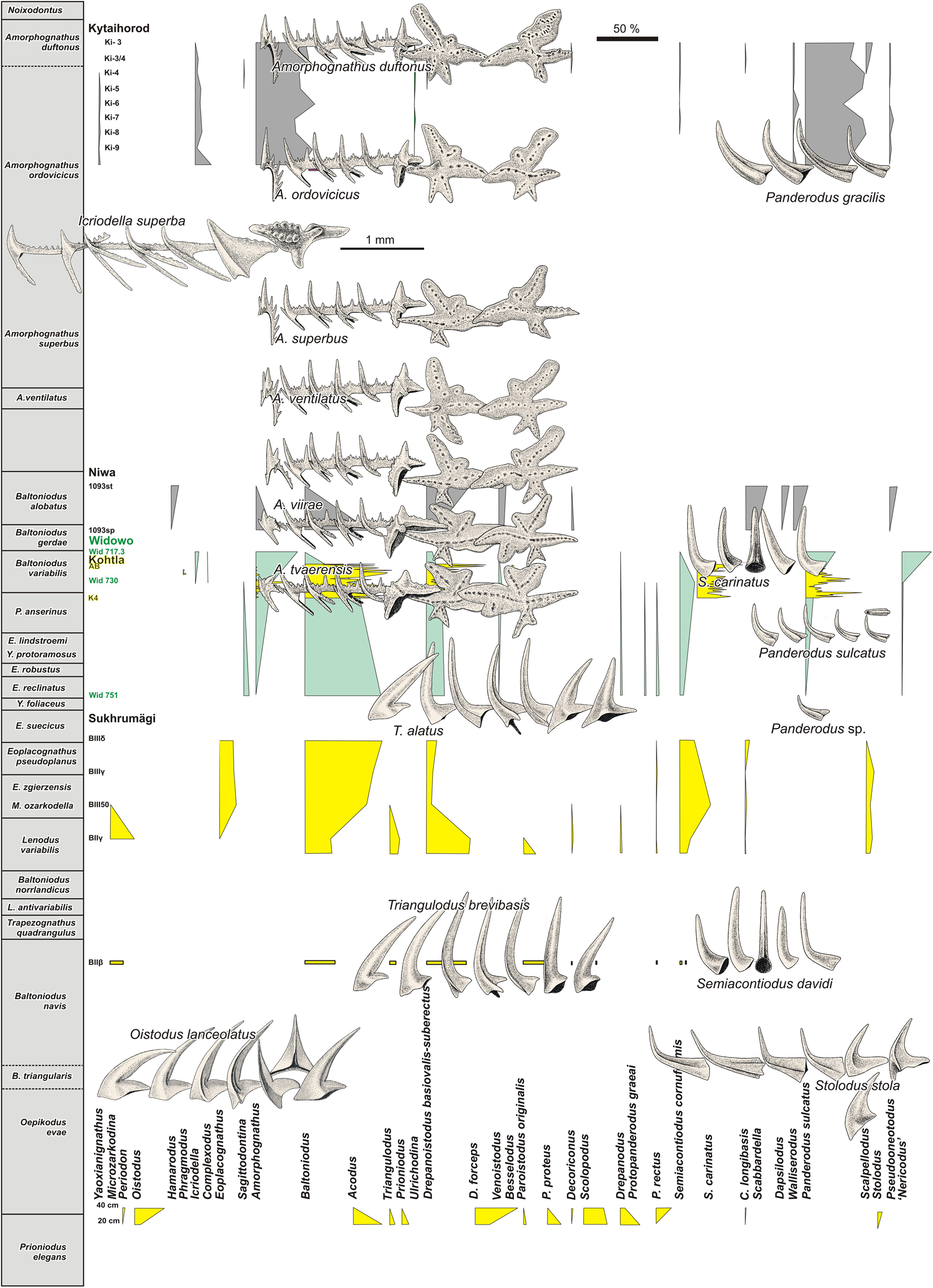
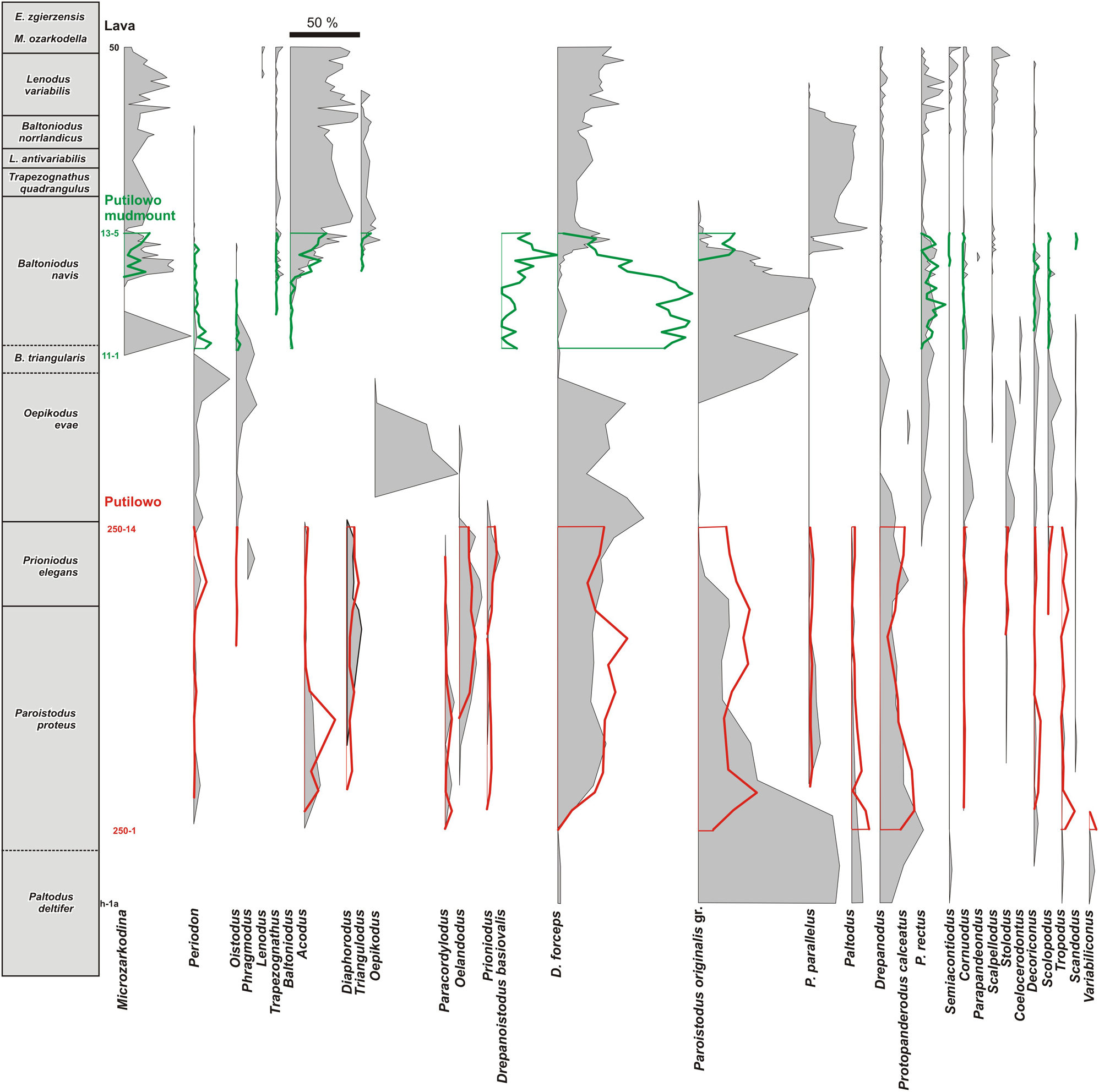
The Ordovician conodonts succession in the Podlasie region recorded in the boreholes of Niwa and Widowo, supplemented by data from exposures at Kytaihorod in Podolia, Ukraine (Dzik Reference Dzik2020), Kohtla (data from Viira et al. Reference Viira, Aldridge and Curtis2006a; supplementary Table 64) and Sukhrumägi in Estonia.

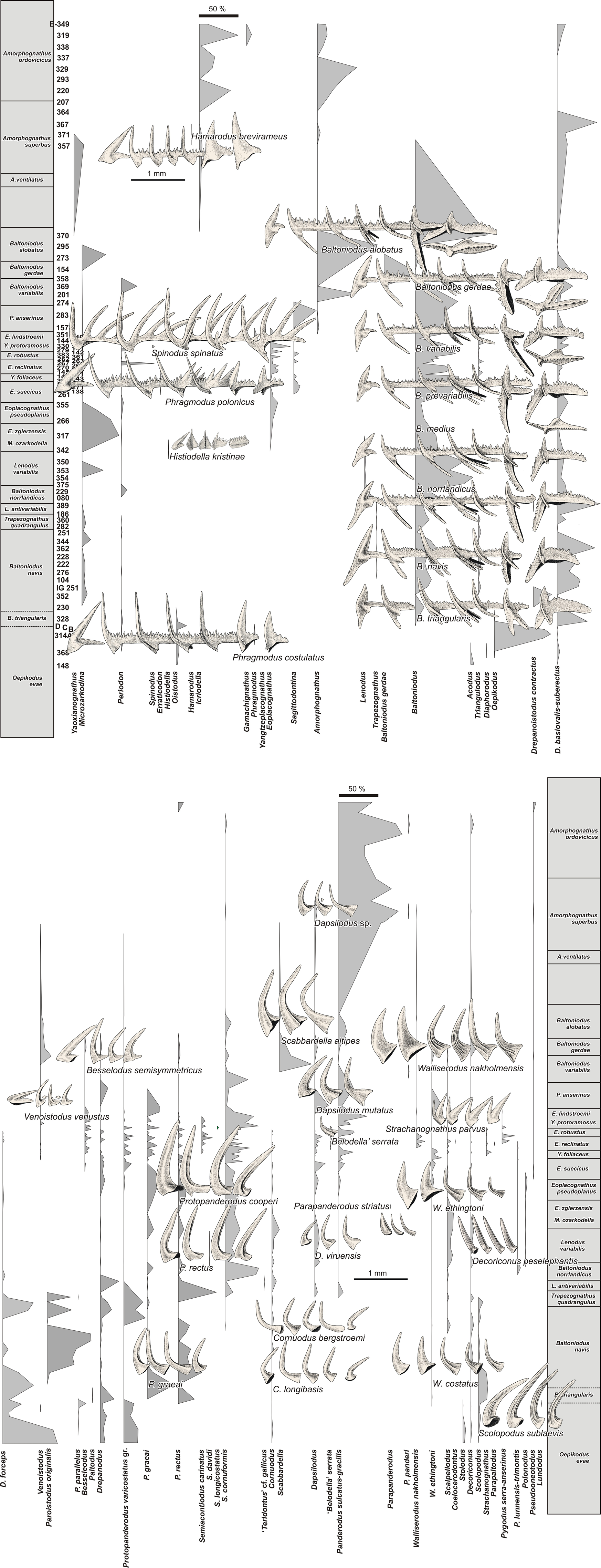
The Ordovician conodonts succession recorded in glacial erratic boulders from eastern Poland. The order of samples within particular zones is arbitrary.

The Ordovician conodonts succession recorded in glacial erratic boulders from western Poland. The order of samples within particular zones is arbitrary. Correspondence to the Baltic and international geochronological units after Männik & Viira (Reference Männik and Viira2012).

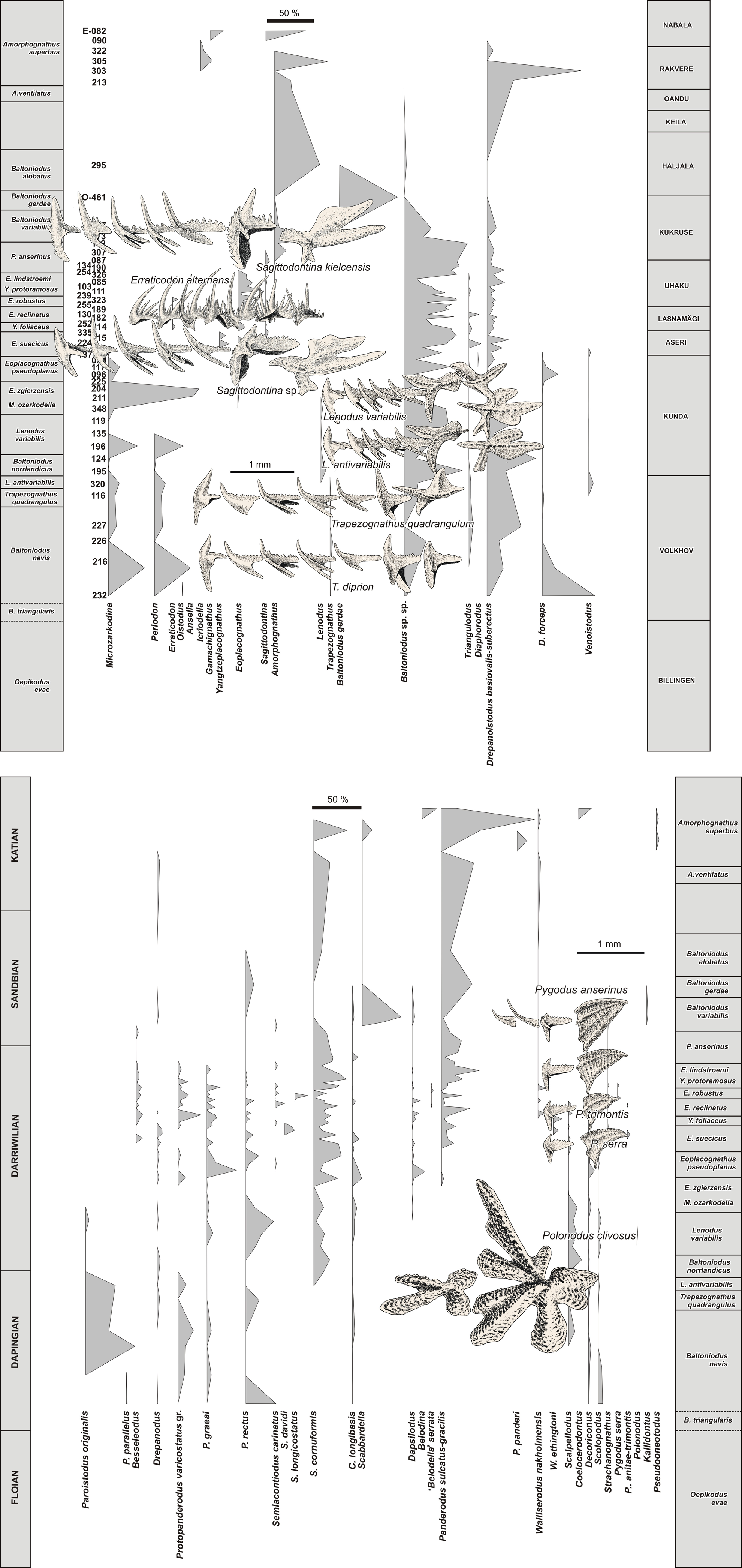
The Ordovician conodonts succession recorded at Hagudden (data from Stouge & Bagnoli Reference Stouge and Bagnoli1990; supplementary Table 18), Horns Udde (Bagnoli & Stouge Reference Bagnoli and Stouge1997; supplementary Tables 8 and 10), Hälludden (supplementary Table 20), Furuhäll (Bagnoli et al. Reference Bagnoli, Stouge and Tongiorgi1988; supplementary Table 27), and Ottenby (supplementary Table 2) in Öland, Sweden.

2.2. Between-orders homology of conodont elements
The number of element types has hardly any correspondence to the number of locations in the apparatus and descriptives referring to it are not used here. Most probably, the same number of elements characterise apparatuses in high rank conodont taxa. Still, it is a matter of continued controversy how many elements were present in them.
Geniculation of the M elements in the basal members of the ozarkodinid, prioniodontid and distacodontid apparatuses makes homology of the remaining locations in the apparatus rather easy despite the profound changes in the apparatus composition (Dzik Reference Dzik2015). This is much more problematic in respect of the panderodontid and protopanderodontid apparatuses, interpreted in contradictory ways. Fortunately, there are two findings of almost complete apparatuses of Panderodus unicostatus (Branson & Mehl Reference Branson and Mehl1933) from Podolia and Wisconsin, which are informative enough to solve the problem.
The fused cluster from Podolia consists of 13 elements and was interpreted as coprolithic in origin. The lack of one asymmetric element was attributed to its loss during preparation of the specimen, whereas that of the symmetrical element to the evolutionary reduction. Such interpretation is substantiated by the general lack of symmetrical elements in fossil assemblages of loose Panderodus elements in the Silurian. As a result of attempted reconstruction of the deformation of the apparatus in the stomach of a predator, the apparatus was restored as composed of 14 elements showing the size gradient, with the largest elements pair in anterior position, representing the M location (Dzik & Drygant Reference Dzik and Drygant1986).
The bedding plane natural assemblage from the Waukesha Shale of Wisconsin consists of 13 elements preserved with the crown tissue plus one described as ‘entirely mouldic’. This set of elements was interpreted as representing a 17-elements apparatus, with two asymmetric elements lost (their ‘symmetry pair are absent’) although both part and counterpart of the apparatus are available. A single element in the middle of the apparatus is symmetric, unquestionably identified as the S0 element. The smallest elements in the apparatus were interpreted as representing the P locations, consistent with interpretation of the Podolian cluster. The most significant difference, as proposed by (Murdock & Smith Reference Murdock and Smith2021), is the place for the compressed ‘falciform’ element, proposed to occupy P3 instead of the M location. This elements pair covers all remaining elements of the apparatus in the composite picture (elements 8 and 9 in Murdock & Smith Reference Murdock and Smith2021, fig. 4c). The apparatus is preserved in an occluded position and I propose that these elements were originally above (or rather below in life position) the S3 elements pair (elements 1 and 2 in Murdock & Smith Reference Murdock and Smith2021, fig. 4c). This removes the main discrepancy between interpretations of the cluster and natural assemblage of Panderodus.
Attempts to arrange M, S and P locations into evolutionary series linking the protopanderodontids with those of the ozarkodinids are guided only by their general morphology: M elements are expected to be characterised by a sharp cusp and curved base, S elements to be represented by a symmetry-transition series of several morphologies, and at least two types of P elements should have a robust appearance with a short cusp. On such basis I proposed interpretation of the apparatus of Drepanodus (Dzik Reference Dzik1994). Löfgren & Tolmacheva (Reference Löfgren and Tolmacheva2003) contested it and proposed the opposite order of the element morphologies, with the short-cusped element representing the M location and that with the longest sharp cusp (‘pipaform’) being the P element. Until complete natural assemblage is available, this controversy will remain hard to solve.
Despite undoubtedly convergent development of geniculation in Belodina, it may truly be a homologue of that in the ozarkodinid and prioniodontid M elements. Then, the orientation of apparatus is such as that proposed by Dzik & Drygant (Reference Dzik and Drygant1986) and Murdock & Smith (Reference Murdock and Smith2021) for Panderodus; that is, the smallest elements pair is the posteriormost one, being homologous to P1.
2.2.1. Descriptives of conodont elements sides
The orientation of elements in conodont apparatuses representing various high-rank taxa may be different (Sweet Reference Sweet1988; Sweet & Donoghue Reference Sweet and Donoghue2001). This makes application of anatomical terminology to apparatuses restored on the basis of isolated elements difficult. To avoid inconsistency, while describing elements I refer to homology of various apparatuses with the late Palaeozoic ozarkodinids as well as to serial homology to P elements within the apparatus. They are visualised as if their processes were directed transversely to the body axis. Thus, in all elements the convexity in the course of carina is considered to correspond to the anterior side, the bulging basal cone denotes the posterior side, whereas the cusp and denticles are bent dorsalwards.
3. Taxonomy of Baltic Ordovician conodonts
Ordovician conodonts were first recognised in the Baltic region by Pander (Reference Pander1856) and elements of some of them were illustrated by Hadding (Reference Hadding1913) adequately enough to identify currently understood species (Lindström Reference Lindström1955b; Bergström Reference Bergström2007). They became high-quality guide fossils owing to the seminal papers by Lindström (Reference Lindström1971) and Bergström (Reference Bergström1971). A lot has been done since that time, but the status of many species remains poorly established. Below I comment on them arranged according to the Linnean evolutionary suprageneric systematics.
3.1. Order Panderodontida Sweet Reference Sweet1988, family Fryxellodontidae Miller Reference Miller1980
3.1.1. Pseudooneotodus mitratus (Moskalenko Reference Moskalenko1973)
The type horizon of this species, the morphological simplicity of which is misleading, is the late Sandbian Baksan formation of Siberia (Moskalenko Reference Moskalenko1973). Its probable ancestor P. nostras (Moskalenko Reference Moskalenko1973) comes from the underlying early Sandbian Chertovo formation. It differs from P. mitratus in a rounded T-outline, one of the lobes having incipient denticulation (Moskalenko Reference Moskalenko1973, pl. 17:12–15). Moskalenko (Reference Moskalenko1973, pl. 17:16) also illustrated and described in open nomenclature a possibly congeneric specimen from the late Darriwilian Kirensk formation with all lobes prominently tuberculated. This suggests proximity to Polonodus as probable relative.
P. mitratus appeared in Baltica in the Baltoniodus navis Zone (boulder E-360, supplementary Table 41; Fig. 2a) and continued its occurrence to the Amorphognathus ordovicicus Zone (Fig. 5), usually being represented by a single element per sample. An exception is the borehole Lesieniec IG 1 with a sample of E. robustus Zone (Les-1371/3; supplementary Table 56) that yielded seven elements and similar occurrences in the A. superbus Zone (supplementary Table 66). This does not allow reasonable restoration of the apparatus but it is likely that it consisted of only one pair of elements. The Silurian species of the genus are represented by elements with a virtually circular outline (e.g., Sansom Reference Sansom1996).
3.1.2. Lundodus gladiatus (Lindström Reference Lindström1955a)
The species occurs in Baltica in the Prioniodus elegans and Oepikodus evae Zones. Bagnoli & Stouge (Reference Bagnoli and Stouge1997) proposed its apparatus reconstruction with denticulated S elements slightly resembling those of Stolodus, but this is based on a small material and requires verification. Five P elements in the Ottenby section sample Ot-10 (supplementary Table 2) in my material do not add anything to its knowledge.
3.1.3. Nericodus capillamentum Lindström Reference Lindström1955a
The ancestry of Polonodus was proposed by me to be in a species illustrated from Ottenby as Nericodus (?) sp. (Dzik Reference Dzik1983) but apparently conspecific with Polonodus? lofgreni Stouge & Bagnoli Reference Stouge and Bagnoli1988. Löfgren (Reference Löfgren1985, fig. 4aab; also Löfgren Reference Löfgren1990, fig. 4p) illustrated its S elements and noticed (Löfgren Reference Löfgren1990, p. 256) that ‘these ramiforms are much less Baltoniodus-like than the ramiforms’ attributed by her to Polonodus. Moreover, there was a large gap in the fossil record between these chronospecies. It has to be pointed out that they are very rare in the Baltic region and appeared there as immigrants from elsewhere, being abundant in Newfoundland and South America. Possibly the lineage can be traced back to the earliest Floian and latest Tremadocian in the succession of species of Kallidontus (Pyle & Barnes Reference Pyle and Barnes2002) from British Columbia. In the course of evolution of this lineage, P elements developed ramification similar to that in Polonodus and S elements became gracile and denticulated like homologous elements of Pygodus. ‘Polonodus’ corbatoi (Serpagli Reference Serpagli1974) from Argentina may belong to the same lineage (Lehnert Reference Lehnert1993; Albanesi Reference Albanesi1998). Probably Nericodus Lindström Reference Lindström1955a, with N. capillamentum Lindström Reference Lindström1955a from the late Volkhov age Lower Limbata Limestone of Yxhult as its type species (Miller Reference Miller1980), has nomenclatorial priority over Kallidontus. Fragmentary elements from sample E-360, as well as some other samples, may be conspecific with it (Fig. 2b, c).
3.1.4. Polonodus clivosus (Viira Reference Viira1974)
The holotype of Ambalodus clivosus Viira Reference Viira1974 from the Ohesaare borehole depth of 510.35 m of the late Kunda age was originally interpreted as a sinistral element with bifurcated processes (probably P1). It co-occurs in the same sample as another specimen (probably P2) interpreted as a dextral element named Ambalodus? sp. n. The illustrated paratype of P. clivosus comes from coeval strata at the Ab'ya borehole. Another late Kunda age sample from the Ohesaare borehole (depth 510.12 m) yielded specimens closely similar to the holotype of P. clivosus, described as Amorphognathus? sp. n. This set of elements provides enough evidence to substantiate attribution of specimens from the Histiodella kristinae Zone of Newfoundland to the same species (Stouge Reference Stouge1984). It co-occurs with the more derived Polonodus tablepointensis Stouge Reference Stouge1984, in respect to bifurcation of processes. I suggest that these are extreme morphotypes within the same population and that the Newfoundland assemblage of Polonodus represents an ontogenetic series of gradual ramification of processes in P1 elements (Fig. 8). Juvenile specimens (Stouge Reference Stouge1984, pl. 13:10) referred to P. newfoundlandensis from older strata (with H. tableheadensis) show four processes with bifurcation that develops at some distance from the cusp in the P1 element. This refers also to the Chinese Dzikodus hunanensis Zhang Reference Zhang1998b that seems closely related to P. clivosus. However, the pattern of ramification of its ventral(?) process in relatively robust P1 elements may not be homologous to that in P. tablepointensis. Zhang (Reference Zhang1998b) noticed that P2 elements do not form mirror-image pairs in P. tablepointensis and D. hunanensis. She proposed to use this difference to erect a separate genus.
The brittle thin-walled Baltic specimens of Polonodus are never complete enough to exhibit a different ramification from that of the holotype of P. tablepointensis. All specimens illustrated by Viira (Reference Viira1974; also Dzik Reference Dzik1976, fig. 29c, d) represent P1 elements, but the specimen from sample E-080 photographed in SEM by me (Dzik Reference Dzik1976, pl. 43:1) is a P2 element. I doubt if more than one species of Polonodus occurred in Baltica.
An extrapolation of the trend towards ramification of processes and thinning of the crown in P1 elements may suggest an alternative for the ancestry for the Polonodus lineage. Either this is a balognathid, with the apparatus rooted in that of Trapezognathus, as interpreted by Zhang (Reference Zhang1998b) or rather a fryxellodontid rooted in Kallidontus lofgreni as proposed by me (Dzik Reference Dzik1983). The nicely documented origin of Pygodus from Polonodus (Zhang & Sturkell Reference Zhang and Sturkell1998; Zhang Reference Zhang1998a) implies that conodonts of these genera had a similar architecture of their apparatuses. The S elements of Pygodus are of bizarre shapes and denticulation (inter alia, McCracken Reference McCracken1991; Zhen et al. Reference Zhen, Wang, Zhang, Bergström, Percival and Chen2011b). The balognathid elements interpreted by Löfgren (Reference Löfgren1990) and Zhen et al. (Reference Zhen, Cooper, Simes and Percival2011a) as S and M elements of Polonodus may represent an extreme morphotypes of Baltoniodus.
3.1.5. Pygodus trimontis Hamar Reference Hamar1966
Pygodus lunnensis Zhang Reference Zhang1998b and P. anitae Bergström Reference Bergström1983 form a connecting link between Polonodus and Pygodus (Zhang & Sturkell Reference Zhang and Sturkell1998). A complete succession of Pygodus species with a set of S elements was assembled by Zhang (Reference Zhang1998a).
Specimens of Pygodus characterised by the wider space between the ventral denticle rows on the P1 elements do not seem to show extremes of population variability of P. serra but rather represent a separate biological species partially coeval with it (Fig. 8). In the borehole Lesieniec IG 1 it is represented by 74 specimens (sample Les-137 1/3; supplementary Table 56). The name proposed by Hamar (Reference Hamar1966; and perhaps P. xinjiangensis Wang & Qi Reference Wang and Qi2001) is available for it. Its occurrence is inserted between ranges of P. serra and P. anserinus both in the Baltic and Małopolska Massif material. In other regions of the world, it continued to occur well within the range of typical P. anserinus (Hamar Reference Hamar1966; Zhang Reference Zhang1998a).
3.1.6. Pygodus serra (Hadding Reference Hadding1913)
The topotype P1 specimen from Fågelsång shows a wide space between the dorsal denticle rows (that houses an additional fourth row in P. anserinus), the morphology represented in the Eoplacognathus lindstroemi and latest E. robustus Zones (Bergström Reference Bergström2007). It is thus conspecific with P. protoanserinus Zhang Reference Zhang1998a, which seems to be a part of the continuous transition to P. anserinus (Fig. 8; Dzik Reference Dzik1994, fig. 26). In the Lesieniec IG 1borehole (sample Les-137prz), specimens transitional to P. anserinus occur; that is, with denticles forming incipient four rows, but the actual transition towards the fourth carina probably took place a little later.
3.1.7. Pygodus anserinus Lamont & Lindström Reference Lamont and Lindström1957
The fourth row of tubercles initially developed at maturity and gradually expanded to earlier and earlier stages in the evolution of this chronospecies. The holotype has this row of tubercles weakly developed, indicating its position in the early stage of evolution, which is well represented in the fossil record (Bergström Reference Bergström1971). A few S elements co-occur with P ones in boulder E-351. Paiste et al. (Reference Paiste, Männik and Meidla2022) attributed a geniculate M element to Pygodus anserinus but its incipient platform and sharp denticulation makes it different from associated unquestionable ramiform elements of Pygodus.
3.2. Order Panderodontida Sweet Reference Sweet1988, family Strachanognathidae Bergström Reference Bergström1983
3.2.1. Acanthodus uncinatus Furnish Reference Furnish1938
Löfgren (Reference Löfgren1997a) interpreted specimens of this species occurring at the Swedish localities Brattefors and Oreholmen as reworked from older strata. The specimen from Brattefors with dorsally gaping basal cone (Löfgren Reference Löfgren1997a, fig. 5b) fits the probably homologous element of Drepanodus expansus Chen & Gong, 1986 sensu Pyle & Barnes (Reference Pyle and Barnes2002, pl. 6:7). Its affinity to Drepanoistodus, proposed by these authors, seems unlikely because geniculate M elements of this genus are missing at Brattefors. Agematsu et al. (Reference Agematsu, Sashida, Salyapongse and Sardsud2008) described specimens from Thailand similar to those from Brattefors.
3.2.2. Variabiliconus variabilis (Lindström Reference Lindström1955a)
Löfgren et al. (Reference Löfgren, Repetski and Ethington1999) presented the apparatus reconstruction and proposed its close relationship to the North American Midcontinent species, V. bassleri (Furnish Reference Furnish1938). Rare specimens of the species occur throughout the Ottenby section (supplementary Table 2).
3.2.3. Strachanognathus parvus Rhodes Reference Rhodes1955
The species is relatively rare in Baltica, but in large samples discrete types of its elements can be arranged into symmetry transition series, including the bilaterally symmetric S0 element, strongly asymmetric probable M element and relatively robust P elements (Fig. 7; Dzik Reference Dzik1994). The specimen of Parapaltodus simplicissimus Stouge Reference Stouge1984 illustrated by Zhen et al. (Reference Zhen, Percival, Cooper, Simes and Wright2009a, fig. 2n) differs from Strachanognathus only in the lack of ventral denticle and may be related to its ancestor. P. simplicissimus preceded S. parvus in Baltica but is very rare in samples (Stouge & Bagnoli Reference Stouge and Bagnoli1990; Rasmussen Reference Rasmussen2001; Löfgren Reference Löfgren2003; Stouge & Nielsen Reference Stouge and Nielsen2003).
3.3. Order Panderodontida Sweet, 1988, family Scolopodontidae Bergström in Clark et al. Reference Clark, Sweet, Bergström, Klapper, Austin, Rhodes, Müller, Ziegler, Lindström, Miller and Harris1981
3.3.1. Scandodus rhomboideus (Pander Reference Pander1856)
According to Bergström (Reference Bergström1988), S. furnishi Lindström, 1955 is its younger synonym. The holotype of S. furnishi (Lindström Reference Lindström1955a, pl. 5:3) from the early Latorpian (Hunneberg) Lower Planilimbata Limestone of Skultorp has its dorsal (‘anterior’) tip of the base broken, but it seems to be gaping there. Lindström (Reference Lindström1971), van Wamel (Reference van Wamel1974; also Johnston & Barnes Reference Johnston and Barnes2000) included S0 elements of Drepanoistodus morphology in the apparatus and transferred it to this genus under the name D. conulatus (Lindström Reference Lindström1955a). In the present samples from Ottenby the set of large hyaline elements, including those similar to the holotype of S. furnishi, resembles rather those of Drepanodus (Fig. 9). Admittedly, I am not sure of its taxonomic determination.
3.3.2. Tropodus comptus (Branson & Mehl Reference Branson and Mehl1933)
Bagnoli et al. (Reference Bagnoli, Stouge and Tongiorgi1988) and Tolmacheva et al. (Reference Tolmacheva, Fedorov and Egerquist2003) identified the main element types of the apparatus. The most characteristic is its S0 element with five ridges forming incipient processes. Tropodus sweeti (Serpagli Reference Serpagli1974) as interpreted by Lehnert et al. (Reference Lehnert, Keller and Bordonaro1998) may be its relative.
3.3.3. Scolopodus sublaevis Pander Reference Pander1856
This is the type species of Scolopodus occurring in Baltica from the late Prioniodus elegans to Microzarkodina ozarkodella Zone (Fåhraeus Reference Fåhraeus1982). Tolmacheva (Reference Tolmacheva2006) restored the apparatus (Fig. 7) and proposed to use the name S. striatus Pander Reference Pander1856 for this species because the S. sublaevis morphotype had not been identified by herself in the section studied by Pander (Reference Pander1856), but the latter remains the type species of the genus chosen by Lindström (Reference Lindström1955a).
3.3.4. Decoriconus peselephantis (Lindström Reference Lindström1955a)
Löfgren (Reference Löfgren1998) attributed elements of the apparatus to six ozarkodinid locations. I failed to see them in my material, probably because of not having enough experience with ‘simple cones’ (Fig. 7). There is apparently an evolutionary continuity of the Decoriconus lineage from the Tremadocian to Llandovery. I apply the chronospecies D. mercurius and D. pesequus introduced by Löfgren (Reference Löfgren1998) referring to their geological age rather than to morphology (Fig. 2m–t).
A finely striated specimen from the basalmost sample Ot-1 from the Ottenby section may be transitional between Scolopodus and Decoriconus but the evidence is hardly conclusive. Specimens from Thailand identified by Agematsu et al. (Reference Agematsu, Sashida, Salyapongse and Sardsud2008) as Parapanderodus striatus (Graves & Ellison Reference Graves and Ellison1941) lack the medial fissure but have a smooth base and the cusp ornamented with numerous riblets resembling in this respect Decoriconus.
3.4. Order Panderodontida Sweet, 1988, family Belodellidae Khodalevich & Chernikh Reference Khodalevich and Chernikh1973
3.4.1. Diaphanodus latus (van Wamel Reference van Wamel1974)
D. latus is probably conspecific with the Furongian to Tremadocian type species of Diaphanodus (Bagnoli et al. Reference Bagnoli, Barnes and Stevens1987, Reference Bagnoli, Faúndez and Stouge2015; Johnston & Barnes Reference Johnston and Barnes2000). Its apparatus is known owing to clusters described by Andres (Reference Andres1988). In Baltica it is known from the Oepikodus evae Zone at Lava, Russia (Tolmacheva et al. Reference Tolmacheva, Koren, Holmer, Popov and Raevskaya2001b). According to Szaniawski (Reference Szaniawski2015) it is a protoconodont (that is, a chaetognath). The crucial difference between the chaetognath grasping spines and conodont elements is their mode of growth: centripetal versus centrifugal – that is, secreted by the soft tissue located inside the basal cavity or by an epithelium covering the element from outside. In the former the growth increments are visible on the external surface of the grasping spine; in the latter growth lines are within the basal cavity, the element exterior remaining smooth. Some of the Diaphanodus elements show transverse striation on their surface (Szaniawski Reference Szaniawski2015, fig. 2f) but this may be an impression of internal surface of the crown tissue. The evidence for its centripetal growth is rather weak. Moreover, in some conodonts this tissue layer may be very thin and wrinkled (e.g., Dzik Reference Dzik2009; Dzik & Moskalenko Reference Dzik and Moskalenko2016, fig. 4).
Rasmussen (Reference Rasmussen2001) suggested the presence of a related species in the Oepikodus evae Zone at the Norwegian locality of Herram.
3.4.2. Stolodus stola (Lindström Reference Lindström1955a)
Most elements of the apparatus of S. stola are similar to those of Diaphanodus and Coelocerodontus in having a very deep basal cavity and sharp costae (Fig. 6), but distal portions of their cusps are straight, making them similar to S elements of prioniodontids and unlike the chaetognath spines (inter alia, Löfgren Reference Löfgren1993). In sample E-368 (54 elements, supplementary Table 37) two element types with a short cusp co-occur, one tricostate, the other bicostate. Possibly they correspond to P locations. Already Lindström (Reference Lindström1964, fig. 29) noticed that there are two kinds of gracile elements with four costae. Among those with costae developed at two sides there seems to be a bilaterally symmetric one.
3.4.3. Coelocerodontus trigonius Ethington Reference Ethington1959
The type horizon of this species is the Late Ordovician Stewartville Member of the Galena Formation in Iowa (Ethington Reference Ethington1959). Nowlan et al. (Reference Nowlan, McCracken and Chatterton1988), Zhang (Reference Zhang1998b) and Zhen et al. (Reference Zhen, Percival and Webby2003) presented composition of its apparatus. It includes not only sharply costate S elements but also robust elements with curved tips at least remotely resembling those in Diaphanodus and bicostate elements virtually identical with that illustrated by Rasmussen (Reference Rasmussen2001). Rare specimens in my samples lack ridges on their posterior or anterior sides but share an extremely deep basal cavity with those of C. trigonius.
3.5. Order Panderodontida Sweet, 1988, family Panderodontidae Lindström Reference Lindström1970
3.5.1. Scalpellodus latus (van Wamel Reference van Wamel1974)
M and S3 elements of this species have a somewhat wider base (Figs 2d–k, 5) than in its successor S. gracilis. The holotype of van Wamel's (Reference van Wamel1974) Protopanderodus latus comes from about 1.40 m above the base of the Horns Udde Formation near Horns Udde, Öland and co-occurs with B. navis (that is, Volkhov in age).
3.5.2. Scalpellodus gracilis (Sergeeva Reference Sergeeva1974)
Löfgren (Reference Löfgren1978) listed the differences in the M elements (her short-based drepanodiform) that have a sharper ventral keel on the base, more symmetrical in S. gracilis than in S. latus (Fig. 5). The angular bending was proposed to be higher above the base than is typical for the holotype S. latus S element of Kunda age of the Popovka River, Ingria (Sergeeva Reference Sergeeva1974). Even if these subtle differences between chronospecies are real, they are obliterated by the high population and within-apparatus variation, acknowledged already by Löfgren (Reference Löfgren1978) and illustrated by Stouge & Bagnoli (Reference Stouge and Bagnoli1990). The only obvious difference in respect to S. latus that I am able to see is the geological age. Scalpellodus viruensis Löfgren Reference Löfgren1978 may be conspecific with S. gracilis.
3.5.3. Walliserodus costatus Dzik Reference Dzik1976
The type population of this species comes from the basal, early Kunda age, part of the Mójcza Limestone in the Holy Cross Mountains, Poland. It differs from W. ethingtoni in multicostate S0 and S1 elements and in their more robust appearance (Fig. 7; Dzik Reference Dzik1994; Albanesi Reference Albanesi1998). Löfgren (Reference Löfgren1978, p. 116) referred early Darriwilian (Kunda age) populations of Walliserodus to ‘Paltodus’ iniquus Viira Reference Viira1974 but the holotype of the latter species is of late Darriwilian (Lasnamägi) age and morphologically closer to W. ethingtoni (Viira Reference Viira1974, text-fig. 124a, b).
Rasmussen (Reference Rasmussen2001, p. 60) claimed that the Silurian Acodus curvatus Branson & Branson Reference Branson and Branson1947 (=Paltodus debolti Rexroad Reference Rexroad1967), the type species of Walliserodus Serpagli Reference Serpagli1967, differs from the Ordovician species attributed to this genus in having a less complex apparatus, deeper basal cavities and higher contribution of symmetrical elements. Although there is undoubtedly some difference between them, a continuity of the lineage across the Ordovician–Silurian boundary was traced by Zhang & Barnes (Reference Zhang and Barnes2002). No geniculate M element proposed by Rasmussen (Reference Rasmussen2001) to characterise the genus Costiconus is associated with elements of Walliserodus morphology in my material.
3.5.4. Walliserodus ethingtoni (Fåhraeus Reference Fåhraeus1966)
S elements of this species differ from W. nakholmensis in bearing only few ribs and having a flat or even concave ventral surface (Fig. 7; Albanesi Reference Albanesi1998). The cross-section of the S0 element is triangular. The holotype of ‘P’. iniquus is roughly coeval with the holotype of W. ethingtoni and I do not see any significant difference between these forms.
3.5.5. Walliserodus nakholmensis (Hamar Reference Hamar1966)
The ventral surface of S elements of this species is convex and their cross-section is more oval than in the previous species (Fig. 7). Some samples show transitional morphology, with varying convexity of elements, but to prove the evolutionary transition would require more numerous samples than those available to me at the moment.
3.5.6. Panderodus sulcatus Fåhraeus Reference Fåhraeus1966
The contents of the apparatus were illustrated by Viira et al. (Reference Viira, Mens and Nemliher2006b). This includes a symmetric S 0 element with slits on both sides of the cusp (Fig. 6). It is noteworthy that elements with two slits occur also in some Llandovery species (Zhang & Barnes Reference Zhang and Barnes2002).
Although the apparatus structure of Panderodus points to Scalpellodus as the ancestor, no transition has been recognised in the Baltic region, as pointed out by Löfgren (Reference Löfgren1978). The oldest occurrence of Panderodus in the erratic boulders studied here is together with Baltoniodus norrlandicus.
Elsewhere, probably the earliest member of this evolutionary lineage is ‘Protopanderodus’ nogamii (Lee Reference Lee1975) from the Oepikodus evae Zone. Although Zhen et al. (Reference Zhen, Percival and Webby2003, p. 207) claim that the slit in its elements ‘is not a true panderodontid furrow, and disappears just before reaching the basal margin’, I am not able to discern any difference between it and that of Panderodus. The main difference between ‘P.’ nogamii and P. sulcatus is the alate appearance of the S0 element in the former.
3.5.7. Panderodus gracilis (Branson & Mehl Reference Branson and Mehl1933)
The presence of only one slit in all elements of the apparatus (Fig. 6) seems to be the main difference of this species from P. sulcatus. This may mean that the medial symmetrical element was lacking in the apparatus. The virtually bilaterally symmetrical elements with prominent costae on both sides (but only one panderodont slit) reported by Trotter & Webby (Reference Trotter and Webby1994) may represent the S1 location.
The slit in the panderodontid elements is narrower than the size of secretory cells known from imprints on various conodont elements, and could hardly hide any canal to transfer venom as proposed by Szaniawski (Reference Szaniawski2009); this is further contradicted by the mode of secretion of conodont elements, permanently covered with secretory tissue. Probably a better analogue would be the belemnite alveolar slit; that is, an attachment for a kind of ligament.
3.5.8. Panderodus panderi (Stauffer Reference Stauffer1935)
The specimens of a rather robust appearance that may belong to this species co-occur with Amorphognathus superbus in erratic boulder E-305 from Mochty, Poland (Dzik Reference Dzik1983).
3.5.9. ‘Belodella’ serrata Dzik Reference Dzik1976
This is clearly a close relative of Panderodus, as indicated by the presence of the ‘panderodont furrow’ (Fig. 7) but, unlike the Ordovician and Silurian Panderodus serratus Rexroad Reference Rexroad1967 (Mellgren Reference Mellgren2010), its fine denticles are inclined towards the element base and there is a sharp posterior ridge along the ventral margin of the element (Dzik Reference Dzik1976). Zhang et al. (Reference Zhang, Tarrant and Barnes2011, fig. 14.18) identified denticulated specimens also in P. gracilis.
3.5.10. Belodina compressa (Branson & Mehl Reference Branson and Mehl1933)
Leslie (Reference Leslie1997) proposed a complete reconstruction of the Belodina apparatus, composed of 14 asymmetric elements, and thus similar to that of the Silurian Panderodus as restored by Dzik & Drygant (Reference Dzik and Drygant1986). This may mean that the lineage of Belodina emerged from Panderodus after losing the medial S0 element. Transitional forms are known from Laurentia (e.g., Nowlan et al. Reference Nowlan, McCracken and Chatterton1988). The species has been reported from the Åland Islands, Finland by Merrill (Reference Merrill1980).
3.5.11. Belodina confluens Sweet Reference Sweet1979
The late Ordovician B. confluens was a descendant of B. compressa (Branson & Mehl Reference Branson and Mehl1933), from which it differs in that the external margin of the largest element in the apparatus is regularly curved throughout its length, rather than distinctly flattened for a short distance above its basal corner. Associated elements with oblique orientation of sharp denticles belonged to the same apparatus, as shown by the fused cluster illustrated in Nowlan (Reference Nowlan1979, fig. 35.2) and reinterpreted by Leslie (Reference Leslie1997; also Bergström in Trotter & Webby Reference Trotter and Webby1994, p. 485).
3.5.12. Dapsilodus viruensis (Fåhraeus Reference Fåhraeus1966)
This is the oldest chronospecies of the Dapsilodus lineage (Fig. 7). Its apparatus composition was restored already by Löfgren (Reference Löfgren1978). The element size increased in its evolution and their appearance became more gracile (Dzik Reference Dzik1994).
3.5.13. Dapsilodus mutatus (Branson & Mehl Reference Branson and Mehl1933)
The oblique striae near the external margin of the relatively large elements make the species easy to distinguish (Fig. 7; Dzik Reference Dzik1994).
3.5.14. Scabbardella altipes (Henningsmoen Reference Henningsmoen1948)
This is a species abundant in subpolar Gondwanan conodont communities, but subordinate in Baltica. Its evolutionary origin remains to be determined. The typical panderodont furrow (Fig. 7) makes it similar to Dapsilodus, which frequently co-occurs but apparently had less deep- or cold-water preferences.
3.5.15. Parapanderodus striatus (Graves & Ellison Reference Graves and Ellison1941)
The distinction between the Laurentian populations of this species and its Baltic relative P. quietus Bagnoli & Stouge Reference Bagnoli and Stouge1997 (Fig. 7) remains unclear. Smith (Reference Smith1991) described fused clusters of Parapanderodus composed of nine and five elements, which supports the reconstruction of the apparatus based on isolated elements. They show gradation in their size, although the gradient seems opposite to that in the Silurian Panderodus from Podolia (Dzik & Drygant Reference Dzik and Drygant1986). Toxotodus? gabriellae Löfgren Reference Löfgren1998 from the O. evae Zone of Sweden may be related to the Parapanderodus lineage.
3.6. Order Panderodontida Sweet, 1988, family Protopanderodontidae Lindström Reference Lindström1970
3.6.1. Cornuodus longibasis (Lindström Reference Lindström1955a)
This is an almost cosmopolitan and long-ranging species, easily identified owing to the expanded base of the P1 element (Fig. 2v–aa; e.g., Zhen et al. Reference Zhen, Percival, Liu and Zhang2009b, Reference Zhen, Percival and Molloy2015a). It appeared for the first time in Baltica in the Paroistodus proteus Zone at Ottenby, found in sample Ot-5 (supplementary Table 2). According to Löfgren (Reference Löfgren1999b) and Johnston & Barnes (Reference Johnston and Barnes2000) there was only a single lineage of Cornuodus in the Baltic realm. This is contradicted by recurrent, although restricted, occurrence of elements with an obliquely cut base.
3.6.2. Cornuodus bergstroemi Serpagli Reference Serpagli1967
The obliquely cut base of some S elements, identical with those described by Serpagli (Reference Serpagli1967), as well as twisted cusp of the probable M element (Fig. 7), distinguishes this species from C. longibasis (Dzik Reference Dzik1994). Its oldest record in the present material is in the Eoplacognathus reclinatus Zone in the borehole Lesieniec IG 1 (sample Les-141/30; supplementary Table 53); as a rare element it occurs up to the Amorphognathus ordovicicus Zone. It may also be present elsewhere in older strata but is variously understood by other authorities.
3.6.3. cf. Teridontus gallicus Serpagli et al. Reference Serpagli, Ferretti, Nicoll and Serventi2008
A single specimen from sample E-389, associated with B. norrlandicus, closely resembles P1 elements of T. gallicus from the P. deltifer Zone of Montagne Noire, France (Serpagli et al. Reference Serpagli, Ferretti, Nicoll and Serventi2008).
3.6.4. Semiacontiodus cornuformis (Sergeeva Reference Sergeeva1963a)
The holotype comes from the Kunda age stratum at Popovka (Sergeeva Reference Sergeeva1963a). According to Löfgren (Reference Löfgren1999a) this species immigrated to the Baltic region in the M. parva Zone together with the evolutionary emergence of Baltoniodus norrlandicus. In younger samples (e.g., E-271) the ridge on the cusp of S elements extends almost to the base. Perhaps these late populations deserve a separate chronospecies status. Leslie (Reference Leslie2000) proposed to resurrect the name Scandodus polonicus Spassov & Teller Reference Spassov and Teller1963 and apply it to a species having symmetrical elements with a shallow medial groove, relatively prominent lateral ribs and asymmetrical elements with prominent flange on one side. Such elements characterise the late S. cornuformis in my material. It remains unknown which bed in the Mójcza section was sampled by Spassov & Teller (Reference Spassov and Teller1963), but elements of Baltoniodus illustrated by them seem to represent B. norrlandicus that at Mójcza is associated with early S. cornuformis.
Leslie (Reference Leslie2000) suggested that the similarity of this species to the early Tremadocian species of Semiacontiodus is convergent and that there is no continuity between them. He included the Darriwilian species in Staufferella. I do not share this idea.
3.6.5. Semiacontiodus longicostatus (Drygant Reference Drygant1974)
Unlike S. cornuformis, S0 elements of this species are roughly rectangular at the cusp base. Other S elements had a flat ridge that extends up to its base, and is not restricted to the distal part of the cusp. The holotype comes from the Uhaku age strata in the borehole Pishcha-16, depth 410 m; that is, from the Pygodus anserinus Zone (Drygant Reference Drygant1974). A morphology of S0 transitional between S. cornuformis and S. longicostatus is represented in sample Ha-4 at Hälludden, Öland (supplementary Table 19b). A continuous gradation connects also S0 elements with long cusps and those of S. bulbosus (Löfgren Reference Löfgren1978) morphology (for instance in sample E-355), which makes their status as separate species uncertain.
3.6.6. Semiacontiodus davidi Löfgren Reference Löfgren1999a
The S0 element lacks lateral ribs (Fig. 6) and is medially sharp (Löfgren Reference Löfgren1999a). In the latter aspect it resembles the geologically younger, and possibly related, S. carinatus.
3.6.7. Semiacontiodus carinatus Dzik Reference Dzik1976
The prominent lateral ribs (Fig. 6) may speak in favour of the origin of S. carinatus from S. cornuformis instead of S. davidi. The contents of the apparatus were illustrated by Viira et al. (Reference Viira, Mens and Nemliher2006b).
3.6.8. Protopanderodus rectus (Lindström Reference Lindström1955a)
This is the oldest of the Baltic species of its lineage (Mellgren & Eriksson Reference Mellgren and Eriksson2006). The most characteristic aspect of most Protopanderodus species is the morphology of the M element (Fig. 7). In P. rectus its posterior surface is gently convex with a wide furrow along the dorsal margin (Fig. 2ah–am). It is not clear which species was counted by Bagnoli & Stouge (Reference Bagnoli and Stouge1997) as Protopanderodus sp. in sample 652 from Horns Udde, Sweden.
3.6.9. Protopanderodus cooperi (Sweet & Bergström Reference Sweet and Bergström1962)
Protopanderodus cooperi probably originated from P. rectus in the late Lenodus variabilis Zone or somewhat later (supplementary Table 15c) and differs from it in the gentle concavity of the external furrow on the posterior surface of the M element, the central convexity being bordered by such furrows on both sides (Fig. 7). This species is frequently referred to as P. robustus (Hadding Reference Hadding1913) but the holotype of Drepanodus robustus Hadding Reference Hadding1913 seems to me to be truly a Drepanodus (Albanesi Reference Albanesi1998). Its S element shows ‘a marked tendency to develop additional costae’ (Lindström Reference Lindström1955b, p. 108), which does not happen in Protopanderodus. Therefore, I follow Zhang (Reference Zhang1998b) in using the name P. cooperi for it. Protopanderodus formosus (Fåhraeus Reference Fåhraeus1966) is its junior synonym.
3.6.10. Protopanderodus parvibasis (Löfgren Reference Löfgren1978)
The posterior surface of the M element cusp is acutely convex and bordered by relatively flat surfaces on both sides in specimens from the Lenodus variabilis Zone (supplementary Table 44c). In this aspect it is transitional between P. rectus and P. graeai, being restricted to strata preceding those, in which P. graeai appears (its reports from the older strata should be confirmed).
3.6.11. Protopanderodus graeai (Hamar Reference Hamar1966)
The furrow in M elements along the inner margin is deep and delimits a sharp ridge along the middle of the cusp (Fig. 7). The margin of the base of all elements runs almost transversely, unlike the sinuous one in P. rectus.
3.6.12. Protopanderodus sulcatus (Lindström, 1955)
Together with P. floridus and P. calceatus this species belongs to the lineage characterised by the presence of a deep furrow along the posterior side of the cusp in some S elements (both sides in S0 element; Fig. 5). Their M element has a narrow furrow along the posterior surface of the cusp (Fig. 2an–aq). In the boulder E-314a some S elements have the furrow very shallow and are closely similar to those of P. rectus. However, there is no discontinuity in the elements’ variation, especially in respect of M ones, that would substantiate distinction of two sympatric species. A single element M shows a sharp ridge resembling that in P. graeai, but its large size suggests that this is the end-member of population variability.
3.6.13. Protopanderodus floridus Bagnoli & Stouge Reference Bagnoli and Stouge1997
According to Bagnoli & Stouge (Reference Bagnoli and Stouge1997) it differs from P. sulcatus in that the central convexity on the posterior surface of the cusp of the M elements is angular and bordered by an external furrow.
3.6.14. Protopanderodus calceatus Bagnoli & Stouge Reference Bagnoli and Stouge1997
The external narrow furrow in the relatively flat cusp of M element is deeper than in P. floridus. The S elements developed a shallow additional furrow near the external margin (Fig. 5).
3.6.15. Protopanderodus varicostatus (Sweet & Bergström Reference Sweet and Bergström1962)
Zhen et al. (Reference Zhen, Cooper, Simes and Percival2011a) illustrated the topotype material from the Pratt Ferry Formation of Alabama. The external furrow on S elements is much deeper than in P. calceatus (Fig. 5). I referred such specimens to P. gradatus (Serpagli Reference Serpagli1974) that may be conspecific rather with P. sulcatus (Dzik Reference Dzik1994). Armstrong (Reference Armstrong1997) described under this name a form from Scotland transitional to P. liripipus. Bergström (Reference Bergström1971, p. 100) dated the transition between these chronospecies as the early Baltoniodus gerdae Zone.
3.6.16. Protopanderodus liripipus Kennedy Barnes & Uyeno Reference Kennedy, Barnes and Uyeno1979
This is a member of the lineage (Fig. 5) that terminated in P. insculptus (Branson & Mehl Reference Branson and Mehl1933), all elements of which bear a prominent denticle at the base. Transitional forms are known and both species have a high correlative potential (Nowlan et al. Reference Nowlan, McCracken and McLeod1997, pl. 2:10; Zhen et al. Reference Zhen, Percival and Molloy2015a).
3.6.17. Drepanodus concavus (Branson & Mehl Reference Branson and Mehl1933)
Owing to a wide population variability, the early populations of Drepanodus are difficult to classify (Fig. 9). The M elements from Ottenby (sample Ot-5) may represent this Midcontinent species as interpreted by Kennedy (Reference Kennedy1980) but the Drepanoistodus-like M element included in the apparatus by Ji & Barnes (Reference Ji and Barnes1990) may contradict this.
3.6.18. Drepanodus arcuatus Pander Reference Pander1856
The apparatus (Figs. 2ab–ag, 9) has been restored by Dzik (Reference Dzik1994) and Löfgren & Tolmacheva (Reference Löfgren and Tolmacheva2003) although with opposite order in elements notation. They interpreted the element proposed by me to be P2 as the M one, referring to the similarity of the Drepanodus apparatus to that of Cordylodus. The counterargument can be put forward that there are two kinds of elements of Drepanodus with short cusps and a robust appearance, whereas the morphological disparate element with long cusp (pipaform) has a notch that resembles incipient geniculation. Until a complete fused cluster or natural assemblage is found, this problem will remain unsettled. Few large elements in samples from the O. evae Zone developed ridges along the dorsal side of the cusp, unlike later populations of D. reclinatus, in which most elements are of such morphology. According to Bergström (Reference Bergström1988), D. planus (Pander Reference Pander1856), referred to by Bagnoli & Stouge (Reference Bagnoli and Stouge1997, table 1, text-fig. 5), is synonymous with D. arcuatus. Zhen et al. (Reference Zhen, Percival and Molloy2015a, Reference Zhen, Zhang, Tang, Percival and Yu2015b) and Agematsu et al. (Reference Agematsu, Sashida, Salyapongse and Sardsud2008) reported this species from as ancient strata as the early Tremadocian Cordylodus lindstroemi Zone.
3.6.19. Drepanodus reclinatus (Lindström Reference Lindström1955a)
Löfgren & Tolmacheva (Reference Löfgren and Tolmacheva2003; also Zhen et al. Reference Zhen, Cooper, Simes and Percival2011a, Reference Zhen, Wang, Zhang, Bergström, Percival and Chen2011b) proposed to use this species name instead of D. robustus for the costate form of Drepanodus (Fig. 9). This is probably a reasonable way to avoid confusion resulting from different interpretation of Hadding's (Reference Hadding1913) holotype that ‘possesses several small but distinct lateral costae’ (Bergström Reference Bergström2007, p. 81) that is typical for Drepanodus, not Protopanderodus, as pointed out by Dzik (Reference Dzik2020).
3.6.20. Drepanodus parformis Löfgren & Tolmacheva Reference Löfgren and Tolmacheva2003
This is a species of Drepanodus with very wide bases of S elements. Possibly specimens labelled Drepanoistodus? sp. in Dzik (Reference Dzik2020, fig. 8f–j) belong to it.
3.6.21. Drepanodus aff. santacrucensis Dzik Reference Dzik1994
The flat M elements associated with rather indifferent Drepanodus elements in a sample from the Gałajny IG 2 borehole (Gał-18sp; supplementary Table 59) resemble D. santacrucensis and may represent an initial stage towards its development from D. arcuatus.
3.7. Order Panderodontida Sweet Reference Sweet1988, family Distacodontidae Bassler Reference Bassler1925
3.7.1. Paltodus pristinus (Viira Reference Viira1970)
The apparatus of this species (Fig. 9) was partially restored by Szaniawski (Reference Szaniawski1980) and completed by Löfgren (Reference Löfgren1997a). These authors applied subspecies rank to it but this is in conflict with the biological understanding of subspecies as a geographic race. Closely related subspecies should not co-occur in the same locality or its understanding as a segment of evolutionary lineage (chronosubspecies) has to be indicated, as proposed by Dzik & Trammer (Reference Dzik and Trammer1980). P. pristinus differs from its successor P. deltifer in the lack of geniculation in the M element and lack of angulation at the anterior surface of P elements. It was reported to co-occur with its probable successors in the Uuga section in Estonia (Löfgren et al. Reference Löfgren, Viira and Mens2005) but it remains unclear whether this is a result of reworking or application of the vertical concept of chronospecies.
3.7.2. Paltodus deltifer (Lindström Reference Lindström1955a)
The apparatus (Fig. 9) was adequately illustrated in Bagnoli et al. (Reference Bagnoli, Stouge and Tongiorgi1988) and Löfgren (Reference Löfgren1997a). It differs from the preceding stage in evolution in the M element in having geniculate, anteriorly angular P elements, and in the S0 element having lateral expansions of the base. Paltodus peracutus (Lindström Reference Lindström1955a) sensu Bagnoli et al. (Reference Bagnoli, Stouge and Tongiorgi1988) seems to be a morphotype within the population variability of P. deltifer.
3.7.3. Paltodus subaequalis Pander Reference Pander1856
The apparatus of this species (Fig. 9) differs from its predecessor, P. deltifer, in most of its elements bearing costae along the base of the cusp (Bagnoli et al. Reference Bagnoli, Stouge and Tongiorgi1988; Löfgren Reference Löfgren1997a).
3.7.4. Besselodus semisymmetricus (Hamar Reference Hamar1966)
The contents of the apparatus (Fig. 7) were illustrated by Leslie (Reference Leslie2000) and Viira et al. (Reference Viira, Mens and Nemliher2006b).
3.7.5. Paroistodus numarcuatus (Lindström Reference Lindström1955a)
This is a cosmopolitan species (Agematsu et al. Reference Agematsu, Sashida, Salyapongse and Sardsud2008). Its M element is of the shape typical for the genus but, unlike its younger species, only rarely do elements of the apparatus show the inversion of basal cavity (Löfgren Reference Löfgren1997b).
3.7.6. Paroistodus proteus (Lindström Reference Lindström1955a)
All elements of the apparatus developed an inverted basal cavity in their external parts that is not as much expanded as is in P. originalis (Löfgren Reference Löfgren1997b).
3.7.7. Paroistodus parallelus (Pander Reference Pander1856)
P and S elements of this species bear sharp ridges on both sides of the cusp (Fig. 9). According to Johnston & Barnes (Reference Johnston and Barnes2000), both costate and acostate elements co-occur in the lower part of the stratigraphic range of this species, suggesting ancestry in P. proteus (Löfgren Reference Löfgren1997b). However, there is no such transition between P. parallelus and P. originalis and their co-occurrence as separate species is accepted (Fig. 3h).
3.7.8. Paroistodus originalis (Sergeeva Reference Sergeeva1963a)
This species is similar to P. proteus (Figs 3i–m, 9), from which it apparently derived allopatrically, reappearing in the Baltic region after some time of almost exclusive occurrence of P. parallelus (Löfgren Reference Löfgren1997b).
3.7.9. Paroistodus horridus Barnes & Poplawski Reference Barnes and Poplawski1973
Löfgren (Reference Löfgren1997b) pointed out that denticulation of P and S elements developed in Paroistodus several times. Albanesi & Barnes (Reference Albanesi and Barnes2000) applied vertical concept of chronospecies to the apparently anagenetic evolution from P. originalis to P. horridus, which resulted in artificial overlap ranges of allegedly sympatric species.
3.7.10. Drepanoistodus basiovalis (Sergeeva Reference Sergeeva1963a)
This seems to be a cosmopolitan species (e.g., Albanesi Reference Albanesi1998; Agematsu et al. Reference Agematsu, Sashida, Salyapongse and Sardsud2008). The holotype comes from the Volkhov age strata at Volkhov (Sergeeva Reference Sergeeva1963a). Among a total of 1,029 elements of Drepanoistodus in the erratic boulder E-368, 13 M elements represent D. basiovalis, 266 of D. forceps, and there are 19 intermediate forms (Figs. 3q–v, 9).
D. stougei Rasmussen Reference Rasmussen1991, characterised by a rounded ventral part of the M element, may be within the population variability range of D. basiovalis. It was referred to as D. basiovalis by Stouge & Bagnoli (Reference Stouge and Bagnoli1990), D. aff. D. contractus by Bagnoli & Stouge (Reference Bagnoli and Stouge1997) and D. contractus by Dzik (Reference Dzik2020). The inverted basal cavity characterises some specimens but I am not convinced that this is not a trait of advanced ontogenetic age of the individuals.
3.7.11. Drepanoistodus contractus (Lindström 1955)
‘Oistodus’ contractus is characterised, according to Lindström (Reference Lindström1955a, Reference Lindström1955b), by a very short base (and extremely long cusp). M elements of such morphology in the present sample are not sufficient to decide whether they truly represent a separate species or are rather extremes of the population variability of D. basiovalis.
3.7.12. Drepanoistodus forceps (Lindström Reference Lindström1955a)
Apparatus elements of the distacodontid conodonts are of a rather simple morphology and very variable (Figs. 3n–p, 9), providing little information of taxonomic value. This especially refers to sympatrically co-occurring Dapingian and Darriwilian species of Drepanoistodus, population variability of which may exceed the difference between species. Dzik (Reference Dzik1983) performed a biometric study to delimit the most commonly occurring Baltic species. The length of the base, length of the cusp and height of the external margin of M elements were measured in 101 specimens from boulder E-116 of the Baltoniodus navis Zone and from boulder E-314 of the Oepikodus evae Zone (supplementary Tables 5, 37). As expected, the ranges of their variation strongly overlap, but at least in the case of the combined height of the external margin and the ratio of basis to cusp length, the standard deviations from the mean values do not overlap (Dzik Reference Dzik1983, fig. 8b). This indicates that they significantly differ from each other, which may be interpreted as an evolutionary change towards a longer and longer cusp and higher external margin of the M elements between the time horizons represented by the boulders.
Alternatively, there are at least two separate biological species (D. basiovalis and D. forceps) represented in the younger sample E-116, but only one of them (D. forceps) is present in the older sample E-314B. M elements in this sample bear a longitudinal ridge on the cusp, but all associated S and P elements have both sides smooth. The latter lineage, characterised by almost equal length of the base and cusp, probably evolved towards an acute external end and a prominent costa along the cusp, typical for even younger species of Venoistodus. It is noteworthy that the M specimens with acute ventral end are not the most common in samples with D. forceps.
The same goal to delimit Drepanoistodus species was undertaken by Rasmussen et al. (Reference Rasmussen, Eriksson and Lindskog2021) with application of basically different methodology. They applied principal component analysis for 58 specimens selected from more than 20 samples of different age and geographic origin. I find such an approach hardly meaningful in terms of evolutionary population biology.
An enigmatic aspect of early populations of probable D. forceps is the co-occurrence of rare S elements with prominent anterior costa (Fig. 3n, o). Even the very large number of elements in sample E-360 (supplementary Table 41) has not helped in solving the taxonomic status of these elements. They are tentatively interpreted as a plesiomorphic trait consistent with the stratigraphic position of the sample.
3.7.13. Venoistodus balticus Löfgren Reference Löfgren2006
The holotype of this species comes from the Eoplacognathus pseudoplanus Zone (Fig. 7); the type population is thus very close to its probable ancestor, D. forceps. The S elements identified by Löfgren (Reference Löfgren2006) have their sides almost smooth, with only indistinct ridge on the cusp.
3.7.14. Venoistodus venustus (Stauffer Reference Stauffer1935)
The holotype of V. venustus comes from the Sandbian Glenwood Formation of Minnesota (Stauffer Reference Stauffer1935) and the apparatus was described by Nowlan et al. (Reference Nowlan, McCracken and Chatterton1988). M elements of this morphology are associated with prominently costate S elements in the Holy Cross Mountains, Poland and Baltic strata of similar age (Dzik Reference Dzik1994). The oldest Venoistodus occurs in the erratic boulder E-334 of Eoplacognathus robustus Zone age (supplementary Table 58).
3.8. Order Prioniodontida Dzik Reference Dzik1976, family Prioniodontidae Bassler Reference Bassler1925
3.8.1. Prioniodus robustus Lindström Reference Lindström1955a
The species preceded P. elegans and may be the oldest denticulated member of the lineage in the Baltic region (Löfgren Reference Löfgren1985, Reference Löfgren1994; Rasmussen Reference Rasmussen2001; Tolmacheva et al. Reference Tolmacheva, Koren, Holmer, Popov and Raevskaya2001b, Reference Tolmacheva, Fedorov and Egerquist2003). Perhaps undenticulated ‘Prioniodus cf. gilberti’ of Löfgren et al. (Reference Löfgren, Viira and Mens2005) belongs to it, but an alternative relationship to Diaphorodus is likely as well. Zhen et al. (Reference Zhen, Zhang, Chen and Wang2023) proposed its Chinese ancestry.
3.8.2. Prioniodus elegans Pander Reference Pander1856
This is a species that was cosmopolitan for a brief environmental change event in the earliest Floian (e.g., Löfgren Reference Löfgren1978; Bergström Reference Bergström1988; Stouge & Bagnoli Reference Stouge and Bagnoli1988; Bagnoli & Stouge Reference Bagnoli and Stouge1997; Zhen et al. Reference Zhen, Zhang, Tang, Percival and Yu2015b).
3.8.3. Stiptognathus microdentatus (van Wamel Reference van Wamel1974)
This species preceded not only O. evae but also P. elegans (van Wamel Reference van Wamel1974, fig. 15) and probably has its relatives in the Canning Basin Emanuel Formation, Australia (Zhen & Nicoll Reference Zhen and Nicoll2009).
3.8.4. Oelandodus elongatus (Lindström 1955a)
Johnston & Barnes (Reference Johnston and Barnes2000) reported a cluster of at least four pairs of S elements, similar to each other, and a pair of M elements. The apparatus reconstruction by van Wamel (Reference van Wamel1974) of O. elongates erroneously includes Protoprioniodus elements. A poorly preserved juvenile M element from Ottenby (sample Ot-6) may represent this species.
3.8.5. Oelandodus costatus van Wamel Reference van Wamel1974
Elements of this species have an incipient platform at the base (e.g., Bergström Reference Bergström1988). Bagnoli & Stouge (Reference Bagnoli and Stouge1997) mentioned the occurrence at Horns Udde of ‘Cooperognathus aranda’, a highly derived representative of this Australian lineage (Zhen et al. Reference Zhen, Percival and Webby2003), but did not illustrate or describe the specimens.
3.8.6. Protoprioniodus papiliosus (van Wamel Reference van Wamel1974)
This is another derived species of Australian affinity (Zhen Reference Zhen2023), reported also from Argentina by Lehnert (Reference Lehnert1993) and from Newfoundland by Johnston & Barnes (Reference Johnston and Barnes2000).
3.8.7. Paracordylodus gracilis Lindström, 1955
Tolmacheva & Löfgren (Reference Tolmacheva and Löfgren2000; also Tolmacheva & Purnell Reference Tolmacheva and Purnell2002 and Tolmacheva Reference Tolmacheva2014) presented the apparatus structure of this deep-water species and identified biometric distinctions between populations from different regions of the world.
3.8.8. Oepikodus evae (Lindström Reference Lindström1955a)
Oepikodus communis (Ethington & Clark Reference Ethington and Clark1964), having a tetraramous S0 element diagnostic for the genus, preceded O. evae (inter alia, Lehnert Reference Lehnert1995; Zhen et al. Reference Zhen, Liu and Percival2007). According to Pyle & Barnes (Reference Pyle and Barnes2002) it is a descendant of Acodus neodeltatus Pyle & Barnes Reference Pyle and Barnes2002, adenticulate but with M elements bearing an elongated dorsal process. This is unlikely and roots of the lineage are rather in Australia, where another adenticulate forms with tetraramous S 0 elements have been found (Nicoll & Ethington Reference Nicoll and Ethington2004; Zhen & Nicoll Reference Zhen and Nicoll2009). Smith (Reference Smith1991) described a cluster of elements of O. communis, lacking M elements and with two sinistral P elements displaced to the centre of the cluster, which suggests its coprolithic (or regurgitated) origin. This suggests that early prioniodontids had apparatuses of composition similar to that of the ozarkodinids.
The S elements of O. evae bear a very long dorsal process (Fig. 9) that rarely is preserved in loose material (Landing Reference Landing1976, pl. 4:1). In the Argentinian San Juan Formation, O. evae is succeeded by O. intermedius Serpagli Reference Serpagli1974 that differs from its predecessor in lacking denticulation on the anterior process of P elements and apparently being the next step in the evolution (Serpagli Reference Serpagli1974). In a sense, this is a case of evolutionary reversal to the morphology of O. communis that differs from O. intermedius only in being of a more gracile appearance (Lehnert Reference Lehnert1995).
3.9. Order Prioniodontida Dzik, 1956, family Balognathidae Hass Reference Hass1959
3.9.1. Diaphorodus delicatus (Branson & Mehl Reference Branson and Mehl1933)
Kennedy (Reference Kennedy1980), while proposing the genus Diaphorodus with D. delicatus as its type species, pointed out that the apparatus of the type species of Acodus, A. erectus Pander Reference Pander1856, remains unknown but A. deltatus is generally assumed to be representative for its genus (Zhen & Nicoll Reference Zhen and Nicoll2009). Diaphorodus delicatus differs from Acodus in having a more prominent cusp and longer processes. Perhaps together with Triangulodus amabilis Rasmussen Reference Rasmussen2001 from the O. evae Zone, it is an early chronospecies of the Triangulodus lineage.
3.9.2. Triangulodus brevibasis (Sergeeva Reference Sergeeva1963a).
The holotype comes from Volkhov strata at Popovka, Ingria (Sergeeva Reference Sergeeva1963a). The apparatus (Figs. 3a–g, 6) was restored by Lindström (Reference Lindström1971). Tolmacheva (Reference Tolmacheva2001, pl. 3:1–9 and 4:1–10) reported in open nomenclature two species of Tripodus from the Lava section in Ingria. The one from the upper part of the Oepikodus evae Zone differs from that occurring in the lower part in having longer and more widely disposed processes of S0 elements. Perhaps they both represent parts of the Triangulodus lineage.
3.9.3. Triangulodus alatus Dzik Reference Dzik1976
The fossil record of this species is not in a continuity with T. brevibasis but, being different only in more prominent processes (Fig. 6), such a relationship seems likely.
3.9.4. Acodus deltatus Lindström Reference Lindström1955a
The apparatus of this species (Fig. 9) is well known (inter alia, Bagnoli et al. Reference Bagnoli, Stouge and Tongiorgi1988; Viira et al. Reference Viira, Mens and Nemliher2006b). As indicated above, it is closely related to D. delicatus and probably gave ancestry to Baltoniodus by developing denticulation on processes, but the transition remains untraced (Stouge & Bagnoli Reference Stouge and Bagnoli1990).
3.9.5. Baltoniodus triangularis (Lindström Reference Lindström1955a)
Stouge & Bagnoli (Reference Stouge and Bagnoli1990; Bagnoli & Stouge Reference Bagnoli and Stouge1997) considered this species as representing the Trapezognathus lineage. It was suggested by the morphology of its tetraramous S1 element but is contradicted by the M elements shape (Fig. 7). As identified by Lindström (Reference Lindström1971), its dorsal process is not perpendicular to the cusp (Wu et al. Reference Wu, Calner and Lehnert2017). However, Bergström & Löfgren (Reference Bergström and Löfgren2009) allowed a very wide range of variability of M elements included in this species, ranging from the morphology typical of Baltoniodus (Bergström & Löfgren Reference Bergström and Löfgren2009, fig. 4t), through those with the undenticulated dorsal process perpendicular to the cusp, typical of early Trapezognathus (Bergström & Löfgren Reference Bergström and Löfgren2009, fig. 4c, r, z, ac), up to prominently denticulated specimens of Trapezognathus pectinatus morphology (Bergström & Löfgren Reference Bergström and Löfgren2009, fig. 4d, s). The same refers to S elements that probably represent co-occurring species of Baltoniodus and Trapezognathus.
3.9.6. Baltoniodus navis (Lindström Reference Lindström1955a)
According to Stouge & Bagnoli (Reference Stouge and Bagnoli1990, p. 10) this is the oldest recognised species of its lineage, but B. triangularis as understood by Lindström (Reference Lindström1971) and partially by Bergström & Löfgren (Reference Bergström and Löfgren2009, also Wang et al. Reference Wang, Stouge, Chen, Li, Wang, Finney, Zeng, Zhou, Chen and Erdtmann2009) better fits such place in the evolutionary sequence. Baltoniodus navis (Fig. 7) differs from its successor, B. norrlandicus, in a more robust appearance of all elements, as well as in shorter processes of P1 and M elements (Fig. 4a–h). Large samples are necessary to trace the transition. Unfortunately, this is not offered by the Les-154ko to Les-148prz series of samples from the Lesieniec IG 1 core (supplementary Tables 39, 41). Attribution of Baltoniodus elements sets from the middle of the sequence to either chronospecies has to remain arbitrary.
3.9.7. Baltoniodus norrlandicus (Löfgren Reference Löfgren1978)
Stouge & Bagnoli (Reference Stouge and Bagnoli1990) understood this species in terms of the vertical chronospecies concept and they even introduced B. clavatus, corresponding to morphotype 8 on fig. 13 in Dzik (Reference Dzik1994). Potentially, it would be possible to interpret it in population concept terms and apply to the segment of the lineage with such modal value for S3 elements, but this does not seem practical. Baltoniodus norrlandicus (Fig. 7) may be conspecific with Falodus parvidentatus Sergeeva, 1963.
3.9.8. Baltoniodus medius (Dzik Reference Dzik1976)
The species (Fig. 7) is characterised by a short but still distinct anterior process in S2 (S3 according to Dzik's Reference Dzik2015 interpretation).
3.9.9. Baltoniodus prevariabilis (Fåhraeus Reference Fåhraeus1966)
In this species the anterior process in S2 is completely reduced (Fig. 7) and almost undistinguishable from that in S3 elements.
3.9.10. Baltoniodus variabilis (Bergström Reference Bergström1962)
The contents of the apparatus (Fig. 7) were illustrated by Viira et al. (Reference Viira, Mens and Nemliher2006b). The posterior part of the basal cone in the P1 element developed a platform with triangular outline.
3.9.11. Baltoniodus alobatus (Bergström Reference Bergström1971)
The platform in the P1 element is robust but relatively narrow, of irregular outline (Fig. 7). A gradual transition connects B. variabilis with B. alobatus in the Holy Cross Mountains (Dzik Reference Dzik1994). This may mean that the latter species is an immigrant to Baltica that replaced B. gerdae.
3.9.12. Baltoniodus gerdae (Bergström Reference Bergström1971)
The range of this species, which is characterised by the denticulated process (Fig. 7) that replaced the platform in P1, was traced within a 0.25 m thick interval in the Dalby Limestone in Sweden. It persisted longer in the Appalachians than in the Baltic region (Bergström Reference Bergström1971). In Estonia it is missing in some localities as a result of sedimentary hiatus (Paiste et al. Reference Paiste, Männik, Nõlvak and Meidla2020). A shallowing and erosional event is evidenced also by the co-occurrence of reworked Kunda age conodonts with B. gerdae in the boulder E-358. This presumably warm-water species is not present in the Holy Cross Mountains. (Dzik Reference Dzik1994).
3.9.13. Barrandegnathus bohemicus (Dzik Reference Dzik1983)
Stouge (Reference Stouge2005) reported this species, originally known only from the locality Mýto near Prague, from the late Volkhov B. norrlandicus to L. antivariabilis Zones at localities Skelbro in Bornholm, Denmark, as well as Limensgade, Fågelsång and Albjära in Skania, Sweden. According to Stouge & Nielsen (Reference Stouge and Nielsen2003), the Volkhov conodont communities at Fågelsång show a Gondwanan cold-water affinity whereas those of the Kunda age contain Laurentian elements.
3.9.14. Trapezognathus pectinatus (Dzik Reference Dzik2020)
The diagnostic aspect of the species is the prominently denticulated dorsal process of the M elements (Fig. 5). Zentagnathus gertrudisae Albanesi, 2023 from the early Darriwilian of Argentina (Albanesi et al. Reference Albanesi, Monaldi, Barnes, Zeballo and Ortega2023) seems conspecific. I suggest that some specimens attributed to B. triangularis by Bergström & Löfgren (Reference Bergström and Löfgren2009) belong to Z. pectinatus. Its presence in Morocco suggests the Gondwanan source area for its immigration to the Holy Cross Mountains and marginal areas of Baltica.
3.9.15. Trapezognathus diprion (Lindström Reference Lindström1955a)
P and S elements in this species are adenticulated (Fig. 8) or weakly denticulated (Bagnoli & Stouge Reference Bagnoli and Stouge1997). As pointed out above, the M elements differ from those of Baltoniodus in orientation of the dorsal process that is perpendicular to the cusp (Fig. 4i–h).
3.9.16. Trapezognathus quadrangulum Lindström Reference Lindström1955a
The P elements are weakly denticulated (Fig. 8; Stouge & Bagnoli Reference Stouge and Bagnoli1990) and with a sharp almost transversely oriented posterior lobe on the dorsal process (Viira et al. Reference Viira, Löfgren, Mägi and Wickström2001). Perhaps elements determined as Baltoniodus triangularis Carlorosi et al. (Reference Carlorosi, Heredia and Aceñolaza2013) belong here. Specimens from the Lesieniec IG 1 borehole (samples Les-154ko, 154tyl and 154śr) have incipiently denticulated posterior lobes and may represent advanced T. quadrangulum or T. falodiformis Sergeeva Reference Sergeeva1963b.
The holotype of Lenodus falodiformis is an M element of Volkhov age from the Popovka River, Ingria (Sergeeva Reference Sergeeva1963b). Its dorsal and ventral processes are finely denticulated but no ridge, diagnostic for Lenodus, is developed on the basal cone of the holotype. This makes it rather a member of the Trapezognathus grade, although not necessarily synonymous with T. quadrangulum as proposed by Stouge & Bagnoli (Reference Stouge and Bagnoli1990).
Lindström (Reference Lindström and Ziegler1977) applied the name Amorphognathus falodiformis for the transitional form between Baltoniodus and Amorphognathus but Bergström (Reference Bergström1983) pointed out that its apparatus was too poorly known to be of use. A few specimens from Hälludden, Öland were attributed to this species and have been illustrated by me (Dzik Reference Dzik1983, fig. 7a–e), but Rasmusssen (Reference Rasmussen1991) suggested that this is a morphotype within the range of variability of L. variabilis. The nomenclatorial problem remains to be settled (Stouge Reference Stouge1989).
3.9.17. Lenodus antivariabilis (An Reference An1981)
The species as understood by Bagnoli & Stouge (Reference Bagnoli and Stouge1997), with undivided posterior process of its P1 (Pb in Bagnoli & Stouge Reference Bagnoli and Stouge1997) element and the posterior lobe of the dorsal process almost parallel to it (Fig. 8), is the first member of the Lenodus lineage, possibly next to T. falodiformis. Its Baltic successor, L. variabilis (but also L. antivariabilis as understood by Wu et al. Reference Wu, Calner, Lehnert, Lindskog, Erlström and Joachimski2018), has this process bifurcated. Zhang (Reference Zhang1998b) included in the Chinese L. antivariabilis forms even more advanced, having the ventral branch of the process longer that the dorsal one. This is a morphology close to that of Eoplacognathus zgierzensis.
The oldest occurrence of Lenodus M elements is in an erratic boulder from Mokrzeszów in the Sudetes, Poland, transported there in the most extensive Pleistocene glaciation (E-374; supplementary Table 17d). Their ventral margin is virtually smooth in juveniles but developed distinct denticulation in adults. The ridge on its basal cone extends into a weakly denticulated process of at least double the length of the cusp. The posterior process of the P1 elements is variable, in juveniles lacking bifurcation that apparently developed later in the ontogeny. The holotype of the type species of Lenodus, L. clarus is an M element from the Kunda age strata at the Popovka River, Ingria (Sergeeva Reference Sergeeva1963b). Its ventral process is prominently denticulated; the posterior process is also finely denticulated. This makes its synonymy with L. antivariabilis likely.
3.9.18. Lenodus variabilis (Sergeeva Reference Sergeeva1963a)
The diagnostic trait of this species is a P1 element with bifurcated posterior process (Fig. 8), its rami being of not more than equal length (Dzik Reference Dzik1994; Löfgren Reference Löfgren2003). Such an element has been found in sample Ha-4 at Hälludden, Öland (supplementary Table 19b).
3.9.19. Lenodus crassus (Chen & Zhang in Wang Reference Wang1993)
Dzik (Reference Dzik1976) suggested that the beginning of the Eoplacognathus lineage is marked by elongation of the dorsal branch of the posterior process in the P1 element. In this respect L. crassus is at the Lenodus grade. Bifurcation of the posterior process with its branches of similar length points to early Lenodus variabilis as its probable ancestor (Zhang Reference Zhang1997). Although typical for the Yangtse Platform (Zhang Reference Zhang1998b), it had its Baltic acme of early Kunda age (Männik & Viira Reference Männik and Viira2012; S. Stouge, pers. comm. 2023).
3.9.20. Amorphognathus tvaerensis (Bergström Reference Bergström1962)
The contents of the apparatus (Fig. 6) were illustrated by Viira et al. (Reference Viira, Mens and Nemliher2006b). Dextral P1 elements with relatively straight dorsal process have been found in the boulder E-173 and in the Lesieniec IG 1 borehole sample Les-134śr (supplementary Tables 60, 62).
3.9.21. Amorphognathus viirae Paiste et al. Reference Paiste, Männik and Meidla2023
Populations of Amorphognathus from the Baltoniodus alobatus Zone differ from those preceding in a sinuous dorsal process of the dextral P1 element (Fig. 6; Paiste et al. Reference Paiste, Männik and Meidla2023).
3.9.22. Amorphognathus ventilatus Ferretti & Barnes Reference Ferretti and Barnes1997
This species precedes A. superbus Rhodes Reference Rhodes1955 in the Holy Cross Mountains, Poland (Dzik Reference Dzik1999) and Estonia, being a member of the Oandu age fauna (Nōlvak et al. Reference Nōlvak, Hints and Männik2006; Männik & Viira Reference Männik and Viira2012). Its origin from the advanced A. tvaerensis seems well substantiated by the M element morphology, with a fan-like arrangement of denticles (Fig. 6). Its type horizon, the Kalkbank horizon in Thuringia (Ferretti & Barnes Reference Ferretti and Barnes1997), seems to mark a global expansion of warm-water conodonts preceding the Late Ordovician cooling (Dzik Reference Dzik1999).
3.9.23. Amorphognathus superbus (Rhodes Reference Rhodes1953)
The diagnostic character of this species, distinguishing it from the ancestral A. tvaerensis, is the absence of postero-dorsal lobe in the dextral P1 element (Fig. 6). M elements are very variable in populations of the late Amorphognathus and usually rare in conodont samples because of their small size (inter alia, Dzik Reference Dzik1994, Reference Dzik1999; Männik Reference Männik2017). This is the main cause of controversies in determining particular species. Ferretti et al. (Reference Ferretti, Bergström and Barnes2014a), in their taxonomically important study on the Late Ordovician conodonts from Wales, proposed co-occurrence of at least four species of Amorphognathus in the same sample and allowed up to nine sympatric species of this genus in their material. I find this biologically unrealistic. The within-sample variation of the diagnostic character for the species is unimodal throughout the Mójcza Limestone in the Holy Cross Mountains (Dzik Reference Dzik1990, fig. 17; Reference Dzik1999). Without considering frequencies of particular morphotypes within their Gaussian distribution, it is hardly possible to determine position of particular chronospecies in an evolutionary continuum.
3.9.24. Amorphognathus sp. n. Dzik Reference Dzik1999
Merrill (Reference Merrill1980) illustrated the M element from the Åland Islands, Finland, associated with other element types he attributed to A. complicatus Rhodes Reference Rhodes1955 and A. superbus (Bergström Reference Bergström1971), but it seems to represent rather this unnamed species.
3.9.25. Amorphognathus ordovicicus Branson & Mehl Reference Branson and Mehl1933
The only M element of the Katian Amorphognathus, with a dominant cusp diagnostic for this species (Fig. 6; Bergström & Leslie Reference Bergström and Leslie2010), has been found in erratic boulder E-207 (supplementary Table 69). Zhang et al. (Reference Zhang, Mirza and Barnes2016) illustrated its almost intact specimen. Other element types are undistinguishable from those of related species but presumably erratics of the Ostseekalk lithology are of similar age and Amorphognathus specimens from them represent A. ordovicicus.
3.9.26. Amorphognathus duftonus Rhodes Reference Rhodes1955
A characteristic dorsal spur on the M elements (Fig. 6) is the diagnostic trait of this species (e.g., Ferretti et al. Reference Ferretti, Bergström and Barnes2014a, Reference Ferretti, Messori and Bergström2014b), well known from Podolia (Dzik Reference Dzik1999). Despite the relatively sparse Late Ordovician conodont fossil record in Estonia (Männik & Viira Reference Männik and Viira2012), Kaljo et al. (Reference Kaljo, Hints, Männik and Nõlvak2008, fig. 8f, g) collected the diagnostic element of A. duftonus from the earliest Porkuni age bed immediately preceding the immigration of Noixodontus girardeauensis (Satterfield Reference Satterfield1971). They identified the species as A. ordovicicus and it is unclear if such determined conodont from the Hirnantian of Latvia (Hints et al. Reference Hints, Hints, Kaljo, Kiipli, Männik, Nõlvak and Pärnaste2010) is conspecific.
3.9.27. Rhodesognathus elegans (Rhodes Reference Rhodes1953)
Specimens from the borehole Lesieniec IG 1 (Les 124 1/3; supplementary Table 67), although rather poorly preserved, provide a complete set of element types of this species (Bergström & Sweet Reference Bergström and Sweet1966). Possibly conspecific elements of somewhat larger size have been found in the erratic boulder E-213 (supplementary Table 67).
The Rhodesognathus lineage is closely related to Amorphognathus (Fig. 5) but its exact ancestry remains unknown. I suggested (Dzik Reference Dzik1994) that the main trend in its evolution is the reduction of ramification in the platform of P1 elements. If true, R. elegans would be the end-member of the lineage.
3.9.28. Sagittodontina sp.
The mid Darriwilian (Kunda age) early populations of the lineage, co-occurring with Eoplacognathus zgierzensis, differ from those of the late Darriwilian type species in a relatively wide angle between dorsal and ventral processes of P2 elements. Also, the M element, probably erroneously referred to Eoplacognathus by Dzik (Reference Dzik1994, pl. 20:15) differs from that of the type species population in having a less posteriorward-oriented prominently denticulated postero-dorsal process (Fig. 8). M elements are invariably broken in the Baltic material but two relatively complete elements from the borehole Lesieniec IG 1 (sample Les-145) bear an extremely long transversely oriented posterior process, more than two times longer than the cusp and with 13 rather prominent denticles.
3.9.29. Sagittodontina kielcensis (Dzik Reference Dzik1976)
The species (Fig. 8) appears in Estonia in the P. anserinus Zone (Hints et al. Reference Hints, Viira and Nõlvak2012). After a long gap in occurrence, the last member of this lineage, Noixodontus girardeauensis, enters the Baltic region again close to the end of the Ordovician (Männik & Viira Reference Männik and Viira2012). It marks the global Hirnantian cooling (McCracken & Barnes Reference McCracken and Barnes1982; Bergström et al. Reference Bergström, Saltzman and Schmitz2006). Its co-occurrence with Kockelella and Ozarkodina (Männik & Viira Reference Männik and Viira2012) indicates surprisingly early immigration of the Silurian fauna from an unknown refuge (unless the Noixodontus specimens are reworked).
3.9.30. Eoplacognathus zgierzensis Dzik Reference Dzik1976
Erratic boulders E-211 and E-266 (supplementary Table 47) yielded P1 elements with branches of the bifurcated posterior process of proportions diagnostic for E. zgierzensis. This is the most ancient member of the Baltic Eoplacognathus lineage (Fig. 5), characterised by the elongated ventral branch of posterior process in the P1 element (the homologous bifurcated process was originally short in Lenodus and remained such in Sagittodontina, Amorphognathus and Rhodesognathus). The Chinese L. antivariabilis sensu Zhang (Reference Zhang1998b) had the ventral branch of the process slightly longer than the dorsal one, which may mean that the E. zgierzensis lineage is rooted there. Saadre et al. (Reference Saadre, Einasto, Nõlvak and Stouge2004) preferred to classify E. zgierzensis (as well as E. pseudoplanus) in Lenodus, although both lineages seem to co-occurred in the mid Kunda.
The M element with prominently denticulated postero-dorsal process, referred to E. zgierzensis by Dzik (Reference Dzik1994, pl. 20:15), belonged to a co-occurring unnamed early species of Sagittodontina. However, there is a gradation within the same sample ranging to morphologies typical of Lenodus, presumably characterising also E. zgierzensis.
3.9.31. Eoplacognathus pseudoplanus (Viira Reference Viira1974)
The holotype of Ambalodus pseudoplanus Viira Reference Viira1974 is a P2 element that comes from the Kunda age strata in the borehole Ohesaare (depth 508.87 m; Viira Reference Viira1974, p. 54, fig. 43). It does not differ from the homologous element of E. zgierzensis found at 510.44 m. The distinguishing and diagnostic aspect of these species is the length of the dorsal branch of the anterior process of the P1 element (Dzik Reference Dzik1976). Also, the posterior process in the P1 element of this species was much more elongated that in the preceding E. zgierzensis (Fig. 5).
Stouge & Bagnoli (Reference Stouge and Bagnoli1990) described non-P elements in E. pseudoplanus, contradicting Dzik (Reference Dzik1976) in that non-P elements were lost in the course of evolution from Lenodus to Eoplacognathus. Dzik (Reference Dzik1994) already corrected this in respect to E. zgierzensis.
3.9.32. Eoplacognathus suecicus Bergström Reference Bergström1971
The holotype chosen by Bergström (Reference Bergström1971, pl. 1:6) is a juvenile dextral P2 element. Specimens of such ontogenetic age do not differ much from those of stratigraphically preceding species and this has resulted in their different interpretation by some authors. The associated sinistral element, as well as sinistral elements from the type locality (Zhang Reference Zhang1999), shows the ventral process (Zhang & Sturkell Reference Zhang and Sturkell1998) significantly longer than that of E. pseudoplanus, from which E. suecicus evolved (Fig. 5). Diagnostic for the species is also the short and bifurcated posterior process of the P1 element (Zhang Reference Zhang1999, fig. 1), in Estonia characterising the late Aseri age. Juveniles recapitulate the morphology of ancestral E. pseudoplanus (Zhang Reference Zhang1999, fig. 3). Specimens attributed to these species described by Mestre & Heredia (Reference Mestre and Heredia2019) from Argentina under the generic name of Lenodus truly represent species of this genus.
3.9.33. Eoplacognathus reclinatus (Fåhraeus Reference Fåhraeus1966)
The diagnostic P2 elements of this species changed during their ontogeny, with the ventral process becoming longer. Mature specimens are closely similar to those of E. robustus and some of the differences between these chronospecies may be due to a change in population dynamics (distribution of mortality) rather than evolution, which was traced in Sweden by Bergström (Reference Bergström1971). There is an evolutionary continuity from this chronospecies (the type for Baltoplacognathus Zhang, Reference Zhang1998b) to E. lindstroemi (the type for Eoplacognathus Hamar Reference Hamar1966) eventually resulting in a decrease of asymmetry of P2 elements, and their separation into different genera seems redundant (Fig. 5).
3.9.34. Eoplacognathus robustus Bergström Reference Bergström1971
The ontogenetic change of P2 elements is expressed in the length of the dorsal process also in this species. It deserves its name owing to a generally large size of elements. Still, even juveniles are clearly different from the preceding and apparently ancestral E. reclinatus in respect to the dorsal process length (Fig. 5).
The erratic boulder E-294 yielded two S3 elements of E. robustus. Heredia & Mestre (Reference Heredia and Mestre2019) identified some S and M elements of this apparatus, although their elements are much more gracile than elements under study here, and puzzlingly similar to those of Baltoniodus.
3.9.35. Eoplacognathus lindstroemi (Hamar, 1964)
Heredia & Mestre (Reference Heredia and Mestre2019), Paiste et al. (Reference Paiste, Männik and Meidla2022) and Ferretti & Bergström (Reference Ferretti and Bergström2022) proposed a controversial partial reconstruction of the apparatus including Baltoniodus-like ramiform elements (Fig. 5).
3.9.36. Eoplacognathus elongatus (Bergström Reference Bergström1962)
The characteristic star-like P1 elements of this species (Fig. 5) occur from the latest Pygodus anserinus to early Baltoniodus gerdae Zones (Bergström Reference Bergström1971, p. 100).
3.9.37. Yangtzeplacognathus foliaceus (Fåhraeus Reference Fåhraeus1966)
According to Zhang (Reference Zhang1999), the first populations of Y. foliaceus co-occur with E. suecicus, which is probably their ancestor, but the transition has not been traced in the Baltic region (Fig. 5). In the Goldwyer Formation, Canning Basin, Australia, Y. foliaceus co-occurs with Lenodus, as shown by a short bifurcation of the anterior process in P1 element, identified as E. suecicus by Watson (Reference Watson1988, pl. 6:33), that seems to agree with reinterpretation of its age by Zhen (Reference Zhen2020).
3.9.38. Yangtzeplacognathus protoramosus Chen et al. Reference Chen, Chen and Zhang1983
The Yangtse lineage of Yangtzeplacognathus reappeared in Estonia (Männik & Viira Reference Männik and Viira2012), the Holy Cross Mountains (Dzik Reference Dzik1994) and the Lesieniec IG 1 borehole (sample Les-138) in the late E. robustus Zone.
3.9.39. Cahabagnathus sweeti (Bergström Reference Bergström1971)
The holotype of C. sweeti comes from the base of the Effna Formation in Virginia and this chronospecies is a continuation of the North American Midcontinent lineage initiated by C. friendsvillensis (Bergström Reference Bergström1971; Leslie & Lehnert Reference Leslie and Lehnert2005). Drygant (Reference Drygant1974) based his Petalognathus bergstroemi on two P2 specimens from the depth of 405 m in the Pishcha-16 borehole in Volhynia, Ukraine, of morphology virtually identical with the Appalachian type specimen. Its age is roughly determined by the occurrence of Eoplacognathus elongatus at the depth of 407 m. Another species exotic to Baltica but of the Yangtse affinity, Complexodus pugionifer, co-occurs in the same interval of the core (405–407 m) as well as in the Fågelsång section in Sweden, where B. variabilis has also been found (Bergström Reference Bergström2007), but in Estonia it ranges only up to the Pygodus anserinus Zone (Männik & Viira Reference Männik and Viira2012).
3.10. Order Prioniodontida Dzik, 1956, family Cyrtoniodontidae Sweet Reference Sweet1988
3.10.1. Phragmodus costulatus (Lindström Reference Lindström1955a)
The apparatus (Fig. 7) was restored by Bagnoli & Stouge (Reference Bagnoli and Stouge1997). This is probably the ancestral chronospecies of the Phragmodus lineage, an early offshoot of the balognathids that appeared in the Baltic region in the Oepikodus evae Zone (Dzik Reference Dzik1994, Reference Dzik2015; Bagnoli & Stouge Reference Bagnoli and Stouge1997). Gutiérrez-Marco et al. (Reference Gutiérrez-Marco, Albanesi, Sarmiento and Carlotto2008) claimed that it had its ancestry in the Andean part of Gondwana.
3.10.2. Phragmodus polonicus Dzik Reference Dzik1978
This chronospecies differs from P. costulatus in the sinuosity of the dorsal process of S0–2 elements (Fig. 7; Dzik Reference Dzik1994). It occurs in the Holy Cross Mountains, Poland in the Lenodus variabilis Zone, and appeared somewhat later in Norway (as Nordiora torpensis Rasmussen Reference Rasmussen2001) and the Canning Basin, Australia (as Phragmodus polystrophos Watson Reference Watson1988; Zhen Reference Zhen2019). In Estonia, it occurs in the E. robustus to B. variabilis Zones (Viira et al. Reference Viira, Aldridge and Curtis2006a; Hints et al. Reference Hints, Viira and Nõlvak2012). Probably the Late Ordovician P. undatus Branson & Mehl Reference Branson and Mehl1933 is the last member of the lineage. It was typical for Laurentia but appeared also in the Baltic Oandu age together with Belodina confluens (Paiste et al. Reference Paiste, Männik and Meidla2022).
3.10.3. Complexodus originalis Chen & Zhang Reference Chen and Zhang1984
This species is of Yangtse origin but known also from Turkey (Kozlu et al. Reference Kozlu, Göncüoğlu, Sarmiento and Gül2002). Biometrical data from the Mójcza Limestone in the Holy Cross Mountains, Poland show that soon after its immigration to the region, C. originalis gradually developed sinuosity of the ventral branch of the anterior process in the course of evolution towards C. pugionifer (Dzik Reference Dzik1994). Thereafter a return to the original morphology is observed, with some gap in the record. An even more complex succession of immigration events was reported in Estonia by Männik & Viira (Reference Männik and Viira2012). A species of Complexodus is recorded there already in the E. suecicus and Y. foliaceus Zones, while C. pugionifer appeared after a gap in the E. lindstroemi Zone to continue its presence until the B. variabilis Zone, replaced by C. originalis in the middle of its range.
3.10.4. Complexodus pugionifer (Drygant Reference Drygant1974)
The species was originally identified in the Pishcha-16 borehole in Volhynia, Ukraine (Drygant Reference Drygant1974) and its complete apparatus has been restored by me (Dzik Reference Dzik2015), based on materials from the Mójcza Limestone.
3.11. Order Prioniodontida Dzik, 1956, family Icriodontidae Müller & Müller Reference Müller and Müller1957
3.11.1. Icriodella superba Rhodes Reference Rhodes1953
The Icriodella lineage had its root in Avalonia (Dzik Reference Dzik1990). The species co-occurs with A. superbus in the erratic boulder E-305 from Mochty, Poland (supplementary Table 67; Dzik Reference Dzik1983). Two kinds of M elements can be distinguished in a loose material (Fig. 6). A complete apparatus structure of a Late Ordovician close relative is known, owing to natural assemblages from the Soom Shale, South Africa (Aldridge et al. Reference Aldridge, Murdock, Gabbott and Theron2013).
3.12. Order Prioniodontida Dzik, 1956, family Ansellidae Fåhraeus & Hunter Reference Fåhraeus and Hunter1985
3.12.1. Ansella jemtlandica (Löfgren Reference Löfgren1978)
The apparatus of this species was illustrated and described in detail by Stouge (Reference Stouge1984), Zhang (Reference Zhang1998b), and Zhen et al. (Reference Zhen, Cooper, Simes and Percival2011a, Reference Zhen, Wang, Zhang, Bergström, Percival and Chen2011b). Zhang (Reference Zhang1998b) determined its position in a Chinese lineage showing a gradual increase in the basal cavity depth. Fåhraeus & Hunter (Reference Fåhraeus and Hunter1985) identified an Ansella species with denticulation extended to the P elements, which is apparently a derived trait. This may mean that the ancestral apparatus for the lineage was undenticulated, with relatively shallow basal cavity. This places Ansella in proximity to Walliserodus, having a similar ground-plan of S0 elements. It is preceded in the Table Head Formation of Newfoundland by A. sinuosa (Stouge Reference Stouge1984), characterised by a rather generalised appearance of M elements (Stouge Reference Stouge1984), and may be ancestral to it.
3.12.2. Ansella sp.
Hints et al. (Reference Hints, Viira and Nõlvak2012) determined Ansella species with obliquely oriented denticles as A. serrata (Dzik Reference Dzik1976) but ‘Belodella’ serrata Dzik Reference Dzik1976 has fine denticles inclined towards the element base, opposite to the Ansella pattern. Moreover, ‘B.’ serrata bears the panderodont furrow, which means that a separate panderodontid genus should be erected for it.
3.12.3. Hamarodus brevirameus (Walliser Reference Walliser1964)
Together with Dapsilodus and Scabbardella, all characterised by thin element walls (Fig. 7), this is a member of the cold- or deep-water Late Ordovician fauna (e.g., Stouge & Rasmussen Reference Stouge and Rasmussen1996; Ferretti & Barnes Reference Ferretti and Barnes1997; Ferretti Reference Ferretti1998) but is known also from the Appalachians (Nowlan et al. Reference Nowlan, McCracken and McLeod1997). In the Nanjing region of China this species seems to have a longer range than elsewhere (Chen & Zhang Reference Chen and Zhang1984). Only a single element possibly belonging to Hamarodus has been found in the Baltoniodus alobatus Zone in the borehole Niwa (sample 1093sp; supplementary Table 66), which would be one of the earliest known occurrences of this lineage.
3.13. Order Ozarkodinida Dzik Reference Dzik1976, family Oistodontidae Lindström Reference Lindström1970
3.13.1. Oistodus lanceolatus Pander Reference Pander1856
Element S0 of this species (Fig. 6) is much smaller than other parts of the apparatus (e.g., Löfgren Reference Löfgren1994, fig. 6:39). The Laurentian species ‘Acodus’ bransoni (Ethington & Clark Reference Ethington and Clark1981) from the Paroistodus proteus to Prioniodus elegans Zones (Ji & Barnes Reference Ji and Barnes1990, Reference Ji and Barnes1994) may be ancestral to it.
3.13.2. Jumudontus gananda Cooper Reference Cooper1981
Nicoll (Reference Nicoll1992) restored its apparatus with an alate S0 element suggesting affinity to Histiodella, but the geniculate M element he attributed to this species does not fit the rest of the apparatus.
3.13.3. Histiodella holodentata Ethington & Clark Reference Ethington and Clark1982
The composition of the apparatus of Histiodella and its early evolution was traced by McHargue (Reference McHargue1982) and Zhen et al. (Reference Zhen, Bauer and Bergström2022) based on the Oklahoma material. The lineage is probably of Laurentian ancestry and only sporadically immigrated to Baltica.
3.13.4. Histiodella kristinae Stouge Reference Stouge1984
The denticles of the ventral process are of the same height as the cusp (Fig. 7). It is a successor, of high correlative value, of H. tableheadensis Stouge Reference Stouge1984, characterised by the cusp in P1 element being higher than the denticles of the ventral process (Stouge Reference Stouge1984; Zhang Reference Zhang1998b).
3.14. Order Ozarkodinida Dzik Reference Dzik1976, family Chirognathidae Branson & Mehl Reference Branson, Mehl, Shimer and Shrock1944
3.14.1. Erraticodon alternans (Hadding Reference Hadding1913)
Polygnathus alternans (Hadding Reference Hadding1913) from the E. robustus Zone at Fågelsång, Sweden is a senior synonym of E. balticus Dzik Reference Dzik1978 (Bergström Reference Bergström2007). This cosmopolitan warm-water species (Fig. 8) appeared in Baltica as early as the M. parva Zone (Löfgren Reference Löfgren1985) and continued to reappear sparsely until the E. lindstroemi Zone (Männik & Viira Reference Männik and Viira2012).
3.14.2. Spinodus spinatus (Hadding Reference Hadding1913)
This is a lineage of extremely long duration extending from the O. evae to A. superbus Zone but still poorly known because of rarity (Zhen et al. Reference Zhen, Cooper, Simes and Percival2011a; Stouge Reference Stouge2012). The apparatus of an early species of Spinodus from the Floian Lower Head Formation of Newfoundland was reconstructed by Johnston & Barnes (Reference Johnston and Barnes2000) who pointed out its similarity to Periodon. It differs from S. spinatus (Fig. 7; Albanesi Reference Albanesi1998) in closely spaced denticles of S elements. The M element bears two denticles on its ventral process, which makes it different from Erraticodon.
3.15. Order Ozarkodinida Dzik, 1956, family Periodontidae Lindström Reference Lindström1970
3.15.1. Periodon primus Stouge & Bagnoli Reference Stouge and Bagnoli1988
Periodon selenopsis Serpagli Reference Serpagli1974 was listed in Bagnoli & Stouge (Reference Bagnoli and Stouge1997) as co-occurring with P. primus in samples from north of Horns Udde but not commented on in the text. Presumably, these are undenticulated and denticulated specimens within population variability of a single biological species (Fig. 9).
3.15.2. Periodon flabellum (Lindström Reference Lindström1955a)
The P and S elements of Periodon are rather variable (Figs. 4aa–af, 9) and P. macrodentatus (Graves & Ellison Reference Graves and Ellison1941) as understood by Rasmussen (Reference Rasmussen2001; also Stouge et al. Reference Stouge, Harper, Sevastopulo, O'Mahony and Murray2016 and Zhen et al. Reference Zhen, Percival, Cooper, Simes and Wright2009a) seems to represent the transitional stage of evolutionary transformation to P. aculeatus in respect to the diagnostic incipient denticulation of M elements.
3.15.3. Periodon aculeatus Hadding Reference Hadding1913
Johnston & Barnes (Reference Johnston and Barnes2000, text-fig. 4) and Stouge (Reference Stouge2012) observed gradual development of denticulation of M elements in the Periodon lineage in the Floian Lower Cow Head Formation. Periodon species (Fig. 9) were typical for deeper-water environments than their relative Microzarkodina (Löfgren & Tolmacheva Reference Löfgren and Tolmacheva2008, p. 44).
3.15.4. Microzarkodina russica Löfgren & Tolmacheva Reference Löfgren and Tolmacheva2008
This is the oldest Baltic species of Microzarkodina from the latest Oepikodus evae Zone (Fig. 5). Its P elements have a few small denticles on the ventral process and the S1 (Sb2 in Löfgren & Tolmacheva Reference Löfgren and Tolmacheva2008) elements have a long denticulated medial process. In these aspects it is somewhat closer to Periodon than the majority of Microzarkodina species. Somewhat surprisingly, a similar denticulation on the medial process developed late in the evolution of the lineage in M. hagetiana and, even more prominent, in its successor M. ozarkodella, but in S2 elements. This means that a rather profound reorganisation of the S series took place.
Microzarkodina buggischi Lehnert Reference Lehnert1995 that occurs in the San Juan Formation in Argentina below M. flabellum, has the S0 element with prominently denticulated medial process (Lehnert Reference Lehnert1995), which makes it similar to early Periodon (elements S1 and S2 remain unknown). However, in contrast to M. buggischi, lacking ventral denticulation, the P elements of M. russica may develop more than one ventral denticle. Albanesi et al. (Reference Albanesi, Carrera, Cañas and Saltzman2006) and Löfgren & Tolmacheva (Reference Löfgren and Tolmacheva2008) proposed to transfer M. buggischi to Texania and would therefore be related to T. heligma Pohler, 1994 that co-occurs with Oepikodus evae and above the first occurrence of Periodon primus and P. selenopsis in the San Juan Formation (Albanesi Reference Albanesi1998; Mango & Albanesi Reference Mango and Albanesi2020). Anyway, the apparatus structure of both M. russica and M. buggischi points to at least distant relationship between Microzarkodina and Periodon.
3.15.5. Microzarkodina flabellum (Lindström Reference Lindström1955a)
Löfgren & Tolmacheva (Reference Löfgren and Tolmacheva2008) identified a population transitional in morphology and age (early B. triangularis Zone) between M. russica and M. flabellum in Kinnekulle, Sweden. This is the next in order chronospecies of the Microzarkodina lineage that continued to have the S1 elements bearing only a single denticle or lacking denticulation of the medial process (Figs 4t–z, 5). The P elements only rarely bear more than one ventral denticle. All the Microzarkodina species presented by Löfgren & Tolmacheva (Reference Löfgren and Tolmacheva2008, fig. 1) in their meticulous study have partially overlapping stratigraphic ranges. This means that they were defined in vertical (typologic) terms, the approach followed by most authors dealing with this genus. This unavoidably implies presence of pairs of artificially sympatric species at each evolutionary transition.
3.15.6. Microzarkodina parva Lindström Reference Lindström1971
The S0 elements that developed rudimentary fourth process and adenticulate S1 elements make this species different from the segments of the lineage preceding and following it (Fig. 5; Löfgren & Tolmacheva Reference Löfgren and Tolmacheva2008, fig. 14).
3.15.7. Microzarkodina hagetiana Stouge & Bagnoli Reference Stouge and Bagnoli1990
This species is characterised by the medial process in S2 elements (Sb1 in Löfgren & Tolmacheva Reference Löfgren and Tolmacheva2008) with a few denticles, the S1 elements remaining adenticulate, which points to M. ozarkodella as its phylogenetic successor (Fig. 5). The stratigraphic range of M. hagetiana strongly overlaps with M. bella Löfgren Reference Löfgren2000, restricted in its occurrence to Öland and Finngrundet in Sweden, where it is represented by small, possibly juvenile specimens (Löfgren & Tolmacheva Reference Löfgren and Tolmacheva2008, fig. 1). It is not clear to me whether these are series of sympatric populations of distinct biological species or results of differences in population dynamics (distribution of mortality). Conodont elements grew by adding denticles (Dzik & Trammer Reference Dzik and Trammer1980, fig. 3) and the appearance of elements classified as M. hagetiana and M. bella (to me difficult to discern and separate from population variability so nicely presented by Löfgren & Tolmacheva Reference Löfgren and Tolmacheva2008) may be due to their ontogenetic age at the moment of death.
According to Löfgren & Tolmacheva (Reference Löfgren and Tolmacheva2008, p. 36, fig. 9x–z) ‘some levels of the upper stratigraphical range [of M. hagetiana] yield elements with up to three’ ventral denticles. This suggests a gradual transition to M. ozarkodella, as this is the most characteristic diagnostic character of the species. A sample (Les-151śr) taken from the core of the borehole Lesieniec IG 1 somewhat below the first occurrence of M. ozarkodella (Les-149tył; supplementary Table 40), yielded P elements with only one ventral denticle. Co-occuring elements of Baltoniodus show a morphology transitional between B. navis and B. norrlandicus.
3.15.8. Microzarkodina ozarkodella Lindström 1971
Löfgren & Tolmacheva (Reference Löfgren and Tolmacheva2008, fig. 12) quantitatively documented the gradual increase of the number of ventral denticles in the P elements from numerical domination of specimens with two denticles to those with domination of three denticles and rare specimens with five denticles (Fig. 5). In the large sample from the erratic E-348 (supplementary Table 46) specimens of M. ozarkodella are not especially variable and bear three to four denticles, but in samples from the borehole Lesieniec IG 1 of comparable size (Les-145) from one to four.
Elements of this species occur sporadically in as young strata as the B. gerdae Zone, but this is probably due to reworking.
3.16. Order Ozarkodinida Dzik Reference Dzik1976, family Spathognathodontidae Hass Reference Hass1959
3.16.1. Yaoxianognathus rhodesi (Lindström Reference Lindström1970)
Leslie's (Reference Leslie2000) restoration of the apparatus of Ozarkodina? abrupta Branson & Mehl Reference Branson and Mehl1933 shows a close similarity to this species. He proposed to classify it in Yaoxianognathus and I adhere to such a taxonomic decision (Fig. 5) despite derived morphology of the type species of this genus. An almost complete set of elements co-occurring with those of Amorphognathus superbus was found in erratic boulder E-305 from Mochty, Poland (supplementary Table 67; Dzik Reference Dzik1983). In Estonia it occurs in the early Katian Amorphognathus ventilatus Zone (Oandu age) but also in the late Katian early A. ordovicicus Zone (Vormsi age) (Viira Reference Viira1974). In Podolia, it co-occurs with A. duftonus, which in England characterises the latest Katian (Orchard Reference Orchard1980).
Zhen et al. (Reference Zhen, Burrett, Percival and Lin2010) proposed that Tasmanognathus careyi Burrett Reference Burrett1979 from the latest Sandbian or earliest Katian of Tasmania is ancestral to the Laurentian Y. abruptus (Branson & Mehl Reference Branson and Mehl1933) as interpreted by Leslie (Reference Leslie2000). A problematic aspect of such interpretation is that, in the apparatus of Y. abruptus, the symmetrical element bears a strong medial process and very short lateral processes, unlike T. careyi that lacks any medial denticulated process in these elements, of a unique morphology as for ozarkodinid conodonts. Its morphology in the type species of Yaoxianognathus remains unknown.
In Y. rhodesi the S0 element is of morphology typical for the post-Ordovician ozarkodinids (Orchard Reference Orchard1980) and it may be near their roots. If the non-M (that is, the non-holotype) elements of Gallinatodus elegantissimus Albanesi in Albanesi et al. (Reference Albanesi, Monaldi, Barnes, Zeballo and Ortega2023) from Argentina (Albanesi et al. Reference Albanesi, Monaldi, Barnes, Zeballo and Ortega2023) are joined with the M element attributed to Pyramidens cactus Albanesi in Albanesi et al. (Reference Albanesi, Monaldi, Barnes, Zeballo and Ortega2023) (unfortunately a prioniodontid P1 element was chosen as its holotype), this may be an early Darriwilian species ancestral for the Yaoxianognathus lineage.
4. Faunal dynamics of Ordovician Baltic conodonts
Baltic conodont assemblages are highly speciose from the late Tremadocian to the late Katian (Viira et al. Reference Viira, Löfgren, Mägi and Wickström2001; Hints et al. Reference Hints, Viira and Nõlvak2012; Männik & Viira Reference Männik and Viira2012). Their diversity to a great degree was controlled by global environmental changes (Bergström et al. Reference Bergström, Chen, Gutiérrez-Marco and Dronov2009; Popov et al. Reference Popov, Álvaro, Holmer, Bauert, Pour, Dronov, Lehnert, Hints, Männik, Zhang and Zhang2019), but the succession of faunas is only superficially known. The problem is in the disproportion between the complex dynamics of appearances and disappearances of particular conodont lineages and the achieved resolution of sampling. This is especially troublesome in respect of the stratigraphically condensed Dapingian and Floian parts of the succession. They are represented mostly by brief sedimentation events separated by long non-deposition periods. Furthermore, available literature data on the post-Darriwilian conodont faunal dynamics are biased by being mostly quantitative, which does not allow one to recognise the real changes in importance of particular species. In this respect, evidence offered by boreholes drilled in the Polish margin of Baltica and by erratic boulders may fill some gaps in knowledge of the conodont faunal dynamics in the region.
4.1. Boreholes in the Warmia–Masuria region
The Ordovician succession starts in Lesieniec IG 1 core from a calcareous glauconitic sandstone (Fig. 5) covering the Cambrian quartz sandstone. The number of conodont elements in the basalmost sample (Les-glauk; supplementary Table 28) is too small to determine its geological age. It yielded Drepanoistodus forceps, a few elements of Oistodus, fragmentary elements possibly representing Oepikodus, a single M element of Paroistodus and other coniform conodont elements of little biostratigraphic importance. The presence of Cordylodus suggests that the assemblage is partially reworked. A relatively high contribution of Paroistodus originalis in another sample from the same glauconitic unit (Les-155?; supplementary Table 28) suggests that the transgression reached this region near the beginning of the Baltoniodus navis Zone. Most of the zone is probably not represented by the rock.
The marl and marly claystone overlying a glauconitic limestone bed (samples Les-154ko–153prz; supplementary Table 39) initiated more or less continuous sedimentation. The two basal samples yielded numerous Trapezognathus quadrangulum elements associated with B. navis, but Microzarkodina P elements from the middle sample have a rather short cusp, suggesting the M. parva chronospecies.
The sample mistakenly labelled Les-141 yielded fragmentary Pygodus-like elements and a few other lightly coloured elements. Virtually all of its contents are identical to the correctly labelled sample Les-151 that yielded a single S element of Trapezognathus. Possible Baltoniodus norrlandicus with still relatively robust elements is present in sample Les-150. The M element from sample Les-148śr may represent Trapezognathus pectinatus (supplementary Table 40), previously unknown from Baltica. This is a surprising finding, but more complete specimens from the nearby borehole Gałajny IG 2 give credence to it (Gał-24; supplementary Table 36). In another sample from the Lesieniec IG 1 borehole (Les-148prz), an M element with a ridge on the swollen basal cone occurs, which means that it probably belongs to a Lenodus species. Baltoniodus S1 elements have adenticulated anterior processes being close to those of B. norrlandicus. Undoubted B. norrlandicus associated with Lenodus P2 elements appears in sample Les-147tył. The next segment of the lineage, B. medius, appears in sample Les-146ś/t associated with Microzarkodina parva. The latter species changes, after a series of low occurrence of the lineage in samples Les-146śr and Les-145tył, into M. ozarkodella in sample Les-145śr. The associated robust balognathid elements may represent Eoplacognathus zgierzensis or E. pseudoplanus. Relatively elongated processes of incomplete P2 elements from sample Les-144tył suggest E. suecicus.
At the transition from red to grey limestone (sample 144c/s), E. suecicus is replaced with E. reclinatus with relatively elongated ventral processes (thus perhaps even E. robustus). This means that a sedimentary gap covers the Yangtzeplacognathus foliaceus Zone and probably the basal part of E. reclinatus Zone. The Yangtzeplacognathus lineage reappears with Y. protoramosus in sample Les-138.
There are distinct sedimentary discontinuity surfaces in the early Darriwilian of the Baltic region (Holmer Reference Holmer1983). Such discontinuity marking change from pink organodetrital and grey marly limestone is represented also in the Gałajny IG 2 core within the E. reclinatus Zone (samples Gał-20A–D; supplementary Fig. 1). Surprisingly, there is no change in composition of the conodont assemblages immediately below and above the discontinuity (supplementary Table 55). Such continuity in the composition of conodont assemblages despite numerous pronounced sedimentary discontinuities was shown by Bergström & Carnes (Reference Bergström and Carnes1976) for the E. suecicus–Y. foliaceus interval.
Above the hiatus there is a period of more or less stable domination of the main Baltoniodus lineage until the replacement of Baltoniodus gerdae (sample Les-128śr) with B. alobatus about 1 m higher (sample Les-128śr). According to Bergström (Reference Bergström1971, p. 146) ‘the evolution of P. gerdae from P. variabilis was quite rapid and is marked by a series of transitional forms occurring in a less than 0.5-m-thick stratigraphic interval at the localities investigated in the Balto-Scandic area’.
The associated distacodontid and protopanderodontid conodont species, including the large size Protopanderodus liripipus, show relatively high diversity in the borehole Lesieniec IG 1 (supplementary Table 64). They are associated with Amorphognathus viirae and B. alobatus. Their contribution to the assemblages gradually decreases with increase of contribution from Baltoniodus. This changes with the end of the B. alobatus Zone, when Baltoniodus disappears. Eventually, a low-diversity fauna dominated by Panderodus emerges. It is unclear whether the topmost sample from the borehole Jezioro Okrągłe IG 1, with Yaoxianognathus rhodesi, is of Amorphognathus superbus or rather A. ordovicicus Zone age, as no M element has been encountered.
The presence of Hamarodus brevirameus in the borehole Lesieniec IG 1 (samples Les-124śr to Les-122prz; supplementary Table 67) agrees with its occurrence in coeval strata at Risebæk, Bornholm (Stouge & Rasmussen Reference Stouge and Rasmussen1996). In this sample Scabbardella altipes, indicative for the Late Ordovician faunas of Gondwana (e.g., Bergström & Massa Reference Bergström and Massa1991; Ferretti & Barnes Reference Ferretti and Barnes1997; Ferretti Reference Ferretti1998; Dzik Reference Dzik1999), is represented by an unusually high, as for Baltica, number of elements. This suggests a climate cooling episode (Edward et al. Reference Edward, Korte, Ullmann, Colmenar, Thibault, Bagnoli, Stouge and Rasmussen2022).
The most surprising aspect of the Warmia–Masuria region fauna is the presence of the Gondwanan element Trapezognathus pectinatus, previously known only from Morocco, Argentina and the Holy Cross Mountains. This suggests exposure of the region to the Tornquist Sea and makes it similar to the conodont fauna of the Skania region. Stouge & Nielsen (Reference Stouge and Nielsen2003) reported the Gondwanan species Barrandegnathus bohemicus, previously known from Bohemia from Bornholm and Skania (locality Fågelsång; supplementary Table 19a).
4.2. Boreholes in the Podlasie region
The conodont assemblages from the Niwa and Widowo boreholes differ from those in the Warmia–Masuria region in a much higher contribution from Baltoniodus, but the most informative difference is in contribution of coniform conodont species (Fig. 6). The Warmia–Masuria sections show much higher contribution from the Protopanderodus rectus lineage in the early Darriwilian than the Podlasie sections. The opposite relationship is shown by contribution of Panderodus in the late Darriwilian. This seems to be an expression of a more inland location of the latter. In this respect, the Podlasie region is similar to Estonia and Podolia.
Although only a few samples have been taken from the Widowo core, covering a rather brief time segment, it closely resembles the coeval Kohtla section in Estonia in a high contribution from Baltoniodus and Panderodus (Viira et al. Reference Viira, Aldridge and Curtis2006a). The Kohtla succession shows a relative stability in composition of the conodont fauna and its surprisingly low taxonomic diversity (Fig. 6; supplementary Table 63). The conodonts from the Estonian exposures of younger age and boreholes were intensely sampled but only qualitative data on ranges of particular species are available. The closest geographic area with exposures of Ordovician rocks south of Podlasie is Podolia in Ukraine. The already mentioned Kytaihorod section has yielded a low-diversity shallow-water Katian assemblage dominated by Panderodus and Amorphognathus, with contribution from Icriodella and Yaoxianognathus (Fig. 6; Dzik Reference Dzik2020).
Generally, the sampling of the boreholes in the Podlasie region is too sparse to exhibit short-term changes in biodiversity. Unfortunately, the literature data on the post-Darriwilian record of conodont faunas succession in Scandinavia is also limited. This is understandable, as most of the sedimentary rock cover was removed and transported to central Europe by movements of continental glacier in at least eight glaciation epochs (Ber Reference Ber2005). The original picture can be to some degree restored, owing to glacial erratic boulders from regions south of the Baltic Sea.
4.3. Glacial erratic boulders
There is some difference between succession of the Ordovician strata inferred from erratic boulders from eastern (Fig. 7) and western (Fig. 8) Poland. In the west, the Dapingian to early Darriwilian red cephalopod limestone is common and the succession starts at least from the Oepikodus evae Zone. In the east, green glauconitic sandy limestone corresponds in age to this time interval. The abundance of the Baltoniodus lineage is slightly higher in the western erratics than in those from the eastern part, but otherwise the picture of diversity is surprisingly uniform. Some difference, although not apparent, continues up to the Katian. Yaoxianognathus, but also Hamarodus, are present in boulders from western Poland but not in eastern ones, possibly due to a difference in exposure to external faunal influences. It has to be noted that the generally higher contribution of Microzarkodina and Periodon to the eastern record makes it similar to successions at Finngrundet and Ingria. Probably local environmental differences controlled the distribution of these conodont lineages and especially the distacodontids. The latter is well exemplified by the replacement of Paroistodus by Drepanoistodus in the microbial mud mound at Putilovo in Ingria (Fig. 10; Tolmacheva et al. Reference Tolmacheva, Fedorov and Egerquist2003).
The Ordovician conodonts succession recorded at Lava (data from Tolmacheva et al. Reference Tolmacheva, Koren, Holmer, Popov and Raevskaya2001b; supplementary Table 4), the Putilovo Quarry (Tolmacheva et al. Reference Tolmacheva, Fedorov and Egerquist2003; supplementary Table 6), and the Putilovo mud mound (Tolmacheva et al. Reference Tolmacheva, Fedorov and Egerquist2003; supplementary Table 11) in Ingria, Russia.

It was rather surprising to find a red limestone boulder E-314 with numerous distinct discontinuity surfaces at Jóźwin in central Poland. Conodont assemblages in particular layers of the boulder are virtually identical, dominated by Oepikodus evae (Fig. 7; samples E-314A–D; supplementary Fig. 2; supplementary Table 6). Its probable source region was Sweden, but rocks of such lithology are exposed far to the east, in Ingria.
4.4. The quaternary glacial drift source region
Most of the Scandinavian Ordovician rocks are now present in the glacial drift and only a small part of the original record is available in Sweden. The routes of transport were complex and material from the same source may be scattered over a large area (Overweel Reference Overweel1977; Hall & van Boeckel Reference Hall and an Boeckel2020).
4.4.1 Bothnian Bay
The most detailed quantitative sampling of the Ordovician at the main route of the glacier along the Bothnian Bay is the Finngrundet borehole studied by Löfgren (Reference Löfgren1985). The core covers the late Floian, Dapingian and earliest Darriwilian conodont succession (Fig. 11). The late Floian is marked by the sudden alternation of Paltodus, Acodus, Paracordylodus and Oepikodus. Apparently, this is an expression of a global environment instability that resulted in short migration events (or rather changes in areas inhabited by these species). An intriguing aspect of the late Floian to early Dapingian transition is the gradual increase and then decrease in contribution of the Drepanoistodus forceps lineage and corresponding decrease and then recovery of the Paroistodus lineage. Perhaps this is a case of replacement by competing species, mentioned above in respect to the Putilovo mud mound (Tolmacheva et al. Reference Tolmacheva, Fedorov and Egerquist2003). Like all other Baltic sections, Baltoniodus gradually and slowly increased its contribution during the Dapingian until it became the dominant element of the assemblage. It was followed, in a more chaotic pattern, by Microzarkodina. A gradual increase from the latest Floian to a decrease in the Darriwilian is also shown by Protopanderodus rectus, which was replaced by Semiacontiodus cornuformis. The Finngrunded record of the conodont succession is especially instructive because it shows the actual changes in frequencies of conodont species almost not distorted by uneven sampling.
The Ordovician conodonts succession recorded in the Finngrundet borehole drilled in the Bothnian Bay, Sweden (data from Löfgren Reference Löfgren1985; supplementary Table 31).

4.4.2. Ingria
Almost equally detailed is the succession in Ingria, ranging from the latest Tremadocian to early Darriwilian (Fig 10; Tolmacheva et al. Reference Tolmacheva, Koren, Holmer, Popov and Raevskaya2001b, Reference Tolmacheva, Fedorov and Egerquist2003; supplementary Tables 4, 6, 11). The exclusive relationship between Paroistodus and Drepanoistodus forceps is recorded there in the Oepikodus evae Zone and near the Tremadocian–Floian boundary, but not later. The discrepancy between the record of these species’ succession at the Putilovo mud mound and the coeval Lava section is intriguing. In more general terms, the Ingria succession shows a relative stability of conodont faunas until the Oepikodus evae immigration. Actually, the appearance of this exotic elements did not cause any profound reorganisation of the conodont community.
4.4.3. Bornholm and Scania
Faunal influences from opposite directions in the late Dapingian and early Darriwilian are recorded in Bornholm and Scania (Fig. 12; supplementary Table 19; Stouge & Rasmussen Reference Stouge and Rasmussen1996). The source of Barrandegnathus, identified by Stouge (Reference Stouge2005) in the Komstad Limestone, is the Czech part of Gondwana, whereas Histiodella (Stouge & Nielsen Reference Stouge and Nielsen2003) is of Laurentian origin. Warm climate elements include Erraticodon, Spinodus and Cahabagnathus in the Almelund Shale at the classic locality Fågelsång in Scania (Hadding Reference Hadding1913; Lindström Reference Lindström1955b; Bergström Reference Bergström2007). Spinodus spinatus was a species preferring deeper-water environments. It is extremely rare in other Baltic localities. Complexodus is probably of the South Chinese Yangtse continent affinity. Such disparity in source areas for immigrants may have resulted from the location of Scania exposed on the margin of Baltica.
The Ordovician conodonts succession recorded at Fågelsång in Scania, Sweden (data from Stouge & Nielsen Reference Stouge and Nielsen2003 and Bergström Reference Bergström2007; supplementary Table 19).

4.4.4. Island Öland
A closer approximation to the beginning of colonisation by conodonts is offered by exposures in the Swedish island Öland (Fig. 9; Stouge & Bagnoli Reference Stouge and Bagnoli1990; Bagnoli & Stouge Reference Bagnoli and Stouge1997; Bagnoli et al. Reference Bagnoli, Stouge and Tongiorgi1988; supplementary Tables 2, 8, 10, 18, 20, 27). The quantitatively described succession starts there from the latest Paltodus deltifer Zone and ends with Eoplacognathus pseudoplanus Zone. Unlike for Ingria, the oldest conodont assemblage sampled at Ottenby is dominated by Paltodus, not Paroistodus. Drepanodus is second in importance; other species are rare, except for Acodus. Assemblages from younger strata are similar to those in eastern Baltica.
4.4.5. Västergötland
One would expect that the Ordovician conodonts from Swedish localities located westward of Scania, thus exposed to the Laurentian influences, would contain Midcontinent faunal elements. This is not necessarily the case and may be restricted to the initial stage in the formation of the Baltic conodont faunal realm. Probably the most complete record of the latest Tremadocian succession is that from Brattefors (Fig. 13; Löfgren Reference Löfgren1997a; supplementary Table 1). It starts from the Laurentian lineage of Variabiliconus (Löfgren et al. Reference Löfgren, Repetski and Ethington1999; supplementary Table 1). Darriwilian assemblages recorded in a few other localities are clearly Baltic (Löfgren Reference Löfgren1995, Reference Löfgren2003; supplementary Tables 32, 34, 35, 45, 49, 50). Paroistodus and Paltodus are dominant there, followed by Drepanodus. Some reworked material is also present.
The Ordovician conodonts succession recorded at the Gullhögen Quarry (data from Löfgren Reference Löfgren1995, Reference Löfgren2003; supplementary Tables 35, 45, 49, 50), Lanna and Orreholmen (Löfgren Reference Löfgren1995; supplementary Tables 32, 34), and Brattefors, (Löfgren Reference Löfgren1997a; supplementary Table 1) in Västergötland, Sweden.

4.4.6. Dalarna
A different pattern to that in Västergötland can be observed in central Sweden (Fig. 14; Löfgren Reference Löfgren1985, Reference Löfgren1994, Reference Löfgren1995; supplementary Tables 4, 28, 33). The Floian conodont community is virtually the same as at Brattefors (Fig. 13). However, as long as the limited data allow one to infer, the Darriwilian is characterised by a relatively low contribution from Baltoniodus (Löfgren Reference Löfgren1995). This places it relatively close to the Caledonides.
The Ordovician conodonts succession recorded at Leskusänget (data from Löfgren Reference Löfgren1995; supplementary Table 33), Sjurberg (Löfgren Reference Löfgren1985; supplementary Table 28), and Fjäcka (Löfgren Reference Löfgren1994; supplementary Table 4) in Dalarna, Sweden.

4.4.7. Jämtland
Northward of Dalarna, the faunal succession shows gradual increase in contribution from the Baltoniodus lineage typical for the Baltic region (Fig. 15; supplementary Tables 14, 22, 24–26, 30). It slowly became more and more important after its appearance as B. triangularis and, after a period of domination, retreats near the end of the local conodont record in the Eoplacognathus robustus Zone (Löfgren Reference Löfgren1978; Zhang & Sturkell Reference Zhang and Sturkell1998; Zhang Reference Zhang1999).
The Ordovician conodonts succession recorded at Gammalbodberget, Gusta, Gärde, Kloxåsen, Sommartjärnen and Lunne (data from Löfgren Reference Löfgren1978; Zhang & Sturkell Reference Zhang and Sturkell1998; supplementary Tables 14, 22, 24–26, 30) in Jämtland, Sweden.

4.5. Exposures of the Ordovician rocks within the Caledonides
The true Caledonian conodont communities, as represented in Swedish (Fig. 16; supplementary Tables 14–16; Rasmussen Reference Rasmussen2001) and Norwegian (Fig. 17; supplementary Table 17; Rasmussen Reference Rasmussen2001) localities, show a relatively low contribution from Baltoniodus but high contribution from Protopanderodus rectus. This was proposed to be an expression of the marginal position in respect to oceanic cold waters (Rasmussen & Stouge Reference Rasmussen and Stouge2018). Equally high frequency of P. rectus in Scania supports this idea. The relatively high frequency of Polonodus is an expression of proximity to Newfoundland.
The Ordovician conodonts succession recorded at Andersön (data from Rasmussen Reference Rasmussen2001; supplementary Table 15) in the Swedish Caledonides.

The Ordovician conodonts succession recorded at Herram, Steinsodden, and Røste (data from Rasmussen Reference Rasmussen2001; supplementary Tables 3, 17) in the Norwegian Caledonides.

The faunal disparity between Baltic and North American Midcontinent conodont faunas is well recognised (e.g., Sweet & Bergström Reference Sweet and Bergström1974). Conodonts of clearly Laurentian affinities occur in the Trondheim region, Norway and in western Sweden, well within the Caledonian orogenic belt (Bergström Reference Bergström1979, Reference Bergström1997; Tolmacheva & Roberts Reference Tolmacheva and Roberts2007). Perhaps of some significance is also the co-occurrence of Oepikodus evae with Trapezognathus in Herram and Steinsodden, located relatively westward (Rasmussen Reference Rasmussen2001). Unless a result of reworking, this would indicate significantly longer persistence of Oepikodus there than in other parts of Baltica.
5. Origins and decline of the Baltic conodont fauna
The only euconodont lineage that undoubtedly passed the Cambrian–Ordovician boundary in the Baltic region is that of the cordylodontids. Its oldest member is Cordylodus andresi Viira & Sergeeva in Kaljo et al. Reference Kaljo, Borovko, Heinsalu, Khasanovich, Mens, Popov, Sergeeva, Sobolevskaya and Viira1986 in the Maardu Member of the Kallavere Formation (early Pakerort age; Viira et al. Reference Viira, Sergeeva and Popov1987). Conodonts of this age are known also from Öland (Bagnoli & Stouge Reference Bagnoli and Stouge2014) and erratic boulders in mainland Sweden (Löfgren & Viira Reference Löfgren and Viira2007). All elements of the C. andresi apparatus are prominently denticulated, which probably originated from the serration in Proconodontus serratus Miller Reference Miller1969. Cordylodus proavus Müller Reference Müller1959, the next in the lineage, characterises the latest Cambrian (Mens et al. Reference Mens, Viira, Paalits and Puura1993, Reference Mens, Heinsalu, Jegonian, Kurvits, Puura and Viira1996), being known in Estonia but not in Sweden, where this time span probably corresponds to a stratigraphic hiatus (Szaniawski & Bengtson Reference Szaniawski and Bengtson1998). The earliest Tremadocian in both areas is represented by the Dictyonema Shale. The presence of ikaite crystals pseudomorphs in the Dictyonema Shale and in preceding late Cambrian black shales indicates sedimentation in low temperatures (Popov et al. Reference Popov, Álvaro, Holmer, Bauert, Pour, Dronov, Lehnert, Hints, Männik, Zhang and Zhang2019). This may mean that the dramatic transformation of the conodont faunas that follows was a result of an environmental change, possibly the northward drift of the Baltic continent and change of the climate from subpolar to temperate in the late Tremadocian to Dapingian.
The earliest euconodonts, as well as their probable relic late Palaeozoic successors (Dzik Reference Dzik2009), had a thin-walled crown (Szaniawski & Bengtson Reference Szaniawski and Bengtson1998), a feature of conodonts living in cold-water environments (Dzik Reference Dzik1997, p. 114). This makes isolated organic-rich basal bodies difficult to distinguish from complete earliest conodonts with an extremely thin (and perhaps weakly mineralised in some Cambrian ‘paraconodonts’) crown tissue cover. The extent of the crown may occasionally be visible on the surface of elements that otherwise look like ‘paraconodonts’ (Dzik & Moskalenko Reference Dzik and Moskalenko2016, fig. 4). The latest Cambrian form attributed to the relatively advanced euconodont Acodus by Müller & Hinz (Reference Müller and Hinz1991) is related rather to the westergaardodinid (paraconodont) Furnishina.
The finding of Iapetognathus in the sandy Rannu Member of the Kallavere Formation marks the beginning of the Ordovician in Estonia (Heinsalu et al. Reference Heinsalu, Kaljo, Kurvits and Viira2003; Nōlvak et al. Reference Nōlvak, Hints and Männik2006). The conodont assemblage there is dominated by species of Cordylodus. A transgressive black shale follows upward. Above its bioeroded surface, another set of sandy sediment, well represented in boreholes, yielded the first member of the Paltodus lineage, P. pristinus Viira, in Viira et al. (Reference Viira, Kivimägi and Loog1970). In the most complete Swedish late Tremadocian section at Brattefors in Västergötland, this species occurs as reworked with Cordylodus, Iapetognathus and several other species of Laurentian affinity (Löfgren Reference Löfgren1997a). The origin of P. pristinus remains unknown but its presence in transgressive chalcedonites (Szaniawski Reference Szaniawski1980) in the Holy Cross Mountains, representing the Małopolska microcontinent of Gondwanan affinity (Dzik Reference Dzik2020), suggests its immigration as a part of a whole fauna with an eustatic sea-level rise possibly connected with a global climate warming.
The Paltodus lineage continued its occurrence in Baltica long enough to record its morphological transformation. It occurs in Estonia usually redeposited in a sandstone succession, mixed with specimens of P. deltifer morphology (Löfgren et al. Reference Löfgren, Viira and Mens2005), which may result from reworking or from application of the vertical concept of chronospecies. In northern Estonia the late Tremadocian strata with Paltodus deltifer are mostly represented by argillaceous clay that changed to glauconitic sandstone in the Paroistodus proteus and Prioniodus elegans Zones and to the glauconitic limestone near the P. elegans–Oepikodus evae Zones transition (Viira et al. Reference Viira, Mens and Nemliher2006b). Members of the Paltodus lineage dominated many Baltic fossil assemblages and this can be seen also at Ottenby in Öland. Soon it was supplemented with Drepanodus. The distacodontids invaded later and gradually increased their contribution, but generally the Tremadocian conodont faunas in Baltica are of low taxonomic diversity.
Jumudontus, the conodont of Australian origin (Nicoll Reference Nicoll1992), occurred sporadically in the P. elegans Zone (e.g., Bergström Reference Bergström1988; Tolmacheva et al. Reference Tolmacheva, Koren, Holmer, Popov and Raevskaya2001b; Viira et al. Reference Viira, Mens and Nemliher2006b). Bagnoli & Stouge (Reference Bagnoli and Stouge1997) found it at Horns Udde, Öland, well above the O. evae Zone.
Based on data from the Horns Udde locality in Öland, Bagnoli & Stouge (Reference Bagnoli and Stouge1997) concluded that the conodont communities changed from cosmopolitan to provincial Baltic during the time span from the late Tremadocian (Hunneberg age) to early Darriwilian (Kunda age). The beginning of this transition has its best record in limestone concretions within black shale at Brattefors in Västergötland (Löfgren et al. Reference Löfgren, Repetski and Ethington1999), limestone at Ottenby in Öland and sandstone at Uuga, Estonia (Löfgren et al. Reference Löfgren, Viira and Mens2005). In the last locality, reworking significantly obliterated the record and makes it difficult to interpret. The Ingria region near St Petersburg, where the Christian Pander's Ordovician samples came from, provided a good record of conodont species succession in the Volkhov and Kunda ages owing to detailed works by Tolmacheva et al. (Reference Tolmacheva, Egerquist, Meidla and Holmer2001a, Reference Tolmacheva, Koren, Holmer, Popov and Raevskaya2001b, Reference Tolmacheva, Fedorov and Egerquist2003) but younger strata there are poor in conodonts.
After the global scale episode of Oepikodus evae expansion, the standard Baltic conodont community, dominated by Baltoniodus, Eoplacognathus, Microzarkodina, Protopanderodus and Scalpellodus, emerged. More lineages enriched the fauna, probably an effect of immigration from environmentally similar regions, where they allopatrically had speciated. Most of these changes can be explained as a result of continental drift of Baltica from its originally subpolar to equatorial position (Rasmussen & Stouge Reference Rasmussen and Stouge2018). A significant enrichment of the fauna occurred in the Sandbian, with immigration of Amorphognathus, Panderodus and other less significant lineages. They all evolved anagenetically in place. The prolonged faunal stability in the Darriwilian to Sandbian was probably a result of temperate climatic conditions. Apparently the climate was the main factor controlling the transformation of Baltic conodont fauna. Brief global warmings were probably responsible for the short time immigrations of lineages of low biological productivity, which do not significantly contribute to fossil assemblages (Erraticodon, Spinodus, Cahabagnathus, and Complexodus).
There were apparent changes in the degree of provincialism of Baltic conodonts (Bergström Reference Bergström1990). The Katian Oandu age experienced immigration of Laurentian species to Baltica, probably as the result of global warming (Männik Reference Männik2017). The Late Ordovician sediments were generally shallow-water in the East Baltic and conodont assemblages preserved in them are usually of low diversity (Kaljo et al. Reference Kaljo, Hints, Männik and Nõlvak2008; Hints et al. Reference Hints, Hints, Kaljo, Kiipli, Männik, Nõlvak and Pärnaste2010; Männik & Viira Reference Männik and Viira2012; Kröger et al. Reference Kröger, Hints, Lehnert, Männik and Joachimski2014) as are those from the Baltic limestone (Ostseekalk) erratics (Kröger et al. Reference Kröger, Penny, Shen and Munnecke2020). The late Katian experienced a rather profound rebuilding of the fauna. It was supplemented by a mix of subtropical forms (such as Yaoxianognathus and Rhodesognathus). The immigration of the Yaoxianognathus lineage, ancestral to post-Ordovician ozarkodinids, is the most significant. Its close relative is known from the North American Midcontinent (Leslie Reference Leslie2000), but the evolutionary roots were probably in the Darriwilian of the Argentinian part of Gondwana (Albanesi et al. Reference Albanesi, Monaldi, Barnes, Zeballo and Ortega2023). The Oandu warming was terminated with the immigration of conodonts with thin basal cone walls typical of subpolar environments (such as Icriodella, Hamarodus, Scabbardella, Pseudooneotodus and Sagittodontina). This was connected with a reduction of species richness and with generally lower secondary biological productivity of the ecosystem (if the generally low contribution of conodont elements to the rock is meaningful).
The Hirnantian global cooling marks completion of the Ordovician epoch in the evolution of conodonts. The glaciation had its expression in immigration of the cold-water Noixodontus fauna at the beginning of the Porkuni age (Nōlvak et al. Reference Nōlvak, Hints and Männik2006; Kaljo et al. Reference Kaljo, Hints, Männik and Nõlvak2008). The latest Ordovician sees a decrease in conodont diversity and their abundance in the rocks has been recognised in Sweden (Bergström et al. Reference Bergström, Calner, Lehnert and Noor2011).
Admitting all methodological limitations of the inference on biology of conodonts, one may conclude that their fossil record offers probably the richest and most complete information about ecology and evolution among the fossil taxa. In terms of the volume, but not number of individuals, the Baltic Ordovician conodont species Scandodus rhomboideus in the Floian, Trapezognathus pectinatus and Eoplacognathus robustus in the Darriwilian, and Protopanderodus liripipus and Yaoxianognathus rhodesi in the Katian ruled in their communities. The opposite end of the spectrum was occupied by species of the long-ranging Decoriconus. Its elements are of minute size, but their contribution in number of elements is equally insignificant.
6. Competing interests
The author declares none.
7. Supplementary material
Supplementary material is available online at https://doi.org/10.1017/S1755691024000070.
8. Acknowledgements
Execution of this work was initiated in 1975, when Viive Viira (Tallinn University of Technology) showed me the classic Sukhrumägi exposure. In 1980 I sampled Ordovician sections in southern Sweden while assisting Yngve Grahn (Geological Survey of Sweden) in his research trip. Borehole cores were sampled by me in 1988 at the defunct Oil Exploration Company in Wołomin. In 1999 Daniel Drygant (State Museum of Natural History, Lviv) introduced me to the Kytaihorod outcrop of the Ordovician in Podolia. I greatly appreciate the generosity of those colleagues. SEM photographs were taken at the Institute of Paleobiology PAS in Warsaw. Constructive criticism on the manuscript by Sven Stouge (Danish Natural History Museum) and very helpful reviews by Guillermo L. Abanesi (National University of Cordoba, Argentina) and an anonymous referee are gratefully appreciated.