INTRODUCTION
Recent experiments in the field of relativistic laser-plasma interaction have shown that the conversion efficiency (CE) from the laser to the kinetic energy of the ion bunch as well as the maximal energy of the ions can be improved by the use of ultra-thin foil targets in the range of 100 nm (Andreev et al., Reference Andreev, Steinke, Sokollik, Schnuerer, Ter Avetsiyan, Platonov and Nickles2009; Antici et al., Reference Antici, Fuchs, D'Humieres, Lefebvre, Borghesi, Brambrink, Cecchetti, Gaillard, Romagnani, Sentoku, Toncian, Willi, Audebert and Pepin2007; Ceccotti et al., Reference Ceccotti, Levy, Popescu, Reau, D'Oliveira, Monot, Geindre, Lefebvre and Martin2007; Limpouch et al., Reference Limpouch, Psikal, Andreev, Platonov and Kawata2008; Neely et al., Reference Neely, Foster, Robinson, Lindau, Lundh, Persson, Wahlstrom and McKenna2006) or by a special target geometry (Schnuerer et al., Reference Schnuerer, Ter-Avetisyan, Busch, Risse, Kalachnikov, Sandner and Nickles2005; Wang et al., Reference Wang, Yu, Yu, Senecha, Xu, Wang, Yuan and Sheng2009). Also, spectral shaping of the ion bunch was demonstrated (Flippo et al., Reference Flippo, Hegelich, Albright, Yin, Gautier, Letzring, Schollmeier, Schreiber, Schulze, Fern and Ndez2007; Schwoerer et al., Reference Schwoerer, Pfotenhauer, Jackel, Amthor, Liesfeld, Ziegler, Sauerbrey, Ledingham and Esirkepov2006; Ter-Avetisyan et al., Reference Ter-Avetisyan, Schnuerer, Nickles, Kalashnikov, Risse, Sokollik, Sandner, Andreev and Tikhonchuk2006, Reference Ter-Avetisyan, Schnrer, Polster, Nickles and Sandner2008).
Additionally, simulations emphasized that besides the standard target normal sheath acceleration (TNSA) (Hatchett et al., Reference Hatchett, Brown, Cowan, Henry, Johnson, Key, Koch, Langdon, Lasinski, Lee, Mackinnon, Pennington, Perry, Phillips, Roth, Sangster, Singh, Snavely, Stoyer, Wilks and Yasuike2000; Wilks et al., Reference Wilks, Kruer, Tabak and Langdon1992) other, radiation pressure dominated acceleration mechanisms become possible for ultra-thin targets (Klimo et al., Reference Klimo, Psikal, Limpouch and Tikhonchuk2008; Robinson et al., Reference Robinson, Zepf, Kar, Evans and Bellei2008; Yan et al., Reference Yan, Lin, Sheng, Guo, Liu, Lu, Fang and Chen2008). An ultra-high contrast is required to avoid substantial expansion of the targets before the interaction with the main pulse. These conditions can be achieved by the use of a specially designed laser system in combination with double plasma mirrors (DPM) (Andreev et al., Reference Andreev, Steinke, Sokollik, Schnuerer, Ter Avetsiyan, Platonov and Nickles2009; Levy et al., Reference Levy, Ceccotti, D'Oliveira, Reau, Perdrix, Quere, Monot, Bougeard, Lagadec, Martin, Geindre and Audebert2007; Wittmann et al., Reference Wittmann, Geindre, Audebert, Marjoribanks, Rousseau, Burgy, Douillet, Lefrou, Phuoc and Chambaret2006). The partial transmission of the intense laser pulse through an expanding target plays a decisive role (Albright et al., Reference Albright, Yin, Bowers, Hegelich, Flippo, Kwan and Fernandez2007; d'Humieres et al., Reference D'Humieres, Lefebvre, Gremillet and Malka2005; Yin et al., Reference Yin, Albright, Hegelich and Fernandez2006) and has been lately experimentally demonstrated with circularly polarized laser pulses (Henig et al., Reference Henig, Steinke, Schnuerer, Sokollik, Horlein, Kiefer, Jung, Schreiber, Hegelich, Yan, Meyer-ter Vehn, Tajima, Nickles, Sandner and Habs2009b).
In this article, we present experimental results on ion acceleration from DLC foils of thicknesses ranging from 50 nm down to 2.9 nm. The targets are irradiated by linear polarized pulses of 45 fs (FWHM) duration focused to a peak intensity of up to 5 × 10¹⁹ W/cm2. We find an optimum in ion acceleration at a target thickness of 5.6 nm, where ion energies reach values of 13 MeV for protons and 71 MeV for carbon ions. Thus, for the ultra-short pulses used, the optimum foil thickness is well below the collisional skin depth l s ~ 13 nm of the heated target, which is thus becoming transparent to the laser. The corresponding CE is reaching values of ~1.6% for protons (E > 2 MeV) and ~10% in the case of C6+ (E > 5 MeV). By means of 2D PIC-simulations, we find that the transmitted laser field imposes a dominantly collective rather than thermal motion of the foil electrons, leading to increased ion energies and enhanced CE. Our findings are supported by a semi-analytical model, which shows good agreement with the experimental results.
EXPERIMENT
The experiments were performed at the MBI-TW Ti:sapph laser of central wavelength 810 nm delivering 1.2 J in 45 fs FWHM pulses with an amplified spontaneous emission (ASE) contrast ratio smaller than 10−7 up to ~10 ps prior to the arrival of the main peak. By means of a re-collimating DPM (Andreev et al., Reference Andreev, Steinke, Sokollik, Schnuerer, Ter Avetsiyan, Platonov and Nickles2009), this contrast was increased by estimated four orders of magnitude (Levy et al., Reference Levy, Ceccotti, D'Oliveira, Reau, Perdrix, Quere, Monot, Bougeard, Lagadec, Martin, Geindre and Audebert2007), which is essential for the suppression of pre-heating and expansion due to the pulse background. The energy throughput this DPM system was improved to values of 60–65% compared to our previous experiments (Andreev et al., Reference Andreev, Steinke, Sokollik, Schnuerer, Ter Avetsiyan, Platonov and Nickles2009), resulting in pulse energies of 0.7 J. Finally, the laser pulse was focused on the DLC target with a f/2.5 parabolic mirror down to 6 µm diameter and is diffraction limited by 30% under normal incidence. This corresponds to a peak intensity of 2.6 × 10¹⁹ W/cm2 or a normalized vector potential of a L = 3.6. For a second set of experiments, the focusing procedure was improved, leading to a focus diameter of 3.6 µm and therefore a peak intensity of 5 × 10¹⁹ W/cm2 or a L = 5. The resulting ions were detected with a MCP coupled to a Thomson-Parabola (Ter-Avetisyan et al., Reference Ter-Avetisyan, Schnuerer and Nickles2005). Additionally, the transmitted laser pulse was registered with a 12-bit optical grating spectrometer.
DLC targets of thicknesses ranging from 2.9–50 nm were used, having a density of 2.7 g/cm3. Owing to the high fraction of sp3-, i.e., diamond-like bonds of ~75%, DLC offers unique properties for the production of mechanically stable, ultra-thin, free standing targets, such as exceptionally high tensile strength, hardness and heat resistance. The thickness of the DLC foils was characterized by means of an atomic force microscope (AFM), including the hydrocarbon contamination layer on the target surface, which was present during the experiments. In addition, in order to precisely determine the structure of the contamination layer, the depth-dependend composition of the foil was measured via elastic recoil detection analysis (ERDA). From these measurements we obtain a thickness of ~1 nm for the hydrocarbon contamination layer. Throughout the manuscript we are referring to the combined thickness of bulk and surface layer as it appears in the actual ion acceleration experiment presented.
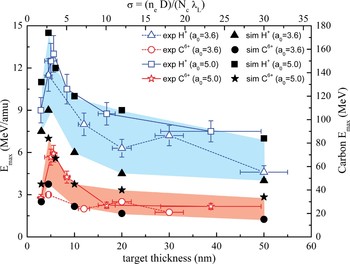
The maximum detectable energy/nucleon (E max) obtained for protons and fully ionized carbon ions C6+ is plotted as a function of the target thickness in Figure 1 for two different laser intensities. The cut-off energies for both ion species exhibit a strong dependence on target thickness. In case of protons and a 0 = 5, E max increases from around 7.5 MeV for a 40 nm foil up to 13 MeV for a 5.6 nm foil, while for C6+ the maximum energy rises from 26 MeV for use of a 40 nm foils to 71 MeV for 5.6 nm. Further decrease of the target thickness down to 2.9 nm results in a steep drop of the observed ion energies. The energy distributions of all species are continuous as expected. However, especially the observed carbon C6+ energy of 71 MeV reaches for the first time a range of values that were previously only accessible by large single shot Nd: glass laser systems with 30–50 J pulse energy (Henig et al., Reference Henig, Kiefer, Markey, Gautier, Flippo, Letzring, Johnson, Shimada, Yin, Albright, Bowers, Fernandez, Rykovanov, Wu, Zepf, Jung, Liechtenstein, Schreiber, Habs and Hegelich2009a; Krushelnick et al., Reference Krushelnick, Clark, Beg, Dangor, Najmudin, Norreys, Wei and Zepf2005). The shot-to-shot variations of 10%, indicated by the error bars, arise mainly from fluctuations of the laser pulse itself and from macroscopic modulations of the target surface.
(Color online) Maximum energy per atomic mass unit for both protons and carbon ions plotted vs. foil thickness for values of the normalized laser vector potential of a 0 = 3.6 and a 0 = 5. The experimental results are in excellent agreement with numbers deduced from 2D-PIC-simulations.

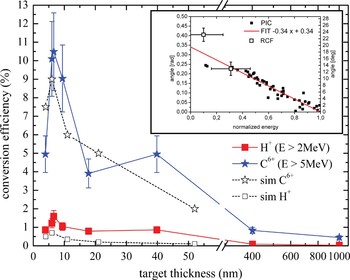
The CE (Fig. 2) was calculated by numerically convoluting an energy dependent divergence of the accelerated ion beam with the initially measured (a 0 = 5) spectra. These values (cf. inset in Fig. 2) were extracted from PIC simulations and supported by experimentally obtained proton beam profiles using a stack of radiochromic film (RCF) layers. Comparing those to the divergencies of ion beams generated by other laser systems (Nurnberg et al., Reference Nurnberg, Schollmeier, Brambrink, Blazevic, Carroll, Flippo, Gautier, Geissel, Harres, Hegelich, Lundh, Markey, McKenna, Neely, Schreiber and Roth2009), our divergence is smaller and the linear dependence on the energy is reasonable in the considered high-energy part. The dependence of the CE on the target thickness is showing analogous characteristics to E max (cf. Fig. 1). A sudden rise is observed when entering the laser transparency regime (D < l s) reaching 10.5% for C 6+ and 1.6% for protons at the optimum thickness. The CE drops down to below 1% when the target thickness reaches the TNSA dominated regime (Fuchs et al., Reference Fuchs, Antici, D'Humieres, Lefebvre, Borghesi, Brambrink, Cecchetti, Kaluza, Malka, Manclossi, Meyroneinc, Mora, Schreiber, Toncian, Pepin and Audebert2006; Neely et al., Reference Neely, Foster, Robinson, Lindau, Lundh, Persson, Wahlstrom and McKenna2006).
(Color online) Calculated CE for protons and C6+ ions as a function of the target thickness, based on a energy dependent divergence angle of the ion beam, which was extracted from PIC simulations and supported by measured beam profiles (cf. figure inset). The experimental data are in good agreement with the values of the CE obtained from PIC simulations.

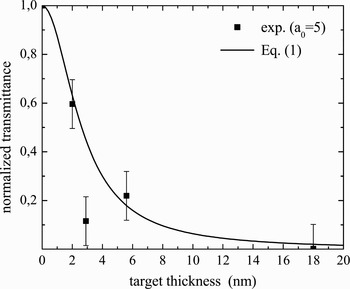
Furthermore, the transmitted laser pulse was imaged to a 12-bit optical grating spectrometer for several target thicknesses. Numerical integrations of the measured spectra, referenced to a shot without target yield to the transmittance T of the DLC targets. In Figure 3, these values for the transmittance are plottet as a function of the target thickness and compared to the analytical formula

where γp is the Lorentz factor in the laser  (Vshivkov et al., Reference Vshivkov, Naumova, Pegoraro and Bulanov1998). The experimental results are in agreement with the analytical model.
Measured laser pulse (a 0 = 5) transmittance of the DLC targets as a function of the target thickness compared to the analytical model of Vshivkov et al. (Reference Vshivkov, Naumova, Pegoraro and Bulanov1998), Eq. (1).

SIMULATION
The experiments were compared to 2D-PIC simulations, where the laser pulse was modeled by a Gaussian shape in time with a FWHM of 16 laser cycles, a Gaussian intensity distribution in focus with a FWHM spot size of 4 µm and an a 0 = 5 (a 0 = 3.6). It interacts with a rectangular shaped plasma of initial density n e = 500 × n c consisting of 90% carbon ions and 10% protons (in number density) to account for the presence of a contamination layer. The simulation box is composed of 1200 × 10000 cells with 1000 particles per cell and a total size of (10 × 20) µm2. The total simulation time τ given in laser cycles is 120.
Figure 1 shows that the simulated maximum proton energies as well as the carbon energies are in excellent agreement with the experimental data. In particular, the optimum target thickness of 5.6 nm is reproduced. This thickness for the peak ion energy is consistent with the thickness given by the empirical relation σ ≈ 3 + 0.4 × a 0 = 5 that was found in multiparametric PIC-simulation studies by Esirkepov et al. (Reference Esirkepov, Yamagiwa and Tajima2006). Here, a normalized areal electron density

is introduced, where D is the target thickness, λL is the laser wave length, n e is the electron density of the target, and n c is the critical electron density, which in our case calculates to σ = 4.6. For foil thicknesses below the optimum (σ < 3 + 0.4 × a 0), the plasma becomes increasingly transparent (Fig. 3) and the pulse is more transmitted than absorbed. Due to the low number of electrons in the focal volume (~1011) their electric current is no longer sufficient to (1) reflect the laser pulse and (2) to establish an effective longitudinal charge separation field. This results in a sudden drop in ion energies and 50% of the CE (the same amount as the reduction of the target thickness), as it was observed in the experiment (see Figs. 1, 2). In case of σ > 3 + 0.4 × a 0, the laser intensity is not sufficient to generate the maximum possible displacement of all electrons within the focal volume which gives rise to a decrease in the longitudinal charge separation field. Note that the optimum thickness for ion acceleration predicted theoretically and observed experimentally is much smaller than previously used target thicknesses.
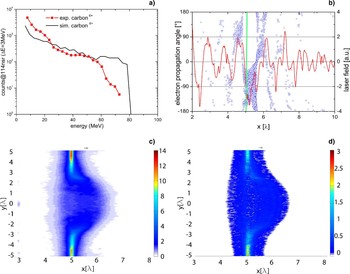
In Figure 4a, the observed carbon energy spectrum is shown along with the simulated one agreeing with each other in their overall spectral shape. To illustrate the underlying ion acceleration mechanism in our case, we show in Figures 4c and 4d detailed electron and carbon densities after 40 laser cycles as a function of the laser propagation direction x and the transverse coordinate y in units of the laser wave length λL. It is immediately striking that ions are accelerated strongly asymmetric heavily favoring the direction of laser propagation. This is in strong contrast to the model based on the self-consistent solution of the Poisson equation presented in Andreev et al. (Reference Andreev, Levy, Ceccotti, Thaury, Platonov, Loch and Martin2008) which predicts a symmetric acceleration that happens primarily after the end of the laser pulse. From Figures 4c and 4d it can be seen that the carbon ions are accompanied by co-moving electrons, which accelerate the ions in forward direction.
(Color online) (a) Comparison between experimentally obtained and simulated C 6+ spectrum as deduced from a 2D-PIC simulation of a 4.5 nm foil target (b) Electron propagation angle (blue circles) and laser transverse electric field E y (red line) at time t = 30τ, plotted vs. laser propagation direction x, given in units of the laser wavelength λ. τ is given in laser cycles. The green line at x = 5λ gives the initial location of the target. For the same simulation, (c) gives the electron and (d) the carbon density distribution vs. x at time t = 40τ.

Unlike the TNSA consideration in case of thicker targets, in our current case, coherence of laser-driven electron motion manifests importantly. In the typical TNSA with thicker targets, none of the laser field is transmitted as the foil remains opaque throughout the interaction duration. The electron motion is an indirect result of interaction with the laser at the front surface of the target and subsequent multiple interactions with matter in the target bulk. That scenario leads to thermal motion as the electrons traverse the target to set up a quasi-static field at the back. In contrast, in nm-scale foils of thickness below the skin depth the laser imprints a directed motion onto electrons as those targets are partially transparent. These coherent electron motions can not be treated as thermal motion, but rather as collective motion tied to the laser and thus directly to the laser amplitude a0. The propagation angle of electrons upon laser interaction with the target as extracted from the 2D PIC simulation at time 30τ is shown in Figure 4b. Obviously, the electron dynamics are classified in three categories. (1) electrons are driven forward by laser, (2) electrons are forced to return backwards due to the electrostatic field, (3) electrons are performing a collective, transversal oscillation owing to the laser-created coherent wave structure. Additionally, the laser transmission coefficient can be determined to be T ~ 0.1 which agrees with the theoretical given by Eq. (1).
ANALYTICAL MODEL
We compared our results to a number of analytical scaling laws that have been derived for the standard scenario of ion acceleration from the back surface of a thin, but opaque foil, i.e., target normal sheath acceleration (TNSA) (Andreev et al., Reference Andreev, Levy, Ceccotti, Thaury, Platonov, Loch and Martin2008; Fuchs et al., Reference Fuchs, Antici, D'Humieres, Lefebvre, Borghesi, Brambrink, Cecchetti, Kaluza, Malka, Manclossi, Meyroneinc, Mora, Schreiber, Toncian, Pepin and Audebert2006; Schreiber et al., Reference Schreiber, Bell, Gruener, Schramm, Geissler, Schnuerer, Ter-Avetisyan, Hegelich, Cobble, Brambrink, Fuchs, Audebert and Habs2006). However, we find that all of the existing analytical models fail to even qualitatively predict the two main features seen experimentally, namely the distinct peak in ion energies at σ ≈ 3 + 0.4 × a 0 as well as the strong dependence of the cut-off value on target thickness. Consequently, a refined theory is needed.
Initially, without assuming thermalized electrons (i.e., in contrast to Mora (Reference Mora2003)), we now formulate the maximal ion energies obtained in the laser driven foil interaction in a semi-analytical model based on Mako and Tajima (Reference Mako and Tajima1984).
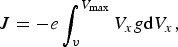
Following the analysis of Yan et al. (Reference Yan, Tajima, Hegelich, Yin and Habs2009), the forward current density of electrons J and electron density n e are related through
and
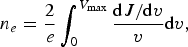
where g is the electron distribution function and Vmax =  . Here we note that at a given position the electron energy E 0 in the electrostatic potential ϕ is given as an implicit function of space and time through ɛ = γm ec 2 − eϕ. We find that

where α, a measure for the coherence is found to be about 3 in our simulation for a target thickness of 4.5 nm. Considering the relativistic dynamics of electrons in our regime, the electron density as a function of the current density may be integrated to yield
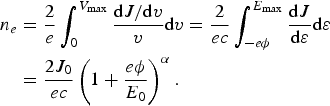
The integration of the nonlinear coupled equations for nonrelativistic ions under the self-consistently evolving potential using Eq. (6) with the boundary condition and initial value settings of Mako and Tajima (Reference Mako and Tajima1984) leads to the maximum ion (with charge Q) energy as ɛmax = (2α + 1)Q E 0, i.e. the maximum carbon energy is determined by the maximum electron kinetic energy. In the present experimental condition we recognize that the electron kinetic energy is primarily dominated by the laser driven collective momentum so that

which gives rise to  . When we insert the exponent of α = 3 as observed in our 2D-PIC simulations, we obtain for the case of a 0 = 3.6 a theoretical maximum carbon (proton) energy of 59 MeV (9.6 MeV), in the case of a 0 = 5, 88 MeV (14.3 MeV). This is in agreement with the experimental value between 36-71 MeV (11–13 MeV).
Again, for conventional TNSA we do not expect a strong dependence of the maximum ion energy on target thickness when the target is much smaller than the transversal size of the laser focal spot as it is the case in the present study. The thickness dependence in TNSA is mainly due to transversal spread of the laser accelerated electrons on their way through the target (Nickles et al., Reference Nickles, Ter-Avetisyan, Schnuerer, Sokollik, Sandner, Schreiber, Hilscher, Jahnke, Andreev and Tikhonchuk2007; Schreiber et al., Reference Schreiber, Bell, Gruener, Schramm, Geissler, Schnuerer, Ter-Avetisyan, Hegelich, Cobble, Brambrink, Fuchs, Audebert and Habs2006).
Instead, the strong increase in ɛmax as it was observed in the experiment is related to the growing transmission for thinner targets leading to collective electron dynamics imposed by the laser field. For thick targets, however, α drops towards zero and Eq. (7) reveals the dependence of ɛmax on the hot electron energy 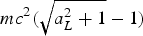 (Mora, Reference Mora2003; Wilks et al., Reference Wilks, Kruer, Tabak and Langdon1992).
SUMMARY
In summary, ion acceleration from ultra-thin DLC foils of thickness 2.9–50 nm was studied. A strong dependence of the resulting maximum energies on target thickness was observed experimentally, with a pronounced optimum for an initial foil extension of 5.6 nm with a very high conversion efficiency from the laser to the kinetic energy of the ion bunch. Here, proton energies of 13 MeV with a CE of 1.6% and carbon ions C6+ of 71 MeV with a CE of 10% were obtained with laser pulse energies as low as 0.7 J. Our experimental results are in excellent agreement with 2D-PIC simulations. However, we find that previously published TNSA scaling laws based on analytical models (Andreev et al., Reference Andreev, Levy, Ceccotti, Thaury, Platonov, Loch and Martin2008; Fuchs et al., Reference Fuchs, Antici, D'Humieres, Lefebvre, Borghesi, Brambrink, Cecchetti, Kaluza, Malka, Manclossi, Meyroneinc, Mora, Schreiber, Toncian, Pepin and Audebert2006; Schreiber et al., Reference Schreiber, Bell, Gruener, Schramm, Geissler, Schnuerer, Ter-Avetisyan, Hegelich, Cobble, Brambrink, Fuchs, Audebert and Habs2006) fail to interpret our results. Therefore, a new semi-analytical model based on Mako and Tajima (Reference Mako and Tajima1984) was developed, showing good agreement with the experimental data.
Demonstrating enhanced ion energies and CE from table-top laser systems operating at high repetition rates represents a major step towards potential applications such as medical or industrial motivated approaches.
ACKNOWLEDGMENTS
This work was partly supported by Deutsche Forschungsgemeinschaft through Transregio SFB TR18 and the DFG-Cluster of Excellence Munich-Centre for Advanced Photonics (MAP). A. Henig, D. Kiefer and D. Jung acknowledge financial support from IMPRS-APS, J. Schreiber from DAAD, X. Q. Yan from the Humboldt foundation and NSFC( 10855001).