Introduction
The serious challenge of accurately defining and describing personality pathology is reflected in the numerous competing systems that have been proposed during the past several decades (Widiger & Simonsen, Reference Widiger and Simonsen2005). This is further reflected in the ongoing debate about how best to revise the official diagnostic system for personality disorders (PDs) to be included in DSM-5 (e.g. Shedler et al. Reference Shedler, Beck, Fonagy, Gabbard, Gunderson, Kernberg, Michels and Westen2010; Bornstein, Reference Bornstein2011; Clarkin & Huprich, Reference Clarkin and Huprich2011; Skodol et al. Reference Skodol, Bender, Morey, Clark, Oldham, Alarcon, Krueger, Verheul, Bell and Siever2011). Although theorists place their emphasis differently, four psychological processes – cognition, emotion, motivation and behavior – are commonly highlighted as the core domains that models of personality and personality pathology attempt to describe (Beck & Freeman, Reference Beck and Freeman1990; Mischel & Shoda, Reference Mischel and Shoda1995; Westen, Reference Westen1995; Millon & Davis, Reference Millon and Davis1996; Livesley & Jang, Reference Livesley and Jang2000). Despite agreement that these four processes are integral to personality, no formal personality assessment system (past or present) has systematically incorporated all of these domains. In the following, we examine data from a measure of personality pathology that was designed specifically to capture information regarding the dysfunctional beliefs endorsed by individuals with personality dysfunction. Given that members of the DSM-5 work group have stated that ‘thoroughness in covering clinically relevant phenomena is among the most critical considerations for DSM-5’ (Krueger et al. Reference Krueger, Eaton, Clark, Watson, Markon, Derringer, Skodol and Livesley2011, p. 174), we offer these data to inform any future assessment or diagnostic scheme that attempts to capture the cognitive components of personality pathology.
Mischel & Shoda (Reference Mischel and Shoda1995) and Beck & Freeman (Reference Beck and Freeman1990) independently developed theories of normal and abnormal personality respectively that fundamentally integrate the four core components of personality (cognition, emotion, motivation and behavior) to explain the development, maintenance and course of personality and personality pathology. Mischel & Shoda (Reference Mischel and Shoda1995) developed the cognitive-affective system theory of personality to reconcile the concept of personality, with its implication that behavior is stable over time, with empirical evidence showing that behavior is heavily influenced by situational factors. In this system, personality is a relatively stable structure of cognition, affect and motivation that accounts for the selection, interpretation and manifestation of behavioral and emotional responses to individually determined, salient features of the environment.
Beck & Freeman's (Reference Beck and Freeman1990) cognitive theory of PDs incorporates the same four psychological processes. It explains that genetic predispositions and environmental experiences combine to form schemas, cognitive structures that interpret information and assign meaning to events in the world. Personality pathology is explained by negative schemas that develop early in life and produce consistently biased judgments and cognitive errors (Beck, Reference Beck1998). The combination of biased information processing and negative beliefs about the self, others and interpersonal relationships generates affect, influences motivation, and eventually narrows the individual's response tendencies to a small set of overused emotional and behavioral dispositions that form the core clinical features of personality dysfunction (Beck & Freeman, Reference Beck and Freeman1990; Beck, Reference Beck1998).
In recent years, criticisms of the current system for diagnosing PDs have been manifold (Widiger & Clark, Reference Widiger and Clark2000; First et al. Reference First, Bell, Cuthbert, Krystal, Malison, Offord, Reiss, Shea, Widiger, Wisner, Kupfer, First and Regier2002; Verheul & Widiger, Reference Verheul and Widiger2004; Clark, Reference Clark2005; Costa et al. Reference Costa, Patriciu and McCrae2005). Although a comprehensive review of this literature is beyond the scope of the current paper, one way to assess the quality with which the categories describe important features of personality dysfunction is to examine the extent to which the criteria sets adequately assess the four psychological processes described above. Others have observed that the criteria for some disorders assess single traits in a redundant fashion (Westen & Shedler, Reference Westen and Shedler2000), emphasize one psychological process over others across disorders (Millon & Davis, Reference Millon and Davis1996), and identify pathology at different levels of description between disorders (Livesley & Jackson, Reference Livesley and Jackson1992). For example, maladaptive beliefs are largely absent in the criteria sets for disorders such as dependent, histrionic and antisocial PDs. Criteria for these disorders focus instead on aspects of motivation, affect and behavior. By contrast, dysfunctional beliefs form a high percentage of the criteria for paranoid PD, whereas behavior and motivation are each assessed by only one criterion, and no criteria assess affect. One possible explanation for this pattern is that some PDs might represent disorders of cognition, and others might represent disorders of motivation or behavior. However, there is no justification in the DSM system for emphasizing particular psychological processes over others for any of the disorders.
At the time of writing this paper, the revisions to the diagnostic system for PDs in the new edition of DSM had not been set firmly. A recent review explaining some of the proposed revisions (Skodol et al. Reference Skodol, Bender, Morey, Clark, Oldham, Alarcon, Krueger, Verheul, Bell and Siever2011) states that the work group is considering a revision to the descriptions of those PD prototypes that will be retained in DSM-5, such that information will be added to describe the given pathology across several domains of functioning, including emotions, cognition and behavior. The work group has not yet made clear whether the cognitive domain will consist of specific dysfunctional beliefs, or whether it will consist of more general qualities of thought content and process. In the following, we describe a measure that examines explicitly the dysfunctional beliefs that may be associated with personality pathology. We describe the psychometric properties of the measure, including its factor structure. Our aim is to facilitate, where relevant, the integration of specific dysfunctional beliefs in future systems intended to characterize personality pathology.
A measure of dysfunctional beliefs in personality pathology
Using beliefs identified by Beck & Freeman (Reference Beck and Freeman1990), the Personality Belief Questionnaire (PBQ) was developed by Beck & Beck (Reference Beck and Beck1991) to assess the dysfunctional beliefs hypothesized to underlie the PDs that were officially recognized at the time. The measure has been shown to have adequate internal consistency and test–retest reliability in a large, out-patient psychiatric sample, and many of the subscales have differentiated patients diagnosed with different PDs (Beck et al. Reference Beck, Butler, Brown, Dahlsgaard, Newman and Beck2001). The measure likewise demonstrated good internal consistency in a non-clinical sample, but it failed to relate strongly to two well-validated measures of personality dysfunction (Trull et al. Reference Trull, Goodwin, Schopp, Hillenbrand and Schuster1993). This result is not surprising given that the PBQ was developed to address the failure of other measures to consider systematically the dysfunctional beliefs that accompany PDs.
Using a sample that included and expanded on the sample previously used by Beck et al. (Reference Beck, Butler, Brown, Dahlsgaard, Newman and Beck2001), Butler et al. (Reference Butler, Beck and Cohen2007) condensed the PBQ item set into a short form (PBQ-SF), using item-total correlations as a guide (Butler et al. Reference Butler, Brown, Beck and Grisham2002, Reference Butler, Beck and Cohen2007, personal communication 6 October 2010). Indexes of internal consistency and test–retest reliability were acceptable for many of the scales on the PBQ-SF (Butler et al. Reference Butler, Beck and Cohen2007), but a structural analysis of the PBQ-SF was not provided from these data. There are no published factor-analytic investigations of any version of the PBQ.
In the current study, we conducted an exploratory factor analysis (EFA) of the reduced 65 PBQ-SF item pool in a sample of depressed out-patients who participated in a clinical trial. We then attempted to cross-validate the structure identified in that sample using confirmatory factor analysis (CFA) in a separate sample of adult psychiatric out-patients with a variety of Axis I and Axis II diagnoses. Finally, we examined the concurrent validity of the PBQ by comparing scores on the PBQ between subgroups formed on the basis of the PDs recognized in DSM-IV.
Method
Sample characteristics
EFA sample
The EFA sample consisted of 438 depressed out-patients participating in an ongoing, multi-site randomized treatment outcome study. All participants were diagnosed with either chronic or recurrent depression, and all scored ⩾14 on the modified 17-item version of the Hamilton Rating Scale for Depression (HAMD-17; Hamilton, Reference Hamilton1960). Exclusion criteria were: history of bipolar disorder, active substance abuse, psychosis, or the presence of another Axis I disorder judged to be primary. Patients with medical conditions that prevented administration of study medications were also excluded, as were patients requiring immediate hospitalization for suicidality.
The majority of patients, 88%, had at least some college education, and 49% had 16 or more years of education. The average age of participants was 43 years, 59% of the sample was female, 86% identified themselves as Caucasian, and 36% of patients were married or cohabiting with a significant other.
PD diagnoses were made at intake using the Structured Clinical Interview for DSM-IV Axis II Personality Disorders (SCID-II; First et al. Reference First, Gibbon, Spitzer, Williams and Benjamin1997). Preliminary diagnoses were reviewed in diagnostic team meetings, during which a final consensus diagnosis was made. Patients with antisocial, borderline or schizotypal PDs were excluded from participation in the parent study, and none of their data were available for the present report.
Approximately 42% of the sample was diagnosed with at least one PD, and 12% of the sample was diagnosed with more than one. Cluster A disorders were diagnosed in 5% of the sample, 4% were diagnosed with Cluster B disorders, and 34% were diagnosed with Cluster C PDs.
CFA sample
The CFA sample was distinct from the EFA sample and consisted of the subset (n=683) of patients included in Beck et al. (Reference Beck, Butler, Brown, Dahlsgaard, Newman and Beck2001) and Butler et al. (Reference Butler, Beck and Cohen2007) studies for whom the requisite data were available. Original sample characteristics and data collection procedures are described elsewhere (Beck et al. Reference Beck, Butler, Brown, Dahlsgaard, Newman and Beck2001; Butler et al. Reference Butler, Beck and Cohen2007). All participants were psychiatric out-patients seeking treatment. Their mean age was 35 years (s.d.=11.5, range=16–82) and there were 351 women and 350 men. Demographic information was not available for two participants. The sample was collected between 1995 and 2001. Anyone entering prior to 31 January 1996 was assessed using the Structured Clinical Interview for DSM-III-R Axis-II Disorders (SCID-II; Spitzer et al. Reference Spitzer, Williams, Gibbon and First1990) and those entering after this date were assessed using the SCID-II for DSM-IV Axis-II disorders (First et al. Reference First, Gibbon, Spitzer, Williams and Benjamin1997). Of the patients in the CFA sample, 53% had a primary Axis I mood disorder and 25% had a primary Axis I anxiety disorder; 72% were diagnosed with at least one PD and 19% with more than one PD. Cluster A disorders were diagnosed in 5% of the sample, 19% were diagnosed with Cluster B disorders, and 49% were diagnosed with Cluster C disorders.
Measure
Participants completed the full version of the PBQ, which contains 126 beliefs organized into nine scales: avoidant, dependent, obsessive–compulsive, histrionic, passive–aggressive, narcissistic, paranoid, schizoid, and antisocial personality pathologies. In the following, only data from the 65 items identified for inclusion in the short form (Butler et al. Reference Butler, Beck and Cohen2007, personal communication 6 October 2010) were included in the analyses. These items represent the nine original PBQ scales (seven items each) and also a tenth scale with items that represent beliefs identified by the short-form authors as corresponding to borderline personality pathology. Five of the items from the borderline scale also appear on other scales; two are unique to the borderline scale. The instructions for the PBQ ask participants to read each statement and to judge the degree to which they believe the statement on a five-point Likert scale from 0 (‘I don't believe it at all’) to 4 (‘I believe it totally’).
Procedures
After complete description of the studies from which these data originate, all subjects provided written informed consent. Participants in both samples completed the PBQ and the SCID-II self-report questionnaires, after which the SCID-I and SCID-II clinical interviews were administered by masters- and doctoral-level diagnostic evaluators. Diagnostic evaluators were blind to the participants' responses on the PBQ.
Statistical analyses
For both exploratory and confirmatory factor analytic models, scores on the PBQ items were treated as representing ordinal categories, and polychoric correlations (Holgado-Tello et al. Reference Holgado-Tello, Chacón-Moscoso, Barbero-García and Vila-Abad2010) were used to estimate the models. EFA and CFA models were estimated using the robust means and variance adjusted weighted least squares (WLSMV) estimator, implemented in Mplus version 5 (Muthén & Muthén, Reference Muthén and Muthén2009).
EFA was conducted using an oblique geomin rotation (Yates, Reference Yates1987). Factor loadings ⩾0.40 were considered to be salient. The number of factors to be extracted was based on both empirical (the scree test) and theoretical (the proposed structure of the PBQ-SF) considerations. Each model was evaluated to determine whether it (a) retained at least three salient item loadings on each factor; (b) produced adequate internal consistency (α >0.70) for unit-weighted salient items; (c) maximized parsimonious coverage and simple structure (i.e. achieved maximum assignment of items to factors while minimizing the number of items that loaded on multiple factors); and (d) was interpretable.
Confirmatory factor models were assessed using the independent CFA sample. Model fit was assessed with the comparative fit index (CFI; Bentler, Reference Bentler1990), the Tucker–Lewis index (TLI; Tucker & Lewis, Reference Tucker and Lewis1973) and the root mean square error of approximation (RMSEA; Steiger & Lind, Reference Steiger and Lind1980). There is considerable controversy surrounding the criteria for establishing adequate fit in confirmatory factor models (Hu & Bentler, Reference Hu and Bentler1999; Marsh et al. Reference Marsh, Hau and Wen2004). Values >0.90 or >0.95 for the CFI and TLI commonly reflect adequate fit; RMSEA values <0.05 were taken to represent close fit and values <0.08 to reflect reasonable fit (Marsh et al. Reference Marsh, Hau and Wen2004).
As an additional test of the measure's psychometric properties, item invariance was evaluated for three variables [gender, age and diagnosis of major depressive disorder (MDD)] with a Multiple Indicators Multiple Causes (MIMIC) model (Muthén & Muthén, Reference Muthén and Muthén2009). This model examines the relationship between the covariates and individual items and tests whether the items function differently for different subgroups of patients.
The criterion validity of the PBQ factors was examined in the combined sample (n=1121) by comparing the distributions of the unit-weighted factor scores (pro-rated to account for missing data) obtained from groups formed on the basis of PD status. A multivariate analysis of variance (MANOVA) was conducted in which scores on each of the factors served as the dependent variables and presence/absence of a PD was the independent variable. In addition, sufficient sample sizes were available to examine within-group differences for patients with each of five PD diagnoses: avoidant (n=244), obsessive–compulsive (n=207), dependent (n=72), narcissistic (n=34) and paranoid (n=48). Separate repeated-measures ANOVAs were conducted for each disorder subgroup to examine whether there were differences in the mean scores among the factors within each group.
Results
Factor structure
The scree test suggested a seven-factor solution whereas the short form of the PBQ was intended to contain 10 subscales. Consequently, oblique solutions ranging from seven to 10 factors were examined initially. The model retaining seven oblique factors met all prespecified criteria. For the other models, at least one factor failed to meet the established criteria. For example, the eight-factor solution contained no items that loaded ⩾0.40 on the eighth factor, and the first seven factors were quite similar to those extracted in the seven-factor solution.
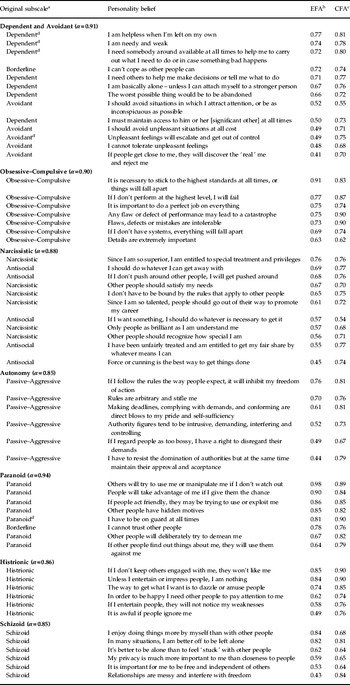
The final exploratory model retained 59 of the 65 items designated for the short form, with two items loading on more than one factor. When these items were removed, the factor structure for the remaining items remained unchanged. Table 1 displays the 57 items composing the seven factors, in addition to the scales from which they originated, the exploratory and confirmatory factor loadings, and the factor reliability.
Exploratory and confirmatory factor structure for the Personality Belief Questionnaire – Short Form (PBQ-SF)

EFA, Exploratory factor analysis; CFA, confirmatory factor analysis.
a Entries refer to the original scales on the PBQ-SF from which the beliefs originated.
b Entries are factor loadings from the EFA using an oblique geomin rotation.
c Entries are standardized loadings from the CFA.
d The belief also appeared on the original borderline subscale of the PBQ-SF.
The first factor (Dependent and Avoidant) was composed of beliefs from the original dependent, avoidant and borderline scales. These included beliefs about the need for others, the danger of situations and feelings, and the affinity for avoidance as a coping strategy. The second factor (Obsessive–Compulsive) was composed of beliefs regarding perfectionism and the importance of systems and details. The third factor (Narcissistic) had a mixture of salient loadings from items written for the antisocial and narcissistic scales. Salient items reflected grandiosity, entitlement and the need to be recognized.
The fourth factor was composed of items from the original passive–aggressive scale but the items do not seem to describe passive–aggressive PD as defined in DSM-IV. Instead, they reflect the importance of self-reliance and the untoward consequences of being dominated by others. Salient items included: ‘If I follow the rules the way people expect, it will inhibit my freedom’ and ‘Authority figures tend to be intrusive, demanding, interfering, and controlling’. These beliefs are more consistent with the cognitive-personality construct identified by Beck (Reference Beck, Clayton and Barrett1983) as Autonomy and the personality configuration labeled Introjective by Blatt et al. (Reference Blatt, Shahar and Zuroff2001). These concepts refer to a pattern of concern for: (1) individualistic achievement, (2) freedom from the control of others, and (3) focus on the self and maintaining a strong self-concept. The fourth factor was labeled Autonomy to reflect this concept.
The fifth factor (Paranoid) contained salient loadings from all seven of the original paranoid beliefs and an additional belief from the Borderline scale: ‘I cannot trust other people’. The sixth factor (Histrionic) contained salient items that seem to address the importance of entertaining others and the negative consequences of failing to do so. Finally, the seventh factor (Schizoid) retained beliefs concerning privacy, independence and the lack of concern about judgments by others.
CFA
Standardized loadings from the CFA are also displayed in Table 1. All items loaded >0.50 on their respective factors. Fit indices for the model revealed a TLI=0.97, reflecting good fit, an RMSEA=0.076, reflecting reasonable fit, and a CFI=0.88, which falls just short of ‘acceptable fit’ using standard definitions.
As an additional test of the robustness of the instrument, measurement invariance was assessed for each item on three variables: age, gender and diagnosis of MDD. Only one of the 57 items displayed differential item functioning, and it did so for only one of the covariates. Namely, for a given score on the Dependent and Avoidant factor, patients with MDD scored lower on the item ‘I must maintain access to [significant other] at all times’ than did non-depressed patients.Footnote 1Footnote † Thus, 56 of the 57 items did not function differently across subgroups of patients.
Validity
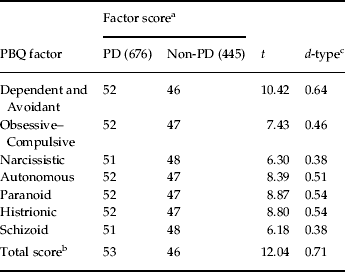
A MANOVA of the combined sample (n=1121) revealed a significant difference between patients with versus without a PD on the mean scores of the seven factors [Wilks' λ=0.89, multivariate F(7, 1111)=20.51, p<0.001]. Post-hoc individual t tests revealed significant differences (at p<0.001) for each of the seven factors between patients with and without PDs. Table 2 displays unit-weighted factor scores (converted to T scores; grand mean=50, s.d.=10) on each of the seven factors for patients with and without PDs.
Unit-weighted scores on each of the seven factors for patients with a personality disorder (PD) and without a personality disorder (Non-PD)

PBQ, Personality Belief Questionnaire.
All entries represent T scores (mean=50, s.d.=10). All comparisons are significant at p<0.001.
a Entries are least squares means estimates of the factor scores.
b Values represent means for the total PBQ–Short Form (PBQ-SF) score for all of the items retained by the factor analysis. The variances of the two groups for this comparison were not equal [F(675, 444)=1.40, p<0.001], so the Satterthwaite method was used in calculating the t test.
c Values represent the d-type effect size difference between patients with and without PDs for each factor. Raw means and pooled standard deviations were used to calculate effect sizes.
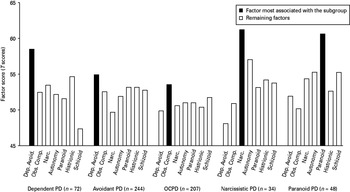
Within-group differences among the PBQ factor scores were examined for patients with each of five PD diagnoses: Avoidant, Obsessive–Compulsive, Dependent, Narcissistic and Paranoid. Separate repeated-measures ANOVAs were conducted for each disorder subgroup, and the omnibus tests of within-group differences among the factor scores were significant for each (all F's ⩾5.0, all p's <0.001). Fig. 1 displays means for each factor within each diagnostic subgroup. The figure also shows that, within each diagnostic category, patients scored significantly higher on the factor corresponding to that disorder than they did on any of the remaining factors.
Within-group comparison of factor scores within five personality disorder (PD) diagnoses. Subgroups were formed on the basis of the five PD diagnoses: Dependent, Avoidant, Obsessive–Compulsive, Narcissistic and Paranoid. All scores represent T scores (mean=50, S.D.=10). The height of each bar represents the mean score for that factor within the given subgroup. Within each subgroup, the black bar represents the factor most closely associated with that type of personality pathology. The white bars represent the remaining factors. Separate repeated-measures ANOVAs were conducted for each disorder subgroup, and the omnibus tests of within-group differences among the factor scores were significant for each (all p's <0.001). d-type effect sizes were calculated from the means and standard deviations by comparing the value of the black bar (the index factor for a given group) to the value of each gray bar within each subgroup. Statistical significance for each comparison was determined by the repeated-measures ANOVA models. For each subgroup, scores on the index factor for that group were significantly higher than scores on the remaining factors. The specific comparisons are as follows: Dependent PD subgroup: Dependent and Avoidant (Dep. Avoid.) >Obsessive–Compulsive (Obs. Comp.) d=0.61***, Narcissistic (Narc.) d=0.43***, Autonomy d=0.59***, Paranoid d=0.66***, Histrionic d=0.37**, Schizoid d=1.21***. Avoidant PD subgroup: Dep. Avoid. >Obs. Comp. d=0.24**, Narc. d=0.55***, Autonomy d=0.31***, Paranoid d=0.17*, Histrionic d=0.17*, Schizoid d=0.22**. Obsessive–Compulsive PD (OCPD) subgroup: Obs. Comp. >Dep. Avoid. d=0.37***, Narc. d=0.29***, Autonomy d=0.25***, Paranoid d=0.26***, Histrionic d=0.32***, Schizoid d=0.17*. Narcissistic PD subgroup: Narc. >Dep. Avoid. d=1.13***, Obs. Comp. d=0.85***, Autonomy d=0.33*, Paranoid d=0.67***, Histrionic d=0.57**, Schizoid d=0.64***. Paranoid PD subgroup: Paranoid >Dep. Avoid. d=0.82***, Obs. Comp. d=0.95***, Narc. d=0.54***, Autonomy d=0.50**, Histrionic d=0.70***, Schizoid d=0.50** (* p<0.05, ** p<0.01, *** p<0.001).

Discussion
Evidence from this study suggests that the content of the PBQ can be captured by seven empirically identified factors. The results of confirmatory and item-invariance analyses suggest that the structures uncovered in this study are robust and replicable. These results provide support for the cognitive theory of PD, which posits that dysfunctional beliefs about the self, others and the world represent an important feature of pathological personality functioning. Beliefs relevant to eight of the disorders recognized in DSM-IV were identified in this work; however, the structure of those beliefs did not map perfectly onto the categories represented in DSM-IV. Beliefs for avoidant and dependent PDs, for example, loaded on a single factor, as did beliefs for narcissistic and antisocial PDs. These findings suggest some degree of overlap within each of these sets of disorders. An additional factor, not well represented in any past or proposed DSM scheme, emerged that is closely related to the personality feature labeled Autonomy by Beck (Reference Beck, Clayton and Barrett1983). Finally, no factors representing borderline or schizotypal PDs were obtained. Although the short form of the PBQ used in this study did contain a subscale for beliefs associated with borderline pathology, the majority of those beliefs also appeared on other subscales. The borderline subscale was not recovered by the EFA. When Beck & Freeman (Reference Beck and Freeman1990) originally drafted the lists of dysfunctional beliefs, they argued that patients with borderline PD endorse several beliefs from many of the other categories and that individuals with schizotypal PD suffer from dysfunction in the process of thinking as opposed to pathology in thought content.
Although the future of PD diagnoses in DSM-5 is unclear at present, the results of the current study suggest that it may be important in any future diagnostic system to describe systematically the dysfunctional beliefs endorsed by individuals with personality pathology. Specifically, the pattern of results obtained in this report demonstrates that beliefs related to avoidant, dependent, narcissistic, antisocial, paranoid, histrionic, obsessive–compulsive and schizoid personality pathology are captured well by coherent sets of dysfunctional beliefs that can be identified and confirmed in independent clinical samples. Validity analyses revealed that individuals with diagnosed PDs scored higher on each of the seven PBQ factors than did individuals without PDs. Sample sizes were adequate for five of these diagnostic categories (Dependent, Avoidant, Obsessive–Compulsive, Narcissistic and Paranoid) to investigate the relationship between categorical diagnosis and dysfunctional beliefs. In each case, patients with a given disorder scored significantly higher on the factor representing the beliefs for that disorder than they scored on any other factor. These findings provide support for the concurrent validity for these prototypes of pathology. This kind of validity was one of three identified by Kendler et al. (Reference Kendler, Kupfer, Narrow, Phillips and Fawcett2009) as important for the DSM-5 work groups to consider when making determinations about which disorders should be included and which should be deleted from the next revision. Despite the strong support for the concurrent validity of the five disorders examined more closely in this report, patients with these disorders displayed a range of dysfunctional beliefs from across the other factors. These results further highlight the importance of retaining in future diagnostic systems the ability to assess aspects of cognition, motivation, behavior and affect from across a wide variety of PD prototypes.
Indeed, the factors identified in the current work describe clinically meaningful sets of beliefs that have the potential to translate directly into unique targets for psychological treatment. The identification of dysfunctional beliefs is a core element of cognitive-based treatments for personality pathology. In Beck & Freeman's original description of cognitive therapy for personality disorders (Beck & Freeman, Reference Beck and Freeman1990), they note that simple endorsement of a belief does not necessarily constitute personality pathology. Rather, it is the intensity with which a dysfunctional belief is held that contributes to pathology. Thus, the identification of dysfunctional beliefs may be more difficult for individuals with personality dysfunction than for individuals with acute Axis I disorders. Beliefs endorsed by a patient with personality pathology may be more long-standing, more firmly held, and more integral to the way in which the patient sees the world. As such, these beliefs may seem natural to the patient. Assessment systems that can help practitioners and patients to identify these cognitions could be expected to have enormous clinical utility. Once identified, the treatment provider could work with the patient to gradually challenge the long-standing dysfunctional sets of core cognitions and to build, over time, more accurate and adaptive constellations of beliefs about him/herself, others, and the world (Beck & Freeman, Reference Beck and Freeman1990).
Limitations
Given that the PBQ was designed for clinical populations, one strength of the present study is the use of two independent clinical samples in which sizeable percentages of individuals were diagnosed with a PD. Nevertheless, the samples had properties that may limit some of the conclusions that can be drawn. Individuals with diagnosed borderline, schizotypal and antisocial PDs were not included in the EFA sample because of the nature of the study from which the data originated. In addition, the EFA sample consisted entirely of depressed individuals, which may have lowered the percentages of individuals with features of particular PDs, such as narcissistic, antisocial and schizoid (Doyle et al. Reference Doyle, Tsuang, Lyons and Tohen1999). The EFA sample was predominantly Caucasian and relatively highly educated, which may also limit the generalizability of the results. Participants in the Beck (Beck et al. Reference Beck, Butler, Brown, Dahlsgaard, Newman and Beck2001) and Butler (Butler et al. Reference Butler, Beck and Cohen2007) samples who were used in previous work to identify items to be retained in the short form of the PBQ were also used in the current study to form the CFA sample. An independent sample would have allowed for firmer conclusions from the CFA; however, the fact that the current analysis tested a different structure than that originally proposed for the PBQ-SF should tend to mitigate any bias that the use of this sample may have caused.
Although two of the CFA fit indices were within the range of acceptable model fit, one fell just short. Poor CFA model fit in personality research is common. A recent examination of CFA research in personality measurement found that the closest fitting model among seven popular personality trait measures was represented by TLI=0.70, CFI=0.79 and RMSEA=0.09 (Hopwood & Donnellan, Reference Hopwood and Donnellan2010). The authors concluded that ‘any omnibus personality inventory that shows adequate fit in CFA models by the criteria we selected … [CFA >.90, TLI >.90, RMSEA <.10] would mark quite an achievement (p. 342).’ The results of the current paper came close to satisfying that goal.
In addition to the specific limitations of the current study, some limitations of the PBQ itself are suggested by a consideration of its properties. First, the full PBQ measure is structured such that the items on each of the scales are presented together. The fact that only a subset of items (those identified for the SF version) were selected for the current analysis should mitigate this concern. Second, all items are keyed in the same direction, exposing the questionnaire to the possible presence of positive or negative response sets. Future revisions of the scale should address this concern.
Conclusions
Even though several personality theorists emphasize the importance of cognition, motivation, behavior and affect in the conceptualization of personality dysfunction, official descriptions of personality disorder have not yet systematically incorporated these features. Recent indications regarding the forthcoming revisions to DSM are promising in that they may contain descriptions of dysfunction in each of these domains for the disorders that will be retained. It is not clear, however, whether these descriptions will include specific dysfunctional beliefs, and whether dysfunctional cognition will also be systematically incorporated into the individual trait descriptions. In the present work, we report the underlying structure of a measure of the cognitive components of personality pathology and demonstrate its validity in discriminating among patients diagnosed with the PDs that have been recognized to date. Revisions to the diagnostic and classification system for PD should endeavor to assess adequately the four psychological processes involved in personality dysfunction. Indeed, the results of this study indicate that there are at least seven coherent patterns of dysfunctional cognition that describe meaningful constellations of personality pathology. Future work should examine the incremental validity achieved by measuring these beliefs and also the clinical utility of targeting these beliefs directly during treatment.
Acknowledgments
This research was supported by grant MH060998 (to R. J. DeRubeis) from the National Institute of Mental Health, Bethesda, MD, USA. We acknowledge the work of other members of the research team responsible for the study from which some of these data originate: S. D. Hollon, J. D. Amsterdam and R. C. Shelton. We also thank S. Stepp for providing methodological advice; B. Freeman for his efforts in managing the data, and D. L. Chambless, A. M. Ruscio, A. C. Butler, R. A. Steer and S. S. Bhar for their comments on a previous draft of this manuscript.
Declaration of Interest
Drs J. C. Fournier and R. J. DeRubeis have no conflicts of interest to disclose. Dr A. T. Beck is the author of the Personality Belief Questionnaire (in the public domain) and six questionnaires (none regarding PDs) published by The Psychological Corporation. He is also the president of the Beck Institute for Cognitive Therapy, a non-profit institution providing psychotherapy and training that receives income through patient fees and trainee payments; he receives no income from this organization.